A Case of Two Cities with Inspector Chen: Qiu Xiaolong
When my sister Sparkle recommends a book, I have learned to listen. I think I ordered this book about six months ago, but never cared enough to actually read it. After reading a recent Donna Leon (like dessert, I use it as a reward for reading something more challenging) I decided it was time to tackle Qiu Xiaolong.
I believe A Case of Two Cities is the first in the series; I tried very hard to make sure it was. When I first started reading it, it was difficult, but it didn’t take long to adjust. When you read a detective story written in a foreign culture, you have to park your old way of thinking, and quickly adapt to a new way of thinking. First, you have to learn what that new way of thinking is. They don’t just tell you at the beginning of the book “Here are the differences in values – you will notice . . .” no, but Qiu Xiaolong is courteous enough to take us by the hand and lead us gently into the Chinese way of thinking, the Chinese way of getting things done, and the technicalities of Chinese detective work.
As we meet Inspector Chen, a published poet, and a detective, ten pages into the book, a new anti-corruption campaign is starting in Shanghai, and Inspector Chen has been given a special assignment – a qinchai dacheng – as “Emperor’s Special Envoy with an Imperial Sword.” Even though imperial days are long gone, this warrant gives him emergency powers to search and arrest without reporting to anyone – and without a warrant. He is to seek and find Xing, a corrupt businessman who has caused huge loss to the national economy and is in danger of tarnishing the Chinese national image, and Xing’s associates.
Just as in the Donna Leon books about Commissario Guido Brunetti, and the Bowen books about Gabriel duPre, and James Lee Burke’s books about New Orleans, and Cara Black’s books about Aimee LeDuc, the detectives and investigators have to walk a fine line between going after the criminal and overstepping their warrant – stepping on the toes of those also engaged in corruption so entrenched that it has become a way of life. Each of these detectives has to maneuver that treacherously fine line – who determines when corruption has become too much? It usually puts their own lives in danger at some point, as those manipulating the system and making a fortune out of it do not want to be caught, do not want to be exposed, and will go to great lengths to protect their ill-gotten gains.
And just as in the above books, the book is more about the actual process than the crime itself. Inspector Chen must go about his task indirectly, having chats here and there, gathering threads of information with which he tries to weave a plausible tapestry of events.
As I was reading A Case of Two Cities, I kept making AdventureMan take me out for Chinese food! The meetings are often held over food, and the descriptions are mouth-watering.



Best of all, when you read these books, you get a tiny little glimpse into another way of thinking, another way of doing business. We are all human, we all have the same needs, and we differ in how we go about getting those needs met. We differ in the way we think. It helps to enter another way of living, another way of thinking, it helps to visit through these books so that we can increase our own understanding that our way of doing things is not the only way, maybe (gasp!) not even the “right” way! Maybe (crunching those brain cells really hard to output this thought) there is more than one “right” way?
Corruption at the Morgue
Where is the Kuwaiti detective novel? I follow Guido Brunetti in Donna Leon’s series on Venice, Dave Robicheaux, the James Lee Burke detective in a small town just outside New Orleans, and now, Investigator Chen, who is a chief investigator in China, but where, oh where is the Kuwait detective / mystery? It is just waiting to be written.
In yesterday’s Kuwait Times is an article I would love to link you to, but it isn’t there, not even when I search “female coroner” from the headline on page 3. Did you know Kuwait had a female coroner, a la Kathy Reich’s Temperance Brennan and Patricia Cornwell’s Kay Scarpatta? As you read the article, it makes sense, as the bodies are kept semi-segregated in the morgue, and women work on women (some of the time) and men on men.
I’m impressed. Any time a woman takes on a traditionally men’s job, it takes a whole lot of courage. I imagine the requirements to be a coroner here are similar to other countries – you have to have a medical degree (be a doctor) and then have advanced training in forensics. So when Nawal Boshehri speaks out, I listen. She’s got my attention.
Nawal Boshehri says conditions in the morgue are awful. From a personal point of view, she has been sexually molested by her superior and frozen in her position over false accusations that she has not been going to work or signing in or out. She has asked the minister of interior to look into her complaints.
As an institution, she reports serious issues – labs that lack necessary equipment, to do tests, such as those that measure drugs and alcohol in the bloodstream, outdated machinery, rusty machinery, lack of ventilation (in a morgue! horrors!) and she states they are constantly in fear of getting infections.
She claims that reports have sometimes been manipulated and twisted to give prosecutors the wrong technical information that would sometimes end up setting a guilty person free, and that one time they certified a murder had been insane without him ever having been examined by any mental health professionals. She was once asked to provide a report that made one citizen swap places with the assaulted expatriate, so that the assaulted expatriate would appear to be the guilty party.
She adds that she fears for her life. She says “a senior coroner at the department falsified reports, namely those related to detainees, who underwent police brutality during interrogations. He usually did this as favors to his colleagues to help them get promoted instead of being punished for their brutality.” She added that because she has reported these things, she fears for her own life.
Every nation has corruption. Corruption is chaotic, and when you get serious about rule of law, you still have corruption, but you do your best to root it out. You report it when it happens. I think that Nawal Boshehri has enough confidence in Kuwait’s institutions to go public with her allegations. While it may appear dirty laundry, that she CAN go public is a very positive sign. I can imagine she fears for her life, and yet, she seems to be fighting to retain her job. That’s very brave.
That the Kuwait Times will publish the article on page three, in three columns, that is also very brave, and speaks well of the increasing confidence in a free press.
Wouldn’t this make a great detective novel?
Cell Phone or Drunk?
From AOL News:
Using Cell Phone While Driving Akin to Driving Drunk, Say Researchers
Posted Mar 7th 2008 11:24AM by Evan Shamoon
According to a new study, talking on your cell phone while driving could be as dangerous as being under the influence of alcohol. Carnegie-Mellon University researchers used brain imaging to show how mobile phone use alone reduces 37 percent of brain activity engaged in driving. The findings were published in the latest gotta-have-it issue of the journal ‘Brain Research,’ and also suggest that using a hands-free headset doesn’t make much of a difference.
Basically, the study found that drivers who spoke on their phones while driving tended to make many of the same driving mistakes as those who just got finished speaking to the bottle.
So to speak.
Comment: I always thought using a headset solved the problem – guess I was wrong. 😦 The Kuwait Ministry of Traffic is currently considering a law against using cell phones while driving in Kuwait. If enforced, it’s going to make a big difference in the lives of a lot of people in Kuwait. I wonder if it will mean fewer pedestrians killed?
Al Ahmadi Minaret

I see a lot of new mosques going up in Kuwait, and I see a lot of renovations. I just wish someone would spruce up this beautiful old minaret in Al Ahmadi. Looks to me like it is well-built, just needs a new coat of paint. And then I start to wonder, do mosques have committees, like churches do? We have the committee for the church grounds, the committee to take care of the altar, the committee to welcome new members, the committee to work with church school programs for the children . . . it goes on and on!
Do mosques have citizens committees?
Segregation – Integration – Choice
A fascinating new and very long article from The New York Times Magazine section discusses a school where boys and girls have a choice of integrated or segregated classrooms – in the same school.
I would have hated going to an all-girl school, and at the same time, I think it is far for people to have a choice in how they want to learn. What was right for me is not right for everyone else, and maybe not for YOU – or your children.
Here is a quote from deep in the article, about how things are succeeding at one same-sex school. I wonder how this technique would fly in Kuwait 😉
If a child arrives at 7:31 a.m., his parents will receive a call at 5:45 the next morning to make sure that boy will be at school on time.
By ELIZABETH WEIL
Published: March 2, 2008
On an unseasonably cold day last November in Foley, Ala., Colby Royster and Michael Peterson, two students in William Bender’s fourth-grade public-school class, informed me that the class corn snake could eat a rat faster than the class boa constrictor. Bender teaches 26 fourth graders, all boys. Down the hall and around the corner, Michelle Gay teaches 26 fourth-grade girls. The boys like being on their own, they say, because girls don’t appreciate their jokes and think boys are too messy, and are also scared of snakes. The walls of the boys’ classroom are painted blue, the light bulbs emit a cool white light and the thermostat is set to 69 degrees. In the girls’ room, by contrast, the walls are yellow, the light bulbs emit a warm yellow light and the temperature is kept six degrees warmer, as per the instructions of Leonard Sax, a family physician turned author and advocate who this May will quit his medical practice to devote himself full time to promoting single-sex public education.
Foley Intermediate School began offering separate classes for boys and girls a few years ago, after the school’s principal, Lee Mansell, read a book by Michael Gurian called “Boys and Girls Learn Differently!” After that, she read a magazine article by Sax and thought that his insights would help improve the test scores of Foley’s lowest-achieving cohort, minority boys. Sax went on to publish those ideas in “Why Gender Matters: What Parents and Teachers Need to Know About the Emerging Science of Sex Differences.” Both books feature conversion stories of children, particularly boys, failing and on Ritalin in coeducational settings and then pulling themselves together in single-sex schools. Sax’s book and lectures also include neurological diagrams and scores of citations of obscure scientific studies, like one by a Swedish researcher who found, in a study of 96 adults, that males and females have different emotional and cognitive responses to different kinds of light. Sax refers to a few other studies that he says show that girls and boys draw differently, including one from a group of Japanese researchers who found girls’ drawings typically depict still lifes of people, pets or flowers, using 10 or more crayons, favoring warm colors like red, green, beige and brown; boys, on the other hand, draw action, using 6 or fewer colors, mostly cool hues like gray, blue, silver and black. This apparent difference, which Sax argues is hard-wired, causes teachers to praise girls’ artwork and make boys feel that they’re drawing incorrectly. Under Sax’s leadership, teachers learn to say things like, “Damien, take your green crayon and draw some sparks and take your black crayon and draw some black lines coming out from the back of the vehicle, to make it look like it’s going faster.” “Now Damien feels encouraged,” Sax explained to me when I first met him last spring in San Francisco. “To say: ‘Why don’t you use more colors? Why don’t you put someone in the vehicle?’ is as discouraging as if you say to Emily, ‘Well, this is nice, but why don’t you have one of them kick the other one — give us some action.’ ”
During the fall of 2003, Principal Mansell asked her entire faculty to read “Boys and Girls Learn Differently!” and, in the spring of 2004, to attend a one-day seminar led by Sax at the school, explaining boys’ and girls’ innate differences and how to teach to them. She also invited all Foley Intermediate School parents to a meeting extolling the virtues of single-sex public education. Enough parents were impressed that when Foley Intermediate, a school of 322 fourth and fifth graders, reopened after summer recess, the school had four single-sex classrooms: a girls’ and a boys’ class in both the fourth and fifth grades. Four classrooms in each grade remained coed.
Separating schoolboys from schoolgirls has long been a staple of private and parochial education. But the idea is now gaining traction in American public schools, in response to both the desire of parents to have more choice in their children’s public education and the separate education crises girls and boys have been widely reported to experience. The girls’ crisis was cited in the 1990s, when the American Association of University Women published “Shortchanging Girls, Shortchanging America,” which described how girls’ self-esteem plummets during puberty and how girls are subtly discouraged from careers in math and science. More recently, in what Sara Mead, an education expert at the New America Foundation, calls a “man bites dog” sensation, public and parental concerns have shifted to boys. Boys are currently behind their sisters in high-school and college graduation rates. School, the boy-crisis argument goes, is shaped by females to match the abilities of girls (or, as Sax puts it, is taught “by soft-spoken women who bore” boys). In 2006, Doug Anglin, a 17-year-old in Milton, Mass., filed a civil rights complaint with the United States Department of Education, claiming that his high school — where there are twice as many girls on the honor roll as there are boys — discriminated against males. His case did not prevail in the courts, but his sentiment found support in the Legislature and the press. That same year, as part of No Child Left Behind, the federal law that authorizes programs aimed at improving accountability and test scores in public schools, the Department of Education passed new regulations making it easier for districts to create single-sex classrooms and schools.
Foley Intermediate School began offering separate classes for boys and girls a few years ago, after the school’s principal, Lee Mansell, read a book by Michael Gurian called “Boys and Girls Learn Differently!” After that, she read a magazine article by Sax and thought that his insights would help improve the test scores of Foley’s lowest-achieving cohort, minority boys. Sax went on to publish those ideas in “Why Gender Matters: What Parents and Teachers Need to Know About the Emerging Science of Sex Differences.” Both books feature conversion stories of children, particularly boys, failing and on Ritalin in coeducational settings and then pulling themselves together in single-sex schools. Sax’s book and lectures also include neurological diagrams and scores of citations of obscure scientific studies, like one by a Swedish researcher who found, in a study of 96 adults, that males and females have different emotional and cognitive responses to different kinds of light. Sax refers to a few other studies that he says show that girls and boys draw differently, including one from a group of Japanese researchers who found girls’ drawings typically depict still lifes of people, pets or flowers, using 10 or more crayons, favoring warm colors like red, green, beige and brown; boys, on the other hand, draw action, using 6 or fewer colors, mostly cool hues like gray, blue, silver and black. This apparent difference, which Sax argues is hard-wired, causes teachers to praise girls’ artwork and make boys feel that they’re drawing incorrectly. Under Sax’s leadership, teachers learn to say things like, “Damien, take your green crayon and draw some sparks and take your black crayon and draw some black lines coming out from the back of the vehicle, to make it look like it’s going faster.” “Now Damien feels encouraged,” Sax explained to me when I first met him last spring in San Francisco. “To say: ‘Why don’t you use more colors? Why don’t you put someone in the vehicle?’ is as discouraging as if you say to Emily, ‘Well, this is nice, but why don’t you have one of them kick the other one — give us some action.’ ”
During the fall of 2003, Principal Mansell asked her entire faculty to read “Boys and Girls Learn Differently!” and, in the spring of 2004, to attend a one-day seminar led by Sax at the school, explaining boys’ and girls’ innate differences and how to teach to them. She also invited all Foley Intermediate School parents to a meeting extolling the virtues of single-sex public education. Enough parents were impressed that when Foley Intermediate, a school of 322 fourth and fifth graders, reopened after summer recess, the school had four single-sex classrooms: a girls’ and a boys’ class in both the fourth and fifth grades. Four classrooms in each grade remained coed.
Separating schoolboys from schoolgirls has long been a staple of private and parochial education. But the idea is now gaining traction in American public schools, in response to both the desire of parents to have more choice in their children’s public education and the separate education crises girls and boys have been widely reported to experience. The girls’ crisis was cited in the 1990s, when the American Association of University Women published “Shortchanging Girls, Shortchanging America,” which described how girls’ self-esteem plummets during puberty and how girls are subtly discouraged from careers in math and science. More recently, in what Sara Mead, an education expert at the New America Foundation, calls a “man bites dog” sensation, public and parental concerns have shifted to boys. Boys are currently behind their sisters in high-school and college graduation rates. School, the boy-crisis argument goes, is shaped by females to match the abilities of girls (or, as Sax puts it, is taught “by soft-spoken women who bore” boys). In 2006, Doug Anglin, a 17-year-old in Milton, Mass., filed a civil rights complaint with the United States Department of Education, claiming that his high school — where there are twice as many girls on the honor roll as there are boys — discriminated against males. His case did not prevail in the courts, but his sentiment found support in the Legislature and the press. That same year, as part of No Child Left Behind, the federal law that authorizes programs aimed at improving accountability and test scores in public schools, the Department of Education passed new regulations making it easier for districts to create single-sex classrooms and schools.
How Good People Turn Evil
This is a subject that fascinates me – how even “good” people can do very very bad things . . . The article and interview is from Wired.com science/discoveries and you can read the entire article and view a videotape by clicking on the blue type.
TED 2008: How Good People Turn Evil, From Stanford to Abu Ghraib
By Kim Zetter 02.28.08 | 12:00 AM
MONTEREY, California — Psychologist Philip Zimbardo has seen good people turn evil, and he thinks he knows why. Zimbardo will speak Thursday afternoon at the TED conference, where he plans to illustrate his points by showing a three-minute video, obtained by Wired.com, that features many previously unseen photographs from the Abu Ghraib prison in Iraq (disturbing content).
In March 2006, Salon.com published 279 photos and 19 videos from Abu Ghraib, one of the most extensive documentations to date of abuse in the notorious prison. Zimbardo claims, however, that many images in his video — which he obtained while serving as an expert witness for an Abu Ghraib defendant — have never before been published.
The Abu Ghraib prison made international headlines in 2004 when photographs of military personnel abusing Iraqi prisoners were published around the world. Seven soldiers were convicted in courts martial and two, including Specialist Lynndie England, were sentenced to prison.
Zimbardo conducted a now-famous experiment at Stanford University in 1971, involving students who posed as prisoners and guards. Five days into the experiment, Zimbardo halted the study when the student guards began abusing the prisoners, forcing them to strip naked and simulate sex acts.
His book, The Lucifer Effect: Understanding How Good People Turn Evil, explores how a “perfect storm” of conditions can make ordinary people commit horrendous acts.
He spoke with Wired.com about what Abu Ghraib and his prison study can teach us about evil and why heroes are, by nature, social deviants.
Wired: Your work suggests that we all have the capacity for evil, and that it’s simply environmental influences that tip the balance from good to bad. Doesn’t that absolve people from taking responsibility for their choices?
Philip Zimbardo: No. People are always personally accountable for their behavior. If they kill, they are accountable. However, what I’m saying is that if the killing can be shown to be a product of the influence of a powerful situation within a powerful system, then it’s as if they are experiencing diminished capacity and have lost their free will or their full reasoning capacity.
Situations can be sufficiently powerful to undercut empathy, altruism, morality and to get ordinary people, even good people, to be seduced into doing really bad things — but only in that situation.
Understanding the reason for someone’s behavior is not the same as excusing it. Understanding why somebody did something — where that why has to do with situational influences — leads to a totally different way of dealing with evil. It leads to developing prevention strategies to change those evil-generating situations, rather than the current strategy, which is to change the person.
You can read the rest of the article and view the video HERE.
Donna Leon: Suffer the Little Children
After reading Zanzibar Chest I decided it was time to give myself a break, and I allowed myself another Donna Leon book, this one Suffer the Little Children. I am currently reading another detective series, recommended by my sister, set in China. What they all seem to have in common is a very tired, sad, jaded view of corruption in society, and particularly among the poorly paid police. Sigh.

In this book, a Doctor and his wife are invaded in the middle of the night by the carabinieri, a kind of police in Venice. I am not sure how the two agencies differ, maybe it is like the difference between state police and local police in the US, but when the paper was faxed over coordinating with Brunetti’s office, it got lost somewhere, and the action was never coordinated, and Brunetti gets a call in the middle of the night.
The doctor and his wife have adopted a child illegally. They bought an unwanted child from an Albanian woman, paid for her pregnancy expenses, paid a huge fee to her, and then had the child taken from them. Here is the saddest part of the story – the child’s mother doesn’t want the child, the illegally adopting parents want him back desperately, but the child is sent to a state orphanage, because of the illegal adoption.
It is a very sad book.
Here is why I read Donna Leon – some of her paragraphs are just brilliant. Memorable. Unforgettable.
“Brunetti’s profession had made him a master of pauses: he could distinguish them in the way a concert-master could distinguish the tones of the various strings. There was the absolute, almost belligerent pause, after which nothing would come unless in response to questions or threats. There was the attentive pause, after which the speaker measured the effect on the listener of what had just been said. And there was the exhausted pause, after which the speaker needed to be left undistrubed until emotional control returned.
Judging that he was listening to the third, Brunetti remained silent, certain that she would eventually continue. A sound came down the corridor: a moan or the cry of a sleeping person. When it stoped, the silence seemed to expand to fill the place.”
When you read Donna Leon, you forget you live anywhere else. For one brief moment, you become Venetian, you live in Guido Brunetti’s shoes. The speak the Venetian dialect, you think like a Venetian. What an escape!
The paperback edition will be out in April for $7.99 at Amazon.com for $7.99 plus shipping.
“So Many Christians!”
My Kuwaiti friend was shaking his head in disbelief. He had been to the old city to pay a condolence call on a Friday, and happened by the Lighthouse compound near the Sheraton circle on a Friday morning, just as some of the services were getting out.
“I had NO idea!” he looked at me in absolute amazement.
I just laughed. When we first got here, we attended church on that compound; our church moved off only months ago, when the road construction work got seriously under way and parking increasingly became a problem. It was the most amazing experience on earth – there were the Indian Men’s Catholic services and the Philipine Evangelical service and the rock-music evangelical service and the staid Anglican services and the family Philipine Catholic services and . . . well, you get the picture. There are an amazing number of expatriate Christians in Kuwait. At any one time on the compound, there are about twelve different services going on, and no sooner does one finish and the participants exit, than the new group is coming in.
Now, churches meet all over Kuwait. They met in villas, they meet in schools, they meet in every neighborhood. Today, in our church, we asked for blessings on Kuwait, on the Emir and his family, and those in leadership positions in Kuwait. We prayed for the leaders of all the countries in our congregation (English, Irish, Scottish, South African, Chinese, Indian, Nigerian, Kenyan, Dutch, Egyptian, Ethiopian, American, Australian {I have forgotten a few, I am sure} . . . lots and lots of blessings!) Most of all, we thank God for the freedom to worship in Kuwait.

(This is not our church in Kuwait. This is the Church of the Holy Sepulcher, in Jerusalem. I was looking for a church that looked more Middle Eastern than Western, and this is what I could find!)
Our pastor also has a blog, q8bridge about which he says “The purpose of this blog is to enable a bridge to be built between Christians and Muslims, especially those living in Kuwait. Through questions and dialogue we hope to promote deep friendships and mutual understanding.”
He examines the beliefs we have in common, and where we differ, and some of the reasons why we differ. I urge you to have a look.
Saudi Men Arrested for Flirting
This is in today’s BBC News.
Saudi men arrested for ‘flirting’
Relations between the sexes outside marriage is against the law
Prosecutors in Saudi Arabia have begun investigating 57 young men who were arrested on Thursday for flirting with girls at shopping centres in Mecca.
The men are accused of wearing indecent clothes, playing loud music and dancing in order to attract the attention of girls, the Saudi Gazette reported.
They were arrested following a request of the Commission for the Promotion of Virtue and Prevention of Vice.
The mutaween enforce Saudi Arabia’s conservative brand of Islam, Wahhabism.
Earlier in the month, the authorities enforced a ban on the sale of red roses and other symbols used in many countries to mark Valentine’s Day.
The ban is partly because of the connection with a “pagan Christian holiday”, and also because the festival itself is seen as encouraging relations between the sexes outside marriage, punishable by law in the kingdom.
You can read the whole article HERE.
I wonder . . . is this what is going to happen in Kuwait? So like they segregate the university. . . then they segregate all the schools, EVEN THE PRIVATE SCHOOLS, so there is no choice. . . then they start patrolling the malls?
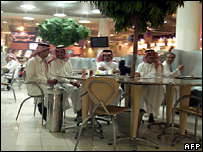
I lived in Saudi Arabia, and I remember the mutawaaeen were NOT police, but sometimes they took on the prerogatives of the police. So I have to wonder, like who made the arrest in the malls? Was it the police? Was it the mutawa hitting the boys with their little sticks? Did they call the boys parents? I have SO many questions!
Keystone Cops
As you all have seen from US Crime tapes, this news story could happen anywhere, but it happened in Kuwait. I would love to see a video of this!
Kuwait Times, 21 Feb 2008
Drunken Man
The operations room received an anonymous call reporting that a drunken man had been dancing in the streets of Fehaheel and terrifying passersby. A police patrol rushed to the scene and managed to arrest the suspect, who initially resisted arrest.
However, after being cuffed and forced into the patrol vehicle for just a couple of seconds, he managed to step out and ran for dear life while police were busy putting some gear into the vehicle’s trunk. A wild goose chase ensued with police hot on his trail, while the man returned to the spot where the vehicle was parked, got in, stepped on the gas and sped to his freedom again. Police later tracked the vehicle that was dumped in a deserted area in Jleeb. A manhunt has been launched to arrest this man.
I commend the writer on the correct use of the plural “passersby.” Bravo.
Your challenge: how many cliche’s did this staff writer use to write this article?
Recent Comments
intlxpatr on Shampoo Ginger tigerbutterya0c5ff1d… on Shampoo Ginger intlxpatr on British Soldier Kidnapped, Esc… John on British Soldier Kidnapped, Esc… intlxpatr on British Soldier Kidnapped, Esc… Wikipedia Donate Button

Amazina


Early Voting in Florida


 Here There and Everywhere