Donna Leon: Death in a Strange Country
Recently I discovered, to my disgust, that I have purchased two Donna Leon books I have already read. I bought them from England, and now they have been published in the US under different titles. Aaaarrrgh! I hate it when that happens.
I have a good friend I want to pass these books along to, an amazing woman who has no idea how amazing she is. When she talks about her early years as a private detective, she refers to herself, with a perfectly straight face, as a “Dickless Dick.”
After I read this book, I passed it along to Adventure Man, who loved it. He aloud to me from it late at night, and we both laughed. Here is the the excerpt he liked, he could identify with it:
In their bedroom, he saw that she had placed a long red dress across the bed. He didn’t remember the dress, but he seldom did remember them and he thought it best not to mention it. If it turned out to be a new dress and he remarked on it, he would sound like he thought she was buying too many clothes, and if it was something she had worn before, he would sound like he paid no attention to her and hadn’t bothered to notice it before. He sighed at the eternal inequality of marriage, opened the closed, and decided that the grey suit would be better.
He, of course, is Commissario Guido Brunetti, Donna Leon’s chief investigator, consumately Venetian, very married, and fighting a lonely battle against the louche corruption of the Italian bureaucracy.
And this book is about the death of an American military man in Venice, except that of course, it turns out to be about something much much bigger. Leon has several axes grinding in this one, but the biggest is illegal dumping, and the arrogance of countries who dump their toxic wastes on smaller countries, eyes wide open, knowing full well that horrorific consequences may result – and not caring.
My favorite part is when Commissario Brunetti visits the American base outside of Venice for the first time:
He left the place and went to stand outside, content to get a sense of the post while waiting for his driver to return. He sat on a bench in front of the shops and watched the people walking past.
A few glanced at him as he sat there, dressed in suit and tie and clearly out of place among them. Many of the people who walked past him, men and women alike, wore uniform. Most of the others wore shorts and tennis shoes, and many of the women, too often those who shouldn’t have, wore halter tops. They appeared to be dressed either for war or for the beach. Many of the men were fit and powerful; many of the women were enormously, terrifyingly fat.
Cars drove by slowly, their drivers searching for parking spaces: big cars, Japanese cars, cars with that same AFI number plate. Most had the windows raised, while from the air-conditioned interiors blared rock music in varying degrees of loudness.
They strolled by, amiable and friendly, greeting one another and exchanging pleasant words, thoroughly at home in their little American village here in Italy.
Donna Leon has a sharp eye for detail, doesn’t she? Don’t you feel like you were sitting there on the bench with Commissario Brunetti, seeing through his eyes?
Reading Donna Leon transports you to another world, Venice, and the joy of reading has less to do with solving the crime than being able, for a short time, to stop and drink coffee while tracking down a criminal, eating a meal or two with Brunetti and his family, experiencing the frustrations of the Venetian bureaucracy in all its radiant corruption, walking along the canals so early in the morning that the delivery men haven’t even begun yet making their deliveries . . .
And yet the problems addressed in the Leon books are part of a greater world picture, and Leon has an enormous capability to draw blurry lines with increasing clarity as we watch how international corruption works hand in hand blindly taking profits while dribble by dribble degrading the world for future inhabitants.
Get an Early Lead and Hold It
The title line is from an old joke: a high school football coach tells his team the secret of winning – Get an early lead and hold it.
Many of you have asked about why it even matters to me what the Yemeni Star is all about. So I am going to tell you a secret from my childhood, a secret that got me through school with good grades.
It’s in two parts. The first is about getting an early lead – it’s called The Halo Effect and it is like getting an early lead and holding it. You work really hard and get good grades when you are young, and those early grades influence the later graders to give you the benefit of the doubt as you move up the grades. It doesn’t always work, but often enough that it has been given it’s own name.
The second secret is to develop an area of interest to YOU. For me, it was the stars. I loved (and still love!) stars, constellations, comets, heavenly rhythms, music of the planets, etc. For me it is God’s hand on this vast, cosmic scale. So I first started writing early reports on stars, constellations, etc. You know, how you have to write science projects?
From the constellations, I branched out into mythology – what a great study. So many references in daily life and literature refer to mythical beings and happenings, and if you don’t have a clue, you miss a whole level of richness. Like if someone refers to a Sisyphusian endeavor, you don’t have to run go look it up, you know they are referring to an almost impossible task. Between astronomy and mythology, there was enough material that I could take previous reports every year and ramp ’em up for the next year. I usually learned something, but the most important thing I learned was that I could succeed without having to re-invent the wheel every year.
If you can develop a particular field that interests you, your school life can be a lot more interesting. And believe me, we all know how deadening the school experience can be, unless you have really good teachers who can make it come alive for you. You have the most amazing tools available to you – a world of information, via the ‘net, and GoogleEarth – GoogleSky,, Wikipedia, and all kinds of illustrations available to add depth to your papers and reports. You are truly a generation who can have a lot of fun learning, if you take responsibility for your own education.
(Big hurrahs and shouts out here for Elijah, Swair, Magical Droplets,, MacoholicQ8, and all my other teaching friends, my classroom-warriors friends, heading back to do battle with and enlighten reluctant minds; you are my heroes!)

WordPress: Where Did Feedback Go?
When I first joined WordPress, there was a place you could click at the top of the page and write FeedBack. What was really really cool was that WordPress was small enough that you usually got an answer on the same day, even if your question was really stupid, like a lot of mine were, because I was just beginning.
There is a great FAQ place, but I couldn’t always understand the answers. Like you know when you know the meaning of each individual word, but when they are strung together, it might as well be an alien language from outer space, you just can’t get the meaning?
So today I wanted to give them some feedback – and FeedBack is GONE! They didn’t even say anything! It’s just gone! Or . . . . am I missing something? At the bottom of my dashboard, it says “use the feedback link at the top right of your page” but . . . am I going blind? I don’t see the feedback link anymore?
Here is what I want:
I love it that I can see statistics for each individual post. Some of my wierdest posts – like Tudo’s Vietnamese Restaurant in Pensacola written back in March can still get a high number of hits, and I like being able to see a post’s history.
And what I would really like is to be able to see ALL my posts in rank order by the number of hits. So like then I could see at a glance what my Top 10, Top 25 were, all time, through the history of the blog.
But . . .WordPress, you no longer want any feedback?
Friday Fishin’ and New Weekend
The fish must be running today. When I got up, there were about 25 fishing boats, the old fashioned shuwi. just off the coast. Sorry, they are about a kilometer off the shore, so I can’t get a great photo. I found a photo at agmgifts however, that shows what the boats look like:
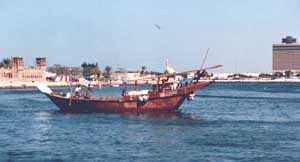
Weather Underground says it’s going to be 118° F/ 48°C today – how can they bear it? Some of the boats have no cover? How can they be out under the hot, scorching sun with no cover?
For my non-Kuwait readers, this is a very special weekend, a Thursday-Friday-Saturday weekend, to celebrate the shift to a Friday – Saturday weekend. It has been a long time coming; Kuwait is one of the last countries in the Gulf to make the shift. We were also living in Qatar when the shift to Friday – Saturday happened, but in Qatar, there was no uproar. Here, some people were outraged, saying that Saturday was the Jewish day, and it was a fire-and-brimstone kind of sin to take a day off on the Jewish day.
The government announced the weekend would switch to Friday-Saturday, and then the National Assembly announced that no, it wouldn’t, it would remain Thursday – Friday. Then the government offices started sending out notices to the people working there, and to customers, etc. giving new working hours, and here we go, Friday – Saturday. I am hearing rumors that even Saudi Arabia is considering the change, the last great hold out.
It brings the working week into closer alignment with the rest of the world, having more business days in common. It will make the traffic in Kuwait even worse than it already is.
Kuwait Bans Melmac

Today on the front page of the Kuwait Times is the announcement of a ban by the Ministry of Commerce on selling any goods containing melamine, stating it was “based on information received from the Customs Department and office of the Secretary-General of the Gulf Cooperation Council, and has to do with melamine containing urea formaldehyde, which is banned” because it is “believed to be harmful to health.”
I was so curious, I had to Google “Melamine kitchenware + danger” because, to the best of my knowledge, Kuwait is now the only country in the entire world to ban melamine.
Melamine appeared in dog and cat food, and is believed to have been the cause of some early poisonings in the US, but as far as I can see, that came from insecticides, not from eating off melmac.
On the same front page is an article about hundreds of camels dropping dead in Saudi Arabia, also believed poisoned by a insecticide contaminated feed. Is there some relationship?
It isn’t an issue in our house; we don’t have melamine. But I have this irrational fondness for Melmac, because there used to be a show called Alf, about an alien that lived with an American family, and he was from the planet Melmac, which always cracked me up. I can’t imagine the generations of Americans – and others – who have eaten off Melmac dishes without any serious effects. How can this be? Is Melmac now formulated differently from before? Are Melmac plate users going to succumb to some serious problems because they ate off Melmac plates?
And why is Kuwait the only country in the world banning Melmac?
The Arab Way (2)
Here is when the Arab way doesn’t work. . .well, it does work, but not in your favor. I was taking my car in for some repairs a couple weeks ago; they told me “just bring it in, we will take care of it” and fool! I believed them!
So I get there, seek desperately for a parking space, and go inside. I take a number. Not too bad. Only five people in front of me.
Five people. But here comes Bashir, and he sits himself down right at the counter, no number. The clerk finishes with number 34 – and Bashir shakes hands with him, greets him, makes small talk with him – and takes care of him.
Meanwhile Ali and his four brothers walk in. They have a number. They want to sit down, but I am on the far end of the couch so only Ali sits down. He tells his brothers they can sit, but with a big wolfy grin – like a dare. Let’s see which one of you will sit next to a WOMAN. And not one of them will. The manager walks over to Ali, greets him and they chat and then Ali and his brothers are all taken to another area, where they get specialized service.
Old Abdul shuffles in next, and I know I am screwed. OK, OK, I tell myself, you have a choice, you can laugh or you can stew. If you stew, you just ruin your own day – it’s not going to change anything. So I just laugh.
Eventually, I get seen, and the dealership makes the problem go away, and I think to myself that in the US this would have cost a lot more, I would have waited a lot longer, and I wouldn’t have all this material for a blog entry.
The Arab ways works – but it works best if you are an Arab, if you are a Moslem, and if you have connections. I am betting it also helps to be male, but I have seen women who knew how “to be preferred”, too. 😉
The Arab Way
My husband and I were very young when we first came to live in the Middle East, back to back embassy assignments, first in Tunisia, and then in Jordan. Before those assignments, we had spent two years learning about the culture, and my husband spoke Arabic and I spoke French. It didn’t matter. We were still woefully ignorant. (And we are still learning!)
People would call us, asking for favors, especially visas and getting their kids into U.S. colleges. We would look at each other in astonishment. How could they think their kids could get into college without passing the tests? How did they think their cousin could get into pilot training when there were other, better qualified candidates? And we learned, that with the right connections, exceptions are made.
We got smarter. We were travelling back in Germany, and wanted to stay in military lodging, but all the rooms were taken. We decided to go get something to eat, and at dinner, I said to my husband “let’s try doing it the Arab way.” He looked at me and said “Whaaaaaattt?”
“Take your orders that say we are with the embassy and on special leave” I told him. “Tell them we just got in, and just need a place for tonight.”
“But they don’t have any rooms!” Adventure Man protested.
“They always hold rooms back for special circumstances, for pilots, for emergencies,” I countered. “Make us special.”
We finished dinner, and felt better with our blood sugars back up. Adventure Man became his charming persona, and we went back to the hotel. He was inside for a bare two minutes, and came back out grinning, and holding a key.
We have learned an important lesson. Yes, there are policies. Yes, there are rules. Yes, there are the way things are done, customs, traditions, inviolable.
But there are also exceptions, and they are based on personal relationships.
Our insurance company told us they would no longer insure our Florida house, too much risk exposure in Florida. We went to a lot of trouble to try to meet a guideline that would allow us to be an exception – to no avail. Yesterday, I spent an hour on the phone with one person who was persistently pleasant in telling me it was not possible. I told her that telling me what a great customer I was, and how they valued our loyalty didn’t ring true when they would abandon us after all our years of being good customers. I didn’t blame her, personally, but neither was I buying all this pleasant stuff, when the bottom line was money, not loyalty.
I hung up the phone with a huge pit in my stomach – this cloud, this worry has hung over my head all summer, and now my worst fears had come true and I would have to seek new, less reliable, insurance. But I decided to put it off until tomorrow, no point trying to do something when you feel really depressed.
Late last night, we were in those early hours of dead-drooling sleep, the phone rang, and it was the insurance representative calling us back. Four hours after our phone call, the phone call which had been “the final answer” she was calling me back to say she had found a way, and our policy was being re-instated.
Thanks be to God! The Arab way worked, even though I wasn’t consciously using the Arab way, probably my thinly veiled anger and frustration and bottom line TERROR had gotten through to her. I thought it was over, but God was working behind the scenes, and a miracle happened.
We are still learning; we still have a lot to learn, and living in this culture helps us continue learning a new tools, additional strategies, for our tool box.
How Security Police Say “Sorry”
This is from today’s Kuwait Times. I know you are all dancing for joy that journalist and blogger Bashar Al-Sayegh is free, and we as a blogging community can all celebrate his release.
His arrest was a mistake.
It says so in the article. Pay attention! You have to read carefully, because security police speak a language all their own.
This is how they say “I’m sorry. It was a mistake.”
Responding to calls to dismantle the state security department, Rujaib stressed that the department was very vital for any state. “It forms the eye that never sleeps in protecting the nation’s security, in political, social and economic fields,” he explained, pointing out that it existed all over the world.
Asked whether Sayegh’s arrest was meant to convey a message against the freedom of the press, Rujaib stressed that press freedom was fully observed, yet reminded that journalists could be arrested for other reasons. “Meanwhile, police officers could be arrested for any reason as well,” he added, underlining that no violations took place during Sayegh’s arrest. On whether he believed that the issue had been politically motivated by some MPs, Rujaib said, “I am a security official and a politician should answer this question.
Do you think he is implying that there might have been another reason? Does it sound like deflecting blame? I think he is saying “We screwed up. We’re sorry.”
Bekir L. Yildirim Weighs In
This is another comment on the issue of Turkey Blocks WordPress. I really like it when, no matter which side the commenter weighs in on, their comments are to the point, well reasoned, and well presented. See for yourself:
Knowing a bit from the first hand experience with the Turkish judicial system and the bureaucracy , I blamed primarily the system in this ostensibly minor event turning into a saga. It appears now that there is enough blame to go around including possibly the WP which I held blameless so far (see for ex. “WordPress banned in Turkey: a case of throwing the baby with the bath-water“).
Perusing through some of the comments on the matter it appears that some of the commenters have an ax to grind with Adnan Oktar (a.k.a. Harun Yahya) . They make his an issue of creationism versus evolutionism, which it should not be. The position Matt seems to be taking is that it is a free exchange of information in the internet , as parti of fundamental right of free speech.
This is certainly a view held by many including myself in principle. However the matter gets a bit thorny when you get into the limits, boundaries of the exercise of such right. That is why we have caseloads before the courts dealing with issues such as slander, defamation, libel, trademarks, copyrights and so on, -some of which are involved in this case. I am not going to attempt to sort out all the legal and moral issues and heir ramifications in this case. All I am trying o do is to invite all concerned to differentiate between personal dislike for a person, or opposition to his views on certain matters and justice.
I understand the predicament Matt and WP finds themselves in. They see the issue as an undemocratic justice system and an individual with strong arming the system to demand immunity from criticism. They are taking a stand on the side of the free speech. I urge them however to go beyond that reflexive behavior and engage in a bit deeper analysis of what Edip Yuksel is doing , and whether he is going over the bounds vis-a-vis the free speech. He has made a name for himself for attacking various religious persons, institutions and values sacred to others. I do not contest his right to be wrong , but I am also cognizant of the fact that WP does render judgement on suitability of the content of the blogs. The method Edip Yuksel is employing , specifically targeting another individual, and inviting others to abuse the blogging system with multiple blogs directed at the same purpose should also be questioned. WP cannot judge the veracity of all accusations in millions of pages of content, however it can place certain limits such as selection of blog names etc, as it does in the terms of service it is offering. Edip Yuksel and others should also be mindful of the fact that they have the right to free speech but exercising it on WP is a privilege.
Back it up! #2 Khalid Al-Hajri
WOOOOOOO Hoooooooooooo Khalid Al-Hajri!
You WILL find this one in the Kuwait Times Online, by clicking right here.
Khalid Al-Hajri, representing The Green LIne Environmental Group, held a press conference and demonstrated how the Wafra Agricultural Area – and all of Kuwait – faces an environmental disaster due to irresponsible disposal of petroleum related wastage.
This takes a bucket full of courage, in a nation where so much wealth is produced by petroleum. And Khalid Al-Hajri didn’t just go on record giving an emotional speech, no. He had graphs and maps and photos – he had the FACTS to back up his assertions.
And bravo to the Kuwait Times for giving him page 3 coverage.
The truth is that I don’t understand the whole of the report. I understand that there are problems with oil products being illegally dumped in the al Wafra farm area and it could have a devastating impact on the farming there. And – I understand that their injecting the oil production by-products deep into the earth NEAR THE SAUDI – KUWAITI BORDER could cause EARTHQUAKES.
Hmmmmmm. . . . didn’t we just have an earthquake? And where was it? Oh . . . yeh! Near the Kuwaiti – Saudi border, wasn’t it?
And worst case of all, these by products pollute the underground aquifer.
I applaud people like Khalid Al-Hajri who care about their country enough to do their homework, and then to speak up in a responsible way to bring our attention to practices that can hurt Kuwait in the future.
Recent Comments
intlxpatr on Shampoo Ginger tigerbutterya0c5ff1d… on Shampoo Ginger intlxpatr on British Soldier Kidnapped, Esc… John on British Soldier Kidnapped, Esc… intlxpatr on British Soldier Kidnapped, Esc… Wikipedia Donate Button

Amazina


Early Voting in Florida


 Here There and Everywhere