Government limits freedom of expression
In the United States, news that people want buried comes out on Saturday night, when people are busy with other things and not paying a lot of attention. Does that happen in Kuwait?
I watched for anyone blogging on this yesterday, but saw nothing. I showed the newspaper to my Kuwaiti friends, who were shocked, and hadn’t heard anything about this. Some of it, I get. I am flummoxed by the forbidding of any mention of veterinary medicine!
From yesterday’s Kuwait Times.
KUWAIT: All newspapers, magazines, publishing houses and printing presses in Kuwait were yesterday issued a list by the government of the types of articles, advertisements and banners that can no longer be printed or published without official approval. Following is the list of the banned topics and the ministry concerned:
Interior Ministry:
1. Publication or display of slogans that glorify some countries against others.
2. Displaying pictures that glorify some political personalities or religious figures of countries where political or religious conflicts exist.
3. Publications or displaying slogans that glorify or support some political or religious parties outside Kuwait.
4. Publication of personal interviews with citizens who support or oppose a certain policy which may place the state at war with other countries.
5. Publication or displaying slogans that glorify or support some religious or political parties in Kuwait.
6. Announcement of seminars that may probe tribal or sectarian conflicts.
7. Sale of books on sorcery and magic.
8. Spiritual healing (without a licence).
9. Sorcery and ability to heal.
10. Massage without a licence (because those activities are subject to Law No. 15/1960 dealing with commercial companies).
11. Sale and trade of weapons by commercial companies, individual establishments and individuals (swords, sabers, daggers, spears, knives, arrows and arrowheads, pointy rods, spiked clubs, knives, brass knuckles, electric sticks), because licenses from the Interior Ministry to import these.
12. Sale of airguns without a licence from the Interior Ministry.
13. Fireworks and explosives.
14. Sale of surveillance cameras and listening devices (bugs) of all types without obtaining a licence from the concerned authority.
Education Ministry:
1. Publication of ads for private tuitions.
2. Publication of supplementary school notes.
3. Ads of private institutes and universities that are not accredited by the Ministry of Education.
Ministry of Health:
1. Conventional and veterinary medicine.
2. Botanic, animal or chemical formulae.
3. Foods that have health-enhancing effect, claimed to be prepared for treatment.
4. Preparations that claim to provide energy or reduce or increase weight.
5. Change of structures of body parts. (It is a must that a license be obtained from the licenses committee on advertisements related to health and nutrition).
Ministry of Social Affairs and Labor:
1. Donation and blood money ads.
2. Charity homes’ advertisements.
3. Ads for lectures, cultural and religious gatherings (unless a permission is obtained from the ministry).
The order was signed by Fahd Sayyah Al-Ajmi, Director of Local Press Affairs at the Ministry of Information.
Catbird Seat
Last week, I wrote a post on Cat’s Paw from A Word a Day, and today they sent me this one. The theme this week is words and phrases which refer to birds, and I have always wondered about the catbird seat. You hear it used in political journals more than anywhere else.
If you subscribe to A Word a Day they send you a fresh word every day, with a definition, they show how it is used in a sentence, and you can click on a link to hear it pronounced. I’ve been a member for over ten years now, and they are still surprising me with new words.
catbird seat (KAT-burd seet) noun
A position of power and advantage.
[A catbird (named after its catlike call) is known to build a pile
of rocks to attract a mate and sit on the highest point around. This
expression was often used by Brooklyn Dodgers baseball commentator
Red Barber and further popularized by the author James Thurber in his
story “The Catbird Seat” where a character often utters trite phrases,
including the expression “sitting in the catbird seat”.]
-Anu Garg (words at wordsmith.org)
“So, Stillking Films seems perched in the catbird seat. ‘Things
are going very well for us at the moment,’ David Minkowski says.”
Steffen Silvis; Stillking is Still King; The Prague Post
(Czech Republic); Apr 5, 2007.
Tornado Before and After
Imagery provided in Ogle Earth of the recent tornado damage in Greensburg, Kansas on May 4th.
If you go to Ogle Earth, you can see the before and after shots. The destruction is unbelievable. The immediacy with which the damage could be assessed with the help of these shots helps emergency workers and insurance assessors do their job more quickly.

Labyrinth by Kate Mosse
When I saw this book at the Barnes and Noble, I thought “isn’t Kate Moss a fashion model?” but that is a different Kate Moss, a Moss without the ‘e’ at the end.
This book was a New York Times bestseller, but then so was the Da Vinci Code, which I thought badly written and sometimes incoherent. The premise was interesting, but it was done years ago by French authors Michael Baigent, Richard Leigh and Henry Lincoln. Holy Blood, Holy Grail hypothesizes (and pulls together a load of hypothetical evidence to support) that the mystical grail is really a symbolic representation of the blood of Christ, that Jesus was not crucified but instead left Jerusalem with his wife Mary Magdeleine and went to France, and started a family there which eventually became the early French royal line.
I remember telling my son this story, as we travelled through the southern areas of France, and him saying in his smart-mouth-teenager way “only the French would be so arrogant as to believe the blood of God was flowing in their veins!”
We spent a lot of time travelling in France. We love France. So when I discovered that Labyrinth was about the beginning of the French crusade against the Cathars, I was delighted. We know this history. We know this area – it is one of the most beautiful areas of France. We know Carcassone, which in its renovation by Viollet-le-Duc is like Disney-does-fortified-city. It’s formidable, but it’s not entirely authentic.
Who are the Cathars? The Cathars were a break-away sect who were called by others ‘bons hommes’ or ‘bons Chretiens’ (good-Christians), but, pre-Luther, they saw many flaws in the way the Catholic church has become more political than spiritual.
They valued inner faith above outward display. They needed no consecrated buildings, no superstitious rituals, no humiliating obeisance designed to keep ordinary men apart from God. They did not worship images, nor prostrate themselves before idols or instruments of torture. For the ‘Bons Chretiens’ the power of God lay in the word. They needed only books and prayers, words spoken and read aloud. Salvations was nothing to do with alms or relics or Sabbath prayers spoken in a language only the priests understood. . . In their eyes, all were equal in the Grace of the Holy Father – Jew or Saracen, man and woman, the beasts of the fields and the birds of the air. There would be no hell, no final day of judgement, because through God’s grace all would be saved, although many would be destined to live life many times over before they regained God’s kingdom.
They believed the earth was created as a trap, by Satan, and that our lives here keep us apart from the glory of God. They believed we keep coming back, until we purify ourselves spiritually, and that in the end, if we get it right, we end up back where we came from, with God. And they believed we all have the right to read the bible, and to talk directly with God, without the necessity of a priest to interpret or to direct.
But this Crusade, the Fourth Crusade, is little known. This Crusade, declared by the Pope to wipe out the Cathar heresy (sometimes known as Bogomilism or Albigencian heresy) was really the tool of the nobility that was then France, less than half of the France of today, to grab the rich, lush southern lands of the Pays d’Oc. The Fourth Crusade was an opportunity for knights to increase their holdings. And it doubled the size of France.
The Labyrinth takes you inside the walls. The main character is not Cathar, but it didn’t matter – this war wasn’t really about wiping out the Cathars as much as subjugating an independant land and making it part of France. You may have heard one famous quote from this Crusade – as the Crusaders were attacking Besiers, the Abbot of Citeaux was asked how the soldiers could tell the good Catholics from the heritics. “Tuez-les tous. Dieu reconnaitra les sien,” he replied – Kill them all. God will know his own.
The book is lightweight, an easy read. The heroine, Alice, seems to have lived before, as Alais, and has memories she has never lived. You jump back and forth between today, and the time of the Crusade, in the early 1200s. Some of the plot mechanisms don’t make a lot of sense, but you do get a real sense of life in a fortified town during the 1200’s, and of the injustice done to this beautiful area in France. For a book I am lukewarm about in retrospect, I read it avidly, and enjoyed the read.
What I like about this book is that it brings to life a time in history that few pay any attention to. Somewhere in the book, it says that “history is written by the victors.” We see France today, and we know little about the struggle that united these diverse areas into one nation. This book illuminates a slice of time, a grave injustice, and a sense that religion is too often a tool for political ends.
Like the heroine, the big church in Carcassone, where the trials and tortures of the ‘heretics’ took place sends a cold chill up my spine, I can hear the screams of the tortured. I love churches, and I can’t go into this one. It feels unholy. Did you know that the origination of the Inquisition was not in Spain, as most people believe, but in this area of France? And it was aimed, first, at the Cathars.
All in all, not a bad book. Though light in plot, it is heavy in content, a book you will remember and think about in terms of issues, if not the main characters.
MOC Bans Porno Film Sites
Today’s Kuwait Times:
Internet Porno Film Sites
The Ministry of Communication has closed down all new sites that advertise pornographic films. The ministry of Communication represented by Undersecretary Eng. Abdulaziz Al-Osaimi and his counterpart at the Ministry of Information achieved this new step. This move was done in order to have control over the sites, which are being followed by the Ministry of Information. Al-Osaimi has assigned administration director Nassar Al-Kandari to work on closing those sites from the Internet and ensuring that companies do not use other systems to re-open it. The ministry succeeded in coordinating with local internet companies to close all porno sites, but lately the ministry realized that there are new sites marketing through drama films to porno films.
My comments:
I truly hate porn. I hate it because it creates a fantasy world that real women can barely compete with. I bet if men spent half the time and attention on their wives and families that they spend on porn, there wouldn’t be so much divorce. And guys – those women are PAID. They’re ACTING. Most of them would rather be doing anything but what they are doing, but they do it for the MONEY. It’s about as real as the World Wide Wrestling Federation Matches, it’s all staging and airbrushing and making money off YOUR fantasies.
Rant over – reality strikes. How do you ban pornography?
First, how do you define pornography? When I was a student in political science, we spent a week of class time trying to come up with a definition that everyone could buy into. We never succeeded.
There is some pretty powerful erotic literature, erotic art out there, stuff I don’t find pornographic in the least. So what are the guidelines?
Second, WHO defines pornography?
Third, how on earth will the Ministry of Communication and the Ministry of Information keep up with all the new porn sites that keep popping up? These sites make people a LOT of money, they have the money to pay ingenious high tech guys to keep devising new ways to get their product to market.
And last, who is the poor porno-guy who has to watch all this garbage and enforce the ban?
And – is your internet phone still working? 😉
Adult Sudden Death Syndrome
This is from the Tuesday, May 1, Kuwait Times.
Beijing: A Chinese judge charged with corruption died in his cell from “adult sudden death syndrome”, Xinhua news agency said yesterday. Investigators said Li Chaoyang, 38, had been uncooperative while in detention in Xing’an county . . . “Cuts on his face and other injuries” had been caused by a fall during an escape attempt,” they said. . . .
Shi Shaosen, head of the Guilin municipal law enforcement supervisory section and chief investigator int he case, said the prisoner had not been maltreated.
“Li Shaoyang’s sudden death conforms with adult sudden death syndrome, said Shi, citing a forensic report. Li’s relatives had claimed there were wounds on his body, a gash across his lip and one of this front teeth was missing.
They had questioned the cause of his death and wrote about it on a blog. . . .”he was naked, and bruises could ber clearly seen on his face, neck and back. My brother was just 38 years old, he had been in perfect health and hardly ever fell ill” said Ki Xiuqing. “I suspect the visible bruises on his body were caused by torture.”
You can read the rest of the report at the Kuwait Times.
There really is a Sudden Adult Death Syndrome. You can get more information about it HERE. Note the “normally non-traumatic, non-violent” part. This is part of the information they give:
What is SADS?
In a medical context the term SADS is most often used in reference to Sudden Arrhythmia Death Syndrome. However in recent times the phrase Sudden Adult Death Syndrome or SADS has been adopted by the media for referring to the more general notion of a sudden death of an apparently fit and healthy young person. To avoid confusion it is important to understand all definitions of SADS when discussing different conditions or syndromes.
The use of the word ‘adult’ enables the distinction between different forms of Sudden Death Syndrome, making the distinction between Sudden Infant Death Syndrome – SIDS and Sudden Adult Death Syndrome – SADS.
Sudden Adult Death Syndrome events are defined as non-traumatic, non-violent, unexpected occurrences resulting from cardiac arrest within as little as six hours of previously witnessed normal health.
Audio and Video Streaming Stopped?
My neice, Little Diamond, checking on Kuwaiti Censorship went to the Ministry on Information where she found this statement:
الإذاعة والتلفزيون
على الإنترنت
حتى إشعار أخر
Audio & Video Streaming is stopped
until further notice
And I just checked it, but I can’t figure out if it means they are discontinuing audio and video streaming from their site, or if they intend to discountinue audio and video streaming into Kuwait?
Anyone know anything?
A Beautiful Apology
Gere apologises over Shetty kiss
The kiss:
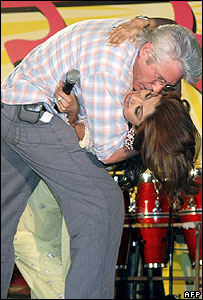
Actor Richard Gere has apologised for causing offence when he kissed Bollywood actress Shilpa Shetty.
The incident, at an Aids awareness event in Delhi, prompted public protests and then an arrest warrant for both stars over the “obscene act”.
Gere, 57, said he had misread Indian customs and that he regretted any problems he had caused Shetty.
You can read the whole story here, at BBC News.
I am guessing both Gere and Shetty got a lot of mileage out of the storm of publicity from his onstage behavior, and now he has graciously and sincerely apologized. Pardon my cynicism, but he has been in India before, I would think he would have been more sensitive.
Nonetheless, he made a beautiful apology. And I wonder why politicians don’t do the same? Why, when you realize you have stepped on someone’s toes, don’t you just make a full and gracious apology? No, it doesn’t change what has happened, but it can sometimes calm the troubled waters.
What if the Danish papers had made a full and gracious apology for publishing the cartoons of the Prophet Mohammed? It would not have changed the fact that they had been published, but it would not have hurt to acknowledge that they had hurt the sensitivities of a large portion of the world, and to apologize for the offence.
“Make This Case Go Away”
This is from today’s Kuwait Times.
MP Intervenes to save rapists
by Hanan Al-Saadoun
Kuwait: Two men accused of kidnap, rape and assault were let off the hook after pressure from a lawmaker and a senior police officer. A captain from the Traffic Department was on duty in Khaitan when he saw a parked car with an Asian maid in it and a man standing next to the car. The maid suddenly pointed to the officer and cried for help, so the captain rushed to the car and found another man inside with the maid.
The captain asked the man outside what the problem was. The main replied that this was a runaway maid and he was a detective. The captain asked for his ID but the man refused. The captain then realized that the man smelled of alcohol.
The men suddenly assaulted the captain and bit his hand, injuring him severely (emphasis added by blogger.) After the captain subdued both men, they confessed that they were drunk and that they had tried to rape the maid. The captain then tried to file a case at the Khaitan police station against the two men, but the MP intervened and tried to stop the captain from registering the case. The captain persisted and kept pushing to file a case for a week, until his superior intervened too and told him to “forget the incident.”
My comment: If I ever stop getting outraged when I read reports like this, God forbid, I will be dead.
First, the maid’s life is seriously damaged. Any victim can tell you that the terror of abduction, with or without rape, resonates through your life. When you are in a situation where you have no power, and are at the mercy of someone stronger or more powerful than you are, it is a life-changing event. And would her sponsor accept her back, even though it were no fault of her own? Would they not be afraid she might be diseased? They might even accuse her of inviting the assault – and this was an assault.
Second, these young men lied to the police, impersonated a police officer, resisted arrest and caused bodily harm to a senior police official. Did you notice – THEY CONFESSED.
Third, the police captain had the guts and integrity to persue filing this case against these wicked young men, inspite of pressures from above. WOOOOOO HOOOOOOOOOO on you, brave one, for your integrity.
Last, kudos for Hanan al-Sadoun who does such a great job presenting so many of these outrageous stories in an objective manner, letting us fill in the details and express our outrage in our blogs. Brava, habeebti.
Evidently this air tight case will never get to court.
And what have these young men learned about accountability? That their name and wasta will make their despicable actions go away? What is the fitting punishment for what they have done? C’mon readers, check in on this one.
OK, OK, I’ll take a deep breath and stop now.
When the Experts are WRONG
This started my morning with a big grin. A friend sent it to me, and I hope it delights you as it delighted me.
Below is a nice collection of quotes that turned out to be very wrong. Many of the quotes are from very famous and respectable people. Maybe we should stop underestimating ourselves so much?
* “Computers in the future may weigh no more than 1.5 tons.”
Popular Mechanics, forecasting the relentless march of science, 1949
* “I think there is a world market for maybe five computers.”
Thomas Watson, chairman of IBM, 1943
* “I have traveled the length and breadth of this country and talked with the best people, and I can assure you that data processing is a fad that won’t last out the year.”
The editor in charge of business books for Prentice Hall, 1957
* “But what … is it good for?”
Engineer at the Advanced Computing Systems Division of IBM, 1968, commenting on the microchip.
* “There is no reason anyone would want a computer in their home.”
Ken Olson, president, chairman and founder of Digital Equipment Corp., 1977
* “This ‘telephone’ has too many shortcomings to be seriously considered as a means of communication. The device is inherently of no value to us.”
Western Union internal memo, 1876.
* “The wireless music box has no imaginable commercial value. Who would pay for a message sent to nobody in particular?”
David Sarnoff’s associates in response to his urgings for investment in the radio
in the 1920s.
* “The concept is interesting and well-formed, but in order to earn better than a ‘C,’ the idea must be feasible.”
A Yale University management professor in response to Fred Smith’s paper proposing reliable overnight delivery service. Smith went on to found Federal Express Corp.
* “Who the hell wants to hear actors talk?”
H.M. Warner, Warner Brothers, 1927.
* “I’m just glad it’ll be Clark Gable who’s falling on his face and not Gary Cooper.”
Gary Cooper on his decision not to take the leading role in “Gone With The Wind.”
* “A cookie store is a bad idea. Besides, the market research reports say America likes crispy cookies, not soft and chewy cookies like you make.”
Response to Debbi Fields’ idea of starting Mrs. Fields’ Cookies.
* “We don’t like their sound, and guitar music is on the way out.”
Decca Recording Co. rejecting the Beatles, 1962.
* “Heavier-than-air flying machines are impossible.”
Lord Kelvin, president, Royal Society, 1895.
* “If I had thought about it, I wouldn’t have done the experiment. The literature was full of examples that said you can’t do this.”
Spencer Silver on the work that led to the unique adhesives for 3-M “Post-It” Notepads.
* “So we went to Atari and said, ‘Hey, we’ve got this amazing thing, even built with some of your parts, and what do you think about funding us? Or we’ll give it to you. We just want to do it. Pay our salary, we’ll come work for you.’ And
they said, ‘No.’ So then we went to Hewlett-Packard, and they said, ‘Hey, we don’t need you. You haven’t got through college yet.’”
Apple Computer Inc. founder Steve Jobs on attempts to get Atari and H-P interested in his and Steve Wozniak’s personal computer.
* “Professor Goddard does not know the relation between action and reaction and the need to have something better than a vacuum against which to react. He seems to lack the basic knowledge ladled out daily in high schools.”
1921 New York Times editorial about Robert Goddard’s revolutionary rocket work.
* “You want to have consistent and uniform muscle development across all of your muscles? It can’t be done. It’s just a fact of life. You just have to accept inconsistent muscle development as an unalterable condition of weight training.”
Response to Arthur Jones, who solved the “unsolvable” problem by inventing Nautilus.
* “Drill for oil? You mean drill into the ground to try and find oil? You’re crazy.”
Drillers who Edwin L. Drake tried to enlist to his project to drill for oil in 1859.
* “The bomb will never go off. I speak as an expert in explosives.”
Admiral William Leahy, US Atomic Bomb Project.
* “This fellow Charles Lindbergh will never make it. He’s doomed.”
Harry Guggenheim, millionaire aviation enthusiast.
* “Stocks have reached what looks like a permanently high plateau.”
Irving Fisher, Professor of Economics, Yale University, 1929.
* “Airplanes are interesting toys but of no military value.”
Marechal Ferdinand Foch, Professor of Strategy, Ecole Superieure de Guerre.
* “Man will never reach the moon regardless of all future scientific advances.”
Dr. Lee DeForest, inventor of the vacuum tube and father of television.
* “Louis Pastueur’s theory of germs is ridiculous fiction.”
Pierre Pachet, Professor of Physiology at Toulouse, 1872
* “The abdomen, the chest, and the brain will forever be shut from the intrusion of the wise and humane surgeon.”
Sir John Eric Ericksen, British surgeon, appointed Surgeon-Extraordinary to Queen Victoria, 1873
Recent Comments
intlxpatr on Shampoo Ginger tigerbutterya0c5ff1d… on Shampoo Ginger intlxpatr on British Soldier Kidnapped, Esc… John on British Soldier Kidnapped, Esc… intlxpatr on British Soldier Kidnapped, Esc… Wikipedia Donate Button

Amazina


Early Voting in Florida


 Here There and Everywhere