The Widow’s Mite
Today’s meditation is on the Gospel reading from the Lectionary found in Forward Day by Day. I’ve always loved this image, this humble, poor woman who gives what little she has.

THURSDAY, June 20
Luke 20:41—21:4. Jesus looked up and saw rich people putting their gifts into the treasury; he also saw a poor widow put in two small copper coins. He said, “Truly I tell you, this poor widow has put in more than all of them; for all of them have contributed out of their abundance, but she out of her poverty has put in all she had to live on.”
There is something about generosity that is compelling. Jesus says that the poor widow has given out of her poverty, but in reality it is only she who has given out of her abundance—an inner abundance of the heart that allows her to behave almost recklessly, as if she had more than enough.
I was taught to save those pennies, to save them for a rainy day, and it can still keep me looking to the horizon for any sign of clouds. My spouse, admittedly, has a much better relationship to money: it’s not about having or not having, but about knowing the relative value of wealth; it is energy to be moved around, rather than bankable power or security. Above all, it is a potent way to extend and manifest generosity.
As we see in the widow’s mite, it’s not the amount, but the heart’s intention behind it that matters. That is where the real power lies.
The Secret Lives of Baba Segi’s Wives by Lola Shoneyin

I don’t know what it is about summer reading, but now and then I go on a theme-fest; a couple years ago it was Nigerian literature, and, once hooked . . . when my friend who is now living in Lagos recommended The Secret Lives of Baba Segi’s Wives, I ordered it right away, thinking from the title it would be maybe light and sweet and humorous.
From the start, that assumption was blown. This is a direct and edgy Nigeria, darker, rougher and full of family secrets, domestic details and messy relationships.
It is a very Nigerian book – this is a good thing. There are cultural things that are not explained, but it all ends up making sense in the end. There are foods I have never heard of – ekuro with shrimp sauce, asun. There is a rudeness in the way they speak to one another, (“Is this a parking lot?” “Do I look like a parking attendant?”), a crudeness in the constant need to carry small bills for bribes, even on public streets. People speak their minds, with little or no mitigation, depending on the status of the person and their own personal goals and agendas.
At the weekly meeting of wives, the senior wife, Iya Segi, doles out rations of household supplies to the other wives, including chocolate powder and hair conditioner . . . and as the senior wives complain about the new wife thrown in their midst, she says:
“You will trip over in your hate if you are not careful, woman. Your mouth discharges words like diarrhea. Let Bolanle draw on every skill she learned in her university! Let her employ every sparkle of youth! Let her use her fist-full breasts. Listen to me, this is not a world she knows. When she doesn’t find what she came looking for, she will go back to wherever she came from.”
There is a whole other world in that one paragraph – a whole other way of seeing life and expressing thoughts. The culture may be alien, but I thoroughly enjoyed being a tiny mouse in the corner at that meeting – and others – and inside the minds of the wives, of Baba Segi, of the driver – so many good stories, so many points of view, and I learned things from behind those high compound walls and closed and locked doors that I might never otherwise have learned. Alien as it was, for me, this was a very good book, new ways of looking at things, and a great recommendation from my friend in Lagos.
The Festival of BERNARD MIZEKI
(Play the video of the Soweto Gospel Choir as you read this summary from today’s Lectionary Readings How I would love to be able to attend this festival!)
BERNARD MIZEKI
CATECHIST AND MARTYR IN AFRICA (18 JUNE 1896)
Bernard Mizeki was born in Portuguese East Africa (Mozambique) in about 1861. When he was twelve or a little older, he left his home and went to Capetown, South Africa, where for the next ten years he worked as a laborer, living in the slums of Capetown, but (perceiving the disastrous effects of drunkenness on many workers in the slums) firmly refusing to drink alcohol, and remaining largely uncorrupted by his surroundings. After his day’s work, he attended night classes at an Anglican school.
Under the influence of his teachers, from the Society of Saint John the Evangelist (SSJE, an Anglican religious order for men, popularly called the Cowley Fathers), he became a Christian and was baptized on 9 March 1886. Besides the fundamentals of European schooling, he mastered English, French, high Dutch, and at least eight local African languages. In time he would be an invaluable assistant when the Anglican church began translating its sacred texts into African languages.
After graduating from the school, he accompanied Bishop Knight-Bruce to Mashonaland, a tribal area in Southern Rhodesia (now Zimbabwe), to work there as a lay catechist. In 1891 the bishop assigned him to Nhowe, the village of paramount-chief Mangwende, and there he built a mission-complex. He prayed the Anglican hours each day, tended his subsistence garden, studied the local language (which he mastered better than any other foreigner in his day), and cultivated friendships with the villagers. He eventually opened a school, and won the hearts of many of the Mashona through his love for their children.
He moved his mission complex up onto a nearby plateau, next to a grove of trees sacred to the ancestral spirits of the Mashona. Although he had the chief’s permission, he angered the local religious leaders when he cut some of the trees down and carved crosses into others. Although he opposed some local traditional religious customs, Bernard was very attentive to the nuances of the Shona Spirit religion. He developed an approach that built on people’s already monotheistic faith in one God, Mwari, and on their sensitivity to spirit life, while at the same time he forthrightly proclaimed the Christ. Over the next five years (1891-1896), the mission at Nhowe produced an abundance of converts.
Many black African nationalists regarded all missionaries as working for the European colonial governments. During an uprising in 1896, Bernard was warned to flee. He refused, since he did not regard himself as working for anyone but Christ, and he would not desert his converts or his post.
On 18 June 1896, he was fatally speared outside his hut. His wife and a helper went to get food and blankets for him. They later reported that, from a distance, they saw a blinding light on the hillside where he had been lying, and heard a rushing sound, as though of many wings. When they returned to the spot his body had disappeared. The place of his death has become a focus of great devotion for Anglicans and other Christians, and one of the greatest of all Christian festivals in Africa takes place there every year around the feast day that marks the anniversary of his martyrdom, June 18.
Men Not Mature Until 43 (!)
From The Business Standard, a recent study verifies that men simply mature later than women do. “Men were nearly twice as likely as women to describe themselves as immature.” (!)
Women often accuse men of being immature – and there may be some truth in it after all!
The age that men mature completely is 43 – which is 11 whole years after women, a new UK study has found.
Women were regarded as being mature at the age of 32, the research commissioned by Nickelodeon UK found.
Eight out of 10 women quizzed in the study believed men ‘never stop being childish’ and said the biggest bug-bears were how they found flatulence amusing, eating fast food in the early hours and playing video games, ‘The Daily Express’ reported.
Staying silent after rows, racing another car at traffic lights, being unable to cook simple meals and sniggering at rude words were also regarded by women as signs of male immaturity.
Men were nearly twice as likely as women to describe themselves as immature.
Also, females were twice as likely as men to feel that they were the ‘grown up’ in a relationship. A third had broken up with a man they thought was too immature.
Men whose mothers still did their washing or cooked them meals rated low in the maturity stakes.
Owning a skateboard or BMX bike was another no-no for women, as was wearing cartoon pyjamas or having a cartoon bedspread.
One in four women felt they were the ones who made all the important decisions in the relationship with the same percentage wishing their partner would talk about themselves and their feelings more often.
Almost 46 per cent of women have had a relationship in which they felt they had to mother their partner a bit too much, the study found.
Qatar Prepares For Leadership Transition as Emir Steps Down
Thank you Grammy, for forwarding this article from The Telegraph. Who knew? I thought the current Emir was looking slimmer and healthier than before, but maybe he just wants a quieter, more private life, and the prince is willing to take the reins?
We watched Doha go from a sleepy little seaside capitol to a skyscraper-laced booming natural gas economy. It was an amazing time to be living in Doha. Sounds like more changes may be in store.

By Damien McElroy, Foreign Affairs Correspondent7:00PM BST 09 Jun 2013
Senior figures in Qatar have briefed foreign counterparts that the time has come for Sheikh Tamim bin Hamad, the 33-year-old crown prince to take over the leadership of the gas-rich Gulf state, the Daily Telegraph has learned.
The succession plan, which is due to be launched by the end of the month, will see Hamad bin Jassim, the prime minister and one of the biggest investors in Britain, give up his post.
Within weeks of that decision the royal court will announce that the emir, Sheikh Hamad bin Khalifa, who has struggled with health problems, will cede powers to the Sandhurst-educated crown prince.
A prominent British visitor to the gas-rich Gulf state was told of the plans earlier this year and sources said other key states, including the US and Iran, have also been briefed about the succession.
“The plan is to manage a staged handover of power that allows the crown prince to come to the fore,” said one source with knowledge of the discussions. “The stakes are very high because Qatar is at forefront of events in a very sensitive region.”
Representatives of the Qatar government were not able to comment on the discussions about the emirate’s future leadership but analysts said any changes in Qatar’s leadership would have huge implications for the Middle East and Western foreign policy.
“The legacy of the emir and the prime minister has been to make Qatar a player in the world,” said Michael Stephens, a Gulf researcher at the Royal United Services Institute. “It was an outpost when they took over and now it has grown into a modern city, it is one of the biggest investors in Europe and Britain, has set up a very powerful Arab television station [Al Jazeera] and has a very prominent foreign policy. That is almost all down to the driving force of those two men.”
Sheikh Hamad, the emir, took power in a bloodless coup in 1995, taking advantage of his father’s absence on a trip to Europe. The charismatic monarch has overseen the transformation of the emirate, which lies just 21 miles from the coast of Iran. His glamorous wife Sheikha Mozah, who was last week seen at a charity function with the Prince of Wales at Windsor Castle, has been a symbol of women’s rights in the Arab world.
The resignation of Hamad bin Jassim has huge consequences for Britain even though he is staying as chief executive of the Qatar Investment Authority, an immensely well resourced sovereign wealth fund that recycles the emirate’s gas revenues.
He will continue to be the driving force behind the entity that owns Harrods and invested in prime property projects in London, including The Shard, Europe’s tallest building.
With a relatively tiny population of less than two million, Qatar is an outsized force in Middle East politics.
Although Sheikh Tamim is well known to diplomats and foreign officials, there are questions over the future direction of policies under the new leadership.
As a result of his education in Britain and Qatar’s role as the host of an American airbase, he has close links to Western militaries.
But observers point to his close alliance with the Islamist Muslim Brotherhood as a potential sign that he will not be as liberal as his father and the prime minister.
The country has spent liberally on supporting Islamist movements in the Arab Spring, playing a key role in providing arms and logistics for rebels in Libya, Egypt and Syria.
Character Becomes Your Destiny . . .
A friend recommended these daily meditations, which as it turns out, I love. He keeps it simple and understandable
Richard Rohr’s Daily Meditations
Seven Underlying Themes of Richard Rohr’s Teachings
Fourth Theme: Everything belongs and no one needs to be scapegoated or excluded. Evil and illusion only need to be named and exposed truthfully, and they die in exposure to the light (Ecumenism).
You Must Nip It in the Bud
Meditation 4 of 52
Remember, always remember, that the heartfelt desire to do the will of God is, in fact, the truest will of God. At that point, God has won, and the ego has lost, and your prayer has already been answered.
To sum up the importance of an alternative mind this message says it all:
Watch your thoughts; they become words.
Watch your words; they become actions.
Watch your actions; they become habits.
Watch your habits; they become character.
Watch your character; it becomes your destiny.
From Breathing Under Water: Spirituality and the Twelve Steps, p. 103
“I Will Wipe out the word WASTA from the Traffic Dictionary”
Wooo HOOOO on You, Major General Abdulfattah Al-Ali!
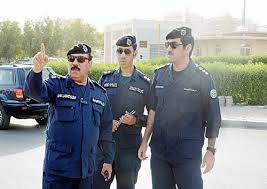
Sometimes, when you are reading a newspaper looking for content, the most significant articles can be little small ones:
Major Al-Ali vows to redraw traffic map
KUWAIT: “I have orders from higher authorities to organize the traffic and the law will be implemented strictly, Assistant Interior Ministry Under Secretary for Traffic Affairs Major General Abdelfattah Al-Ali said. “I will change the traffic map within six months and wipe out the word wasta from the traffic dictionary ,” he added. “I have strict orders from higher authorities to organize traffic and the law will be implemented very strictly,” Major Ali said.
The Kuwait Times got his title wrong; it is Major GENERAL, not Major, LOL, that’s a big difference. It appears he has the clout – and the backing – to make a brave and steadfast stand:
“WIPE OUT THE WORD WASTA FROM THE TRAFFIC DICTIONARY”
I can hardly believe my eyes. This is going to be very painful for young Kuwait men, who have learned – from prior experience – that the rules do not apply to them. IF Major General Abdulfattah Al-Ali can maintain his strong position, there may be more young Kuwait men who live to be grown-up men, there may be fewer heart-wrenching funerals, far fewer trips to the emergency room (did you know that some of the best head-trauma physicians in the world are in the ER’s in Qatar, Kuwait, and the UAE? There’s a reason for that.) The days of seeing babies on their daddy’s laps in traffic may be over. People may actually start wearing seatbelts!
Wooo HOOO on You, Major General Abdulfattah Al-Ali. You are a brave and courageous man, with a vision for a safer future for Kuwait.
11,800 Deported: Kuwait Deportations Continue “Without an End Date”
I still have a large contingent of loyal readers from Kuwait, but by early this morning, I could see something was up:
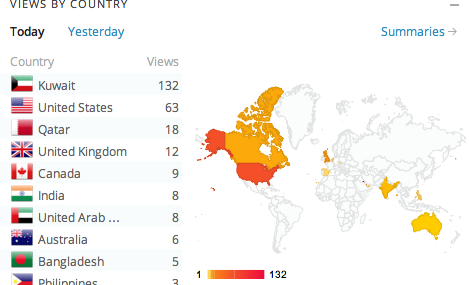
It’s not often that I have 132 Kuwait hits before noon.
So I checked the Kuwait Times:
Expat deportations will continue: Traffic chief – 11,800 deported in two-and-a-half months
KUWAIT: Major General Abdulfattah Al-Ali’s name has become synonymous with extensive traffic campaigns, aimed at enforcing the law at all costs, including implementation of mass deportations. The senior Interior Ministry official, who takes pride in deporting 11,800 people and impounding 3,000 vehicles during his tenure as head of the Ahmadi Security Department over the past two and a half years, told a local daily that deporting expatriates for serious violations will continue without an end date. “Administrative deportation of violating expatriates is not going to stop, especially of those carrying passengers illegally, in which case a person would be in violation of traffic and labor regulations,” Maj Gen Al-Ali, the Interior Ministry’s Assistant Undersecretary for Traffic Affairs, told Al-Rai on Friday.
He added that any ticket can be disputed “by a request to refer the case for traffic department investigations”. In the series of crackdowns that started late April, at least 2,000 traffic violations were registered, including 1,000 tickets issued directly on the street, while thousands of people were reportedly deported. Moreover, Maj Gen Al-Ali revealed that the ministry collected KD4 million, out of the KD24 million owed in traffic fines, during the same period. In that regard, the senior official pointed out that only KD8 million worth of fines are registered against individuals, while the rest are against companies and state departments. Out of the KD8 million, KD6 million is registered against expatriates, Maj Gen Al-Ali said. “Cases are soon to be filed with the traffic court in order to issue travel ban orders against people with more than KD80 in fines owed to the ministry,” he added.
Al-Rai published Maj Gen Al-Ali’s statement yesterday, along with a transcript of an interview with Al- Watan TV during which he defended the ongoing campaigns. “Our procedures are necessary to save lives, with average statistics indicating that 450 people are killed and 3,000 are injured annually due to traffic accidents,” he explained. During the interview, Maj Gen Al-Ali insisted that all drivers are equal when it comes to implementation of the law. “There have been doctors among the people deported, including a surgeon caught driving without a license for three years,” he said, before confirming news reports that he had taken a decision to impound a vehicle owned by Minister of Cabinet Affairs Sheikh Mohammad Al-Abdullah Al-Sabah on grounds of repeated violations committed by his personal driver. Meanwhile, the senior official urged any person who had obtained a license through illegal means to dispose of it “because once caught, they are going to be charged with forgery”. —Al-Rai, Al-Watan
League of Women Voters
My friends and I had an animated conversation about Florida politics as we sat around the table having a late breakfast at Adonna’s Bakery, down on Palafox in Pensacola. We were explaining how in the last election, if it were not for the voters handbook the League of Women Voters published, explaining exactly what a yes or no vote would mean for each proposed amendment, Florida would be stuck with constitutional amendments voters never intended to approve.

The League of Women Voters cuts through all the baloney and explains the issues, clearly and objectively. Without their clear, cool voice of reason, voters would be blown to and fro by the turbulent election rhetoric which blows at hurricane force during each election in Florida, obscuring the clearest issues. The League is neither liberal nor conservative, but contains members of all parties. Their goal is getting people to vote, and to understand the issue on which people are voting.
So grown up. So mature. So wise and clear sighted. Way too grown up for me, all these years, until, after that conversation, one of these friends sent me an invitation she had received for an upcoming League of Women Voters annual luncheon. As an added attraction, a local NPR reporter would be the speaker.

I hate meetings. It brings out the ADD child in me; I fidget, I wish I were anywhere but in the meeting.
And yet . . . this is a group I have long admired, and I want to support them. So I agreed, and we attended.
It was so much fun. These women – and men, about a fifth of the attendees were men – are people focused on ISSUES. They have study groups for how juveniles in the local area are arrested and treated in our jails and custodial facilities. They have groups which study the impact on the environment of legislative and local government decisions. They go to civic meetings, speak out, and report back to the League. This is a group of people who take positions and recommend actions! Exciting stuff.
You know I am a believer, so I might see things differently from you, or others, but I met some really cool members, people I believe I was meant to meet. One said wonderful things about my son as he practices his profession. There is no Mother’s Day gift on earth that means as much as the words she spoke, praising his ethics and integrity.
An elderly man sitting next to me was leaving this week to go to Heidelberg.
“Are you going for the closing down?” I asked, and told him I had graduated from Heidelberg American high school, lo, these many years ago. “Yes,” he replied, he has family who have lived there many years, and he has been back many times. It led to a discussion around the table, where I discovered two other women who had been in DoDs schools in Germany. What an unexpected blessing!
Every now and then, as you lead your life, you get the feeling you are exactly where you are meant to be at this very moment, and I had that feeling as I left the meeting. I am so thankful for the serendipity that led me there, and for the rush of blessings the meeting provided.
LOL, the group I thought might be stuffy and staid played this wonderful Lady Gaga video:
The Church Remembers Bede the Venerable
I found this while reading the daily meditation at Forward Day by Day:
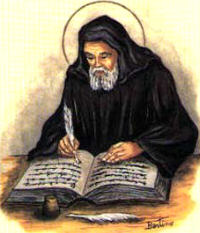
Today the church remembers Bede, the Venerable, Priest, and Monk of Jarrow, 735.
When the monks of Jarrow sang, “Lord, leave us not as orphans,” it is said that Bede would often weep. As a child he was left orphaned in a dark, hostile, and dangerous land. He was cared for and reared by kindly monks. When he was but a youngster, plague struck the monastery, almost wiping it out. The only surviving souls were Bede and the old abbot. Bede naturally had a strong sense of the importance of community, of the fine line between life and death, and of our utter dependence upon the Creator.
He rarely ventured outside the walls of Jarrow monastery, yet his knowledge of theology, geography, and language was worthy of the most sophisticated of his time in Western Europe. He wrote a number of excellent books on various subjects, but he is best remembered for his Ecclesiastical History of the English People. This work has justly earned for him the title “Father of English History.” Unlike some of the careless historians of his day, he was meticulous in listing his authorities and sources. He took care to separate known fact from hearsay, but his descriptions are lively and dramatic.
Bede thought of himself as a teacher, and he seems to have built most of his teaching around the Divine Offices which the monks read daily. It is altogether fitting that he was pronounced a “Doctor of the Church” by Pope Leo XIII. Bede’s remains rest in Durham.
May the riches of Bede’s scholarship inspire us to fill our minds with the story of your work among us, O God. Amen.
Heavenly Father, you called your servant Bede, while still a child, to devote his life to your service in the disciplines of religion and scholarship; Grant that as he labored in the Spirit to bring riches of your truth to his generation, so we, in our various vocations, may strive to make you known in all the world; through Jesus Christ our Lord, who lives and reigns with you and the Holy Spirit, one God, for ever and ever. Amen.
Recent Comments
intlxpatr on Shampoo Ginger tigerbutterya0c5ff1d… on Shampoo Ginger intlxpatr on British Soldier Kidnapped, Esc… John on British Soldier Kidnapped, Esc… intlxpatr on British Soldier Kidnapped, Esc… Wikipedia Donate Button

Amazina


Early Voting in Florida


 Here There and Everywhere