Qatar’s ‘Manly Women’
Thank you, Little Diamond, who sent this article from The Economist as an update to blog entry on cross dressing based on a tiny article in the Gulf Times
CROSS-DRESSING is on the rise among young Qataris. The local press says that more tradition-minded locals are upset by the growing number of young women affecting a masculine style of dress, baggy trousers, short hair and deep voices. These women, who call themselves boyat, which translates as both tomboy and transsexual (and is derived from the English word boy), are being seen in schools and on university campuses where some are said to harass their straiter-laced sisters.
In an episode of a talk show on Qatari television, called Lakom al Karar (The Decision is Yours), a leading academic said that the “manly women” phenomenon was part of a “foreign trend” brought into Qatar and the Gulf by globalisation. Foreign teachers, the internet and satellite television have been blamed. So have foreign housemaids, for badly influencing children in their care.
The studio audience was divided over how to respond. Some called for the death penalty for cross-dressers, while others favoured medical treatment. A rehabilitation centre for Qatari boyat has been set up, but a local report says that as many as 70% of them refuse to give up their “abnormal behaviour”.
It is not just Qataris who are rattled. A year ago the ministry of social affairs in the United Arab Emirates (UAE) launched a campaign against “masculine women”. The project, entitled “Excuse me, I’m a girl”, involved workshops, lectures and television programmes, stressing the virtues of femininity and raising awareness of the presumed dangers of women looking like men. An emirates’ foundation is helping to fund a research project on “gender identity disorder among Emirati youth”.
One official describes the “deviant behaviour” of the boyat as a “menace” to society. But others sound less fazed. An American university lecturer in the region says the short hair and gym shoes worn by these young women would look perfectly normal on an American campus. That is just what unnerves the traditionalists.
Why do you think these girls dress and act like men? Why would a girl do that?
I think girls do that – in any country – for a reason. If privileges and freedoms are heavily weighted in favor of males, perhaps there is no great mystery as to why some females would prefer to be males. It makes sense to me. Girls aren’t stupid. They can see who is getting all the goodies. My guess it is less a gender issue than a values issue.
On the other hand, when – and if – things are more equal, there is less motivation to be other than what we were created to be.
I had some young local friends who told me that they were taking Tai Kwan Do, but quit when a neighbor told their mother that it might threaten their virginity. It broke my heart. The martial arts give grace and confidence to young women. There are a lot of ways a hymen can be broken; I have never heard of it happening while training in Tai Kwan Do. These young, vibrant girls have fewer and fewer activities that they are encouraged to do, and end up staying home or strolling endlessly at the local malls. Aaarrgh!
Dads – teach your daughters to hunt! Teach them to fish! Teach them to swim, to throw a softball, to kick a football. Take them camping in the desert, and let them run freely. Teach them chess, and how to win. Give them the gift of physical and intellectual activity, give them the understanding that sports, employment and power are equally accessible for all sexes, and you won’t be having problems with girls who yearn for the freedoms and privileges of being male.
Qattari Cat Goes Wild

It was like the ninth circle in Hell. We had been told this was the best clinic in town, so when we thought the Qatteri Cat was having a problem, we made an appointment, and braved the Doha drive-time traffic to get there, only to discover that there were like 25 people milling around the waiting room, most holding animals loose in their arms, and a feeling of desperation in the air.
The customer service was shocking. I watched one man, big guy, football-player type, sway and his knees nearly buckle as the curt woman behind the desk said in her loud voice “Oh! Your cat didn’t make it! Your’s was the little grey cat, right?” He was devastated. I was horrified that the news could be delivered so callously, and so loudly.
Many of the people without appointments had kittens bought at the Souq al Waqif. You know I love the Souk al Waqif, but if you buy an animal there, you are buying an animal who already has strikes against it, and people who breed them just for sale, with no regard for ethical treatment of another living creature. You are buying trouble, and big veterinarian bills. It’s gotten so bad for me, I can’t even walk through the bird/animal area anymore. I can’t bear to see the way the animals are treated.
We got to see the vet over an hour later. He was nice, very professional, very knowledgeable, and I cannot imagine what it is like having to run a veterinary service under these hellish conditions.
One of his handlers walked in, looked at me coldly and said “Is this your cat?” I said yes, and she continued on “this is the worst cat I have ever handled. He is EVIL! He is VICIOUS! He is the cat from hell. Is he like this at home?”
Imagine saying something like that to a customer!
I felt like I had been punched in the stomach. The Qatteri Cat had a rough beginning in life. I met his first owners, and the women in the family didn’t like him. When he came to live with us, he loved – and trusted – AdventureMan from the beginning, but it took me a long while to win his trust. He was skinny and always watching my feet and hands; he would flinch if I moved too quickly. He had been mistreated.
He has bitten me twice, in his seven years living with us, both times when other cats were around and he was scared. When he is scared, or when he is in pain, all his natural instincts kick in. I give him a short time-out in a confined environment (the bathroom!), and everything is fine. He’s a cat. No, he is not vicious at home. He is a SWEET cat!
He has never misbehaved at a vet clinic, never. At the clinic in Kuwait, he couldn’t wait to get out of the cage; the female Italian vet told him what a handsome big boy he was and he was putty in her hands. I have to admit it, I felt a twinge of jealousy. He had eyes only for her!
The Qattari Cat is a cat who wants to co-operate. It doesn’t matter how good the vet is, if the staff is unprofessional, discourteous to the point of rudeness, and ignorant about handling animals, we won’t go back. We won’t risk him being handled cruelly. I cannot imagine why they keep this woman on their staff.
But I couldn’t resist taking a flash photo of QC to illustrate this post, with demonic, gleaming eyes, LLOOOLLLL!
The Law of the Harvest
A small group was huddled, talking about volunteer work, and how people are afraid to commit, when the duties are actually very light, and easily accomplished, then we drifted into giving generously . . .
“It’s called The Law of the Harvest” one of my favorite women popped in as I was trying to explain that when you give, open-handedly, give with your heart, it all comes back to you multiplied.
We all turned to her. “Remember the seeds? You sow the seeds and then it is multiplied?”
Of course! It’s so simple! Why didn’t I think of that?
Handbook for 2010
Thank you, Dear Friend, who sent this to me this morning 🙂
HANDBOOK 2010
Health:
1. Drink plenty of water.
2.. Eat breakfast like a king, lunch like a prince and dinner like a beggar.
3. Eat more foods that grow on trees and plants and eat less food that is manufactured in plants….
4. Live with the 3 E’s — Energy, Enthusiasm and Empathy.
5. Make time to pray.
6. Play more games.
7. Read more books than you did in 2009.
8. Sit in silence for at least 10 minutes each day.
9. Sleep for 7 hours.
10. Take a 10-30 minute walk daily. And while you walk, smile.
Personality:
11. Don’t compare your life to others. You have no idea what their journey is all about.
12 Don’t have negative thoughts or things you cannot control. Instead invest your energy in the positive present moment.
13. Don’t over do. Keep your limits.
14. Don’t take yourself so seriously. No one else does.
15. Don’t waste your precious energy on gossip.
16. Dream more while you are awake..
17. Envy is a waste of time. You already have all you need.
18. Forget issues of the past. Don’t remind your partner with his/her mistakes of the past. That will ruin your present happiness.
19. Life is too short to waste time hating anyone. Don’t hate others.
20. Make peace with your past so it won’t spoil the present.
21. No one is in charge of your happiness except you.
22. Realize that life is a school and you are here to learn. Problems are simply part of the curriculum that appear and fade away like algebra class but the lessons you learn will last a lifetime.
23. Smile and laugh more.
24. You don’t have to win every argument. Agree to disagree.
Society:
25. Call your family often.
26. Each day give something good to others.
27. Forgive everyone for everything.
28. Spend time w/ people over the age of 70 & under the age of 6.
29. Try to make at least three people smile each day.
30. What other people think of you is none of your business.
31. Your job won’t take care of you when you are sick. Your friends will. Stay in touch.
Life:
32.. Do the right thing!
33. Get rid of anything that isn’t useful, beautiful or joyful.
34. God heals everything.
35. However good or bad a situation is, it will change..
36. No matter how you feel, get up, dress up and show up..
37. The best is yet to come.
38. When you awake alive in the morning, be thankful for it.
39. Your Inner most is always happy. So, be happy..
Last but not the least:
40. Please Forward this to everyone you care about, I just did..
3 Months for Killing, One Year for Stealing
These articles are in today’s Gulf Times, under Court Roundup.
Jail term, fine for death crash
A local motorist has been sentenced to three-month’s imprisonment for reckless driving that led to the death of a 56-year-Pakistani pedestrian.
The Doha court of first instance imposed on the 26-year-old motorist a fine of QR20,000.
The fatal accident took place in the Old Airport area on September 27, 2008. According to the traffic report, “the accident occurred because the motorist was speeding.”
A traffic official told the court that the motorist was driving at 80kmph on a busy street.
Family members of the deceased can claim blood money in a civil court.
Man sentenced for stealing
A Sri Lankan driver has been sentenced to a year-imprisonment for stealing items including two gas cylinders and a vacuum cleaner from the labour camp of a private company. Four of the co-accused were sentenced in absentia to five years in jail.
The theft took place on July 21, 2008 in New Rayan area, the charge-sheet said.
Two Egyptians, who witnessed the incident, testified that they saw five men loading the items, estimated to cost QR4,000, on to a pickup from a store inside the camp.
The Egyptians said they captured three of the workers while the others drove away in the pick-up.
The police arrested all the accused and four of them were deported on an administrative order before the commencement of the trial.
Heart of Doha Creates Beauty out of Destruction
‘Heart of Doha’ construction work to begin
Web posted at: 1/11/2010 1:47:59
Source ::: The Peninsula / By Huda NV

DOHA: Dohaland, a subsidiary of Qatar Foundation, is all set to begin the construction work of its signature project “Heart of Doha”. Under the patronage of
H H Sheikha Mozah bint Nasser Al Missned, Chairman of the Qatar Foundation, the foundation stone will be laid at a special event on Wednesday at a specially build venue at the Corniche.
“Heart of Doha has all together brought in a new language of architecture by understanding the essence of the place which led to rediscovering its poetry,” said Jawaher Al Khuzaei, Assistant Manager, Public Affairs.
“We have finished the preparation stage of the first phase of the project which is expected to be completed by February 2012. Embodied in traditional Qatari architecture are the timeless aspects of beautiful proportions, robustness, simplicity, ornament, along with tried-and-tested local responses to the hot climate and intense daylight. Local traditions have been studied and analysed to distil the essence of Qatari architectural character rooted in the past, appropriate for the present and looking to the future.”
The first stage – Phase 1A has Diwan Emiri Quarter which includes Emiri Diwan annexe, Emiri Guard head quarters and the National Archives. It also has a heritage quarter which includes the Eid prayer ground and four heritage houses – a Company House, Jalmoot House and Houses of Mohammed bin Jasim and Abdullah bin Jassim. Dohaland is working with Qatar Museum Authority to make the best use of the houses.
The first phase infrastructure includes central cooling plant, utilities and waste provision, basement service roads and parking. In the second stage, which will is expected to begin this year and conclude in 2013 a multimedia centre for arts, central hotel and serviced apartments, luxury shopping street, exclusive town house, a primary school, the Ferjan Square mosque and see the first satge of rebirth of Al Kahraba street. The later stages will include a connection to souq wakif, a retail mall, more hotels, offices apartment, shops, a tram system and an underground Metro station hub apart from to Nakeel Square.
“We have also done archiving of photographs of the area prior to demolition. The area will be for mixed use and will have house more than 25,000 people.”
The project with an estimated cost of QR 20 bn, and an area of 35 hectares is expected to be completed in 2016 in five phases. Heart of Doha will become a hub of activity as a place to live, work, shop, visit and spend time with family and friends once completed
THE PENINSULA
Update: Dohaland has been renamed Musherib.
Community Police Graduate
Community policing is necessary when we neglect to police ourselves. . . if, for example, we find ourselves throwing a tissue out of our car window as we drive along, littering the pristine streets of Doha. If we bully someone because we want that parking spot he is driving into, if we disrupt the peace and quality of life of others by our behavior.
I notice, in this story from the Gulf Times, that women are a part of this program, and that they are wearing uniforms, and hijab, and that those uniforms are very modest and also that they are wearing pants. Please see the previous article.
I commend Qatar for this visionary program, helping the community police itself, and for including women from the very first class.
46 take part in community policing basic course
Graduates with officials at the convocation ceremony
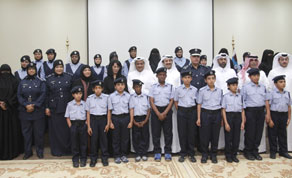
The Police Training Institute (PTI) recently held a ceremony to mark the graduation of participants in the first batch of the Community Policing Basic Course, under the auspices of Minister of State for Interior Affairs HE Sheikh Abdullah bin Nasser bin Khalifa al-Thani.
Some 46 students from various security departments took part in the course, which lasted seven weeks, said a spokesperson.
The ceremony was attended by the chairman on the Central Municipal Council, HE Nasser al-Kaabi; director of the PTI, Brigadier Mohamed Hassan Youssef al-Saei as well as other ministry officials.
Brigadier al-Saei explained that the course has been conducted to “enhance the role and mechanisms of community policing,” as well as helping to create partnerships with various social institutions to help with national security.
The PTI director added that the graduates of this course will be able to translate the Ministry of Interior’s aims and strategies to encourage understanding between various communities and to help the police to be able to prevent crimes before they are committed.
Brigadier Rashid Shaheen al-Atheeque, chairman of the steering committee of community policing, said: “The graduation of the first course of community policing is one of the stages of qualifying the national cadres at the Ministry of Interior to work in the national project.”
“Qatar is currently witnessing progress in all aspects of development in economic and social fields – this increases the role of all sectors in the country to face all kinds of challenges brought with this development,” he said, adding: “These factors require the improvement of capabilities to keep pace with development.”
Brigadier al-Atheeq explained that the ministry had pursued the initiative of community policing to help reduce crime throughout all institutions, and said that they had pursued the objective with the co-operation of the Supreme Council for Family Affairs as well as other ministries and companies, working towards the National Vision 2030.
He explained that the concept will initially be employed in the North Security Department from April 2010, with plans to apply it across the board from 2011.
Representing the director of the Ummul Qura Independent School for Boys, teacher Areezah al-Yami described the noticeable benefits of introducing the community policing programme in the school over the past year.
Stieg Larsson and The Girl With the Dragon Tattoo
I needed some escape time, so I started The Girl With the Dragon Tattoo, a mystery by Stieg Larsson, set in Sweden. I love these detective stories set in other countries; I can learn something as I pass the time reading an exciting mystery. And part of my heritage is Swedish, so I thought this should really be fun.

It wasn’t, at least not at the beginning. At the beginning, I didn’t like any of the characters, and they were always eating sandwiches that sounded awful, like liverwurst and egg. I felt like the characters didn’t have any moral center, like they drifted from day to day without neither conscience nor a plan. The main character, Mikael Blomkvist, is about to go to prison for libel; he printed a story about a major industrialist which turned out to be false, and he protected his source. We don’t really know the whole story, not until the end, which makes it hard to evoke a lot of sympathy for Blomkvist.
He is contacted by another industrialist, and asked to solve a mystery, if possible, about the disappearance, 40 years ago, of his niece, Harriet Vanger. Blomkvist would investigate under the cover of writing an autobiography of his employer and his family. There are members of the family who object. In many ways, it isn’t a very nice family.
Blomkvist gets an assistant, a deeply troubled and flawed young woman, Lisbeth Salander, with a gift for investigation. There is a lot of violence, sexual violence, and mutilation of animals. One of the points I credit Larsson with making is the amount of violence against women in Sweden, which goes on under a seemingly civilized veneer. The truth, as I see it, is that there is violence against women in every society; in some it is better documented than in others. In some, it is better punished that others. It exists in all societies, in all countries.
Another think I ended up liking about the book was that the main character, Blomkvist, who writes financial analysis, takes the press to task for printing what passes for financial news without critically reading and evaluating, which he feels is a responsibility of the press. At one point, as people quail with fear that the stock exchange will drop dramatically, he is interviewed and explains that the stock market is based on perceptions, while the Swedish economy is based on production and services; that while the markets may fail, the economy can still be going strong.
Slowly, the book tightens up. Actually, by the end, I was hooked. The only question in my mind is – did I like it enough to read another?
The book is available, new, from Amazon.com at $6.00 plus shipping.
Recent Comments
intlxpatr on Shampoo Ginger tigerbutterya0c5ff1d… on Shampoo Ginger intlxpatr on British Soldier Kidnapped, Esc… John on British Soldier Kidnapped, Esc… intlxpatr on British Soldier Kidnapped, Esc… Wikipedia Donate Button

Amazina


Early Voting in Florida


 Here There and Everywhere