Indian Drivers the Worst
When it came time to get a driver’s license, it wasn’t important to me. I was living in a place with great public transportation. When I finally decided to learn to drive, I took driving lessons. My best friend, still my friend to this very day, would take me out driving. One time my car stalled in the middle of a crowded intersection, the light changed, and I was almost out of my mind with panic.
My friend calmly said “You’re doing just fine. Take a breath. You have time. Start the car, and complete the turn.” She didn’t sound worried at all – only later did I discover how terrified she was. She held it together. I will owe her to the end of my life for her loyalty to me and for her patience with me.
This is from the Arab Times. My mistake – I thought Kuwait was the deadliest spot on earth to drive. Not so – the Indians take that cake:
Good luck needed as Indians drive themselves to death
MUMBAI, Oct 23, 2008 (AFP) – The Good Luck Motor Training School in Mumbai is aptly named, according to its owner, Sohail ‘Raja’ Kappadia, who says luck is exactly what you need to drive on India’s roads.
Kappadia knows it only too well: a friend recently became another of the country’s shocking fatal road accident statistics, while one of his pupils has just rammed into the back of another car during a lesson.
‘Sometimes you just don’t know if the guy in front is going to brake,’ he told AFP with a shrug. ‘Presence of mind is a must here. Most of the accidents in Mumbai are due to rash negligence.’
India has the dubious distinction of being the deadliest place in the world to drive.
The country has 10 percent of the estimated 1.2 million road deaths worldwide, according to the International Road Federation in Geneva.
Mortality rates on Indian roads are 14 per 10,000 vehicles, compared to less than two per 10,000 in developed countries, the World Bank has said.
And by the end of the next decade, the organisation predicted that road deaths will overtake those from deadly diseases and most of the fatalities will be pedestrians.
It is not difficult to see why.
Drivers here run the gauntlet of speeding taxis, weaving auto-rickshaws, trucks and buses as well as hand-carts and cows on congested, pot-holed roads, some of which have remained largely unchanged since the end of the colonial era more than 60 years ago.
At the same time they have to be on their guard against stray dogs and jaywalking pedestrians, forced into the road by the clutter of street vendors, crumbling pavements or crossings.
Meanwhile laws governing the wearing of seatbelts and a ban on using mobile phones at the wheel are frequently flouted, indicators are seldom used and at night drivers often fail to switch on their headlights.
Motorcyclists riding without helmets with pillion passengers perched behind are a common sight.
For a learner driver, Shahik Arqam looks unfazed by such experiences.
‘It’s a little bit difficult but I know how other drivers work,’ the 24-year-old architect said.
During an hour-long lesson in a battered right-hand drive Hyundai Santro, Arqam has had to be alert.
Other drivers made no allowance for the red L-plates and warning triangle displayed prominently on the car.
Instead he was treated like any other road user and blasted by a chorus of car horns for driving too slowly, failing to pull away quickly enough from traffic lights or for stalling.
Filtering vehicles from the left failed to give way as he headed down the main road to Churchgate railway station, and he had to hold his nerve as cars swerved in and out of lanes in the tussle for pole position.
Mohsin Ali, an instructor for 12 years, takes Mumbai’s chaotic roads in his stride, gently issuing either verbal instructions or hand signals to his pupil as the car picked its way through the heavy mid-afternoon traffic.
‘If you follow the traffic rules then it’s very easy,’ the 39-year-old said afterwards. ‘Compared to Calcutta (Kolkata) and Madras (Chennai) the traffic is better here.’
To be sure, the Mumbai authorities have been trying to make the roads safer.
Roadsigns reminding drivers to belt up, only use the horn when necessary — rather than in constant cacophony, as encouraged by the ‘horn please’ request painted on the rear of many vehicles — and not use their mobile phones have appeared across the city.
Signs also remind motorcyclists to wear helmets and there has been a crackdown on drink-driving.
Some 632 people died in what the Indian media calls road traffic ‘mishaps’ in Mumbai in 2007, but by the end of August that had fallen to 377, according to police figures.
Kappadia agrees that better driver training is a must if safety is to be improved on India’s roads, particularly as private car ownership increases on the back of the country’s strong economic growth.
The 33-year-old said he would ban heavy goods vehicles from cities during the day, toughen sentences for drink-drivers, improve road infrastructure and spread the message that speed kills, especially among the young.
Some welcome measures have been taken, such as raising entry standards and lowering age limits for truck drivers, but more needs to be done, he said.
In the meantime, the Indian driving mantra of ‘good brakes, good horn, good luck’ will have to do.
Peter Bowen and Nails
Three men trundle a naked woman through the desert to a remote place, where she was placed in a container, 6 x 6 x 6 with only a candle, a cot, water and a holy book, until she could come to her senses and behave.
Four girls were strangled, one each day, for refusing the sexual advances of their father and his brother. The two youngest girls, their older sisters dead, complied.
Women with inconvenient views, women who start having thoughts of their own disappear. Many in this tribe are home-birthed and home-schooled, so there aren’t records of their existence, and when they disappear, no-one is the wiser.
Saudi Arabia, you ask? Pakistan? Afghanistan? Where on earth are women treated this vilely?

Peter Bowen, in Nails, gives vent to his frustration of minor fundamentalist Christian cults roaming the American West, many of them ending up in Montana where they believe they will have the privacy to practice their beliefs without interference, and where those who are well-funded can influence poverty-stricken school districts to toss out Science classes and incorporate Intelligent Design. Bowen has utter contempt for their studied ignorance, their need to be the sole authority on what the scriptures say, and their insistence on the utter submission of women.
His worst scorn is for their treatment of women – he attributes it to their fears about their own sexuality. Women are often the victims, Bowen states, when men worry about their size, worry about how to keep women faithful, tractable, and docile. (And let’s face it, who can successfully control a woman? 😉 )
This is the latest Gabriel du Pre novel, or at least the latest I have read. Gabriel du Pre is a retired brand inspector (he goes back every now and then when needed, when the brand inspector is overstretched, insuring that the cows sold are from the herds they are being sold from), Metis (French and Indian mix), a renowned fiddler, and a deputy sheriff when the sheriff – or the FBI – needs help solving a particularly tricky murder. It takes a while to get your ear used to his dialect, and he spends a lot of time in bars, but the man has a real knack for figuring things out.
Gabriel du Pre is everything a straight-living woman like myself shouldn’t like. He drinks, morning to night, keeps his flask of whisky under the driver’s seat in his car. He drives way over the speed limit. He doesn’t go to church, he goes to an ancient Indian spiritualist / medicine man when he needs guidance. He isn’t married to the wry, very smart woman with whom he lives. He breaks the rules, he goes outside the boundaries.
For all his flaws, du Pre has a deep down, rock solid core of decency, and a way of looking at life and situations that is practical and . . . forgiving. He is charitable toward his brothers and sisters. He detests cruelty, especially when the strong take advantage of the weak or the arrogant walk all over the humble. There is something about this flawed hero that keeps the reader coming back for more.
His Gabriel du Pre novels are not heavy reading. You can toss one off in about half a day, but they are not so simple as they appear. You find yourself thinking about the issues he raises, and you find yourself looking to see when the next Gabriel du Pre mystery will appear.
You can find this on Amazon.com for $16. new or from $3.07 used, plus shipping of course. (Yes, I own stock in Amazon.com.) 🙂
Hildegard of Bingen
I don’t often do this, reprint an entire article. I usually leave it to you to click on the blue type and read it for yourself. I am guessing very few people would make any effort to read this article, so for the few who have the interest, I am making it easy for you.
The article is written by James Kiefer, who writes many of the articles on saints in The Lectionary. He makes them human; his articles are so readable.
I like Hildegard of Bingen because she was a woman ahead of her time. She followed the yearnings of her soul to become a religious person, a nun, but rather than escaping from life, she engaged in it fully, as an administrator and as a musician. She engaged fully – and capably. She would probably be a remarkable woman in any age.

(This photo is from Geocities where there is another extensive article on Hildegard von Bingen and her life and times, with additonal information.)
“Listen: there was once a king sitting on his throne. Around him stood great and wonderfully beautiful columns ornamented with ivory, bearing the banners of the king with great honor. Then it pleased the king to raise a small feather from the ground, and he commanded it to fly. The feather flew, not because of anything in itself but because the air bore it along. Thus am I, a feather on the breath of God.”
Hildegard of Bingen has been called by her admirers “one of the most important figures in the history of the Middle Ages,” and “the greatest woman of her time.” Her time was the 1100’s (she was born in 1098), the century of Eleanor of Aquitaine, of Peter Abelard and Bernard of Clairvaux, of the rise of the great universities and the building of Chartres cathedral. She was the daughter of a knight, and when she was eight years old she went to the Benedictine monastery at Mount St Disibode to be educated.
The monastery was in the Celtic tradition, and housed both men and women (in separate quarters). When Hildegard was eighteen, she became a nun. Twenty years later, she was made the head of the female community at the monastery. Within the next four years, she had a series of visions, and devoted the ten years from 1140 to 1150 to writing them down, describing them (this included drawing pictures of what she had seen), and commenting on their interpretation and significance. During this period, Pope Eugenius III sent a commission to inquire into her work. The commission found her teaching orthodox and her insights authentic, and reported so to the Pope, who sent her a letter of approval. (He was probably encouraged to do so by his friend and former teacher, Bernard of Clairvaux.) She wrote back urging the Pope to work harder for reform of the Church.
The community of nuns at Mount St. Disibode was growing rapidly, and they did not have adequate room. Hildegard accordingly moved her nuns to a location near Bingen, and founded a monastery for them completely independent of the double monastery they had left. She oversaw its construction, which included such features (not routine in her day) as water pumped in through pipes. The abbot they had left opposed their departure, and the resulting tensions took a long time to heal.
Hildegard travelled throughout southern Germany and into Switzerland and as far as Paris, preaching. Her sermons deeply moved the hearers, and she was asked to provide written copies. In the last year of her life, she was briefly in trouble because she provided Christian burial for a young man who had been excommunicated. Her defense was that he had repented on his deathbed, and received the sacraments. Her convent was subjected to an interdict, but she protested eloquently, and the interdict was revoked. She died on 17 September 1179. Her surviving works include more than a hundred letters to emperors and popes, bishops, nuns, and nobility.
(Many persons of all classes wrote to her, asking for advice, and one biographer calls her “the Dear Abby of the twelfth century.”)
She wrote 72 songs including a play set to music. Musical notation had only shortly before developed to the point where her music was recorded in a way that we can read today. Accordingly, some of her work is now available on compact disk, and presumably sounds the way she intended. My former room-mate, a non-Christian and a professional musician, is an enthusiastic admirer of her work and considers her a musical genius. Certainly her compositional style is like nothing else we have from the twelfth century. The play set to music is called the Ordo Virtutum and show us a human soul who listens to the Virtues, turns aside to follow the Devil, and finally returns to the Virtues, having found that following the Devil does not make one happy.
She left us about seventy poems and nine books. Two of them are books of medical and pharmaceutical advice, dealing with the workings of the human body and the properties of various herbs. (These books are based on her observations and those of others, not on her visions.) I am told that some modern researchers are now checking her statements in the hope of finding some medicinal properties of some plant that has been overlooked till now by modern medicine.
She also wrote a commentary on the Gospels and another on the Athanasian Creed. Much of her work has recently been translated into English, part in series like Classics of Western Spirituality, and part in other collections or separately. If your university library or bookstore cannot help you, try a Christian bookstore. If they do not have it, try a trendy (feminist, New Age, ecology) bookstore.
But her major works are three books on theology: Scivias (“Know the paths!”), Liber Vitae Meritorum (on ethics), and De Operatione Dei. They deal (or at least the first and third do) with the material of her visions. The visions, as she describes them, are often enigmatic but deeply moving, and many who have studied them believe that they have learned something from the visions that is not easily put into words.
On the other hand, we have the recent best-seller, The Man Who Mistook His Wife for a Hat, by Oliver Sacks, Professor of Clinical Neurology at Albert Einstein College of Medicine, and author of Migraine and various other books. Professor Sacks is concerned with the relation of the brain to the mind, and ways in which the phsical state of the nervous system can affect our ways of perceiving reality. He views the pictures in Hildegard’s books of what she saw in her visions, and says, “The style of the pictures is a clear indication that the seer suffered regularly from migraine attacks. Migraine sufferers tend to see things in this manner.” And indeed, it is true that Hildegard suffered throughout her life from painful attacks of what may have been migraine. Professor Sacks hastens to add that this has nothing to do with whether her visions are authentic insights into the nature of God and His relation to the Universe.
Hildegard has undergone a remarkable rise in popularity in the last thirty years, since many readers have found in her visions, or read into them, themes that seem to speak to many modern concerns.
For example:
Although she would have rejected much of the rhetoric of women’s liberation, she never hesitated to say what she thought needed to be said, or to do what she thought needed to be done, simply because she was a woman. When Pope or Emperor needed a rebuke, she rebuked them.
Her writings bring science, art, and religion together. She is deeply involved in all three, and looks to each for insights that will enrich her understanding of the others.
Her use of parable and metaphor, of symbols, visual imagery, and non-verbal means to communicate makes her work reach out to many who are totally deaf to more standard approaches.
In particular, non-Western peoples are often accustomed to expressing their views of the world in visionary language, and find that Hildegard’s use of similar language to express a Christian view of reality produces instant rapport, if not necessarily instant agreement.
Hildegard wrote and spoke extensively about social justice, about freeing the downtrodden, about the duty of seeing to it that every human being, made in the image of God, has the opportunity to develop and use the talents that God has given him, and to realize his God-given potential. This strikes a chord today.
Hildegard wrote explicitly about the natural world as God’s creation, charged through and through with His beauty and His energy; entrusted to our care, to be used by us for our benefit, but not to be mangled or destroyed.
You can listen to some of her extraordinary and ethereal music of worship by clicking on the YouTube video below:
Moroccan Blogger Jailed
You can read the entire story, which appeared today, on BBC News Africa:

A Moroccan blogger has been jailed for two years for showing disrespect to the monarchy, say the man’s family.
Mohammed Erraji, 29, was convicted after writing an article claiming King Mohammed VI’s charitable habits were encouraging a culture of dependency.
There has been no official comment on the case, but rights groups claim Erraji did not have a fair trial.
A BBC reporter says criticising the king is an offence in Morocco and the royal family remains a taboo subject.
Morocco has previously caused international outrage with its treatment of internet users.
Earlier this year, Fouad Mortada was sentenced to three years in prison for creating a false profile on the internet site Facebook using the identity of the king’s brother.
He received a royal pardon following protests from internet users around the world.
‘Disastrous’
Erraji claimed in an internet article that the king’s charity towards Moroccans was stifling development by encouraging people to be lazy.
“This has made the Moroccans a people without dignity, who live by donations and gifts,” he wrote.
The BBC’s James Copnall in the capital, Rabat, says he was particularly critical of the practice known as grima – giving lucrative licences to run taxis and other transport in exchange for begging letters.
Erraji said this did not happen in developed countries, where hard work rather than begging is rewarded.
He was arrested by the authorities last Friday and accused of “lacking the respect due to the king”.
In court on Monday, he was given a two-year prison sentence and fined 5,000 Dirham ($630:£356).
Damages, Glen Close and Paradise Road
AdventureMan and I could hardly wait to get home – we started Glen Close’s Damages, a critically acclaimed, award winning legal drama that hit the screen in 2007, but only recently came out in DVD form. As I am always on the watch for series that will grip us – and give us hours of speculation and conversation over dinner – I snapped this one up en route back to Kuwait, knowing with Ramadan here, we would have quiet hours we could spend watching.
Holy. Smokes. Damages is gripping. Damages is amazing. Damages has you sitting on the edge of your chair, and panting for more!
You have to get used to the cinematic style – we start in the present and throughout the entire 13 episodes, we go back into the past – from years ago to months ago to weeks ago, as we get closer to the end – days ago – to follow the career of new lawyer Ellen Parsons, as she goes to work for the top-of-the-heap firm Hewes and Associates. Hewes, played by Glen Close, is simply breathtaking.

Hewes and Associates are in the process of going after Arthur Frobisher, an egomaniacal developer who, similar to other big rich crooks in the US, took his funds out of his company when he had inside information it was about to tank, leaving his 500 employees unemployed, pension fund bankrupt and without the financial security they had invested in for so long. We know there is more going on here, and from week to week, we learn a little more of the puzzle. The puzzle is intricate and complex, and with each episode – man, the hook is set. We are addicted.
We hurried through the last three episodes to share it with some good friends who appreciate the same kinds of shows we do. We look forward to sharing it with our son, who shared Deadwood with us – it’s that good. It’s Deadwood level.
Glen close plays Patty Hewes as a driven, hard working woman, feared, admired and hated in a field which allows little room for mistakes. Part of what keeps you coming back is the revealing of all the different layers of her personality – the vulnerable mother, the trophy wife, the tough-minded head of her firm, the manipulator of all around her. Her motto (reminiscent of the old X-files) is Trust No One. We certainly have questions about how far we can trust her.
Did she try to have her protegee murdered?
We can hardly wait for Season 2.
UPDATE: 22 Sep 08 Last night Glen Close won Best Actress in a Drama (Emmy Awards) for her role as Patty Hewes.
Did you ever see Glen Close in Fatal Attraction? Did you see her as the police chief in The Shield? She is the most amazing actress, such subtlety in her expression, such vulnerability, such toughness.
My very favorite movie with her in it is Paradise Road.
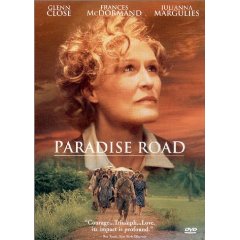
It has to do with a boatload of women and children, and how they survive in a Japanese prison camp during World War II. I don’t buy a lot of movies, but I bought this one – it’s that good. You can watch it once a year and feel equally inspired every time you watch it.
This is from Wikipedia and is a summary of the movie Paradise Road:
Singapore falls to the Japanese in 1942 and the women and children are put on boats to be shipped to safety. Japanese fighters, however, sink one boat and those on board must swim for their lives. Landing on the Japanese controlled island of Sumatra, the women, including Adrienne Pargiter (Glenn Close), a British graduate of the Royal Academy of Music, Susan Macarthy (Cate Blanchett), an Australian nursing student, Topsy Merrit (Julianna Margulies), a pessimistic American, and “Margaret” Drummond (Pauline Collins), a sweet missionary, are captured and imprisoned in a Japanese POW camp. Suffering from cruel and inhumane treatment, tropical diseases and the uncertainty of their future, the women band together for moral support. Others, including Dr. Verstak (Frances McDormand) and Sister Wilhelminia (Johanna Ter Steege) do what they can to tend to the physical and spiritual needs of the group. As the years pass, the women, led by Adrienne, form a “vocal orchestra” that not only softens the guards’ demeanor, but also lifts the women’s spirits as it provides a purpose in their lives.[1]
Paradise Road announces itself in large print to be “based on a true story”. The film is said to be centred on a group of women who are on a ship fleeing Singapore. Having survived the bombing and sinking of the ship they think that “the worst is over”, but they find that the tough times are in the prison camp, and that is when they face their harshest test of survival. However, when introducing viewers to setting and characters, and getting the characters into a prison camp, Paradise Road makes an obvious change from true incidents.
Sharks and Underwear
Two things happened yesterday that caught my attention – and I wonder if everyone knows about these things except for me, or if others are also caught by surprise.
First, on the way to go shopping, my good friend told me that shark is no longer available in the fish souks. We don’t eat a lot of shark, but we often buy it to fill in a good bouillabaisse (if you are superstitious and believe there must be seven different fish in your bouillabaisse) or to cook up to feed the feral cats in the neighborhood. Even the heads make a big hit with the local cats. 🙂
“No, a recent religious decision says that shark is ‘haram’, ” she said, as I gaped in disbelief. “Their skin has no scales.”
“But the Kuwaitis eat shrimp!” I responded, “and shrimp are also haram according to some Muslims. Who is going to tell Kuwaitis not to eat shrimp?”
“I don’t make the rules,” she responded. “I am just letting you know. The fishman said that because sharks have no scales and something about the male sexual organ, I don’t know, but now they can’t sell shark anymore.”
She paused, thoughtfully.
“What will the poor people do?” she asked. “Most of the people who buy shark can’t afford anything better.”
Later, our marketing accomplished, our goods safely in cupboards and refrigerators, I read the news. This is from yesterday’s Kuwait Times:
Shops Banned from Displaying Lingerie
Kuwait: The Minister of Commerce and Trade and Minister of State for National Assembly Affairs Ahmad Baqer last week issued decision No. 430/2008 which bans any display of women’s underwear in shop windows or at the front of shops.
It is permissible, however, to display such garments inside outlets.
The decision also banned any unclothed display of mannequins used for modeling underwear in order to protect the moral well being of passersby, with legal penalties to be taken against shops which violate the new regulations.
I’m sorry if this offends you, but it just made me laugh. Even Saudi Arabia, the most traditional of the traditional, allows underwear to be displayed. Even Qatar, more conservative than Kuwait, allows underwear to be displayed. Some of my very favorite images are those of abaya’d, veiled, ladies looking at a particularly luscious set of fabulous under-garments.
Changes are occurring in Kuwait, small changes, incremental changes, and little by little, as they aggregate, the face of Kuwait is changing.
Dick Cheney and Darth Vadar
As I was leaving Barnes and Noble today (they are out of Orphan Pamluk’s My Name is Red) I heard this on National Public Radio:
(Actually I found the exact quote on The Huffington Post.)
Vice President Dick Cheney cracked a number of jokes Wednesday night at the Radio & Television Correspondents’ Dinner In Washington D.C. Cheney got some laughs when he told the audience that he had asked his wife, Lynne Cheney, whether the label Darth Vader applied to his personality. According to Cheney, his wife said it “humanizes you.”
Don’t you just love a woman with a great sense of humor?
Geraldine Brooks: March
Geraldine Brooks knocks my socks off. If she writes a book, fiction or non-fiction, I will buy it and read it. The first one I read by her was Nine Parts Desire: The Hidden World of Islamic Women, and the second most memorable book was her Year of Wonders, a book about how the plague comes to a 17th century English village and how the villagers cope with it – how some survive. She has a knack for keen observations, and for writing so as to place you squarely in the scene she is describing.
So when she came out with a new book extrapolating from the experiences protrayed in Louisa May Alcott’s classic favorite Little Women, why didn’t I rush to buy it? March is described by Publisher’s Weekly as “the Civil War experiences of Mr. March, the absent father in Louisa May Alcott’s Little Women.”

Didn’t you love Little Women when you read it? What’s not to love? Those wonderful sisters, their saintly mother, working together, suffering together, prevailing through sheer grit and determination – we can read that book over and over again, loving it every time.
Geraldine Brooks takes us with Mr. March into the grim realities of the American Civil War, the “war to free the slaves,” the war to keep the United States united, or the war between the states. This is not the idealized world of Little Women, this is not the memory we have of the nice letters he writes home from the field, this is the reality of war and all it’s ugliness. As the book opens, Mr. March is fleeing a massacre, struggling to survive, he is surrounded by the dead and seriously wounded, bullets are flying past him and he has to cross a deep, rushing river. A man grabs him who can’t swim, and he has to push him away to gasp for air. The man drowns, March survives, feeling deep guilt. When he finally finds a group of his men, drying out by the side of the river, he sits down and writes to his girls about the sweet breeze in the air. Not a word about the horrors he has witnessed, not his personal despair about having failed a wounded comrade.
As we experience the horrors of this war with Mr. March, we experience with him the brutality, cruelty, and crudity of all conflict. There are no good guys. There is no “just cause,” just winners and losers, and it’s very hard to tell what they are fighting for. Seeing this war from the point of view of the combatants, we realize that no-one will remain untouched; that this experience will resonate through the rest of their lives.
Geraldine Brooks knows how to grab us and keep us gripped. Every chapter reveals a new facet – how March and Marnee met and married, how they built a life together, how, in their idealism, they lost everything. Most discouraging of all is how, below the surface, they understand themselves and one another and their relationship so little.
I dare you to read this book. It isn’t an easy book, and at the same time, it is a book with timeless qualities, and a book that will get you thinking and keep you thinking for a long time. Isn’t that the definition of a good book?
Stat Spike
Blogging keeps me humble. I can write my heart out, and maybe not even get a single comment. I can write a two sentence entry on live Olympic coverage on July 31st, and get no response, and then ten days days later it is driving my stats to new heights – two record days in a row, all because people are looking for live Olympic coverage. No comments, or few. Total hoot.
Seattle OKs Bag Fee
From the Seattle Post Intelligencer:
City OKs 20-cent fee on plastic, paper bags
Council also outlaws foam food and drink containers
By KATHY MULADY
P-I REPORTER
Move over, baseball caps and T-shirts.
Logo-emblazoned cloth grocery bags could soon become the most popular company freebie in the Puget Sound region.
Seattle became on Monday one of the first major American cities to discourage the use of paper and plastic shopping bags by requiring grocery, drug and convenience stores to charge 20 cents per bag. In a related action, the City Council also banned plastic foam food and drink containers.
Both laws will go into effect Jan. 1.
People can avoid the fees by bringing their own reusable bags when they shop. The city of Seattle will launch a 90-day education effort to help people figure out the best ways to use cloth bags, and remember to take them when they go shopping. The city also plans to provide residents with a couple of free bags.
One of my favorite stores, Trader Joe’s, has been selling reusable bags forever. They now have a display with many sizes and designs to choose from:

I’m really trying hard. I have a friend who is so conscientious about recycling, she always carries her own bags, and her actions have influenced me greatly. She believes even one person makes a difference, and I believe her – I can see that her behavior has already changed mine! I am trying to carry my own reusable bags now, too.
Especially for my Kuwait/Gulf/Middle East readers, I got a big grin when I saw this in the prepared food section:

A ready-to-go lunch, with felafel, hummous, tabouli and a little bit of flat bread.
Recent Comments
intlxpatr on Shampoo Ginger tigerbutterya0c5ff1d… on Shampoo Ginger intlxpatr on British Soldier Kidnapped, Esc… John on British Soldier Kidnapped, Esc… intlxpatr on British Soldier Kidnapped, Esc… Wikipedia Donate Button

Amazina


Early Voting in Florida


 Here There and Everywhere