In the last post, I told you AdventureMan and I are not very good about staying on track with a tour. Sometimes there is too much information, and too much time at a location about which I care little. VIgeland Park was just the opposite, for both AdventureMan and I. Vigeland Park was so extraordinary it made us want to come back to Oslo and to walk the streets and visit all the public art we can, and spend a lot more time with these lovely, terrifying, amazing sculptures.
This gutsy sculptor told the city of Oslo that he would do a series of sculptures for free if the city would pay for materials, provide a location, and provide help for the project. After lengthy debate, astonishingly, the city agreed. Vigeland created the statues, the park was completed and Oslo had a cultural treasure.
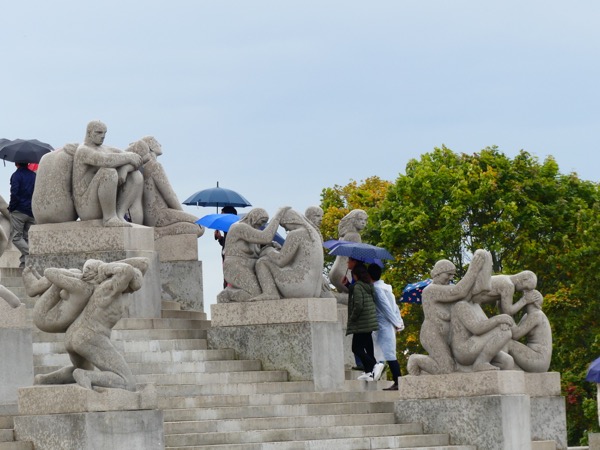
Vigeland’s sculptures deal with mankind, in all glory and in all despair, in all conditions. I will show you one of my favorites, because I am one of three sisters, and what I read into this statue is sisterhood:
Can you see why I like this statue? You can read so much into his statuary. If I were teaching high school art, I would put out a series of photos of his sculptures and ask each student to choose one and to write about what he or she sees in the sculpture.
There are mothers and fathers with their children:
What do you see? Some saw a man, overwhelmed, careless as he handled his children. I saw a metaphorical balancing act, and don’t children alway find their fathers the most fun because of the risks they take?
Some saw joy in this mother racing with her child. What do you see?
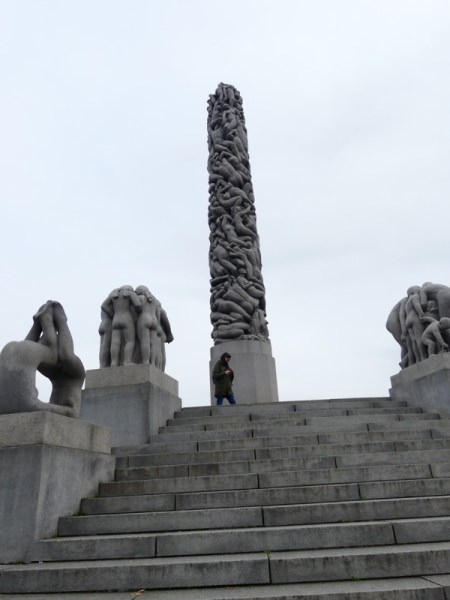
This column centers the exhibit. It is full of people and children, surrounded by people, men and women, all nude, all naked spiritually and open for our observation and interpretation:
This park is incredibly popular. I would love to go back when there aren’t a lot of people. This is a park where you can spend a lot of time speculating.
This is a separate pavilion with depictions of the stages of a life, and the transitions back and forth from the “other world” to this world.
I struggle with this series below – I’ve only shown two. It is a woman with a dragon – or is it a demon? Is she fighting with it, or dancing with it? And in the last picture, is he embracing her? Is he devouring her?
These sculptures are like a good book, you can think about them for a long time, and at different times in your life you may come to understand them in different ways.
It’s not that I am THAT compulsive, but I do like to plan ahead, and things that happen at the last minute that require attention can disturb my sleep.
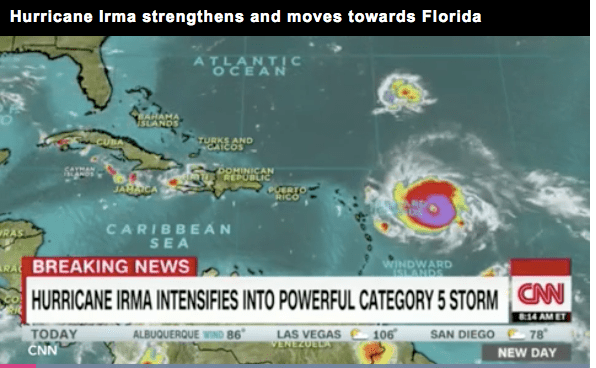
This is a trip we’ve had planned for over a year and a half. We didn’t plan for Hurricane Harvey, and we are flying out of Houston. We didn’t plan on Hurricane Irma, another all-time historical hurricane, headed toward Florida, and possibly into the Gulf. Possibly into Pensacola.
We have a wonderful couple who take care of our house and our cats while we are gone. She called the day before we were leaving to ask if we had any plans for the hurricane she needed to know about. Hmmmm. No, I didn’t. I planned not to worry about it. And . . . at the same time, all around me, people are stocking up on propane, and Sam’s has run out of water, and . . . . some people are preparing to hunker down and some to leave home, heading north.
We got moving. I had an hour before my last meeting, and spent that hour figuring out what really mattered to me (photo albums) and putting photo albums up high and in cupboards, and fragile things, like the crystal candelabra AdventureMan gave me for our first anniversary in the safest place I could think of.
Law and Order Man (our son) said he would take Ragnar and Uhtred, our very young cats, to a safe place, if needed.
AdventureMan braced the garage doors with huge specially made steel beams that bolt into place, and we called our contractor who said if it looked like Irma was heading our way, he would put up all the ballistic window and door covers.
It’s not everything, but it’s something. We all felt a lot better.
And thanks to the ‘net, we know that Houston is up and running, and our flights into Houston and out of Houston will fly.
Around eleven, we hear the front door opening (? ! ? ! ? !) and it is the couple who are coming to stay with the house and cats; they thought we were leaving at night, not the next morning. We all laughed, got them settled, and went to sleep peacefully.
The flight into Houston was the best kind, uneventful. We love uneventful flights. You can still see a lot of standing water, and water damage, but the greatest part of the upswell of waters appears to have subsided.
“Today is the first day that the airport is 100% up and running,” a Houstonian tells us. We are good listeners, and he tells us that the worst part of all this drama is that the death count continues to mount as rescue-workers go into places where people thought they could shelter in safety. The mold is also hitting hard and fast, and emergency facilities are strapped. They are functioning, and they are prepared, and some things are beginning to run out.
The best, he followed up with, is that “you know how divided we have all been? Once the storm hit, it didn’t matter if you were black or white or Mexican or Confederate, we were all just people, and we helped our neighbors, we helped each other. In that way, it was one of the best things that has ever happened in Houston.”
Is hate speech free speech, even post-Charlottesville?
The states with the highest number of hate groups may not be the areas of the country that many people would assume.
California ranks highest among the 50 states, with nearly 80 different hate groups calling the Golden State home, says a report from the Southern Poverty Law Center.
Most of the groups are concentrated in Southern California, the San Francisco Bay area and the Sacramento region, the report says.
Data show the western half of the U.S. has significantly fewer hate groups than the East Coast, the report says, but California — the nation’s most populous state — easily has the highest number of hate groups operating within its borders.
The “Hate Map” report shows 917 hate groups operating across the country. It includes data not only on white supremacists, but Black Separatist organizations and anti-LGBT groups as well.
The report also cites numbers from 2016 that show 130 Ku Klux Klan groups and 193 Black Separatist groups active across the county. The SPLC also notes there has been a nearly 200 percent increase in anti-Muslim groups since 2015.
In 2011, the total number hit its peak with over 1,000 groups operating. That number dropped to 784 just three years later, but there has been a steady increase since then. The SPLC also says in its report that the country has seen an unprecedented rise in hate groups since the turn of the century. In 1999 when there were only 457 documented groups in the country.
Florida ranks No. 2 with 63 hate groups, and is No. 1 on the East Coast.
Ranking third is New York state, home to 47 hate groups. Pennsylvania is not far behind, with 40 groups.
States with the lowest numbers of hate groups lie mostly in the Midwest and West. Iowa has only four groups in operation, while Wyoming and New Mexico have two apiece and North Dakota and Vermont have one each.
Data for the “Hate Map” list was compiled using hate group publications and websites, citizen and law-enforcement reports, sources from the field and news reports, the SPLC says.
Perry Chiaramonte is a reporter for FoxNews.com. Follow him on Twitter at @perrych
Every now and then, God, in his infinite mercy, sends an abundance of blessings, covers us with blessings. In a time in which I have found myself uncharacteristically depressed and anxious about the path our country is taking, for one brief moment, the last few days, all depression has lifted and all anxieties have calmed.
One source of anxiety has been a personal matter, a family matter, and that has resolved itself graciously, happily, with a great feeling of relief and gratitude.
For Sunday, July 2nd, our priest had prepared us for a new set of studies, kicked off by an examination of Democracy and Religion. There were rules – 1) Be nice (that’s what they say in the South for ‘be civil’) and 2) Try to see the issue through the eyes of someone with whom you disagree.
The church hall was set up with twenty-four chairs. A half hour before he was due to start, people started pouring in, and we started pulling out more chairs, and more chairs and more chairs. He actually started off early with a reflection on our Old Testament reading, the story of Abraham and the almost-sacrifice of Isaac. (My Moslem friends correct me; they tell me it was Isaac. Let’s just agree that it was Abraham and a son, and perhaps the details will come clear on the other side of the great divide.) More people arrived, more chairs put out until we were out of chairs. Toward the end of the discussion on Religious rights and Democracy, I did a quick count of chairs and people standing and figured we had over ninety people – and one of the best Sunday School classes ever.
Our priest took a Socratic approach, asking questions, bringing in current topics. In these times of divided opinions, there was, surprisingly, a lot of laughter. My favorite moment was when we were discussing limits on religious freedoms, and things that there are laws against – live animal sacrifices, bigamy, sale of alcohol on Sunday before 11 a.m. – then one of the lawyers added “How about serving liquor to minors without checking IDs every Sunday?” That got a big laugh. It’s what we do; we use real wine in the communion cup, it’s Anglican / Episcopalian tradition. And yep, even young children get to take a sip. Oops.
As divided as we are, as it turns out, we have a lot in common. It takes a lot of courage to open up such a topic to the congregation. We all behaved. I think we all came away thinking we need more of this.
The very next day, yesterday, I was at the County Courthouse for my first ever call to jury duty. Well, this was my first ever call where I actually was living in the United States and able to show up. While we lived overseas, I would have to get on my VOIP late at night when the Clerk’s office opened and tell them I was living in (Germany. Kuwait. Qatar. Saudi Arabia. Jordan. Tunis. Take your pick.)
Jury duty is an exercise in tedium. At one point when the large selection pool left a courtroom, one of the potential jurors was going “Baaaa baaaaa baaaaa; we are all like sheep.” You park in one place and get on a trolley to the courthouse, you line up to enter the courthouse, you gather in a room and you wait to be called. You get instructions, you watch instructive videos, you get pep talks on your civic duty.
I had my eyes opened in a lot of ways. First, that I would guess more than two hundred people showed up, and this was a Monday between the weekend and the Fourth of July holiday. Many had to take time off from work to show up. We were supposed to be in “business’ dress, but this is Florida, and I guess ‘business dress’ is a matter of interpretation.
Groups would be called to go before judges for jury selection. There were many cases, so almost all of us were a part of one group or another. From my group, juries were being chosen for three trials, so they asked a lot of questions up front that would pertain to all three trials, then the lawyers for the prosecution and the lawyers for the defense would ask questions.
The questions surprised me. They named the witnesses, and the defendants were there in the courtroom; they asked if anyone knew the defendant or any of the witnesses. They asked about our prejudices for or against law enforcement officials, and could we overcome our prejudice to listen to the evidence fairly. They asked about our own court experiences, and they asked about our convictions for drug use, and other things. Many of my pool had served many times on juries and knew how things went. Many were reluctant, yet, there they were. Serving. Doing their duty.
Here is what really surprised me – at least in Florida, the defendant, who is sitting there through all the questioning, gets a say in who will be on his jury. I had no idea! We don’t see a lot of jury selection on TV (although the lady sitting next to me said I need to watch a show called Bull, where jury selection is what the show is about.)
None of the defendants wanted me, and I can understand why. They want people on the juries to truly be as close to their peers as possible, people who can identify with being arrested, maybe even convicted of a crime. They want people who might give them the benefit of the reasonable doubt.
How often have you been arrested? My son, who has been a part of the system, once told me that there are Americans who never have a brush with The Law, other than maybe a traffic ticket or a DWI. Now and then, I ask my friends. None has ever been inside a jail, but these days, a friend or two has a child who has become involved with heavy drug use, and has spent some heart-breaking time in the system.
It was a long day, full of tedium. I thought about the judge, and the lawyers, who go through this day after day, asking the same questions, looking out at groups full of people who maybe don’t even want to be there, going through the process to insure that our system is as fair as possible, day after day, month after month. I had no idea that the wheel of justice ground so finely, so relentlessly, on and on. I had no idea what stoic determination it takes to be a part of that system, and trying to make sure that while the state makes the case, the defendants rights are protected.
I’ve lived, as you know, in countries where justice prevails – occasionally. I remember living in one country, which was peaceful, and thinking to myself that they were educating a lot of people for positions they will never be able to fill, because they are not in the elite.
We have all seen, in every country, that those with the money to buy the best legal protection can often escape the consequences of their crime, but there is hope, for me, even in making them stand trial.
I had no idea how proud I would feel at the end of the day, being a part of this huge effort, seeing how many of my fellow citizens, at great sacrifice to themselves, showed up. I had no idea what an education it would be for me. I had no idea how often those who least want to serve are those chosen to serve – and they persist. They show up.
I was in a room with maybe two hundred people from all walks of life. We were really just numbers, there to fill a systemic need. Some may even be, like me, a little cynical about how much justice our system really delivers . . . and we show up.
One of the defense lawyers yesterday asked us “Do you know what we are here about today?” and while we were all thinking about the charges, she answered “we are here about this man’s liberty. We’ll be deciding where he will spend his time in the next weeks, and months and years. We’ll be deciding his liberty.”
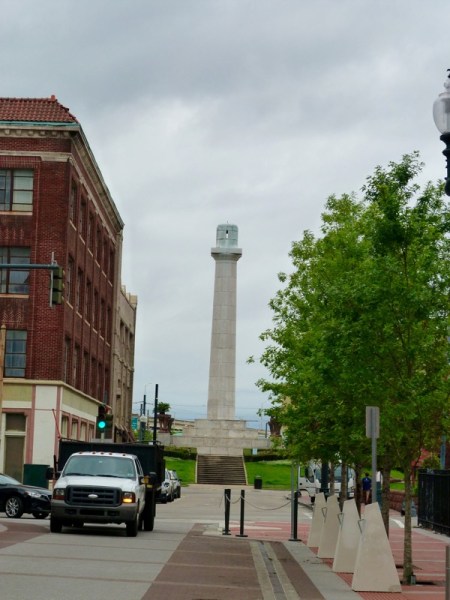
Near the World War II Museum is a traffic circle called Lee Square. It once had a statue at the top of a tall pedestal of General Robert E. Lee. Recently, the city of New Orleans removed several public statues of Confederate heroes as an affront to those rights we all hold in common; the dignity of all men and women before the law, regardless of race, religion or gender.
Those who were hired to remove the statues had to remove them in the dark of night. Many of the workers wore balaclavas and the company markings were taped over on all trucks and construction machinery, like the huge cranes.
So now Lee Square is Lee-less.
The Mayor of New Orleans, Mitch Landrieu, made a moving speech regarding the removals which has gone viral:
Ah! What a difference a day makes! We do not have the museum all to ourselves, but we have room to breathe. The lines are short, there is no huge din of voices in the cavernous spaces. We are so glad to be here!
There is something very special about this museum, something we are finding in our visits around the United States, and that is the vision of the volunteers. There is something so lovely and so meaningful about how these generous souls are leaving the workplace, and then working, free, because they believe in something. The World War II Museum couldn’t function without it’s cadre of volunteers, and these volunteers are treasure troves of first hand knowledge about the displays and equipment. Bravo! Brava! to all the Valiant Volunteers at the World War II Museum!
See all those people? This is nothing compared to the day before!
We hurried to the Nazi Propaganda display. It was terrifying. A “Strong Man” takes over using simple, strong phrases, telling the voters that only he can solve the problems, and blaming foreigners and “the other” for the nation’s problems. He wins, and chaos ensues.
Oh? Pardon me, my politics are showing.
AdventureMan has a ball. I poke around, but WWII is not my era, and I have some reading I really want to get done. I find a bench in the ship displays, and have a quiet couple of hours to read while AdventureMan pursues his bliss. Hey, it works for us.
I had a group of women delegates from a variety of countries, some were elected officials, all were active in their countries. It was a fast-paced visit, with many meetings at colleges, with groups and with activists, and by the third day, we knew each other well.
At lunch, as I often do, I asked them what surprised them most about their time in this country.
“The news!” the representative from Australia said, without hesitation. “Your news is so exciting! In our country we have news, but nothing so exciting as in your country. Sometimes we don’t even pay any attention, because nothing that exciting is happening. Here, something is happening all the time, and you get glued to your television.”
The others chimed in, stating similar opinions. They talked about how the election had affected women in their own countries, how the shock resonated still.
AdventureMan and I just got back from two weeks visiting a wonderful part of our country, the four corners, Colorado, Utah, Arizona and New Mexico. Much of the time, we had no service on our phones and woeful wifi in our rooms. We were unconnected. It was, frankly, wonderful.
This current president likes attention. He creates drama. Other presidents get down to the hard work of leading and working their agenda through congress, he attempts to unite a diverse population behind him. This president does what he pleases, and says what he will, with no regard for his position. He claims to be a very smart man, and yet he has a pattern of saying very stupid things, and behaving in a disorderly manner. It’s like watching a disaster about to happen. It’s riveting, but you reach a point where you say “enough!” We were relieved to be disconnected.
And now we are back for the busiest and most event-filled news week so far. Arrgh.
(I will write up the trip as soon as I can upload my photos. My computer says I don’t have enough space to store all the photos I took, so we are working a solution . . . )
Yesterday, we saw this bumper sticker: Elect a clown, expect a circus.
This is America. I am legally allowed to say these things about our leader. 🙂
In this morning’s lectionary readings from Deuteronomy, I find words of hope this morning:
Deuteronomy 10: 17 – 18
17For the Lord your God is God of gods and Lord of lords, the great God, mighty and awesome, who is not partial and takes no bribe, 18who executes justice for the orphan and the widow, and who loves the strangers, providing them with food and clothing. 19You shall also love the stranger, for you were strangers in the land of Egypt.
I often tell my friends that I encountered very good Christians as I lived among the Moslems; they believe in Christ, and as we differ among ourselves as Christians, they also differ from us. Some of the differences are significant, and at the same time, I am aware that Christians did not agree – and still do not agree – on Christ’s divinity. So I look at the fruits of the spirit, I look at actions, and I look at being faithful to God’s intentions for us as his creation. I welcome the stranger as the stranger so often welcomed us.
Right now, it shames me that our very Christian country is no longer hospitable to the stranger. We were the shining light of hope in the world. Now we are led by a me-first bully, who will rob the poor even of their access to affordable health care to fill his pickets and those of his cronies. He forgets we are all strangers in a strange land, and will have to answer for our misdeeds.
I take courage in the spiritual renewal of resistance; there are those who continue to welcome, clothe and feed the stranger, who are fighting against injustice in the criminal and legal system, who are fighting for a woman’s equal place in this country, who are protecting the widows and orphans, the very things we are called to do. For the first time in my life, I am a member of the ACLU. I continue to receive training as a spirit warrior. We use our increased investments to fund Planned Parenthood. We strive to feed the hungry and clothe those without clothing.
We laugh, as we discuss issues in our classes, at our activities, over lunch, that at this later stage in life, we could be so reactivated 🙂
First, God bless America, where every and any citizen is free to criticize our President. Second, this man is not the “real face of America.” He became president by a statistical sleight-of-hand, winning the electoral college, but losing the popular vote by THREE MILLION votes.
Many people who voted for him have voters remorse – the Americans happy with his performance is 36%.
(CNN)President Donald Trump enters office facing low job approval ratings and skepticism from voters, according to a new Quinnipiac University poll released Thursday.
The survey found that 36% of American voters approve of Trump’s handling of his job after his first week, while 44% say they disapprove. By comparison, former President Barack Obama received a 59%-25% approval rating in the first Quinnipiac poll taken after his inauguration in 2009.
Mr. Trump, as is his habit, calls all news which is not flattering “fake news.” His staff makes things up all the time, and seem unembarrassed when caught – no wonder they see the world a making things up. When it’s what you do, that’s what you think others are doing.
There is a majority of good hearted Americans who do not see “radical Islamic terrorism” in the face of every refugee. There are Americans demonstrating for people they don’t even know, for their right to immigrate to this great nation of immigrants. There are Americans sending money to the American Civil Liberties Union, to fight the battles through the judicial system, to Planned Parenthood, to make sure our abortion rate continues to fall because unwanted children are neither conceived nor born, the International Rescue Committee, to help settle the refugee families and keep our borders open to the flows which have given us the strength of diversity.
No, Mr. Trump is not the face of America, not the America I grew up in. He has to move fast, because he knows he doesn’t have long before the next election, when his mis-deeds come home to roost.
I believe he is a smart man, in the way con-men are often smart – clever. He doesn’t do his homework, he doesn’t understand the complexities of domestic nor international politics, he offends everywhere he goes with his bad manners and bluster. He has some very outdated ideas about women. He is fascinated with celebrity. Perhaps, if there were any indication he was taking this job seriously, he would be effective, but he is lazy, and arrogant, and thinks the laws don’t apply to him because he is in some way special. Like the bully on the playground, he is fragile, insecure and vulnerable to flattery, and will go crying home when the people call “The Emperor Has No Clothes!”
No, Ayatollah Khamenei, this man Trump does not show the real face of America.
The outcome of the recent election has not been a positive thing for everyone. Fuzzy headed liberal thinkers like me have some hard work to do in the next four years, feeding the hungry, making sure the homeless have a warm place on a cold night, protecting our drinking water, our drugs, protecting the air we breathe (what? you didn’t think all that regulation was for you?) and protecting against the removal of financial protections against those shenanigans by banks and financial institutions which brought us the great recession that peaked during the last year of the second Bush administration.
We will be the guard-dogs against gerrymandering, and against the stripping of human rights, reproductive rights, voting rights, protection against child abuse, spousal abuse and animal abuse. We will insist that the laws are enforced, equally, and do our best to protect against bad legislation.
Meanwhile, this wonderful article appeared in the HuffPost, well worth a read. Successful people have some really healthy habits and attitudes.
What Successful People (Who Are Actually Happy) Do Differently
Author of #1 bestselling book, Emotional Intelligence 2.0, and president of TalentSmart, world’s leading provider of emotional intelligence
Achievement rarely produces the sense of lasting happiness that you think it will. Once you finally accomplish the goal you’ve been chasing, two new goals tend to pop up unexpectedly.
We long for new achievements because we quickly habituate to what we’ve already accomplished. This habituation to success is as inevitable as it is frustrating, and it’s more powerful than you realize.
The key to beating habituation is to pursue, what researchers call, enduring accomplishments. Unlike run-of-the-mill accomplishments that produce fleeting happiness, the pleasure from enduring accomplishments lasts long after that initial buzz. Enduring accomplishments are so critical that they separate those who are successful and happy from those who are always left wanting more.
Researchers from the Harvard Business School studied this phenomenon by interviewing and assessing professionals who had attained great success. The aim was to break down what these exceptional professionals did differently to achieve both long-lasting and fulfilling success.
The researchers found that people who were both successful and happy over the long term intentionally structured their activities around four major needs:
Happiness: They pursued activities that produced pleasure and satisfaction.
Achievement: They pursued activities that got tangible results.
Significance: They pursued activities that made a positive impact on the people who matter most.
Legacy: They pursued activities through which they could pass their values and knowledge on to others.
Lasting fulfillment comes when you pursue activities that address all four of these needs. When any one of them is missing, you get a nagging sense that you should be doing more (or something different).
The behaviors that follow are the hallmarks of people who are successful and happy because they address these four needs. Try them out and see what they do for you.
1. They are passionate. Jane Goodall left her home in England and moved to Tanzania at age 26 to begin studying chimpanzees. It became her life’s work, and Goodall has devoted herself fully to her cause while inspiring many others to do the same. Successful, happy people don’t just have interests; they have passions, and they devote themselves completely to them.
2. They swim against the current. There’s a reason that successful and happy people tend to be a little, well, different. To be truly successful and happy, you have to follow your passions and values no matter the costs. Just think what the world would have missed out on if Bill Gates or Richard Branson had played it safe and stayed in school or if Stephen King hadn’t spent every free second he had as teacher writing novels. To swim against the current, you have to be willing to take risks.
“To be normal is the ideal aim of the unsuccessful.”
– Carl Jung
3. They finish what they start. Coming up with a great idea means absolutely nothing if you don’t execute that idea. The most successful and happy people bring their ideas to fruition, deriving just as much satisfaction from working through the complications and daily grind as they do from coming up with the initial idea. They know that a vision remains a meaningless thought until it is acted upon. Only then does it begin to grow.
4. They are resilient. To be successful and happy in the long term, you have to learn to make mistakes, look like an idiot, and try again, all without flinching. In a recent study at the College of William and Mary, researchers interviewed over 800 entrepreneurs and found that the most successful among them tended to have two critical things in common: they were terrible at imagining failure, and they tended not to care what other people thought of them. In other words, the most successful entrepreneurs put no time or energy into stressing about their failures as they see failure as a small and necessary step in the process of reaching their goals.
5. They make their health a priority. There are an absurd number of links between your health, happiness, and success. I’ve beaten them to death over the years, but the absolute essential health habits that successful and happy people practice consistently are good sleep hygiene (fights stress, improves focus, and is great for your mood), eating healthy food (helps you to focus), and exercise (great for energy levels and confidence).
6. They don’t dwell on problems. Where you focus your attention determines your emotional state. By fixating on your problems, you create and prolong negative emotions and stress, which hinder performance. However, by focusing on actions to better yourself and your circumstances, you can create a sense of personal efficacy that produces positive emotions and improves performance. Successful, happy people don’t dwell on problems because they know that they’re most effective when they focus on solutions.
7. They celebrate other people’s successes. Insecure people constantly doubt their relevance, and because of this, they try to steal the spotlight and criticize others in order to prove their worth. Confident people, on the other hand, aren’t worried about their relevance because they draw their self-worth from within. Instead of insecurely focusing inward, confident people focus outward, which allows them to see all the wonderful things that other people bring to the table. Praising people for their contributions is a natural result of this.
8. They live outside the box. Successful and happy people haven’t arrived at where they are by thinking in the same way as everyone else. While others stay in their comfort-zone prisons and invest all their energy in reinforcing their existing beliefs, successful people are out challenging the status quo and exposing themselves to new ideas.
9. They keep an open mind. Exposing yourself to a variety of people is useless if you spend that time disagreeing with them and comforting yourself with your own opinions. Successful, happy people recognize that every perspective provides an opportunity for growth. You need to practice empathy by putting yourself in the other person’s shoes so that you can understand how their perspective makes sense (at least, to them). A great way to keep an open mind is to try to glean at least one interesting or useful thing from every conversation you have.
10. They don’t let anyone limit their joy. When your sense of pleasure and satisfaction are derived from comparing yourself to others, you are no longer the master of your own happiness. When successful, happy people feel good about something that they’ve done, they don’t let anyone’s opinions or accomplishments take that away from them. While it’s impossible to turn off your reactions to what others think of you, you don’t have to compare yourself to others, and you can always take people’s opinions with a grain of salt. That way, no matter what other people are thinking or doing, your self-worth comes from within. Regardless of what people think of you at any particular moment, one thing is certain — you’re never as good or bad as they say you are.
Bringing It All Together
People who are successful and happy focus on activities that address a variety of needs, not just immediate achievements.
What other habits can make you happy and successful in the long term? Please share your thoughts in the comments section below, as I learn just as much from you as you do from me.


















 Here There and Everywhere