WOW! New YMCA For Pensacola in Maritime Park?
Fresh from the Pensacola News Journal Page:
Wow. Wow. Wow.
A $5 million pledge by Quint and Rishy Studer has kick-started a drive to build a new downtown Pensacola YMCA on a waterfront site at Community Maritime Park.
Studer said this afternoon he is interested in seeing a new YMCA downtown because of the positive impact it can have on children and adults, on community health and on residential development in the downtown area.
Studer said his pledge is contingent on the YMCA being located on a waterfront site at the southwest corner of the park, and that the project move forward at a rapid pace.
“We told them (the YMCA board) if they are serious, this has to move quickly,” Studer said. “Emotionally, Rishy and I can’t take another long, drawn-out things like with the stadium. We can’t take getting beat up again.”
Studer said the YMCA project, tentatively estimated at about $10 million, would be an excellent fit for the Maritime Park.
“There is a vacant piece of property there and either there’s going to be nothing on it, or a private developer will build something, or there can be a YMCA there.”
Brian Hooper, chair of Mayor Ashton Hayward’s Urban Development Advisory Committee, said a new YMCA in the downtown area was a key recommendation of the report released last month.
“One of the most common suggestions we heard from the public was the strong desire to see a family-oriented community center downtown,” Hooper said. “As our final report recommended, a new YMCA in downtown Pensacola would provide those who live and work in the community with a centrally-located hub for recreation, wellness, learning, and community. And I’m excited to see that many of our recommendations — such as this one — are already being acted upon.”
In addition to Studer’s pledge, community benefactor Terri Levin said she is co-chairing the YMCA fundraising committee.
Levin also said she will be making a dollar pledge to the project but has not yet decided the amount.
Pensacola developer Eric Nickelsen and real estate developer Joe Buehler are co-chairing the steering committee.
Nickelsen said the 10-person, all-volunteer YMCA steering committee, which includes former Mayor Mike Wiggins and former Pensacola City Councilman Ron Townsend, is meeting later this month to recommend a site to the Y’s board of directors. It’s
expected the recommended site will be the CMPA’s waterfront parcel.
Nickelsen said the YMCA project is in the early stages of development, but has considerable momentum.
“Apparently there is good feeling among our committee members that we can be successful in our fund raising campaign,” Nickelsen said.
Pecans From Texas – Such Generosity!
When I was living in Kuwait, and my son married, one of my new daughter-in-law’s aunts sent me pecans from Texas. She didn’t just send me a pound or two, she sent like 15 pounds of pecans! It was a wondrous gift, and oh, we had pecan muffins, pecan date pies, pecans in everything. Pecans in Kuwait cost dear, you can’t imagine, and these pecans were TASTY, so so good. She tells me it is because they are from Texas, where everything tastes better. 😉

At Thanksgiving, she gave me a HUGE bag of pecan meats.
“I want you to have pecans from TEXAS!” she told me. Her car was packed with sweet gifts for all her nieces and nephews and all the little ones related to her in any remote way. It’s just the way she is. She can’t help it, she is wired to be loving and generous.
AR, I am so thankful you are in my life! I am enjoying every cup of pecans I use, and although I have used a lot, there are so many pecans left it is like I haven’t used any! You are so generous, and I am enjoying your pecans so much! All of Pensacola is enjoying your pecans!
Wikipedia Campaign

So many times when I go to look for information (much of which I share with you on this blog) the first and most comprehensive place to pop up with the information I need is Wikipedia. Today, when I was gathering information on school shootings, I saw, for the second time (the first time was a couple years ago) a banner asking me to donate to keep Wikipedia going.
I did. And I hope you will, too, if you use Wikipedia.
If you donate, you will get one of the nicest thank-you letters you will ever receive. I used to write these letters. I know how hard it is to strike just the right tone. I applaud the people at Wikipedia who wrote this one. (What is the goal of a fund-raiser’s thank you? To be sure you donate again the next time 🙂 )
Dear Donor,
Thank you for donating to the Wikimedia Foundation. You are wonderful!
It’s easy to ignore our fundraising banners, and I’m really glad you didn’t. This is how Wikipedia pays its bills — people like you giving us money, so we can keep the site freely available for everyone around the world.
People tell me they donate to Wikipedia because they find it useful, and they trust it because even though it’s not perfect, they know it’s written for them. Wikipedia isn’t meant to advance somebody’s PR agenda or push a particular ideology, or to persuade you to believe something that’s not true. We aim to tell the truth, and we can do that because of you. The fact that you fund the site keeps us independent and able to deliver what you need and want from Wikipedia. Exactly as it should be.
You should know: your donation isn’t just covering your own costs. The average donor is paying for his or her own use of Wikipedia, plus the costs of hundreds of other people. Your donation keeps Wikipedia available for an ambitious kid in Bangalore who’s teaching herself computer programming. A middle-aged homemaker in Vienna who’s just been diagnosed with Parkinson’s disease. A novelist researching 1850s Britain. A 10-year-old in San Salvador who’s just discovered Carl Sagan.
On behalf of those people, and the half-billion other readers of Wikipedia and its sister sites and projects, I thank you for joining us in our effort to make the sum of all human knowledge available for everyone. Your donation makes the world a better place. Thank you.
Most people don’t know Wikipedia’s run by a non-profit. Please consider sharing this e-mail with a few of your friends to encourage them to donate too. And if you’re interested, you should try adding some new information to Wikipedia. If you see a typo or other small mistake, please fix it, and if you find something missing, please add it. There are resources that can help you get started. Don’t worry about making a mistake: that’s normal when people first start editing and if it happens, other Wikipedians will be happy to fix it for you.
I appreciate your trust in us, and I promise you we’ll use your money well.
Thanks,
Sue
The Gift of Saint Nicholas
This is from today’s Lectionary reading on the saints, by James Kiefer; today is the feast of Saint Nicholas, and in many European countries, little children find their shoes filled with little gold coins (chocolate) or . . . sticks with coal (usually also candy, these days)
The true Saint Nicholas embodied the spirit of anonymous giving – a grace more rarely seen in these days of blogs and twitters and 15 seconds of news coverage.
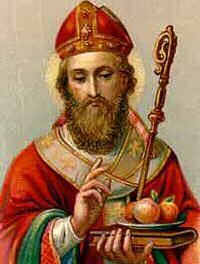
(of course I chose this image of Saint Nicholas because of the pomegranates 🙂 )
NICHOLAS OF MYRA
FRIEND OF CHILDREN, GIVER OF GIFTS, CLIMBER OF CHIMNEYS, ETC. (6 DEC 326)
The story of St. Nicholas offers a possible way of dealing with the “Santa Claus” problem, to parents who do not want to lie to their children, even in fun, but do not want to say simply: “Bah, humbug! There is no such thing as Santa. Forget about him.”
Nicholas was a native of the western part of what is now Asiatic Turkey. He became Bishop of Myra in the fourth century, and there are many stories of his love for God and for his neighbor.
The best-known story involves a man with three unmarried daughters, and not enough money to provide them with suitable dowries. This meant that they could not marry, and were likely to end up as prostitutes. Nicholas walked by the man’s house on three successive nights, and each time threw a bag of gold in through a window (or, when the story came to be told in colder climates, down the chimney). Thus, the daughters were saved from a life of shame, and all got married and lived happily ever after.
Because of this and similar stories, Nicholas became a symbol of anonymous gift-giving. Hence, if we give a gift to someone today without saying whom it is from, it can be called “a present from Saint Nicholas (or Santa Claus).” Some parents explain this to their children and invite the child to join them in wrapping a toy (either something purchased for that purpose, at least partly with the child’s allowance, or else a toy that the child has outgrown but that is still serviceable) or an outgrown but not shabby item of the child’s clothing, or a package of food, and then going along to donate it to a suitable shelter that will give it to someone who will welcome it. This gift is then called “a present from Santa,” so that the child understands that this is another name for an anonymous gift given to someone whom we do not know, but whom we love anyway because God does. (Presents within the family can be “From Santa” or “From Santa and…”)
Pictures of Nicholas often show three bags of gold next to him, and often these bags have become simply three disks or balls. Nicholas became the patron of an Italian city (I think Bari, which is where his body is now buried) that was a center of the pawnbroking business, and hence a pawnbroking shop traditionally advertises by displaying three gold balls over its front. It is thought that some persons looking at pictures of Nicholas confused the three round objects with human heads. Hence there is a story of a wicked innkeeper who murdered three boys and salted their bodies to serve to his guests, to save on the butcher’s bill. Nicholas visited the inn and confronted the innkeeper, who confessed his crime, whereupon Nicholas prayed over the brine-tub and the three boys leaped out unharmed. Other stories have him saving the lives of three innocent men who had been condemned to death. Still other stories have him coming to the rescue of drowning sailors (could this be related to the brine-tub incident?). Nicholas has always been popular with children, mariners, pawnbrokers, the Dutch, the Russians, and recently, the department-store owners. (American readers may remember the story of the brine-tub through reading it as children in the book The Dutch Twins, by Lucy Fitch Perkins, author of The Spanish Twins, The Italian Twins, and many similar books, all children’s favorites in the middle of this century. They may now be banned as politically incorrect — I have no idea. If your children know the brine-tub story, from this book or elsewhere, they may be interested to know how it may have originated.)
In many countries, Nicholas visits children on his feast day, 6 December, and brings them gifts then. In these countries, there is usually no exchange of Christmas presents, but there may be gifts again on January 6, the feast of the coming of the Wise Men, who brought gifts to the Holy Child of gold, frankincense, and myrrh. In America, it may be thought necessary to yield to outside pressure and let Nicholas distribute gifts on December 25.
If you want to show your children (or yourself) how Nicholas is remembered by Christians with a background different from your own (unless, of course, this IS your background), you might want to attend an East Orthodox service at this time. Many Eastern Orthodox congregations have services on the evening before 6 December that feature “visits from Saint Nicholas.” He appears as a bishop, with no red suit. The faithful leave their shoes outside the church door, and find in them afterwards gold coins (actually chocolate wrapped in gold foil) representing the gold dowries of the three daughters. To find a service and inquire what it is likely to be like, look up CHURCHES, ORTHODOX in the Yellow Pages. For an English-language service, “Orthodox Church in America” or “Antiochan Orthodox” parishes are likely choices, but do not overlook other possibilities.
We are told, but it is uncertain, that Nicholas was imprisoned for his faith before the accession of Constantine, and that he was present at the Council of Nicea in 325. We may note in passing that the picture of him as roly-poly is a late development. Early stories indicate that he was generous to others, but not given to self-indulgence. Indeed, even as an unweaned infant, he fasted regularly on Wednesdays and Fridays.
by James Kiefer
The Power of Kindness to Change Lives
This week AdventureMan and I have been blessed, greatly blessed. We have met some wonderful people and heard some amazing things. Two stories in particular have shaken the earth for me.
“How It Happened for Me”
The first story is about a friend we met from the newest country on earth, South Sudan. A group of us were sitting together when one woman turned to this man from the South Sudan and asked “How did you find Jesus?”
This was not a religious gathering, so it is an unusual question on a social evening. But this quiet, modest man responded “I will tell you. It is a long story. It starts when I was only five months, not a baby, five months in my mother’s womb.”
He told us of a life with no security. His parents and family fled to the forest, and were on the run continually most of his life – until recently. He told of a life trying to find safe places, sometimes being separated from his parents.

He told of a priest who, when he and his brothers and sisters were very young, taught them to say “God bless Mother and God bless Father and God bless my brothers and sisters and watch over us always.” He was kind to the children, and taught them that God loves them, that God is kind. He said they did not know who this God was, but he and his brothers and sisters said this prayer every night, to keep his family safe. He said they learned other simple prayers. There would be rare times when someone would teach them a letter, or some numbers, drawing in the sand, or the floor of the forest, simple, quick lessons.
“So I don’t know all the stories you do,” he said. “I don’t even know the bible very well, we never had educated priests, just simple men who taught us simple prayers. Only later did we become more educated.”
As we listened, we had huge lumps in our throats. I could hear Jesus’ voice saying that we must believe as little children, and this man had the pure simple faith of a child, a memory from his earliest years, as he prayed for his family to be safe in a world where life was continual chaos and a struggle to survive.
“When I understood about God,” he went on, “there wasn’t even a church or a pastor-man who could baptize me; I had to believe for many years before I could become a Christian.”
As a footnote, he told us that somehow, most of his village managed to survive, helping one another. His entire family made it through, his parents are still alive. The village children little by little gained education, becoming doctors, lawyers, professionals of all kinds. His village now has a church, a simple church, not always staffed, but a church. The war is ended. For him, the simplicity of peace is all he ever wanted.
We will never forget his, and his story. We have met an extraordinary human being.
Today, we went to a lunch, invited by a friend, to raise funds for public education. LOL, this is what I used to do; I worked for an education foundation and raised money for public education. I love this kind of thing. I knew just what to expect – lots of success stories, stellar achievements, and a gentle pitch.
Whoa! Wrong! Darling kids – check. Recognition of important guests – check. Gentle pitch – no way! They got right to business; you will see this form, please take your pens RIGHT NOW and fill it out and give what you can, education funds seem to get cut more every year and we are trying to do more with less and less. Give NOW. CHECK!
The final speaker was a local businessman and patron-of-just-about-everything, a man who also brought baseball to Pensacola. He talked about his own public education. He talked about his speech impediment, and his deafness, he talked about his short stature and his inability to sit still and concentrate. He talked about teachers who identified him and instead of treating him as an obstacle, made him believe they were glad to have him in their class. He talked about teachers who gave him special assignments, who taught him math by having him calculate baseball averages. He knew their names, these saints who kept him in school, no matter how discouraged he might be.
He graduated with a 1.9 grade point, and had no intention of going to college, but ended up astonishing everyone by doing well on the ACT test and having a guidance counselor who found him just exactly the right environment where he could flourish on the college level.
Important people usually enjoy telling you the great things they have done. This man focused on his disabilities, his humiliations and his weaknesses, and how the kindness of educators had pulled him out of a very dark place and set him on the road for the success he is today.
I am willing to bet that the education foundation gained a lot of donors today. We were caught by surprise. We can defend against the powerful and successful, but when the heart speaks from vulnerability and failure, our hearts respond. This man is a success, but he gives credit to those who looked at him with caring eyes, with caring hearts, who lifted him and helped him on his way to the incredible (wealthy) success he is today, with a flourishing business and innumerable local charities who are grateful for his support.
What a week! And it’s only Tuesday! I wonder what the rest of the week will bring?
Blog Action Day 2012: Register Now!
I just registered for Blog Action Day October 15, 2012. Take part in a huge global discussion http://bit.ly/OtyYtE #BAD12
I love the theme they have chosen for this year: The Power of We 🙂
Hello Bloggers
Welcome back to Blog Action Day for 2012.
As previous participants of Blog Action Day, I am pleased to share with you three important announcements.
1. Blog Action Day will be held on October 15, 2012,
2. Our theme is “The Power of We” – you can use the #powerofwe hashtag, and
3. Registrations for Blog Action Day are now OPEN.
Why did we choose The Power of We?
We choose this theme for a few reasons.
Firstly, the popularity of the subjects Community, Equality, Transparency/Anti-Corruption and Freedom, in the theme poll we ran via Facebook and Twitter, over te last few weeks.
Secondly, we felt that Blog Action Day needed to reflect the ever growing movements of people working together for positive social change.
Whether using digital tools like blogs, social networks and mobiles, or meeting face to face in local community halls, neighbours house, andpublic streets. Greater numbers of people have been coming together to make change, either for their own communities or the world at large.
For the team at Blog Action Day, we see The Power of We as a celebration of people working together to make a positive difference in the world, and we hope you take part and register your blog for Blog Action Day.
Ideas for how you can discuss “The Power of We”
For Blog Action Day, you might profile a person or a group who inspire you, talk about your own efforts to make change, or highlight a cause that has been successful for using people power to make a difference.
There are hundreds of examples you could choose from such as; fighting for healthier meals for kids in schools, protecting people’s rights in countries far away, stopping practices in industries that hurt the environment and communities, challenging authorities to listen and act for the people.
Or, you may want to focus on historical social change movements such as the Suffragettes movement, campaigns against slavery or civil rights.
If you are active in a movement, you might even want to discuss the strategies and tips of how to organise to encourage other people to make change happen.
Getting ready for Blog Action Day
As Blog Action Day gets closer (just under seven weeks away) we will be sharing thoughts from our NGO partners, previous Blog Action Day participants and interesting individuals about our theme, and ask them to provide suggestions and materials that you can use for your blogs on October 15, 2102.
Also, over the next few weeks we will be increasing our communications with a weekly email, as well as regularly updates, content and opportunities via our website and social media channels.
The team at Blog Action Day can’t wait to see what you all blog about and we really hope that you enjoy taking part in Blog Action Day on October 12, 2012.
All the best
Karina and Jason and the rest of the Blog Action Day team
PS. Don’t forget to register for this year’s event via our website
That Cheeky Woman At The Well
Today’s Gospel reading from the Lectionary is one of my favorites, and every time I read it, I am amazed. Amazed that this good Jewish boy would speak to a woman who cavorted with men, having five husbands, and being with a man now who was not her husband. It’s the middle of the day, and he is sitting by a well having a conversation with a woman most good Jewish boys would run from, a woman of ill-repute!

She must have had a rough life, five husbands, etc. but it hasn’t broken her spirit, and she is joking around with Jesus. She knows something about Jewish traditions, but has no idea who Jesus might be. Then, oddity of oddity, he reveals himself to her as the Messiah – to this woman. He reveals himself to a woman at the very lowest end of the social scale, a woman barely tolerated in her own society. This woman believes him; for all her sins, she ‘hears’ the truth of what he is saying in her heart.
John 4:1-26
4Now when Jesus* learned that the Pharisees had heard, ‘Jesus is making and baptizing more disciples than John’— 2 although it was not Jesus himself but his disciples who baptized— 3he left Judea and started back to Galilee. 4But he had to go through Samaria. 5So he came to a Samaritan city called Sychar, near the plot of ground that Jacob had given to his son Joseph. 6Jacob’s well was there, and Jesus, tired out by his journey, was sitting by the well. It was about noon.
7 A Samaritan woman came to draw water, and Jesus said to her, ‘Give me a drink’. 8(His disciples had gone to the city to buy food.) 9The Samaritan woman said to him, ‘How is it that you, a Jew, ask a drink of me, a woman of Samaria?’ (Jews do not share things in common with Samaritans.)* 10Jesus answered her, ‘If you knew the gift of God, and who it is that is saying to you, “Give me a drink”, you would have asked him, and he would have given you living water.’ 11The woman said to him, ‘Sir, you have no bucket, and the well is deep. Where do you get that living water? 12Are you greater than our ancestor Jacob, who gave us the well, and with his sons and his flocks drank from it?’
13Jesus said to her, ‘Everyone who drinks of this water will be thirsty again, 14but those who drink of the water that I will give them will never be thirsty. The water that I will give will become in them a spring of water gushing up to eternal life.’ 15 The woman said to him, ‘Sir, give me this water, so that I may never be thirsty or have to keep coming here to draw water.’
16 Jesus said to her, ‘Go, call your husband, and come back.’ 17The woman answered him, ‘I have no husband.’ Jesus said to her, ‘You are right in saying, “I have no husband”; 18for you have had five husbands, and the one you have now is not your husband. What you have said is true!’ 19The woman said to him, ‘Sir, I see that you are a prophet. 20Our ancestors worshipped on this mountain, but you* say that the place where people must worship is in Jerusalem.’
21 Jesus said to her, ‘Woman, believe me, the hour is coming when you will worship the Father neither on this mountain nor in Jerusalem. 22You worship what you do not know; we worship what we know, for salvation is from the Jews. 23But the hour is coming, and is now here, when the true worshippers will worship the Father in spirit and truth, for the Father seeks such as these to worship him. 24God is spirit, and those who worship him must worship in spirit and truth.’ 25The woman said to him, ‘I know that Messiah is coming’ (who is called Christ). ‘When he comes, he will proclaim all things to us.’ 26Jesus said to her, ‘I am he,* the one who is speaking to you.’

James Lee Burke and the Creole Belle
James Lee Burke is number one on my guilty-pleasures list.

I first met his main character Dave Robicheaux in A Morning For Flamingos, a book I picked up in a military library at Lindsay Air Station, a post that doesn’t even exist any more. In the cold dark endless winter in Wiesbaden, Germany, James Lee Burke lit up my life. I had thought I was picking up just another escapist mystery novel, but when James Lee Burke puts words together to describe the way a storm moves in over the bayou, prose becomes poetry.
There is a downside. Whether it is his character Dave Robicheaux, the former New Orleans cop, now head homicide investigator in New Iberia, Louisiana, or his Hackberry Holland series set in West Texas, James Lee Burke’s books are filled with extreme violence and disturbing images that live in your head for a long time.
I’ve recommended James Lee Burke to friends, some of whom have said “Why do you read this trash??? It is HORRIBLE! It is full of over-the-top violence!”
And then again . . . he is writing about some really really bad people. They are out there. There are people who exist who inflict cruelty. I don’t understand it, I can’t begin to fathom where the urge would come from, but I’ve seen it. It’s out there. James Lee Burke pulls up that rock and exposes the dark happenings underneath.
On one level, as I started reading Creole Belle, I thought “Oh James Lee Burke, stop! Stop! It’s the same old formula! A downtrodden victim (often a beautiful woman) cries for help. You and Clete start looking for information and end up beating people up and then they retaliate by threatening your family! There is a rich, beautiful woman who seems vulnerable and who you kind of like, but she is complicated. There are rich amoral people who keep their hands clean, but who are calling the shots and never go to jail! Stop! Stop!”
Well, I should say that, and maybe I should stop. Then he starts talking about the smoke from the sugar cane fields and the bridge over the Bayou Teche, and the big Evangeline oak in St. Martinsville, and I am a goner. I’m sucked in, I’m hooked.
I detest the violence and the images. I keep coming back because James Lee Burke has some important things to say.
I’d love to have him to dinner. I’d love for him and our son to have a chance to talk about Law Enforcement. Here is what James Lee Burke has to say in Creole Bell:
There are three essential truths about law enforcement: Most crimes are not punished; most crimes are not solved through the use of forensic evidence; and informants product the lion’s share of information that puts the bad guys in a cage.
My son hates shows like CSI, and Law and Order, where the evidence convicts the criminals. He says it raises unreal expectations in juries, and makes it harder to get a conviction.
We watched a Violation of Parole hearing, or actually a series of hearings, where the judge asked each individual whose parole was about to be revoked what had happened when he or she was re-arrested. In each case, the parolee had done something stupid; drove a car with an expired license, drove to another state, was arrested driving drunk, etc. EVERY time. The judge made his point, I believe.
From Creole Belle:
But if Caruso was the pro Clete thought she was, she would avoid the mistakes and geographical settings common to the army of miscreants and dysfunctional individuals who constitute the criminal subculture of the United States. Few perpetrators are arrested during the commission of their crimes. They get pulled over for DWI, an expired license tag, or throwing litter on the street. They get busted in barroom beefs, prostitution stings, or fighting with a minimum-wage employee at a roach motel. Their addictions and compulsions govern their lives and place them in predictable circumstances and situations over and over, because they are incapable of changing who and what they are. Their level of stupidity is a source of humor at every stationhouse in the country. Unfortunately, the pros – high end safecrackers and jewel thieves and mobbed-up button men and second story creeps – are usually intelligent, pathological, skilled in what they do, middle class in their tastes and little different in dress and speech and behavior from the rest of us.
And then there are paragraphs like this that discuss the human experience, and have a far wider application than the book:
No one likes to be afraid. Fear is the enemy of love and faith and robs us of all serenity. It steals both our sleep and our sunrise and makes us treacherous and venal and dishonorble. It fills our glands with toxins and effaces our identity and gives flight to any vestige of self-respect. If you have ever been afraid, truly afraid, in a way that makes your hair soggy with sweat and turns your skin gray and fouls your blood and spiritually eviscerates you to the point where you cannot pray lest your prayers be a concesion to your conviction that you’re about to die, you know what I am talking about. This kind of fear has no remedy except motion, no matter what kind. Every person who has experienced war or natural ctastrophe or man-made calamity knows this. The adrenaline surge is so great that you can pick up an automobile with your bare hands, plunge through glass windows in flaming buildings, or attack an enemy whose numbers and weaponry are far superior to yours. No fear of self-injury is as great as the fear that turns your insides to gelatin and shrivels your soul to the size of an amoeba.
Last, but not least, this is what keeps me coming back to James Lee Burke, so much so that I buy the book almost as soon as it is released. James Lee Burke isn’t afraid to take on the big guys. He “gives voice to those who have no voices.” (Proverbs 31:8) His focus is always on the dignity of the common man, the dignity of hard work, done well, and on the dignity of doing unexpected kindnesses to those who have no expectation of kindness.
. . . All was not right with the world. Giant tentacles of oil that had the color and sheen of feces had spread all the way to Florida, and the argument that biodegradation would take care of the problem would be a hard sell with the locals. The photographs of pelicans and egrets and seagulls encased in sludge, their eyes barely visible, wounded the heart and caused parents to shield their children’s eyes. The testimony before congressional committees by Louisiana fisher-people whose way of life was being destroyed did not help matters, either. The oil company responsible for the blowout had spent an estimated $50 million trying to wipe their fingerprints off Louisiana’s wetlands. They hired black people and whites with hush-puppy accents to be their spokesmen on television. The company’s CEO’s tried their best to look ernest and humanitarian, even though the company’s safety record was the worst of any extractive industry doing business in the United States. They also had a way of chartering their offshore enterprises under the flag of countries like Panama. Their record of geopolitical intrigue went all the way back to the installation of the shah of Iran in the 1950’s. Their even bigger problem was an inability to shut their mouths.
They gave misleading information to the media and the government about the volume of oil escaping from the blown well, and made statements on worldwide television about wanting their lives back and the modest impact that millions of gallons of crude would have on the Gulf Coast. For the media, their tone-deafnessness was a gift from a divine hand. Central casting couild not have provided a more inept bunch of villains.
James Lee Burke has a voice, and he uses it. He could just cash in on his reputation as an Edgar Award winning author, but he uses his voice to speak out against injustice and corruption. He is a champion of the people. I’ve written several book reviews, and taken some trips just because I wanted to see James Lee Burke country; if you are interested in those, you can read them here.
I have a concern about this series, in that this book ended differently than all the others. So differently it made me seriously question whether Burke intends to continue writing about Dave Robicheaux or if Dave is about to hang up his shield and call it a day. He’s a guilty pleasure I am not yet ready to give up.
Awaiting My Donation
This scam – and I am pretty sure it is a scam – intrigues me because it is different. I love it that they assume I will donate.
REV.APOSTLE JOHN MCLAIN
THE MAN AFTER GODS HEART.
revapostlejohnmclain@yahoo.com
recievertogodschildren@yahoo.com
Dear Anointed man of GOD
With all due respect, we here by greet you and your family world wide and the
goodness of GOD in your christian organization.
This message have been approved to be sent to you and how you understand the
impact of this message is very important to our Christian organization as it
will yield to your life proceedings accurate.
Simple,obedience to Gods command draws blessings.
And giving to the levites is GODS command,therefore obeying this diligently
pulls GODS blessing upon the church and its members which is you.
We lose nothing to make the levites smile,that rather makes us smile too.
What ever you can do to make the levites smile,will make you equally smile.
Smile is contagious and reciprocal. so do some thing to make someone smile.
Their welfare, health, employment, education, physical security, and empowerment
are of paramount importance in realizing this vision of the future. To reduce
poverty and inequality, the plan proposes acting on several fronts:
This is because,the found will be used as a stepping stone to reform Levites in
the house of the LORD and for the spreading the word of God worldwide.
My worlds are short but according to my directions,i have deposited this
particular message to you which stands to reach only you for notifications.
Thus, you and your whole organization will be multiplied & blessed. with more
than what the heart expects.
You have been proven worthy of supporting our christian kingdom financially
which you will receive according to your faith, and our (motto) is what is
written in our e-mail id.
We wait for your reply and we will send you a form for your Donation.
Great people of GOD
Yours sincerely
REV.APOSTLE JOHN MCLAIN
THE MAN AFTER GODS HEART.
revapostlejohnmclain@yahoo.com
recievertogodschildren@yahoo.com
From Wikipedia, the definition of Levites:
In Jewish tradition, a Levite ( /ˈliːvaɪt/, Hebrew: לֵוִי, Modern Levi Tiberian Lēwî ; “Attached”) is a member of the Hebrew tribe of Levi. When Joshua led the Israelites into the land of Canaan, the Levites were the only Israelite tribe that received cities but were not allowed to be landowners “because the Lord the God of Israel himself is their inheritance” (Deuteronomy 18:2).[1][2] The Tribe of Levi served particular religious duties for the Israelites and had political responsibilities as well. In return, the landed tribes were expected to give tithe to the Levites, particularly the tithe known as the Maaser Rishon or Levite Tithe. In current Jewish practice, dating from the destruction of the Temple in Jerusalem, the communal privileges and responsibilities of Levites are mainly limited to the synagogue Torah reading and the ritual of pidyon haben.
Moses and his brother, Aaron, were both Levites. Notable descendants of the Levite dynasty according to the Bible include Miriam, Samuel, Ezekiel, Ezra, Malachi, John the Baptist, Mark the Evangelist, Matthew the Evangelist, and Barnabas. The descendants of Aaron, who was the first kohen gadol, high priest, of Israel, were designated as the priestly class, the kohanim. As such, kohanim comprise a family dynasty (although people claiming to be kohanim have many haplogroups) within the tribe of Levi, and thus all kohanim are traditionally considered to be Levites, but not all Levites are kohanim.
Recent Comments
intlxpatr on Yellowstone: Old Faithful to C… Michelle on Yellowstone: Old Faithful to C… Cathy on No Grown-Ups in Charge intlxpatr on Waiting for Snow intlxpatr on Waiting for Snow Wikipedia Donate Button

Amazina


Early Voting in Florida


 Here There and Everywhere