Jungle Bell Rock in Kuwait :-)

If you remember, the Qatari Cat is a former street cat, a rescue cat. I wish I could be there to support this wonderful event and the good work that K’s Path in Kuwait is doing. They have some illustrious sponsors, and a host of great volunteers supporting their efforts.
Non-Profits: Something From Nothing
Here is what I love – people who get an idea, and make the world a better place because they have a vision and make a plan so that the vision can become a reality.
The Gulf Coast Citizens Diplomacy Council
I volunteer for the Gulf Coast Citizens Diplomacy Council. The one in Pensacola was started from nothing by a young woman with a vision, Gina Melancon Gissendanner. Her organization, her Board of Directors, her members and her resources deep within the Pensacola community have welcomed several hundred of the US Department of States International Visitor’s Leadership program delegates, bringing awareness – and dollars – to Pensacola.
When the visitors come into town, they have activities, tours and visits with professional counterparts that give them new strategies and resources to take back with them to their home countries. While here, they meet local people, shop in local stores and dine in local homes.
I love this program. From nothing, this young woman has created an organization with a far-reaching legacy. Thanks to her innovative and relevant programs, the international delegates leave here with happy memories of their time in Pensacola, and they go home and tell their friends and neighbors about their time here.
This weekend, we crossed paths with three more organizations, creating a better world, each in their own way.
The Master Gardeners
“You have to come to the sale at the County Extension Office!” our aqua aerobics friends told us. “It is so much fun, and they have Florida-hardy plants available at really good prices.”
OK! Finding ourselves awake and ready to hit the road early on a Saturday morning, we headed for the County Extension office, and the Master Gardener’s Sale. Now, I may get some of the details in this story wrong, but this is what I think I have been told. . . Several years ago, county extension offices (who answer questions about soil and growing things) found themselves deluged with questions, with too few people to answer them. They started a program – and I believe it is nation wide – training people in all aspects of growing things in the local area.
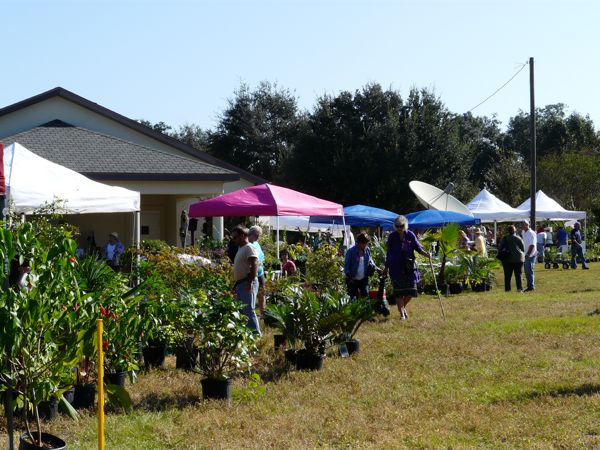
People who signed up for the training also signed up for a commitment to volunteer, and pass their knowledge along. Slowly, slowly, we have begun to know these people.
The sale was a lot of fun. While gardeners love a challenge, like growing flowers in Florida that aren’t supposed to grow here (like me, I am trying to grow bougainvillea, which isn’t really good at getting through cold winters, but maybe if I find the right protected spot, I can get it going and keep it going until it develops a deep root system and an ability to withstand the minimally cold winters we have in Pensacola) and they also love to share their knowledge.
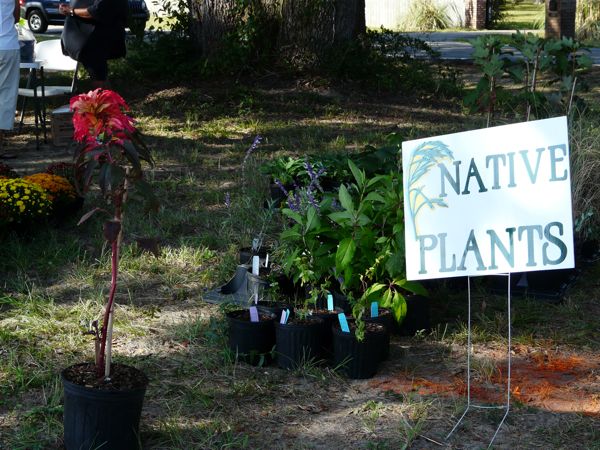
There was an experienced, knowledgeable and enthusiastic Master gardener about every ten steps at the sale, and we could ask all the questions we ever wanted, and they just loved talking with us and giving all the answers. Free! There was no admission charged, the plants were reasonably prices (and many were very cool plants) and it was just a great place to pass a Saturday morning.
We’ve been told the Spring Sale is THE best sale – we can hardly wait.
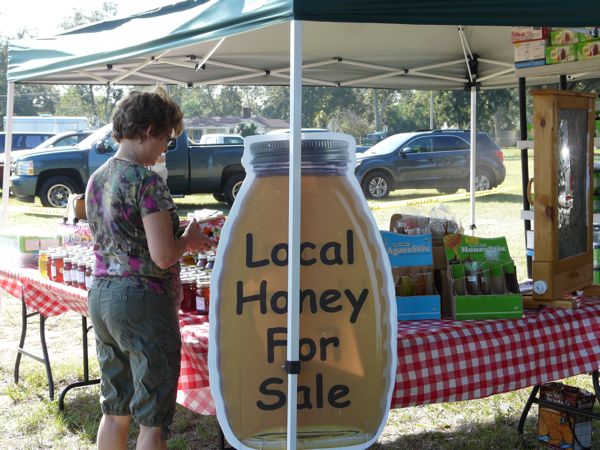
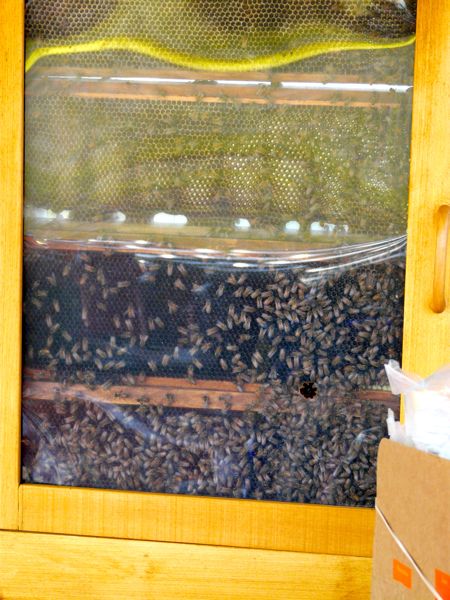

When we left, AdventureMan said “Every one of them seemed so comfortable in their own skin.” I think he is right. I think working in the earth with your hands helps ground you. 🙂
The Master Gardeners are those people you find in Home Depot and Lowes, giving information on gardening in Florida, and at special booths at Arts Fests, in the schools, and working the beds at the County Extension office. They are volunteers. They do this work for the love of making the world a more beautiful place.
The Butterfly House
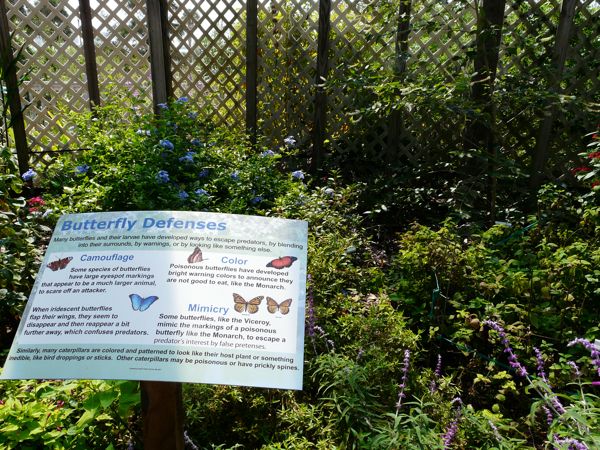
Our next stop was the Monarch Madness festival at the Panhandle Butterfly House in Navarre, where there was also an Arts Fest in progress. The volunteers at the Butterfly House all wore these terrific T-shirts with a caterpiller on the front and Monarch butterfly on the back. They had a great system, too, for getting a lot of people through the butterfly house in an organized and civil way, still giving people a lot of time to ask questions, and with lots of really cool activities for children to do, to help them understand the life cycle of these beautiful and short-lived creatures.





The Manna Food Pantries, Pensacola
I’m lucky. I work on a church committee where the chair brings in representatives from all the major charities in Pensacola to talk with us about what they do. The Manna Food Pantries is, in my humble opinion, a poster-child for how a non-profit should operate. Providing food for those who are hungry, for those going through tough times – and there are more than you might think – is truly part of God’s work for us here on earth. Manna Food Pantries collect and distribute food to the hungry. This morning, we had two Manna vans at the church and people were bringing in their full bags to donate.
It’s been a very tough year in Pensacola. The tough times just go on and on. You can prepare for tough times, save your money, gather your resources, but when tough times linger, sometimes those resources run dry. Manna has been faced with just such a time; resources are drying up, donations were down and the need is greater than ever. Manna hit the front page this week two days in a row, and is getting great coverage on radio, in the churches, in social groups – they are very very good at getting the message out, and the message is clear: We need your continued support, food, money, now more than ever.
They are brilliant at managing their volunteers, and many have been with them for years and years.
All these organizations are only able to exist because people believe in giving of their time and efforts in the hopes of making the world a little better, a little more beautiful, a little more peaceful, a little more hopeful – one person at a time.
Where are you going to put your efforts? What organizations do you support – and why?
Ann Patchett: The Patron Saint of Liars
I didn’t expect to like this book as much as I did. The main character is odd, a woman who doesn’t really think things through clearly, and somehow doesn’t even really know what she is feeling.
She gets married, and three years later, pregnant, decides “the marriage isn’t working” and leaves her husband, with a note saying only that the marriage isn’t working. We’ve been with her when she met him and fell in love, and she seemed to love him OK, and their lives together seemed to be OK, but somehow, she had to leave. I didn’t understand it when it happens in the book, and I never did understand it. The author tells us that Rose is a private person.
Rose drives from California to Tennesee, to a home for unwed mothers, where she bears a child, whom she keeps. Most of what she does seems to be on automatic pilot. I never really understand what Rose wants, only that she is aware that this isn’t it.
The story is told from three different points of view, and at no time did I have a clear idea of what motivated the main character, Rose. You can’t help but love her husband, Son, and her daughter, and all the women who love Cecilia, and help raise her.
You do get was a rounded picture of people around her, the good sisters running the home for the unwed women, how the women who arrived changed over the years as our culture changed, and how you may not understand how a person’s mind is working but sometimes you can just find a way to accept that she is what she is, and get on with living your life.
I really liked the book, even though I was not taken with the main character. I can’t tell you too much without giving it all away. Read the book and tell me what you think.
Sign of the Times in Pensacola

Pensacola, with its mild climate, attracts a lot of the nation’s homeless. In an area with high unemployment and where the housing crisis has wreaked havok with the economy, people still find it in their hearts to be generous and compassionate.
There are united efforts to clothe and feed the homeless, and efforts to help them get off the street – if they want to get off the streets, and a lot of them don’t.
I wonder what funds Krispy Kreme gives – bus tickets home? A donut and a cup of coffee? Help with a mortgage payment? I thought it might give a glimmer of hope to someone down and out.
An Old Dented Bucket
THIS IS NOT MY STORY. 🙂 This is from my long time friend Kit Kat who passed it along to me and I loved it so much I want to share it with you:
THE OLD DENTED BUCKET
Our house was directly across the street from the clinic entrance of
Johns Hopkins Hospital in Baltimore . We lived downstairs and rented
the upstairs rooms to out-patients at the clinic.
One summer evening as I was fixing supper, there was a knock at the
door. I opened it to see a truly awful looking man. “Why, he’s hardly
taller than my 8-year-old,” I thought as I stared at the stooped,
shriveled body. But the appalling thing was his face, lopsided from
swelling, red and raw.
Yet his voice was pleasant as he said, “Good evening. I’ve come to
see if you’ve a room for just one night. I came for a treatment this
morning from the eastern shore, and there’s no bus ’til morning.”
He told me he’d been hunting for a room since noon but with no
success, no one seemed to have a room. “I guess it’s my face …. I
know it looks terrible, but my doctor says with a few more treatments
..”
For a moment I hesitated, but his next words convinced me: “I could
sleep in this rocking chair on the porch. My bus leaves early in the
morning.”
I told him we would find him a bed, but to rest on the porch.. I went
inside and finished getting supper. When we were ready, I asked the old
man if he would join us. “No, thank you. I have plenty.” And he held
up a brown paper bag.
When I had finished the dishes, I went out on the porch to talk with
him a few minutes. It didn’t take a long time to see that this old man
had an oversized heart crowded into that tiny body. He told me he
fished for a living to support his daughter, her 5 children, and her
husband, who was hopelessly crippled from a back injury.
He didn’t tell it by way of complaint; in fact, every other sentence
was preface with a thanks to God for a blessing. He was grateful that
no pain accompanied his disease, which was apparently a form of skin
cancer. He thanked God for giving him the strength to keep going…
At bedtime, we put a camp cot in the children’s room for him. When I
got up in the morning, the bed linens were neatly folded and the little
man was out on the porch.
He refused breakfast, but just before he left for his bus, haltingly,
as if asking a great favor, he said, “Could I please come back and stay
the next time I have a treatment? I won’t put you out a bit. I can
sleep fine in a chair.” He paused a moment and then added, “Your
children made me feel at home. Grownups are bothered by my face, but
children don’t seem to mind.”
I told him he was welcome to come again.
And, on his next trip, he arrived a little after 7 in the morning. As a
gift, he brought a big fish and a quart of the largest oysters I had
ever seen! He said he had shucked them that morning before he left so
that they’d be nice and fresh. I knew his bus left at 4:00 a.m. And I
wondered what time he had to get up in order to do this for us.
In the years he came to stay overnight with us, there was never a time
that he did not bring us fish or oysters or vegetables from his garden.
Other times we received packages in the mail, always by special
delivery; fish and oysters packed in a box of fresh young spinach or
kale, every leaf carefully washed. Knowing that he must walk 3 miles to
mail these, and knowing how little money he had made the gifts doubly
precious.
When I received these little remembrances, I often thought of a
comment our next-door neighbor made after he left that first morning.
“Did you keep that awful looking man last night? I turned him away!
You can lose roomers by putting up such people!”
Maybe we did lose roomers once or twice. But, oh!, if only they could
have known him, perhaps their illnesses would have been easier to bear.
I know our family always will be grateful to have known him; from him
we learned what it was to accept the bad without complaint and the good
with gratitude to God.
Recently I was visiting a friend, who has a greenhouse, as she showed
me her flowers, we came to the most beautiful one of all, a golden
chrysanthemum, bursting with blooms. But to my great surprise, it was
growing in an old dented, rusty bucket. I thought to myself, “If this
were my plant, I’d put it in the loveliest container I had!”
My friend changed my mind. “I ran short of pots,” she explained, “and
knowing how beautiful this one would be, I thought it wouldn’t mind
starting out in this old pail. It’s just for a little while, till I can
put it out in the garden.”
She must have wondered why I laughed so delightedly, but I was
imagining just such a scene in heaven.
“Here’s an especially beautiful one,” God might have said when he came
to the soul of the sweet old fisherman. “He won’t mind starting in this
small body.”
All this happened long ago – and now, in God’s garden, how tall this
lovely soul must stand.
The LORD does not look at the things man looks at. Man looks at the
outward appearance, but the LORD looks at the heart.” (1 Samuel 16:7b)
“Love Your Enemies and Pray for those who Persecute You”
Today’s reading in The Lectionary is the heart of the Christian faith. Jesus told us many things that turned the world upside down. If we as Christians, truly practiced the teachings of the Christ, what a different world this would be:
Matthew 5:38-48
38 ‘You have heard that it was said, “An eye for an eye and a tooth for a tooth.”
39 But I say to you, Do not resist an evildoer. But if anyone strikes you on the right cheek, turn the other also;
40 and if anyone wants to sue you and take your coat, give your cloak as well;
41 and if anyone forces you to go one mile, go also the second mile.
42 Give to everyone who begs from you, and do not refuse anyone who wants to borrow from you.
43 ‘You have heard that it was said, “You shall love your neighbour and hate your enemy.”
44 But I say to you, Love your enemies and pray for those who persecute you,
45 so that you may be children of your Father in heaven; for he makes his sun rise on the evil and on the good, and sends rain on the righteous and on the unrighteous.
46 For if you love those who love you, what reward do you have? Do not even the tax-collectors do the same?
47 And if you greet only your brothers and sisters,* what more are you doing than others? Do not even the Gentiles do the same?
48 Be perfect, therefore, as your heavenly Father is perfect.
If YOU were to pray for your enemies, who would you pray for?
I tried it one time, almost as a challenge to God, I didn’t believe it would change anything but I would do it because it was required – and it turned out well – for God. When you pray for your enemy, you open a door for change to happen, unexpected change, miraculous change, transformational change.
As a young woman, I studied power and it’s application, reading books from many cultures on strategies of winning. This gospel summarizes a totally unexpected and wildly successful use of the spiritual power in each one of us, the God-given power to turn evil to good, to bring friendship out of enmity.
So today I challenge you. Is there someone in your life whose very presence makes you miserable? Pray for that person. As often as that person comes to mind, send up a prayer. I challenge you to see what happens in your life.
“We All Have Red Blood in Our Veins”
I joke with my bible study group that God kept sending me back to the Middle East until I ‘got’ what he was trying to tell me. The dilemma now is how do I share this? When my Christian friends see Islam as the great enemy, how do I tell them that some of the best Christians I know are Muslims?
Sunday, at Christ Church in Pensacola, Father C. Neal Goldsborough gave a sermon on loving one another, a “who is my neighbor?” sermon. He is only the second priest I have ever met who mentioned Osama bin Laden, that we have to forgive him and to love him. The first time, it was in a military church, and the gasp was audible. What a courageous priest! Imagine, going among the warriors and telling us we have to love our enemy! Imagine!
Living in the Middle East, living in Tunisia, Jordan, Saudi Arabia, Qatar and Kuwait, I was greatly blessed. My friends were of all nationalities, and I learned one great lesson – we all have red blood in our veins, and we all share more similarities than we do differences. I try to texplain to my friends here by telling small stories of my experiences. I blog a little about them. We are all God’s children, and we create needless barriers when we draw lines that say the equivalent of ‘our way is the right way and you way is not.’
This is from today’s Forward Day by Day meditation for today:
Today’s Meditation
Tuesday, february 22
Ruth 1:15-22. Do not press me to leave you or to turn back from following you! Where you go, I will go; where you lodge, I will lodge; your people shall be my people, and your God my God.
During political upheaval and mounting racial tensions, we were having a Bible study at home. A Fijian woman came in great distress. She was from a rural area that grew sugar cane. She had grown up alongside people of another ethnic group. They were her friends. She could not understand why people were being victimized because they were of another ethnic group. She was so disturbed she had to be taken aside. She kept clutching her arm. “We have red blood in our veins. We all have red blood in our veins!” she repeated, weeping.
In the scripture we have the moving words of the widow Ruth to the widow Naomi, whose son Ruth had married. Ruth and Naomi had in common that they were bereaved, but Ruth was a Moabite, whereas Naomi was from Bethlehem. Naomi shows kindness to Ruth, and Ruth proves loyal to Naomi—a loyalty that goes beyond narrow family blood ties.
We are all God’s children. Today I give thanks for strong bonds of friendship. I give thanks for loyal friends who are not of my ethnic group.
‘Lost Boy’ Casts Vote for Independence
I found this today on NPR News and it delights me for a number of reasons. For one thing, I didn’t know David Eggars (you remember him from Zeitoun) had helped with the writing of ‘What Is The What?’. Second, who knew that any of these kids would survive? Survive, write a book, thrive, go back to the Sudan, give to the country – and vote. Every now and then in this sad world you hear a good story. This is one.
January 10, 2011
During Sudan’s civil war, in which some 2 million people died, Valentino Achak Deng fled to Ethiopia on foot. Separated from his family for 17 years, Deng is one of Sudan’s so-called Lost Boys, children who were orphaned or separated from their families during the brutal war.
Now, voting is under way in Southern Sudan in a referendum that is expected to split Africa’s largest country. Among those voting this week are the Lost Boys, including Deng, whose life became a best-selling novel in America and who has returned to his homeland to build a school.
After a peace agreement between north and south, Deng returned to Juba, the capital of Southern Sudan, in 2006. He says when he got there, the place was still a wreck.
“On some of these roads, you could see old war tanks. On some of these roads, in some neighborhoods you could see the bones and skulls of dead people,” he recalls now, driving around Juba.
Now, as Southern Sudan appears headed for independence, Deng is optimistic — and Juba looks a lot better. Paved roads, now lined with hotels and restaurants, arrived for the first time in 2007.
Juba is a booming city, one of incredible contrast: Barefoot women selling piles of gravel by the side of the road sit next to a Toyota dealership.
Peace is spurring investment and consumer demand. Juba’s growth is driven by Southern Sudan’s oil revenue as well aid from foreign governments and nongovernmental organizations.
Deng grew up in a tiny village called Marial Bai. In the 1980s, northern bombers and Arab militias came.
“They bombed Marial Bai, destroyed it, killed everything, burned crops and livestock,” he says.
Deng was there when the fighting came. He says he “ran away with the rest.” He was 9 years old.
Deng joined thousands of Lost Boys, who spent months trekking across Sudan to refugee camps in Ethiopia. His experience is captured in What Is the What, a novel by Dave Eggers, which reads like a modern-day story of Job.
The boys, some naked, march across an unforgiving landscape, facing Arab horsemen, bombing raids, lions and crocodiles.
Deng eventually resettled in the U.S., where he attended college and was mentored and sponsored by ordinary Americans.
In 2007, he returned to start a high school in Marial Bai, where there was none.
“We have 250 students. Our annual budget now stands at about $200,000 because the school is free,” he says.
The school is funded by Deng’s private foundation. He says most donations come from Americans touched by his story and the plight of Southern Sudan.
Deng, now 32, has just cast his vote for independence. He says that for a Sudanese child of war, his life’s journey is almost inconceivable.
“I never imagined I would be the person I am right now,” he says.
The Gift
AdventureMan and I used to have lavish Christmases, trying to delight one another, and we did. One year, I bought his some crystal goblets he had been admiring, and some years I was able to add to his collection. One year, he bought me a Mont Blanc pen, which I adored, and another year two beautiful salad serving bowls with irises in them. (I still have them and delight to use them.)
This year, he gave me the best gift of all. I was working on a committee in our church, helping to make sure children we had volunteered to sponsor in the Salvation Army angel program received gifts of clothing and a toy or bike or age-appropriate gift. There were a few children at the end who had not found sponsors, but other people had chosen to donate cash or checks in lieu of sponsoring a child.
As we were getting ready for church, AdventureMan told me he had an idea for my Christmas gift, but he wanted to run it by me.
“How about if I make a donation to the Angel Tree, to help sponsor the kids who don’t have sponsors?”
He took my breath away. He can still do that.
We are not rich, we are modestly comfortable. We have always lived within our means, and placed a high value on saving. We have a comfortable home, enough to eat, and we keep our spending under control so that we even continue to grow our savings a little while we are now ‘retired.’ There is nothing I need for Christmas.
I’m still grinning from the grandness of his gift; the delight it continues to give me every time I think about it.
The Salvation Army has one of the lowest rates of administration funds to charitable funds of all the charities in America. They make every dollar you donate squeak, they work it so hard. They feed the poor, they give hope to children, they comfort the homeless and veterans, and they counter pornography and human trafficking (Yes. It happens in America, too.)

To find out how you can help this organization which helps so many, so generously, just click on the blue type Salvation Army and it will take you to their home page. There are many options for giving, including donations, giving of your time and energies as a bell ringer, or working with them in a variety of human services.
Recent Comments
ExpatAlien on What Country am I Living … intlxpatr on Yellowstone: Old Faithful to C… Michelle on Yellowstone: Old Faithful to C… Cathy on No Grown-Ups in Charge intlxpatr on Waiting for Snow Wikipedia Donate Button

Amazina


Early Voting in Florida


 Here There and Everywhere