Jesmyn Ward and Salvage the Bones

You are fifteen, poor, black, and motherless as this book opens. Dad drinks, and isn’t around much. You are the only girl in a family of brothers. Having sex is no big deal, and there is one guy you really like, Manny.
Your oldest brother’s pit bull is having puppies, and you are having trouble with throwing up most of what you eat, especially every morning. Dad says a hurricane is coming, but he’s said that before, no big deal.
As this book opens, it has the feel of a myth of the nightmare kind. We know, because we have the benefit of hindsight, that the impending storm, Katrina, will be catastrophic. The Batiste family has already suffered a catastrophic storm with the death of their Mama, just after the birth of her last child. Throughout the book, we watch these children suffer the daily absence of their mother, raising one another, squabbling, but tenderly looking after one another.
If someone had told me about this book, I don’t think I would have wanted to read it. Amazon.com kept telling me I needed to read it, so finally, I did. From the opening page, I was in a world utterly alien from my own, and yet a world I could understand and inhabit. There are worse things than being poor, and one of them is heartless. This family has heart; they are loyal to one another, they look after one another and they sacrifice for one another. For all the violence – and there is a lot of violence – there is also beauty.
There is the familial love, and there is the love between Skeet, the oldest brother, and his dog, China. There is friendship, and good people who give you refuge in the aftermath of the storm. There is the stunning numbness of surviving the worst hurricane ever.
Jesmyn West has a deft touch, with the language, with the interweaving of the Medea myth, with non-verbal communication, with the complexities of families and love. This is a book worth reading.
Hardest Day of the Year
Today is beautiful, after endless days of clouds and rain, clear, sunny, not quite so hot, yes, the pollen is flying about, but all in all, not such a bad day.
And yet, the hardest day of the year, the church year.
Our Gospel reading for today, from The Lectionary:
John 13:36-38
36 Simon Peter said to him, ‘Lord, where are you going?’ Jesus answered, ‘Where I am going, you cannot follow me now; but you will follow afterwards.’ 37Peter said to him, ‘Lord, why can I not follow you now? I will lay down my life for you.’ 38Jesus answered, ‘Will you lay down your life for me? Very truly, I tell you, before the cock crows, you will have denied me three times.
In my walk as a Christian, I am struck at how often his disciples, those who walked with Jesus, lived with Jesus, believed in Jesus and served Jesus with all their hearts – how often they misunderstood Jesus. He often had to correct their idea of what he was trying to tell them about life, about the kingdom of heaven. Peter, one of his earliest disciples, one who loves Jesus utterly, is about to deny his Lord and Master three times.
On Good Friday, we are all Peter.
“You Brought the Sunshine!”
When I arrived in Seattle, my best friend from University said “You brought the sunshine!”

(This week’s weather in Seattle)
Now, when I fly back to Seattle, it takes a mere half day, not a day and a half. When I leave early enough, I can arrive mid-day, and beat the rush hour traffic. You’d think after driving in Kuwait and Qatar that I would find Seattle traffic tame, but Germany, with it’s wide-laned autobahn, and Pensacola, with it’s laid back version of going-home traffic have spoiled me.
Seattle is beautiful, although my trip is one of those more stressful ones, with things to be done to manage changing circumstances. My Mom may – or may not – have had a stroke. What is verifiable is that she has been very very sick, too sick to live on her own any longer, sick enough to need hospitalization, and professional monitoring from now on. The sisters have handled mountains of work and desperate calls for assistance, and now it is my turn to do what I can.
I stayed in Mom’s condo, but it was a little soulless, all her favorite pieces of furniture moved to her new place, her plants languishing, the stuff and detritus of life waiting to be cleared out.
Thank God for my best friend, and for the sunshine.
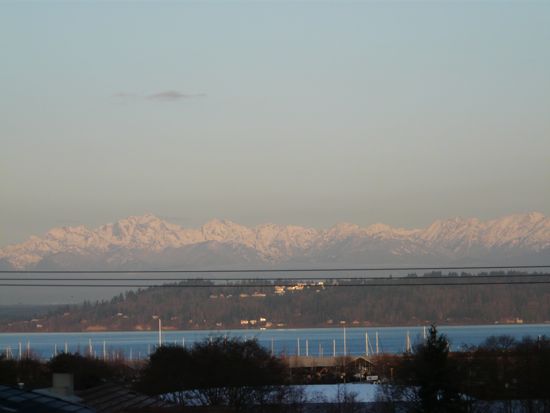
The sun just beginning to color the mountains as it rises off in the east.
The sisters had a full day of business, money, finances, and Mom’s recovery plan. We get a little goofy after a while; it’s a family culture. Our way of handling the worst, worst of times is laughter, and there were several times we were almost breathless from laughing. Yeh, I guess some would find it inappropriate, but for us, for our family, I think it is how we survive.
My second day there, we had a joyful family wedding. It was one of the sweetest events I have attended in a long time, and I loved the way the bride and the groom looked at each other, that they enjoyed their own wedding, smiling, laughing, dancing. Their signature was over everything; the colors (Purples!) and the food and the music and the ceremony, it was all perfectly thought through and delightful.
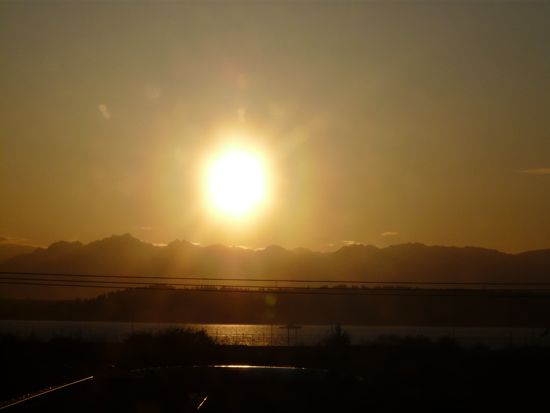
Sun setting in the west over the Olympic mountains
The rest of the trip was just hard work. And now, back in Pensacola, I have flights booked already for my next trip back. All part of life’s circle, I guess.
Through all this, we have met with kind, helpful people, who have made all the sorting out easier. Thanks be to God.
Driving in Qatar
Almost every day, the two articles garnering the greatest number of hits have to do with new traffic rules in Kuwait and in Qatar. I think I wrote the posts in 2009. Here is what the US Department of State has to say to US Nationals about driving in Qatar:
TRAFFIC SAFETY AND ROAD CONDITIONS: While in Qatar, you may encounter road conditions that differ significantly from those in the United States. The information below concerning Qatar is provided for general reference only and is subject to change at any time. Current traffic regulations may be obtained through the Ministry of Interior’s Traffic Police.
Short-term visitors should obtain a valid International Driving Permit prior to arrival and should not drive in Qatar on a U.S. driver’s license. New and prospective residents should obtain a permanent Qatari Driving License immediately after arrival. To obtain a Qatari driver’s license, U.S. citizens need to pass a driving exam, including a road test. Short-term visitors and business travelers can also obtain a Temporary Qatari Driving License by presenting their U.S. driver’s license at any branch of Qatar’s Traffic Police.
Traffic accidents are among Qatar’s leading causes of death. Safety regulations in Qatar are improving, thanks to a more stringent traffic law adopted in October 2007 and a country-wide traffic safety campaign. However, informal rules of the road and the combination of local and third-country-national driving customs often prove frustrating for first-time drivers in Qatar. The combination of Qatar’s extensive use of roundabouts, many road construction projects and the high speeds at which drivers may travel can prove challenging. The rate of automobile accidents due to driver error and excessive speed is declining but remains higher than in the United States. In rural areas, poor lighting, wandering camels and un-shouldered roads present other hazards.
Despite the aggressive driving on Qatar’s roads, drivers should avoid altercations or arguments over traffic incidents, particularly with Qatari citizens who, if insulted, have filed complaints with local police that resulted in the arrest and overnight detention of U.S. citizens. Drivers can be held liable for injuries to other persons involved in a vehicular accident, and local police have detained U.S. citizens overnight until the extent of the person’s injuries were known. Due to its conservative Islamic norms, Qatar maintains a zero-tolerance policy against drinking and driving. Qatar’s Traffic Police have arrested Americans for driving after consuming amounts of alcohol at even smaller levels normally accepted in the U.S.
Any motor vehicle over five years old cannot be imported into the country. For specific information concerning Qatari driver’s permits, vehicle inspection, road tax and mandatory insurance, please contact either the Embassy of the State of Qatar in Washington, DC or the Consulate General of the State of Qatar in Houston, Texas.
There are things that the Department of State is too diplomatic to tell you, and that people living there will not write for fear of having a travel ban put against them, a case filed against them for ‘insulting’ a national or the government.
The beautiful roads in Qatar were wonderful when they had a tenth of the cars on the road they have now. There are two categories of “most dangerous.” One category is the expat $200 car held together with gum and rubber bands that breaks down in the worst possible place, or has a blow-out, or hits someone because the driver not only doesn’t have a license, he also doesn’t know how to drive.
Although there are rules about what trucks are allowed to haul and how it is to be tied down, the laws are ignored and unenforced. It is still important never to travel behind or beside a truck carrying cement blocks. They look like they are not secured. They are not secured. Watch out, too, for any truck delivering bottled water (that makes a huge mess all over the roundabout) or sheep or cows, which regularly overturn.
The worst hazard of all is Qatari male drivers between 11 and 35 years old. They own the roads. They will drive on the sidewalks, down the wrong way of a six lane highway to get to the roundabout, through red lights. They will push you into an unsafe roundabout with the Hummer daddy bought for their 12th birthday. If you insult a Qatari young male driver in any way, they may block you, stop you and threaten you, and no one, least of all the police, will come to your aid. They know no speed limits, blow through stop lights, harass female expat drivers, and they pay no fines for traffic violations. For a short time, the law was applied somewhat equally to all, but there were so many outraged Qataris paying the humungous fines that no one enforced the law against the Qataris anymore, and you rarely see the police stopping anyone except the poorest of the poor.
If you want to drive in Qatar, you will want a sturdy car to get over the unpaved areas and the roads torn up for infrastructure improvements, as well as for protection against the aggressive Qatari male drivers and the accidents that may not be your fault but cannot be avoided. You will want to drive only during the lowest traffic times of the day, if possible. Even during the summer, when much of the population goes elsewhere, anywhere, to avoid the heat, night traffic on the major ring roads, the major arterial roads and on the Corniche is gridlock.
The Department of State will also not tell you that if you are ever in trouble on the road, you are certain to have many kind older Qatari men stop and render assistance. They will insist on giving you water, and fixing whatever they can fix, or at the very least waiting with you until help comes. If they think you are lost as you journey around Qatar, they will make sure you get where you are going. There is a long tradition of taking good care of the guest, and of civility among the Qataris, but mostly it seems to kick in when they mature – like around 35 or so.
This may not be the truth for everyone; we all have our own stories, horror stories and stories of kindness. It’s a little bit of the wild west, driving in Qatar.
Unity in Diversity
As so often happens, when I read Forward Day by Day, an illumination of the daily readings in the Lectionary, I think “Oh! This is meant for me.”
My heart is heavy as the Syrian peoples in Homs and Hama are bombarded, and babies, children, mothers, non-combatants – all are killed, whether they are fighting or not. I remember the shivers as we would pass the headquarters of the Mukhabarat, or secret police, which we called ‘the fingernail factory’ and I am shamed at our shallowness and callowness, as the reality of people tortured and damaged just for the example of it. While I know that the troubles are political, they are following religious lines. Homs and Hama have always resisted the rule of the Alawites, and have suffered horribly, 30 years ago, at the hands of Bassam Al-Assad’s father, who almost leveled Hama. I know, because I visited there shortly afterwards. It was a silent ghostland, a beautiful city, deserted and haunted.
Who is next, Assad? After the cities of Homs and Hama – oh, and don’t forget Deraa – will you start hitting the Christian villages, even though the Syrian Christians are at the very least, neutral, and many support you? The monster of tyranny is not easily sated, and to survive, there must be constant sacrifices to keep the people in fear, or else they won’t be obedient.
This is all heavy on my heart. I lave loved Syria, all of it, not just Damascus. When will we learn to live in peace with one another?

(Image of Hama from WikiMedia)
John 17:20-26. The glory that you have given me I have given them, so that they may be one, as we are one, I in them and you in me.
This verse is taken from the so-called high priestly prayer of Jesus for the unity of the church. What is our understanding of unity in the church? From the outset there was a great diversity of Christian groups. Diversity arose from differing practices and religious customs as well as from the difficulty of interpreting authentically the mystery of the person of Jesus.
What is meant by the unity of all Christians? An imposed uniformity in which everyone must bow their heads and obey without freedom of expression and cultural variations? That would be more harmful than beneficial. That idea persisted for a long time and led to the imposition of strict uniformity in religious practice worldwide. It was pernicious.
Today we realize that there can be unity in diversity. It is important to highlight the diversity of cultures while maintaining unity. The unity that Jesus wanted was based on love, compassion, and mercy—not uniformity.
PRAY for the Diocese of Bukuru – (Jos, Nigeria)
Ps 30, 32 * 42, 43; Ezekiel 39:21-29; Philippians 4:10-20
Depends Who Writes the Obituary . . .
I am sorry, but this totally cracks me up. I found in on AOL Huffpost and it is about a Tampa family, where the one writing the obituary gets to insert his point of view. We all have families; they each have their points of view.
When I am reading the obituaries, the ones that crack me up are the ones who have clearly written their own obituaries and had them ready to go when their time is up. Many of the ones written by men are a little grandiose, the ones written by women are more matter-of-fact. You can usually tell what they found most important about the life they lived. Now and then, you find someone original, with a sense of humor and proportion about themselves, who talk about hunting, or their dogs, or sailing. There are people I wish I had met when I read their obituaries; maybe we should all publish pre-death summaries of our lives so far . . . Oh wait . . . that’s a blog, LOL!
When AdventureMan says “that’s not how I remembered it!” I always say (you’ve heard it before, you can say it along with me) “Get your own blog, AdventureMan!” But it is true, the one who is doing the blog gets to skew the history, LLOOLL!
By Laura Rowley
One of my first assignments in my first real job in journalism was writing obituaries for The Milwaukee Journal. I found it a little daunting at first, this job of writing about the dead. But that changed after a phone call with a woman whose daughter had died in a car crash overseas with her husband and toddler.
It was my job to call the family for the story, and I assumed the mother would hang up on me. Instead she spoke for an hour, sobbing, telling me stories about her extraordinary daughter and son-in-law, and the grandchild she had barely gotten to know. At the end of the call she said, “Thank you, my husband won’t talk with me about this.”
In every call I made after that I had a different attitude. I realized that the obituary is a place where ordinary people have the opportunity to honor the people they love in a very public way.
That is, unless the survivor is self-centered enough to believe the obituary is about him, as appears to be the case with Angelo “A.J.” Anello of Florida. Anello placed an obituary for his mother Josie, who died on February 11, taking the opportunity to insult his siblings Ninfa and Peter with the following line:
“She is survived by her Son, ‘A.J.’, who loved and cared for her; Daughter ‘Ninfa’, who betrayed her trust, and Son ‘Peter’, who broke her heart.”
The source of this rivalry between these post 50 siblings? Money. Ninfa Simpson told the Tampa Bay Times that her brother A.J. became more controlling over their mother once their father died, which A.J. denied. The two told the paper that the third sibling, Peter, has been estranged from the family for more than 25 years. The Tampa Bay Times also reported that:
Simpson says Anello drained the mother’s savings and maxed out her credit cards. Anello says Simpson and her husband used their mother’s Social Security checks to go on vacations to Branson, Mo., and Alaska.
Both siblings deny the other’s allegations.
A.J. told the Tampa Bay Times that he was merely conveying what his mother said through the obituary; nevertheless, an alternative version of Josie Anello’s obituary — which does not include evidence of the siblings’ feud — has also been published.
What do you think about Josie Anello’s obituary? Let us know in the comments, and watch the below video to hear more about this unbelievable family rift.
Cramming for the Exam
“I’m cramming for my exam” I said to AdventureMan, as he eyed my plate full of vegetables and my WonTon soup broth.
“What exam?” he asked.
“I have a follow up with Dr. Internal Medicine, and I need to get my blood tested in two weeks. In two weeks I can make sure my cholesterol and blood sugar and blood pressure are all in line,” I told him.
My sister, Big Diamond, told me that it only takes two weeks of proper eating to get the numbers right. I did it last time and it worked. Now and then, between exams, I eat something too sweet, or too white, or too high on the glycemic index, but not the two weeks before my blood test! No no no!
Whoda thunk I would reach this ripe, mature age and still have to worry about exams?
Scanning Obituaries
Who knew? I certainly didn’t, and yet I find that I’m not alone. AdventureMan does it, too, and other friends. One friend says she thinks she scans the obituaries to celebrate the fact that she is still alive. That may be it for most of us, but in addition, I find that there are people living among us with amazing histories, and we don’t even know. Sometimes when you read an obit, you can tell that the person wrote it himself or herself, and what that person considered important in his/her life. Sometimes the obituary is not very loving.
Southern newspapers, in my experience, are much richer in extraordinary detail that newspapers in bigger cities, like Seattle. In bigger cities, only the rich and famous or notorious get much space; it may be that the space is far more expensive in the bigger cities, or that families are less willing to shell out from the estate for the bigger coverage. Southerners value family, and history; it’s a part of the culture.
Yesterday, when I took the Pensacola News Journal in to AdventureMan, I had circled something in one of the obituaries, knowing that he, like me, only reads them now and then. I didn’t want him to miss this line:
(Name) was a Past Mighty Chosen One of the Zelica Daughters of Mokanna, Ladies Auxiliary to the Grotto.
Holy smokes! I thought it might be one of the Mardi Gras Krewe things, but AdventureMan googled, and discovered that is a Masonic offshoot, and their larger groups are called Cauldrons. (!)
In America of the early 1900’s, social affiliation groups were important. People belonged to religious groups like Knights of Columbus, Ladies of the Church, etc, quasi-religious groups like Masons and Shriners, and social groups like the Elks and Moose and Lions Club. Some groups still exist, and are still going strong, like Rotary Club, and special interest groups. In Pensacola, there is a Tea Party AND a Coffee Party. There is a Philipino-American Republican Club. When people gather together regularly to share something in common, they can form a group. All of these groups help people be connected in their communities and in their lives, and help people to look after one another.
I belonged to a group once that called ourselves the Aqua-Babes. To be perfectly honest, we might not be total babes, but hey – it’s our group, we can call ourselves what we want, right?
But oh, my, to be a Mighty Chosen One . . .
Happy Two Years Old
I remember when they were called the Terrible Twos . . . but, at two, our little Happy Toddler is a delight:
He is so delighted to be able to communicate. We can hear him in his car seat, practicing his pronunciation, so people will understand what he says. Two weeks ago, he was patiently trying to communicate something to us, and we thought he was asking about the garbage can, but he was asking about his car blanket. Now “car blanket” is clear, and daily he gathers more and more vocabulary. “Stuck!” he chortles! “Bubbles!” “Tractor!” “Door OPEN!”
We laugh with glee to see his delight at our comprehension.
There are other times he cracks us up. “What color is this?” we ask, and he says “Lello,” but he isn’t even looking. He doesn’t really care much what color it is. If we say “no, it isn’t yellow” he might say “red” or “geen” or “boo” but he isn’t looking and he doesn’t care. The-Grandmother-who-lives-on-color hopes that this is just a passing phase, and that one day he will care whether it is carmine or flaming or blood or cherry or claret . . .
He walks boldly, he runs exuberantly, he skips, he dances, he climbs; he is a very all-boy boy. He has a dignity all his own, and a confidence that he is greatly loved. We thank God for this little grandson.
Abraham Buys a Cave and a Field
When I was an undergrad in college, I was majoring in political science, and there weren’t a lot of women in the field. You’d think that would be heaven for a young woman, but many of these political scientists had political aspirations, or an ax to grind, and were constantly standing up and making speeches. It was annoying; I needed some balance, so I took on another major, in English Literature, to give my academic life some balance.
It’s not like that was without its own problems; English Lit was full of these really OLD women, like in their thirties, who had come back to school to earn or finish up a degree, and they took it seriously. Aarrgh! Didn’t they know that this was university? This was supposed to be fun? Having those women in class competing for grades forced the rest of us to work harder . . . not such a bad thing.
One of the things you learn in studying Lit is that there are things that are important, or the author wouldn’t include them. As I read today’s Old Testament reading from The Lectionary, I found myself reading as literature, asking “where is the significance?” “why was this story included?” The Hittites are so very gracious to grieving Abraham; they sound like loving friends. Abraham insists on paying for the land, the cave where Sarah would be buried. Why was it so important to pay for the land? Was it so that there would be no question later as to whether the land was his?

Genesis 23:1-20
23 Sarah lived for one hundred and twenty-seven years; this was the length of Sarah’s life. 2And Sarah died at Kiriath-arba (that is, Hebron) in the land of Canaan; and Abraham went in to mourn for Sarah and to weep for her. 3Abraham rose up from beside his dead, and said to the Hittites, 4‘I am a stranger and an alien residing among you; give me property among you for a burying-place, so that I may bury my dead out of my sight.’ 5The Hittites answered Abraham, 6‘Hear us, my lord; you are a mighty prince among us. Bury your dead in the choicest of our burial places; none of us will withhold from you any burial ground for burying your dead.’ 7Abraham rose and bowed to the Hittites, the people of the land. 8He said to them, ‘If you are willing that I should bury my dead out of my sight, hear me, and entreat for me Ephron son of Zohar,9so that he may give me the cave of Machpelah, which he owns; it is at the end of his field. For the full price let him give it to me in your presence as a possession for a burying-place.’ 10Now Ephron was sitting among the Hittites; and Ephron the Hittite answered Abraham in the hearing of the Hittites, of all who went in at the gate of his city, 11‘No, my lord, hear me; I give you the field, and I give you the cave that is in it; in the presence of my people I give it to you; bury your dead.’ 12Then Abraham bowed down before the people of the land. 13He said to Ephron in the hearing of the people of the land, ‘If you only will listen to me! I will give the price of the field; accept it from me, so that I may bury my dead there.’ 14Ephron answered Abraham, 15‘My lord, listen to me; a piece of land worth four hundred shekels of silver—what is that between you and me? Bury your dead.’ 16Abraham agreed with Ephron; and Abraham weighed out for Ephron the silver that he had named in the hearing of the Hittites, four hundred shekels of silver, according to the weights current among the merchants.
17 So the field of Ephron in Machpelah, which was to the east of Mamre, the field with the cave that was in it and all the trees that were in the field, throughout its whole area, passed 18to Abraham as a possession in the presence of the Hittites, in the presence of all who went in at the gate of his city. 19After this, Abraham buried Sarah his wife in the cave of the field of Machpelah facing Mamre (that is, Hebron) in the land of Canaan. 20The field and the cave that is in it passed from the Hittites into Abraham’s possession as a burying-place.
Recent Comments
intlxpatr on Shampoo Ginger tigerbutterya0c5ff1d… on Shampoo Ginger intlxpatr on British Soldier Kidnapped, Esc… John on British Soldier Kidnapped, Esc… intlxpatr on British Soldier Kidnapped, Esc… Wikipedia Donate Button

Amazina


Early Voting in Florida


