Skinny and Scarred No More
Yesterday, as Zakat was sitting on my desk in the sunlight, watching cars go by, butterflies in the garden, whatever catches a cat’s eye, a ray of sunlight caught his skull and I saw tiny hairs covering his scars. I whooped for joy! Coming to us, one of his most distinguishing features was his scars, almost entirely circling his face.
We have had many cats through the years, most of which have stayed with us for 11 – 14 years. We have loved them all, but AdventureMan and I agree that this is the sweetest cat we have ever owned. There isn’t a mean bone in his body. He exists to love and be loved. Best of all, he is truly AdventureMan’s cat. He follows him around like a dog, sleeps touching him at night, and yearns, always, to be in his lap. I don’t mind. It is so adorable how much he loves AdventureMan.
The veterinarian, who treated him before we ever knew him, had told us it might happen. He said Zakat was in such poor condition that he hesitated to treat him, it almost felt as if it would be kinder to just put him down. His face was so infected, it was huge, distorted and swollen. But as painful as it must have been, Zakat was always a sweet cat. By the time we got him, his face was healed, the infection gone, but the scars were still fresh and raw.
We continue to go to the same vet. He has become an important member of our community of friends. He sees us often. Zakat is also FiV positive, which means he has the cat equivalent of AIDs. He is immuno-deficient, susceptible to infections other cats could easily fight off. In contrast to our sweet Pete, the Qatari Cat, we have to make sure Zakat eats; he needs good body weight to help him through the fevers and infections.

We got him through a good friend, who rescues abandoned and stray cats, neuters them, gets their shots and houses them while they search for a good home for these cats. We give thanks for their mission on a daily basis; one of the things they did was teach Zakat to take pills. It’s a good thing. He takes pills almost every day.
He pretty much stays on anti-biotics, so we also give him pro-biotics, to help his digestive system. He gets fevers. His skin breaks out in huge patches of itchy oozing pustules, which drive him crazy. He looses teeth. Sometimes one eye gets red.
Two weeks ago, the vet gave him a shot of cortisone to help with the itching, and a new course of antibiotics and pro-biotics. It was like a miracle. Within a week, there was no compulsive licking, no more outbreaks, no teeth loss, and this scars are starting to fuzz over. His coat is gorgeous. We are learning to dance for joy for every small gain, but this gain is monumental. For all appearances and behavior, he is a perfectly normal, healthy cat. We’ve had five wonderful days. It’s amazing just how good “normal” can be.
We know it won’t last, but for five days he has been totally well, thanks be to God.
AdventureMan Wept
Long ago, and far away, in the exotic Kuwait City, I started this blog, holy smokes, almost nine years ago in September. I met so many wonderful people, some of whom I’ve even become friends with in person. Others I still keep up with, in a comment here or there (LOL, Here There and Everywhere) or in a backnote, or on FaceBook.
Several months ago, I contacted one blogger, Aafke, whose very honest and very artistic blog I admired. We often commented back and forth in those days. I wrote about how outraged I was at a veterinary tech in Doha who told me my cat was the demon cat from hell, and I raged at how scared he must have been to have behaved so badly. Like, if you work with animals, you should know that! If you treat them roughly, they will respond! (Oops! I still get worked up revisiting it!)
Aafke loved the story, and did a painting, our sweet Pete as the demon cat from hell. There were some things I loved about it – moody purple background, a great representation of Pete. It sort of hurt my feelings that she painted him with horns and a forked tail, not my sweet Pete.
But as the months went by after Pete’s sudden and unexpected death following an operation that succeeded in its goals, but killed Pete, I thought about that painting so I wrote to Aafke, and asked if I could buy it. I thought it would make a good present for AdventureMan, for Father’s Day. She responded quickly, said she thought she knew where it was, and in the mean time, she also painted another, a really lush, beautiful portrait of a cat we dearly loved. She wouldn’t let me buy it, it was a gift.
So the paintings arrived, and I had them framed. They are small, exactly what I wanted. We don’t want a shrine; we want a sweet reminder. When I gave the beautiful one to AdventureMan, he wept. Aafke truly captured the sweetness of Pete. He hung it on his office wall, where he could see it from his desk.
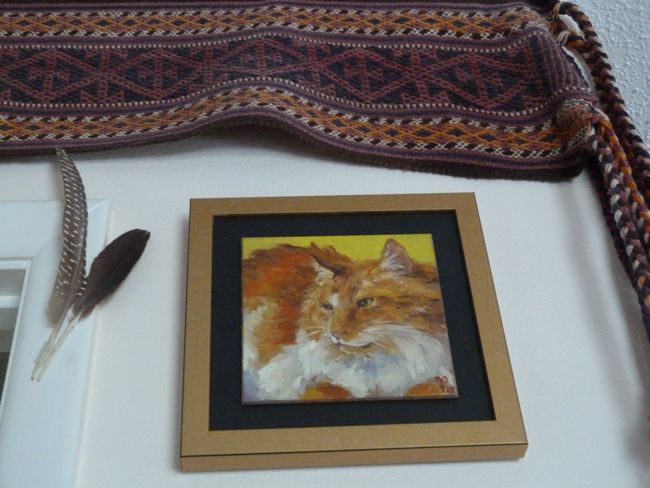
When he came into my office, he laughed. I have my painting just behind my chair where I write these posts. “You’ve got the devil cat looking over your shoulder!” he crowed with laughter!
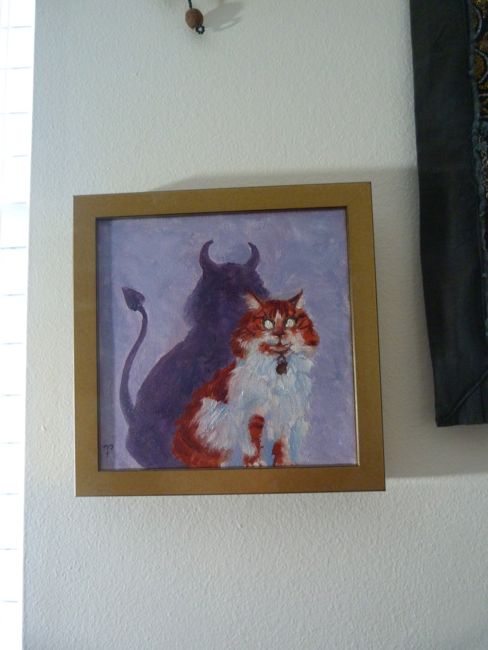
Yes! I do! We all have our sweet side, and our devilish side 🙂 Pete was no angel. He loved to escape, and he was fast. We loved him, warts and all, and this portrait makes me smile every time I see it.
Thank you, Aafke, for your beautiful heart that captures the nature of those we love.
A Dreary Day on One Of My Favorite Routes: I-10 San Antonio to El Paso
I was eager to drive this leg of our journey; I drove it the last time. AdventureMan had a cold and thought it was boring, but I loved the colors and the dryness and it was very much one of those zen zone kind of things for me. I-10 in West Texas is easy driving. Or it was the last time.
This day, it is an anomalous day in San Antonio, it varies only from heavy rain to downpour. As we hit the road, and I have to say, life is so much easier with Google Maps, and now that I’ve discovered the voice, I don’t even have to nag when I am navigating, she just tells us where to turn, and most of the time, gives us plenty of warning, tells us when there is going to be a left exit, tells us which lane we need to be in when exiting, etc. IF, on the rare occasion (LOL) we miss the right turn, she is very patient. She doesn’t even say “recalculating,” she just gets on with it, getting us to where we need to be. It takes a lot of stress out of driving in strange cities.
We wanted to get on the road early, as this is going to be one of our long days driving, and wouldn’t you know, the long day is this messy, rainy day?
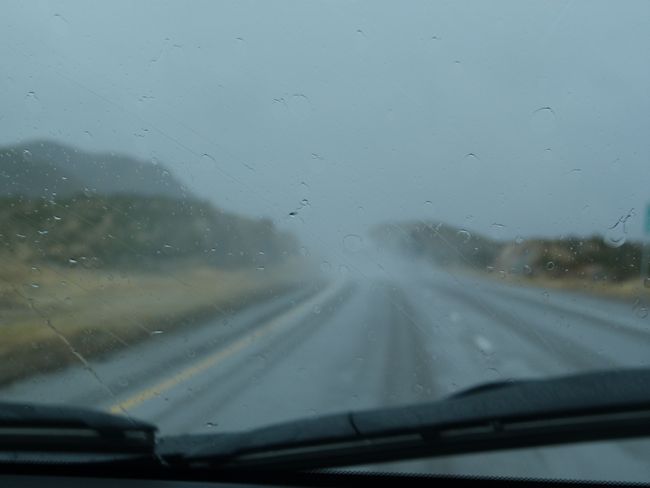
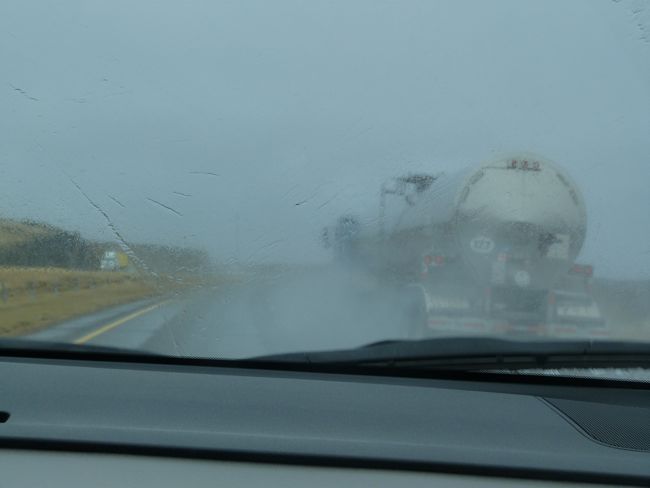
We really need some breakfast to fortify us for this drive, all this rain, all this low-visibility and all these racing trucks with sheeting water spilling off the tops. At one point, I am trying to pass a truck on a curve and AdventureMan is saying “Go! Go! Go!” and I can’t see a thing and I am on a curve and I have to drop back behind the splashing truck until I can get a straight-away and a clean pass.
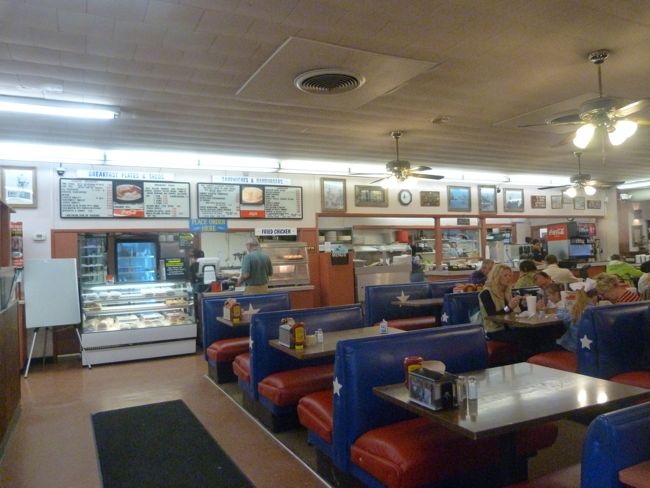
Thank God we find the Flag Stop, in Bjorn, just outside San Antonio.

AdventureMan and I diverge. I had a great breakfast, very traditional, eggs, bacon, and coffee. The coffee was surprisingly good, and the eggs and bacon were fine. Filling, tasty, cooked pretty well. I mean, it’s breakfast, it’s a truck stop. He had biscuits and gravy, and it did not meet his standards.
On this route, there are a lot of areas that are very rural, without a lot of stopping places for gas. At one point, when we were beginning to get nervous, we came to a gas station but the gas was marked way up. We thought we’d drive a little to see if there was a station in the town, and quickly came to a sign that said “no further services” meaning NO GAS. So we went back to the highway robbery place and bought gas, happy to have gas. We ran into a couple just coming from the South by Southwest Festival in Austin, heading on toward Los Angeles. We almost got run off the road entering El Paso by the Eagles road van, with an aggressive woman driver, also coming from South by Southwest.
About four hours later, hour after hour of driving rains and speeding, splashing trucks, we found a town big enough to have a place to eat. We searched for one that was not a chain, and we found the Bienvenidos. I loved the exterior.
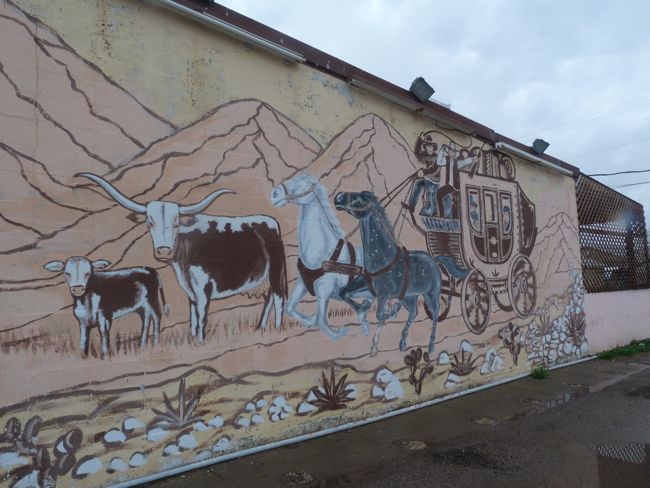

Once again, we diverged. AdventureMan thought the food was very good; I thought it was just OK. I didn’t even bother taking photos of my two greasy tacos. Service was fast and friendly, and there were a lot of local people there, so maybe I just ordered the wrong thing.
Just wanted you to get a feel for the road conditions. The good news is, as we got close to El Paso, the sun broke through and we had clear visibility finding our hotel.
Obesity Linked to Lower Risk for Dementia
From today’s AOL news, surprising and counter-intuitive findings:
Obesity is linked to a whole slew of illnesses like cancer, type 2 diabetes, and heart disease, just to name a few.
However, new research surprisingly finds that obesity can actually reduce your risk of a devastating and fatal condition: dementia.
A study out of the UK found the link after analyzing data from nearly 2 million people over the course of decades.
According to the research by Oxon Epidemiology and the London School of Hygiene and Tropical Medicine, underweight people had a 39 percent higher risk of dementia versus people of average weight. The shocking part is that overweight people had an 18 percent reduction in risk and those who are clinically obese, a 24 percent reduction.
The lead researcher told BBC News, “The controversial side is the observation that overweight and obese people have a lower risk of dementia than people with a normal, healthy body mass index. That’s contrary to most if not all studies that have been done, but if you collect them all together our study overwhelms them in terms of size and precision.”
It is important to note that while this study is certainly controversial, it’s not the be all and end all in determining how weight correlates to risk of dementia. If nothing else, though, it certainly opens the door for further research.
“Plus ça change, plus c’est la même chose”
Last week, we were in Atlanta, and stayed near a small town called Smyrna. We wondered several times where ancient Smyrna was, guessing Greece or Turkey. We were both right.
Today, the church remembers Polycarp, Bishop and Martyr of Smyrna. It is timely. There is a saying, the more things change, the more they stay the same (“plus ça change, plus c’est la même chose” – Alphonse Kerr) – and today, too, we are seeing people killed for what they believe, when they do not fall into step with the specific style of belief of the crowd. Oh, the things we do in God’s name!
The Liturgical Calendar: The Church Remembers
Today the church remembers Polycarp, Bishop and Martyr of Smyrna, 156.
Polycarp, Bishop of Smyrna in what is now called Turkey, did not seek martyrdom and did not encourage others to do so. When persecution broke out, Polycarp made every honorable effort to protect his flock and himself. He even hid in the country but, eventually, the authorities found him.Since Christians worshiped Jesus Christ, an “unauthorized god,” and since they refused to worship the Roman gods or the “Divine Caesar,” they were considered atheists and subversives.
Best Birthday Ever!
Who knew that growing older could have so many joys? I sure didn’t. I dreaded growing old, leaving a life of adventures behind. I had NO idea.

I recently had a birthday. On my birthday, I had a new group in town, and I was taking them around to their appointments. It’s always hard, the first day, connecting with a group who has been together for a while, but the structure carries it, and the day went smoothly.
When my itinerary and biographies were delivered, I also got a birthday gift from the best boss, ever. I’ve been with them as a volunteer for almost five years now, and they gave me a silver name tag – beautiful! with a magnetic back, so it doesn’t ruin my silk blouses. They also gave me a box of my own business cards, even though I am “just” a volunteer.
The biggest gift, though, was the gift of their trust.
In my innermost mind, I sometimes hear voices. These voices are harsh. They say things like this:
“What do YOU know about government and politics and how they work?”
“Who do you think you are?”
“What makes you think you’re so special?”
These are the malicious voices that will make me cower in fear, will make me turn down opportunities, voices that make me doubt myself.
My boss asked me in December to take this particular group. I’ve taken several groups before, often enough that it’s not a big deal, but this time had a twist – she would be out of town, so would her deputy; I would be “it.”
I heard the voices. I hesitated, but only briefly. They trust me to do a good job, in their eyes, I can do it. In my most rational mind, I know better than to listen to those voices that would tear me down and undermine my confidence, and it really helps to have the trust of those with whom I work on a regular basis to counter those voices who would have me keep my head down, stay in my place. I am in my place. I am doing what I was created to do.
So it was more than the beautiful silver name-tag and the cards, it was the expression of trust that I would handle any problems that came up (I did) and that trust was a wonderful confirmation of who I am and of what I am capable.
We had a very good day, this group and I. When I got home, there was a huge bouquet of white roses waiting for me; my sweet husband knows what I love. I was over the moon, and he said “I really really wanted to throw in a red rose or two because I love them, but I know YOU love white roses” and that was the second wonderful gift of the day, that he would buy me beautiful roses, the kind I like, not the kind he though I should like. 🙂
He also took me out for Chinese take-out, not his favorite thing, but one of my favorite comfort food kind of things, and it turned out to be surprisingly good, especially for Pensacola where we all bemoan the lack of really really good Chinese food. Every dish was really good, exceeding our expectations.
Then, we got a call from our son and his family, off on their own grand adventure, and my little just-five-year-old grandson sang to me “Happy Birthday to you,” and totally made my day.
The next night we went to Seville Quarter and had this wonderful steak they serve, on top of a crusted mashed potato-garlic-cheese combination, with a fabulous sauce that reminded us of France, and grilled asparagus. Still my birthday 🙂

There are things that matter, and things that don’t. I suspect I will hear those harsh voices as long as I live, and I thank God for all the countering experiences and voices which have shown those demeaning voices to be false – and meaningless. Living my life in the best way I know – that is a gift. Being surrounded by those who value me and encourage me and love me and who lift me when I stumble and say “You CAN do it!” That’s a gift. Having a sweet family who love me genuinely, and value me – that is a gift. Having work to do that is worth doing – that is a gift. Having a husband who cares what I like, who encourages and supports me and makes me laugh – I am so blessed.
Freedom of Speech: Je Suis Charlie
In our country, in the West, open discussion is a part of life. Your point of view may be ignorant, or repugnant to me, but I will defend to the death your right to express your opinion. One of the great weapons of freedom of speech is humor. It’s hard to maintain a dignified moral high-ground when one of the cartoonists piques with a cartoon showing the emperor has no clothes. Or at least the emperor has flaws, as do we all.
Pensacola is blessed with such an editorial cartoonist, Andy Marlette. Andy Marlette is controversial, and in a state with lax gun laws and pistol-packin-mamas, he risks his life daily, skewering the pomposity of us all. Occasionally, he is outrageous. Occasionally, he is offensive. That’s OK. If an editorial cartoonist isn’t skewering someone, or all of us at once, he isn’t doing his job. His job is to elicit discussion.

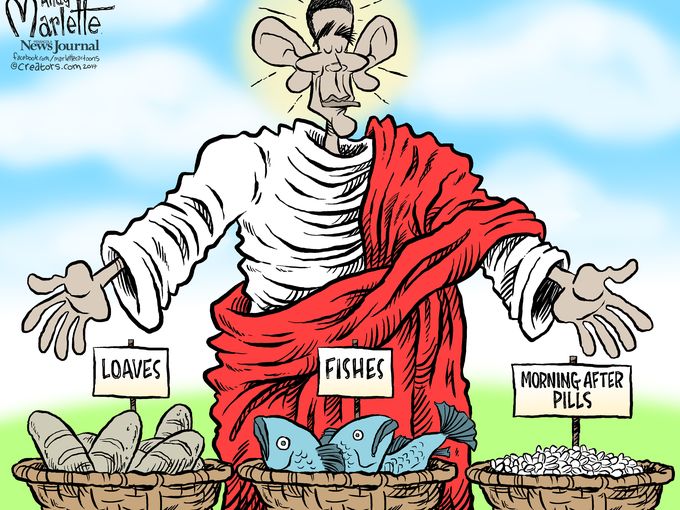



I have lived for so long in Moslem world that I take a risk now, offending my Moslem friends, by printing the cartoon of Mohammed weeping. It’s the cartoon that touched me to the bone. I have listened and learned in the Moslem world, and I have never met with hatred. The Mohammed I have read about in the Qu’ran and in hadith, and heard about in legend and stories from my Moslem friends portrayed a prophet who, like Jesus, was all about loving and serving the one true God. He would weep at what has been done in his name, as Jesus weeps for us, when we kill others in his service.

A Prayer for the Innocents
Today the church remembers King Herod’s slaughter of all infant boys in his territory to put to rest these rumors of a newborn king of the Jews. The prayer for today is for all innocents killed by those who seek their ends through violence and oppression.
We remember today, O God, the slaughter of the holy innocents of Bethlehem by King Herod. Receive, we pray, into the arms of your mercy all innocent victims; and by your great might frustrate the designs of evil tyrants and establish your rule of justice, love, and peace; through Jesus Christ our Lord, who lives and reigns with you and the Holy Spirit, one God, for ever and ever.
Middle East Map of Deadliest Infectious Diseases

This is from AOL News/Upworthy, where you can view the deadliest infectious diseases in all parts of the world.
*A note from GlobalPost on how these maps are set up: The numbers in black boxes show how many thousands of people died from the dominant infectious disease in that country in 2012. Keep in mind that these are absolute numbers, so they’re not scaled to account for a country’s population. They also don’t convey the total number of deaths from all infectious diseases in each country, just the number of deaths from the deadliest disease. You’ll also notice that many countries in the maps are grayed out (like the USA). That indicates the deadliest infectious disease wasn’t among the ones monitored by the WHO.
Protein Tau Alzheimer Key?
This is hopeful news from AOL Healthnews My family has a history of living long; my Mother is 92 and still has all her marbles. Staving off dementia is as key as keeping your body fit if you live to be a ripe old age.
Is a Protein in the Brain Key to Alzheimer’s?
By Dennis Thompson, HealthDay News
The malfunction of a protein, tau, is the likely culprit behind Alzheimer’s. When it malfunctions, brain cells die, a study finds.
Monday, November 03, 2014
Malfunction of a key brain protein called tau is the likely culprit behind Alzheimer’s disease and other forms of dementia, a new study in mice concludes.
Neurons — highly specialized nerve cells in the brain — appear to die when tau malfunctions and fails to clear the cells of unwanted and toxic proteins, explained Charbel Moussa, head of the Laboratory for Dementia and Parkinsonism at Georgetown University School of Medicine, in Washington, D.C.
This means drugs that replace the function of tau in these brain cells are likely to slow the progression of Alzheimer’s, he said.
“A strategy like this will give us hope that we can delay or stabilize the disease progression,” Moussa said.
Tau has long been a prime suspect in the search for the cause of Alzheimer’s disease. The brains of Alzheimer’s patients wind up clogged with twisted protein threads made of tau, particularly in regions important to memory.
But researchers have been at a loss to explain why tau might cause Alzheimer’s, and whether the tangles of tau are more important than another hallmark of Alzheimer’s, plaques made of a protein called amyloid beta that fill the spaces between the brain’s nerve cells.
Moussa said his experiments with mice have shown that tau works to keep neurons naturally free of amyloid beta and other toxic proteins.
When tau malfunctions, the neurons begin to spit amyloid beta out into the space between the brain cells, where the protein sticks together and forms plaques, he said.
“When tau does not function, the cell cannot remove the garbage,” Moussa said. The result is cell death, he explained.
Tests on the brain cells of mice revealed that removing all tau impaired the neurons’ ability to clear out amyloid beta, according to findings published Oct. 31 in the journal Molecular Neurodegeneration. But if researchers reintroduced tau into brain cells, the neurons were better able to remove accumulated amyloid beta from the cells.
Moussa said his study suggests the remaining amyloid beta inside the neuron destroys the cells, not the plaques that build up outside. The mouse experiments also showed that fewer plaques accumulate outside the cell when tau is functioning.
Malfunctioning tau can occur as part of the aging process or due to genetic changes. As people grow older, some tau can malfunction while enough normal tau remains to help clear the garbage and keep neurons alive. “That explains the confusing clinical observations of older people who have plaque buildup, but no dementia,” Moussa explained in a Georgetown University news release.
In this study, Moussa also explored the possible use of a cancer drug called nilotinib to force neurons to keep themselves free of garbage, with the help of some remaining functional tau.
“This drug can work if there is a higher percentage of good to bad tau in the cell,” added Moussa, whose work was funded in part by a grant from Merck & Co., the pharmaceutical company.
Heather Snyder, director of medical and scientific operations for the Alzheimer’s Association, said Moussa’s findings are interesting but not conclusive.
“They’re saying that tau may have an earlier role than we currently know. That’s as far as I would go,” Snyder said. “We still don’t know how all the pieces come together.”
Snyder said new imaging technology that allows doctors to track tau buildup in a person’s brain over time may help solve this question in the future.
Also, experts say, results of animal experiments don’t necessarily apply to humans.
But Dr. Ronald Petersen, director of the Mayo Clinic Alzheimer’s Disease Research Center, said the new study adds to the growing evidence that “the role of tau is fundamental in the disease process.”
“Developing therapeutics for tau is a high priority,” Petersen said. “Not easy, not simple, but it could be very fruitful.”
Recent Comments
ExpatAlien on What Country am I Living … intlxpatr on Yellowstone: Old Faithful to C… Michelle on Yellowstone: Old Faithful to C… Cathy on No Grown-Ups in Charge intlxpatr on Waiting for Snow Wikipedia Donate Button

Amazina


Early Voting in Florida


 Here There and Everywhere