Zombies and Me and Romans
A very long time ago, I loved scary movies, and then a friend told me to see ‘Night of the Living Dead’ and scary movies lost all their charm for me. I was young, to get to my job I walked eight blocks to the bus stop, and I was living in Seattle, where early morning is still very dark. Rationally, I know zombies of the kind in ‘The Night of the Living Dead’ do not exist; irrationally, those were eight long dark blocks and my heart jumped with every movement caught out of the corner of my eye.

Why is it that zombies are so terrifying to me? I have always thought it was because they exemplify the worst in us, the kinds of things we do when we are in mobs fueled by passion and violence, or even smaller groups where we go places and do things we would never do on our own.
As I read todays Lectionary readings, however, I realized that the reasons zombies have such a visceral horror for me is that they are the hidden me, the appetites and hungers I won’t even acknowledge to myself; the urge to kill when someone treats me rudely or cuts me off in traffic, the appetites I yearn to indulge, zombies epitomize everything we are without the saving grace of a loving God.
Romans 8:1-11
8There is therefore now no condemnation for those who are in Christ Jesus. 2For the law of the Spirit* of life in Christ Jesus has set you* free from the law of sin and of death. 3For God has done what the law, weakened by the flesh, could not do: by sending his own Son in the likeness of sinful flesh, and to deal with sin,* he condemned sin in the flesh, 4so that the just requirement of the law might be fulfilled in us, who walk not according to the flesh but according to the Spirit.* 5For those who live according to the flesh set their minds on the things of the flesh, but those who live according to the Spirit* set their minds on the things of the Spirit.* 6To set the mind on the flesh is death, but to set the mind on the Spirit* is life and peace. 7For this reason the mind that is set on the flesh is hostile to God; it does not submit to God’s law—indeed it cannot, 8and those who are in the flesh cannot please God.
9 But you are not in the flesh; you are in the Spirit,* since the Spirit of God dwells in you. Anyone who does not have the Spirit of Christ does not belong to him. 10But if Christ is in you, though the body is dead because of sin, the Spirit* is life because of righteousness. 11If the Spirit of him who raised Jesus from the dead dwells in you, he who raised Christ* from the dead will give life to your mortal bodies also through* his Spirit that dwells in you.
Juneau to Anchorage on Alaska Airlines

I have such mixed feelings towards Alaska Airlines. I am about to vent, so if venting bores you, just skip down to the pictures.
I love that Alaska Airlines is truly Alaskan, formed of a conglomeration of smaller companies that used to fly Alaska, and that they truly serve Alaskans well. Alaskans get all kinds of perks on Alaskan airline. So when they board, it’s like “these special people, and then these special people, and these special people, and all the rest of you” and like there are six of us not-so-special people still standing there waiting to get on. After my first flight with Alaska, I learned not to carry any carry on baggage; just a large handbag I can tuck under the seat in front of me; all the overhead compartments are full.
Yes. I know. It sounds like sour grapes, and it is a little bit. I’ve been special too, on other airlines, and you get so you kind of like being treated special. I just take a deep breath and tell myself that old saw “every monkey gets his turn in the barrel” which is sort of a karma thing, everybody gets lucky some time and other times everyone has to take a turn in the barrel.
Here’s where the grapes really got sour. I am a cherry picker when it comes to trip planning. I don’t always get it right, but I put a lot of planning into finding the right small tours, the right schedule, the right seats, the right accommodations. I love the special details, and I take pride in juggling all the factors and getting a strategic plan together.
I found the perfect reservations, reservations that got us from Pensacola to Juneau in one day, and then from Anchorage back to Pensacola in one day. For three months, I gloried in the perfection of those reservations, until Chelsea called me and said they had changed everything.
It was horrible. I had to make decisions I wasn’t prepared to make. Chelsea did her best, but I was no longer in control (OH NO!) and I just did the best I could. She really did work with me. I was mad about the circumstances, but she did her best to find a solution. Just about every change cost me money, including the worst of all, because I am not special on Alaskan Airlines or American Airlines, we had to pay $25 every time we checked a bag, and every time we had a (mandatory) overnight, we had to pick up our bags and PAY AGAIN THE NEXT DAY! It irked me because I had us starting off with Delta originally, where our bags go free. Hey, these $50 (for two people) charges add up fast!
Of course, any seasoned traveller will laugh at “perfect” travel plans. It is a set-up. There is no perfect; God-with-a-sense-of-humor will always humble our human arrogance when we think we have achieved perfection.
So you know our trip started badly with the continuing weather delays in Dallas Fort Worth, and that was not American Airlines fault, but even so, neither was it a fun way to start our vacation.
Now, leaving Juneau for Anchorage, it’s a piece of cake. The hotel is five minutes from the airport and car rental drop-off is just out the back door. Juneau airport is small, and friendly feeling. The Alaska Airlines baggage check-in was compassionate. She looked at our trip history so far and said “you guys don’t have to pay today” and that small gesture really made us feel good.
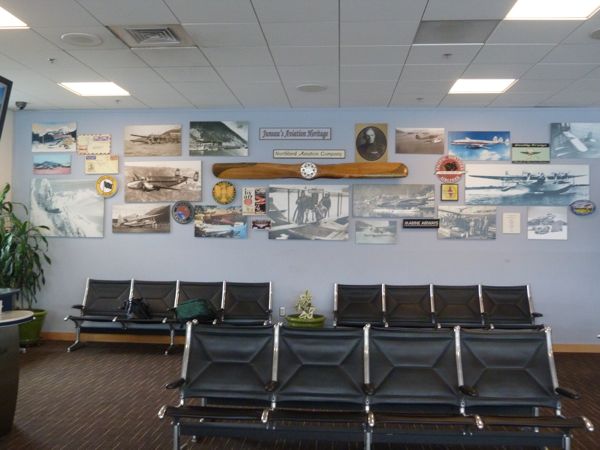
At our gate, I took a photo of the entire upstairs waiting room. This is the whole Juneau airport:

At our gate is a pictorial history of Alaska aviation, but it doesn’t answer my question: What was the other airline that flew alongside Coastal Airlines out of the downtown amphibious airport?
The plane we are on is kind of old-timey, and it is stopping in Yakutat and Cordova, two fishing villages, en route to Anchorage. There is no first class on this flight, but there is freight, and evidently a whole lot of freight. I have never seen this before, but the front part of the airplane is all blocked off with this black curtain/built-in thing for freight:

Sitting next to me is a man exactly my age who grew up across the channel from me. We were the same year in school, and he is cousin to the girls I played with when I was a kid. We didn’t know each other. As a grown-up, he piloted ferries for the Alaskan Marine Highway System and now does special contracts, guiding the large cruise ships through the various ice fields. And, he tells me, the other airline flying out of Juneau when we were kids, the one with the green planes, is Ellis Airlines. Wooo HOOOO! He tells me before we take off so I quickly text my Mom’s old friend because she was stumped, too! I knew it started with an “S”, LOL. Isn’t life funny, how you can end up sitting next to the right person at the right time and place, and ask the right question?
Anchorage airport is much larger than Juneau, but as we pick up our rental car, the man behind the counter learns we are former military and gives us a great car, and map, and lots of good directions to get us headed towards Seward. Life is sweet, in spite of all my griping and sour grapes.
Revolutionary Government: South Africa
AdventureMan and I have a soft spot for South Africa, not the least of which for the dramatic and radical way they transformed from apartheid government to democratic government. It is not to say South Africa has been without problems – there are still problems. But the manner in which they confronted and dealt with their past and then moved on allows change to happen, change in the heart.
Today’s meditation from Forward Day by Day:
FRIDAY, May 30
Psalm 85:3. You withdrew all your wrath; you turned from your hot anger. (NRSV)
But for the grace of God and the work of extraordinary leaders such as Nelson Mandela and Desmond Tutu, the fall of apartheid in South Africa could have been marked by one of the worst bloodbaths ever seen.
The incendiary ingredients were all present: a repressive minority regime that ruled by violence, fear, and fiat over a majority population denied fundamental human rights and forced to live a subservient existence.
There was upheaval, but the nation never fell into anarchy as it radically changed its government, thanks largely to the Truth and Reconciliation Commission.
Chaired by Tutu, then the Anglican Archbishop of Cape Town, the commission held hearings throughout the country. Victims told their stories of torture, killing, and degradation, sometimes confronting the accused.
The goal was not vengeance or justice but truth-telling to clear a path for healing. Powerful emotions were released. There were tearful confessions and apologies. There was forgiveness. The people of South Africa managed to turn from their hot anger and begin building a new nation.
Can we do the same? Where can we forsake our anger for the liberating power of forgiveness?
Worst Places in the World to Work
From AOL Huffpost Business:
Where are the worst places on the planet to be a worker?
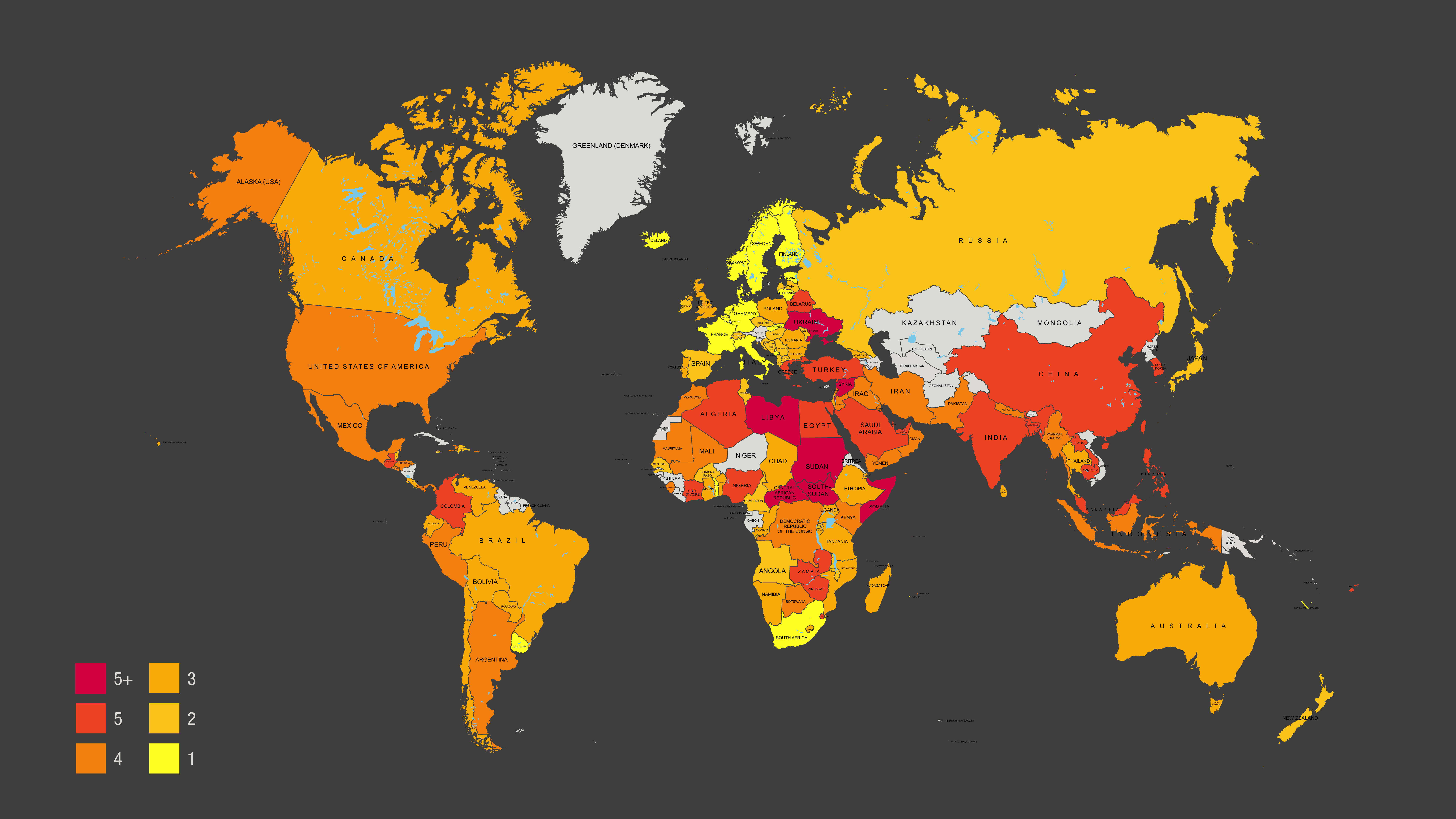
A new report by the International Trade Union Confederation, an umbrella organization of unions around the world, sheds light on the state of workers’ rights across 139 countries. For its 2014 Global Rights Index, the ITUC evaluated 97 different workers’ rights metrics like the ability to join unions, access to legal protections and due process, and freedom from violent conditions. The group ranks each country on a scale of 1 (the best protections) to 5 (the worst protections).
The study found that in at least 35 countries, workers have been arrested or imprisoned “as a tactic to resist demands for democratic rights, decent wages, safer working conditions and secure jobs.” In a minimum of nine countries, murder and disappearance are regularly used to intimidate workers.
Denmark was the only country in the world to achieve a perfect score, meaning that the nation abides by all 97 indicators of workers’ rights.
The U.S., embarrassingly, scored a 4, indicating “systematic violations” and “serious efforts to crush the collective voice of workers.”
“Countries such as Denmark and Uruguay led the way through their strong labour laws, but perhaps surprisingly, the likes of Greece, the United States and Hong Kong, lagged behind,” wrote ITUC general secretary Sharan Burrow in a statement about the report. “A country’s level of development proved to be a poor indicator of whether it respected basic rights to bargain collectively, strike for decent conditions, or simply join a union at all.”
Here’s a look at the world rankings. Darker shades represent worse protects for workers. A score of 5+ means that active conflicts, like those in Syria or Sudan, block any legal protections for workers.
Leadership – A Memorial Day Meditation
This is today’s Forward Day by Day reading, and I think it is perfect for Memorial Day, a day in which we celebrate those who fought and gave their lives that we might live free:
MONDAY, May 26 Rogation Day
Matthew 13:14. You will indeed listen, but never understand, and you will indeed look, but never perceive.
The daughter of the young clergyman looked and she did perceive.
She had taken a bus trip with her father to their home country so she could obtain an identification card at the age of eighteen. Before the bus left, the driver asked if someone would pray for a safe journey. Her father walked to the front of the bus and led the passengers in prayer. Later, at a rest stop, the priest noticed some trash littering the area. After other passengers walked past heedlessly, he scooped it up and put it in a trash bin.
The acts seemed minor, and he thought no more about them. But later, his daughter asked him to read her homework—a profile of a leader. He did and was humbled and amazed.
The profile was about him. Citing those two examples and others, the daughter described how his behavior reflected his values. She wrote, “Leadership is not a title, but it is about the way you live your life.”
She had done much more than see her father’s actions. She had perceived their meaning and importance in the context of their faith.
Crime to be “Happy” in Teheran?
From today’s Kuwait Times:
TEHRAN: The arrest of six Iranian youths for dancing to US singer Pharrell Williams’ hit “Happy” in a video that went viral highlights the rift between conservatives and youths fascinated by the West. Recorded on a smartphone and uploaded multiple times on YouTube, the clip shows three girls dancing and singing along to the song in a room, on rooftops and in secluded alleys with three young men. For the youths, the homemade video now watched one million times was merely an “excuse to be happy”, but for the Iranian authorities it was “vulgar” breach of the Islamic republic’s values. Originally posted online in April, the clip gradually spread online before it led to the arrest of the dancers and their director on Tuesday for having “hurt” the country’s strict moral codes, according to Tehran police chief Hossein Sajedinia.
The youths appeared on state television repenting for appearing in the clip, after the girls failed to properly observe hijab, a series of rules that oblige women in Iran to cover their hair and much of their body when outside.
Their arrest sparked international fury and criticism in the media and online, with many Iranians expressing shock and some observers questioning whether it was a “crime to be happy in Iran”. Supporting the young Iranians, Williams himself chimed in and hit out at their treatment, saying on Twitter and Facebook: “It’s beyond sad these kids were arrested for trying to spread happiness.” Reports emerged Wednesday night that the dancers were released on bail, with one of the arrested girls, Tehranbased fashion photographer Reihane Taravati, saying on Instagram: “Hi I’m back.” The arrests came after President Hassan Rouhani-a selfdeclared moderate who claims to be for more social freedomsreiterated in a weekend speech his calls for a relaxation of Internet censorship. Rouhani’s statements have irked the conservatives, who have long imposed limitations on the Internet, blocking millions of websites particularly social media platforms, including Facebook and Twitter, as well as YouTube. — AFP
Alcuin: Faith is an Act of Free Will
Today, from Forward Day by Day, we remember Alcuin, advisor to King Charlemagne, who, among other things, told King Charlemagne not to kill people who did not believe as he did.

Today the church remembers Alcuin, Deacon, and Abbot of Tours, 804.
A breath of fresh air swept across Western Europe in what we call the Age of Charlemagne. There was relative peace, security, and prosperity. Learning and the arts revived. The leading spirit of this renaissance was Alcuin of York, the foremost teacher of his day. He revived “letters.” Indeed, he is credited with the invention of the running script we use today. He was a competent theologian, poet, and author. He was a pioneer in conceiving the idea of a university.
After serving for some years as Master of the Cathedral School in York, England, he traveled to Italy to study. There he met Charlemagne and they became fast friends. Alcuin served as royal tutor and as the great king’s chief advisor in religious and educational matters. In 796 he became abbot of the monastery at Tours, France, and there he founded a famous library and school. From there he exercised great influence in correcting misunderstandings of the Christian faith and in discouraging practices which seemed inconsistent with this faith, both in morals and in forms of worship.
We beseech you to shed upon your whole church the bright beams of your light and peace, and help us to follow the good example of your servant Alcuin. Amen.
Almighty God, in a rude and barbarous age you raised up your deacon Alcuin to rekindle the light of learning: Illumine our minds, we pray, that amid the uncertainties and confusions of our own time we may show forth your eternal truth; through Jesus Christ our Lord, who lives and reigns with you and the Holy Spirit, one God, for ever and ever. Amen.
Wikipedia tells us that as early as 797, Alcuin told King Charlemagne not to kill people who did not believe as he did:
In this role as adviser, he tackled the emperor over his policy of forcing pagans to be baptised on pain of death, arguing, “Faith is a free act of the will, not a forced act. We must appeal to the conscience, not compel it by violence. You can force people to be baptised, but you cannot force them to believe.” His arguments seem to have prevailed – Charlemagne abolished the death penalty for paganism in 797.[9]
Leaving Civil Seattle
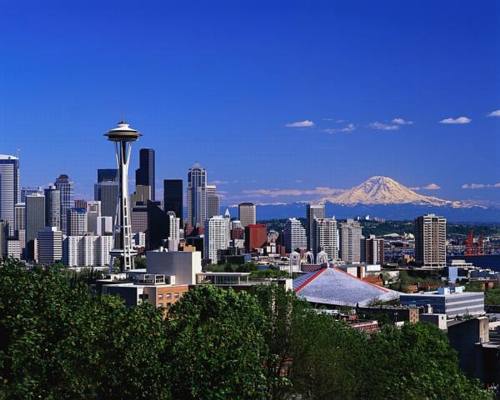
No, I didn’t take that photo, but it was exactly that kind of day. It was beautiful when I got to Seattle, it rained buckets one of the days I took my Mom shopping; she was such a good sport as we raced across the parking lot to the restaurant, both getting soaked, and then it was beautiful again for Mother’s Day and departure day.
Had juicy, laughing, crying visits with two very long time friends, feasted my eyes on all the rhododendrons growing so luxuriously, dancing with their intense colors in the Seattle gardens, watched the ferries coming in and out of little Edmonds. It was heaven.
 This is really a Chihuly rhododendron 🙂
On the way to the airport KUOW, the local National Public Radio station, mentioned, very politely, that there was a huge accident on I-5 going South, blocking all lanes of the freeway, and would I please consider taking an alternate route south, and gave a couple of suggestions.
So so Seattle. So civil.
Rarely do I hear a car beep in Seattle. People actually do the “after you” gesture – all the time. It takes some getting used to. 🙂
As soon as I got there, I opened the window where I was staying and just breathed the fresh sweet air. It always smells like fresh mown grass when I drive into Edmonds, and then the salt air. It is cool and refreshing. When the birds settle in for the night, there are the sounds of a thousand bird voices, loudest of all the seagulls, squawking at one another while the others are all doing sorter nestling sorts of sounds.
There are trains that go through in the middle of the night, but you learn to just wake up a little and say “oh, the train” and you go right back to sleep.
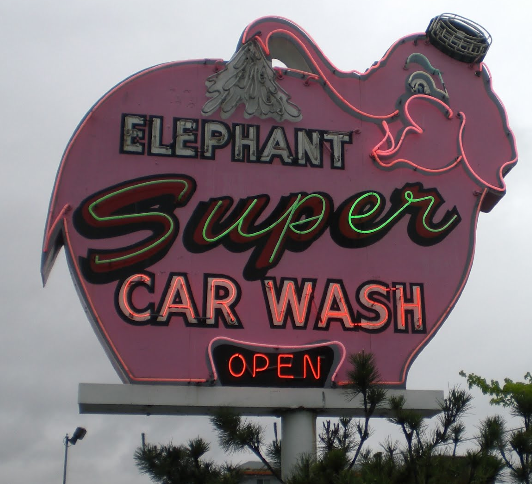
I took highway 99, which at one time was the major north south road, and while it was a little crowded, due to cars like me taking the alternate routes, it was peaceful and steady, with no delays. I haven’t taken the route for a long time, and got to see an old truck-stop my youngest sister mentioned, and I got to see all the things that are no longer there – the teepee pancake house, the elephant car wash sign. Things change. Taking 99 South took me a little longer than normal, but sometimes it can take a long time on the interstate, too, even without a major accident. Seattle, like Kuwait, has outgrown its infrastructure.

It seems to be the story around the United States. Who is paying attention to the decaying bridges, the once smooth and now potholed highways? Who is checking the buildings in the abandoned city centers and malls?
When I turned in my rental car, the little girl checking me in was in hijab and looked Sudanese. She asked me where I was from, and I told her, and I asked where she was from and she told me Cleveland. LOL.
The Seattle Airport is a gem, full of art works, you just have to take the time to look. Off in corners, they also have free wi-fi, free power plugs, Chinese take away and quiet areas where people can read or use the internet. For some reason, I am TSA PreCheck. Someone said it is age related, but AdventureMan looked it up online and there doesn’t seem to be a connection. I love the shorter line, and not taking off my shoes.
I have plane karma. Just before the plane was loaded and ready to go, the two inside passengers for my row arrived – a basketball player and his also-tall Mom. Behind us arrived a Mom and her two babies – in two seats. The doors closed. There were only three empty seats in the plane, and they were across from me. The basketball player jumped into the window seat and the woman sitting in the aisle seat behind me jumped into the aisle seat across from me, and the Mom and her babies had all three seats to themselves, while the rest of us had room for knees and elbows and room to breathe . . . it makes all the difference.
I like Pensacola, and I like our life here. I am already missing the beauty and coolness of Pensacola winter, dreaming of the beauty and coolness of Seattle summer, LOL.
Pensacola Tough @ Grafitti Bridge
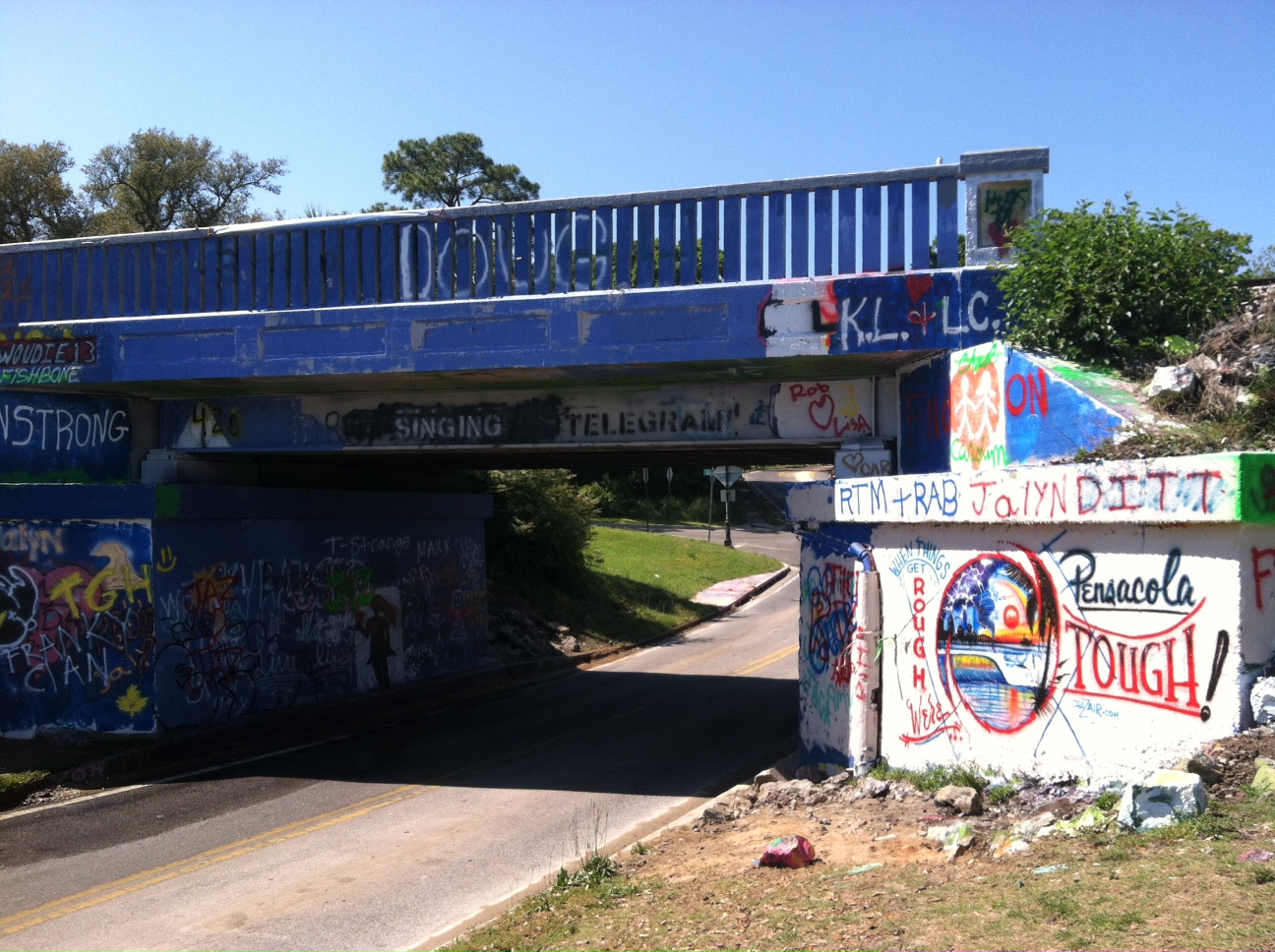
On my way home from a great Algerian pastry treat at SoGourmet, I passed Grafitti Bridge. Grafitti Bridge is one of Pensacola’s quirks. Every month – sometimes every week, even sometimes daily – the bridge is repainted. Sometimes it is that BubbleGum pink of Breast Cancer Awareness, with names of the fallen and names of survivors, sometimes it is Gay Pride, sometimes it is who loves who, or who is a first class jerk, sometimes it is Class of TwoThousandWhatever – it can be whatever someone feels passionate enough about to buy the paint and make it happen. No one gets too bent out of shape about it. Occasionally profanity will show up, but very shortly someone else will spray paint out the offensive word, or, which I love, alter it to have an entirely new meaning.
As I drove past today, I saw a lightning storm, well done, I couldn’t imagine how they had captured what it was like seeing so many strikes at once, and then I saw “Pensacola Tough.” By that time, I was through the bridge, so I had to circle and go back. I had to park, and take a closer look. And then I had to photograph it, and post it here.
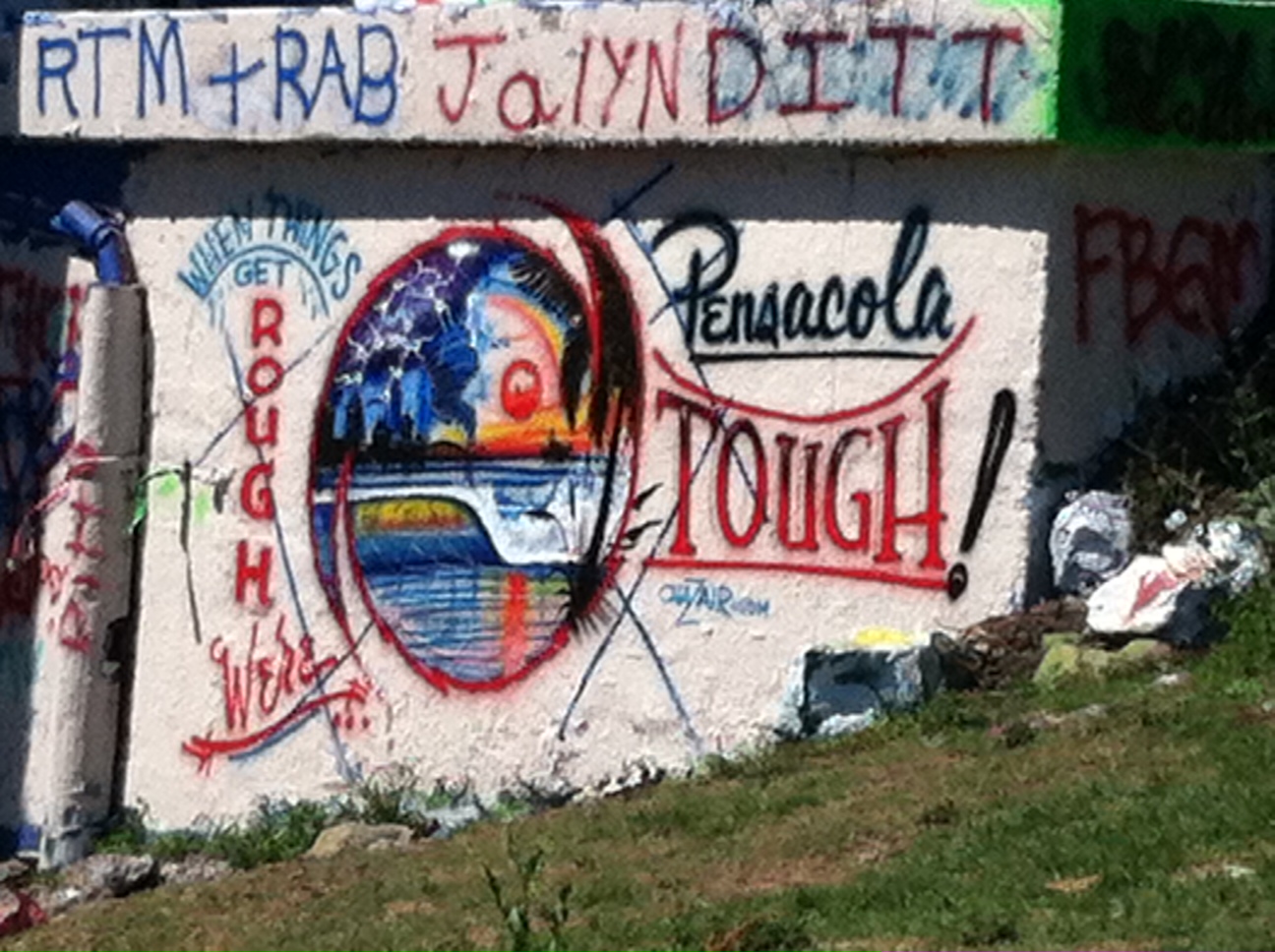
Pensacola Tough. Pensacola got an award as the Toughest City in the USA, based on a criteria that measured percentage of felons in the population (it’s OK, it keeps us humble), sports heros, the number of military personnel, violent crime statistics, etc. It isn’t an award cities run for.
And yet, as the raging water abates, tales of heroism and helpfulness abound. While there have been bands of looters at an apartment complex housing the low-income workers in Pensacola, there have also been bands of volunteers scouring the county, helping clean out houses, pull out sodden carpeting, moving soaked furniture to the curbs for pickup, pulling out drywall and ceilings to prevent black mold. In today’s Pensacola News Journal, there is a story of a man who worked just above where the Escambia County Jail exploded and fell through the floor, breaking legs, ribs and assorted bones. He was paralyzed. His co-worker, also hurt, saw him with his head under water and pulled his head out, and held his head out for over an hour while waiting for help to arrive. She got tired, but the alternative was letting him die. She didn’t let go.
Pensacola Tough.
“When Things Get Rough . . . We’re Pensacola Tough.
You gotta love this place
“Water is Life: SAVE it!”
Today’s meditation from Forward Day by Day deals with precious water. I think about how innocent we were, all of us in Pensacola, going about our daily lives as if every tomorrow would be so lovely, buying and planting new plants in our gardens, sweeping, cleaning, painting, all the things we do in Spring. And then – the deluge. And after the deluge, the “Boil water” warning (now lifted) because the water sources had been contaminated.
We have two cases of water set aside in case of hurricane. Two cases . . . really isn’t very much. We also have large containers which we fill – for hurricanes – so we can flush toilets (assuming the water mains have not broken) and keep a little clean. Those containers have not yet been filled for the upcoming season . . . Too much water – and then, too little.
After hearing the haunting strains of Nkosi Sekelel iAfrica just last weekend, I hear it again as I read the meditation:
SATURDAY, May 3
Exodus 17:1. But there was no water for the people to drink.
“Water is life—SAVE it!”
It was just a small sign on the wall next to the lavatory in a bed and breakfast, but it made a big impact. The word “SAVE” was written boldly in red block letters. Each time I approached the lavatory, my eye was drawn toward that sign. Each time, before I turned on the water, I asked myself, “Is this really necessary?”
South Africa is a water-challenged nation, and it shows. From small signs in bathrooms to national conservation campaigns to the removal of nonindigenous plants that use too much water, the country is trying to meet the challenge.
The South African Constitution’s Bill of Rights guarantees access to clean water for every citizen. After apartheid, the government extended water lines to all townships so residents without running water could at least get clean water from communal taps.
Our faith calls us to be good stewards of God’s creation. That includes the water we drink. Help us, Lord, to live out our faith by conserving, protecting, and sharing this life-giving resource that you have given us. Because water is life. Amen.
Recent Comments
ExpatAlien on What Country am I Living … intlxpatr on Yellowstone: Old Faithful to C… Michelle on Yellowstone: Old Faithful to C… Cathy on No Grown-Ups in Charge intlxpatr on Waiting for Snow Wikipedia Donate Button

Amazina


Early Voting in Florida


 Here There and Everywhere