Iran Raids Coffee Shops as Un-Islamic

(Starbucks in Dubai Mail)
I always thought coffee shops started in that part of the world – oh wait, right, those were just for men.
LOL, found this on AOL, from Huffpost, from a Reuters report:
DUBAI, July 15 (Reuters) – Iranian police shut down dozens of restaurants and coffee shops over the weekend, Iranian media reported, in a renewed crackdown on what the state sees as immoral and un-Islamic behaviour.
Regular officers and members of the “morality police” raided 87 cafes and restaurants in a single district of the capital Tehran on Saturday and arrested women for flouting the Islamic dress code, according to the Iranian Students’ News Agency (ISNA).
“These places were shut for not following Islamic values, providing hookah to women, and lacking proper licenses,” said Tehran police official Alireza Mehrabi, according to ISNA. Women are not allowed to smoke hookah, water pipes, in public.
Mehrabi said the raid came as part of a plan to provide “neighbourhood-oriented” security, and would continue in other parts of Tehran.
Coffee shop culture has flourished in Iran in recent years, offering wireless Internet, snacks, hot drinks, and a place to hang out for Iranian youth in a country where there are no bars or Western chain restaurants or cafes.
But that trend has been criticised by conservative Iranians who consider it a cultural imposition from the West and incompatible with Islamic values. The government periodically cracks down on behaviour it considers un-Islamic, including mingling between the sexes outside of marriage.
In 2007, Tehran police closed down 24 Internet cafes and other coffee shops in as many hours, detaining 23 people. (Reporting By Yeganeh Torbati; Editing by Robin Pomeroy)
Emirates Women Seek Law Forcing Tourists to Dress Modestly
Qatari women have the same concerns in Qatar; this article from http://www.huffingtonpost.com/2012/07/06/emiratis-dress-code_n_1653446.html?utm_hp_ref=world:

ABU DHABI, United Arab Emirates — With the number of foreigners dwarfing that of locals in her hometown of Abu Dhabi, Asma al-Muhairi has become increasingly anxious at the prospect of her younger nieces abandoning their full-length black robes in favor of Western attire that seems to be everywhere she goes.
But it wasn’t until the 23-year-old marketing worker came face to face with two scantily-clad female foreigners at one of the many luxury shopping malls in the United Arab Emirates that she decided to take action.
“While going to a mall, I saw two ladies wearing … I can’t say even shorts. It was underwear,” said al-Muhairi, whose black abaya – a long garment worn by conservative Gulf women – is offset by a gold Versace watch and egg-shell blue handbag.
“Really, they were not shorts,” she said. “I was standing and thinking: `Why is this continuing? Why is it in the mall? I see families. I see kids around.'”
Failing to persuade the mall to intervene, al-Muhairi and another Emirati woman, Hanan al-Rayes, took to Twitter to air their concerns in May.
They were inundated with responses that prompted them to launch a Twitter campaign dubbed (at)UAEDressCode that aims to explore ways to combat the growing number of shoppers in low-cut dresses and hot pants.
As the campaign picked up steam, it also has served to symbolize the growing concerns among Emiratis, a tiny minority in their own country.
Emirati citizens account for a little more than 10 percent of the 8 million people living in the Gulf nation. Most of the population is made up of Asian, African and Middle Eastern guest workers, as well as Western expatriates living here temporarily.
The overall population more than doubled over the past decade as the country embarked on a building boom that transformed Dubai, up the coast from Abu Dhabi, into the Arabian Gulf’s financial hub and a popular tourist draw.
“I think in an increasingly tumultuous region and in an era of powerful and often intrusive globalizing forces, citizens of the UAE are increasingly concerned that their traditions and core values are being eroded,” said Christopher Davidson, an expert on Gulf affairs at Britain’s Durham University.
“In some senses, it is a grassroots reaction to authorities and leaders that have for many years done little to check this erosion,” he added. “We’ve seen reactions to alcohol, so now we are seeing a reaction to immodest dress.”
Jalal Bin Thaneya, an Emirati activist who has embraced the dress code campaign, said it is a way for Emiratis to show they are concerned about the loss of traditions.
“If we were the majority and had the same make up, things would be different,” Bin Thaneya said. “You wouldn’t need anything. You would see Emiratis everywhere and you would be afraid of offending them … Now, we’re a minority so you feel the need to reach out to an authority.”
As the number of foreigners has increased, so have the stories of them violating the UAE’s strict indecency code, which limits drinking to bars and nightclubs and bans public displays of affection. A drunken couple was caught having sex on the beach and another allegedly having sex in a taxi. A Pakistani was deported for flipping the middle finger at a motorist, and the courts are filled with cases of foreigners having sex out of wedlock.
Most Emiratis rarely come face-to-face with misbehaving foreigners.
The malls, however, are a different story.
They are one of the few places where everyone comes together to escape the brutal summer heat. The cultural clash is hard to ignore, as families of traditionally dressed Emiratis shop and relax in cafes alongside foreign women wearing tank tops, shorts and even transparent gowns over bikinis.
Most malls have policies in place that require “conservative” dress and encourage shoppers to avoid showing shoulders and knees, but few publicize them or enforce them. Police in Dubai, where the mall that al-Muhairi visited was located, didn’t respond to a request for comment. They told the Gulf News newspaper there is nothing they can do since there are no specific laws against immodest dress.
“People were seeing it for a long time but they didn’t say anything,” Bin Thaneya said. “You can’t go to the police for such stuff. There is no one to go to. You can’t go to the mall management. The mall security guard gets paid less than someone at McDonald’s. He isn’t going to do anything.”
Al-Muhairi’s campaign is just one of several over the years led by Emirati women who have tried in vain to enforce the dress code – handing out brochures, confronting foreigners. But hers has benefited from the growing popularity of social media as well as the Arab Spring popular uprisings, which has given Emiratis a sense they can speak out on some social issues.
The UAEDressCode feed has more than 3,300 followers with a lively discussion that includes plenty of support for a code but also concerns that it would unfairly target foreigners or create divisions between locals and foreigners. Unlike similar campaigns in Kuwait or Saudi Arabia, the impetus for a code has not come from Islamic hard-liners, but from moderate locals like al-Muhairi who love their Starbucks and Western movies but just want foreigners to respect local customs.
“We are not asking others to cover up like us. We are giving them freedom based on their beliefs and religion,” al-Muhairi said. “We are not judging and saying this shows she has other interests. We never want to judge. Do whatever you want and wear what you want but with limits. Just respect the public here.”
The campaign has caught the attention of the Federal National Council, which pledged last month to push for stronger measures to enforce the dress codes. That came after the country’s culture minister, Abdulrahman al-Owais, supported efforts to emphasize the conservative traditions of the UAE.
Members of a half-elected, half-appointed council have suggested a law could include warnings and fines but not jail time for offenders. But the FNC has no law-making powers, so any decision now rests with the UAE government.
“If there is a law, the behavior will be different,” said Hamad al-Rahoomi, an FNC member who compared a UAE dress code to laws in France that bans the niqab, in which a veil has only a slit exposing a woman’s eyes, or the new dress code at Royal Ascot in Britain that aims to limit provocative outfits.
“We don’t want to catch people. We just want people to think of the other parties,” al-Rahoomi said. “What I want is to go with my family in my country and not see something that is harming me.”
The Abu Dhabi police issued this week a booklet on dos and don’ts for tourists that will be available at the Abu Dhabi International Airport and hotels, according to The National newspaper. It advises tourists that public displays of affection including kissing are considered indecent and that they should wear “modest” clothing.
Tourists – some in skimpy summer dresses, others in shorts and T-shirts – defended their right to wear what they want, either because it is fashionable or keeps them cool in the summer heat. None of the 10 people interviewed in Dubai and Abu Dhabi knew about a mall dress code, nor were they advised their outfits violated it. Several said a dress code law would go too far.
“I think it’s ridiculous because most of the people in Dubai are tourists,” said Sarah, a 21-year-old tourist from Kenya wearing a short dress exposing her shoulders and legs. “I want to go somewhere where I would be comfortable in my own skin as a travel destination. I feel comfortable like this and this is how I will dress.”
Timbuktu Sufi Mausoleums Destroyed by Ansar Dine
From today’s Al Watan, Kuwait:
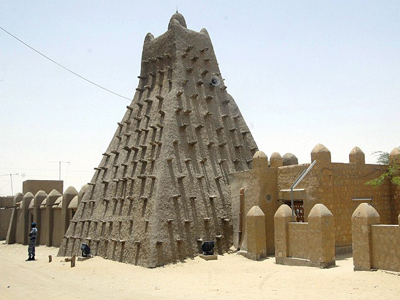
Mali Islamists destroy more holy Timbuktu sites
Monday,02 July 2012
Source : -Reuters
BAMAKO: Militants from the Al-Qaeda-linked Ansar Dine group destroyed mausoleums of Sufi saints with guns and pick-axes in the famed Mali city of Timbuktu for a second day, said witnesses on Sunday, ignoring international calls to halt the attacks.
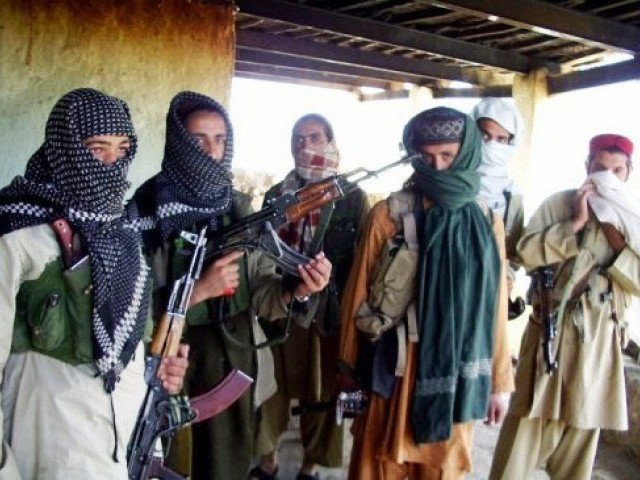
The salafist Ansar Dine backs strict sharia, Islamic law, and considers the centuries-old shrines of the local Sufi version of Islam in Timbuktu to be idolatrous.
Sufi shrines have been attacked by hard-line Salafists in Egypt and Libya in the past year.
The group has threatened to destroy all of the 16 main Sufi mausoleum sites in Timbuktu despite international outcry. UNESCO Director-General Irina Bokova has called for an immediate halt to the attacks.
Local journalist Yaya Tandina told Reuters that about 30 militants armed with Kalashnikovs and pick-axes destroyed three mausoleums of saints on Sunday.
“They had armed men guarding the door. Just like yesterday, the population did not react. They (local people) said we need to let them (the Islamists) do what they want, hoping that someday we will rebuild the tombs,” Tandina said.
Residents said the destruction was halted around midday when some of the militants went to a mosque in the centre of the city, but it was unclear if they would continue.
“We are subject to religion and not to international opinion. Building on graves is contrary to Islam. We are destroying the mausoleums because it is ordained by our religion,” Oumar Ould Hamaha, a spokesman for Ansar Dine, told Reuters by telephone from the northern Mali city on Sunday.
Timbuktu resident Hamed Mohamed said the Islamists destroyed the tombs of saints Sidi Elmety, Mahamane Elmety and Cheick Sidi Amar, all in the west of the city. -Reuters
Departing Chongwe River Camp
Oh! What luxury! To sleep in until 0615 and to watch the sun rise from my bed, hearing the Egyptian Geese, the hippo, the Fish Eagle- and across the river, from the Lower Zambezi River Park, the sound of the roaring lion, one last thrilling morning at Chongwe River Camp.
I dress quickly once I am up – it’s not yet 0630 – but the mornings are chill in late June, and we have learned to lay our clothes out so we can jump into them soon after we arise, so as to keep warm. We are dressed to travel today, so many flights, so many people. . .
Although it is chilly, it is not cold this morning, and there is no wind. When we look out, there is this perfect reflection:

Victor joins us for breakfast, and CJ, and . . . we hate to leave. We are packed on time, our bags go, but we linger. . .
Victor says it’s time to go, he wants to take us by the Chongwe River Lodge – we had asked to see it. It is a marvel, sort of Gaudi-on-the-Chongwe, all natural materials and space, all privacy and perfect for family or a group of friends. There are four bedrooms with King sized beds, and more beds can be moved in to each room or the common rooms, if you really want to fill the house. 🙂
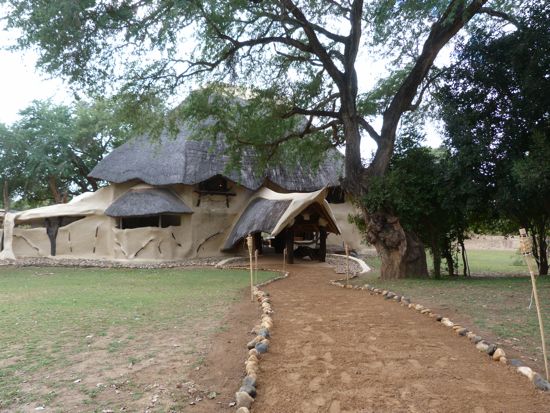

We head out to the landing strip; we can hear the plane coming in, but here is what is cool – the plane is for us! If he dawdle, he will wait! LOL, we don’t dawdle, we are there to check in – check in is the pilot asking if we are the passengers, and we can go whenever we are ready. Oh, I could get so used to this 🙂


The check in counter:
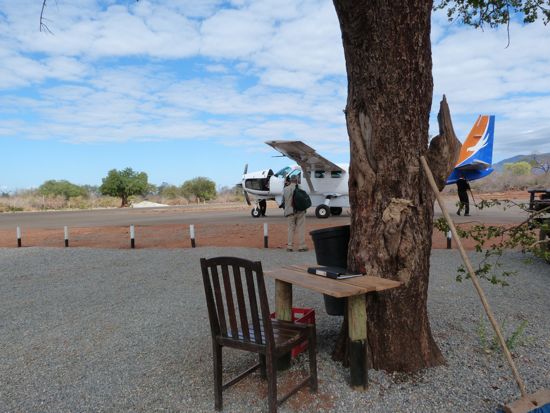
A few last photos with Victor, promises to write, we scramble aboard. Sigh. Farewell, Chongwe River Camp Adventure . . .

Leaving Nsefu for Chongwe; The Most Exciting Moment of our Trip
Early, early the next morning we heard a crashing and crunching – sounds we can easily identify as elephant. At first we continue sleeping, our only morning for sleeping in, but I can’t resist, I have to get up, and lo! The elephant is between our cabin and the next, obliviously chomping and breaking and tearing the tree for an early breakfast.
I decide to get up and get dressed so I can get the iPad charged before the generator goes off at 10, but I can’t go out until the elephant has departed, and she heads in the direction of the lodge, which is where I need to be. Deb Tuttle, the walking guide, walks with me once we see the elephant walk a little further down the valley, I’m able to get the iPad charging and grab a cup of coffee so to be able to say farewell to some of the guests whom we will not see again.
Sunrise over Nsefu:

Travel agents heading out on a Robin Pope Walking Safari:

Making Toast is the favorite job in the winter, close to the hot coals:

It is so nice to be able to pack in daylight! My iPad is at 100%; I have finished The Paris Wife and am starting Wolf Hall, which also holds my attention. While carrying books is bulky, this constant underlying awareness of needing to recharge camera batteries and iPad is also a deterrence. I find I am less desperate about the camera batteries, I always carry at least one back-up so I always have a charged spare, but when the iPad goes, it has to be recharged before we can use it again.
A couple of the travel agents who didn’t know each other had to bunk together in Nsefu. I don’t feel sorry for them; they get to come free. It seems to me, though, is hard to come on these trips as a single person and not feel the odd one out when the game drives go out. They say it is no problem, but I’ve been the odd one on trips to Kawazaa, etc., when AdventureMan wanted to do some activity and I wanted to do something else. It is possible, anything is possible, but sometimes it is just a little awkward. Sometimes people are nice; sometimes they are not so happy to have someone else with them. We are finding that the best of all worlds is to come with your own little traveling group.
The first time we came as a small group was with our son and his wife. We were able to do game drives with people who share our preferences, have people to talk to at dinner if everyone else has their group, etc. We like meeting up with other people, and at the same time, it gives you more confidence to have a group with you, if the other people are all absorbed in one another, or not great company.
The most difficult people are those who don’t understand that this is not a predictable experience – that’s why it is an adventure. There is no guarantee that the lion will crawl over the lip of the riverbank just in front of your car. There is no guarantee you will find the same great, shaggy maned lion at the salt pans that the other guests found the day before. There are NO guarantees, and so you have to treasure all the moments, great and small, and if you are blessed with an extraordinary experience, you celebrate, but honestly, just being here is cause for celebration. Those whose noses get out of joint because you might have seen something they haven’t aren’t a lot of fun to be around. We had one experience when a group that had been friendly to us got all sour and disgruntled because we had seen the lions at the salt pan and they had not. Hey! The lion don’t always show up! The leopard are elusive. This experience is one that totally has to be lived in the moment.
You have to love the smell of the campfire in the morning, and be willing to sacrifice your one morning of sleeping in to spot the elephant chomping outside your bathroom wall. You have to love the little elephant shrew as much as the elephant. There are some drives that are just quiet. It’s like you can’t expect Christmas every day, and if it were Christmas every day, it wouldn’t be special any more.
Just before Holly arrives to open up the Bend Over Store (LOL, it’s a trunk full of goodies) we are blessed with one last elephant crossing! Two days earlier, the elephant were crossing back and forth like a street in New York, then yesterday – not an elephant! It was so unearthly quiet! Today, groups are massing once again, and crossing. We love watching the baby elephants as they learn how it is done.
Drinking; getting ready to cross:



Mom, wait!

On the way to Mfuwe airport, we see Eland – we’ve been looking and looking for these large elk-like ungulates, they are shy and elusive, but Jonah spots them off in the distance, a parting gift from Nsefu.
We have an all-too-brief mad dash through Tribal Textiles, where we ‘invest’ in tablewares, cushion covers and deco for children’s rooms. AdventureMan befriends one of the Tribal Textile cats while I am busy shopping. I have cleared out my backpack so I would have space to put my purchases. 🙂
We have a full flight from Mfuwe to Lusaka, and not a lot of time to spare before our next flight. Smooth flight to Lusaka, just minutes to pick up luggage and transfer to next ProFlight flight, this one is not even on the departure board, only eight passengers, our party of four and a German family from Bavaria. At the very last minute another man comes running, running to catch the plane, we are all busy chatting, it is already a family. They are en route to Chiawa.
It’s a short flight, but here comes the most exciting moment in our day. The pilot is looking at a cheat sheet and the suddenly the plane is saying loudly “Pull Up! Pull Up!Terrain! Terrain!”
The pilots are looking confused and annoyed, one still looking at the instruction sheet, a mountain is rising in front of us, the plane is banking and the loud voice keeps saying “Pull up! Pull up! Terrain!”
I thought I had a movie of all this. I remember making a movie, thinking that if these are my last moments, I will record what happened and try to store the iPad in a place where it might be safely found. Of course, as it turns out, we landed safely and . . . somehow, I don’t have the movie. I must have shut it off too quickly and it didn’t save; I was in a hurry – just in case those were my last moments. I have to admit I am disappointed not to have it to share with you.
Waiting at the airstrip is Victor, our guide, and we rode with him and Chris, who turns out to be one of the owners of Chongwe, to the Chongwe River Camp.

(This is a waterbuck we passed on our way into camp, and again on our way out of camp the next morning; so so sad, part of the circle of life and death, but as we departed Chongwe, his bloated body was in the same field; they suspect he was bitten by a snake and died.)
Arrival is lovely, we are greeted at a tall stand, so we are not climbing in and out of the Land Cruiser, we walk right out onto this stand and down the steps. Flossie greets us and then they tell us that we have been upgraded and put in the family suite.
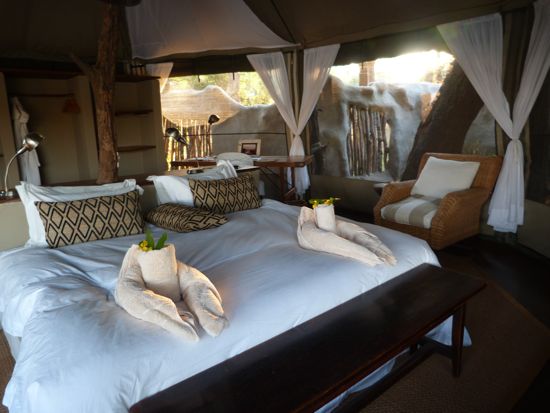
The Family Suite . . . As soon as we see it, we remember. We had totally forgotten . . . we loved our cabins at Chongwe, we were delighted with all the amenities, and we also remember our first boat trip riding by a place that looked like a fantasy from 1001 Nights, a tented living room and dining room, with carpets and nice furniture and linen tablecloths and gleaming candles – it was so lovely. We remember, it was the family suites. And now, the family suite was ours!
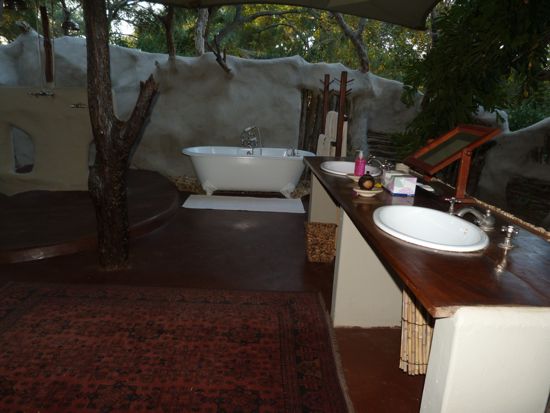
We were a little dazed by our good fortune, we couldn’t believe this lovely place was ours. Our butler, Steve, offered us drinks, Flossie, the camp hostess showed us to our bedroom/bathroom/dressing areas and explained how everything worked, where the electrical outlets and switches were, how the double shower works, where the bath oils were for the claw-footed bathtub, gave us the white cotton pique robes and the fluffy thick Turkish Towels.
This is our sleeping area:
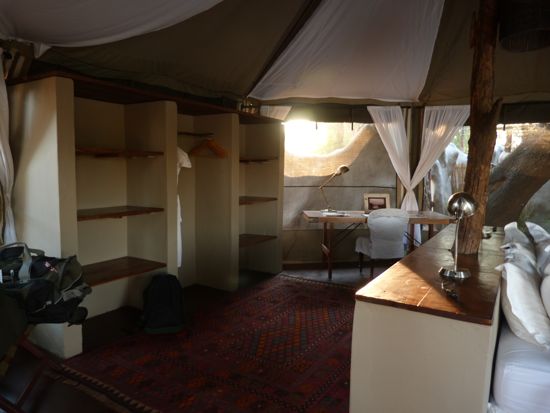
This is our dressing area:
This is the view from our tent toward where the Chongwe River meets the Zambezi River:

This is our bathroom, with a two-person shower and claw-foot tub 🙂
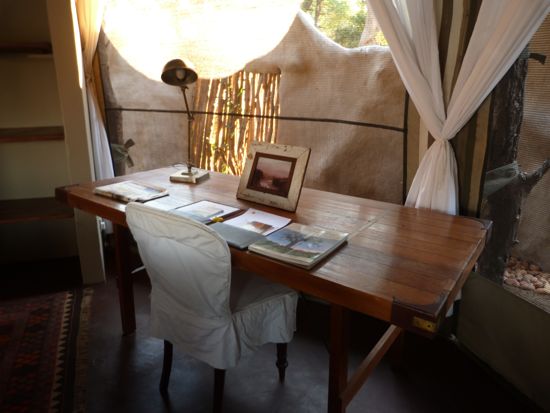
And this is the desk area, also where we can charge our batteries and electronics:
This is our dining room:
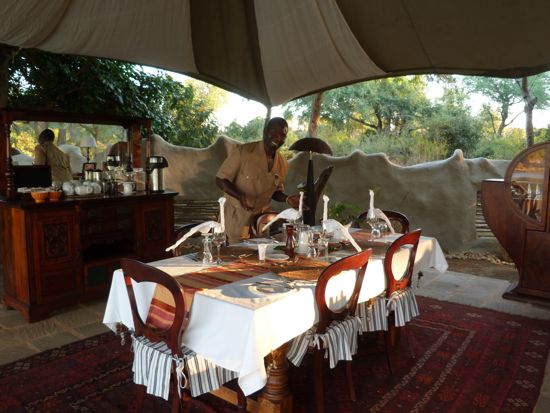
The Family Room:

This is the view out over our swimming pool to the Chongwe and Zambezi Rivers, and the hippo pods:
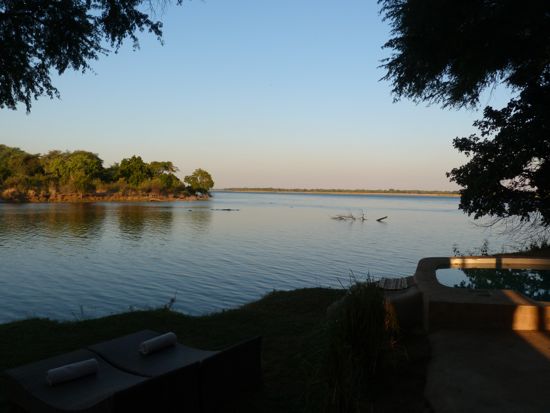
There are woven mats and kelim carpets, and we feel at home, if home can be a huge octagonal tent with an indoor / outdoor feel. Victor comes back, pulling up in a boat next to our swimming pool,to take us for a sundowners up the Chongwe and then back down into the Zambezi.

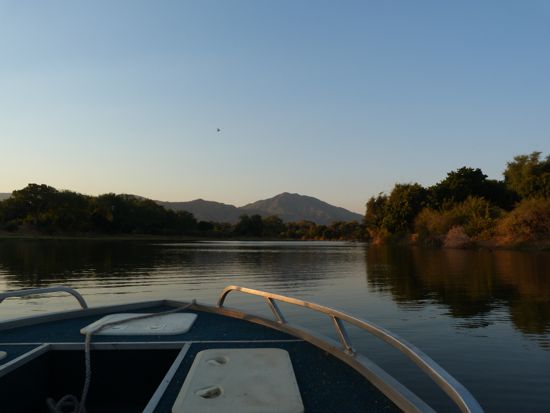
And Victor has fishing equipment with him for the fishing enthusiast in our party. He is able to cast to his heart’s content with a rod and reel trying to hook a Tiger Fish (catch and release) but no luck.

We see lots of animals coming down to drink at dusk, just across the Chongwe:


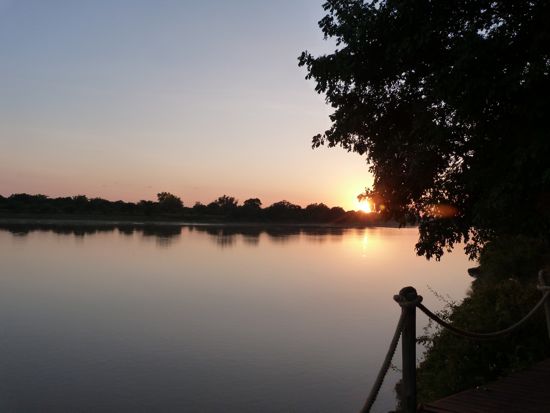
Our first Chongwe sunset:

Dusk settles on the Zambezi:

After sundowners, we head back and go to our luxurious tents to clean up, then reassemble around the fire to have a glass of wine before dinner.
The ultimate luxury is privacy. We have met such lovely people in the camps, and still, I am who I am, it is hard for me to exert myself to be charming every night at the end of a long day. I do fine at breakfast around a campfire. I manage at lunch, although after an early start and a long game drive, I am usually eager for a quick snooze. But by night, at the end of the game drive, all I want is comfort food, quick, like tomato soup and a cheese sandwich, not so much chit chat and good night, see you all in the morning when I am more chipper.
I recognize there are people who do well later in the day. I recognize that there is this thing called civilized behavior. I do have manners, I know what is important, and . . . yet . . . late in the day, I have the nature of a curmudgeon. I need some quiet. AdventureMan and our friends are out having a great conversation in our living room area, I can hear them, I delight that they are having such a great conversation, and I really, really need to be in here, writing up my notes. By the grace of God, they understand me and have compassion on me. I am able to join them a little later, and we have a lovely laughter-filled dinner in our private dining room and then off to bed – we have a full day tomorrow in Chongwe!
The butler, Steve, does wonderful napkins:

We did nothing to deserve this beautiful upgrade. We loved the spacious tents we had the last time we were in Chongwe River Camp, but this . . . this is a totally unexpected, undeserved blessing, it just fell in our laps, and we are so appreciative. We feel so cherished, so blessed, so beautifully taken care of. We go to sleep with the sound of hippos . . . . .ZZZzzzzzzzzzzzzzzzzzzzzzzzzzz . . . . . .
The Paris Wife by Paula McLain
The Paris Wife
Pauline Mclain

“This isn’t going to end well” you tell yourself when you start reading
this book, and you tell yourself not to read any further but you can’t
stop. This is a very good girl who meets a bad boy – what is it about
bad boys, anyway? You know you should go for the serious guy, the one
who will always have a good job, be a good provider for the family, a
good father to your children. You know all this, and you choose the bad
boy anyway. Why?
Hadley Richardson is a good girl at one of those transitional times in
history; world war I had ended, the damaged young men, including Ernest
Hemingway, are back from war, it is the 1920’s and the world is turned
upside down. When they meet, the chemistry is hot and strong. Their
friends warn Hadley against marrying “Hem” but when the attraction is
so hot and high, who can listen?
You know from the beginning that she is just the first wife, so most of
the book is full of dread, waiting to find out just how awful it is all
going to be. The early years, living in Paris, being dirt poor while
Hemingway gets started with his writing, are good years. They meet lots
of interesting expats living in Paris, they drink a lot, they are off
to Spain for the bullfights, and to Austria for the skiing, on the move
a lot, even once the baby comes.
It’s a fascinating book, a snapshot of the roaring 1920’s, of the
transitional era when women started becoming less submissive and more
free, and of a relationship between a nice girl and a talented but
damaged and self-destructive man. You’ll hate having to put it down.
Post review add: I finished this book while in Zambia and wrote the review. I really want to read A Movable Feast, now, Hemingway’s last book before he killed himself, written about this marriage. I understand it is a nostalgic tribute to his first marriage and to Hadley.
We watched Hemingway and Gelhorn last night, and watched him leave Pauline, the false friend who snatched him from Hadley (this is not a spoiler, folks, this is history) for Gelhorn, and then in anger at Gelhorn, turn to the woman who would become his last wife. She is protrayed as a total twit.
The movie, Hemingway and Gelhorn, was only mildly interesting; Kidman was her glorious self but there was zero chemistry, her romance with Hemingway barely believable. And he comes off as a real jerk. The jerk part is consistent with The Paris Wife, but while The Paris Wife is more sympathetic to Hemingway, portraying him as damaged but vulnerable, in Hemingway and Gelhorn, he is just arrogant, egotistic and obnoxious. Still, after you read The Paris Wife, it is interesting to see the rest of the story.
Lusaka, Zambia to Nkwali, South Luangwa Valley, Zambia
Lusaka to Nkwali
“The shuttle will leave promptly at one” the concierge scolded, as if we had been late for any shuttle before.
“We’ll be there!” we responded, and we were. We had our bags packed and ready, and were in the lobby by 12:45. The shuttle, this time a big bus, was just for us, and in spite of Friday afternoon traffic, made good time to the airport.
For all our efforts to be on time, we learned that our flight would be delayed another hour and a half. On one hand, we are always glad when airlines make needed repairs . . . we’d rather have a safe flight. On the other hand, the sun sets early, it is winter in Zambia, and it would be nearly dark when we arrived. It isn’t like the US, or Kuwait, or Qatar, or even Lusaka, where there are strong lights so you can land after dark. If it is dark in Mfuwe, your plane can’t land. We really, really don’t want to stay in Lusaka another night when we really want to be in the bush.
It was very nearly dark when we arrived, but we did arrive in time to land. We missed the sunset, but we got to see the villagers all en route to the nearest markets for Friday evening shopping, and got to camp just in time to set down our bags and have dinner. Earlier campers have left, and for the first night, the four of us have the entire camp to ourselves.
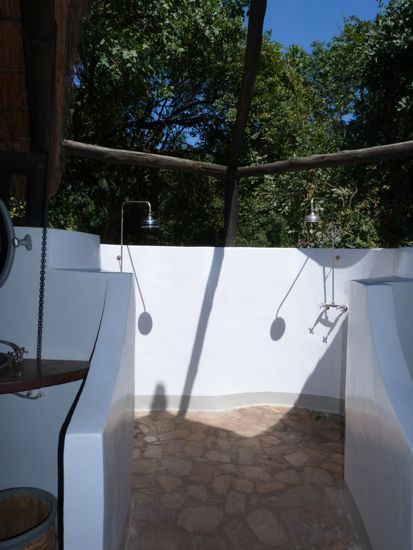
Here is a view that thrills me – the full moon, as seen from our shower:

Nkwali is a Robin Pope Camp, and we have been coming back regularly since our first trip about 12 years ago. We were last there four years ago with out son and his wife.
“What would you like to see?” our hostess Tina and camp manager Chris asked us.
“I’ve always loved giraffe,” one of our group replied, “Can you arrange for a giraffe?”
“Yes, we can arrange that,” he smiled.
Meanwhile, camp wildlife joined us for dinner:

Still jet lagging, we went to bed and AdventureMan was sound asleep quickly, just after hearing the “hahahahahahahaha” of the hippos. Just as I was falling asleep, I heard what I thought were the guards footsteps around our cabin, but they went on and on, and it sounded like he was sitting on our front porch. After about five minutes, I got up and peeked out the curtains. A hippo! A hippo, not ten feet away, munching on greenery just off our patio. It’s amazing how quietly a hippo walks – soundlessly, on those big round feet – but how noisily he munches. It was the munching I had mistaken for footsteps.

There are also monkeys, which are adorable, like tiny kittens, playful and scampering, but they like to come in the cabin. We are told that they don’t bother with anything except food, so not to keep food open in our cabins, but our neighbor had her medications knocked about, and a glass full of soda sent crashing to the floor by monkeys – while she was right there showering!
Morning came too quickly, the drums drumming at 0530 to wake us for a 0545 breakfast and 0600 departure for the bush.
It’s a beautiful day, we eat some hot porridge and load up for a morning in the bush.
Just leaving the camp, we saw hyena ahead of us on the road, and a warthog family, and then giraffe! One, off in the distance! Later in the day we would see more of these Thornicroft giraffe, endemic to this part of Zambia.
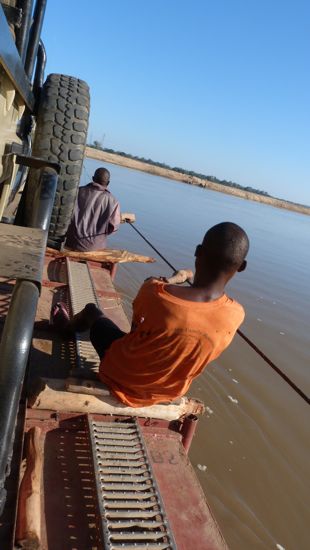
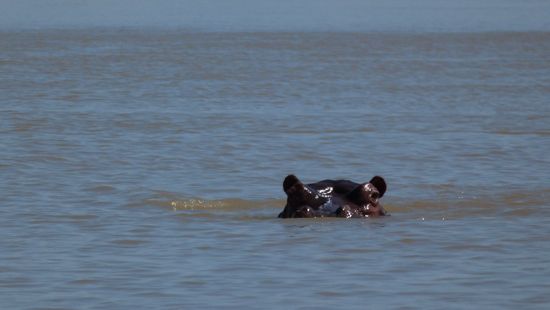
We drove up to the river cross barge, a private barge funded by the local camps to help get their guests across to the national park on the other side. The barge trip is an event in itself, hand pulled across the wide, but shallow Luangwa river. Shallow, but full of hippo, and full of crocodiles, too.

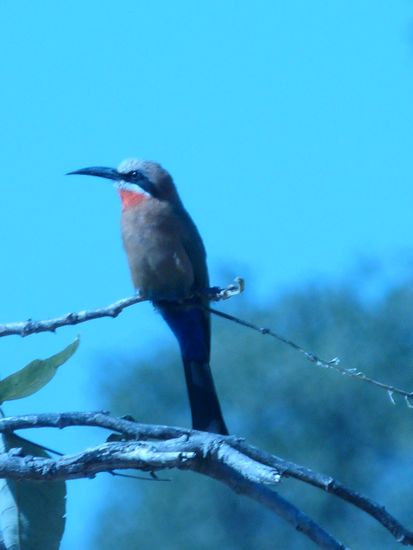
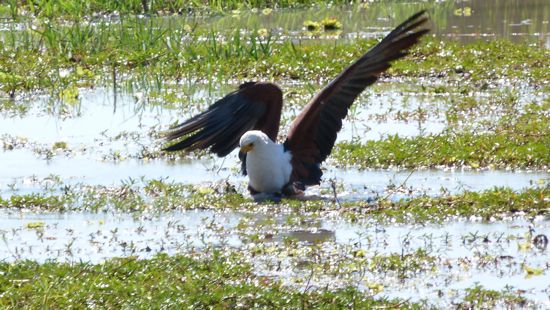
The best part of the morning was reaching a huge lagoon, full of exotic birds, and with a constant stream of animals coming to drink, parades of zebra, elephant, a fishing eagle, ibis, Egyptian duck and many others. We are a patient bunch, and we loved just finding a good position and watching the game pass through, getting a good shot when we could. By the time we headed back to the lodge for lunch, we were exhausted.

This isn’t the most crisp photo, but I love the length of that loooonnng trunk reaching out into the lagoon for water. Sometimes you only get one shot:


This is a fish eagle. The next shot, he has a fish in his claws, but it isn’t a very clear shot:

Nkwali Cape Buffalo

Then, just for our companion, we came across giraffe – lots of giraffe, but it’s not easy to get a good clear shot, because you are mostly shooting them against trees, head in the leaves, and you have to shoot fast or all you get are giraffe butts, walking away:

We leave the Land Cruiser on the National Park side of the river, and men from the camp poll us back. The river is so shallow that we almost get stuck on the sand bar.

You’d think we could just walk across, but there are territorial hippo and hungry crocodile, and we don’t want to tangle with either of them.
One of the funniest continuing jokes on the trip are the questions from people who have never traveled in Africa who with great concern ask “But what will you eat?” We took photos often, because we ate often, and well. This is our lunch the first day when we got back:

I always have a list of things I need to do. Like at these camps, women need to wash out their own underwear, it’s a cultural thing, men are doing the laundry but they won’t touch womens underclothes, so I always have some clothespins to hang things to dry. I also wanted to wash my hair, which gets dusty quickly out driving on the game drives. I have to do it in the afternoon, so it will dry (no hair dryers in the bush), and then I need to lay down, because I’m really sleepy, still jet lagging. When I wake up to the “tea-time” drums two hours later. I felt so good! I felt like it was the best sleep I had gotten since leaving Pensacola, and it made me feel good, and full of energy once again.
Here is what our cabin, and Nkwali Camp, look like:

This is our writing desk; there is one in each cabin:
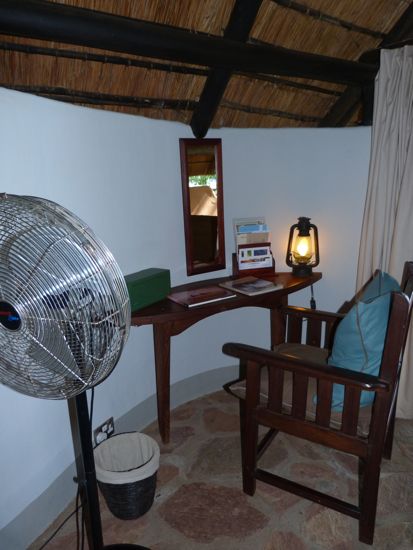
This is where you can unpack while you stay here, and where I lay out my clothes the night before so I don’t have to think when we get up early the next morning. When you are getting up really early, and only have about 15 minutes to get ready, you need to be able to get dressed without thinking too much about it. (It’s kind of like going to kid’s camp, only this is grown-up camp, LOL)

I almost hate to show you too much, it’s all such a wonderful surprise, finding these lovely cabins in the wild, but some people are so afraid to give it a try, I wanted to reassure you that it is quite civilized:
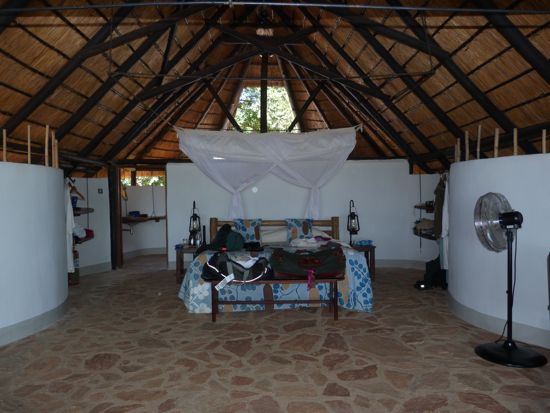
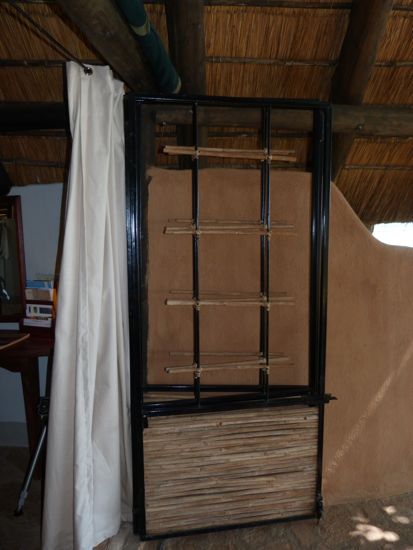
This doesn’t look like a lot, but the screen is enough to keep the wild animals out of your room when the sun goes down:
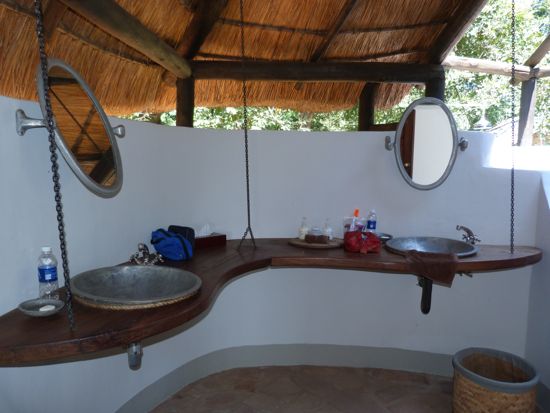
We love this bathroom:

We really really love this, this huge shower, with dual heads, big enough for both of us to shower at the same time, in the hot afternoon.
This is the Nkwali dining area:

This is the pool area and lagoon adjoining the dining area:
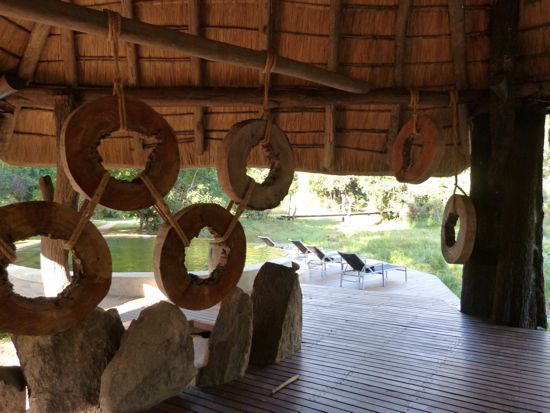
This is the gathering area/bar, and also where the campfire is, and where we eat breakfast around the campfire:
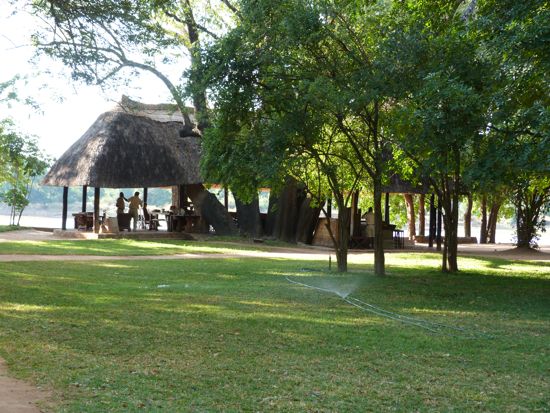
It seems to me that Nkwali is pretty much the intake area, where they help us all understand how things work, then they send us off to the other camps, Nsefu and Tena Tena, or to the fly camps (outdoor camping), or the mobile tented safaris. Before you go, you have to know the protocols, so Nkwali sort of educates you.
Your day goes like this – drums, get up, get dressed, go eat, load up into the car, go look for game. Back to camp for lunch, take care of washing underwear or hair, take a nap, drums, wake up, drink tea and eat cake, go for a game drive, stop for sun-downers, see lions (if you are lucky), back to camp, meet up in the gathering area/bar for drinks, drums for dinner, eat dinner, lay out your clothes, fall into bed (repeat)
After tea, we took a boat, polling back across to the national park, where we left the car. We drive, admiring giraffe (many!) and elephant and hippo. We run into one elephant who seriously, seriously does not like us. He does several mock charges, but he doesn’t walk away, he keeps charging.

We had a beautiful sunset on the river, and then went seriously looking for lion.


At the same time the sun is setting in the west, the full moon is rising in the east, fabulous:

The most exciting part was coming across a group of three young lions, one with a battered and bleeding ear, who tolerated our photo-taking until they didn’t. Then, one got up with a roar, and started walking and roaring.


Have you ever heard a lion roar? It is very very impressive; very loud, very resonant, it shakes your bones with its power. Shortly, one of his brothers joined him. They walked away down the wadi (what we call dry river beds when we live in the Middle East) and we thought we had a great night. Little did we know we were also going to have a leopard walk right next to our vehicle, and each of us was working frantically to figure out night time settings, so totally unexpected that not one of us got a photo. It didn’t matter. The very closeness of the passage and his utter disregard for our presence, his focus, was amazing and memorable.
All this fresh air and fabulous meals – Now I am back on schedule and sleeping through the night. I can hear the hippo outside munching as I am drifting off – but I just smile to myself and go happily straight to sleep.
Bullying and Community
I found this on AOL/Huffpost Parenting: it contains a line – I italicized it – that I need to think about. In America, we tend to think of the individual over the community. For the most part, we don’t encourage our children to continue with an activity they don’t like ‘for the good of the group,’ we tend to take them out of the activity. I’ve lived in cultures where obligations to the group are much stronger, and I’ve always felt confined and constricted by the burden of those expectations, but it does make for a more peaceful situation when we consider the needs of others and the needs of the group.
Preventing Bullying Begins With Us
Richard Weissbourd and Stephanie M. Jones
On Feb. 29, Lady Gaga will launch a foundation dedicated to creating caring communities and stopping bullying. Hosted by the Harvard Graduate School of Education and Harvard’s Berkman Center, Lady Gaga will be joined by Oprah and other celebrities. A powerful new film, “Bully,” will be widely released at the end of March, and many Americans in recent years have been galvanized by a blizzard of tragic bullying stories.
Yet too often in the past a problem plaguing children like bullying has received huge waves of public attention that simply never translates into any positive changes in kids’ lives. What will it take to capitalize on this attention? How can we curb this problem once and for all?
We can start by recognizing where the main solution lies. There is a tendency to simply blame bullying on “bad” kids or peer groups or destructive media. But bullying often has deep roots in parents’ attitudes and behavior, and stopping bullying begins with us.
How can parents prevent bullying? Parents in recent years have been flooded with articles and books that guide them in shielding, or “bully-proofing,” their own child. But just protecting our own kids won’t stop bullying, and this guidance reinforces the damaging tendency of many parents to just focus on their own children. The best way to prevent bullying — and many other forms of cruelty and harassment — is to encourage and enable children to care for and take responsibility for each other. Research indicates that bullying is greatly reduced in particular when children who witness bullying stand up for the victim. Bullying brings home to parents our fundamental moral responsibilities. How can we help our children widen their circle of concern and stand up for other children? How can we help our children build more just and caring communities?
Bullying, unlike more typically developmental teasing and hurtful remarks, is commonly defined as prolonged or frequent cruelty to others, often characterized by imbalances of power. This kind of cruelty can produce intense and often lasting feelings of shame in children, a sense that they are defective in some core way. About 30 percent of children are bullied each year on school property alone. Adults’ understandable reflex is to curb this kind of bullying by punishing perpetrators. Yet this strategy alone usually fails to stop bullying, and sometimes it backfires.
On the other hand, bystanders — especially a friend of the bully — tend to be far more effective. A bystander is present in 85 percent of bullying situations, and bystanders who intervene appear to prevail over half the time. Yet in the vast majority of cases bystanders elect not to intervene.
What can we do as parents to help our children stand up for others? Research suggests that parents bolster their children’s ability to act independently and to withstand disapproval when they respect their children’s capacity as independent thinkers from early ages and give them input into family decisions. All the things parents do to build in their children a sturdy sense of self make it easier for children to hold their ground against a powerful peer. As parents we strengthen the self, for example, when we praise appropriately, know and appreciate who our children are and maintain their trust and respect. Nurturing empathy in children from early ages certainly matters as well. That means in part helping children appreciate people who may not be on their radar, whether a bus driver, a custodian or a new child in class. It means helping children consider the perspectives of those they’re in conflict with as well as people who are different from them in customs or background or other characteristics.
While it’s vital that we convey high moral expectations and underscore the importance of sticking up for others, we also must listen carefully to our children and understand the complexity of their social worlds and ethical decisions. We as parents will be more real and valuable to children if we pay careful attention to their perceptions and experiences of bullying and discuss when and how to stand up for someone else. We need to talk to them about the complexities of balancing our needs with others and what consequences are worth and not worth bearing. We need to help them figure out how to challenge someone else constructively.
But perhaps most important, stemming bullying will require us to seriously examine our parenting priorities. As a good deal of research now indicates, we live in an era when many parents are intensely focused on their children’s self-esteem, happiness and achievements, not on how well they care for others. And in all sorts of subtle ways we can prioritize happiness over taking responsibility for others. Too many of us, for example, don’t push our children to fulfill obligations that might distress them. We let our children write off friends they find annoying, or fail to reach out to a friendless child on the playground, or quit a team or chorus without asking them to consider what it means for the group. How many of us simply tell our children that their classrooms, schools and neighborhoods are communities to which they have obligations?
Just as worrisome, many of us as parents are failing to model for our children a sense of responsibility for others. Over and over we have heard from teachers that many parents are occupied with their own child and care little about other children in the classroom. “It’s a dog fight,” one recently retired teacher says, driven out of the profession in part by his fatiguing battles with parents. “Parents are out of control. They’re always seeking an advantage for their own kid… they lobby for a gifted class or they want their kid to get extra attention… and they don’t care how they might be hurting other kids.” Some parents say they want kids with behavior problems immediately removed from the classroom because they believe their own child’s learning is compromised. But that message certainly doesn’t convey responsibility for others and the community. At least for some period of time, we as parents ought to encourage teachers to work with that child and ask our own child how she/he might support the struggling child.
It is, of course, a great deal easier and tidier for us as parents to simply wrap our attention around our own child or to periodically remind our child to respect others. But such bland reminders will never get us where we need to go. Our children’s moral development is deeply interwoven with our own. If we want our children to be fair, courageous and humane, we have to take a close, hard look at whether those values are priorities in our parenting, and whether we are living those values day to day.
Social Network Interactions
I do go to FaceBook now and then, and I have connected with old friends, college friends, high school friends, and people from the many ‘places I remember’ in my life . . .
It’s pretty public, don’t you think? And you do one little thing, and it’s like glue, you’re stuck with that relationship. I am now careful who I ‘like’, because I seem to end up linked to them, and honestly, I try to be careful to limit my connections to people I know, or have known, people I have something in common with, like a family member, etc.
It’s like if you indicate any interest at all, you get linked. Is it just me? I don’t think of myself as isolationist, but time is precious, and I try to spend it wisely, focusing on genuine long term relationships, family relationships and people with whom I have commonalities.
I find that magazines who which I subscribe, cultural organizations, charitable organizations are all sending me surveys; they want to get to know me better. (? ? ? )
It’s too much relationship for me. I know there are people who can handle a huge number of social acquaintances . . . that’s not me. I am civil, even cordial. I don’t want to get to know organizations through surveys, nor businesses, relationships take TIME. So many of the ‘relationships’ make me feel rushed, and when I feel rushed, or pushed, my reaction tends to be to drop the relationship; it just doesn’t work for me.
I do believe we are all supposed to be connected, to be kind to one another, to care about one another. It’s asking too much of me to expect it to happen quickly. Am I the only one? Does anyone else have any problems with the instant sort of intimacy that seems to spring up so commonly on the social networks?
Recent Comments
intlxpatr on Shampoo Ginger tigerbutterya0c5ff1d… on Shampoo Ginger intlxpatr on British Soldier Kidnapped, Esc… John on British Soldier Kidnapped, Esc… intlxpatr on British Soldier Kidnapped, Esc… Wikipedia Donate Button

Amazina


Early Voting in Florida


 Here There and Everywhere