The Law of the Harvest
A small group was huddled, talking about volunteer work, and how people are afraid to commit, when the duties are actually very light, and easily accomplished, then we drifted into giving generously . . .
“It’s called The Law of the Harvest” one of my favorite women popped in as I was trying to explain that when you give, open-handedly, give with your heart, it all comes back to you multiplied.
We all turned to her. “Remember the seeds? You sow the seeds and then it is multiplied?”
Of course! It’s so simple! Why didn’t I think of that?
Volunteer Day at Animal Friends Kuwait
God bless the work of your hands, all you who work to help those who have no voices, who rescue the animals, give them food and shelter, and adopt them.

Animal Friends and K’S PATH will be hosting its bi-annual Shelter Open Day where everyone is invited to come out, visit with the animals and learn all about their rescue and care. Visitors will be able to walk the dogs, cuddle the cats, play with the puppies, brush the donkeys, watch the baboons and so much more. The weather is beautiful, so come and make a day of it.
When: Friday 29 January, 2010, 11:00am to 3pm
Where: Animal Friends Shelter and K’S PATH sanctuary in Wafra
Cost: Free, although we certainly appreciate donations
Notes: Please leave your own pets at home and refreshments will be available for sale.
Huge Yard Sale — antiques, collectibles, book worm’s treasure trove, gently used infant clothing and toys, gently used adult clothes and shoes, Indonesian teak furniture, home wares, gourmet kitchen gadgets, dishes, pots and pans and so much more. Come on over and rummage through the goods and you might find a treasure. All funds will go to support Animal Friends.

When: Saturday 6 February, 2010, 10:00am to 3pm
Where: Fintas, Block 4, Street 11, House 29
Notes: Refreshments will be available for sale.
The Party House
We stumbled into the upstairs lounge, all four of us, sleep muzzy and disheveled, but then again, it was 3 in the morning.
“What is that?” asked Mr. Ambassador, who is no longer Ambassador anymore, but still gets to be called that. He was asking about a wailing, like that of an injured cat, only accompanied by music.
I blushed to the roots of my hair. Fortunately, it was dark. No one could see the depth of my humiliation
“It’s the party house.”
This was punctuated by shrieks of laughter from the new influx of ‘hostesses’ invited to entertain the male guests when they ceased their karaoke singing. Doors slamming, karaoke machine at it’s highest setting, the party is in full swing.
AdventureMan broke the ensuing horror-filled silence.
“We are SO sorry. It hardly ever happens. Most of the time they aren’t even there. You just happen to be here on the ONE night.”
With the beautiful weather, we have our windows open. We make up the beds in the rooms on the other side of the house, close all the windows, and turn on the air conditioning to muffle the alcohol-fueled revelry.
“Can’t you do anything? Can’t you complain?” my good friend, the ambassador’s wife, whispered to me.
“It’s their compound. We tried complaining. Nothing happens. I can’t tell you how embarrassed I am that this would happen while you are here, as our guests,” I replied.
She laughed – diplomatically – and brushed my embarrassment aside. She’s a good friend.
Community Police Graduate
Community policing is necessary when we neglect to police ourselves. . . if, for example, we find ourselves throwing a tissue out of our car window as we drive along, littering the pristine streets of Doha. If we bully someone because we want that parking spot he is driving into, if we disrupt the peace and quality of life of others by our behavior.
I notice, in this story from the Gulf Times, that women are a part of this program, and that they are wearing uniforms, and hijab, and that those uniforms are very modest and also that they are wearing pants. Please see the previous article.
I commend Qatar for this visionary program, helping the community police itself, and for including women from the very first class.
46 take part in community policing basic course
Graduates with officials at the convocation ceremony
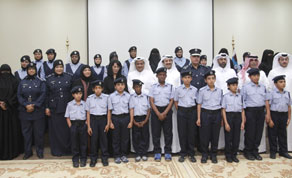
The Police Training Institute (PTI) recently held a ceremony to mark the graduation of participants in the first batch of the Community Policing Basic Course, under the auspices of Minister of State for Interior Affairs HE Sheikh Abdullah bin Nasser bin Khalifa al-Thani.
Some 46 students from various security departments took part in the course, which lasted seven weeks, said a spokesperson.
The ceremony was attended by the chairman on the Central Municipal Council, HE Nasser al-Kaabi; director of the PTI, Brigadier Mohamed Hassan Youssef al-Saei as well as other ministry officials.
Brigadier al-Saei explained that the course has been conducted to “enhance the role and mechanisms of community policing,” as well as helping to create partnerships with various social institutions to help with national security.
The PTI director added that the graduates of this course will be able to translate the Ministry of Interior’s aims and strategies to encourage understanding between various communities and to help the police to be able to prevent crimes before they are committed.
Brigadier Rashid Shaheen al-Atheeque, chairman of the steering committee of community policing, said: “The graduation of the first course of community policing is one of the stages of qualifying the national cadres at the Ministry of Interior to work in the national project.”
“Qatar is currently witnessing progress in all aspects of development in economic and social fields – this increases the role of all sectors in the country to face all kinds of challenges brought with this development,” he said, adding: “These factors require the improvement of capabilities to keep pace with development.”
Brigadier al-Atheeq explained that the ministry had pursued the initiative of community policing to help reduce crime throughout all institutions, and said that they had pursued the objective with the co-operation of the Supreme Council for Family Affairs as well as other ministries and companies, working towards the National Vision 2030.
He explained that the concept will initially be employed in the North Security Department from April 2010, with plans to apply it across the board from 2011.
Representing the director of the Ummul Qura Independent School for Boys, teacher Areezah al-Yami described the noticeable benefits of introducing the community policing programme in the school over the past year.
Stieg Larsson and The Girl With the Dragon Tattoo
I needed some escape time, so I started The Girl With the Dragon Tattoo, a mystery by Stieg Larsson, set in Sweden. I love these detective stories set in other countries; I can learn something as I pass the time reading an exciting mystery. And part of my heritage is Swedish, so I thought this should really be fun.

It wasn’t, at least not at the beginning. At the beginning, I didn’t like any of the characters, and they were always eating sandwiches that sounded awful, like liverwurst and egg. I felt like the characters didn’t have any moral center, like they drifted from day to day without neither conscience nor a plan. The main character, Mikael Blomkvist, is about to go to prison for libel; he printed a story about a major industrialist which turned out to be false, and he protected his source. We don’t really know the whole story, not until the end, which makes it hard to evoke a lot of sympathy for Blomkvist.
He is contacted by another industrialist, and asked to solve a mystery, if possible, about the disappearance, 40 years ago, of his niece, Harriet Vanger. Blomkvist would investigate under the cover of writing an autobiography of his employer and his family. There are members of the family who object. In many ways, it isn’t a very nice family.
Blomkvist gets an assistant, a deeply troubled and flawed young woman, Lisbeth Salander, with a gift for investigation. There is a lot of violence, sexual violence, and mutilation of animals. One of the points I credit Larsson with making is the amount of violence against women in Sweden, which goes on under a seemingly civilized veneer. The truth, as I see it, is that there is violence against women in every society; in some it is better documented than in others. In some, it is better punished that others. It exists in all societies, in all countries.
Another think I ended up liking about the book was that the main character, Blomkvist, who writes financial analysis, takes the press to task for printing what passes for financial news without critically reading and evaluating, which he feels is a responsibility of the press. At one point, as people quail with fear that the stock exchange will drop dramatically, he is interviewed and explains that the stock market is based on perceptions, while the Swedish economy is based on production and services; that while the markets may fail, the economy can still be going strong.
Slowly, the book tightens up. Actually, by the end, I was hooked. The only question in my mind is – did I like it enough to read another?
The book is available, new, from Amazon.com at $6.00 plus shipping.
Saturday Night Live Does Tiger Woods
There are mixed reviews on this hilarious Saturday Night Live take-off of the Tiger Woods situation. Some people feel it is tasteless, and that if the batterer were a man, it would be seriously unfunny.
They are right. And who on earth expects Saturday Night Live to stay within the boundaries of good taste? Or any boundaries at all?
As for me – I find it tastelessly hilarious.
( I will try to keep posting ones that work until they get taken off)
Cheaters Leave Digital Tracks
No, not another post about cheetahs – this is about cheaters.
Today in AOL: Sphere
(Dec. 3) — Tiger Woods has long since mastered the use of every club in his golf bag. Yet he, like many Americans, apparently is still learning the hazards of communicating too openly by modern methods such as text messaging.
Woods is certainly not alone. As communication technology continues to evolve, unfaithful partners are finding it easier to keep in touch with their illicit lovers — but it’s also a lot easier to get caught.
The golf champion has said only that “I have let my family down” through unspecified “transgressions.” But one of his alleged mistresses, Jaimee Grubbs, says she still has 300 text messages sent to her by Woods. In one, Grubbs tells RadarOnline.com, Woods says, “Send me something very naughty. … Go to the bathroom and take [a picture].”
Us Weekly magazine has also posted a voice mail Grubbs says is from Woods, warning that his wife has examined his cell phone and may have discovered the former cocktail waitress’ name via caller ID.
“Any electronic means of communication — a cell phone call, an e-mail or a text message — will leave some sort of trail behind,” said Ed Edmister, a private investigator and computer forensic expert at Integrity Security & Investigation Services, which has branches in California and Virginia. “Even if you toss your phone in an incinerator or dump your computer in a lake, there are still records kept by phone and Internet companies. Digital forensics has become a huge field.”
Of course, not every spouse needs to hire a private investigator, or send in a partner’s cell phone to one of the dozens of companies that specialize in recovering deleted text messages and call logs. Sometimes, the evidence is hiding in plain sight.
Take the case of Tony, a 38-year-old Jacksonville, Fla., man who did not want to use his real name for this article. After eight years of marriage, Tony began an affair with a younger woman. “We sent text messages to each other all the time,” Tony said. “I carried my cell phone with me wherever I went.”
After staying out late one night with his mistress, Tony slept in while his wife and two sons ate breakfast together in the kitchen. His cell phone, carelessly left in a coat pocket, chirped to indicate a text message had been received. “My 8-year-old son picked it up and read the message aloud,” Tony recalled. “It said, ‘Good morning, honey. Have a good day.'”
Tony’s wife snatched the phone from her son’s hand, headed into the bedroom and confronted her husband. Six months later, the couple divorced.
“Infidelity is so much easier today,” said Ruth Houston, author of “Is He Cheating on You? 829 Telltale Signs” and a widely cited infidelity expert. “In the past, a potential cheater would go to a bar or a nightclub — very risky stuff when you’re in a marriage. Now you can sit down in your home and click on a mouse and find willing partners.”
Thanks to unreliable self-reporting, trustworthy infidelity statistics are difficult to come by. But a recent study sponsored by the National Science Foundation, and reported in The New York Times, showed marked increases in infidelity among both men and women from 1991 to 2006.
“Infidelity is definitely on the rise because of technology,” Houston said.
Even in innocuous ways, the Internet can bring together aspiring adulterers. After all, the Web is quick to sort users into affinity groups. Two people who meet in a dedicated chat room already have some interest in common, and that can foster a rapid sense of intimacy.
“Women, especially, crave emotional intimacy,” Houston said. “E-mail or chatting can start off innocently, but if there are actual connections, relationships develop quickly.”
In any case, adulterers are slow to grasp that modern communication devices are not nearly as private and secure as many people believe. Just ask South Carolina Gov. Mark Sanford, whose e-mails to his mistress, Maria Belen Chapur, were first made public by The State, a Columbia, S.C., newspaper.
Kwame Kilpatrick, the former mayor of Detroit, suffered a similar turn in the electronic pillory. Some 6,000 text messages from his mistress’ pager were posted online by The Detroit Free Press and helped lead to his conviction on perjury charges.
Those politicians are certainly not the only ones to be caught with their virtual pants down. Digital technology, which has democratized almost everything it touches, is making adultery accessible to the masses.
Round 2, Why You Should Always Carry Your Camera in Doha
“HOLY COW!” I shouted at AdventureMan, as I am already digging for my camera. He hates it when I do that, he things maybe I have spotted some danger or something and it gets his adrenaline going. I couldn’t help it. I was shocked, and I said “There’s a CHEETAH in that car!”
We love cheetah. Anyone who has ever seen a cheetah in the wild knows the awesome measure of God’s creativity and wonder. The cheetah is a speed machine, a glorious hunter, born to run. The cheetah is a glorious creation.
AdventureMan didn’t believe me, not for two or three full seconds and then – he saw it, too:


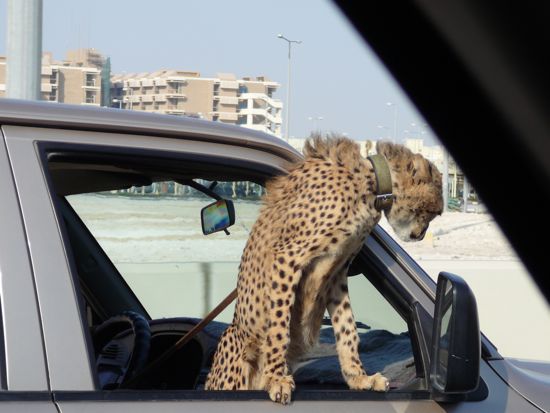
The man with the very young cheetah on a leash under very loose control was having a ball. The cheetah looked very happy to be out in the car with him, even on a leash.
It is a shame, and it should be a crime.
A cheetah, even when snatched away from his mother early in life, is not a toy, not an accessory. A cheetah can eat your innocent babies. A cheetah can bite you or scratch you badly, and think it is just playing. Taking a cheetah out of the wild is probably not a really good thing for the cheetah. How long with this man find him novel and fun and pay attention to him? And then what?
This is what a cheetah is meant to do, and this is how a cheetah is meant to live:
My friends, if you love wildlife, no matter how rich you are, leave the wildlife in the wild. Please.
Big Change; No Smoking
Sometimes change happens, and it happens so slowly or so subtly that you don’t really realize it has happened until something draws it to your attention.
Kuwait blogger Touche, one of my old virtual-blogging-buddies commented on a driving post, wondering about the baby steps it takes to change a mentality. The subject was driving, and I know he was right, I am writing “endlessly” about how annoyed I get by the lack of civility in driving here.
What I am not writing about, I noticed, is how annoying it is to be breathing other people’s smoke while I am eating.
Because it is not happening.
Who knew?
When we lived in Qatar before, people would sit right under the NO SMOKING signs and light up.
I saw things change in Kuwait. From the time we got there to the time we left, there were fewer and fewer times someone would light up in a restaurant.
Things CHANGED.
Expectations changed. I am guessing the smokers felt pressure, not just from the community, but also from family members. I don’t know if there are fewer smokers; I am inclined to think not, because I can see them smoking in their own cars. Hey – as long as I do not have to breathe their smoke, it’s fine with me, it’s their choice.
But the significant thing is – I didn’t believe it could ever change. And it did change, and it changed faster than I would have thought possible.
So I have hope for the driving issue. I think it starts with seat belts. I think if Mothers and wives start buckling up, and buckling up their children, that will be a first step. I think if there is an emphasis on driving manners, things could change. It’s a mind-shift before a behavior shift, an awareness of safety and an awareness of our interconnectedness. One thing I have seen in the Gulf is that parents raise their children to have good manners; manners are an important consideration also when considering a mate. If you take the driving problem as a manners problem, and emphasize the need for good manners on the road, maybe there is a possibility of change . . .
There is another area where I think change can happen – throwing things out the car window. If it becomes a commonly held value that throwing trash / cigarette butts / food wrappers out the window is bad behavior, I think it will stop. Maybe hand out car trash bags to raise awareness?
Have you seen the change in smoking? What I am noticing is that my dinners are no longer ruined by someone nearby lighting up. I don’t smell smoke in the malls. I don’t smell smoke in the airports. Pretty amazing, don’t you think?
Doha: Keep Your Camera Handy
Today I had one of those experiences I have so often in Doha, a “no-one-would-believe-me” moment, but I have learned to keep my camera handy, and fortunately we were stopped in traffic so I could snap this one without endangering any lives, especially my own.
Traffic is steady, busy, but pretty mellow. Yeh, there are the normal “I’m-going-to-make-a-left-turn-from-the-right-lane” guys; I’ve lived here for so long it doesn’t even rate a roll of the eyes. It’s part of the Doha / Kuwait driving culture.
This, however, I only see in Qatar. Mr. I’m-So-Important-I-Can’t-Wait is this guy in the white Land Cruiser.

He is sitting half on top of the street median, trying to get back into traffic going in his direction. To get there, he drove down the wrong way down the street on the other side of the divider. At first, there was no traffic, but when traffic came, he got up on the divider so he was only HALF blocking traffic from the other direction, and he is bullying his way back into the line he was too important to wait in.
I carry my camera now, every day, in my purse, because I know if I just tell you about these things, you won’t believe them.
I have seen this also at major roundabouts. Some yahoo drives up the other side of the road to the roundabout to avoid waiting in the line. Up over the medians, facing oncoming traffic. I know, I know, what are they thinking?
In Kuwait, I was sickened by the number of young men killed on the roads every week, every month. If it were an epidemic killing young men, people would do something about it, but tell these guys to obey the law? Make them pay fines for reckless driving? Make them wear seat belts? Their behavior tells me that no one has ever held them accountable for their arrogant and dangerous driving habits.
While we are told that “no one is above the law” somehow the message hasn’t made it to these guys.
Recent Comments
intlxpatr on Shampoo Ginger tigerbutterya0c5ff1d… on Shampoo Ginger intlxpatr on British Soldier Kidnapped, Esc… John on British Soldier Kidnapped, Esc… intlxpatr on British Soldier Kidnapped, Esc… Wikipedia Donate Button

Amazina


Early Voting in Florida


 Here There and Everywhere