What is Your Greatest Fear?
Reach down deep. Take your time. Think about this.
A friend sent one of those “getting to know you” e-mails, and this question was on it: What is your greatest fear?

(Photo from Acclaim images)
My first reaction is – whoa! That is a VERY personal question! But I shared my answer with her.
One of the reasons we share when we blog, I think, is to connect with one another, to make this world a less lonely place. When we are going through a hard time – and don’t be fooled, no matter how good, how together, we look on the outside, we ALL go through hard times – it helps to know that we are not the only person in the world who has ever gone through this, whatever this may be.
There are things we don’t talk about. From time to time, you find a friend you can really really trust, and you take a chance. What a relief! You discover, if you are lucky, that maybe he or she has been there, too. At the very worst, you have someone who knows what you have suffered. It can be years down the road that they come back to you and say “I’m there now – can you help me through it?” And two people are less alone, and your suffering has not been for nothing; it has equipped you to walk this path with your friend, and lighten the load a little.
So here is is: my greatest fear is to die a meaningless, stupid death.
I don’t want to die on a Kuwait highway saying “oh sh$t” as I see some doped up, testerone-loaded, out-of-control driver barreling straight into me.
I don’t want to die as a random, unchosen victim of terrorist attack, like 9/11, or Pan Am 103.
I don’t want to trip over my high heels and break my neck falling down the stairs. (My own stupidity!)
I wouldn’t mind dying a heroic death, but my preference is to die quietly, prepared, even eager to meet my Creator. But my terror is to die too soon, for no good reason, as the result of someone’s stupidity.
So. I’ve taken the risk, early on this Thursday morning. Step up to the plate. Take a deep breath. Even if you’ve never commented before, take a risk, here, now. (Regular commenters, welcome!) Share your greatest fear.
What is your greatest fear?
“Woh ist der bahnhof?”
One of our family jokes is about how when you go to live in Germany, for some reason, one of the first phrases you learn isn’t “guten tag” or “Wiegehts” (hello! / how are you?) but “where is the train station?” And it is particularly hilarious because even if you ever say it exactly right (or so you think) no one can understand what you are saying. And if they DO understand – they start giving you directions with elaborate hand signals.
Germans are very precise. They won’t just point in a general direction, they will use all kinds of words for left, right, straight ahead, and my personal favorite “gegenuber” which means catty-corner, or diagonally across from something, all words that the beginner doesn’t have a clue. So even if you successfully ask for directions, you can’t understand the answer.
Most of the time, however, you will ask “woh ist der bahnhof” several times, as the response is continually “wie, bitte?”, the polite way of sayinh “WHAT??” and then finally they will get this “aha!” and they will say “Oh! Woh ist der bahnhof?!” and it sounds exactly like what you have been saying for the last five minutes.
I had a “woh is der bahnhof” experience here in Kuwait. I was searching for a souk I had heard about. I asked some of my friends – where is the souk Watiniya? I experienced that two seconds of total blank non-response that always feels like two days, and then one of them laughed and said “oh, she means the souk Watiya” and they told me where it was.
But I’m getting smarter. It wasn’t the part where I added the extra syllable that confused them. It was the fact that I used the soft “t” and not the hard “t”. It’s a small thing, but enough to make me dance for joy – I can hear the difference!
Peeking Inside
You are a blessing in my life.
You think you are just blogging, but for me, you allow me to get a little bit beneath the surface of what your lives are like here in Kuwait.
I have to assume that most of you, like me, protect a lot of realities in your life, and that I am just getting the surface, just getting what you feel comfortable sharing with me.
And yet . . .no matter how superficial the “peek,” it is better than nothing.
Over time, we build a body of work. No matter how discreet we are ( Little Diamond I almost wrote “discrete,” and thinking of your pet peeve, checked it, thank God!) we reveal how we think, and what is important to us.
I love having some Kuwaiti friends. You teach me things I could never learn in a million years, just looking from the outside.
True story: I am having breakfast with my Kuwait friend at the Al-Kout Mall and she shivers. This friend is very special to me; it’s as if a flame burns inside her, keeping her pure and true from the inside out.
“I feel so out of place here!” she says.
I am truly bewildered.
“You are Kuwaiti! This is a Kuwaiti Mall!” I cry. “What is it that makes you so uncomfortable?”
“It’s like another world,” she says. “I’m not dressed conservatively enough.”
She is dressed in jeans – not tight. A t-shirt – not tight. And has a long sleeved shirt to go over it tied around her shoulders. She is entirely modest.
“I don’t see it,” I say. “Please, let me see through your eyes. What are you seeing, how is it different, why are you uncomfortable?”
“You’ve been to Marina Mall,” she responded. “You can see the difference?”
Of course. But Marina Mall . . . it is kind of a la la land to me, sort of bizarre. It almost looks Western, but there are things that are just not quite right . . .
“Yes,” she said. “You’ve got it.”
I still don’t know what I’ve got. So she starts explaining . . .”Look, you can see how the thobes are cut differently down here, tighter around the chest.”
(Uh . . . no, I can’t see!)
“. . . and the cuffs, the way they button. And the shoes are different, less . . . . ”
all of a sudden, I am thinking of my friend who taught Arabic, and the hours she labored, trying to get me to hear the difference between the light “t” and the hard “t”, I am trying and trying, but I don’t get it and then one day – I do!
I thank God for you, my friends, letting me see through your eyes, helping me understand, giving me new ways of seeing the world.
Internet Phone Blockage
So far, my internet phone is still working. But I can no longer pick up messages; I had a work-around and the work-around is now blocked, too. I still have the connection, but I can’t connect with my internet phone service provider. Hmmmmm.
In Qatar, the problem was solved in less than a week, when ambassadors went to the Emir and protested that the ban on internet phones hurt the entire population. Does the government here understand that Kuwaitis have kids at school in the UK, the US, and are relying on these phone services, too?
My sense is that with the government currently in chaos, no one has the time to focus on this “small” problem. Nor the problem of increasing population and buildings vs. limited infrastructure – roads. water. electricity.
My Kuwaiti friends say that even 20 short years ago, Kuwait was paradise. I believe it, there is so much beauty here, so much natural richness. They say Kuwait was more free twenty years ago.
I know my focus on the internet phone service is selfish; there are bigger problems to be solved. Right now – it’s the one that affects ME!
This Little Eggy
I was with my sweet friend and many of her 12 children, and I was goofing off with the younger ones, running, chasing. With tiny Abdulaziz, I started playing with his toes.
“This little . . . ” I started, and then caught myself in horror. The next word is “piggy” and my friends are devout Muslims.
She just laughed.
She said “Oh we do this too! We say ‘this little eggy went to market and this little eggy stayed home'”.
Oh! Thank goodness! Every child around the world loves that game; I’m so glad I can continue to play it here!
Who Knew? Skimmed Milk Gets Top Post
When I blog, I know what I think is important. I don’t just blog what I think is important, I also blog what I think is funny, what catches my eye, what I want people who don’t live in Kuwait to know about how life here is different from their life, and then.. . things in the news that might be obscure, but interesting.
Every day, the Who Knew? Skimmed Milk Affects Fertility post gets hits. Although I only posted it two weeks ago, it is the leader for the last thirty days, way ahead of the next most popular post.
I never know. Mostly I blog because I have things ( originally wrote “thinks” which must be truly Freudian) I want to say, but in any kind of communication, you need feedback. Feedback, for me, is a combination of what you comment, and what you read – my statistics. It just cracks me up, what you, the reader, find most interesting in my posts as opposed to what I am thinking when I post. Go figure!
The Wire
A couple years ago our son started talking to us about The Wire. He always puts us on to really interesting series. The Wire is an HBO series, like Rome
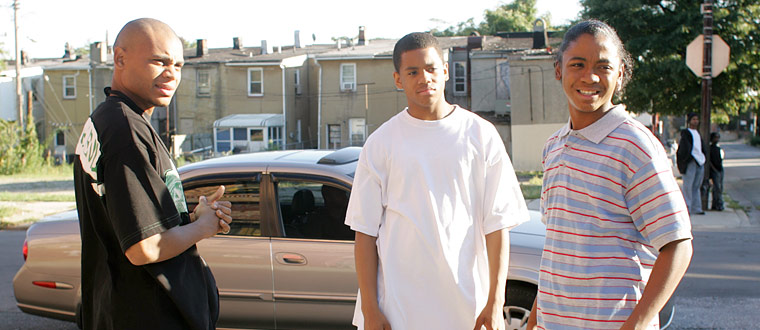
Season 1 starts with a new unit being set up to interdict the drug trade in Baltimore. Season 2 re-unites the team to combat illegal imports and illegal importation of sex slaves out of Eastern Europe and Asia. Season 3, my favorite season of all, is back to the drug trade, but with a difference.
In Season 3, one police district changes the rules. They clean up their neighborhood and send all the drug traders and sex trade workers to one area. The area doesn’t legalize crime – not exactly – but the police leave that area alone. As they explain it to the primary drug dealers, it’s a little like Amsterdam. The homies don’t understand; they call it “Hamsterdam”. I laugh everytime I hear it.
The series doesn’t focus strictly on the police – we get to go inside to watch how the drug dealers organize and divide up the city. We learn how drug lords use big business management modules to streamline their supply and demand, and to stay ahead of the police technology. And they are masters at manipulating the judicial system.
There is brutality. There is sex. There is love and there is betrayal. Sometimes, it isn’t easy to tell who the “good” guys are. There are bad guys who show decent values and there are police and politicians on the take. You get the impression it is probably pretty real stuff. In one season 3 episode, a policeman is shot in the line of duty, and they hold a wake in an Irish pub. They are all very very drunk, and vomiting out in the streets. It isn’t pretty.
And all the same, when each season ends, we can hardly wait for the next one. It is gripping drama, vintage HBO cutting edge production. It keeps you on the edge of your chair. You can read more about The Wire at it’s HBO site, where I just learned that The San Francisco Chronicle calls The Wire “the best television show of the year.”
Tchotchke
I used this word in conversation the other day, and my friend wasn’t familiar with it. I said it is something maybe sparkly, that catches the eye, but isn’t necessarily valuable, like the way Ravens go after a piece of tinfoil. Here is the official version, from Wikipedia.
Tchotchke (originally from Yiddish tshatshke (often spelled in a variety of other ways because there is no standardized transliteration) (trinket), ultimately from a Slavic word for “toys” — Polish: cacka, Russian: цацки) are trinkets, small toys, knickknacks, baubles, or kitsch. The term has a connotation of worthlessness or disposability, as well as tackiness. For example, an overly ostentatious piece of jewelry, valuable or not, might be referred to as a tchotchke.
The word may also refer to swag, in the sense of the logo pens, keychains and other promotional freebies dispensed at trade shows, conventions and similar large events. Also, stores that sell cheap souvenirs in tourist areas like Times Square and Venice Beach are sometimes called tchotchke shops.
The term was long used in the Jewish-American community and in the regional speech of New York City. It achieved more notoriety in mainstream culture during the Monica Lewinsky scandal. In addition, the 1999 movie Office Space features a tacky restaurant called “Chotchkies.”
Leo Rosten, author of The Joys of Yiddish, gives an alternate sense of tchotchke as meaning a desirable young girl, a “pretty young thing”. Less flatteringly, the term could be construed as a more dismissive synonym for “bimbo” or an attractive, but not very intelligent, female. Some consider this usage sexist and it is not widely used outside Jewish circles. The term (in the form tzatzke) is sometimes used in modern Hebrew as a slang word equivalent to “slut.”
Internet Phones Giggle
From a teeny-tiny article on page 2 of today’s Kuwait Times:
‘Phone’ Teams Honored
Kuwait: It is important to reduce charges of international calls to prevent illegal activities, Communication Minister Dr. Maasouma Al-Mubarak stressed yesterday.
In a press conference held on the occasion of honoring the team of the ministry’s telephone control department, Al-Mubarak said the department succeeded in cooperation with the Interior Ministry in locating and stopping illegal international calls dealers praising their efforts that continued despite the dangers they faced.
My comment: I’m sorry. I truly mean no disrespect. And at the same time I am having a very hard time trying to maintain a straight face. Oh, these dangerous telephone callers out there!
• Raiding brothels.
• Chasing drug dealers.
• Dealing with arrogant/immature/drunk/drugged drivers.
• Family disputes involving knives and guns.
• Protecting the borders, land and sea.
All of the above can involve serious dangers. One of the axioms in policing is that your most dangerous call is getting between a fighting husband and wife. But the bravery of raiding telephone call centers? Please. Spare me.
You can’t turn back the clock. Technology has given us a whole new way of making international calls. The MOC can spend its resources fighting a numerous enemy – people who want to make reasonably priced phone calls – or they can become a part of the solution, regulating and encouraging growths of new technologies to the greater good of all.

Lying Hurts the Liar
I came across this post in an old archive. The author was writing to teens about the Monica Lewinski scandal, but as I read through his wise words, I found myself thinking how appropriate the words are for all age groups:
Lying Hurts the Liar
If you lie, it will make things worse for you, too. Oh, you might get away with it once or twice, but you will get caught sooner or later.
How Does Lying Make Things Worse?
Lying makes things worse because it hurts your personal relationships: relationships with friends, brothers and sisters, parents, children, teachers and other adults.
Think of it for a moment. When you lie, it is a burden you have to carry with you. It makes you feel bad inside. You know you hurt your relationship with someone by lying. It violates the trust people have in you. Usually you have to lie again to cover up the first lie, and you feel even worse for doing that.
Have you ever noticed how badly you feel when you discover a friend has told you even a little lie? It hurts a lot. You wonder why a friend would do that to you. You think about it a lot, and you just don’t trust your friend as much after that. It’s not the same.
Then think about how you feel when someone is telling you what a good, good friend he is, and then he goes behind your back and says just the opposite. It destroys all trust.
A Way You Can Understand Lying
When you become a friend to another, you put your life in some small or large way into his cupped hands. You trust the person by putting part of your life in their hands. You want and need your friend to be worthy of that trust. When they lie to you, he lets your life slip through his hands, and is not worthy of your trust. How lonely that feels! How disappointing!
Lying harms not only personal relationships, but business relationships as well. In conducting business we also put ourselves into the hands of others. Our business associates need to be worthy of our trust. Take the simple example of going into a store and buying a box of chocolate chip cookies. The picture of the cookies on the box looks terrific. The chocolate chips look tasty, but you open the box at home and find cookies with no chips. You feel cheated because you believed what you saw. You believed a liar. No wonder you feel cheated. No wonder you’ll probably avoid that brand in the future.
Why Are We Tempted to Lie?
We are tempted to lie because we want something and use a lie to get it . . . That sounds a little selfish, doesn’t it? No wonder lying makes us feel lonely. No wonder the devil is called the father of lies.
We lie because we believe it will make things better. So you shoplift, and when questioned, say: “If I lie I won’t get caught. If I’m caught, they will be mad at me. I want to avoid the pain.”
Once we give into this temptation to lie, we start lying some more by saying: “I want to spare my loved ones the pain of knowing what I did.” So you try to spare them that pain by lying to them. That doesn’t make sense.
It’s like saying: “I’m not going to admit I robbed the bank because it will upset the police.” What kind of nonsense is that?
How Do We Respond When We Are Caught Lying?
Our response is usually to say: “Everybody lies. So what difference does it make?” The trick of a good liar is to attack the accuser. So when another kid accuses you of lying, you say: “Well, I heard you lie once.” It’s the “look who is calling the kettle black.” Attacking the accuser does not make the lie less a lie. It is still a lie. It still hurts relationships.
Your trying to justify lying by saying everybody lies is like saying: “Everybody hurts their loved ones so hurting loved ones must not be so bad.” Do you really believe that since so many people steal, stealing must not be so bad? It’s like saying everyone makes your life miserable so being miserable must not be so bad. This doesn’t make sense.
Why Are These Rationalizations Wrong?
Lies decrease the love we have for one another. They diminish hope. They extinguish trust and belief in one another. Lies are morally wrong.
Why don’t we just say: “Let’s forgive and go on with life?” Forgiveness makes us feel good, and like anything, it can be taken to excess. For example, if a person has no remorse, don’t forgive him just so you can feel good or look good. It mightily confuses the liar. Likewise, don’t forgive someone who has done nothing wrong. It confuses others.
On the other hand, don’t hold onto forgiveness as a form of vengeance. “I won’t forgive you because you need to suffer some more.” That’s like saying until you extract a pound of flesh, the score is not even.
The action of appropriate forgiveness is an action making the situation better . . . it produces a good set of outcomes. Failure to forgive in a situation where forgiveness is warranted makes the situation much worse.
It doesn’t do any good to censure a person who feels no shame, who feels no guilt. He will just make more excuses.
On the other hand, it does a great deal of good to refrain from censuring a person who already has censured himself. This is the person who really feels guilt and tries to make amends. Failure to forgive here is inappropriate.
It’s also good to remember that there is a difference between forgiving and condoning. Condoning diminishes the action. It’s inaccurate and it’s a cop-out. The religious call to forgiveness is not a call to be a sucker. If what was done hurt you, you need to say that, and not pretend it didn’t hurt and it doesn’t matter.
At every point a person has a choice to forgive or not forgive for the right reasons. Conciliatory personalities tend to forgive too much, too quickly. Aggressive personalities tend to forgive too little, too late. We need to strike a balance.
Is it Hard to Forgive After the Lying Has Stopped?
Yes, it is a lot easier to forgive when the person is trying to make up to you for all the lies he told you. Even then, it takes a long time for forgiveness to settle in. Why? Because the hurt is still there.
It is rather easy for a person who lies from time-to-time to quit. It can
be done rather readily if there is determination to do so. What about a person who lies habitually over a period of time and cannot quit easily or without consistent help? A habitual liar will be tempted to believe he just has to say he’s sorry, just as a habitual drinker will tend to believe all he has to say is he’s sorry. It doesn’t work that way. On the other hand, bull throwers, braggarts and exaggerators are a tiresome lot, but they are easier to get along with than habitual liars.
How Is Lying Made Worse?
The bigger the role model, the worse the lie. If someone I hardly know lies to me, it is bad. However, it is much worse if my mother lies to me. She is a much bigger role model in my life. That makes the lie worse.
That’s why the President falls off a mountain when he lies. Yes, he falls a great distance, and if he lies over and over again, he falls an even greater distance.
You may say that if we raise the bar too high, no one will run for public office. Then all we will get is the biggest bully or the guy with the most money. That’s really not our problem. The problem is just the opposite.
We need to raise the bar high enough so better people will run for office. We need to restore the expectation that includes honest behavior. The solution is not to take the bar away. To put it another way, if many people are lying, the solution is not to approve of lying, but rather to rekindle the fires of devotion. Otherwise, human flourishing is diminished.
Every time we see someone shoplifting in the store, we need to cry out: “Thief, thief!” Similarly, every time we see someone lying, we need to call out: “Liar, liar pants on fire!” We will be better off with fewer liars, not more.
These are just some of the reasons why the good Lord tells us not to lie.
Here is the source of the article: Girls and Boys Town.
Recent Comments
intlxpatr on Shampoo Ginger tigerbutterya0c5ff1d… on Shampoo Ginger intlxpatr on British Soldier Kidnapped, Esc… John on British Soldier Kidnapped, Esc… intlxpatr on British Soldier Kidnapped, Esc… Wikipedia Donate Button

Amazina


Early Voting in Florida


