I love words; I am a word-nerd. To this day, I always thought hoist by one’s own petard must mean a petard was some kind of edged weapon (knife, dagger, etc) so to know the true meaning is a glorious thing!
From Anu Garg’s A Word a Day to which I have subscribed for around 15 years now. You can subscribe and get a similar daily email here:
A.Word.A.Day
with Anu Garg
What comes to your mind if I say the name Dumpty? Perhaps you’re thinking of Humpty and you’d be right. The two go together. Each of this week’s words also prefers specific company, and usually appears in set expressions.
You can also think of them as fossil words. They are mostly obsolete and only appear as part of idioms. We are used to seeing them bundled and never stop to think about what they literally mean. This week we’ll go behind the scenes to identify their origins.
petard
PRONUNCIATION:
(pe-TAHRD, pi-)
MEANING:
noun:
1. A small bomb used to blast down a gate or wall.
2. A loud firecracker.
ETYMOLOGY:
From French péter (to break wind), from Latin peditum (a breaking wind), from pedere (to break wind). Ultimately from the Indo-European root pezd- (to break wind) which also gave us feisty, fart, and French pet (fart). Earliest documented use: 1566.
NOTES:
A petard was a bell-shaped bomb used to breach a door or a wall. Now that we have advanced to ICBMs, this low-tech word survives in the phrase “to hoist by one’s own petard” meaning “to have one’s scheme backfire”. The idiom was popularized by Shakespeare in his play Hamlet. Hamlet, having turned the tables on those tasked with killing him, says:
For ’tis the sport to have the engineer
Hoist with his own petard
USAGE:
“Her attempt to rub salt in the wound had backfired. She had been well and truly hoist by her own petard.”
Immodesty Blaize; Ambition; Ebury Press; 2010.
“Ned … heard the petard exploding against the doors of the fort.”
Dudley Pope; Corsair; House of Stratus; 1987.
Explore “petard” in the Visual Thesaurus.
A THOUGHT FOR TODAY:
Ultimately, the only power to which man should aspire is that which he exercises over himself. -Elie Wiesel, writer, Nobel laureate (b. 1928)
September 30, 2013
Posted by intlxpatr |
Communication, Words |
Leave a comment

“Fractious” isn’t a word you often hear. Clearly the veterinary tech had just read the word off the record, perhaps there is some warning in there about the Qatari Cat.
The Qatari Cat was born on the streets of Qatar, and had a bumpy start with another owner. While the man and his daughter liked him just fine, the wife and her mother did not. When the Qatari cat came to live with us, he was very wary of me. It took a couple years for him to fully trust me. He watched my feet all the time. He quailed in fear, ears back, if I used a loud voice. He was terrified of the sound of plastic bags.
Slowly, slowly, we built a relationship. Today, ten years later, he is a sweet cat.
He is a sweet cat every single day of the year, but he still has his street instincts. AdventureMan has learned that you can’t play rough with the Qatari Cat; you play rough, you lose. I never speak loudly to him; it just won’t work, it just gets his back up. Because he knows I am the boss, I speak sternly, but softly to him and he will do just what I ask him to do.
Our first visit to the vet went badly. You can read about it here. He was fine until the buzzing razor hit his bottom and then all his survival instincts kicked in. He’s been back twice, and he has been as good as gold, but somehow . . . that notation has stuck.
“No!” I replied, maybe a little bit too loudly.”No! He is a sweet kitty! He is snuggly and loving and quiet and good! But if he is scared, he wants to defend himself.” I told the tech about the Italian vet the Qatari Cat fell in love with in Kuwait, she snuggled him and told him how beautiful he was and how much she loved him and he was putty in her hands. I was almost jealous. I thought maybe she distilled some catnip and mixed it with her perfume or something, Qatari Cat’s eyes glazed a little in sheer adoration when he was around her, and he even drooled a little. She could take his temperature, give him a shot and check his innards and he never complained, just looked at her adoringly.
The tech shot a skeptical look at me and exited the room. I could hear her repeat this to the vet, and muffled laughter before she entered the room again.
So the vet came in and snuggled Qatari Cat, and told him he was pretty, and while she did not say it with an Italian accent, Qatari Cat was clearly intrigued – and on his best behavior. It doesn’t take much . . . he’s a male. Snuggle him a little, rub his fur the right way, chat him up . . . it doesn’t have to be rational, it’s all in the tone of voice and the flirtation. He totally digs it, he eats it up. A little grope here, a quick look at the teeth, a quick injection and he’s finished, not a fractious moment in the entire visit.
On the way home, we laughed thinking of our sensitivity at having our cat called “fractious.” We remember the indignant response of friends whose cat was annotated as “vicious” by a German vet. The cat was diabetic and objected to the roughness with which the vet wanted to take his blood. I think if you are a veterinarian, you might have an understanding that a sick animal, or a scared animal, might act unpredictably or defensively, there are big thick gloves you can wear if an animal seems wired up.
Does this look like a fractious cat to you?


September 23, 2013
Posted by intlxpatr |
Civility, Communication, Community, Customer Service, ExPat Life, Family Issues, Kuwait, Living Conditions, Pensacola, Pets, Qatteri Cat, Relationships |
4 Comments
LLOOLLLL, oh please, please do NOT vote for this man!

July 27, 2013
Posted by intlxpatr |
Communication, Humor, iPhone, Mating Behavior, Photos, Political Issues, Values, Women's Issues, Work Related Issues | Anthony Weiner, selfies, sexting |
Leave a comment
As I worked on my earlier map post, I needed to know if it is “capital city” or “capitol city.” Yes. It matters. Here is what I learned at About.com:
Capital has multiple meanings: (1) a city that serves as the seat of government; (2) wealth in the form of money or property; (3) an asset or advantage; (4) a capital letter (the type of letter used at the beginning of a sentence).
Capitol refers to the building in which a legislative assembly meets. (Remember that the o in capitol is like the o in the dome of a capitol building.)
Examples:
- The dome of the United States Capitol may well be the most famous man-made landmark in America.
- Juneau is the capital of Alaska.
- “It is a capital mistake to theorize before one has data.” (Arthur Conan Doyle)
- “Capital punishment would be more effective as a preventive measure if it were administered prior to the crime.” (Woody Allen)
Practice:
(a) The United States Capitol is the ______ building that serves as the location for the United States Congress.
(b) It is located in Washington, D.C., the ______ of the United States.
July 16, 2013
Posted by intlxpatr |
Communication, Education, Words |
Leave a comment
Someone will lose their job, if it is ever discovered who pranked this totally politically incorrect news broadcast. This from Reuters via Huffington Post on AOL:
NTSB Intern Mistakenly Confirmed To KTVU Wrong Asiana Names, Statement Says
(Please note offensive language in paragraph 6)
July 12 (Reuters) – The National Transportation Safety Board apologized on Friday after an intern mistakenly confirmed to a local television station racially offensive fake names for the pilots of an Asiana flight that crashed in San Francisco.
“The National Transportation Safety Board apologizes for inaccurate and offensive names that were mistakenly confirmed as those of the pilots of Asiana flight 214, which crashed at San Francisco International Airport on July 6,” the NTSB said in a statement.
“Earlier today, in response to an inquiry from a media outlet, a summer intern acted outside the scope of his authority when he erroneously confirmed the names of the flight crew on the aircraft,” the NTSB said.
The crash of the Boeing 777 plane resulted in the deaths of three teenage girls in a group of students from eastern China who were visiting the United States for a summer camp, one of whom died on Friday in the hospital. Over 180 passengers and crew members were injured.
On Friday, an anchor for Oakland, California, station KTVU read a list of the supposed names of the pilots of the South Korean carrier on its noon broadcast after an employee apparently called the NTSB seeking to verify them.
The names appear to mock the events of the crash. The prank names were: Captain Sum Ting Wong, Wi Tu Lo, Ho Lee Fuk and Bang Ding Ow.
July 13, 2013
Posted by intlxpatr |
Communication, Cross Cultural, Cultural, Humor, Joke, Lies, Words | Bang Ding Ow., Captain Sum Ting Wong, Ho Lee Fuk, Wi Tu Lo |
4 Comments
Fascinating study results published in Qatar’s Gulf Times:
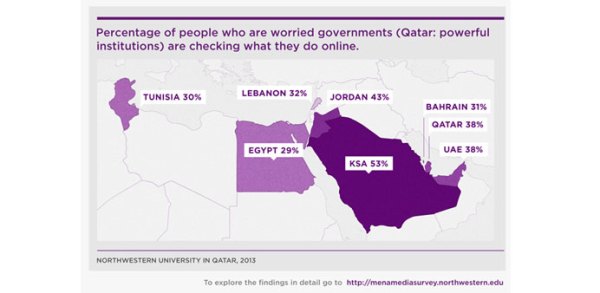
Northwestern University in Qatar has released new findings from an eight-nation survey indicating many people in the Arab world do not feel safe expressing political opinions online despite sweeping changes in the aftermath of the Arab Spring.
From over 10,000 people surveyed in Lebanon, Tunisia, Egypt, Saudi Arabia, Bahrain, Qatar, Jordan and the UAE, 44% expressed some doubt as to whether people should be free to criticise governments or powerful institutions online.
Over a third of Internet users surveyed said they worry about governments checking what they do online.
According to the report, “The implied concern (of governments checking what they do online) is fairly consistent in almost all countries covered, but more acute in Saudi Arabia, where the majority (53%) of those surveyed expressed this concern.”
The study – titled ‘Media Use in the Middle East – An Eight-Nation Survey’ – was undertaken by researchers at NU-Q to better understand how people in the region use the Internet and other media. It comes as the university moves towards a more formalised research agenda and is the first in what will be a series of reports relating to Internet use.
The survey includes a specific chapter on Qatar, the only country where those surveyed regarded the Internet as a more important source of news than television. “We took an especially close look at media use in the State of Qatar – a country with one of the highest Internet penetration rates in the Arab world—and internationally,” said NU-Q dean and CEO Everette Dennis.
These findings follow a preliminary report NU-Q released last April that showed web users in the Middle East support the freedom to express opinions online, but they also believe the Internet should be more tightly regulated. “While this may seem a puzzling paradox, it has not been uncommon for people the world over to support freedom in the abstract but less so in practice,” Dennis explained.
Among other findings, the research shows: 45% of people think public officials will care more about what they think and 48% believe they can have more influence by using the Internet.
Adults in Lebanon (75%) and Tunisia (63%) are the most pessimistic about the direction of their countries and feel they are on the ‘wrong track.’
Respondents were far more likely to agree (61%) than disagree (14%) that the quality of news reporting in the Arab world has improved in the past two years, however less than half think overall that the news sources in their countries are credible.
Online transactions are rare in the Middle East, with only 35% purchasing items online and only 16% investing online.
The complete set of results from the survey is available online at menamediasurvey.northwestern.edu. The new interactive pages hosting the survey on the website have features that allow users to make comparisons between different countries, as well as between different demographics within each country.
Dennis confirmed that the research report is the first in an annual series of reports produced in collaboration with the World Internet Project; one of the world’s most extensive studies on the Internet, in which NU-Q is a participating institution.
NU-Q and WIP signed an agreement earlier in the year, providing a global platform for the current research.
June 29, 2013
Posted by intlxpatr |
Blogging, Bureaucracy, Communication, Community, Cross Cultural, Cultural, ExPat Life, Jordan, Leadership, Living Conditions, Middle East, Privacy, Qatar, Safety, Saudi Arabia, Social Issues, Survival, Transparency, Tunisia | Bahrain, Egypt, Lebanon, U.A.E. |
Leave a comment
“We’ve started the count-down calendar,” said my beautiful and very pregnant daughter-in-law, “We have so many things we want to get done before the baby comes.”
We were gathered at one of our favorite casual lunch places, a place where we could eat well and our 3 year old could be both free to roam a little, and safe to roam, while the grown-ups talked.
“We’ve started, too,” I smiled at her, “I need to finish up her baby quilt, and two quilts for the homeless project I have due in September. And of course, we will be out of the loop the last two weeks before she is born, so I need to keep motivated now.” I know she will call on me once the new baby is here; I am the back-up, the “can you fix dinner / wash the dishes / hold the baby while I shower / clean up the baby spit / run to the grocery store/ feed the cats” person. I love it. It’s why we moved here, to be here when they need us, when they need the help. Being close to family, being there to help when they need the help – this is one of the great lessons we learned from our friends in Amman, in Kuwait, in Doha, in Tunis.
We also have an Alaska adventure in store, planned before any of us knew the new baby was en route. It’s not Africa, but we aren’t up for another of those 17 hour rides from Atlanta to Johannesburg this year. Alaska will be fun, a sentimental journey back to my origins for me, and a whole new environment for AdventureMan.
“We’ll also have the school break to cover,” beautiful D-I-L added, “but I know there is going to be a cousin’s camp; I just don’t know when it is going to be.”
Cousins camp – oh what fun. All the little like-aged cousins get together for a week of hell-bent-for-leather activities, from water parks to fire departments to scavenger hunts, they keep those little rascals so busy that they just fall into bed at night. It’s all good.
“I know it’s all going to fall into place,” she sighed, smiling at our son, “but we need that calendar to keep us on track.”
Yeh. Us too!
June 23, 2013
Posted by intlxpatr |
Alaska, Arts & Handicrafts, Circle of Life and Death, Communication, Community, Cross Cultural, Cultural, Eating Out, ExPat Life, Family Issues, Generational, Living Conditions, Pensacola, Travel |
2 Comments
I love this! Yes, I am a nerd, yes, I get excited about geeky things, but after my first year in Pensacola, paying electrical bills in the $400’s because I like to be cool, I have learned a few tricks about spending less, like turning the a/c up when leaving the house, it really makes a difference.
And now, we monitor our energy use on a DAILY basis. I love it! When you log into your Gulf Power account, you can see your energy usage calculated against the daily temperatures, with a range of your estimated end-of-month bill. No more bad surprises!
I think I inherited a small bit of my father’s engineer mentality; I love being able to manage my energy use 🙂

Thank you, Gulf Power, for making it possible.
June 22, 2013
Posted by intlxpatr |
Bureaucracy, Communication, Community, Customer Service, Environment, Financial Issues, Living Conditions, Statistics, Technical Issue |
Leave a comment
You all know me – I am a law and order kind of gal. I like order, I like laws, especially those voted on by the people. I like laws which can be enforced, and are enforced, equally, for all people equally in the country. Oh? I did? I said EQUALLY twice?
We are all equal before the law.
Now here is the tricky part. Have you ever seen a listing of traffic laws in Kuwait? Can you find a listing of laws, violations, and their charges? When we apply for driver’s licenses in almost any country, we get a little booklet to memorize, with the laws written inside it. The laws are clear. Clear laws are enforceable.
I’ve looked at the MOI website. I see something that looks like it might be a traffic code in Arabic. I have looked everywhere; I cannot find one in English. I find no reference to any handbooks for people applying for their driver’s license.
How can you enforce a law if the law is not published? Is there a code somewhere listing violations and fines? I published one many years ago, something that all the expats were sending around as ‘the new Kuwait traffic rules’ but IF it was, there was never anything in the paper about it to confirm its validity.

If you are going to have a major campaign to enforce traffic codes, you might want to publish the laws . . . in all major languages use today in Kuwait.
From the Kuwait Times:
Ali vows to rid traffic ‘disease’
Interior Ministry Assistant Undersecretary Maj Gen Abdulfattah Al-Ali
KUWAIT: Interior Ministry Assistant Undersecretary Maj Gen Abdulfattah Al-Ali stressed that all traffic violation-related deportations are in accordance with the law. Speaking at a press conference at the Kuwait Journalists Association (KJA) headquarters, Ali said that deporting people for traffic violations was also adopted by the US and other countries worldwide. “The problem is that we were very tolerant with violators and this does not mean that law violation is a right for motorists,” he underlined, urging all human rights organizations who have criticized Kuwait’s traffic police to examine human rights in their respective countries before talking about Kuwait.
“We have filed over 70,000 traffic citations including 43,000 serious ones such as running red lights, driving under the influence of alcohol, driving on the wrong side and many others,” he elaborated, pointing out that those already deported did not want to respect the traffic laws they had repeatedly violated. Ali added that the results of studies of traffic problems revealed many and that once one problem was solved, another emerged immediately.
“We have various problems… including the fact that motorists speak many languages and dialects which requires a large number of specialists to develop their traffic awareness,” he explained, noting that the traffic remedy strategy started by diagnosing the “disease” by studying random “specimens” at different times of the day at places with heavy traffic flows such as Jleeb Al-Shuyoukh, Shuwaikh Industrial Area, Amman Street, Bnaid Al-Gar, Khaitan, Farwaniya and Fahaheel.
“The specimens showed some major problems such as domestic drivers using private vehicles as taxis, taxi and large vehicle drivers who do not hold general driver’s licenses and people driving without licenses at all,” he said, adding that this called for strict law enforcement.
“Traffic in Kuwait is like an old sick man who once treated for one aliment develops another,” he noted, adding that 18 traffic inspection teams dressed in civilian clothes had been formed and deployed in various places. “Fortunately, traffic police only file 100 daily citations in Jleeb compared to 1,000-1,500 in the past”, he concluded.
June 18, 2013
Posted by intlxpatr |
Bureaucracy, Civility, Communication, Cross Cultural, Customer Service, ExPat Life, Kuwait, Law and Order, Leadership, Living Conditions, Safety, Social Issues | cell phone ban while driving, Driving, running red lights, seat belt mandatory, speeding, traffic laws, Traffic violations |
2 Comments
“Red Robin!” I sang, and AdventureMan responded “YUMMMMMMMM!” I had mentioned I am getting ready for my annual hamburger, and he became obsessed with Red Robin and we had to go there. I had the Whiskey River Chicken Salad. If I only have one hamburger a year, I want it closer to the 4th of July. It doesn’t have to make sense to you, but it matters to me. If you only eat one hamburger a year, it has to be a really good hamburger. 🙂
Back to the “YUMMMMMMM!”
Now, that’s good marketing. There is nothing not good about “YUMMMMMMM”
A campaign where you train people to think “YUMMMMM!” every time you hear Red Robin – brilliant!
We love good marketing. We love good ads; we notice good ads and good marketing techniques. We also scorn the bad ones.
Here’s what we love:
Mayhem – the entire series for Allstate, also the Allstate commercials when suddenly the black-guy-who-was-President-in-24’s voice comes out of an unlikely person.
Gecko/Geico – anytime you smile and you remember who the ad is for, that’s a good ad.
“What’s in Your Wallet?” Those hilarious Vikings make the point for Capitol One.
There are ads we like, but they don’t win our awards because while we like them, we can’t remember who they are for. If you can’t remember who an ad is for, the ad isn’t effective.
Campaigns I hate:
COX TV ads, all of them, just dumb.
Direct TV ads, just dumb.
Toilet Paper ads
As you can imagine, AdventureMan and I can have this conversation over a lot of long-distance drives and over a lot of meals.
So – what’s your favorite ad campaign? And why? Worst?
June 17, 2013
Posted by intlxpatr |
Arts & Handicrafts, Communication, Cultural, Entertainment, Marketing |
2 Comments





 Here There and Everywhere