We can’t say enough good things about the Viking business model, and we are critical travelers. We headed out on a tour this morning, we who are not good at touring in groups, and had to give our admiration to the facility with which Viking gets large numbers of people on the ground and going out and learning something. When you book a cruise, there are always “included” tours, included means you don’t pay extra. The included tours are usually overviews, often panoramic, i.e. you get in a bus and drive and stop now and then for a photo. Everyone who wants a tour gets a tour.
Having lived overseas most of our married life, we know that it is so much easier to stay comfortable than to go out and see something and learn something. About 10% of people will make it happen for themselves, another 80% will go if it is made easy enough, and 10% will never go. In the Embassies, that 10% will hang out at the American Club or the Marine Bar, and if military, shop almost exclusively at the PX (BX, Navy Exchange) and commissary.
Viking makes it easy. The night before we reach a port, there is a Port Talk, where the local currency is explained, a few good phrases (usually like “good morning” and “thank you”) taught, and photos and videos (all very full of sunshine) are shown to give you an idea what to expect. The daily newsletter always tells you how to say “Please take me back to my ship” in the appropriate language. Buses show up on time. There are enough guides for all the passengers. The guides have the patience of Job.
Our guide for Vistas, Vikings, and Village Woodturner was very very good. I don’t really know that I learned a lot about Vikings. Really, Vikings raided a little, intermarried a little, and are just a part of the history of the Faroes, the way Angles and Picts and the Norse are a part of the English. We had a very good guide, a funny man who often broke into song, and who has probably attended to more tourists than is good for him.
There were sheep everywhere, including sleeping alongside the road. Drivers are all very careful, because if you hurt a sheep, you pay the owner like $500. for his loss. The sheep were every color from white to brown, and black, and spotted white and brown and black. If I lived in the Faeroe Islands I would learn to sheer and card sheep wool, and spend evenings spinning the raw wool into threads for weaving into cloth and yarns. I’ve always wanted to learn to spin. LOL, too late to be a spinster 😉
What do I think is a good guide? This man told us a lot about life on the Faroes, about choices people make. Do they want to be a part of Denmark or not? It would require an election, and people can figure about half want one thing and half want another, and no matter who won, it would be narrow and cause turmoil, so why spend all that money on an election, just leave things as they are.
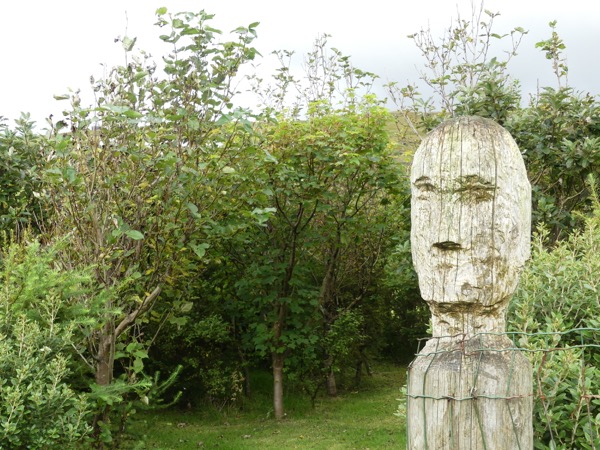
We head to the village of Kvivik to see the Viking longboat remains, or where they once were, and then to Leynar to visit the Village Woodman.
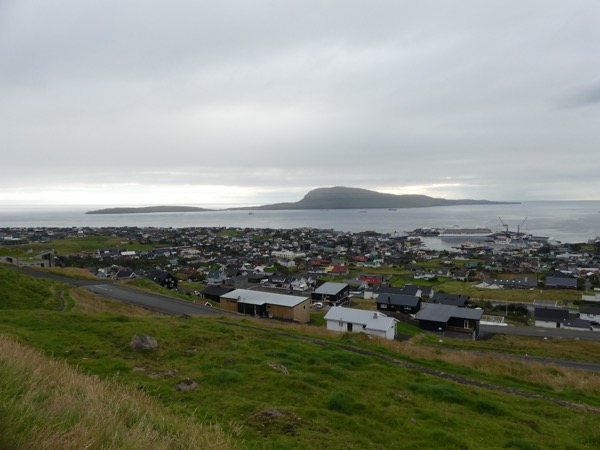
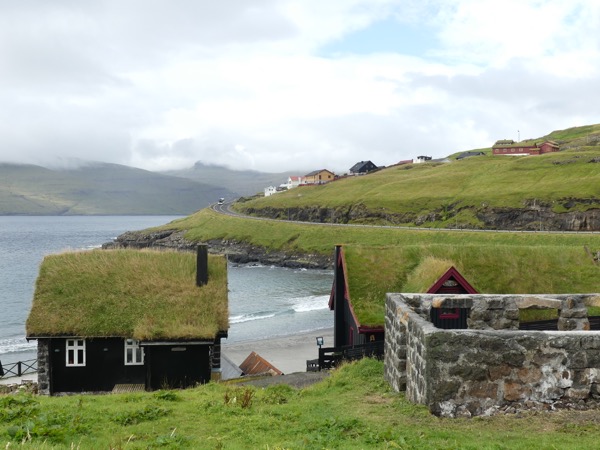
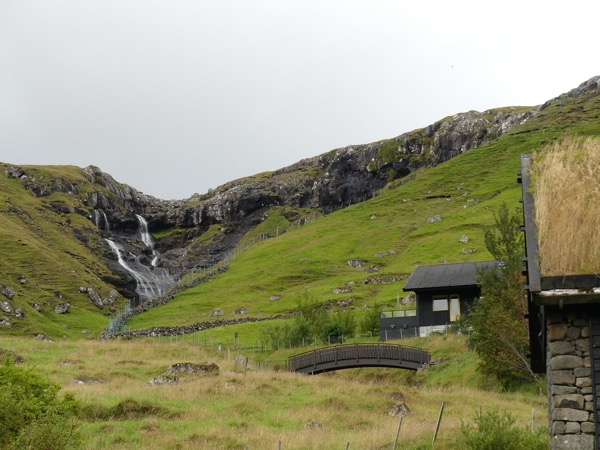
Below are stone built salmon jumps, old technology, but with devices which keep count of each salmon who climbed the steps, new technology. Can you see how green and lovely everything is, evan as fall approaches?
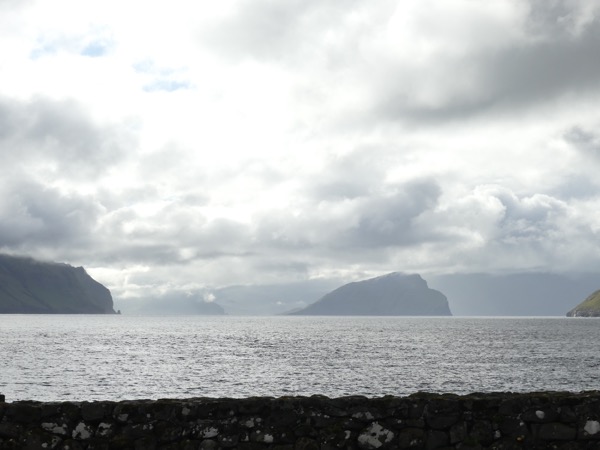
Drama Drama Drama! Who could be bored when the weather changes every minute with such verve and gusto?
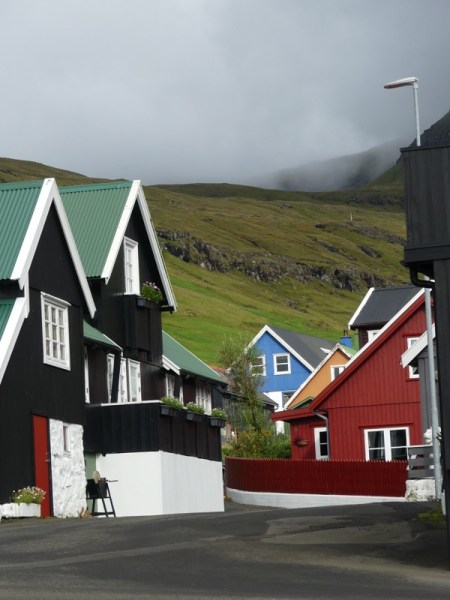
We are always interested in how people choose to live. Our guide explains that houses often contain three generations, the grandmother, the mother, and the daughter. Isn’t that an interesting way to describe it? We tend to think in male-ownership terms, but these houses are communal based on matrilineal lines.
I wonder where daughters-in-law fit in?
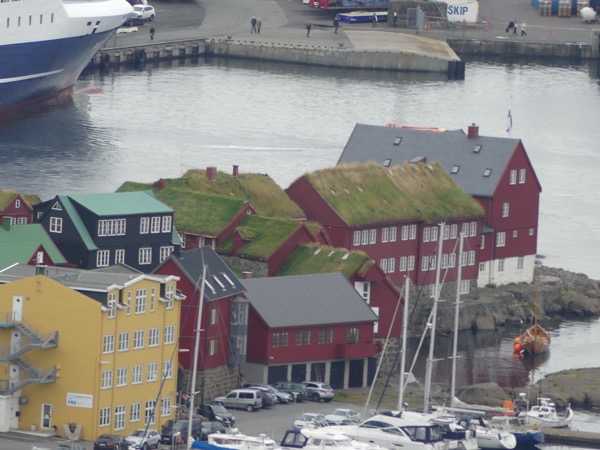
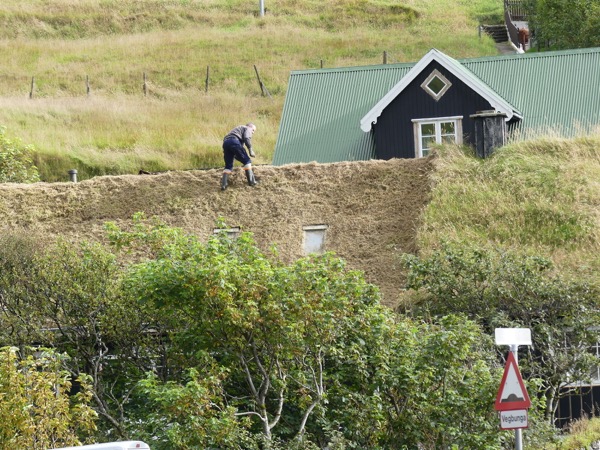
Look closely here, a man is up on his turf roof, trimming things down for the winter.
Viking longboat site
They teach their children three important rules. 1. Be kind. 2. Be kind. 3. When one and two fail, be kind.
He told us how houses are built, and how people help one another get their houses built. They are taught “better that many are not poor than that a few are rich.” We did not see a single dump any where in our journey took us; everything was clean and well-kept. People are fined heavily for dropping trash. There are only two policemen in the Faroes, and there is no prison, there is so little crime. “Where would you run? Where would you hide?” he asks. “Everyone would know you, so you don’t do it.”
He told us that many of the families of the Faroes were started by Norsemen who found local girls and were afraid to go home and face their wives, who were waiting for them with big sticks. He made us laugh, and laughter always helps us understand.
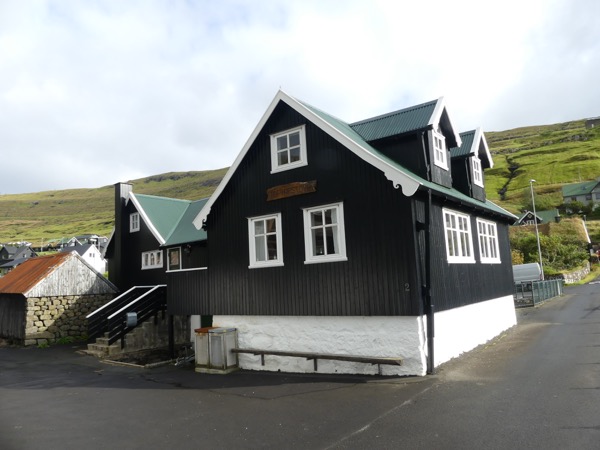
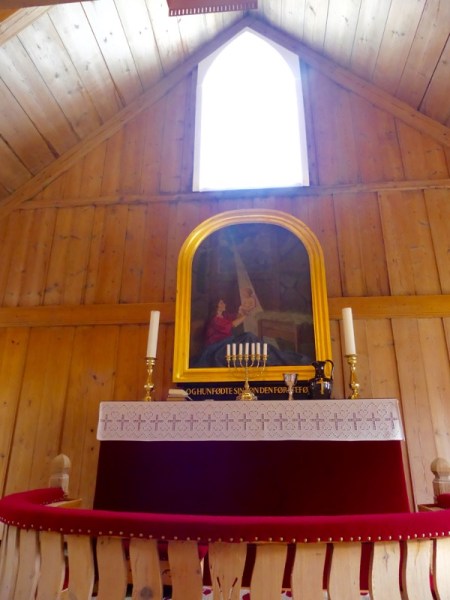
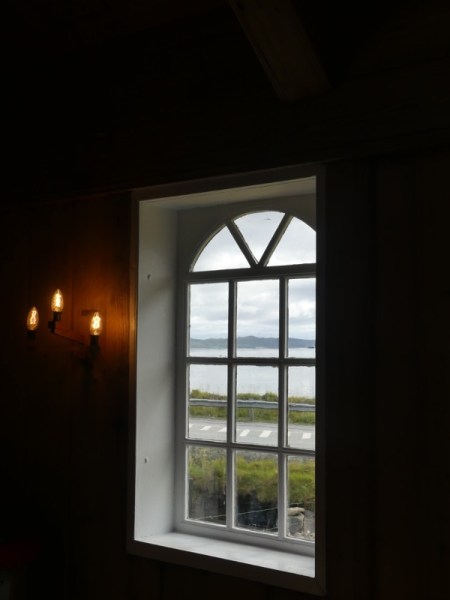
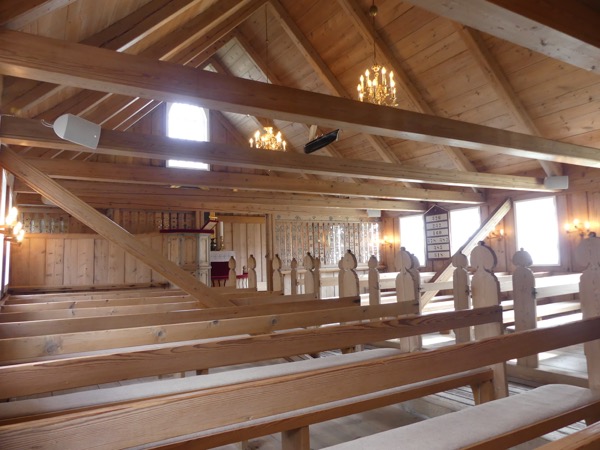
He took us into a beautiful little church, beautiful finished wood on the inside (see below) and he sang to us a familiar hymn, in Faraoese, Nearer My God to Thee. It was so sweet, and so beautiful, my eyes teared. He told us he waited 30 years to get married, and was the first one to wed once the Danish stopped insisting on state churches. (The church is now Lutheran.)
The Faero Islands reminds me of where I grew up, in Alaska, where neighbors held that same kind of concern for one another and for the communal life. We lived on an island full of Scandinavian immigrant families, along with the native Haida, Aleut, Tlingket, and occasional Inuit. It never mattered that we differed, when someone needed help, we helped. A neighbor didn’t go hungry, their children didn’t go unclothed. I remember the delight when our neighbor passed along her daughter’s lightly used clothing they had outgrown, and we could wear it. I remember one skirt in particular, a grey and yellow plaid Pendleton skirt which I wore for years, and maybe fifteen years later my old neighbor saw me wear it and said “I used to have a skirt just like that!” and I laughed and said “This is your skirt!” When you have a Pendleton skirt, you can wear it for the rest of your life; they wear so well. We were frugal people, and we never wanted for anything. We shared what we had.
I got the impression that actually the guide doesn’t much like Americans. It didn’t matter, he was kind, he was professional, and I believe he gave a great value for the money. He shared the truth of his culture as he lives it and was fair to us. That’s good enough.
I can’t give you a lot of information about the photos, only that I took what I thought would give you an idea of what life on the Faroe Islands might look like. For me, this was a great day, very little rain, even some sunshine, and I learned about a culture I really like. I like that they teach their children: Be Kind. Be Kind. Be Kind.
I have a dear friend I met on a previous Viking Trip. We met outside a museum of Archaeology in Zadar, and we were astounded, watching the Viking Tours go by and not one mention of this really good museum for the bargain price of 4 Euro.
Every time we saw one another, we had very quick but high quality conversations. It might be we’d pass at a restaurant in Dubrovnik, and they would tell us about a purchase and we would tell them about a cauldron of mussels. It might be in a quiet corner outside the WinterGarden. Even aboard ship, we led very different lives, but have developed a lively friendship via correspondence, greatly about books and politics and efforts to create a better world.
We laugh at how different we are. I told her about yesterday, the rolling waves and going to the spa and laughing as we rolled around in the hot pool, the waves sloshing back and forth and front to back. She wrote back that not only does she not believe she will ever see her husband in a spa, but that he would also be “knee-walking sick” in those “rollicking” waves. She makes me laugh, and I make her laugh, and part of our friendship is respecting our differences.
So my favorite parts of the ship may not be your favorite parts of the Viking Sky. I am an introvert. I would rather pay more for a room, and spend time there, than in most of the public spaces, no matter how lovely they are, and the Viking Sky truly has many lovely and serene spaces.
Here are mine: the room
The spa:
Below is the snow room; there really is snow underfoot and snow falling, you go there after the wonderful hot pool
The wonderful hot pool, above
Where you rest before you go back to real life again 😉
A quiet corner just outside the Winter Garden
I would have also taken a couple photos in the Explorer’s Lounge, but . . . it was full of people! On our last cruise, it was rarely full, not even close, only some people would come, for Mamsen’s, for the view, for the quiet and privacy. When the bar is open, it is more crowded and noisier. You can see photos of the Explorer’s Lounge from our last trip, on the Viking Sea.
If this is your first time visiting this blog, there are things you don’t know yet. One important thing would be that AdventureMan and I love to travel, and the other is that we are very independent. We are pretty awful about tours. We aren’t very good at following with a crowd, we sort of break off, and often disappear altogether. I have pity for the tour guides who get us; they have a job to do and we are not compliant. We ARE good at keeping the guide informed, like when we are dropping off, and assuring them that we will be able to meet up with them elsewhere.
Having said that, this tour of Oslo was very thorough. Much of it was “panoramic” which is travel industry code for drive-them-around-in-a-bus-and-show-them-things, stop-a-couple-times-to-let-them-take-photos. It did that. What I liked was that the guide really knew her stuff, and gave us a lot of cultural information, a lot of local lore along with the “this is the parliament building” kind of information. We got a lot of information, buildings, institutions, and we also got a lot of information about how the locals live and how the locals view things.
As we drove through posh neighborhoods, the guide told us about how the housing costs in Oslo have forced most Norwegians out of the city; that old buildings and new have spaces rented by foreigners and corporations. For the same price as a small apartment, Norwegians can buy a house out of town. The commute is horrible, but many get up at five and are at their desks by seven to avoid the traffic.
She took us to see a famous ski-jump. Now this is one of those things I would have said “I don’t care,” but when I got there, I could see that it was like a DESIGNER ski-jump, curvy and futuristic looking. I also loved it that there were kids roller-skiing (roller-skiing ? ! ?) and adults doing all kinds of fitness running, jumping – it has become a space where people go for exercise and experiencing the outdoors.
I have to stop a minute here – look at the design of this ski-jump. Is that not thrilling, so perfectly functional and so simply beautiful?
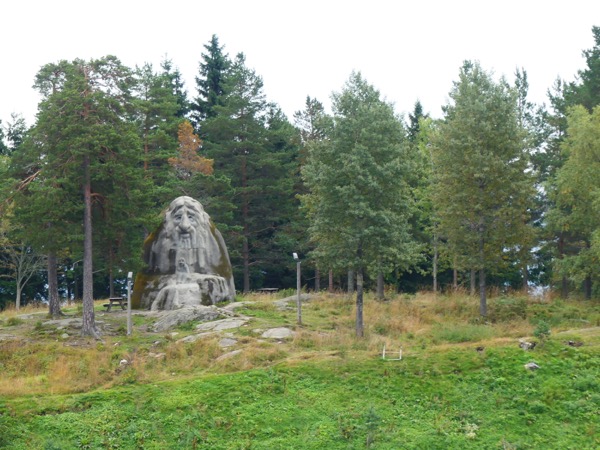
At the foot of the ski jump is a forest troll – can you spot him?
People living in the vicinity of the ski jump have a wonderful view of the city and bay:
It’s not that I am THAT compulsive, but I do like to plan ahead, and things that happen at the last minute that require attention can disturb my sleep.
This is a trip we’ve had planned for over a year and a half. We didn’t plan for Hurricane Harvey, and we are flying out of Houston. We didn’t plan on Hurricane Irma, another all-time historical hurricane, headed toward Florida, and possibly into the Gulf. Possibly into Pensacola.
We have a wonderful couple who take care of our house and our cats while we are gone. She called the day before we were leaving to ask if we had any plans for the hurricane she needed to know about. Hmmmm. No, I didn’t. I planned not to worry about it. And . . . at the same time, all around me, people are stocking up on propane, and Sam’s has run out of water, and . . . . some people are preparing to hunker down and some to leave home, heading north.
We got moving. I had an hour before my last meeting, and spent that hour figuring out what really mattered to me (photo albums) and putting photo albums up high and in cupboards, and fragile things, like the crystal candelabra AdventureMan gave me for our first anniversary in the safest place I could think of.
Law and Order Man (our son) said he would take Ragnar and Uhtred, our very young cats, to a safe place, if needed.
AdventureMan braced the garage doors with huge specially made steel beams that bolt into place, and we called our contractor who said if it looked like Irma was heading our way, he would put up all the ballistic window and door covers.
It’s not everything, but it’s something. We all felt a lot better.
And thanks to the ‘net, we know that Houston is up and running, and our flights into Houston and out of Houston will fly.
Around eleven, we hear the front door opening (? ! ? ! ? !) and it is the couple who are coming to stay with the house and cats; they thought we were leaving at night, not the next morning. We all laughed, got them settled, and went to sleep peacefully.
The flight into Houston was the best kind, uneventful. We love uneventful flights. You can still see a lot of standing water, and water damage, but the greatest part of the upswell of waters appears to have subsided.
“Today is the first day that the airport is 100% up and running,” a Houstonian tells us. We are good listeners, and he tells us that the worst part of all this drama is that the death count continues to mount as rescue-workers go into places where people thought they could shelter in safety. The mold is also hitting hard and fast, and emergency facilities are strapped. They are functioning, and they are prepared, and some things are beginning to run out.
The best, he followed up with, is that “you know how divided we have all been? Once the storm hit, it didn’t matter if you were black or white or Mexican or Confederate, we were all just people, and we helped our neighbors, we helped each other. In that way, it was one of the best things that has ever happened in Houston.”
This is the first year since I moved to Pensacola that I haven’t thought about quitting blogging. I’ve given this some thought. I remember when I started this blog, upon arriving in Kuwait. Well, not exactly upon arrival, I spent a lot of time reading and observing before I took that leap. It was scary for me.
On the other hand, I didn’t have much to lose. I was new in the country, didn’t know a lot of people, had a husband very busy putting out fires and starting new ones . . . I needed an outlet, a place where I could learn more about Kuwait. Thus Intlxpatr and Here There and Everywhere was born.
Today is the birthday of my blog alter ego 🙂 I bought myself my favorite flowers to celebrate. (remember, this is virtual world; you don’t have to believe everything I say.)
I’m finding that eleven years later, the blog functions in a similar, but different way; it allows me to express my exasperation with the current regime of greed, robbing the poor to further enrich the rich, oppressing the workers they promised to uplift, spreading distrust, even hatred, of the other . . . and WHO is not the other? “Who is my neighbor?”
Keeping with tradition, you are welcome to enjoy the lavish birthday cakes here to entertain you. This year, I’m a little focused on the elaborate, and destinations. 🙂
I’m almost afraid to cut this one:
So pretty! I would love to do this one for my little granddaughter when she is a little older:
Our next expedition; AdventureMan says we are sailing into cold temperatures, freezing rain and possible hurricane conditions. Thrills my heart!
Of course, there always has to be a little bit of Paris 🙂
And a bit of the beach 🙂
Thank you for coming by to wish us all well for another year 🙂
Is hate speech free speech, even post-Charlottesville?
The states with the highest number of hate groups may not be the areas of the country that many people would assume.
California ranks highest among the 50 states, with nearly 80 different hate groups calling the Golden State home, says a report from the Southern Poverty Law Center.
Most of the groups are concentrated in Southern California, the San Francisco Bay area and the Sacramento region, the report says.
Data show the western half of the U.S. has significantly fewer hate groups than the East Coast, the report says, but California — the nation’s most populous state — easily has the highest number of hate groups operating within its borders.
The “Hate Map” report shows 917 hate groups operating across the country. It includes data not only on white supremacists, but Black Separatist organizations and anti-LGBT groups as well.
The report also cites numbers from 2016 that show 130 Ku Klux Klan groups and 193 Black Separatist groups active across the county. The SPLC also notes there has been a nearly 200 percent increase in anti-Muslim groups since 2015.
In 2011, the total number hit its peak with over 1,000 groups operating. That number dropped to 784 just three years later, but there has been a steady increase since then. The SPLC also says in its report that the country has seen an unprecedented rise in hate groups since the turn of the century. In 1999 when there were only 457 documented groups in the country.
Florida ranks No. 2 with 63 hate groups, and is No. 1 on the East Coast.
Ranking third is New York state, home to 47 hate groups. Pennsylvania is not far behind, with 40 groups.
States with the lowest numbers of hate groups lie mostly in the Midwest and West. Iowa has only four groups in operation, while Wyoming and New Mexico have two apiece and North Dakota and Vermont have one each.
Data for the “Hate Map” list was compiled using hate group publications and websites, citizen and law-enforcement reports, sources from the field and news reports, the SPLC says.
Perry Chiaramonte is a reporter for FoxNews.com. Follow him on Twitter at @perrych
This is from this morning’s news on AOL. It calls drinking the biggest drug problem in America.
Americans are drinking a lot – and it’s scaring researchers
DAVID OLIVER
Aug 11th 2017 11:01AM
If you’re an American and you drink alcohol, you’re not alone. In fact, there are more people like you now than in the past. But with increased drinking comes increased health consequences – so much so that researchers are calling it a public health crisis.
Specifically, the portion of Americans consuming alcohol during a year has increased 11.2 percent from 2001-2002 to 2012-2013 (65.4 percent to 72.7 percent, respectively). High-risk drinking ticked up from 20.2 million Americans to 29.6 million Americans during this period, and those diagnosed with alcohol use disorder rose from 17.6 million to 29.9 million Americans.
High-risk drinking was defined as four or more regular drinks on any day for women, five or more for men, and exceeding those limits at least weekly during the year. A person was considered to have alcohol use disorder if they met criteria for alcohol dependence or abuse in the past year.
The study took into account about 80,000 people’s individual interviews between several surveys, and was published earlier this week in JAMA Psychiatry.
Women, older adults, racial/ethnic minorities and people of lower income and education levels saw the largest increases, save for a few exceptions.
“These increases constitute a public health crisis that may have been overshadowed by increases in much less prevalent substance use (marijuana, opiates and heroin) during the same period. … Most important, the findings herein highlight the urgency of educating the public, policymakers and health care professionals about high-risk drinking and [alcohol use disorder], destigmatizing these conditions and encouraging those who cannot reduce their alcohol consumption on their own, despite substantial harm to themselves and others, to seek treatment,” according to the study.
And it’s not just the study authors who are concerned.
“This should be a big wake-up call,” David Jernigan, director of the Center on Alcohol Marketing and Youth at the Johns Hopkins Bloomberg School of Public Health, told Bloomberg. “Alcohol is our number one drug problem, and it’s not just a problem among kids.” He was not a part of the research.
It’s estimated that 88,000 people die every year due to alcohol-related causes, reports the Washington Examiner – and people can’t seem to agree on how to get a handle on them.
Why is this happening in the first place? There isn’t one root cause, Bloomberg reports. Researchers suggest economic stress post-Great Recession could play a role, in addition to the improved accessibility of alcohol at retailers and restaurants and weakened alcohol tax impact. Today, alcohol is cheaper than it’s ever been since at least 1950 in relation to average income.
I saw a set of movies a couple years ago, about a post apocalyptic America, where there is a capitol full of fabulously rich, fabulously well-dressed, ornately made-up rulers who entertained themselves with a yearly survival ordeal, the Hunger Games, fueled by “tributes” who were chosen from each of 12 districts to compete to the death, to the last one standing. One woman and one man were chosen from each district to compete.
Upon the inauguration of our current regime, I had to find ways to fight my despair and outrage; I had to find ways to join with others of similar feelings and counter moves which I consider to be against the best interest of my country, and who I have always believed us to be – people who believe in liberty, equality and brotherhood, people who have all arrived here from elsewhere (Immigrated), and people who believe in giving others a fair chance at the American Dream.
My best friend forever (we met in college) and I challenged one another; she added Planned Parenthood to her charitable donations, and I added the ACLU.
I had always thought the ACLU a little nutty, but when the first immigration ban went into effect, and the ACLU had the skill, imagination and resources to mobilize and to man tables offering legal help – FREE – at the airports to stunned arrivals being turned back, I was proud I had supported their efforts.
I live in a conservative area, and because I don’t want my car damaged, or any sort of ugly confrontations in parking lots, I don’t put bumper stickers on my car. There is one I have seen that I love:
I would never dare put this on my car, living where I live.
I did, however, buy a mockingjay pin which I found on Amazon, amazing Amazon. I can safely wear it, knowing it signifies rebellion, and no one here has a clue.
Wear it in Seattle, I learned, and everything changes. My best friend forever and I went to dinner, and I was wearing that pin. The waitress peered, and peered again, and asked “Is that what I think it is?”
I said it was a mockinjay, and a metaphor. She took our order, left, and within seconds another waitress appeared, and then a waiter. Each treated me like royalty, giving salutes, blessing me with “may the odds be ever in your favor.” They asked me questions I couldn’t answer; I kept explaining that it was my metaphor for finding ways to counter a corrupt regime, and I particularly loved it because it connects us all, young and old.
I had seen the movies, but now I am deep into reading the Hunger Games trilogy, so that I can wear the pin again, with deeper knowledge when I run into the people who really know all the lore.
Every now and then, God, in his infinite mercy, sends an abundance of blessings, covers us with blessings. In a time in which I have found myself uncharacteristically depressed and anxious about the path our country is taking, for one brief moment, the last few days, all depression has lifted and all anxieties have calmed.
One source of anxiety has been a personal matter, a family matter, and that has resolved itself graciously, happily, with a great feeling of relief and gratitude.
For Sunday, July 2nd, our priest had prepared us for a new set of studies, kicked off by an examination of Democracy and Religion. There were rules – 1) Be nice (that’s what they say in the South for ‘be civil’) and 2) Try to see the issue through the eyes of someone with whom you disagree.
The church hall was set up with twenty-four chairs. A half hour before he was due to start, people started pouring in, and we started pulling out more chairs, and more chairs and more chairs. He actually started off early with a reflection on our Old Testament reading, the story of Abraham and the almost-sacrifice of Isaac. (My Moslem friends correct me; they tell me it was Isaac. Let’s just agree that it was Abraham and a son, and perhaps the details will come clear on the other side of the great divide.) More people arrived, more chairs put out until we were out of chairs. Toward the end of the discussion on Religious rights and Democracy, I did a quick count of chairs and people standing and figured we had over ninety people – and one of the best Sunday School classes ever.
Our priest took a Socratic approach, asking questions, bringing in current topics. In these times of divided opinions, there was, surprisingly, a lot of laughter. My favorite moment was when we were discussing limits on religious freedoms, and things that there are laws against – live animal sacrifices, bigamy, sale of alcohol on Sunday before 11 a.m. – then one of the lawyers added “How about serving liquor to minors without checking IDs every Sunday?” That got a big laugh. It’s what we do; we use real wine in the communion cup, it’s Anglican / Episcopalian tradition. And yep, even young children get to take a sip. Oops.
As divided as we are, as it turns out, we have a lot in common. It takes a lot of courage to open up such a topic to the congregation. We all behaved. I think we all came away thinking we need more of this.
The very next day, yesterday, I was at the County Courthouse for my first ever call to jury duty. Well, this was my first ever call where I actually was living in the United States and able to show up. While we lived overseas, I would have to get on my VOIP late at night when the Clerk’s office opened and tell them I was living in (Germany. Kuwait. Qatar. Saudi Arabia. Jordan. Tunis. Take your pick.)
Jury duty is an exercise in tedium. At one point when the large selection pool left a courtroom, one of the potential jurors was going “Baaaa baaaaa baaaaa; we are all like sheep.” You park in one place and get on a trolley to the courthouse, you line up to enter the courthouse, you gather in a room and you wait to be called. You get instructions, you watch instructive videos, you get pep talks on your civic duty.
I had my eyes opened in a lot of ways. First, that I would guess more than two hundred people showed up, and this was a Monday between the weekend and the Fourth of July holiday. Many had to take time off from work to show up. We were supposed to be in “business’ dress, but this is Florida, and I guess ‘business dress’ is a matter of interpretation.
Groups would be called to go before judges for jury selection. There were many cases, so almost all of us were a part of one group or another. From my group, juries were being chosen for three trials, so they asked a lot of questions up front that would pertain to all three trials, then the lawyers for the prosecution and the lawyers for the defense would ask questions.
The questions surprised me. They named the witnesses, and the defendants were there in the courtroom; they asked if anyone knew the defendant or any of the witnesses. They asked about our prejudices for or against law enforcement officials, and could we overcome our prejudice to listen to the evidence fairly. They asked about our own court experiences, and they asked about our convictions for drug use, and other things. Many of my pool had served many times on juries and knew how things went. Many were reluctant, yet, there they were. Serving. Doing their duty.
Here is what really surprised me – at least in Florida, the defendant, who is sitting there through all the questioning, gets a say in who will be on his jury. I had no idea! We don’t see a lot of jury selection on TV (although the lady sitting next to me said I need to watch a show called Bull, where jury selection is what the show is about.)
None of the defendants wanted me, and I can understand why. They want people on the juries to truly be as close to their peers as possible, people who can identify with being arrested, maybe even convicted of a crime. They want people who might give them the benefit of the reasonable doubt.
How often have you been arrested? My son, who has been a part of the system, once told me that there are Americans who never have a brush with The Law, other than maybe a traffic ticket or a DWI. Now and then, I ask my friends. None has ever been inside a jail, but these days, a friend or two has a child who has become involved with heavy drug use, and has spent some heart-breaking time in the system.
It was a long day, full of tedium. I thought about the judge, and the lawyers, who go through this day after day, asking the same questions, looking out at groups full of people who maybe don’t even want to be there, going through the process to insure that our system is as fair as possible, day after day, month after month. I had no idea that the wheel of justice ground so finely, so relentlessly, on and on. I had no idea what stoic determination it takes to be a part of that system, and trying to make sure that while the state makes the case, the defendants rights are protected.
I’ve lived, as you know, in countries where justice prevails – occasionally. I remember living in one country, which was peaceful, and thinking to myself that they were educating a lot of people for positions they will never be able to fill, because they are not in the elite.
We have all seen, in every country, that those with the money to buy the best legal protection can often escape the consequences of their crime, but there is hope, for me, even in making them stand trial.
I had no idea how proud I would feel at the end of the day, being a part of this huge effort, seeing how many of my fellow citizens, at great sacrifice to themselves, showed up. I had no idea what an education it would be for me. I had no idea how often those who least want to serve are those chosen to serve – and they persist. They show up.
I was in a room with maybe two hundred people from all walks of life. We were really just numbers, there to fill a systemic need. Some may even be, like me, a little cynical about how much justice our system really delivers . . . and we show up.
One of the defense lawyers yesterday asked us “Do you know what we are here about today?” and while we were all thinking about the charges, she answered “we are here about this man’s liberty. We’ll be deciding where he will spend his time in the next weeks, and months and years. We’ll be deciding his liberty.”
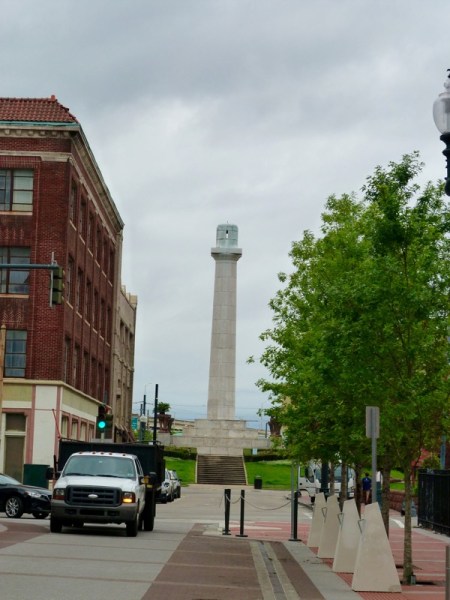
Near the World War II Museum is a traffic circle called Lee Square. It once had a statue at the top of a tall pedestal of General Robert E. Lee. Recently, the city of New Orleans removed several public statues of Confederate heroes as an affront to those rights we all hold in common; the dignity of all men and women before the law, regardless of race, religion or gender.
Those who were hired to remove the statues had to remove them in the dark of night. Many of the workers wore balaclavas and the company markings were taped over on all trucks and construction machinery, like the huge cranes.
So now Lee Square is Lee-less.
The Mayor of New Orleans, Mitch Landrieu, made a moving speech regarding the removals which has gone viral:






































 Here There and Everywhere