Operation Hope News Flash
Those of you who read regularly know I am a great fan of people who see a need and have the courage to tackle it. One of those people here in Kuwait is Sheryll Mairza, who feeds and clothes the poorest of the poor – mostly laborers who are not paid. With her vision and enthusiasm, she has provided for – literally – thousands in Kuwait. Provided warm clothing in cold winter months, provided meals, provided basic necessities. Her most recent quest is below:
Operation Hope Kuwait would like to promote a used shoe drive to benefit farm-hands working in Abdalli, Kuwait… preferably sports shoes and/or work boots. Last Saturday a small group of dedicated volunteers went to Abdalli to deliver used clothing, which was collected by AGILITY LOGISTICS. While there they noticed that many of the workers had barely any sole left on the shoes they wore.
Currently am hoping a local private school will open its doors to receive donations from August 1 – 10. If you’ll stay in touch with me I can get you the final drop-point details.
Again ~ many thanks for your support! God bless, Sheryll
I don’t know about you, but I tend to buy new athletic shoes often – I like a fresh springy step :-). She probably isn’t looking for your daintiest 4 inch spikes from last season, but shoes with some life and some support left in them. As she gives out further information, I will keep you informed. Meanwhile – gather your old shoes and save them for Operation Hope!
Strange Practices
This is from the Kuwait Crime section of the Arab Times:
And in an unrelated development, Interior Minister Sheikh Jaber Al-Khaled Al-Sabah should look into the alleged immoral practices on Kuwaiti islands, National Assembly Comptroller Dr Mohammed Al-Huwailah told Alam Al-Yawm. Urging the minister to take stringent measures to curb ‘immorality’ in these islands, Al-Huwailah wondered how could some people engage in strange practices under the supposedly watchful eyes of security authorities, particularly the Coast Guard. Asserting he will closely follow up the issue, Al-Huwailah warned the minister’s lenient attitude on the issue will lead to the destruction of Arab and Islamic values. He called for the strict implementation of the law to protect the Kuwaiti society.
I am guessing these strange practices are alien practices? What kind of practices are taking place on Kuwait’s islands?
Today’s Kuwait Times: Monday, 21 July
First, to give credit where credit is due, the Kuwait Times has become better and better during my time here in Kuwait. The grammar is better, they have (most-of-the-time) stopped using “red handed” in every crime report, and the captions under the photos match the photos.
Until today. I think an editor must be on vacation.
Here is the photo:

And here is the caption under the photo: KUWAIT Director of Public Relation and Moral Guidance department COL Adel Al-Hashash receiving Deputy Chairman of Police Sports Association COL Mubarak Al-Mubarak and head of police Karate team to the Arab championship LTC Waleed Ghanem Al-Ghanem over the weekend.
Now down at the bottom of the page is the same caption, with this photo:

Also on page 2 is the following article – please read it closely and tell me if I am reading it correctly – that this will compel women, but not men, to go to the reconciliation committee before filing for divorce? I hate divorce. I am all in favor of family counseling. I am in favor of any law helping families, as long as it applies equally to men and to women:
Family Court will halve divorce rates in Kuwait
Published Date: July 21, 2008
KUWAIT: Judge Faisal Al-Mirshid has revealed that family court should be up and running in Kuwait within one year, predicting that its existence would halve the country’s divorce rates. The Appeal Court head, member of the Higher Judicial Council and chairman of the committee entrusted with establishing the family court said that the court’s establishment would reduce divorce cases by 50 percent because those asking for divorce will first have to go to the reconciliation committee, otherwise their cases will be automatically rejected in all courts.
Al-Mirshid said that a ministerial decision has been issued to establish the family court, and the committee has already begun working on the regulatory legal framework which will control its decision making process, reported Al Jarida.
He explained that the committee has already contacted the Awqaf Ministry’s Secretariat General regarding the allocation of a building to house the family court, which will include several departments and sections, including a shelter for women and children fleeing domestic violence.
He explained that it will also establish a fund to help Kuwaiti families and provide financial aid for divorced Kuwaiti women or those whose husbands are imprisoned.
Al-Mirshid said that there are some impediments to the success of the family courts, including a need to amend the current divorce legislation in order to compel women seeking a divorce to first resort to the reconciliation committee before filing for divorce.
He said the family court law will be applied to followers of the Jaafari Shia sect followers just like other personal affairs legislation, emphasizing that there is no contradiction with the idea of Jaafari courts which call for reconciliation before resorting to court for divorce.
He said that there will also be a fund established to provide expenses for families within the Jaafari rules.
Last, but not least, on the very same page 2 is this intriguing article. So you tell me – what are they saying DID happen?
MoI clarifies erroneous rescue operation
Kuwait: The Ministry of Interior clarified an erroneous report published in some local dailies recently. It referred to a report on the rscue operation of four persons whose boat sank off the Kubbar island.
It said the coast guard acted promptly the minute they received the call, while the delay in rescuing them was actually caused through wrong coordination.
That error resulted in the team having to scour the entire square area around the island in their search for the missing persons.
Help was sought from a helicopter from the US search rescue team to assist in the operations, it added.
Ministry officials also disclosed that the four persons of both sexes were not in any way related to the Al-Sabah family, and that the search operation succeeded in locating them and getting them safely ashore without any casualties.
They said contradictory reports of the rescue operations published in newspapers was due to the fact that the media did not source the correct information from the concerned authorities.
A statement released by the ministry said rescue teams from the fire service department as well as central operations (777) participated in the rescue.
Kuwait’s History – for Children
Thank you, Little Diamond, for your sharp eye spotting this story:
Children”s books about Kuwait”s history translated into English
Al Watan staff
KUWAIT: A new and rare series of stories about Kuwait”s history and
the nature of life in Kuwait in the past can now be found on sale in
Kuwait. The books, written by Dr. Yaqoob Yousef Al-Ghunaim and
translated into English by Dr. Shaban Afifi Abdulaziz, have been
printed by the Center for Study and Research in Kuwait and contain
illustration by artist Suhiala Hussein Al-Jundi.
The stories in the books are written in a simple manner that interests
children and that allows them to learn more about the history of
Kuwait and how Kuwaitis lived in the past. In the stories AlÜGhunaim
discusses traditional Kuwaiti society and the importance of fishing
and the rearing of animals.
The first story entitled Kuwait”s Wall is about a group of children
who ask Abu Abdullah questions about Kuwait”s wall and the reasons
behind its construction.
In the second story, AlÜGhunaim relates in a dramatic style the
stories of old Kuwaiti ships and underlines how society was based on
conservative religious values.
Al-Ghunaim also discusses life in the desert and how people were fond
of hunting gazelles and other wild animals which were commonly found
in the country.
A story about Burqan oil field was also added to the series to show
how the discovery of oil changed the Kuwaiti community.
http://www.alwatan.com.kw/Default.aspx?MgDid=652853&pageId=473
One Step Beyond: Baan Sabaidee
We all have our limits. When it comes to food, my limits are farther out there than most – I like taste. I like most cuisines, or at least most of most cuisines. I do have my limits.
One limit is okra / ladyfingers/ bamyi:
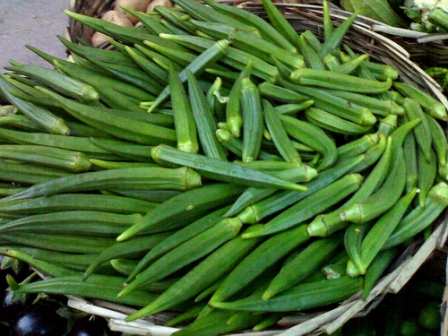
One time, at a buffet in Jordan, I told my husband I was going back for something I found totally delicious, and he laughed and said “You know it is okra?” No, I didn’t know. I did go back and get a little more anyway, but it no longer tasted the same – I knew it was okra. It’s the texture; okra is, to me, slimy, gooey, in my mouth it gives me shudders. It’s like raw oysters. Shudder.
Deep fried okra in a spicy tomato sauce was OK – until I knew it was okra.
I was visiting with a friend, working on some projects and we decided to order out from a nearby newly opened Thai restaurant for lunch. She’s a crazy woman, like me. We are not alike – she says “tomahto” and I say “tomato” and somehow we get along just fine. We decided to order things we have never ordered before.
We ordered two safe things – the first was Gai Sate (chicken sate). It was gorgeous and delicious. The sauce is one of the best sauces I have had with Thai food, hot, sweet, and sesame. Delightful.
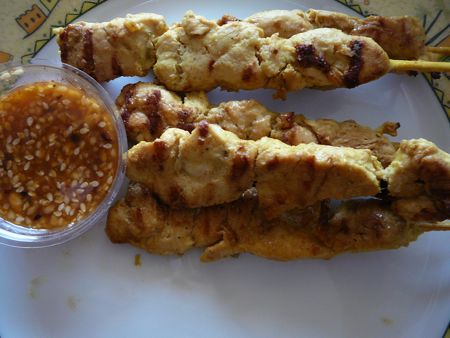
The second safe thing was Pad Thai, which was also beautiful and tasty:

We ordered Pad Ka Phrao, because we had never heard of it, and because it has basil leaves in it:

It was delicious.
We loved the way the food was packaged. The green curry and the soup was packed in sealed plastic sacks, inside the normal plastic containers. Not a single drop was spilled in the bag. I’m impressed. I love soups, and I hate the mess when soups spill in the bags:

This is the green curry (Gaeng Khew Wan). It is totally delicious.
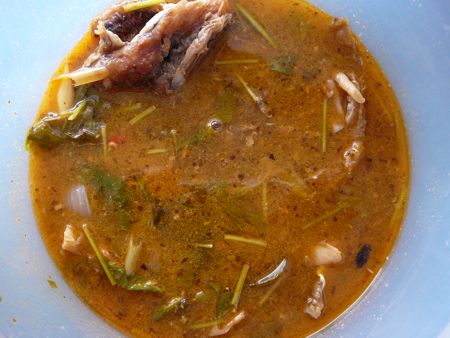
You know me. I love fish. We had never tried the Tom Kling (smoked herb soup) so we ordered that, with grilled smoked fish. It came beautifully packaged, like the above curry. When we went to eat the soup, however, although it was delicious, I had to fish out the fish. I am not normally squeamish, but their little fishy eyes were too much for me:

AdventureMan and I later made a trip to find the restaurant. It wasn’t easy, but it was worth the trouble. Tucked back behind some of the behomoth apartments on the Southern Gulf Road, it only has maybe six tables, but it is tiny and exquisite. Someone went to a lot of trouble to make this little place beautiful and serene. Although it is a new restaurant, it was already packed when we got there, but a table opened up just as we arrived.
We asked for recommendations, and tried the Tod Mun (shrimp cakes) and a dish I loved. Pad See Ew, which was vermicelli noodles stir fried in soy sauce with shrimp. We also had the chicken sate again – delicious. We were busy watching other people with big pots of something in front of them, shared by groups. We have to go back and try that, whatever it was.
Their take out menu has a nice feel to it – heavy paper with good photos so you can guess what you are ordering:
And- the bonus – it has a map of how to get there on the back, so I don’t have to confuse you trying to figure out the directions:
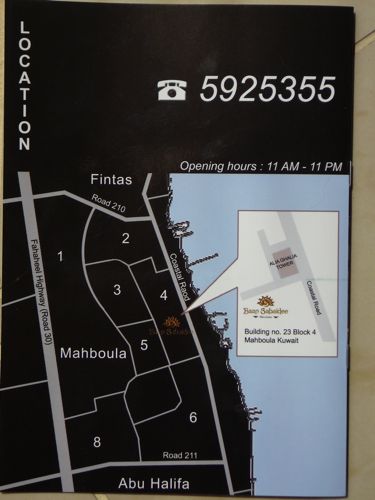
If they are full, I noticed across the street is another branch of China Queen, one of the best kept secrets in Kuwait for Chinese food with authenticity.
Ministry Conducts Demographics Study
This is from today’s Kuwait Times. I LOVE demographics. I love tagging factors, loading them all into a data base and seeing where the stats fall. You learn so much.
The Ministry of Social Affairs and Labor is studying effective means to rectify the country’s demographic imbalance. The ministry has reportedly reached the conclusion that the blend of different nationalities in Kuwait has proved detrimental to its societal fabric. One Arab nation’s expatriate population in the country has exceeded 300,000, sources say, which puts the states economic and political stability at great risk. Sources said that the matter is complicated and needs all the ministries’ undivided support.
Expatriates, it is felt, bring with them their own modern culture and customs which are alien to the local citizens, most of whom follow archaic customs deeply rooted in tribal practices. Expatriates are also accused of taking the law into their own hands without approaching the concerned authorities whenever they are confronted with a problem. It has also been observed that expatriates belonging to a certain nationality inhabit certain areas in droves, leaving security officials at a loss to change the situation.
As a move towards controlling the situation, the ministry is to form a permanent committee comprising officials from different ministries to scrutinize all the expatriates who arrive at Kuwait.
It will issue a fitness certificate to eligible expatriates on the lines of medical fitness test. Employers will then be able to decide whether to appoint those workers or repatriate them. The ministry also plans to come down heavily on expats who obtain jobs using illegal residence permits.
Hmmm. Rectifying the population imbalance might require giving up expatriate labor. What laborers do you want to give up? The largest number are probably doing low-skill level work – cleaning houses, cleaning the streets . . .Or do you want to give up those who are managing your stores, taking your orders in all the restaurants, cooking, taking care of the office chores?
I can guess which expatriates are bringing in alien modern customs and practices, but unless you are going to give up television, cable, the internet and travel . . . that train has probably left the station.
So which nationality has over 300,000 expats in Kuwait? And which nationalities “inhabit certain areas in droves?”
Who takes the law into their own hands?
First Dates
There are some advantages to being in Kuwait in the dead heat of summer. One is that even in peak driving time, the roads are far less crowded. Restaurants are less crowded. Shops are full of all the things that go missing when the entire population is in town.
And – if you are here in July, and if you have good Kuwaiti friends with date trees – you get a big bowl of fresh, sweet DATES!

These are unbelievably yummy. I always liked dates, but until we moved to Tunisia, I didn’t know the pure joy of fresh dates. Living in Kuwait when the first dates of the season start ripening – pure bliss.
No, my Kuwaiti friends are very generous, they gave me a great big plate of dates, it’s just I’ve already eaten most of them! I had to take a photo quickly, before I ate the few remaining!
I went to Wikipedia on Date Palms to discover there are countless varieties of dates. They give this lengthy list of dates, and then say that in Iraq there are more than 100 different dates cultivated:
Aabel – common in Libya
Ajwah – from the town of ‘Ajwah in Saudi Arabia, it is the subject of a famous hadith of the prophet Muhammad.
Al-Barakah – from Saudi Arabia
Amir Hajj or ‘Amer Hajj’ – from Iraq, these are soft with a thin skin and thick flesh, sometimes called “the visitor’s date” because it is a delicacy served to guests.
‘Abid Rahim (Arabic: عبد رحيم), from Sudan
Barakawi (Arabic: بركاوي), from Sudan
Barhee or (barhi) (from Arabic barh, a hot wind) – these are nearly cylindrical, light amber to dark brown when ripe; soft, with thick flesh and rich flavour. One of the few varieties which are good in the khalal stage when they are yellow (like a fresh grape as opposed to dry, like a raisin).
Bireir (Arabic: برير) – from Sudan
Deglet Noor (Arabic: ‘translucent’ or ‘date of light’) – so named because the centre appears light or golden when held up to the sun. This is a leading date in Algeria, the USA, and Tunisia, and in the latter country it is grown in inland oases and is the chief export cultivar. It is semi-dry and not very sweet.
Derrie or ‘Dayri’ (the ‘Monastery’ date) – from southern Iraq – these are long, slender, nearly black, and soft.
Empress – developed by the Deval Family in Indio California USA from a seedling of ‘Deglet Noor’. It is larger than ‘Deglet Noor’, somewhat softer and sweeter. It generally has a light tan top half and brown bottom half.
Ftimi or ‘Alligue’ – these are grown in inland oases of Tunisia.
Holwah (Halawi) (Arabic: ‘sweet’) – these are soft, and extremely sweet, small to medium in size.
Haleema – in Hoon, Libya (Haleema is a woman’s name)
Hayany – from Egypt (Hayani) (Hayany is a man’s name) – these dates are dark-red to nearly black and soft.
Iteema – common in Algeria
Kajur – common in Pakistan / India
Kenta – common in Tunisia
Khadrawi date / Khadrawy (Arabic: ‘green’) – a cultivar favoured by many Arabs, it is a soft, very dark date.
Khalasah (Arabic: ‘quintessence’) – one of the most famous palm cultivars in Saudi Arabia, famous for its sweetness level that is not high nor low, thus, suits most people. Its fruit is called ‘Khlas’. Its famous place is ‘Huffuf’ (Al-Ahsa) in the Eastern Province of Saudi Arabia (Al-Sharqheyah).
Khastawi (Khusatawi, Kustawy) – this is the leading soft date in Iraq; it is syrupy and small in size, prized for dessert.
Maktoom (Arabic: ‘hidden’) – this is a large, red-brown, thick-skinned, soft, medium-sweet date.
Manakbir – a large fruit which ripens early.
Medjool date
Medjool or (Mujhoolah) (Arabic: ‘unknown’) – from Morocco, also grown in the USA, Saudi Arabia, Jordan and Israel; a large, sweet and succulent date. It is named unknown because who owned it at first didn’t know its specie and thus called it unknown.
Migraf (Mejraf) – very popular in Southern Yemen, these are large, golden-amber dates.
Mgmaget Ayuob – from Hoon, Libya
Mishriq (Arabic: ‘East’ – مشرق) – from Sudan and Saudi Arabia
Nabtat-seyf – in Saudi Arabia.
Rodab – from Iran, they are dark and soft.
Sag‘ai – from Saudi Arabia.
Saidy (Saidi) – soft, very sweet, these are popular in Libya.
Sayer (Sayir) (Arabic: ‘common’) – these dates are dark orange-brown, of medium size, soft and syrupy.
Sekkeri – (lit. sugary) Dark brown skin; distinctly sweet and soft flesh, from Saudi Arabia.
Sellaj – in Saudi Arabia.
Tagyat – common in Libya.
Tamej – in Libya.
Thoory (Thuri) – popular in Algeria, this dry date is brown-red when cured with a bluish bloom and very wrinkled skin. Its flesh is sometimes hard and brittle but the flavour described as sweet and nutty.
Umeljwary – in Libya.
Umelkhashab – Brilliant red skin; bittersweet, hard white flesh (Saudi Arabia).
Zahidi (Arabic: ‘[Of the] ascetic’) – these medium size, cylindrical, light golden-brown semi-dry dates are very sugary, and sold as soft, medium-hard and hard.
Why Women Should Vote
“Courage in women is often mistaken for insanity.”
When I got this in the mail this morning, I had to smile. The woman who sent it to me is now in her 90’s. She was a mentor to me as a young woman, and she was a pistol. She taught me, over and over again, that women can do anything they put their mind to doing – that nothing can hold us back except ourselves. She’s a pistol. I want to be like her when I grow up. 🙂
It is always a shock to me to know that women in the United States have only had the right to vote for less than a hundred years. We take it for granted. We shouldn’t. We should make our vote a mighty force.
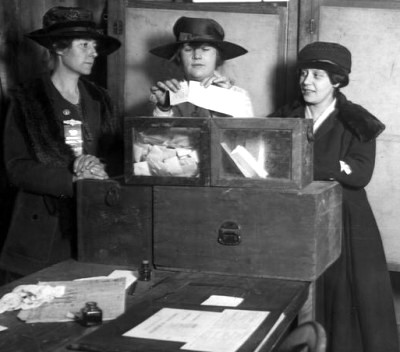
WHY EVERY WOMAN SHOULD VOTE
This is the story of our Grandmothers, and Great-grandmothers, as they
lived only 90 years ago. It was not until 1920 that women were granted
the right to go to the polls and vote.
Thus unfolded the ‘Night of Terror’ on Nov. 15, 1917, when the warden at
the Occoquan Workhouse in Virginia ordered his guards to teach a lesson
to the suffragists imprisoned there because they dared to picket Woodrow
Wilson’s White House for the right to vote. The women were innocent and
defenseless. And by the end of the night they were barely alive. Forty
prison guards wielding clubs and their warden’s blessing went on a
rampage against the 33 women wrongly convicted of ‘obstructing sidewalk
traffic.’
They beat Lucy Burn, chained her hands to the cell bars above her head
and left her hanging for the night, bleeding and gasping for air. They
hurled Dora Lewis into a dark cell, smashed her head against an iron bed
and knocked her out cold. Her cell mate, Alice Cosu, thought Lewis was
dead and suffered a heart attack. Additional affidavits describe the
guards grabbing, dragging, beating, choking, slamming, pinching,
twisting and kicking the women.
For weeks, the women’s only water came from an open pail. Their
food–all of it colorless slop–was infested with worms. When one of the
leaders, Alice Paul, embarked on a hunger strike, they tied her to a
chair, forced a tube down her throat and poured liquid into her until
she vomited. She was tortured like this for weeks until word was
smuggled out to the press.
So, refresh my memory. Some women won’t vote this year because–why,
exactly? We have carpool duties? We have to get to work? Our vote
doesn’t matter? It’s raining?
Last week, I went to a sparsely attended screening of HBO’s new movie
‘Iron Jawed Angels.’ It is a graphic depiction of the battle these women
waged so that I could pull the curtain at the polling booth and have my
say. I am ashamed to say I needed the reminder.
All these years later, voter registration is still my passion. But the
actual act of voting had become less personal for me, more rote.
Frankly, voting often felt more like an obligation than a privilege.
Sometimes it was inconvenient.
My friend Wendy, who is my age and studied women’s history, saw the HBO
movie , too. When she stopped by my desk to talk about it, she looked
angry. She was–with herself. ‘One thought kept coming back to me as I
watched that movie,’ she said. ‘What would those women think of the way
I use–or don’t use–my right to vote? All of us take it for granted
now, not just younger women, but those of us who did seek to learn.’ The
right to vote, she said, had become valuable to her ‘all over again.’
HBO released the movie on video and DVD. I wish all history, social
studies and government teachers would include the movie in their
curriculum. I want it shown on Bunco night, too, and anywhere else women
gather. I realize this isn’t our usual idea of socializing, but we are
not voting in the numbers that we should be, and I think a little shock
therapy is in order.
It is jarring to watch Woodrow Wilson and his cronies try to persuade a
psychiatrist to declare Alice Paul insane so that she could be
permanently institutionalized. And it is inspiring to watch the doctor
refuse. Alice Paul was strong, he said, and brave. That didn’t make her
crazy. The doctor admonished the men: ‘Courage in women is often
mistaken for insanity.’
Please, if you are so inclined, pass this on to all the women you know.
We need to get out and vote and use this right that was fought so hard
for by these very courageous women. Whether you vote democratic,
republican or independent party – remember to vote.
History is being made.
More Three Cups of Tea
The timing couldn’t be better. Thank you, Phantom Man, for sending a link to this New York Times article on Three Cups of Tea, from the July 13th New York Times.
By NICHOLAS D. KRISTOF
Published: July 13, 2008
Since 9/11, Westerners have tried two approaches to fight terrorism in Pakistan, President Bush’s and Greg Mortenson’s.
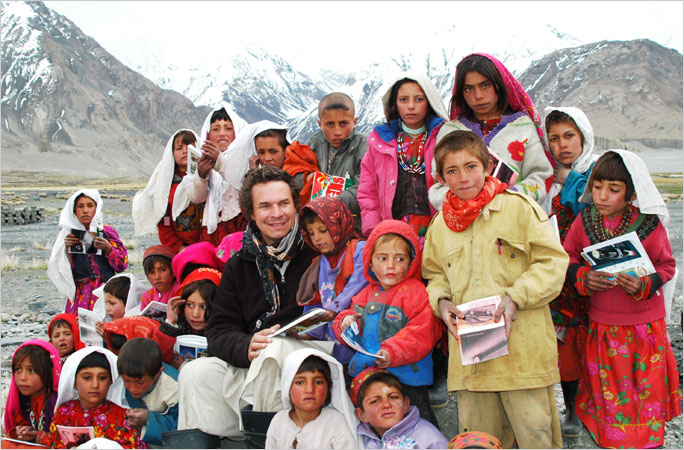
Greg Mortenson with Sitara “Star” schoolchildren. Photo: Fred R. Conrad/The New York Times
Mr. Bush has focused on military force and provided more than $10 billion — an extraordinary sum in the foreign-aid world — to the highly unpopular government of President Pervez Musharraf. This approach has failed: the backlash has radicalized Pakistan’s tribal areas so that they now nurture terrorists in ways that they never did before 9/11.
Mr. Mortenson, a frumpy, genial man from Montana, takes a diametrically opposite approach, and he has spent less than one-ten-thousandth as much as the Bush administration. He builds schools in isolated parts of Pakistan and Afghanistan, working closely with Muslim clerics and even praying with them at times.
The only thing that Mr. Mortenson blows up are boulders that fall onto remote roads and block access to his schools.
Mr. Mortenson has become a legend in the region, his picture sometimes dangling like a talisman from rearview mirrors, and his work has struck a chord in America as well. His superb book about his schools, “Three Cups of Tea,” came out in 2006 and initially wasn’t reviewed by most major newspapers. Yet propelled by word of mouth, the book became a publishing sensation: it has spent the last 74 weeks on the paperback best-seller list, regularly in the No. 1 spot.
Now Mr. Mortenson is fending off several dozen film offers. “My concern is that a movie might endanger the well-being of our students,” he explains.
Mr. Mortenson found his calling in 1993 after he failed in an attempt to climb K2, a Himalayan peak, and stumbled weakly into a poor Muslim village. The peasants nursed him back to health, and he promised to repay them by building the village a school.
Scrounging the money was a nightmare — his 580 fund-raising letters to prominent people generated one check, from Tom Brokaw — and Mr. Mortenson ended up selling his beloved climbing equipment and car. But when the school was built, he kept going. Now his aid group, the Central Asia Institute, has 74 schools in operation. His focus is educating girls.
To get a school, villagers must provide the land and the labor to assure a local “buy-in,” and so far the Taliban have not bothered his schools. One anti-American mob rampaged through Baharak, Afghanistan, attacking aid groups — but stopped at the school that local people had just built with Mr. Mortenson. “This is our school,” the mob leaders decided, and they left it intact.
You can read the entire article in the New York Times by clicking on the blue type.
Obama Magazine Cover Controversy
This is the New Yorker magazine cover that is causing so much controversy in the USA – it shows a newly elected Obama showing up to work in the oval office (US President’s office) in Islamic dress and trading congratulatory fists with his terrorist dressed wife. Obama and his election campaign group find it distinctly unfunny.

Recent Comments
intlxpatr on Shampoo Ginger tigerbutterya0c5ff1d… on Shampoo Ginger intlxpatr on British Soldier Kidnapped, Esc… John on British Soldier Kidnapped, Esc… intlxpatr on British Soldier Kidnapped, Esc… Wikipedia Donate Button

Amazina


Early Voting in Florida


