The Wire, Season 4
This show, The Wire, is one of our all time favorites, all the more so because our son also loves this show and passes along the entire season when he has finished watching.
Season 4 is the very best so far. The major theme is a subject near and dear to my heart – the schools, keeping kids in school, and trying to find ways to help them learn. Two former policemen end up in Tilghman Middle School, working with the poorest kids in the Baltimore school system.
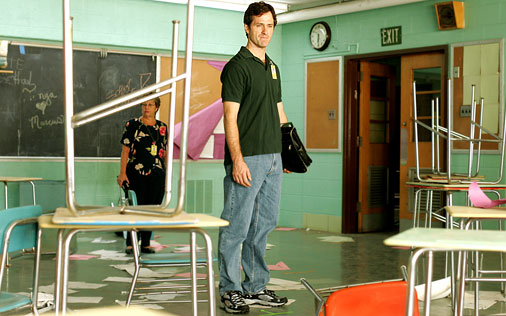
First, you need to know that teaching middle school is the stuff of heroes. At very best, middle school kids are dealing with those raging hormones of adolescence. They can’t sit still. They are so full of energy, and sitting and reading is the last thing they want to do.
New teacher “Prez” suffers total loss of control over his class on his first day, but slowly finds ways to engage their attention – such as teaching them to use math to figure odds rolling dice. Once they understand the value of the new information, they are enthusiastic learners . . . or at least, they co-operate with the boring stuff because he finds ways to reward them with interesting information, relevant to helping them cope with their lives. The teachers learn from the students – to keep it real, keep it relevant.
The teachers in Tilghman Middle School are HEROES. Most of the children they deal with have huge problems outside the school, poverty being the smallest of the problems. For many, their parents are their worst problems, literally stealing the food out of their mouths for another fix. The kids bring their baggage into the schools every day, their anger, their acting out. The teachers have to be a mix of tough, compassionate and flexible. They know they are going to lose some of them, and they have to keep on, hoping a few will make it. It is truly a war zone, and the teachers are the stand-up soldiers in this season.
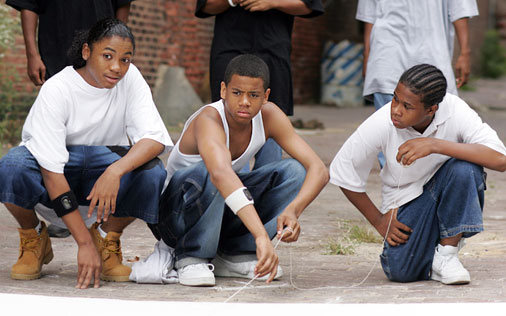
We follow a tough race for the Mayor’s office, the rise of a drug lord, two stone-cold killers who figure out how to “disappear” their victims, and one very clever schemer who manages to pull off a major drug heist, and then sells the product back to his victims. It’s an amazing show.
If you follow this season via DVD, choose to use the subtitles. A lot of the language is slang, much of it is street talk, mumbled, garbled – real speech. It helps to use the subtitles.
Women Are Women: Abayas and Hijab
One of the questions I get most often when I am back in the US is whether I have to cover, whether I have to wear an abaya, whether I have to cover my hair.
I tell them that in Kuwait, it is still a choice. Many Kuwaiti women do not cover their hair, but most dress modestly and are still traditional and conservative in behavior.
I tell them that in Saudi Arabia, I had to wear the abaya, but that the embassy instructions were to carry a scarf, but only to wear it if the muttawa / religious police made a fuss, as it was not the law of the country. The law stated that Moslem women would be covered, but not non-Muslim women. The Saudi women would tell me all the time that I didn’t have to cover, but when I mentioned the Muttawa – they all just sighed and nodded, and said that some people have a funny idea about religion, but that this was not the real Islam.
What I loved about women in Saudi Arabia is that they have a lot in common with women everywhere. When confined, they have ways to press the envelope. For example, the malls are full of stores with the sexiest shoes I have ever seen – and when feet are one of the few things that CAN be seen, guess where the money gets spent? There were also entire floors devoted to perfumes, and women would pass and you could nearly swoon from the delicious scents, an entire cloud of scents as they passed, cloaked in anonymity. There were glove shops, with the sexiest, laciest gloves you have ever seen. At the time, most of the abayas and scarves in Saudi Arabia were plain black, although occasionally you might see one with a discreet little trim, or a tiny little sparkle.
The kids told me they could tell their family members; they learned to identify posture and voices. They didn’t have any problems picking out their Moms and sisters.
Women would approach me in stores, standing next to me, pretending to examine some goods and whisper “Hi! Where are you from?” and “Do you like it here?” Many times, on planes, husbands would make their wives change places so as not to be contaminated by sitting by the likes of me, a wicked western woman with her hair showing, but the women would smile shyly when the husband was looking the other way. Women are women. We have our ways. We manage to get around restrictions.
On the other hand, I want to share with my Western readers the trend in abayas and scarves in the last few years. They are GORGEOUS, and there are times I am tempted to buy just because they are gorgeous.
On a deserted morning, I found these shop windows to share with you:
These are going-out-calling dresses, worn under abayas

These would probably be worn to an evening event like a wedding

Even the younger girls have special evening clothes
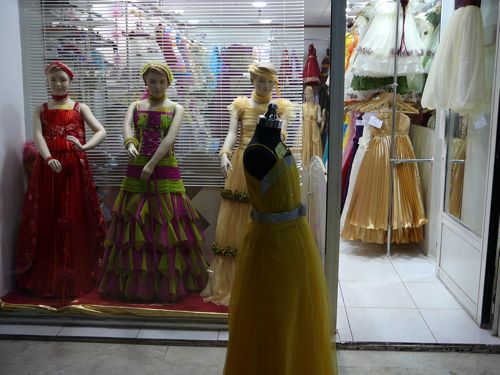
Not your old fashioned abayas

Love these details

Scarves to wear with abaya

Things We Love About Robin’s House
We had reservationsin Nkwali, the jumping off place for most of the Robin Pope Safaris, but we had to change the reservations by a couple weeks, and that meant a total reversal of the reservation. We started off in Tena Tena, then we went to Nsefu, then we ended up in Nkwali. We have always loved Nkwali, loved the cabins there, but this time we were happier than happy – they put us in Robin’s House.
Robin’s House is where Robin and Jo Pope lived before they built a gorgeous house on the other side of the camp.
It is perfect for two couples, or two couples and children. It is perfect in so many ways that I had to make a list of all the things I loved about being there.
* Space – spacious bedrooms, spacious, private bathrooms on each side of the house with a spacious common living/sitting/dining room in the center.
* Indoor/ outdoor living – the windows have screens on them to keep out critters, but indoors or outdoors, it all feels a part of a whole.
* Wrap around windows – a view anywhere you look
* Huge walk in shower, with animal prints molded into the painted cement floor. Love the whimsy.
* High, airy ceilings, with ceiling fans
* natural materials, canvas colored curtains, a neutral palette with beam accents
* great big soft fluffy bath towels
* all our favorite drinks stocked in the refrigerator, and a liquor bar, which we barely touched, that had Amarula, which I love.
* electricity! We could recharge our own camera batteries without going to the camp itself
* being taken care of by a hostess, a cook, a dedicated guide and Thomas and Amos, who took care of us without over-taking-care of us – they gave us plenty of privacy when we needed it, and were there when we needed them.
* variety of seating for people of different heights
* Tribal Textiles accents – pillows, covers, etc – in rooms
* a book case! With books! and games!
* multiple views of hippos, and hippo sounds at night
* grand, comfy beds with good sheets, good pillows and good mattresses
* kikoys provided for our use
* shaded porch with a variety of seating options
* a hammock with a view
* insect repellant – with a good smell and nice texture, and it really seemed to work
* ditto shower gel and shampoo and conditioner provided
* a drying rack for swimming towels, washed clothes, etc.
Our last day there, LawAndOrder Man and EnviroGirl had to leave for their 32 hour return to the USA, flying Mfuwe – Lusaka – Johannisburg – Dakar – Atlanta – Pensacola – imagine. And they had to work the next day. It was such a sad parting, and we were all glad to have had the last days together in this beautiful, very private location.
Photos:
This is the wing of the house where AdventureMan and I stayed

This was our room (sigh!)
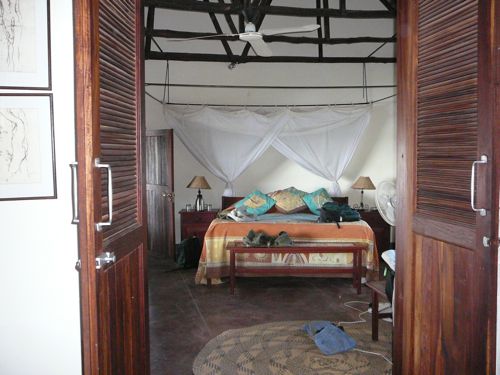
And this is the shower we loved
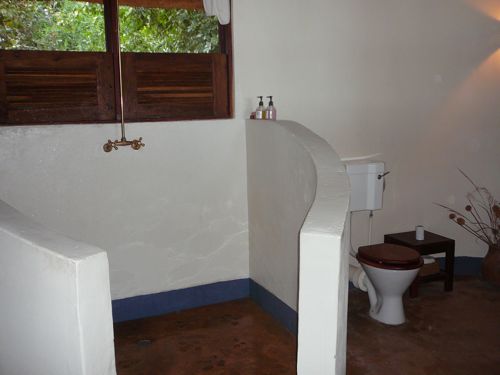
This was the living room/sitting room where we would gather

This was the second bedroom – there were additional beds for kids
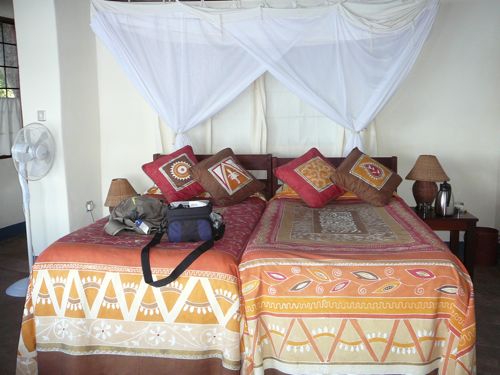
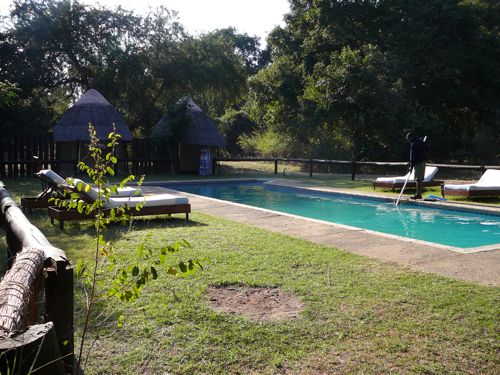
This is the pool. Other guests from the camp could use it, but no one did while we were there. It was separate from the house but very close.
These spaces for outdoor sitting were outside the other wing, where our son and his bride slept


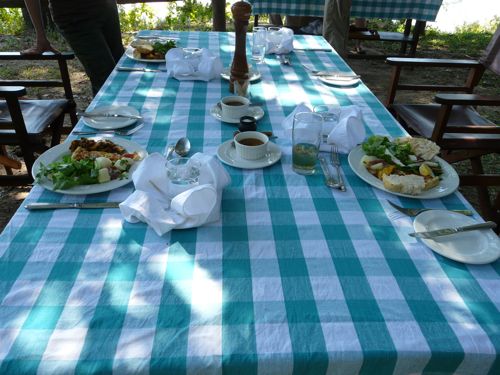
They served our meals privately, too. What wonderful luxury privacy is
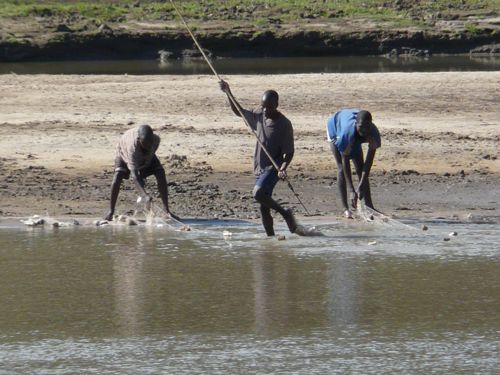
You know, the little Alaska girl is still alive and well inside me, and I am always fascinated with fishing techniques. This was right across the river from Robin’s House, and they caught quite a few fish.
Robin and Jo Pope have expertise, and also VISION. Problems, to them, are opportunities. Need to get tourists to the camps? Invest in an airline. Need to get them to the national park across a river? Build your own pontoon bridge – it gives Zambia additional park revenue, provides additional employment, and gives tourists a thrilling experience. When they solve a problem, everyone wins.
We crossed several times on this boat, and once, in pitch dark, got caught on a tree snagging us from under the water. It took about 15 minutes to maneuver us off, and to get across, but it is not like this ferry is on a schedule. It goes back and forth when vehicles are going into or coming out of the park.

How the boat is pulled across the river

We had some fabulous game drives; I will only bore you with this one. The hippo ponds are covered with nile cabbage, and I just loved this hippo with his nile cabbage blanket

The Sunshine Vitamin
This is from The Washington Post and you can read the entire article by clicking on the blue type.
Vitamin D deficiency is, ironically, a serious issue for Middle Eastern women who stay out of the sun and who cover – wear abaya, hijab and niqab. The body makes Vitamin D from sunshine – which we have here in the Gulf in great abundance. Even exposing your skin for ten minutes a day in a secluded sunny spot will help your body create the Vitamin D it needs to build your bones and your system.
Some Seek Guidelines to Reflect Vitamin D’s Benefits
By Rob Stein
Washington Post Staff Writer
Friday, July 4, 2008; Page A01
A flurry of recent research indicating that Vitamin D may have a dizzying array of health benefits has reignited an intense debate over whether federal guidelines for the “sunshine vitamin” are outdated, leaving millions unnecessarily vulnerable to cancer, heart disease, diabetes and other ailments.
The studies have produced evidence that low levels of Vitamin D make men more likely to have heart attacks, breast and colon cancer victims less likely to survive, kidney disease victims more likely to die, and children more likely to develop diabetes. Two other studies suggested that higher Vitamin D levels reduce the risk of dying prematurely from any cause.
In response to these and earlier findings, several medical societies are considering new recommendations for a minimum daily Vitamin D intake, the American Medical Association recently called for the government to update its guidelines, and federal officials are planning to launch that effort.
But many leading experts caution that it remains premature for people to start taking large doses of Vitamin D. While the new research is provocative, experts argue that the benefits remain far from proven. Vitamin D can be toxic at high doses, and some studies suggest it could increase the risk for some health problems, experts say. No one knows what consequences might emerge from exposing millions of people to megadoses of the vitamin for long periods.
“The data are intriguing and serve as, no pun intended, food for further fruitful research,” said Mary Frances Picciano, at the Office of Dietary Supplements of the National Institutes of Health. “But beyond that, the data are just not solid enough to make any new recommendations. We have to be cautious.”
The current clash is the latest in a long, often unusually bitter debate. Some skeptics question whether funding by the tanning, milk and vitamin industries is biasing some advocates. Frustrated proponents accuse skeptics of clinging to outdated medical dogma.
“It feels kind of ridiculous working in this field sometimes,” said Reinhold Vieth, a professor of nutritional sciences and pathobiology at the University of Toronto. “Every week, I get interviewed about the next important publication about Vitamin D. But this field remains mired in the muck.”
Vieth is one of a small but vocal cadre of researchers pushing doctors and patients to stop waiting for new official guidelines. Physicians should routinely test their patients for Vitamin D deficiencies, and more people — especially African Americans — should take supplements and increase their exposure to the sun, they say.
“The bottom line is we now recognize that Vitamin D is important for health for both children and adults and may help prevent many serious chronic diseases,” said Michael F. Holick, a professor of medicine, physiology and biophysics at Boston University.
Scientists have long known that Vitamin D is a vital nutrient the skin produces when hit by ultraviolet light from sunlight and other sources. The amount of Vitamin D produced varies, depending on where the person lives, skin pigment, age and other factors. African Americans and other dark-skinned people, and anyone living in northern latitudes, make far less than other groups.
With people spending more time indoors surfing the Web, watching television, working at desk jobs, and covering up and using sunblock when they do venture outdoors, the amount of Vitamin D that people create in their bodies has been falling. Milk and a few other foods are fortified with Vitamin D, and it occurs naturally in others, such as fatty fish, but most people get very little through their diets.
“Humans evolved in equatorial Africa wearing no clothes,” said Robert P. Heaney, a leading Vitamin D researcher at Creighton University in Omaha. “Now we get much less direct sunlight, and so we don’t make nearly as much Vitamin D.”
Electricity Bills Certificate?
Back in May, we saw the following in the Kuwait Times:
“the Ministry of Electricity and Water (MEW) has decided to ask all expatriates before exiting the country – whether on holiday or permanently – to obtain a certificate of clearance from the ministry. The certificate is only valid for one month. If the expat doesn’t have it, he will be returning from the airport the same day . . . “
School is out, people have fled the heat in droves, even with the atrocious airline prices. Has anyone heard of this policy being implemented? I haven’t heard of anyone being halted from travelling because of an unpaid bill, nor did anyone look us up when we were departing on holiday.
Masumbe’s Wisdom By the Campfire
Every night before dinner in these camps is a time for gathering around the campfire, sharing stories, getting to know the fellow guests. At Tena Tena our third night, we are sitting with Msumbe, the assistant camp manager, and listening to him talk about Zambia.
Zambia is a peaceful nation, and it is a miracle. More than seventy different tribes, and that many different languages and dialects. Rich in natural resources, full of children hungry to learn, Zambia has placed a high priority in educating everyone in getting along with one another.
“So like when you come across another person, not from where you are from, you don’t start in with a lot of questions. First you ask ‘How is it where you are from?’ and then you listen. When you know where he is coming from, and how are things there, then you can ask better questions, and not offend someone.”
Hmmmm, I thought, good advice. Sometimes I feel a little shy, especially when there are large groups of “others” like South Africans, or British, and they have their own values, their own ways of communicating, different from ours.
Soon, I was sitting next to a British woman, and desperately trying to think of a way to get HER talking, so I could be listening, and that is exactly what I asked “Tell me what life is like where you are from?”
She looked at me like I was a little crazy and asked what I meant. I said that I knew her life was very different from mine, and I was interested to know what her daily life was like. So she started telling me she wasn’t very interesting really, but gave me some details, and actually, it WAS interesting. Once she got going, knowing I really was interested, I learned a whole lot!
One detail I will never forget is that she rides to the foxes every weekend in the fox hunting season, this very respectable woman, and that they all do, even if it is against the law. No matter what the weather, they ride, hour upon hour. She laughed and said they ride so long and so hard that her clothes become discolored from the saddle leather, and she comes home stained and filthy from her rides.
Now how would I ever have known all that without Masumbe’s good question? It’s like being given a key that opens many locks. You never know what treasures you will come upon, but you have this wonderful key. Thank you, Masumbe!
Disturbing Change
Late yesterday, I was online on AOL checking my e-mails. I often do, Law and Order Man comes online around that time in Pensacola and we can grab a quick chat.
Only Instant Messaging didn’t show up on my screen. I took care of business, and went on to other things. We don’t chat every day, just when we can.
Today, I noticed again – I don’t have AIM. I have a couple other ways to check in online, so I tried them. No AIM. Finally, I tried iChat, which also logs into AIM. It showed me logged in, it also showed no contacts.
My other AOL entry route didn’t show the Buddy Screen, even when I asked it to repeatedly.
I am hoping this is a little AOL glitch, temporary.
You don’t think Instant Messaging is being blocked in Kuwait, do you?
Sacred Spaces in Kuwait
As I was on my way home from picking up milk and vegetables, I passed another local mosque undergoing renovation. Or at least, that is my best guess; it has been gutted and partially destroyed. I am guessing it is about to be reconstructed, but I don’t know for sure. I am only guessing because I have seen it happen to other mosques since we arrived.
And it got me thinking, and I am going to ask a question, but I will tell you before I ask it, that if you asked me the same question about Christian spaces, I would have to ask an expert; it is not a question I can answer about my own culture.
Do Moslems have sacred spaces? How are they made sacred? Is there a ceremony? If you are going to destroy parts of a building on a sacred space, does it have to be de-consecrated (made no-longer-sacred) while it is undergoing renovation? If a mosque is destroyed/no longer used is there a ceremony that makes it no longer a holy spot?
I know that in my religion, churches are consecrated, made officially holy, and that there is a ceremony. I know that in some places, churches that are no longer needed are deconsecrated, not made UNholy, but made not a sacred place of worship any more, and they become restaurants, housing, etc.
In my specific branch of Christianity, which is Episcopalian, there is a service for blessing a new house, which I love, and it is called a House Blessing. The priest comes, usually at dusk, you can have friends there, you carry candles and he blesses every room in the house. When we buy and move into a new house, we always have it blessed. The priest tells me that it is really a mis-nomer, it is not the house being blessed, but those who live within in. To me, that is a distinction that hardly matters, all I know is that I feel more secure in a house that has been blessed.
And no, there is no un-blessing ceremony when we leave a house. The blessing does not create a holy space, a place of worship, a sacred place, but only blesses a humble dwelling.
No, I don’t understand exactly how this all works.
I remember travelling in Syria with an archaeology group one time, and we went to see the site of St. Simeon the Stylite. In my cynical heart, I was not wild about the visit – a saint who sat atop a huge rock for several years to show his devotion to God? When I got there, however, my heart changed – it felt like a holy place. It felt like Saint Simeon had done a holy act, demonstrating his faith so . . . faithfully. If you know Syria, you know how bitterly cold it can be in winter, and how bone-breakingly hot it can be in summer. The pure grit and devotion it took to stay atop the pillar of stone was an amazingly faithful act. It felt like a sacred place, a holy place, to me.
So my question is not just for the Moslem readers, but also for Christian readers – what makes a space holy? Does it need a ceremony to be holy? Does it need a ceremony if it will no longer be used for sacred purposes?
Jackknife
The Kuwait Times crime editor has come across a new term, and now he is using it every chance he gets. It is driving me crazy.
See if you can pick it out:
Policeman Injured
A policeman was injured after his patrol vehicle jackknifed when he lost control of the steering with the car coming to a rest upside down in the road. The officer managed to use the car’s radio to call for assistance and emergency services were quickly rushed to the scene, rushing the injured policeman to hospital.
Unless the police officer was driving a sectioned vehical; a car towing a trailer, a truck carrying a connected load – something that can be BENT, FOLDED, like a jackknife –

– then it is NOT a jackknifed vehicle. Most police vehicles are sedans. A sedan cannot jackknife.
This is the explanation from Wikipedia:
Jackknifing means the accidental folding of an articulated vehicle (i.e. one towing a trailer) such that it resembles the acute angle of a folding pocket knife. If a vehicle towing a trailer skids, the trailer can push it from behind until it spins round and faces backwards. This may be caused by equipment failure, improper braking, or adverse road conditions such as an icy road surface.
Jackknifing is not very common and usually only happens to an empty vehicle. Most truck drivers are skillful enough to correct a skid before it becomes a jackknife. It would be an exaggeration to claim that jackknifing accounts for a large number of tractor-semitrailer accidents since in many cases it is the collision that would have caused the vehicle to jackknife and not vice versa. Radio stations often report jackknifed trucks because people phone to tell them, but more often than not, the truck has not technically jackknifed; it may be stuck in the snow or damaged in a crash.
Five Under Five Tag – You’re It!
It’s a slow summer day, not a lot going on, so let’s play.
I was making the Pasta Melanzane and added some sun-dried tomatoes when the smell suddenly reached my nose and I was caught by the sweet intensity of the smell. I thought to myself “so much flavor! and at so little cost!” and it started a whole train of thought.
What gives your life pleasure and doesn’t cost much? Here are the rules – the cost of your pleasure must be under 5KD (under $20 for my USA players). See if you can think of five. If you find more than five, you can list those too, if you want – the rules here are pretty vague. so – give me five!
Here are mine:
1. The sound of my husband whistling – it means he is feeling peaceful, even happy.
2. Moments with my family when I suddenly realize how special they are, and truly treasure our time together.
3. The intense flavor of sun-dried tomatoes.
4. The sound of waves crashing onto the shore.
5. The smell of the sea, cloves, lavender, baked apples, roasting meat, a fresh pine Christmas tree,
the first rain in a dry, dusty country.
Bonus: The smell of Comfort fabric softener on laundered underwear. 🙂
The sound of my friend’s voice when I don’t expect a call from her.

Recent Comments
Kitchen on Isiais: Winding Down intlxpatr on Shampoo Ginger tigerbutterya0c5ff1d… on Shampoo Ginger intlxpatr on British Soldier Kidnapped, Esc… John on British Soldier Kidnapped, Esc… Wikipedia Donate Button

Amazina


Early Voting in Florida


