Rolls Royce and Lamborghini Dumped
From today’s Arab Times:
Rolls Royce and a Lamborghini dumped in a desert
Kuwait : Police found two luxurious cars — a Rolls Royce and a Lamborghini — worth KD 200,000 dumped in a desert area, reports Al-Anba daily. Reportedly, the cars were stolen from a rental office about 20 days ago. Personnel from the Criminal Evidences Department lifted fingerprints to identify the culprits.
Does anyone else find this funny? I mean funny, hahahaha, not funny strange, or weird. I mean it IS weird, it is so weird, but it makes me laugh.
In a little village in Washington State, there was a huge snowstorm a few years ago, and the roofs in the yacht club collapsed from the weight of the snow, collapsed on all those big fine yachts, and the citizens of the little village gathered and laughed. Boat moorage in their own little village had gotten so expensive, they couldn’t afford it, so these were all other people’s boats. And they just laughed.
200,000 KD worth of car in two cars. Just dumped in the desert. Seems kinda wasteful, doesn’t it?
Stalking Purgatory
The blogger Purgatory has recently expressed anxiety about being stalked. (Actually, he sounded very pleased about it.) He had evidence; a note accompanying a cookie (someone knows the way to his heart!).
Purg, trust those feelings. Be very wary. Your stalkers are everywhere:

Prices and Variety
My friends and family enjoyed my last Sultan Center post so much, I am going to add a couple photos here.
The price of eggs is breathtaking:

(Remember, for KD to $, you can figure about $4/KD)
Down below these packages of 6 (top shelf) and 12 second shelf) were flats of 30 for only KD 1.000. They are smaller eggs, and need washing, but that’s what I bought.
The Sultan Center serves a wide variety of people – local and expat – so I always love to see the things they put next to each other. This is a section I call “food helpers;” they are not food, but you add them to something – meat, rice, something that really IS food:
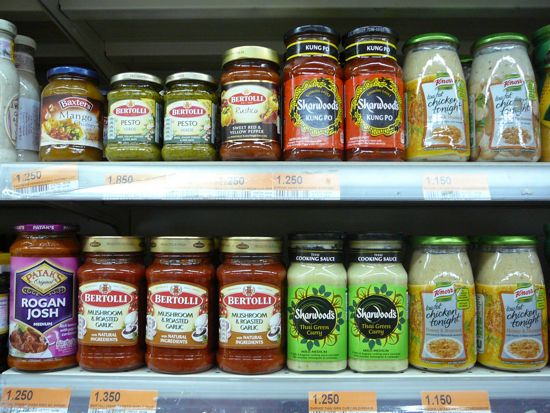
There is no lack of condiments. There is only the lack of the one particular condiment you need on the day that you need it!

“Except Through Me. . .”
Today’s Gospel reading includes a phrase that causes a lot of concern and discussion among Christians. The entire reading is this:
GOSPEL: John 14: 1 – 14 (RCL)
John 14: 1 – 12 (Roman Catholic)
John 14:1 (NRSV) “Do not let your hearts be troubled. Believe in God, believe also in me. 2 In my Father’s house there are many dwelling places. If it were not so, would I have told you that I go to prepare a place for you? 3 And if I go and prepare a place for you, I will come again and will take you to myself, so that where I am, there you may be also. 4 And you know the way to the place where I am going.” 5 Thomas said to him, “Lord, we do not know where you are going. How can we know the way?” 6 Jesus said to him, “I am the way, and the truth, and the life. No one comes to the Father except through me. 7 If you know me, you will know my Father also. From now on you do know him and have seen him.”
8 Philip said to him, “Lord, show us the Father, and we will be satisfied.” 9 Jesus said to him, “Have I been with you all this time, Philip, and you still do not know me? Whoever has seen me has seen the Father. How can you say, “Show us the Father’? 10 Do you not believe that I am in the Father and the Father is in me? The words that I say to you I do not speak on my own; but the Father who dwells in me does his works. 11 Believe me that I am in the Father and the Father is in me; but if you do not, then believe me because of the works themselves. 12 Very truly, I tell you, the one who believes in me will also do the works that I do and, in fact, will do greater works than these, because I am going to the Father. 13 I will do whatever you ask in my name, so that the Father may be glorified in the Son. 14 If in my name you ask me for anything, I will do it.
The phrase that causes problems is this: No one comes to the Father except through me.
Today’s Forward Day by Day (thoughts on the readings for the day) is very comforting. It says this:
Today’s gospel text is another hard one. The absoluteness of Christianity is affirmed over and over in John’s Gospel and never more disturbingly (to our pluralistic ears) than in this passage. Jesus declares himself to be “the way, the truth, and the life” that leads to the Father; no one comes to the Father except through him.
This grates on us. What about Jews? Muslims? Buddhists? Agnostics? C. S. Lewis, addressing this concern in Mere Christianity, reminds us that “God has not told us what his arrangements about other people are.” We know that no man can be saved except for Christ, but we do not know that only those who know him can be saved through him, Lewis adds. The heart of the matter, then, is not measured by the extent of our awareness. Grace is a mystery, not a formula-and not subject to our prior approval.
The Spirit blows where it will.
The epistle to the Hebrews reminds us that the word of God spoken in Christ is “living and active.” In hidden ways we cannot see, control, or imagine-even in other religions-Christ is bringing the whole world home to the Father, one beloved person at a time.
I have a sweet Moslem family who loves me. When they come back from Hajj, they always bring me prayer beads, and they always pray for me at the most important time and place. It delights my heart; it delights me that they love me and want me to be in paradise with them, and I will accept prayers for me from anyone, any day of the week!
One of the most meaningful things they ever said to me was that, in spite of everything, they believe I will be in the afterlife with them. They are devout. I know their beliefs exclude me, and somehow they have found a way to think I might be included.
I like this devotion for the same reason. I want to believe that God/Allah is so big that we can’t begin to comprehend how much he loves us, his creation, and how his mercy and forgiveness and powers of inclusion will work. We don’t believe the same things, not exactly the same, and yet I believe there is a way we can all be saved.
Pirates!
Wow! Wow! Wow!
The last night was sold out! When the Ahmadi Singers and Orchestra staged Pirates of Penzance in the Mishref Theatre, Kuwait had a real treat.



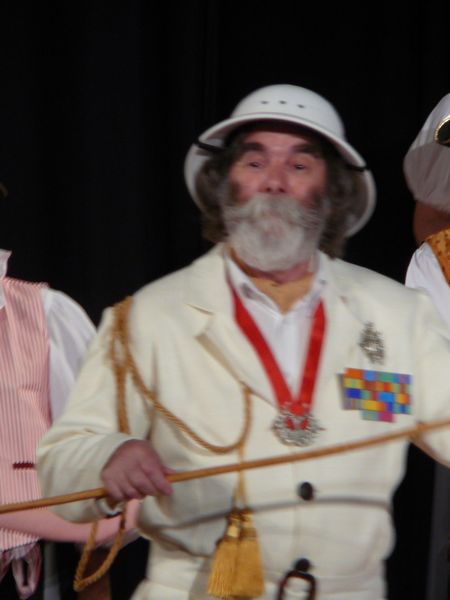

The Singers, the Orchestra – and the audience – were all multinational. The Mishref Theatre is a delightful space, warm, comfortable, intimate. There were many many children in the audience, and all were particularly well behaved. Only one cell phone went off (twice) and it was immediately silenced; the owner did not chat on his phone while the performance went on. Wooo Hoooo, Kuwait!
Neither did the audience sit on its hands! Each song was warmly applauded, and the old favorites, like the Modern Major General, brought the house down.
What I liked the very best about this performance of Pirates of Penzance was that the singers seemed to be having a lot of fun. The staging was clever and well-done, lots of stage play, lots of interaction, lots for people to see. Lots of fun for the kids, too. The actors sang the complicated song slowly but snappily, and we could understand the lyrics, those hysterically funny Gilbert and Sullivan lyrics. The costumes were a lot of fun – do you see the parrot on one pirate’s shoulder?
Brava! Bravo! The Ahmadi Singers and Orchestra have caught fire! Who knows what they will stage next?
Kuwait Elections: Vote Buying
Front page of the online Arab Times:
They’re buying votes … Do something
KUWAIT CITY : The Ministry of Interior should immediately take the necessary action to curb the widespread vote-buying in some constituencies and prevent incompetent candidates from entering the Parliament, former MPs and 2008 parliamentary election candidates told the Arab Times.
One of the smartest bloggers out there, Touche´, wrote a comment on an earlier election blog entry, and it was SO good, so memorable (this man should be writing and editing for one of the daily English papers and teaching Political Science) on vote buying and how it is implemented that I am going to reprint his comments here to illustrate how the vote buying in Kuwait is accomplished.
Let me indulge you with our rotten political trends.
This is a funny ironic melancholic TRUE story, I have a colleague at work who is “Mutawa” (fresh your old post) who belongs to “Salaf a.k.a. The Islamic Heritage Rejuvenating Society (this is my best translation) and who is has the last name of one of the tribes. Now on the last elections back on 2006 I asked him to whom did you vote, thinking that he must have voted for that group’s candidates, and the shocking news is that he said the week before elections I swore an oath with all the area followers to vote for the Islamic candidates and I quote him “When I went there to vote and tried to vote for the sworn names, the pen would go directly to those candidates who belong to my tribe, I couldn’t do it, so I voted for one of the Islamic candidates and the other vote went to our tribe’s guy”. Now I told him that you’ve sworn on the Quran!! How cold you do that? The answer was simple, “I just couldn’t, it’s in my blood, it’s something beyond your comprehension”
As for your question about votes purchasing, it starts as follows (sorry but I had to put them into steps for clarity purposes:
1. The buyer’s representative (BR) scouts the area for the right voters who are willing to sell their votes for money.
2. BR approaches the voter and persuade him/her and both agree on the price of each vote (female votes are being negotiated with the woman’s brother, father or husband)
3. Once the deal is closed, the voter has to submit his/her national ID to the BR to insure that voter hasn’t closed another deal with another candidate and the documents are held with the BR until elections day (on extreme cases, a trust worthy voter won’t submit the documents and his word is taken as it is considered stronger than oak)
4. All BRs know each other as they are basically residents of the same area and they exchange a list of those voters who sold their votes an cross examine them for duplications to prevent any frauds.
5. Now the interesting tactics, on election day, a candidate may choose not to give the national ID to the voter if the he feels that he has secured his win and thus eliminating any chances of any frauds by voter to shift his votes to opponents.
6. If the candidate needs the vote, the corresponding BR calls up the voter and walks him to the election classroom signaling another same candidate’s BR who sits in that classroom to observe the integrity of the processes, now that guy knows that the voter isn’t a supporter and has been paid based on the signal thus he keeps a hawk eye on him trying to see how many ticks were placed on the voting form and does the tick fits the area on the form where candidate’s name is printed (it’s merely an approximate observation).
P.S.
a. The timing of the purchased votes isn’t random and are chosen specifically by the candidate’s campaign and usually the purchased voted are being herded as sheep in groups either at the early morning or an hour before the closing time.
b. The paid amount is %50 before voting and the remaining %50 when the inside BR sms the voter’s delivery BR that the vote has been verified based on his observation and thus the full payment is due.
c. The vote’s price depends on the nature of the vote itself (solo/dual for the old election ways). Solos are the highest paid and the ones which BRs aim for.
d. Buying votes isn’t to insure number of votes, the key element of the whole process is to target those votes which are considered as opponents insured votes, by keeping those national ID (voting ID for this election) the candidate uses a term called “Votes Burning” where he holds back those IDs and never giving them to voters until election boxes are sealed to eliminate opponents’ insured votes.

Blogger Chirp reports being offered KD 4000 (that’s about $16,000) for her vote. Imagine the temptation! Chirp has character and integrity, and turned it down, but imagine how tempting that might be to a young person who wants education, or a new car, or to pay off debts, or who has a wedding coming up. That’s a LOT of money for just one vote; imagine the deep pockets who can afford to buy that many votes?
Turning into a Kuwaiti
We were lingering over the last bites of dessert and coffee in our favorite French restaurant when one phone rang and after a brief conversation, my friend turned to the rest of us and said “We have to get home. That was Anwar saying another storm had rolled in.”
We had all known it was a possibility, but wanted to take the chance to get together anyway. It was one of those rare occasions when our husbands were out of town, we could eat at a restaurant WE liked that they didn’t, we could get together and not worry about when we were getting home. We flurried out, I quickly dropped off my friends and headed home.
The streets were relatively quiet and the traffic relatively slow. I found myself thinking about the evening and how far I have come, living in Kuwait. I’m driving at night, and I don’t even feel a surge of fear-filled adrenalin, I’m driving in a sandstorm going ho-hum, just need to get home, and I’ve just had a great evening with female friends.
And I thought “I’m turning into a Kuwaiti woman.”
The West is so couple oriented. I remember when I was living near my parents in Seattle, and my husband was overseas, I hated Sundays; Sundays seemed like couples’ day to me – couples/families go to church, go to breakfast, go out shopping. Mostly on Sunday I would go to church, go to breakfast with a bunch of church friends and then go home, spend the rest of the day reading the Sunday paper and working on projects. If I were out and about, I would only be reminded how lonely I was, how I was missing a piece, I was incomplete.
In the Gulf, most of the social life is segregated – women go to women’s things, men go to men’s things, families do family things. Things are changing, but there isn’t a lot of “married-people-having-dates-with-their-own-spouses going on. Women go to engagement parties, wedding parties, condolence calls, they go shopping, they meet up at restaurants, they get together in one another’s houses. Men meet up at the diwaniyya, a local shisha cafe, they visit their extended family, they hang out and play cards, they race along the streets. The great circle called men’s social life intersects with the great circle called women’s social life intersect only rarely.
And here I am, meeting up for dinner with my female friends, and driving home alone at night through a sandstorm. Yep. I am definitely turning into a Kuwaiti.
Drought and Rising Food Prices
We are all so interconnected. I knew rice prices here in Kuwait had gone sky high, so high that imported American rice is now a relative bargain. I always bought Indian rice, in an effort to buy more (relatively) locally, and I knew India had restricted rice exports, but I didn’t know that the long drought in Australia was also contributing to the short supply.
You can read the entire article at this New York Times link.
THE FOOD CHAIN
A Drought in Australia, a Global Shortage of Rice
By KEITH BRADSHER
Published: April 17, 2008
. . . . . .
The collapse of Australia’s rice production is one of several factors contributing to a doubling of rice prices in the last three months — increases that have led the world’s largest exporters to restrict exports severely, spurred panicked hoarding in Hong Kong and the Philippines, and set off violent protests in countries including Cameroon, Egypt, Ethiopia, Haiti, Indonesia, Italy, Ivory Coast, Mauritania, the Philippines, Thailand, Uzbekistan and Yemen.
Drought affects every agricultural industry based here, not just rice — from sheepherding, the other mainstay in this dusty land, to the cultivation of wine grapes, the fastest-growing crop here, with that expansion often coming at the expense of rice.
The drought’s effect on rice has produced the greatest impact on the rest of the world, so far. It is one factor contributing to skyrocketing prices, and many scientists believe it is among the earliest signs that a warming planet is starting to affect food production.
It is difficult to definitely link short-term changes in weather to long-term climate change, but the unusually severe drought is consistent with what climatologists predict will be a problem of increasing frequency.
Read the rest of this article, and related articles, by clicking HERE.
Traffic Watch
Never fear, the Qatteri Cat is on traffic watch today. All is well, you can tell by his relaxed stance. Every now and then, he will utter an alarm – birds come by and taunt him because they are flying freely and he is trapped inside. He’s not smart enough to say “yeh, but I get free food, water and medical care in this gilded cage.” All he knows is that he would love to be free to show those birds a thing or two.

Once, in our Qatar villa, a great big pigeon hit a window and then THUNKED to the ground, not 10 feet from QC, who was allowed in the garden as long as someone was with him. The bird was so big and QC was so astounded, that by the time he decided to go investigate, the bird had recovered consciousness, stood up and shook his wings. He was bigger than QC! As QC thought twice about approaching, the pigeon flew off. I am betting that is about the closest QC has been to a real live bird.
One time (one of many) the Qatteri Cat escaped the yard. This time I knew where he was within the first half hour, because I could hear him crying pitifully. I had to ask a neighbor if I could go into her back yard, and there was QC, high up in a tree, scared and unsure how to get down. There was a wind blowing, and the only thing QC could think of, every time the boughs swayed to a strong gust of wind, was to go higher. He had reached the spot where every gust made him sway like a pendulum. He was terrified.
It took me about an hour to talk him down. First, he had to get over his panic, because his terror was paralyzing him. Second, he didn’t know how to climb down, so he had to turn around, to kind of walk down the tree, which, with gravity, was a very scary thing. He kept turning and then turning back.
(How do you teach a cat to back down a tree?)
Finally, I just kept talking. I locked eyes with him, and every time he would look away, I would say his name, get him focused on me again. Slowly, slowly, he worked his way down (he was up very very high, higher than a ladder could reach). He ended up falling the last 20 feet, but I could catch him. His little heart was beating like thunder, his adrenelin was pumping and I had to hold on to him to get him home. He didn’t want to be held, and I have the scars to prove it.
The neighbor thought I was a nut case, I am sure, but I don’t care. A cat can be so paralyzed by fear that they cling to the tree until they are exhausted and drop to their death. Some cats will figure out how to get down, but not all, and not while a wind is blowing and swaying them back and forth.
As much as I love fresh air, we have to keep the windows closed. He’s a sweet cat. His little brain just goes on hold sometimes. If a bird taunted him, he would be out that window in a heartbeat, no second thoughts, just instinct.
Not New News
Just as the Qatteri Cat monitors traffic in front of our place, I monitor my blog traffic – a lot like Qatteri Cat, sort of lazily, desultory.
Yesterday, I got the most hits – a lot – on MOC bans Porno Film Sites, a post I wrote almost a year ago.
80 hits. That’s a lot for a post almost a year old. Why so much interest? Are there new movements afoot in the Ministry of Communication to ban undesirable content? Are there new technologies available that make that possible?

I knew exactly the kind of photo I wanted to include here, so I googled “saudi censorship image” and found this wonderful blog: Your World Today. I really like his blog.
Recent Comments
intlxpatr on Shampoo Ginger tigerbutterya0c5ff1d… on Shampoo Ginger intlxpatr on British Soldier Kidnapped, Esc… John on British Soldier Kidnapped, Esc… intlxpatr on British Soldier Kidnapped, Esc… Wikipedia Donate Button

Amazina


Early Voting in Florida


