(Women have been driving in Saudi Arabia for years. Brothers, fathers, take the women into the desert and teach them so that in an emergency they will have the skills. Saudi women drive outside the kingdom. Now, they will – legally – be allowed to drive in their own country. Hallejujia!
What an irony, that women are gaining rights under repressive regimes, and losing rights in the USA under our current regime)
Saudi government says it will allow women to drive
Saudi Arabia plans to lift ban on women driving
The change aligns Saudi Arabia with virtually every other country in the world, including other conservative monarchies in the Persian Gulf. (The Washington Post)
Women in Saudi Arabia will be permitted to drive in the kingdom for the first time, according to a royal decree issued in Riyadh on Tuesday that overturned one of the most widely criticized restrictions on human rights.
The change may be the most visible sign yet of a modernizing Saudi Arabia, with reforms implemented by the heir apparent to the Saudi throne, Crown Prince Mohammed bin Salman. Signed by his father, King Salman, and broadcast on state television, the decree said that the “majority of senior scholars” had deemed the change legitimate under Islamic law and ordered the government ministries concerned to make whatever legal adjustments are required to implement it by June 24.
For much of the rest of the world, the prohibition on women driving has long symbolized the many restrictions on individual freedoms in Saudi Arabia, particularly those applying to women.
The Saudi ambassador to the United States, Prince Khaled bin Salman, who spoke at a news conference in Washington, hailed the development as a “historic, big day in our kingdom.” He said that female drivers would not need to travel with male “guardians” or seek permission to obtain driver’s licenses, and that women’s licenses from other countries in the region would be recognized.
The change aligns Saudi Arabia with other conservative monarchies in the Persian Gulf that have long allowed women to drive. It was unclear whether the lifting of requirements that male relatives accompany women or give permission for them to leave their homes, still implemented in much of the country, would apply to activities other than driving.
Saudi King Salman bin Abdulaziz al-Saud speaks at a ceremony on Sept. 20, 2017. (Bandar Al-Jaloud/AFP/Getty Images)
The Saudi government, which has long endured negative publicity over its restrictive domestic policies, was eager to broadcast the change. In addition to the news conference at the embassy in Washington, the Foreign Ministry contacted reporters offering to arrange calls with selected Saudi women to comment on the policy.
The ambassador said the decision was not based on religion but on social and economic considerations, and was part of the modernization reforms being implemented by the crown prince.
“There is no wrong time to do the right thing,” the ebullient ambassador said. With more women entering the workplace, “they need to drive themselves to work.” He said the implementation delay was needed to ensure that the legal and logistical environment was prepared for the change. “We have to make sure our streets are ready” for a potential doubling in traffic, he said.
Actually, it isn’t a Bad Moon Rising, it’s my blood pressure.
We’ve not paid any attention to the news for almost three weeks. We would catch a glimpse here and there, but we had other things to hold our attention.
I usually watch news while waiting for our grandson to arrive after school. It’s like an addiction. I can feel myself getting angry and tense, I don’t really think my blood pressure is really going up, but I no longer feel relaxed and content.
I can’t speak for AdventureMan, but together we spent years in Germany and in the Middle East, at military posts and in Embassies, fighting totalitarian regimes who cannot tolerate and who suppress all dissension.
I saw a news story yesterday, about an 88 year old WWII veteran who posted a photo of himself, a white man, bending the knee in support of those who are using the bent knee as a non-violent, respectful way of drawing attention to recent increased racial inequality and injustice in our great nation. His courage brought tears to my eyes. He says “I am a warrior, and I stand for all the good things that our nation stands for. We stand together for justice and equality.” He expressed solidarity with those bending their knees.
I don’t see bending the knee as disrespectful. It’s not turning one’s back. It’s not disrespectful to our country in any real way. It’s an expression that all is not well with the current direction of our leadership. It’s a First Amendment right, peaceful dissension.
I wonder if I bend the knee in support, will someone help me get back up? 🙂
We awaken to a beautiful morning on the Saguenay river. As I am fixing my hair, there are dolphins – or porpoises (is there a difference?) playing just outside the open window, and whale spouts and tails from time to time. It is a glorious morning, and AdventureMan is feeling better, but not better enough to take the Zodiac ride in the park which we had scheduled.
It doesn’t matter. It is a glorious day, we have some fog as we pass along the river, but the day is beautiful. Blue skies and whales! AdventureMan snoozes after breakfast, building up energy, and I leave him alone so he can recuperate.
We have to go very slowly; Canadian Maritime law is humane, and protects the migrating whales.
Around noon, we dock in Saguenay:
This boat is not us, it is one of the French Soleal line. Only one boat can dock, so this time they have to use the tenders.
AdventureMan and I exit the boat to walk through Saguenay and find a bite of non-ship food to eat. Viking Ocean cruises has a lot of nice food, and most of it is lightly seasoned so as not to offend anyone. They do a great job of taking care of a lot of people, but sometimes there are slips. We ate mussels one night, and they were delicious – but served tepid! Almost cool!
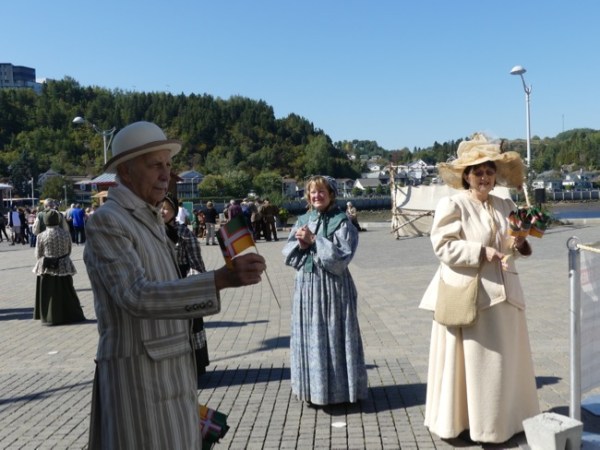
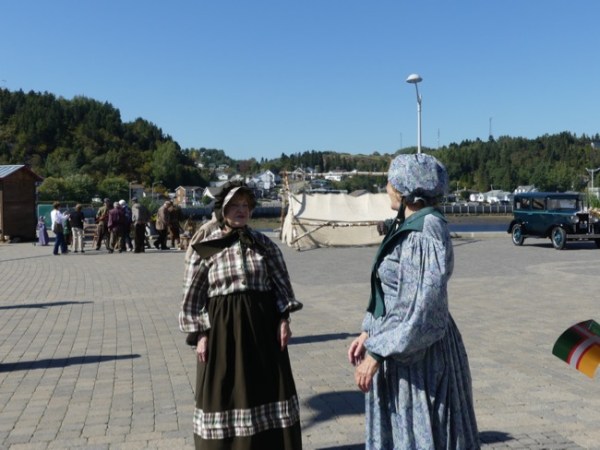
We are blown away by the Saguenay welcome. We have been told these are all volunteers, they dress in old time costumes and greet the arriving passengers with welcomes, photos, flags, free little blueberry juices, free blueberry pie, a small musical group playing local music – oh, it is a total party on the dock! Many of them don’t speak English, but they understand my French and I feel terrific. They understand my French! I’ve lost so much because I so rarely get an opportunity to use it, but the fluency comes back and I feel exhilarated.
Here is the man handing out Saguenay flags to all arrivals. AdventureMan tells me that the green signifies forestry and wildlife, the yellow is for agriculture which is a mainstay of their economy and he can’t remember what the silver stands for; you would think it is white, but it is really silver and as it is the cross, he believes it has to do with faith.
These people are so much fun, and are having such a great time. So are we!
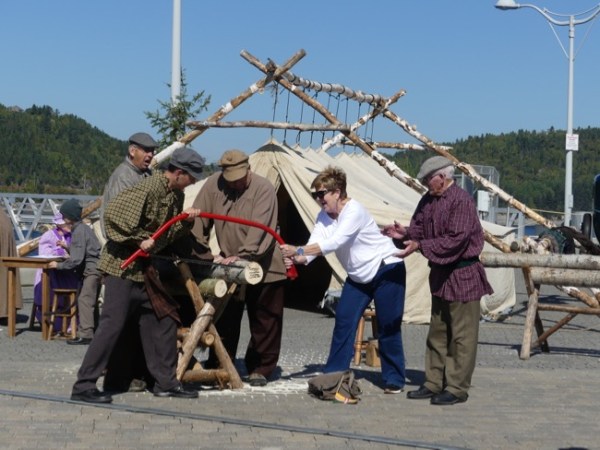
They get one of the passengers to try the saw – it’s harder than it looks!
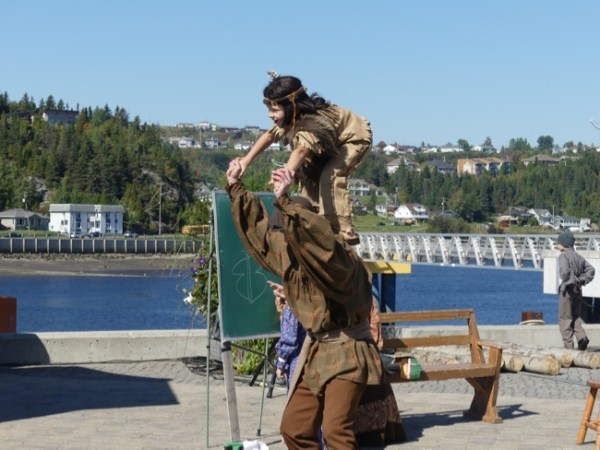
This man was flipping his son all around, and they were both really having fun with this local greeting party.
Yes! Yes! a “bluet” is a blueberry! I have a new word in my French vocabulary!
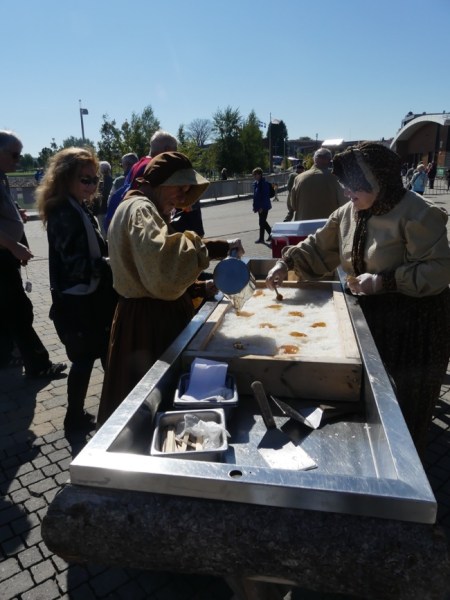
They are making natural maple sugar candy here, on a bed of ice, and giving it out. I get to show our grandson this; we were reading that American children’s classic, “Little House on the Prairie” and the author, Laura Ingalls Wilder described perfectly how this is done.
You know what I love about this? This is pure generosity of spirit. There really isn’t that much going on in Saguenay that would make it a draw, but these good people with their slices of blueberry pie, their costumes, their music, and their warm welcome, have created something worth traveling to see. They have their heritage. They are proud of it, and they are happy to share it with visitors. It’s just all win-win.
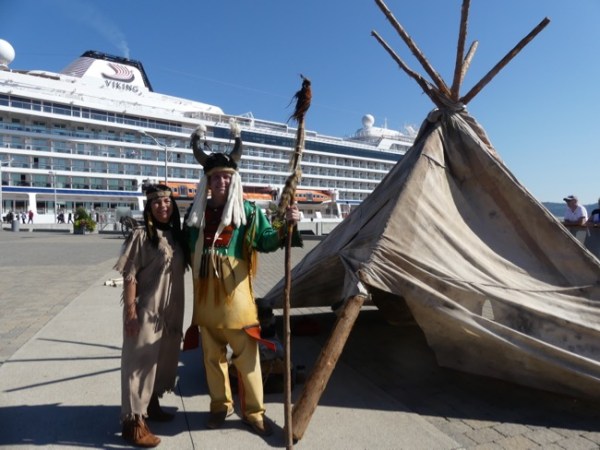
I love the juxtaposition here, the First Nation representatives against the background of the Viking invaders 😉
We asked one of the guides if they could recommend a good restaurant and they recommended one I had seen on TripAdvisor, just a short walk down the bicycle path. And Big Bravo for AdventureMan, the person I asked didn’t speak English, and we were trying to find the bicycle path and AdventureMan remembered “piste” from when we lived in Tunisia, and as soon as he said it, the person’s face lit up and he pointed us in the right direction.
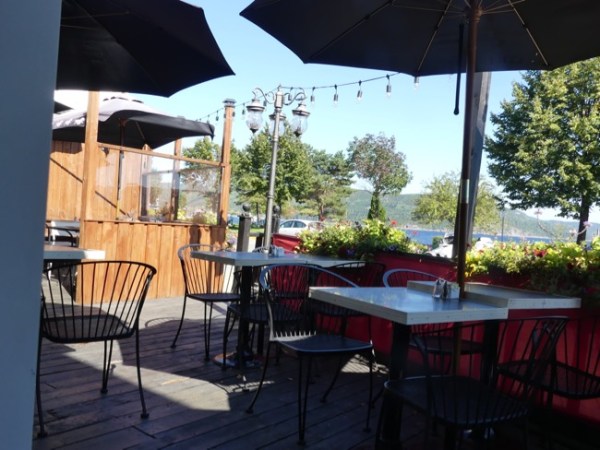
It’s a perfect day. I am in short sleeves; temperatures are in the 70’s F. and the local young folk are in short shorts, halter tops and summer dresses. It is probably a wonderful late summer day to them. We dine outside at La Grange aux Hiboux.
It reminds us of places we used to eat lunch when we would get up early early on cold mornings to go to the big flea market in Metz.
We took the long way back to the ship, and passed this church.
I have to tell you something funny. Or at least it strikes me funny; I guess there are times when I am still silly and seven years old in my heart. The bay that Saguenay is situated along is called the Bay of Ha! Ha! There is a hop-on hop-off bus for cruise passengers, called, the Ho Ho. The HoHo is right next to the Bay of Ha! Ha!
Well, I think it is funny.
What I love, too, about Viking is their willingness to accommodate religious observances. (Did I already say this?) Tonight they are having a special dinner for those celebrating Rosh Hoshhana. How cool is that?
AdventureMan went to bed as soon as we got back from the spa; he had been chilled and had warmed up in the hot pool and sauna, but he was tired – and sick.
The night before he had been fine. We had gone to dinner with a couple we met at breakfast in Oslo, the day we were all traveling to Bergen. Within three minutes we had a lot in common – as happens in Expat world. They have been to many wonderful places overseas in their academic careers, and especially loved their time in Beirut, Damascus and a wonderful wedding in Amman, Jordan.
How often do you come across people like that? How do you find out so quickly those shared points of enthusiasm?
At dinner, it was more of the same; there are some people that no matter how many topics come up, you know there are still so many to cover.
And they remind me very much of a couple we met last year on Empires of the Mediterranean, outside the Archaeology Museum in Zadar. None of us could believe that there was NO mention of this fabulous museum in the Port Talk or in the City Tours. One thing led to another, but you know me – all roads lead to books. We are still in touch with this couple; she and I are active in book clubs and avid in our e-mails about our latest finds. They are coming to visit us next month!
It’s the same with our new friends from Las Cruces, they are widely read and have a wide range of interests. We laugh a lot. We can’t stop talking.
But the next morning, as we went into L’Anse Aux Meadows, Adventureman said he was tired, and he was coughing a lot, and he had a headache. He slept and slept, only getting up for a little soup at dinner, then going right back to bed.
Today is a day at sea, and started out a little bleak.
I went upstairs to the Explorer Lounge, my favorite quiet place, and had my oatmeal with blueberries and raspberries. Around nine, I went down to the spa pool, and, for a while, had it all to myself. I came back to the room to spend some time with AdventureMan, but when he is sick all my suggestions (“do you think you might want to see the doctor? Can I make you some mint tea?”) just annoy him, so I am quiet until we go to lunch. After lunch, I go back upstairs to read and to leave him in peace, coming back to the room for a couple hours, then heading out for a lecture on the Bayeux Tapestry. The weather has greatly improved, and way way off in the distance, we can even see land.
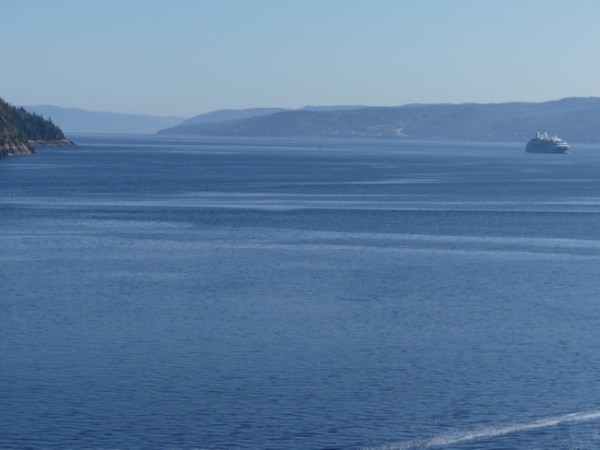
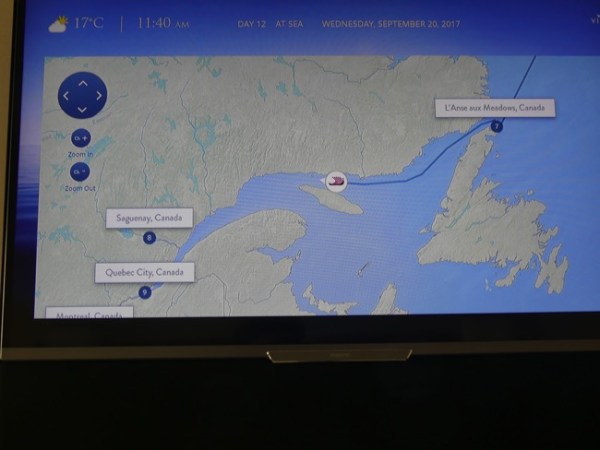
On our way to Saguenay on the Saint Lawrence River:
Look at this beautiful weather! It hit 70 degrees F. today, first time we have seen a temperature like that since leaving Pensacola. I am taking it as an omen that AdventureMan is about to make a rapid and full recovery so he can enjoy the end of the trip with me.
At the lecture about the Bayeux Tapestry, our Las Cruces friend asked if I had written about them in my blog, and said he was trying to find it. Aargh. You know, I don’t talk about the blog, in Pensacola maybe one person other that AdventureMan and our son even know about it. I have my faithful friends from Doha and Kuwait who keep up with me here, but honestly, who else really cares? There are so many blogs about exciting things like politics and sex and fashion and they get millions of visitors. I am just trying to remember places I have been and events and experiences, sometimes I am just thinking out loud, or venting therapeutically, and some of you are kind enough to come along for the ride. I am humbled, and thankful, that you are still there.
We have a wake-up call for six o’clock; we are on the first tender headed into L’anse Aux Meadows and we are excited. Who wouldn’t be; just look at this gorgeous morning sky to greet us. I’m good with drama if it is a morning or evening sky.
We wait a long time to get clearance; there is one other boat in town, and it is the National Geographic Explorer. Canadian Customs officials have to go through our paperwork and interview a select few face-to-face. Our 0700 departure is more like 0830.
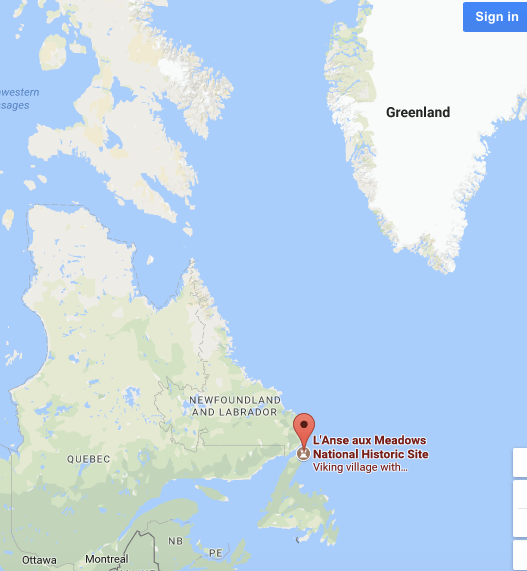
No rain, so we are thankful, because rain is predicted. We are hoping it will hold off until we have visited the L’anse Aux Meadows Viking Site. Or is it a Native American Camp? For many long years it was believed to be Native American, but a team of archaeologists did a re-look and determined it may well have been an early Norse settlement.
The people in L’anse Aux Meadows go all out to make this interesting for their visitors. They dress in Viking costume to welcome us, and the site we visit has people who are “in character” telling us about their challenging lives in the early settlement, which only lasted maybe ten years.
Below is the woman who organized the buses:
A beautiful statue of the Vikings reaching the new world:
Statue detail of the ship:
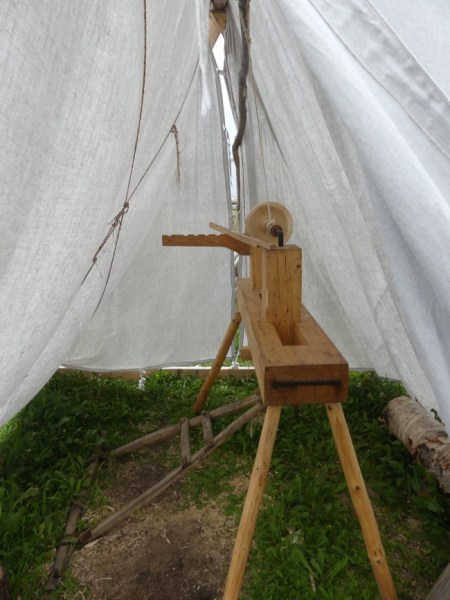
There are a series of rooms built together, covered with sod. At one end is an outbuilding with a lathe. This may be someone’s imagination rather than something they really found, like they may have found evidence of an out-building and someone thought “oh it might have been a place where people worked wood, which Vikings did, a lot.”
These character actors really enjoy playing their roles. They were a hardy lot, and they work hard.
Decoration on entry to middle of houses:
Outside view of houses:
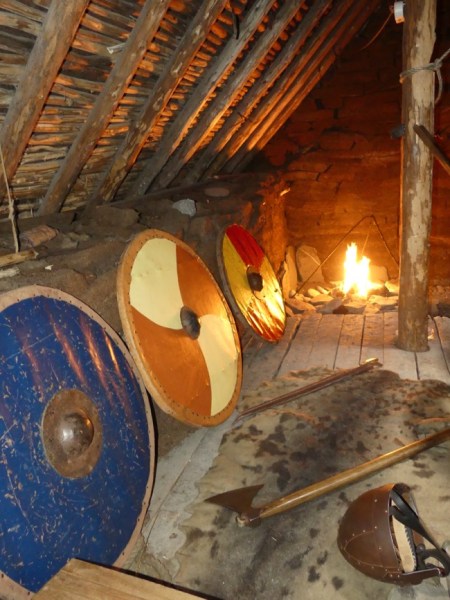
To the far end of the connected rooms is a multiple bedroom, with kinds of clothing they might have worn. The beds are small, the mattresses thin. It would appear this might be where a family might live, or a father keep his unmarried daughters, as it looks like the next room, much larger, is more of a lodge room where unattached men might sleep along the side of rooms or on the floor near the fire.
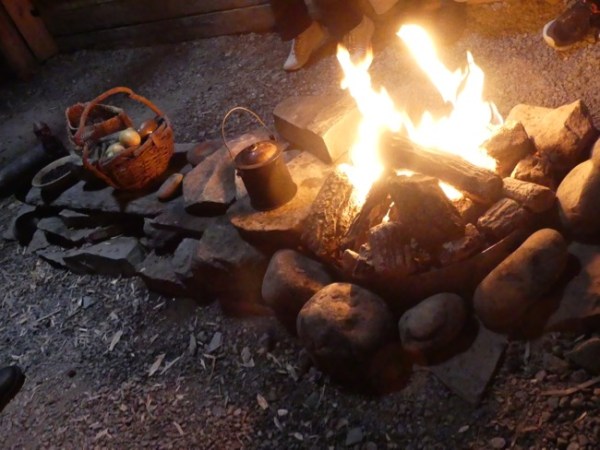
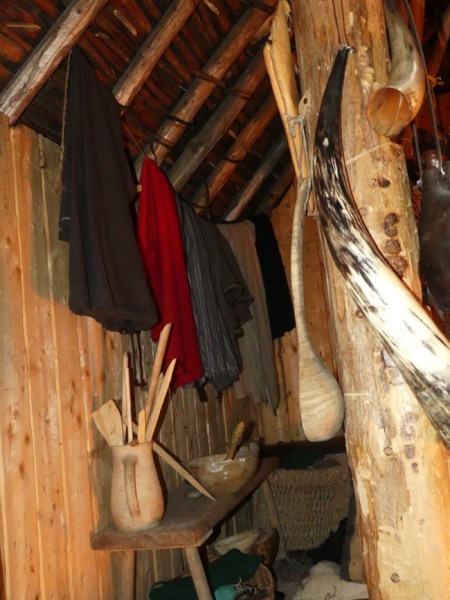
More clothing, and cooking tools. Sigh. I am guessing mostly women did the cooking, and that those are women’s clothes, and the corner where they speculate women might have worked preparing meals.
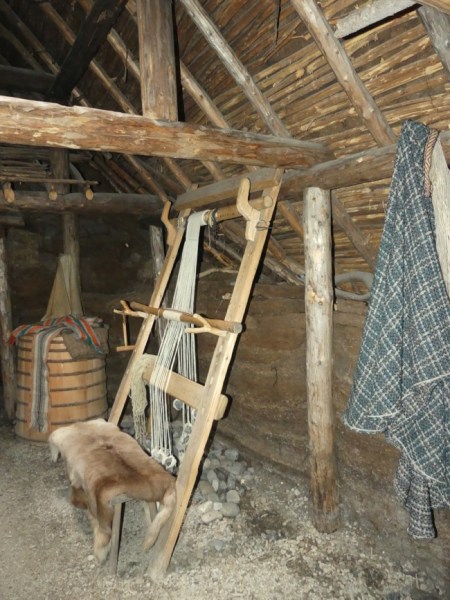
I love the room at the far end. I bet some old woman lived there, some old woman who loved fabrics and colors and textures, who would shear the sheep and clean and comb the wool, card the wool and make it into yarn, or thin threads that could be woven into serviceable clothing.
And I am speculating that old woman slept in this chaste little bed among all the supplies for spinning and weaving the wool into yarn and fabrics to clothe the inhabitants. Maybe she even made warm blankets 🙂
Outside the far end of the long house, with an opening for smoke to escape, and light to come in.
This was a forge. What it seems they might have made there was nails, using the most primitive tools and techniques.
We walked back to the center, where we were told to catch the bus, but we are told no, go to this bus-gathering place. Our meet-up seems to have been scheduled about the same time as the National Geographic Explorer meet-up, as their buses are there and . . . ours are not. It is starting to rain.
We wait a long time, and then our bus comes, to take us to another stop, a sort of re-creation of someone’s idea what things may have been like. AdventureMan and I look at each other. He is really tired. He wants to go back to the ship. When the others get off, we stay on, and one other couple asks if the bus can take us to the ship. More and more people figure out that this bus might be going back to the ship, and hop on.
It is really raining now. A tender has just arrived, and a lot of people get off, more people than I would have thought possible. We get on. I learn that a tender can hold a total of 234 people. We head back to the ship. On our way to the elevator, we ask the spa lady if the spa pool is open and she says “YES!” We run upstairs and take off all our clothes and jump into our swim clothes and head down to the hot pool. There is no one else there, just us, rolling around, warming our chilled bodies in the relaxing hot pool and the “ya-kut-zee.” We have a quick lunch, AdventureMan sacks out, and the ship is making rumbles like we are leaving L’anse aux Meadows any minute now. Life is sweet, or as the Captain ends all of his daily announcements from the bridge – All is Well.
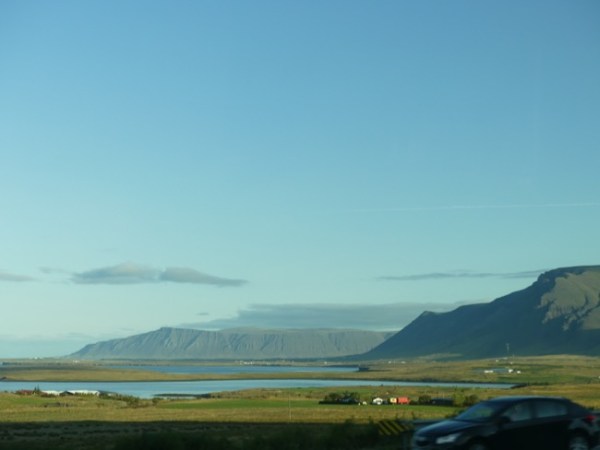
We can’t believe our good luck, after the clouds and rain in Oslo, Bergen and being shut out of Lerwick, here we are in Iceland, and the weather is PERFECT. Perfect, that is, if you are an Alaska girl who loves to chill 😉 as AdventureMan debates whether or not he needs to wear his long underwear to keep warm.
The cruise director, Aaron Syfert, has told all of us, his cruise-children, to dress “like onions,” in layers, so that we can dress down if possible, and be warm enough when it is really cold. As we enter the bus, we have three or four layers; within minutes, there is a loud outcry from those aboard “Please turn down the heat!” In our full-up onion garb, it is really hot. The driver laughs and said he had wanted us to be warm enough, and turns down the heat until everyone is happy.
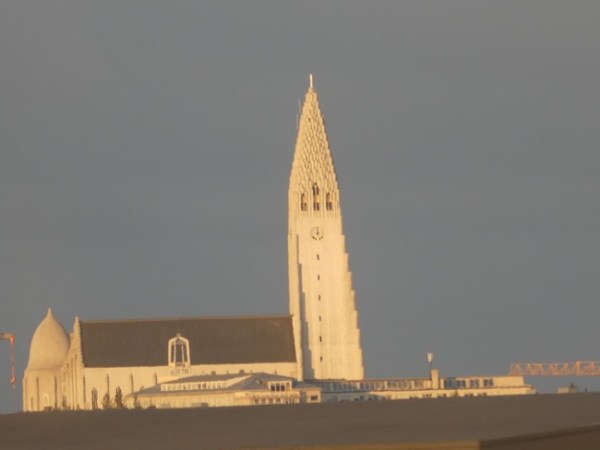
We drive through part of Reykjavik en route to our first stop, and the place I have wanted to see the most, Thingviller.
I have a thing about sacred spots, that it seems to me that there are some places in the world where the interface between this world and . . . the next? . . . the former? . . . .the alternate? . . . the interface is thin and perhaps not open, but permeable. Thingviller is a very very old place, a place where all those spread out in rural Iceland would gather to made decisions for the community. It was one of the most ancient forms of democracy, or democracy of a sort, of course it was mostly chieftains making the decisions, advised by their counsel, and while those decision makers were probably mostly men, they made decisions by consensus, and vote, for the greater good of the community.
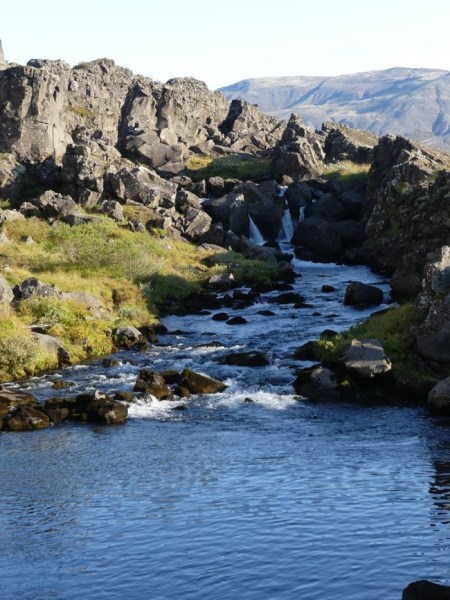
Some of the decisions they reached would chill you. You will see a waterfall, below, by which there is a pond where violates of the law were drowned. Our guide tells us that most of them were women who had children out of wedlock. “What happened to the men?” one guest asked. “They were beheaded, if they could be found, if they could be identified,” she replied. She added that most of the time, the women went to their death without identifying the man who had impregnated her.
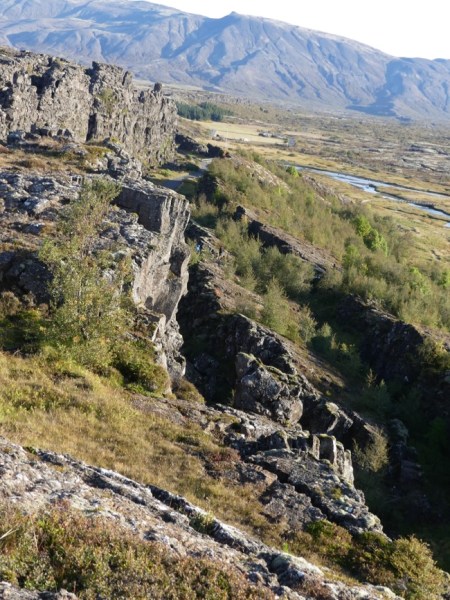
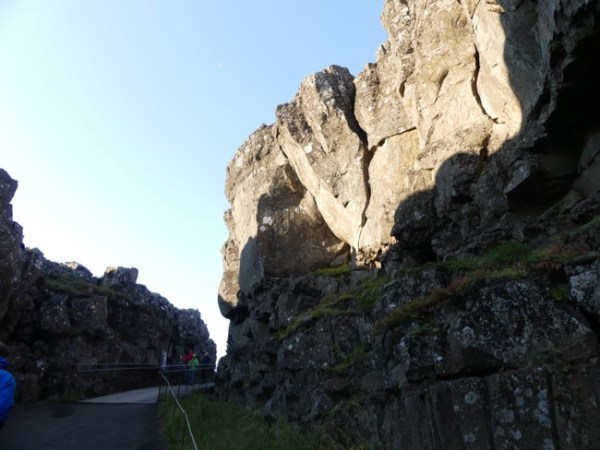
Geologically, Thingviller is fascinating. Thingviller is a huge rift between two tectonic plates, the North American Plate and the Euro/Asian Plate. I had known of “The Thing” the Viking Thing, about the decision making places, but it wasn’t until Digg, or one of the other news sourcing articles I get told me in some spectacular photos from around the world, that I knew about the rift. There were photos underwater, photos of daring young divers with one hand and foot on the North American Plate and the other on the EuroAsian Plate, truly spectacular. I wanted to visit the decision making place, and I wanted to visit the rift.
Last – and not least – Thingviller is one of the locations where Game of Thrones is shot, many of the scenes north of The Wall and of The Wall are shot here. It gives us a thrill, first Spain and the Alcazar and Alhambra, then Dubrovnik, and now Iceland, we are on a roll.
We had a great day, a truly great day, and the weather held. For me, Thingviller was worth the trip to Iceland.
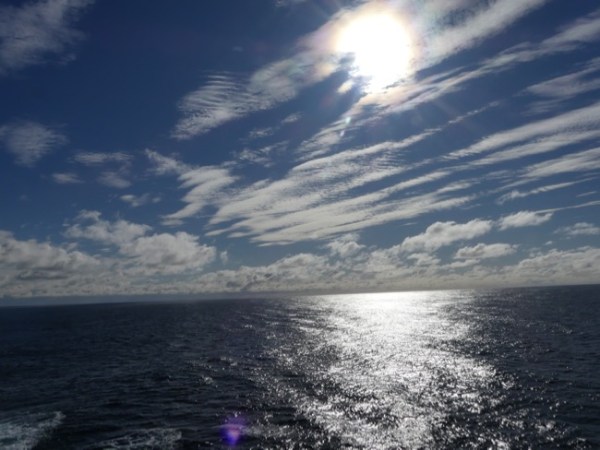
It’s party time aboard the Viking Sea, with gentle seas and blue skies and a whole load of sunshine:
One of the fun parts of this trip is that every other day or so, we gain another hour, so we often get to sleep in an hour “extra” in the morning. Even after sleeping our extra hour, we were up bright and shiny, had our breakfast, and I suited up and hit to pool when it opened, at 0800.
Except . . . it wasn’t opened. I was still mostly emptied, and closed. The jacuzzi was open (or as the spa manager calls it, the ya-kut-zi) and I spent about ten minutes there, but for me jacuzzis aren’t that fun, I really loved how the waves rolled and roiled as the ship tosses from side to side, and fore and aft. It did, however, give me time to update the blog.
AdventureMan and I laugh; we spend money to have a nice room and we spend time reading. We could do that at home, but at home, there are so many things demanding our attention. We are willing – even eager – to have this time with no responsibilities, no cooking, no cleaning, no yard work. There is some guilt associated with the luxury of having this kind of time, especially when the hurricanes have devastated to many to the east of us, and to the west of us. It’s almost primal; if we enjoy ourselves too much are we inviting destruction?
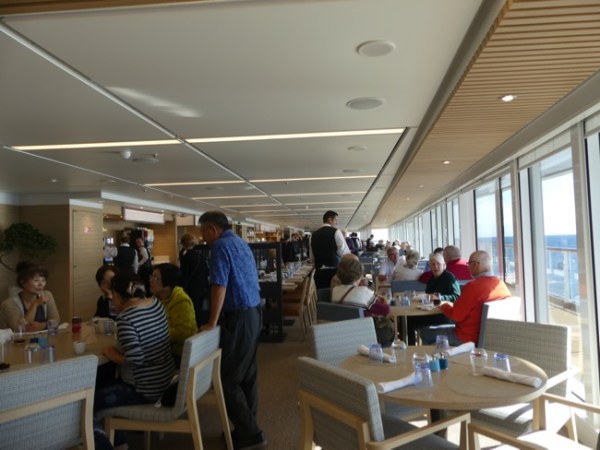
When we get hungry, later than usual because of the time change, we discover that with everyone on board, no tours, no lunches in a local city, everyone using the same facilities, that the facilities are more crowded than usual. The World Cafe, where we take most of our meals, is packed. We head for the Pool Cafe, which we also like, but there is a loud rock band entertaining the lunchers, and people have even found our hidden favorite places near the WinterGarden.
Below is the World Cafe, where we tend to eat. There are other restaurants, an Italian restaurant, Manfredi’s, the Chef’s Table, where a specialty menu is paired with wines, and another called The Restaurant.
AdventureMan and I are odd. We have preferences, and our preferences are strong enough to prevent us from eating often in the other restaurants. We really like Italian food, and we have eaten at Manfredi’s, where we found the tables too close together for our comfort; we could hear every word of conversations in every directions, and we felt shy about having our own conversations which could be overheard. We also asked for small portions, and were told that the plates come as they come; they didn’t split, they couldn’t give small portions, but that we would love it so much we would want to eat it all. I hope my face didn’t show how aghast I was at that response.
We had similar problems with The Restaurant. Seats too close together, no privacy, and the service is SO SO SLOW. I can manage an hour, even an hour in a half without getting too antsy, but at some point attention deficit kicks in and all I can think is “get me out of here!” Too much eating! The Chef’s Table does a lot with foam and freezing and precious tiny portions of things I can barely taste, as well as having close seating and pretentious presentation. Actually, that is too harsh, I am a fan of presentation, it is this style that annoys me and you might like it just fine. You might like more leisurely meals, and be fine with two to two and a half hours of sitting, but I am a restless sort, so as fine as some of the food may be, I like the World Cafe.
It would be awful to be married to someone whose style was different from your own. Lucky for me, AdventureMan is a lot like me. We really LIKE good food (you couldn’t guess 😉 reading this blog?) In the World Cafe, I can tell the man I would like a small portion of the risotto, and I get a small portion. Or if I want to make a dinner of mushroom soup, I can go back for more. We have found the horseradish, the tabasco sauce, the red pepper flakes, the balsamic vinegar, the things we need to enhance the blander foods. We are up and down, soup, salad, maybe a little main course – or maybe not. We like having choices, and I even like being able to get up and walk around to get what I want next. All that walking helps me justify a small bowl of ice cream, or even maybe a small fudge brownie. All the desserts are tiny, which I like a lot. They also have smaller plates and larger plates; we stick to the smaller plates.
It’s not that we are so virtuous; it must be an age group thing. The ship is full of our demographic, and most are eating healthily.
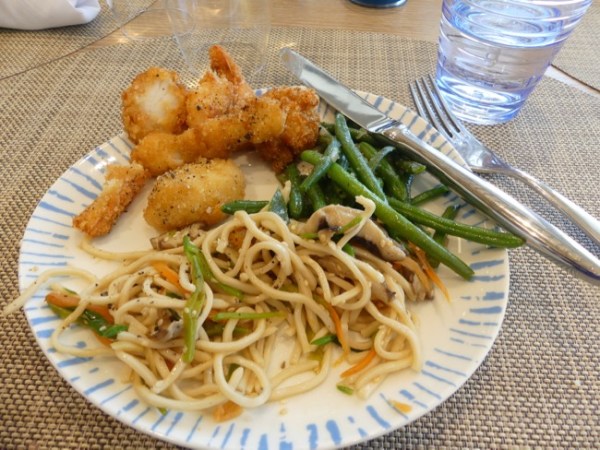
This was my lunch on the Sea-Day-En-Route-to-Reykjavik – fritto misto, green beans, and a soba noodle salad which tasted of sesame, divine combination.
With the glorious sunshine, there is a party atmosphere on board, a huge group playing Trivia in the Explorer’s Lounge, the bridge players all down in the Chef’s Table, lectures in the Star Theatre, movies – so much going on!
My thrill – I had just washed my hair and was dressing when I saw a spout. I know that spout! That is whale! I quickly finished dressing and went out on the balcony, where I happily spent an hour or two taking photos where the whale had just been. Finally I got the one photo showing a spout as it was just finishing. I quit taking photos and just enjoyed the sunshine and the frolicking whales; one was flicking his tail after spouting.
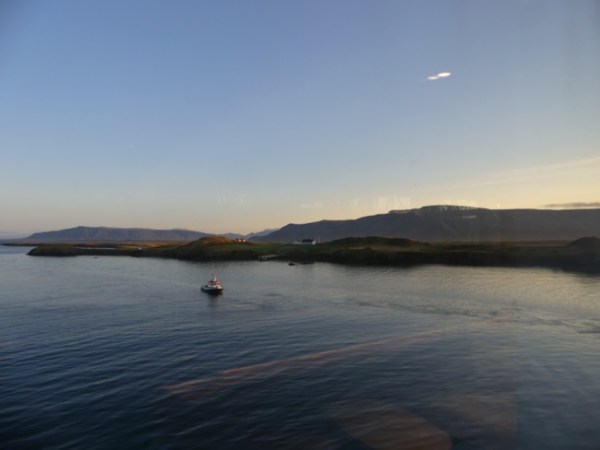
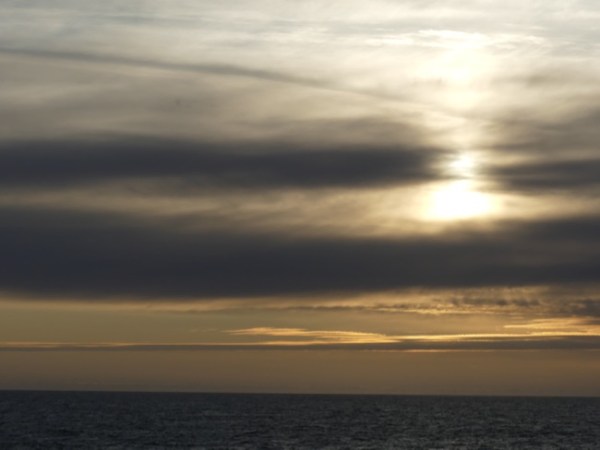
The day ends with a beautiful sunset. We are nearing Reykjavik, and can’t wait to visit this beautiful, dramatic land.
We can’t say enough good things about the Viking business model, and we are critical travelers. We headed out on a tour this morning, we who are not good at touring in groups, and had to give our admiration to the facility with which Viking gets large numbers of people on the ground and going out and learning something. When you book a cruise, there are always “included” tours, included means you don’t pay extra. The included tours are usually overviews, often panoramic, i.e. you get in a bus and drive and stop now and then for a photo. Everyone who wants a tour gets a tour.
Having lived overseas most of our married life, we know that it is so much easier to stay comfortable than to go out and see something and learn something. About 10% of people will make it happen for themselves, another 80% will go if it is made easy enough, and 10% will never go. In the Embassies, that 10% will hang out at the American Club or the Marine Bar, and if military, shop almost exclusively at the PX (BX, Navy Exchange) and commissary.
Viking makes it easy. The night before we reach a port, there is a Port Talk, where the local currency is explained, a few good phrases (usually like “good morning” and “thank you”) taught, and photos and videos (all very full of sunshine) are shown to give you an idea what to expect. The daily newsletter always tells you how to say “Please take me back to my ship” in the appropriate language. Buses show up on time. There are enough guides for all the passengers. The guides have the patience of Job.
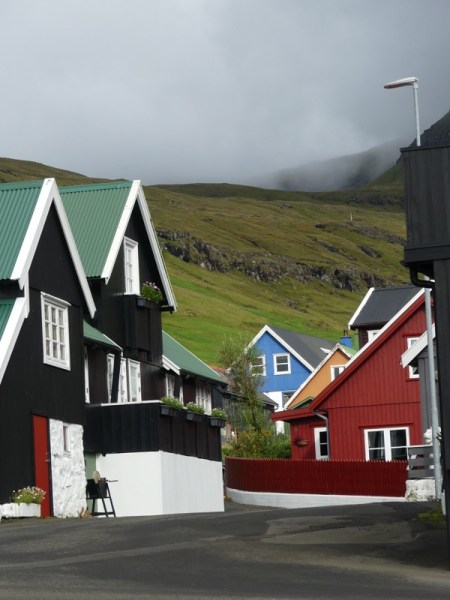
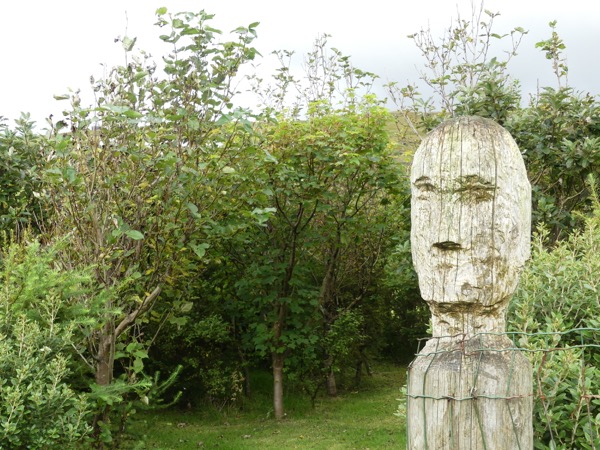
Our guide for Vistas, Vikings, and Village Woodturner was very very good. I don’t really know that I learned a lot about Vikings. Really, Vikings raided a little, intermarried a little, and are just a part of the history of the Faroes, the way Angles and Picts and the Norse are a part of the English. We had a very good guide, a funny man who often broke into song, and who has probably attended to more tourists than is good for him.
There were sheep everywhere, including sleeping alongside the road. Drivers are all very careful, because if you hurt a sheep, you pay the owner like $500. for his loss. The sheep were every color from white to brown, and black, and spotted white and brown and black. If I lived in the Faeroe Islands I would learn to sheer and card sheep wool, and spend evenings spinning the raw wool into threads for weaving into cloth and yarns. I’ve always wanted to learn to spin. LOL, too late to be a spinster 😉
What do I think is a good guide? This man told us a lot about life on the Faroes, about choices people make. Do they want to be a part of Denmark or not? It would require an election, and people can figure about half want one thing and half want another, and no matter who won, it would be narrow and cause turmoil, so why spend all that money on an election, just leave things as they are.
We head to the village of Kvivik to see the Viking longboat remains, or where they once were, and then to Leynar to visit the Village Woodman.
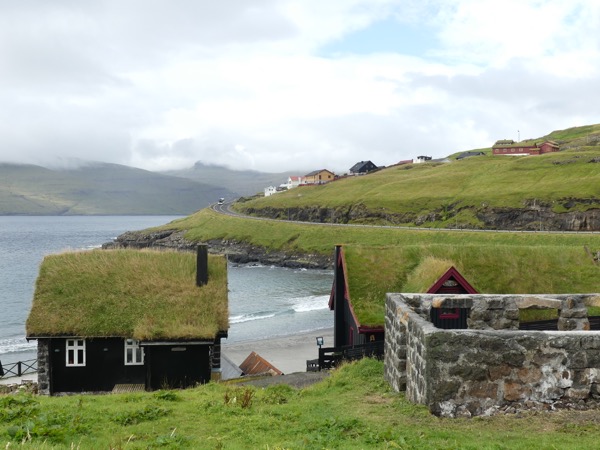
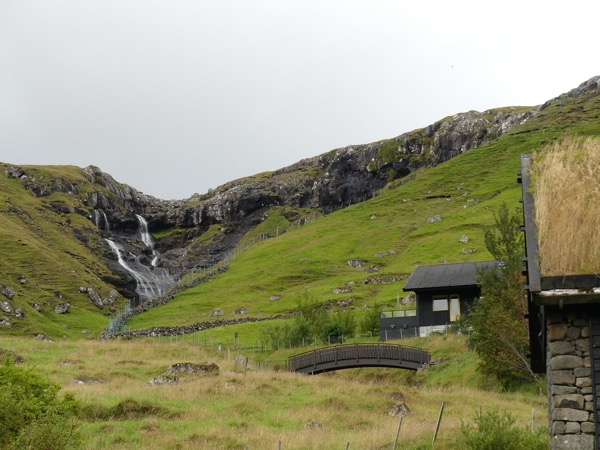
Below are stone built salmon jumps, old technology, but with devices which keep count of each salmon who climbed the steps, new technology. Can you see how green and lovely everything is, evan as fall approaches?
Drama Drama Drama! Who could be bored when the weather changes every minute with such verve and gusto?
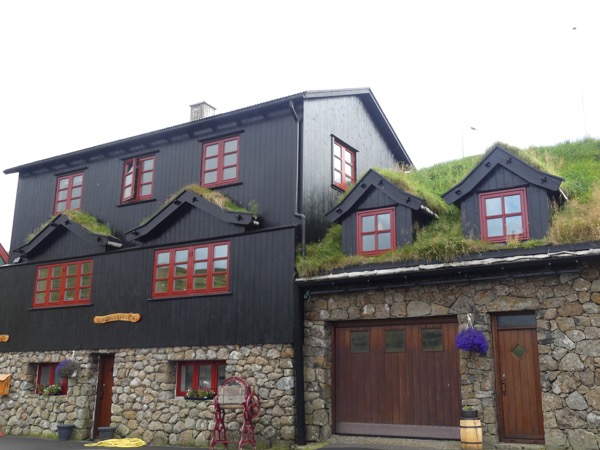
We are always interested in how people choose to live. Our guide explains that houses often contain three generations, the grandmother, the mother, and the daughter. Isn’t that an interesting way to describe it? We tend to think in male-ownership terms, but these houses are communal based on matrilineal lines.
I wonder where daughters-in-law fit in?
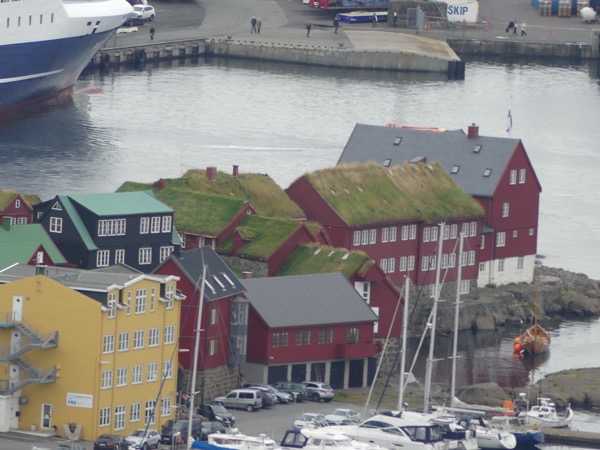
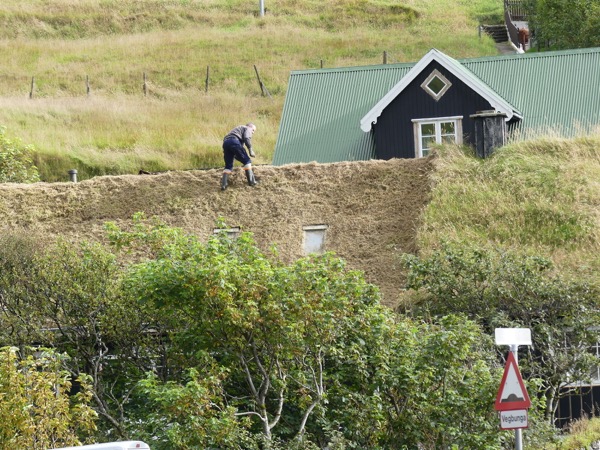
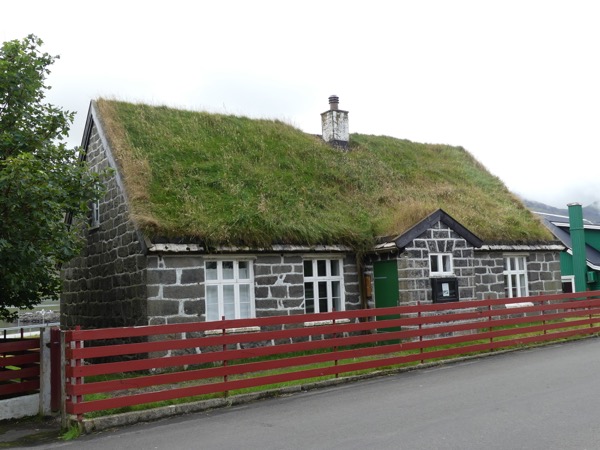
Look closely here, a man is up on his turf roof, trimming things down for the winter.
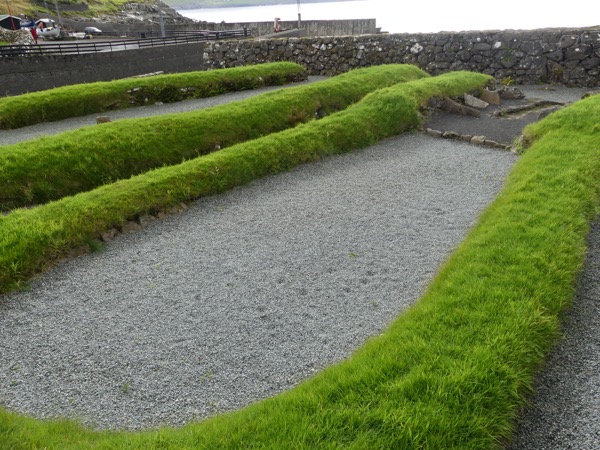
Viking longboat site
They teach their children three important rules. 1. Be kind. 2. Be kind. 3. When one and two fail, be kind.
He told us how houses are built, and how people help one another get their houses built. They are taught “better that many are not poor than that a few are rich.” We did not see a single dump any where in our journey took us; everything was clean and well-kept. People are fined heavily for dropping trash. There are only two policemen in the Faroes, and there is no prison, there is so little crime. “Where would you run? Where would you hide?” he asks. “Everyone would know you, so you don’t do it.”
He told us that many of the families of the Faroes were started by Norsemen who found local girls and were afraid to go home and face their wives, who were waiting for them with big sticks. He made us laugh, and laughter always helps us understand.
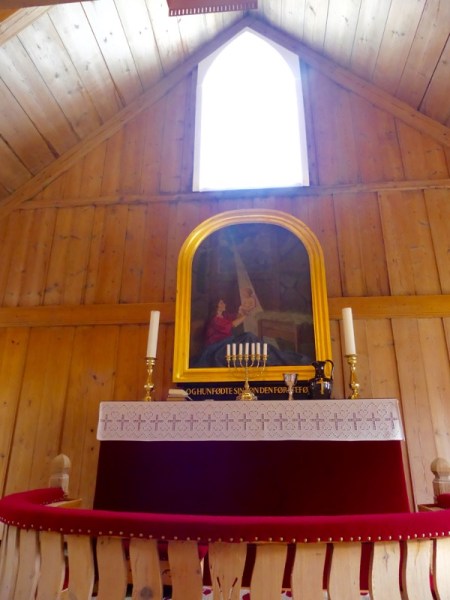
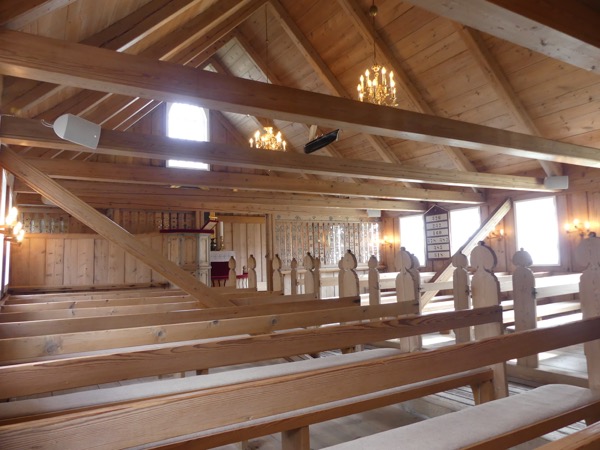
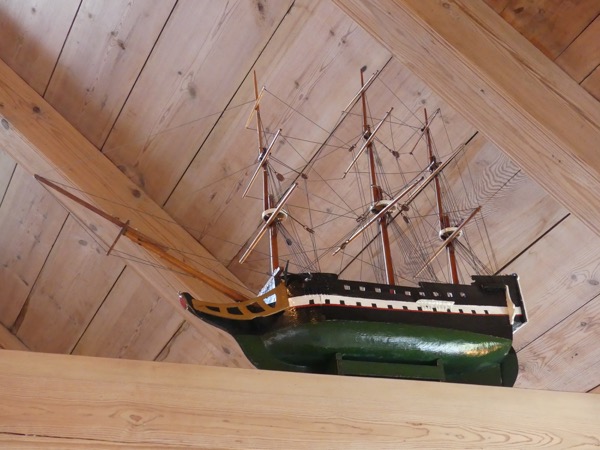
He took us into a beautiful little church, beautiful finished wood on the inside (see below) and he sang to us a familiar hymn, in Faraoese, Nearer My God to Thee. It was so sweet, and so beautiful, my eyes teared. He told us he waited 30 years to get married, and was the first one to wed once the Danish stopped insisting on state churches. (The church is now Lutheran.)
The Faero Islands reminds me of where I grew up, in Alaska, where neighbors held that same kind of concern for one another and for the communal life. We lived on an island full of Scandinavian immigrant families, along with the native Haida, Aleut, Tlingket, and occasional Inuit. It never mattered that we differed, when someone needed help, we helped. A neighbor didn’t go hungry, their children didn’t go unclothed. I remember the delight when our neighbor passed along her daughter’s lightly used clothing they had outgrown, and we could wear it. I remember one skirt in particular, a grey and yellow plaid Pendleton skirt which I wore for years, and maybe fifteen years later my old neighbor saw me wear it and said “I used to have a skirt just like that!” and I laughed and said “This is your skirt!” When you have a Pendleton skirt, you can wear it for the rest of your life; they wear so well. We were frugal people, and we never wanted for anything. We shared what we had.
I got the impression that actually the guide doesn’t much like Americans. It didn’t matter, he was kind, he was professional, and I believe he gave a great value for the money. He shared the truth of his culture as he lives it and was fair to us. That’s good enough.
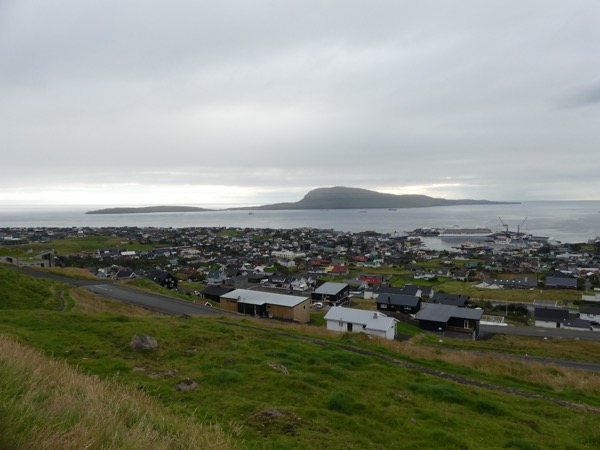
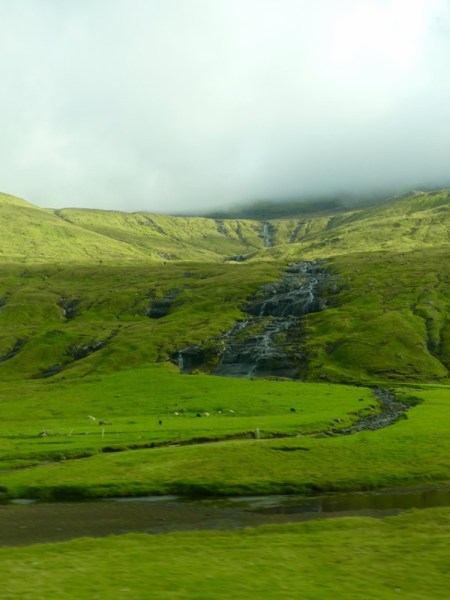
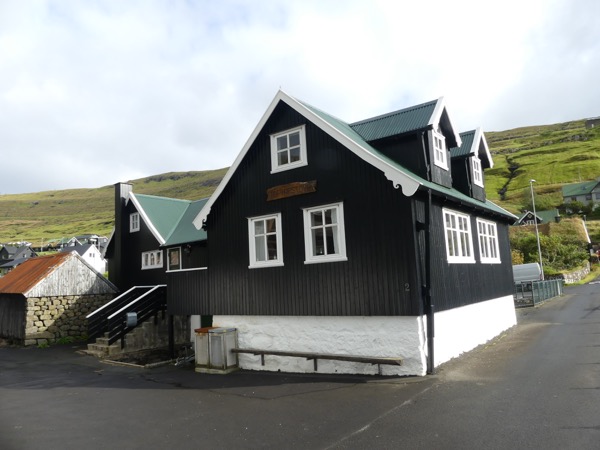
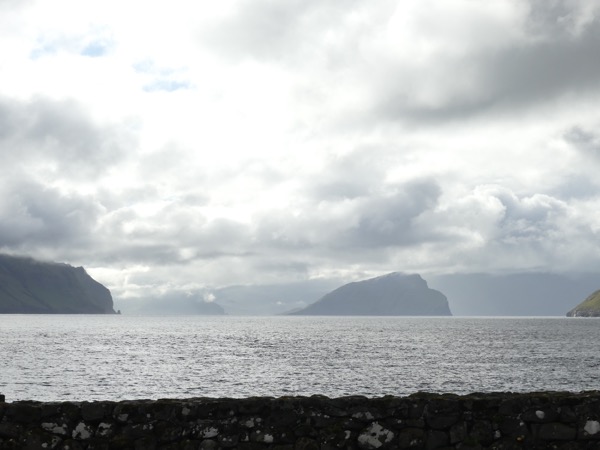
I can’t give you a lot of information about the photos, only that I took what I thought would give you an idea of what life on the Faroe Islands might look like. For me, this was a great day, very little rain, even some sunshine, and I learned about a culture I really like. I like that they teach their children: Be Kind. Be Kind. Be Kind.
I have a dear friend I met on a previous Viking Trip. We met outside a museum of Archaeology in Zadar, and we were astounded, watching the Viking Tours go by and not one mention of this really good museum for the bargain price of 4 Euro.
Every time we saw one another, we had very quick but high quality conversations. It might be we’d pass at a restaurant in Dubrovnik, and they would tell us about a purchase and we would tell them about a cauldron of mussels. It might be in a quiet corner outside the WinterGarden. Even aboard ship, we led very different lives, but have developed a lively friendship via correspondence, greatly about books and politics and efforts to create a better world.
We laugh at how different we are. I told her about yesterday, the rolling waves and going to the spa and laughing as we rolled around in the hot pool, the waves sloshing back and forth and front to back. She wrote back that not only does she not believe she will ever see her husband in a spa, but that he would also be “knee-walking sick” in those “rollicking” waves. She makes me laugh, and I make her laugh, and part of our friendship is respecting our differences.
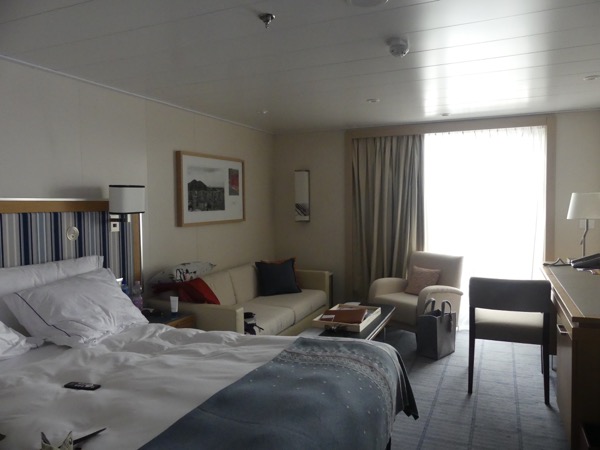
So my favorite parts of the ship may not be your favorite parts of the Viking Sky. I am an introvert. I would rather pay more for a room, and spend time there, than in most of the public spaces, no matter how lovely they are, and the Viking Sky truly has many lovely and serene spaces.
Here are mine: the room
The spa:
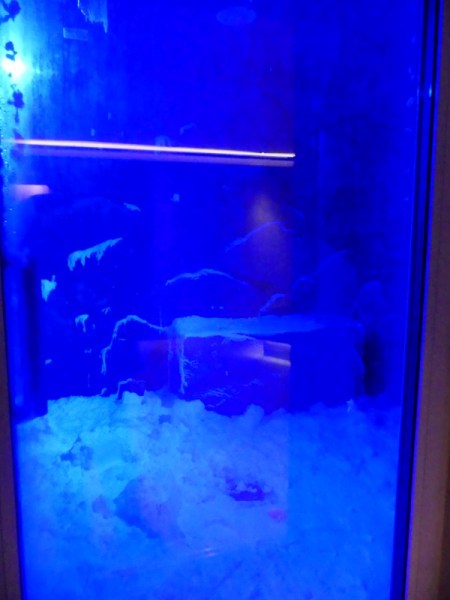
Below is the snow room; there really is snow underfoot and snow falling, you go there after the wonderful hot pool
The wonderful hot pool, above
Where you rest before you go back to real life again 😉
A quiet corner just outside the Winter Garden
I would have also taken a couple photos in the Explorer’s Lounge, but . . . it was full of people! On our last cruise, it was rarely full, not even close, only some people would come, for Mamsen’s, for the view, for the quiet and privacy. When the bar is open, it is more crowded and noisier. You can see photos of the Explorer’s Lounge from our last trip, on the Viking Sea.
If this is your first time visiting this blog, there are things you don’t know yet. One important thing would be that AdventureMan and I love to travel, and the other is that we are very independent. We are pretty awful about tours. We aren’t very good at following with a crowd, we sort of break off, and often disappear altogether. I have pity for the tour guides who get us; they have a job to do and we are not compliant. We ARE good at keeping the guide informed, like when we are dropping off, and assuring them that we will be able to meet up with them elsewhere.
Having said that, this tour of Oslo was very thorough. Much of it was “panoramic” which is travel industry code for drive-them-around-in-a-bus-and-show-them-things, stop-a-couple-times-to-let-them-take-photos. It did that. What I liked was that the guide really knew her stuff, and gave us a lot of cultural information, a lot of local lore along with the “this is the parliament building” kind of information. We got a lot of information, buildings, institutions, and we also got a lot of information about how the locals live and how the locals view things.
As we drove through posh neighborhoods, the guide told us about how the housing costs in Oslo have forced most Norwegians out of the city; that old buildings and new have spaces rented by foreigners and corporations. For the same price as a small apartment, Norwegians can buy a house out of town. The commute is horrible, but many get up at five and are at their desks by seven to avoid the traffic.
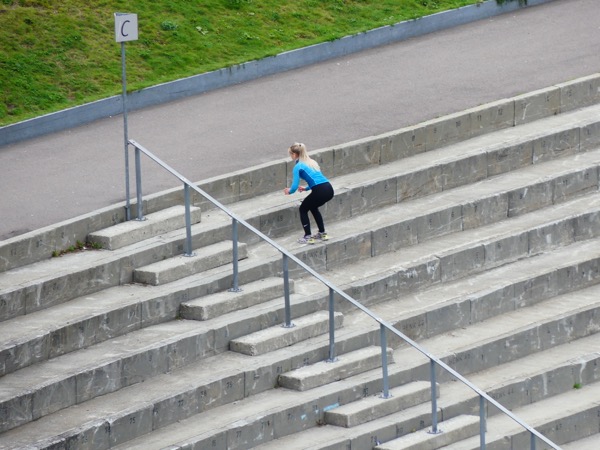
She took us to see a famous ski-jump. Now this is one of those things I would have said “I don’t care,” but when I got there, I could see that it was like a DESIGNER ski-jump, curvy and futuristic looking. I also loved it that there were kids roller-skiing (roller-skiing ? ! ?) and adults doing all kinds of fitness running, jumping – it has become a space where people go for exercise and experiencing the outdoors.
I have to stop a minute here – look at the design of this ski-jump. Is that not thrilling, so perfectly functional and so simply beautiful?
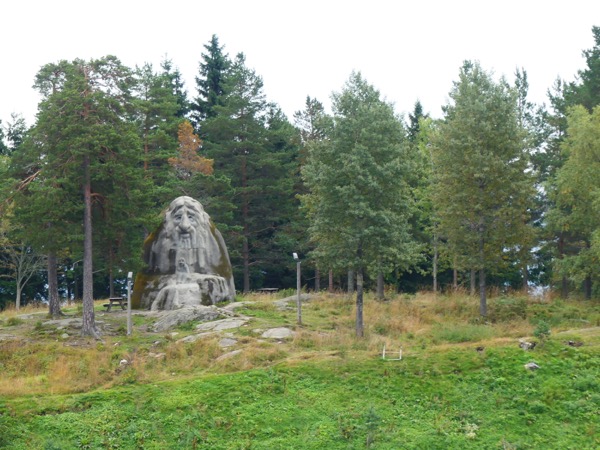
At the foot of the ski jump is a forest troll – can you spot him?
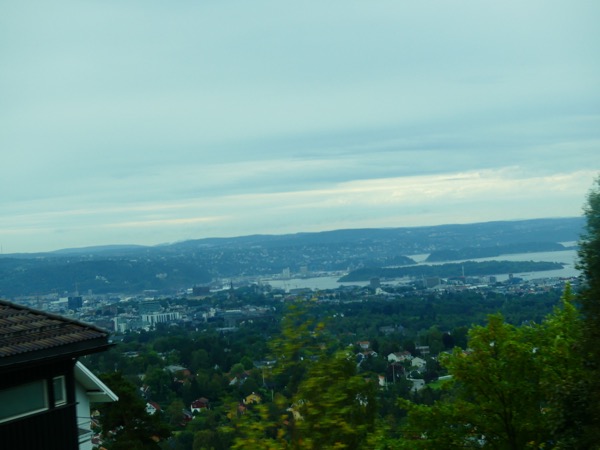
People living in the vicinity of the ski jump have a wonderful view of the city and bay: