Fintas Observatory
You know me, I’m a newspaper addict. Maybe even a news addict. I read many of the articles to the very end; I read some of the filler articles. Life is a mystery to me, in some of the exotic countries I live in (No, not exotic to YOU, but exotic to a little Alaska girl who finds herself in the fairy-tale lands of Arabia!).
So here is the real question. Every now and then, I find a reference to the Fintas Observatory.
I’ve looked on maps – no Observatory.
I’ve GoogleEarthed Fintas – some parts are still pretty vague, but I see nothing that looks like an Observatory.
The Kuwait sky is often murky with haze – the clear nights we are currently having are a fabulous rarity – but maybe they were more common in the past?
Do you know where the Fintas Observatory is? Do they allow visitors, or is it invitational only?
“Can You Help Me Get to Bangladesh?”
I have a dilemma. I don’t know how to handle it.
I carry small bills with me, because I am often asked for money. I keep it so I always have money to give to the people who help me get groceries to my car, the people who deliver propane, people who give good service – I don’t mind. Part of the blessing of having work is the obligation to pass that blessing along to others. We know that God Almighty knows where there is real need, and he moves us to give where giving is needed; he gives us a little shove in our hearts.
Yesterday, a well dressed man with a steady job told me he wants to go home to Bangladesh to see his parents. Could I help him?
I understand about aging parents. I’ve made a few trips myself. I totally understand what it is like to be far away when crises strike. We have always had funds set aside for emergency trips, and, by the grace of God, we haven’t had to dip into those funds often.
“How can I help you?” I asked.
“I need money,” he responded.
Money for a ticket to Bangladesh – that’s not small change. Along with that thought is the thought that were I to “help” this man, word would get around, and I would have many people knocking on my door for serious help with funds.
I don’t think he wants the kind of help I could easily give – showing how to set up an account and contribute to it faithfully, letting the money accumulate until you reach your goal. I don’t think he wants to do what my parents did with me, and what we did with our son – matching funds. (You save up half and we will match your savings dollar for dollar.) He wants an outright big gift.
In our church, we sing a song that says “Freely, freely, you have received, Freely, freely give.” I’ve always believed that with all my heart, it is like a magnified spiritual Locard Exchange Principal especially for blessings; what you have received you give, and it comes back to you doubled, tripled, magnified.
We tend to give larger charitable donations to organizations that make the money work hard – Medicins Sans Frontiers, African schools, our church fund. I consider a ticket to Bangladesh a relatively large charitable donation, large especially for one individual, one individual who is well employed.
So I ask for your prayers for clear guidance. I am not feeling that shove in my heart.
African Leadership Prize to Chissano
This is from BBC News: Africa and you can read the entire article by clicking on the blue type BBC News.
Former Mozambique President Joaquim Chissano has won the first Mo Ibrahim prize rewarding a retired African head of state for excellence in leadership.
Mr Chissano, who is credited with bringing peace to Mozambique, had been seen as a frontrunner for the prize.

The prize, announced by former UN head Kofi Annan, is worth $5m (£2.5m) over 10 years, and then $200,000 a year.
Mobile phone millionaire Mo Ibrahim is funding the project in the hope it will help improve governments’ performance.
The Sudanese businessman also hopes it will increase Africa’s self-sufficiency and bring a day when the continent’s people no longer need to live on aid.
His decision not to seek a third presidential term reinforced Mozambique’s democratic maturity
Kofi Annan on Joaquim Chissano
Mr Annan chaired the panel that awarded the prize, billed as the largest of its kind.
Mr Annan praised Mr Chissano for “his most outstanding contribution” to peace and democracy.
“This remarkable reconciliation between opponents provides a shining example to the rest of the world and is testament to both his strength of character and his leadership,” Mr Annan said.
Wider role
After winning independence from Portugal in 1975 Mozambique suffered a civil war that lasted until 1992. Mr Chissano was president from 1986 to 2005. He also served as chairman of the African Union in 2003 and 2004, and has worked as a UN envoy.
Mr Annan praised Mr Chissano’s role at home and more widely in Africa.
“His decision not to seek a third presidential term reinforced Mozambique’s democratic maturity and demonstrated that institutions and the democratic process were more important than personalities,” he said.
“He was a powerful voice for Africa on the international stage and played an important role in pushing debt relief up the agenda.”
Mr Chissano is something as a rarity in Africa as a leader who has left office with his reputation intact, says BBC southern Africa correspondent Peter Biles.
My comment: I love a prize that says “I caught you doing something good.” Mr. Chissano had no idea, when he was leading Mozambique, or when he chose to step down from power, that he would be competing for this prize. He led as he led, and he stepped down from power (imagine!) because he thought it was the best thing for his nation.
Some people has scoffed, called it a patronizing award. As if every country in the world doesn’t have its corruption! Africa needs shining examples of selfless leaders who can put the interests of the country in front of their own. Africa needs leaders who can unite diverse populations, drawn into nations by colonial powers, not along lines of ethnicity or religious differences.
I love it when a person does something good, without seeking reward, and then is spot lighted for the good work they have done.
Christmas for Expats
By the time October hits, it is almost too late for many expats to be thinking about Christmas. Packages have to be in the mail in time for a December 25th delivery, and that can mean different things in different countries.
Even travel and delivering the gifts yourself has become more challenging; one of the changes 9/11 made in all our lives is that we can no longer travel with wrapped gifts; baggage inspectors must be able to look at everything we pack, which means a mad scramble on the arriving end to get everything wrapped and labled before delivery.
We all face that universal problem – what to get for the people who already have everything?
So I sent to Find Me a Gift.
Here were some of their suggestions:
Become a Lord or a Lady – Buy Yourself a Title
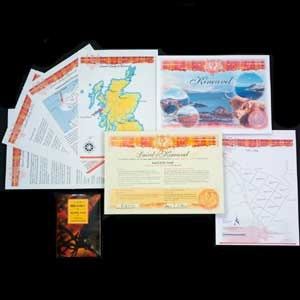
Name a Star

Neiman Marcus always has outrageous and imaginative gifts for the people who have everything, and this year one of the catalog items is a Top Stars Orchestra concert for only $1,590,000.00
(Their 100 year anniversary catalog is a must-see, even if just for the giggles)
And, of course, here in Kuwait you can make a donation of time, goods or money to Operation Hope – Kuwait to help Sheryll Mairza with her 2007 goal of feeding and providing winter clothing for 7,000 poor laborers here who are unprepared for the cold winter to come.
Community
Jeremiah is one of the great prophets of our Old Testament. The Wikipedia article on Jeremiah tells me that his name in Arabic is Eremiya. The problem with being a prophet is that not everyone wants to hear what God tells you to say. Jeremiah spent time in jail for telling people what they didn’t want to hear.
God told Jeremiah, “You will go to them; but for their part, they will not listen to you”.
Today’s reading in the Lectionary has this verse from Jeremiah. My blogging friend Kaos asked me why I care about Kuwait when I am only an expat, passing through. When I saw this verse in the reading for today, as the Jews are being sent into exile in Babylonia, I knew for myself the answer:
From Jeremiah 29 7But seek the welfare of the city where I have sent you into exile, and pray to the Lord on its behalf, for in its welfare you will find your welfare.
Wherever we find ourselves – it’s up to us to make the best of our lives. There are reasons for every expat to care about Kuwait and what happens to Kuwait. Kuwait belongs to the Kuwaitis, and 67% of the population is “expat” or “visitor” or “laboror”(whatever lable you choose.) As long as we live and work side by side, we are a community, diverse and conglomerate, but all wanting to live in peace as best we can. Kuwait belongs to Kuwaitis, and the lives we lead as individuals make up a community that belongs to us all.
On the Worst Day
We all have them – the day you wake up with a pit in your stomach and gloom in your heart. And we each have our own way of coping with those days . . . .
the quad espresso
the exercise binge
your favorite music
the Birkin bag 😉
the shopping blow-out
a 10 km run
headphones!
craft therapy
Skype chats
For me, it’s I Can Haz Cheezburger. No matter how blue the funk, someone has taken a goofy photo and put a caption on it that will make me laugh out loud – and you know how the blues hate laugher! The just run away!

I think this cat knows Kuwait roads! And this one is my tech support cat!

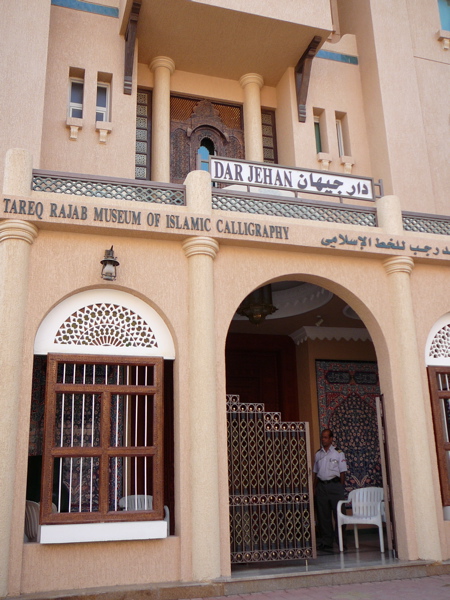
Tareq Rajab Museum of Islamic Calligraphy
One of the most beautiful buildings in Kuwait is the new – open only since March – Museum of Islamic Calligraphy in Kuwait. I am in total awe of this family, who have an eye for the history and culture of this area, collect it lovingly, and then display it – free of cost – to all who wish to visit.
The TR Museum of Islamic Calligraphy is on the same street as the Dar al Cid, where many art exhibits are held, also under the auspices of the Tareq Rajab family. It is around the corner from the Tareq Rejab Museum.
It is open every day:
Mornings 9 am – 12 noon
Afternoon 4 pm – 7 pm
Friday 9am – 12 noon
We visited recently. The museum is beautiful, and well organized. We wished only that more of the exhibits had explanations; sometimes we would be looking at something very beautiful, but we didn’t know the significance of what we were seeing.
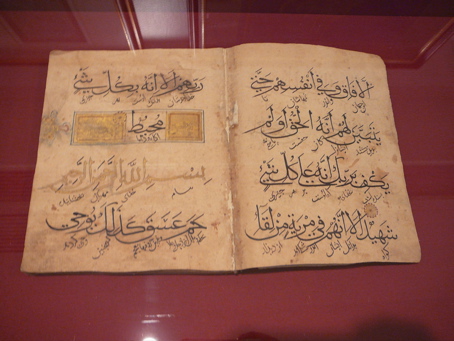
The calligraphy is manifest in hangings, ancient Qurans, quiltings, posters and carved wood. Each item is a work of art. We were fascinated by some of the Chinese calligraphy, and by the video they run showing how calligraphic quills are made, how the paper is prepared, even how the calligrapher prepares for work.
This is the entry to the Museum of Islamic Calligraphy:
Some examples of the beautiful works on display:


If you are looking for books about Kuwait, and/or Islamic Arts, the Tareq Rajab Museum has a well stocked little shop with books, cards, postcards, etc. for reasonable prices.
We take all our houseguests to these museums, and every time we go, we are moved by the generous hearts that create these museums and then offer them to the public – free of charge. They give so much to their community. It’s like a little piece of heaven. Visit soon!
No E-mail Day
Productivity at the office is increasingly becoming an issue. The industry giant Intel has introduced “no e-mail days” to encourage Intel engineers to get off their behinds, move out of their cubicles and talk to one another, rather than sending an e-mail to a co-worker just a few steps away. You can read the entire story at BBC News: Technology.
With inboxes bulging with messages and many workers dreading the daily deluge of e-mail, some companies are taking drastic action.
Intel has become the latest in an increasingly long line of companies to launch a so-called ‘no e-mail day’.
On Fridays, 150 of its engineers revert to more old-fashioned means of communication.
In actual fact e-mail isn’t strictly forbidden but engineers are encouraged to talk to each other face to face or pick up the phone rather than rely on e-mail.
In Intel’s case the push to look again at the culture of e-mail followed a comment from chief executive Paul Otellini criticising engineers “who sit two cubicles apart sending an e-mail rather than get up and talk”
7 drunk girls held for abusing officer
From today’s Arab Times If you are the parents of any of these seven young women, I can imagine your hearts are aching. I am sorry for your pain.
At the same time, I’m sorry, something about it makes me laugh, too. I can’t imagine the problems the police had handling seven drunk young women at one time. And I have to imagine the “abuse” was verbal and not physical. Somehow, it sounds like a very comical scene to me. I also imagine that the aftermath for these seven young women is far from comical.
KUWAIT CITY: Police have detained for interrogation an unidentified young Kuwaiti woman for verbally abusing a police officer on duty at a police checkpoint in Salwa, reports Al-Watan daily.
According to a police source, officers manning the checkpoint saw seven young women riding in a car. All of them appeared disoriented and were carrying a bottle of alcohol.
When the officers ordered the women to come out of the vehicle, one of them not only refused but insulted a police officer.
All the seven women have been referred to a police station. Attempts by unidentified persons to set the women free have been turned down, says a police source.
The source added 11 men had also been arrested for drinking alcohol. However, it is not known if the incidents are related
A Moment for Mirth
As we complain about traffic, write passionately about the environment, and wonder what on earth is going on with our government(s) (What? you thought it was just Kuwait?) and even worse, as we start to talk about the good old days, back in the day . . . whoa! Oh no! We are starting to sound . . . like our parents!
So, for a moment of fun, take a look at a song from a very old musical, The Music Man, set over a hundred years ago, where he talks about the new phenomenon corrupting the youth of the country. Watch how the parents get all worked up. And remember – it is all part of his agenda.
Recent Comments
Kitchen on Isiais: Winding Down intlxpatr on Shampoo Ginger tigerbutterya0c5ff1d… on Shampoo Ginger intlxpatr on British Soldier Kidnapped, Esc… John on British Soldier Kidnapped, Esc… Wikipedia Donate Button

Amazina


Early Voting in Florida


