The Street of Ramadan Lanterns
Over 15 years ago, this article appeared in the March/April edition of SaudiAramco World.

Blessed is He who made constellations in the skies and placed therein a lamp and a moon giving light; and it is He who made the night and day to follow each other: For such as have the will to celebrate His praises or to show their gratitude.
The Qu’ran, Chapter XXV (Al-Funqan, The Criterion), Verses 61-62
Written and photographed by John Feeney
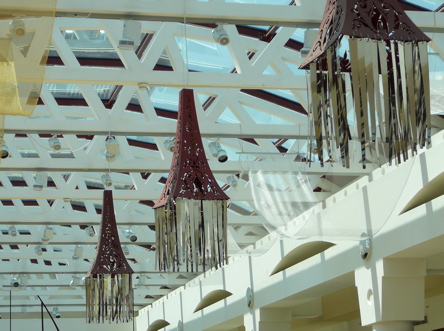
No one knows for certain when the use of children’s Ramadan lanterns began, but it is a very old Egyptian tradition. Indeed, lanterns and lamps of various kinds, of many hues and degrees of brightness, and even both real and imaginary, have always been special to Egypt. For centuries before the coming of electricity, Cairo itself was noted for its spectacular use of lanterns to illuminate the city, especially during the holy month of Ramadan.
Ramadan, the ninth month of the Muslim lunar year, is a time of fasting, blessings and prayers. It also commemorates the revelation of the first verses of the Qur’an to the Prophet Muhammad.
As a way of giving thanks to God during this holy month, and as a way of unifying the worldwide community of believers, Muslims – with special exceptions for the sick, nursing mothers, pregnant women and travelers – spend the daylight hours fasting. The hours of the night, until dawn, are marked by prayers, ceremonial meals and celebration of the day’s spiritual victory over human desires. After sunset, streets and squares all over the Muslim world are thronged with people out buying food after the long day’s fast, or visiting friends, or preparing for sahur, the last meal of the night, which will be taken before dawn. It is then that young Cairenes, allowed to stay up late because of Ramadan, traditionally gather in groups of three or four to go out among the crowds, swinging their glowing lanterns and chanting their ancient song of Ramadan – just as children in other lands go caroling – hoping to receive in return a few nuts or sweets for their vocal efforts.
Passed on by children from generation to generation, the traditional song, in colloquial Egyptian Arabic, accompanies the swinging of the lanterns in the little ones’ hands. It goes like this:
Wahawi, ya wahawi
iyyahah
You have gone, O Sha’ban,
You have come, O Ramadan,
iyyahah
The daughter of the Sultan
is wearing her caftan,
iyyahah
For God the forgiver
Give us this season’s gift.
Some believe that the children’s lantern song comes all the way from Pharaonic times, like the ancient Egyptian song called O-Faleh in the Pharaonic tongue and al-Bahr Sa’id in Arabic (meaning “The River Has Risen”). In the days before the Aswan Dam was built, that song was sung by groups out in small boats on the night the Nile reached the peak of its annual flood. Certainly, the lantern song is very old, and very Egyptian.
The opening lines – “Wahawi ya, wahawi iyyahah” – have no known meaning. “You have gone, O Sha’ban” refers to the month that comes before Ramadan in the Muslims’ lunar hijri calendar, and “the daughter of the Sultan is wearing her caftan” means she is dressed in the garment worn when going out, maybe to the mosque. “Give us this season’s gift” refers to the small presents children receive from family and friends at the time of the ‘Id or holiday that follows the month of fasting.
In the days leading up to Ramadan, children become more insistent about having a lantern; many can hardly wait to start swinging and singing – for what child, from its earliest years, is not attracted by a glowing, magical lantern? Yet Cairo children may be the most “lantern-struck” of all: Recent research by Dr. Marsin Mahdi of Harvard University indicates that Scheherezade’s ‘Alaa’ al-Din (Aladdin) of the magic lamp may well have been a Cairo boy.
One week before Ramadan begins, part of Ahmad Maher Street, for most of the year a humble thoroughfare in the old medieval quarter of Cairo, is transformed. Usually home to tinsmiths, marble-cutters and makers of mousetraps, for one glorious month it becomes “The Street of the Lanterns.”
Filmmaker John Feeney, who has lived in Cairo for a quarter century, is a long-time contributor toAramco World. He wishes to thank Laila Ibrahim, renowned authority on Mamluk Egypt, for her help with this article.
This article appeared on pages 14-23 of the March/April 1992 print edition of Saudi Aramco World.
You can read the rest of this fascinating article HERE.
I love the Ramadan lanterns. I’ve been to Cairo, and found the heat and the teeming population, the gridlocked traffic and all the begging a little scary. But I would go back in a heartbeat to see this street of lanterns!
For my non-Muslim readers, I found a wonderful site while researching Ramadan lanterns that gives a simple overview of Ramadan: Hamad El Afandi’s Ramadan Kareem. It is heavily illustrated with photos.
Invisible Moms
A friend sent this to me in an e-mail today. I know I have been invisible, and some of you may relate to it, too. It’s long, but well worth the read.
It started to happen gradually.
One day I was walking my son Jake to school. I was holding his hand and we
were about to cross the street when the crossing guard said to him, ‘Who is
that with you, young fella?’
‘Nobody,’ he shrugged.
Nobody? The crossing guard and I laughed. My son is only 5, but as we
crossed the street I thought, ‘Oh my goodness, nobody?’
I would walk into a room and no one would notice. I would say something to
my family – like ‘Turn the TV down, please’ – and nothing would happen.
Nobody would get up, or even make a move for the remote. I would stand there
for a minute, and then I would say again, a little louder, ‘Would someone
turn the TV down?’ Nothing.
Just the other night my husband and I were out at a party. We’d been there
for about three hours and I was ready to leave. I noticed he was talking to
a friend from work. So I walked over, and when there was a break in the
conversation, I whispered, ‘I’m ready to go when you are.’ He just kept
right on talking.
That’s when I started to put all the pieces together. I don’t think he can
see me. I don’t think anyone can see me.
I’m invisible.
It all began to make sense, the blank stares, the lack of response, the
way one of the kids will walk into the room while I’m on the phone and ask
to be taken to the store. Inside I’m thinking, ‘Can’t you see I’m
on the phone?’ Obviously not. No one can see if I’m on the phone, or cooking, or
sweeping the floor, or even standing on my head in the corner, because no
one can see me at all.
I’m invisible.
Some days I am only a pair of hands, nothing more: Can you fix this? Can
you tie this? Can you open this?
Some days I’m not a pair of hands; I’m not even a human being. I’m a
clock to ask, ‘What time is it?’ I’m a satellite guide to answer, ‘What
number is the Disney Channel?’ I’m a car to order, ‘Right around 5:30, please.’
I was certain that these were the hands that once held books and the eyes that
studied history and the mind that graduated summa cum laude – but now they
had disappeared into the peanut butter, never to be seen again.
She’s going… she’s going… she’s gone!
One night, a group of us were having dinner, celebrating the return of a
friend from England Janice had just gotten back from a fabulous trip, and
she was going on and on about the hotel she stayed in. I was sitting
there, looking around at the others all put together so well. It was hard
not to compare and feel sorry for myself as I looked down at my
out-of-style dress; it was the only thing I could find that was clean. My
unwashed hair was pulled up in a banana clip and I was afraid I could
actually smell peanut butter in it. I was feeling pretty pathetic, when
Janice turned to me with a beautifully wrapped package, and said, ‘I
brought you this.’
It was a book on the great cathedrals of Europe I wasn’t exactly sure why
she’d given it to me until I read her inscription: ‘To Charlotte , with
admiration for the greatness of what you are building when no one sees.’
In the days ahead I would read – no, devour – the book. And I would
discover what would become for me, four life-changing truths, after which
I could pattern my work:
No one can say who built the great cathedrals – we have no record of
their names.
These builders gave their whole lives for a work they would never
see finished.
They made great sacrifices and expected no credit.
The passion of their building was fueled by their faith that the
eyes of God saw everything.
A legendary story in the book told of a rich man who came to visit the
cathedral while it was being built, and he saw a workman carving a tiny
bird on the inside of a beam. He was puzzled and asked the man, ‘Why are you
spending so much time carving that bird into a beam that will covered by the
roof? No one will ever see it.’ And the workman replied, ‘Because God sees.’
I closed the book, feeling the missing piece fall into place. It was
almost as if I heard God whispering to me, ‘I see you, Charlotte. I see
the sacrifices you make every day, even when no one around you does. No act
of kindness you’ve done, no sequin you’ve sewn on, no cupcake you’ve
baked,
is too small for me to notice and smile over. You are building a great
cathedral, but you can’t see right now what it will become.’
At times, my invisibility feels like an affliction. But it is not a
disease that is erasing my life. It is the cure for the disease of my own
self-centeredness. It is the antidote to my strong, stubborn pride.
I keep the right perspective when I see myself as a great builder. As one
of the people who show up at a job that they will never see finished, to
work on something that their name will never be on. The writer of the book
went so far as to say that no cathedrals could ever be built in our
lifetime because there are so few people willing to sacrifice to that
degree.
When I really think about it, I don’t want my son to tell the friend he’s
bringing home from college for Thanksgiving, ‘My mom gets up at 4 in the
morning and bakes homemade pies, and then she hand bastes a turkey for three
hours and presses all the linens for the table.’
That would mean I’d built a shrine or a monument to myself. I just want him
to want to come home.
And then, if there is anything more to say to his friend, to add,
‘You’re gonna love it there.’
As mothers, we are building great cathedrals. We cannot be seen if we’re
doing it right. And one day, it is very possible that the world will
marvel, not only at what we have built, but at the beauty that has been
added to the world by the sacrifices of invisible women.
“Don’t you know that you yourselves are God’s temple and that God’s
Spirit lives in you?” I Cor.3:16
“I Miss Hamad. . . “
Talk was desultory as the book club broke up, several women had already left when Hannah hit us with this bombshell. It was a most puzzling statement. We had all passed Hamad in the hallway on our way to bookclub. He would greet us gruffly, but not really look at us as we buzzed into the women’s diwaniyya.
“What are you talking about?” popped up Lena, never at a loss for words. “How can you miss Hamad? He’s right here!”
Hannah exchanged glances with Diana, also married to a Kuwaiti. They grinned, ruefully.
“You’ve only been back a week,” Diana said.
“Yes, but I MISS that sweet, loving husband. When we are away, he turns back into the delightful, charming man I married! He holds my hand, he takes me out for dinner, it’s like when we first met! He’s a different man! Oh, how I miss him! And we’ve only been back a week.” She echoed Diana.
Diana sighed.
“And is he playing the ‘ayb’ card?” she asked? “‘Ayb’ how you walk around the house, ‘ayb’ how you smile too much, ‘ayb’ here, ‘ayb’ there, ‘ayb ayb’ everywhere?”
They started giggling. Others joined in, their giggles were so infectious. Soon, the seven women remaining from the book club meeting were gasping for air, they were laughing so hard.
“I’ve stopped changing!” Hannah hooted! “Every time I changed what he asked, he found something new!”
And the laughter started again – it’s an international group, and the critical husband thing is something that is easily understood by women of all nations.
“I want him back!” Hannah moaned, weak from laughter. “I want my Hamad back!”
Where are Hussein and Ali?
Ten days ago I was taking a new friend around the old souks and I showed her Hussein and Ali, on the corner across from the main entrance to the Heritage Souk area, where a lot of expats buy carpets.
One week later, downtown with Adventure Man – Hussein and Ali’s shop is gone. The sign is down, the shutters are closed and it looks like they are never coming back.
Have they moved? Does anyone know what happened? Did they lose their lease?
The Arab Way (2)
Here is when the Arab way doesn’t work. . .well, it does work, but not in your favor. I was taking my car in for some repairs a couple weeks ago; they told me “just bring it in, we will take care of it” and fool! I believed them!
So I get there, seek desperately for a parking space, and go inside. I take a number. Not too bad. Only five people in front of me.
Five people. But here comes Bashir, and he sits himself down right at the counter, no number. The clerk finishes with number 34 – and Bashir shakes hands with him, greets him, makes small talk with him – and takes care of him.
Meanwhile Ali and his four brothers walk in. They have a number. They want to sit down, but I am on the far end of the couch so only Ali sits down. He tells his brothers they can sit, but with a big wolfy grin – like a dare. Let’s see which one of you will sit next to a WOMAN. And not one of them will. The manager walks over to Ali, greets him and they chat and then Ali and his brothers are all taken to another area, where they get specialized service.
Old Abdul shuffles in next, and I know I am screwed. OK, OK, I tell myself, you have a choice, you can laugh or you can stew. If you stew, you just ruin your own day – it’s not going to change anything. So I just laugh.
Eventually, I get seen, and the dealership makes the problem go away, and I think to myself that in the US this would have cost a lot more, I would have waited a lot longer, and I wouldn’t have all this material for a blog entry.
The Arab ways works – but it works best if you are an Arab, if you are a Moslem, and if you have connections. I am betting it also helps to be male, but I have seen women who knew how “to be preferred”, too. 😉
Sheikh Faisal Bin Qassim Al Thani Museum
On a recent flight, I found an insert for the Sheikh Faisal Bin Qassim Al Thani Museum, the Doha equivalent to the Tarek Rajab Museum here in Kuwait. I have visited both of these museums many times – and have marvelled that private individuals would amass such great collections and share them – free – with the public.

You have to be invited, or you have to ask (groups often do) if you can visit; it is not open daily the way the Tarek Rajab Museum is.
You can find the museum online at Sheikh Faisal Bin Qassim Al Thani Museum.
Sex Education Trouble in India
This is from yesterday’s BBC News Asia
(Every country had differences on whether sex education should be taught in the classroom, and if it should be taught, how it should be taught. Our current political administration paid a lot of money to support an abstinence campaign, which proved a failure. So how do we best protect our young?)
Sex education runs into trouble
The Indian government’s recent attempt to introduce sex education for school children has provoked a vigorous debate. In the second of two articles, the BBC’s Jyotsna Singh considers the case against a more open discussion of sex in schools.
The decision to introduce sex education in India’s schools, aimed primarily at creating awareness about HIV-Aids, has generated howls of protests from many quarters.
Many women’s organisations and religious groups as well as several politicians say exposing children to an open debate on the subject, specially in classrooms, will make them “more permissive”.
More than 30% of Indian states have rejected the federal government-supported sex education programme.
The Secondary School Teachers’ Association in Uttar Pradesh state has even threatened to make a bonfire of books if sex education isn’t withdrawn immediately.
Several teachers and student groups have objected to the teaching aid or kit to be used for educating the pupils in the class.
One of the main objects that has drawn the ire of the protestors is a flip chart, prepared jointly by the Unicef and government-controlled National Aids Control Organisation (Naco) to facilitate the government’s adolescent education programme.
‘Too graphic’
The chart, entitled “Knowledge is Power”, contains illustrations and images dealing with issues related to growing up and relationships in the context of sexually transmitted infections and HIV/Aids.
The chart also contains a chapter on essential skills needed to prevent the disease.
But protesters say the visuals in the chart are too “graphic”.
The right-wing Hindu organisation Rashtriya Swayamsevak Sangh (RSS) blames “a Western mindset behind the move”.
“We run about 26,000 schools across the country. Our teachers have studied the curriculum and they find it obscene and objectionable,” RSS spokesman Ram Madhav told the BBC.
“The whole curriculum is designed to suit the lifestyle in Western countries, where there is a general free atmosphere. In our country we live with families.”
You can read the rest of this article HERE.
How Security Police Say “Sorry”
This is from today’s Kuwait Times. I know you are all dancing for joy that journalist and blogger Bashar Al-Sayegh is free, and we as a blogging community can all celebrate his release.
His arrest was a mistake.
It says so in the article. Pay attention! You have to read carefully, because security police speak a language all their own.
This is how they say “I’m sorry. It was a mistake.”
Responding to calls to dismantle the state security department, Rujaib stressed that the department was very vital for any state. “It forms the eye that never sleeps in protecting the nation’s security, in political, social and economic fields,” he explained, pointing out that it existed all over the world.
Asked whether Sayegh’s arrest was meant to convey a message against the freedom of the press, Rujaib stressed that press freedom was fully observed, yet reminded that journalists could be arrested for other reasons. “Meanwhile, police officers could be arrested for any reason as well,” he added, underlining that no violations took place during Sayegh’s arrest. On whether he believed that the issue had been politically motivated by some MPs, Rujaib said, “I am a security official and a politician should answer this question.
Do you think he is implying that there might have been another reason? Does it sound like deflecting blame? I think he is saying “We screwed up. We’re sorry.”
Back it up! #2 Khalid Al-Hajri
WOOOOOOO Hoooooooooooo Khalid Al-Hajri!
You WILL find this one in the Kuwait Times Online, by clicking right here.
Khalid Al-Hajri, representing The Green LIne Environmental Group, held a press conference and demonstrated how the Wafra Agricultural Area – and all of Kuwait – faces an environmental disaster due to irresponsible disposal of petroleum related wastage.
This takes a bucket full of courage, in a nation where so much wealth is produced by petroleum. And Khalid Al-Hajri didn’t just go on record giving an emotional speech, no. He had graphs and maps and photos – he had the FACTS to back up his assertions.
And bravo to the Kuwait Times for giving him page 3 coverage.
The truth is that I don’t understand the whole of the report. I understand that there are problems with oil products being illegally dumped in the al Wafra farm area and it could have a devastating impact on the farming there. And – I understand that their injecting the oil production by-products deep into the earth NEAR THE SAUDI – KUWAITI BORDER could cause EARTHQUAKES.
Hmmmmmm. . . . didn’t we just have an earthquake? And where was it? Oh . . . yeh! Near the Kuwaiti – Saudi border, wasn’t it?
And worst case of all, these by products pollute the underground aquifer.
I applaud people like Khalid Al-Hajri who care about their country enough to do their homework, and then to speak up in a responsible way to bring our attention to practices that can hurt Kuwait in the future.
Recent Comments
Kitchen on Isiais: Winding Down intlxpatr on Shampoo Ginger tigerbutterya0c5ff1d… on Shampoo Ginger intlxpatr on British Soldier Kidnapped, Esc… John on British Soldier Kidnapped, Esc… Wikipedia Donate Button

Amazina


Early Voting in Florida


