“How’s That Working For You?”
I love watching language shift and segue like the waves at sea. One moment there will be a gust of adjectives (“cool” “hot!” “baaaadddd!” “fly”) and another there will be typhoon of localisms, like the Valley Gal phenomenon, and from time time time, apparently quiet times. If you are watching closely, however, you will see the waters twitch and a new word or phrase surface, create a few ripples, and then most of the time, fade away.
“How’s that working for you?” is a phrase that doesn’t mean what it seems to mean. Yes, it is a very neutral way of asking how a person is doing.
Underneath, however, it implies disbelief.
Language is so subtle. It’s one of the reasons I will never be fluent in French, or German, or Arabic – I can skim the surface, I can even dive beneath the surface, but there are depths that you have to be a native to plumb.
“How’s that working for you?” keeps the conversation going when an addict defends his addiction.
“How’s that working for you?” keeps the door open when your daughter defends an inappropriate relationship.
“How’s that working for you?” is the response to someone with big talk of big dreams who never gets organized enough to put the dreams into action, but wants credit, although nothing was accomplished.
“How’s that working for you?” is a compassionate response to someone who is lying to herself about an important issue and you don’t want to burst her balloon.
Most people ask the question when there are clear signs that it is NOT working. It returns the ball the the court of the person who needs to deal with the problem.
A person who is not willing to face the problem will respond “Great!” The appropriate response to “great” is “Glad to hear it!”
(“Glad to hear it!” used in this context means “I don’t believe a word of it.”)
If someone asks you “how’s that working for you?” they have sent you a signal that it’s time to re-examine what you’re doing.
Good Neighbors Blog
The Qatteri Cat knocked the lid off his cat-box at oh-dark-thirty this morning, but it was so beautiful out I decided to have a cup of coffee, get an early start and maybe take a snooze in the afternoon, when the heat kicks in and I drop out.
As I was visiting Little Diamond’s blog I noticed a blog in her blogroll that I wanted to check out. And WHOA! I’m glad I did.
The blog is Good Neighbors. It has fifteen authors – Lebanese, Palestinian and . . . Israeli. Maybe more, I don’t recognize all the flags. Totally amazing. These bloggers are educated, and highly literate. Even better, they have a noble goal. I urge to to visit them, especially if you are following the current situation in Lebanon.
Here is what they say about themselves on the About page:
The Good Neighbors Website
Building bridges for understanding and cross-cultural dialogue
This site is dedicated to increasing dialogue and understanding between Israelis, Palestinians, Jordanians, Lebanese, Egyptians, Saudis, Iranians, Iraqis, Libians, Sudanese, and Syrians on a cross-country level, as well as to increase understanding, respect and dialogue among the various strata of society within our individual countries.
The aims of the website are numerous and include:
1) discovering and fostering shared common values, interests and beliefs
2) fostering greater understanding for those views and values that are not shared
3) bringing to light “local” issues and experiences (e.g., those specific to a particular segment(s) of a particular country)
4) engaging in constructive dialogue on conflictual issues
5) providing a window into one’s culture and into the daily life and concerns within one’s country
6) educating one another and the audience about the primary social, political, and historical issues in one’s country or one’s group within one’s country.
We all of us participating here are committed to being open-minded, tolerant and respectful of others’ views and opinions even when those opinions and beliefs run counter to our own. We are committed to trying to be part of the solutions to the many problematic issues in our region. We are committed to building a better future. And we are full of hope.
Speaking English
A few months ago I made a mistake. When the complex management asked for suggestions, I told them that it did not make me feel secure that the guards on duty did not, as promised, speak English.
Ever since, I have been the focus of a lot of attention.
“Oh Madam, I am so happy to see you!” gushes one guard, and when I ask about his family, he looks at me blankly.
“Good morning, madame, yes fine, thank you” greets the guard before I have asked him how he is.
Someone is teaching them, and they are actually very happy to be learning some phrases, and they all want to be sure I know they are speaking English.
So yesterday, when a series of bulbs were replaced, when the hariss showed me the brilliant results, I said “Cool!”
And under his breath, the Nepali assistant said, with my exact inflection, “Cool!”
And I could hear him practicing, as he left. I am wondering if I will be greeted with a chorus of “cool!”s as I leave this morning.
Strolling Through Villagio
As I sat in the Kuwait airport, waiting, waiting, waiting . . . .I ran into a friend also heading to Doha, and we spent some time together. For one thing, she told me about Villagio, which didn’t exist when I lived in Doha.
If I lived in Doha, this is where I would spend my summer, walking along the avenues and gondola filled lagoons of Villagio. After a good stroll, I could sit down at one of the many restaurants and cafes and wipe out all the good work I had done strolling!
How cool is this?
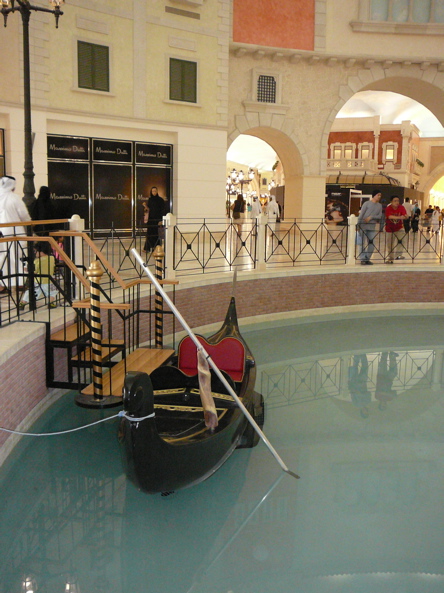
The lagoon winds through the Mall, and you can take a boat ride when you are tired of shopping:

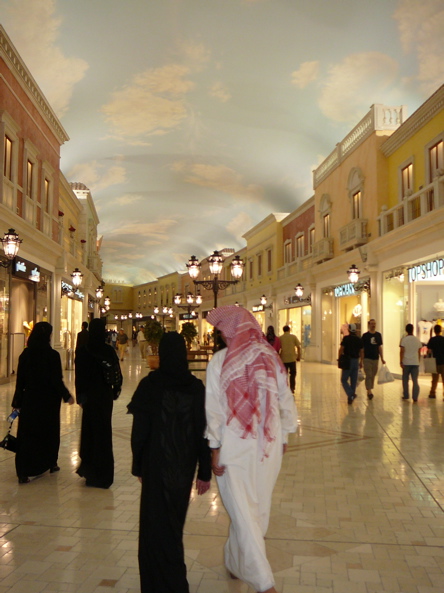
I love all the attention to detail, especially the streetlights, which are lit day and night, and provide a delightful romantic atmosphere:

The perfect place for a stroll – or a 10K hike!
Travel Karma Failure
I have really good travel karma – most of the time. Even when things go wrong, something good comes out of it. And before you read any further, you must know that during this trip, I had a really good time, surrounded by friends, good conversation, a lot of laughter and a very understanding husband – it had a happy ending. But this was a serious travel karma failure.
Oh, I had planned to carefully – fly out early, my friends pick me up, we loll around the pool catching up, grab a bite to eat, and eventually they drop me off at my hotel where I hook up with my husband.
Only this is what I saw on my way to the airport:

And this is what I saw as the plane was delayed – and delayed – and delayed again:

And this is what the airport looked like as more and more planes got delayed:

After – literally – hours, we board. We are rolling away from the airport when a guy a couple seats up from me says . . . something . . . to the stewardess and the guy across from him. As the plane continues rolling, I watch the guy across the aisle get up, go to the galley and make a phone call. The plane keeps rolling rolling rolling, but . . . rolls to a stop and all kinds of vehicals come out to the plane.
They all have a discussion:
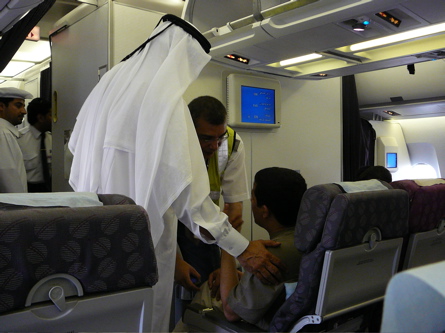
But you know this part of the world, everyone has an opinion and wants to be heard. Back and forth up and down the aisle. The entire Qatar soccer team weighed in on this one:

Somehow, it all got resolved. I get to Doha – not early morning, but six at night. I’ve already told my friends to forget picking me up in peak traffic time, but I would see them the next day – we already had plans. But the topping on this perfect day is that my suitcase didn’t come. People were sent looking here and there, and another hour passed.
No suitcase. No explanation, but they assure me the suitcase is still in Kuwait. Get it here, I tell them, I need it. Send it to my hotel. And I rush to duty free to pick up some face cream and mascara and lipstick – you know, the essentials. When I get to the hotel I realize I have nothing, but the gift shop, thank God, has very large T-shirts I can sleep in, a hairbrush, a toothbrush and even underpants.
My greatest fear, as the suitcase continues to NOT show up, is that I will never see it again. It is a great suitcase, and inside it is my computer power cord. Normally a balanced, easy going person, I have bad dreams, angry dreams, frustrated dreams and I wake unrested, and wanting clean clothes.
My husband, not normally known for his patience, was very tenderly patient with me. I think he was more than a little bewildered to see me so bent out of shape. It was probably funny – if you weren’t me.
For three days, for every event, I wear the same clothes. Three days. The bag finally showed up this morning – still at the airport – just in time for my return trip to Kuwait.
Now that, my friends, is a SERIOUS travel karma failure.
Anya Seaton and Avalon
Avalon, by Anya Seaton, is an amazing book, a book I almost didn’t read, but once I picked it up, I could hardly stop reading until I had reached the end. It took me to a whole new world.

It opens in England, around the turn of the first millenium, when people had names like Aethelred and Aelfrhryth which is enough to make me NOT want to read the book. But I read another book by Anya Seaton, Katherine, and I really liked it. It, too, took place in very early English history, and had such an authentic feel. It wasn’t like you pick up the book and all the lords and ladies are in gorgeous clothes, Seaton captures the primitive life many lived in “castles”, freezing cold most of the winter, no plumbing – many of the poorest laborers in Kuwait live better, in terms of food, a roof over their head, toilet facilities – that these early nobles. And the life of villagers was even more basic, a true scrabble for survival, and under filthy conditions, not a lot of time of opportunity for bathing, so people had quite an odor most of the time.
Avalon begins with a chance meeting of a young man and a young woman, a tragedy, and a journey. Their story, as first one love and the other doesn’t, then the other does and misses the opportunity – takes us from the southernmost part of England to Iceland, to Ireland, to Greenland and to the new world, all in the space of these two intertwined lives. They never marry, and yet the book, and their relationship, is a romance.
As you can see, once I got into the book, I couldn’t put it down until the last page. These people are so real, so genuine and so human – and Seaton makes you care about them. She manages to throw in enough detail that I could almost swear I visited these places – a thousand years ago. I have spun wool to buy necessities for our sod house in Iceland, I have embroidered tapestries in the Bower of my husband’s castle, I have sent my son off to settle with his Irish bride in the new world – yes, I think I have done.
The political situation in England at this time is chaotic, with Vikings raiding their coastal cities, and deep up the rivers into the interior, feuding over who will wear the crown, and problems with the capabilities of rulers to rule. There is a constant friction between the church and state, for land, for power, for wealth. The majority of the novel takes place during the reign of – I am not kidding – Ethelred the Unready.
At the very end, I found to my astonishment, that this book also concerned the ramifications of a big lie, just as my previous book reviewed. This is a total co-incidence, something that surprised me, and this book ends in a totally different way, as the main character comes to grips with her deception, owns up to it, willing to suffer the consequences.
Is this what I want? Merwyn thought, and at once came the answer. Yes, it is. There would be boring days ahead, but never again the depressions and miseries of before . . . She felt cleansed, peaceful, and there was much gratitude. . .
That totally cracked me up, but this is a romance of a different nature, a very real romance, with the real kinds of choices that real-life romances entail, and the real life consequences. The hand of God is a major player here, and the beliefs of the characters shape events in a way consistent with the times. Dreams are taken very seriously, and the power of curses, and sorceries, which I never give two thoughts in my daily life in the 21st century.
The main characters have their own nobility, based on their choices, their growth, and their coming to terms with their lives and situations. I learned a lot reading Avalon, and I also had a great time while learning.
All in all, a fascinating read.
The Old American Hospital
I discovered the beautiful building we park in front of when we got to church is the Old American Hospital. I don’t know what it is used for now, but it has been beautifully renovated.


From Kuwait Toplist Places of Interest.
Old American Hospital:
Located on the left side of the gulf street facing the bay, stands the old American Hospital. This was the first hospital run by the Christian Missionaries. An architecture from the early part of the 20th. century.
Emergency Service in Kuwait
I had an emergency. Now YOU may not consider it an emergency, but I have a piece of equipment, and I have a major project and a deadline, and to meet that deadline, I need that piece of equipment. And, of course, that piece of equipment began to fail me.
Not to worry. I had heard of a place in Kuwait that could fix my machine. I had that pit in the stomach feeling, like “why didn’t I do some homework and find this place before my machine needed fixing. . . ” Do you ever say things like that to yourself?
And of course, because I was desperate, when I would go into stores and ask if they knew where this place was, I was told, over and over, there was no such place.
Until one brave young Pakistani guy contradicted his employer and told me where he thought the place might be. Because of one way streets, and a convoluted traffic pattern, it took me several more passes before I spotted the place – which fortunately had one very small sign in English, as I can’t read Arabic very quickly, I still have to sound out all the letters until it sounds like a word I know. Like I am really good at “sharia” being street, but not very good at things I don’t see all the time.
And, by the grace of God, not only do I see the store, but there is – and this is truly a miracle – a decent parking spot fairly close to the shop. Thanks be to God.
I went into the shop, and there is another woman there, with her machine. I tell the man behind the counter that I have a small emergency. He doesn’t understand me, but he understands my tone, and sends a man to help bring in my machine.
It’s like the stand-off at the OK Corral. She looks at my machine, evaluating whether her’s is better, or mine. Seconds tick by, and she smiles, and the crisis is averted. She tells the man she will be back for her machine, which he sets aside to take a look at mine.
My machine is one of those simple machines, you are supposed to be able to do almost everything yourself. He does everything I have already done, and sits back, stumped. We both know what the problem is, and I know he can’t fix it. He calls a friend. He orders tea. We sit and talk as customers come in and out, checking on their machines, asking prices on new machines. We are speaking in Arabic, a language we both speak badly, so conversation often lulls. I’m not sure his friend is coming.
Finally, I pack up my machine, and of course, as soon as I get ready to leave, the friend arrives, and we need to unpack it again. Ten minutes, and my machine is good as new. He tells me what the replacement part would cost in Kuwait (if he hadn’t been able to fix it) and I gasp in horror – I will have to look for a replacement part this summer, back in the US, because I have checked online and yes, they are expensive, but cost about the same in dollars as it would in KD – i.e. $49 vs KD 40. Aaarrgh.
I’ve spent two hours sitting and drinking tea in a shop that is sort of air conditioned, but the door was always open. I am hot, and sweaty, but my machine is fixed, at least enough that I can work on my project.
This is not the way it would happen in the United States. In the United States, I might get some sympathy, but I would not get same day service. I would have to leave my machine, I would have to be served in order, and I would not get my machine back until it were fixed, if it were fixed – people are not so good at fixing old things in the United States, you have to be really lucky. Mostly, when machines break, you buy a new one.
So I am feeling really lucky, really lucky, really blessed, to have had my machine emergency in Kuwait, where things are done differently, and my machine could be fixed on am emergency basis, while I waited.
P.S. The man who fixed my machine earns KD 80 a month – $280 for my US readers.
The Memory Keeper’s Daughter
Rember the post Lying Hurts The Liar? In The Memory Keeper’s Daughter, the whole plot revolves around a huge lie, and the toll that protecting that lie takes on the lives of everyone it touches.
in the middle of a huge snowstorm, Dr. David Henry’s wife goes into premature labor and he is forced to deliver her in his nearby clinic because he can’t get to the hospital in the snowstorm. To his surprise, he delivers twins. The boy is fine and healthy, the baby girl clearly has Down’s Syndrome. It is the 1960’s.
He hands the baby to the nurse, and tells her to take the baby to a home for Down’s syndrome children and adults. When his wife, Norah, regains consciousness, he tells her she had twins, but that the girl was born dead.
Meanwhile, Caroline, the spinster nurse, takes the baby to the home, but when she sees the lack of caring in the “care” of the patients, she makes an instant decision to walk away. She keeps the baby. She never goes back to the clinic. She drives away and creates a new life for herself and the baby, a joyful life, the life she was waiting for.
To protect his secret, Dr. Henry maintains a distance between himself and his grieving wife. Norah never gets over the loss of her daughter, and she never gets over the change in her relationship with her husband. She knows something is not right, and no matter what she does, she can’t fix it. For a while she drinks. Later she pulls herself together, gets a job, ends up taking over the business (a travel agency) because she has thrown herself into her work.
The son, the healthy baby, grows up in a family where things are not right. His mother loves him, but is distracted by her grief. His father loves him, but is distracted by the energy it takes to protect his terrible secret. It is a family, but a family whose connections to one another are damaged by the tragic secret.
The discarded daughter, meanwhile, grows up surrounded by love and a family who makes a life out of creating opportunities for Down’s Syndrome children.
Late in the book, there is both some resolution and redemption. Things work out, but I find myself thinking of all the wasted years, years of unhappiness and loss, years of happiness sacrificed, brought about by one great big lie. When you read the book, you understand his reasons, and you know how easily, given the times, you and I might have made the same decision.
I think the doctor would have been happier had he risked telling his wife. He often wanted to. He didn’t.

Available for $8.40 + shipping at amazon.com
Hats off to Saudi Women
Last week in the May 10th Kuwait Times, Dr. Sami Alrabaa wrote a fascinating article on Saudi Women, Saudi Arabia and some shifts in press coverage in Saudi Arabia.
This is how the article starts:
Anti-Woman Culture
More and more Saudi women are speaking out against preachers in their country. Fatma Al-Faqih, a columnist at the daily Saudi Al-Watan accuses preachers (April 17) of “denigrating women” and “inciting discrimination against women.” “Day in day out, our preachers flood us with accusations against women and beg men to defend the virtues of society that women corrupt,” Al-Faqih writes. This “anti-woman culture”, Al-Faqih continues, causes women to feel mentally and psychologically inferior, “like a quarrelsome child who must be constantly supervised, intimidated, and punished into performing her duties.”
It is also unprecedented that the Saudi print media are allowing women to air their indignation and frustration. Al-Faqih also writes, “Women are good Muslims as men are. But our preachers insist on producing a distorted picture of women, which has nothing to do with true Islam. The Prophet Mohammed (PBUH) never discriminated against women. He respected them. He valued their opinions and occasionally sought their advice. He treated them as full-fledged human beings. Our preachers however, depict women as spoilt minors who have got to be constantly instructed to behave themselves. They cannot be trusted.”
Al-Faqih also wonders, “Where is it written in the holy Quran and Hadeeth that women are not allowed to drive their own cars? Where is it stated that women are forbidden to travel alone, leave their houses, or travel alone with the family’s chauffeur? Where is it stated that women are forbidden to have a passport without permission from their male closest relatives, forbidden to go to school or university without permission, forbidden to take a job without permission, forbidden to open a bank account without permission, forbidden to name their own children without their men’s approval?”
Further, Al-Faqih complains, “Where is that divine law which does not allow women to sue their husbands for divorce? Where is it written that women’s voice is a sexual organ and hence she is not allowed to speak in public and express her concerns? Where is that sacred law that does not allow women to keep their own children after divorce? Where is it written in Islam that women are not allowed to vote or run for office?”
Al-Faqih concludes, “Are we in Saudi Arabia a special brand of Muslims? In other Muslim countries, women have become presidents (in Bangladesh for example), prime ministers (in Turkey and Pakistan), ministers in Egypt, Syria, Morocco, Kuwait and other Arab countries. In all Muslim countries, women have the right to vote and run for office. No, we are not a special brand of Muslims. It is our preachers who interpret Islam their own way.”
You can read the rest of the article by clicking HERE.
My comment: When I lived in Saudi Arabia, my eyes were opened. My Saudi Arabian women friends were SO smart, and they really knew their Quran. They also knew hadith, and they knew the weight of each hadith, which were strong and which were weak. They didn’t just memorize suura; they thought about them, they discussed them and analyzed them.
Through them, I understoon Islam in a whole new way, and understood the revolutionary thinking of the Prophet, who was kind to women, took council from women, and treated women fairly. In an age when female babies were routinely killed, he stood against the tide of tradition, and forbid the killing of female babies, and insisted on rights of inheiritance for females (and this in the 7th century).
And no one found it more ironic than the Saudi women that Saudi Arabia has become a worldwide symbol for repression of female rights. My Saudi sisters claim that in the birthplace of Islam, Islam has become distorted, a weapon used against women.
My Saudi women friends often told me I was not required to wear a scarf. My embassy told me the same thing, that it was a voluntary sign of submission to Islam. The embassy also told me to carry a scarf, and if accosted by the mutawa,(religious police, the “The Committee for the Promotion of Virtue and the Defense Against Vice” or something like that) to put it on until he was out of view, and then to take it off again, that the scarf was not mandatory. The mutawa felt differently, and would boom out in loud, offended voices: “MADAME, COVER YOUR HAIR!”
I would comply. But the unfairness never failed to rouse my ire. Excuse me? My hair might cause YOU to have a lustful thought? You control YOURSELF and your thoughts, and let ME worry about my morality.
So my scarf – errr hat – is off to these Saudi women who have the bravery to write these well thought out position papers to the Saudi papers.
The interesting thing to me is that the Saudi press is printing the women’s complaints now. . . perhaps, insh’allah, some changes are in the air.
And a muse – So when a Saudi woman comes to Kuwait, for example, or to France – is she allowed to drive? We know it is illegal for her to drive in Saudi Arabia, but is it also immoral for her to drive in Saudi Arabia? Or is it immoral for her to drive anywhere? So like is it immoral for all us women to be driving anywhere?
Recent Comments
intlxpatr on Shampoo Ginger tigerbutterya0c5ff1d… on Shampoo Ginger intlxpatr on British Soldier Kidnapped, Esc… John on British Soldier Kidnapped, Esc… intlxpatr on British Soldier Kidnapped, Esc… Wikipedia Donate Button

Amazina


Early Voting in Florida


