USAF Band Flash Mob at National Air and Space Museum
Once again, Hayfa, you have found a total winner. Wonderful music, wonderful surprise for the museum visitors 🙂
The Miracle of Giving (WestJet)
Thank you, friend Hayfa, for sending me this wonderful website. It kept me spellbound, made me laugh, and left me in tears of joy. You can see that the givers were enjoying it as much as the receivers.
The Toughest Commandment
It should be so simple, shouldn’t it? Love God and put him first, love your neighbor as yourself? And then you run into the one who is hard-t0-love . . . A challenging meditation for the day from Forward Day by Day:
Matthew 22:39. You shall love your neighbor as yourself.
I wish we could keep the two Great Commandments—to love God and our neighbor—at the forefront of our minds. Too often, I fear that we have equated loving our neighbor with being nice to those around us. Even a cursory glance at the gospels reminds us that it’s much harder than that, although the commandment is simplicity itself.
The massive wealth imbalance in the United States belies our adherence to this simple yet difficult commandment. If we really loved our neighbors, would we support a society in which a few people control so much wealth while millions go without enough food? Would we permit some of us to enjoy the best health care on the planet while millions more have no regular health care?
If I have read the gospels right, there is no way of saying their problems are not my problems. Rather, we are obligated to share of our abundance with those who have less. Jesus tells us to care for the last, the lost, and the least. Token gifts are a mockery of the Great Commandment. We are called to care for those around us with reckless abandon. Love is not sentimental here; it is hard work.
American Shedding Reliance on Cars
. . . in bigger cities where good public transportation is available, at least. But across the board, Americans are driving less. When I was a young woman living in Seattle, I took the bus to work. It was fast, reliable and I got to read going to and fro. A generation later, my son would park his car at the park and ride lot and take the bus into downtown. When you have GOOD public transportation, it makes a lot of sense. Found this article on AOL Auto News:
Commuters are shedding their reliance on cars.
They’re not driving to work in their own vehicles as often as they once did. They’re not carpooling with other workers as often. They’re increasingly using public transportation or simply working from home.
Those are the conclusions of a study released this week by U.S. PIRG, which reviewed data from the Federal Highway Administration, Federal Transit Administration and U.S. Census figures.
It says the proportion of workers commuting in private vehicles, either alone or in a car pool, declined in 99 of the 100 largest urban areas in America between since 2000.
Newark, New Jersey saw the greatest percentage of workers put down their keys, with a 4.8 percent drop, followed by Washington D.C., down 4.7 percent and Austin, Texas, down 4.5 percent.
In recent years, there have been numerous indications that Americans overall are shifting away from driving. The number of per capita vehicle miles traveled reached its peak in 2004. This study claims to be the first to specifically look at the decline in American cities.
“Many existing transportation plans continue to reflect outdated assumptions that the number of miles driven will continue to rise steadily over time,” wrote Phineas Baxandall, senior analyst at U.S. PIRG and the study’s author. “Officials at all levels should revisit transportation plans to ensure they reflect recent declines in driving and new understandings of the future demand for travel.”
The U.S. PIRG study details changes that on a market-by-market basis. Among its other findings:
– The proportion of residents working form home has increased in every one of the 100 largest urban areas since 2000
– The proportion of households without cars increased in 84 of the 100 largest markets between 2006 and 2011
– The proportion of households with two cars or more decreased in 86 of the 100 largest markets between 2006 and 2011
One of the more notable trends appears to be the death of carpooling as a commuting option. Between 2000 and 2011, carpooling declined 17.8 percent, according to the U.S. PIRG study. Only 9.7 percent of workers now report they share rides to work.
The results are not entirely surprising: The number of Americans who work from home increased 45 percent between 1997 and 2010, according to an earlier study conducted by the U.S. Census Bureau.
Curiously, the decline in driving hasn’t dampened demand for cars. Automakers expect to sell approximately 16.4 million vehicles this year, according to the latest projections released earlier this week. It’s the best year for auto sales since 2007, when more than 17 million cars were sold.
Pete Bigelow is an associate editor at AOL Autos. He can be reached via email at peter.bigelow@teamaol.com and followed on Twitter @PeterCBigelow.
Qatar National Day: What Not to Do

LOL, This is exactly what everyone does. Not doing any of these things will not prevent the absolute gridlock that develops as everyone in the country drives into Doha.
From Qatar Gulf News:
The Traffic Department has urged motorists not to violate traffic norms while celebrating National Day.
In this connection, the department has reminded motorists of certain common violations that are seen during this time and asked them not to commit the same during this year’s celebrations.

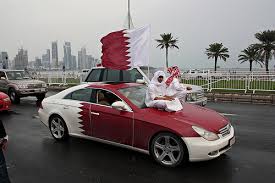
These violations include placing pictures, posters and flags on the entire car, thereby completely changing the look and colour of the vehicle; shading the windshield and rear window of the car, obstructing the driver’s view (both of the road in front of him and behind the car) and hiding the car plates; climbing on to the roof and bonnet of a car; getting out through the car’s windows and sunroof, which exposes passengers to the risk of falling down, besides affecting the control of the driver; and blocking traffic and parking in no-parking zones.
The department has appealed to all motorists to celebrate the occasion in a safe and secure manner and not to commit violations that may jeopardise the safety of other road users.
Southern Family Thanksgiving
Oh, what fun!
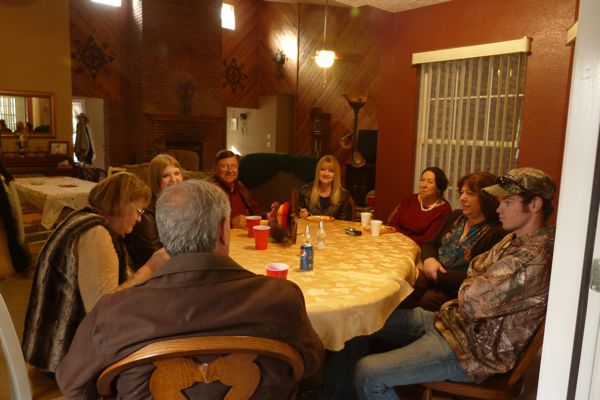
Some photos from the gathering.
My daughter-in-law made these fabulous bacon-wrapped stuffed dates:


The kids dish up their plates first, and go to the Cousins Table:

These are all the desserts waiting to be unveiled:

AdventureMan did the roasted root vegetables on this table 🙂


Re-telling old family stores – so much laughing!

Uncle Woodrow introduces the cousins to farm-grown sugar cane:

Schooners For Dinner
We usually start our stay at Panama City Beach with dinner at Schooners, a very local beach bar with a aid back atmosphere. It is a cold cold windy night, the bar is packed, but there is a table for us.

We start with the smoked tuna:

AdventureMan has a Cuban with so much meat he can’t even eat it all:

I have the seafood gumbo, perfect for a cold night; sticks to your ribs kind of food, LOL:


If You Lived Here, I’d Know Your Name: Heather Lende

“You have to read this!” said my book friend, “You’re from Alaska! It’s about a woman who lives in some small town and writes obituaries!”
I grinned politely and put the book in my bag. Some books sound more interesting than other books – I’ve always loved adventures and mysteries and murders – add a little drama to the day-to-day-ness of everyday life. A woman who writes obituaries? Hmmm, not so much.
But spending my afternoons tending to my sweet little 3-month-old granddaughter means I often sit, anchored by the soundly sleeping baby who I don’t want to disturb, even by twitching. I have one hand free – and you can only play so much iPhone Sudoku.
An Alaskan friend had also recommended this book, so early this week I picked it up and started reading.
Oh. my. goodness. Yes, Haines is a small town, but oh the drama of writing obituaries. Oh, the things you learn about your neighbors and the surprises you get learning about their earlier lives. I love the way Heather Lende weaves the writing of the town obituaries with the current ongoing dramas in her own life and in the lives of her friends and makes it work.
It’s not unlike where I grew up, although my hometown had a hospital. We also had moose and bear and elk in our back yards, and learned to treat wildlife with respect, and that the best option was to back away slowly. There are the same senseless deaths from auto accidents, fishing boat accidents and unexpected changes in weather. There is the same feeling of wonder, almost every day of your life, knowing how very lucky you are to live in the midst of such awe-inspiring beauty. It’s hard for me to imagine being an unbeliever living in Alaska.
It’s also a great book to read before going to bed. Some of the books I read are too exciting or too disturbing to read before bed; books that infiltrate your dreams with images and situations that give you a restless night. While Lende deals with death and sadness and drama, there is an underlying message of hope in the neighborliness of your neighbors, the security of living in a town where everybody knows everybody else, in the civility even of people who strongly disagree with one another. If You Lived Here, I’d Know Your Name gives you peaceful sleep. She ties it all together with an ending that rips your heart out; you will never forget this book once you read it. After reading, you will feel like you have lived in Haines, Alaska.
The paperback version is available from Amazon.com for $9.73. No, I no longer own stock in Amazon.com.
Kuwait to Limit Auto Ownership to Solve Traffic Gridlock?
Limit Kuwaitis to two cars per citizen?
Limiting expats to one car will also limit the people willing to take contracts in Kuwait, and family willing to accompany them . . .
Or is this another of those unenforceable laws to put on the books?
Restrictions on automobile ownership in the offing – Bid to solve traffic problems
KUWAIT: According to a report published yesterday in a local Arab daily, the government is planning to limit the number of vehicles a person is allowed to own at two for citizens and one for expats. This proposal may be announced at the beginning of the next year. The proposal also calls to stop renewing registrations of old vehicles without specifying the period, which could be between 8 to 12 years.
The Ministry of Interior hasn’t received any official instructions to take action in this matter. “We are an executive department that applies the law and executes decisions. It’s possible that there are committees at the ministry studying this proposal, but we are not aware of it yet,” Maj Naser Buslaib, Head of the Media Department at the Ministry of Interior told Kuwait Times. Economic analyst Hajaj Bukhadour thinks such a proposal is not realistic and doesn’t believe it may be applied. “Such rules do not exist in any country, even the poor ones or those suffering from traffic woes. Through such unreal proposals, the officials in charge are trying to shirk the problem.
The officials pin the blame and responsibility on expats as they are not qualified and creative enough to find a solution for the traffic problem in Kuwait,” he pointed out. Development and improvement in administration is important to solve major problems. “We should improve the performance of the officials who are in charge of issuing decisions.
There are mistakes in any institution, but we need to improve and this is a great part of solving the problem. Such a proposal proves that officials in charge at the Ministry of Public Works, Ministry of Interior and other institutions didn’t study the problem correctly,” stressed Bukhadour. There are various solutions according to him.
“Different public institutions should cooperate to organize the movement of people in streets through different timings of public employees, schools and others. Also, the government should provide modern and clean public transportation such as a metro or new modern buses that will respect the time and have stops near residential areas that are shaded to suit the hot weather when passengers are waiting for the bus,” he explained.
He mentioned additional solutions. “Developing roads and the infrastructure is very important in solving the traffic problem. Also, the development of the Traffic Department will help in this matter. I think that such suggestions may bring better results in solving the traffic problem rather that coming up with unreal proposals,” concluded Bukhadour.
By Nawara Fattahova
Recent Comments
ExpatAlien on What Country am I Living … intlxpatr on Yellowstone: Old Faithful to C… Michelle on Yellowstone: Old Faithful to C… Cathy on No Grown-Ups in Charge intlxpatr on Waiting for Snow Wikipedia Donate Button

Amazina


Early Voting in Florida


 Here There and Everywhere