Seventy Times Seven
I come from a great mixture of nationalities, but two of them, the Irish and the German, specialize in carrying grudges for a long time. I once lived in a small German village, where a woman told me that her family did not speak to this other family, nor that family to them. Their grandmothers had some great falling out – nearly 100 years ago – and while no one can remember what it was about, the families still don’t speak.
Seventy times seven – it goes against the grain, doesn’t it? Jesus said so many earth-changing things, like “Love your neighbor as yourself” and to take care of the poor and the prisoners and the widows and children – people who are considered, even in today’s society, to have less value. To let go of your angry feelings, to forgive – that is hard work.
And yet, he spells out how very damaging our grudges are – to US! If we can get over our selves, and our own selfish instincts, our lives are so much happier and so much more productive . . .
Matthew 18:21-35
21 Then Peter came and said to him, ‘Lord, if another member of the church* sins against me, how often should I forgive? As many as seven times?’ 22Jesus said to him, ‘Not seven times, but, I tell you, seventy-seven* times.
23 ‘For this reason the kingdom of heaven may be compared to a king who wished to settle accounts with his slaves. 24When he began the reckoning, one who owed him ten thousand talents* was brought to him; 25and, as he could not pay, his lord ordered him to be sold, together with his wife and children and all his possessions, and payment to be made. 26So the slave fell on his knees before him, saying, “Have patience with me, and I will pay you everything.” 27And out of pity for him, the lord of that slave released him and forgave him the debt. 28But that same slave, as he went out, came upon one of his fellow-slaves who owed him a hundred denarii;* and seizing him by the throat, he said, “Pay what you owe.”
29Then his fellow-slave fell down and pleaded with him, “Have patience with me, and I will pay you.” 30But he refused; then he went and threw him into prison until he should pay the debt.
31When his fellow-slaves saw what had happened, they were greatly distressed, and they went and reported to their lord all that had taken place. 32Then his lord summoned him and said to him, “You wicked slave! I forgave you all that debt because you pleaded with me. 33Should you not have had mercy on your fellow-slave, as I had mercy on you?” 34And in anger his lord handed him over to be tortured until he should pay his entire debt. 35So my heavenly Father will also do to every one of you, if you do not forgive your brother or sister* from your heart.’
Lusaka, Zambia to Nkwali, South Luangwa Valley, Zambia
Lusaka to Nkwali
“The shuttle will leave promptly at one” the concierge scolded, as if we had been late for any shuttle before.
“We’ll be there!” we responded, and we were. We had our bags packed and ready, and were in the lobby by 12:45. The shuttle, this time a big bus, was just for us, and in spite of Friday afternoon traffic, made good time to the airport.
For all our efforts to be on time, we learned that our flight would be delayed another hour and a half. On one hand, we are always glad when airlines make needed repairs . . . we’d rather have a safe flight. On the other hand, the sun sets early, it is winter in Zambia, and it would be nearly dark when we arrived. It isn’t like the US, or Kuwait, or Qatar, or even Lusaka, where there are strong lights so you can land after dark. If it is dark in Mfuwe, your plane can’t land. We really, really don’t want to stay in Lusaka another night when we really want to be in the bush.
It was very nearly dark when we arrived, but we did arrive in time to land. We missed the sunset, but we got to see the villagers all en route to the nearest markets for Friday evening shopping, and got to camp just in time to set down our bags and have dinner. Earlier campers have left, and for the first night, the four of us have the entire camp to ourselves.
Here is a view that thrills me – the full moon, as seen from our shower:

Nkwali is a Robin Pope Camp, and we have been coming back regularly since our first trip about 12 years ago. We were last there four years ago with out son and his wife.
“What would you like to see?” our hostess Tina and camp manager Chris asked us.
“I’ve always loved giraffe,” one of our group replied, “Can you arrange for a giraffe?”
“Yes, we can arrange that,” he smiled.
Meanwhile, camp wildlife joined us for dinner:

Still jet lagging, we went to bed and AdventureMan was sound asleep quickly, just after hearing the “hahahahahahahaha” of the hippos. Just as I was falling asleep, I heard what I thought were the guards footsteps around our cabin, but they went on and on, and it sounded like he was sitting on our front porch. After about five minutes, I got up and peeked out the curtains. A hippo! A hippo, not ten feet away, munching on greenery just off our patio. It’s amazing how quietly a hippo walks – soundlessly, on those big round feet – but how noisily he munches. It was the munching I had mistaken for footsteps.

There are also monkeys, which are adorable, like tiny kittens, playful and scampering, but they like to come in the cabin. We are told that they don’t bother with anything except food, so not to keep food open in our cabins, but our neighbor had her medications knocked about, and a glass full of soda sent crashing to the floor by monkeys – while she was right there showering!
Morning came too quickly, the drums drumming at 0530 to wake us for a 0545 breakfast and 0600 departure for the bush.
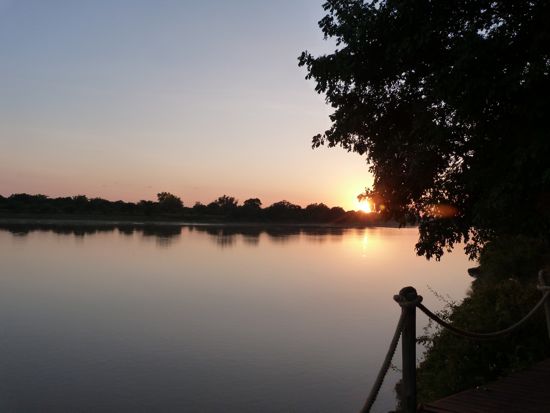
It’s a beautiful day, we eat some hot porridge and load up for a morning in the bush.
Just leaving the camp, we saw hyena ahead of us on the road, and a warthog family, and then giraffe! One, off in the distance! Later in the day we would see more of these Thornicroft giraffe, endemic to this part of Zambia.
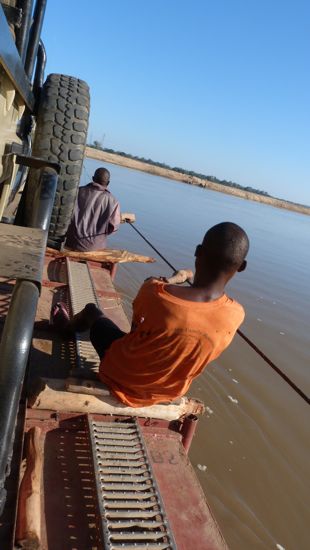
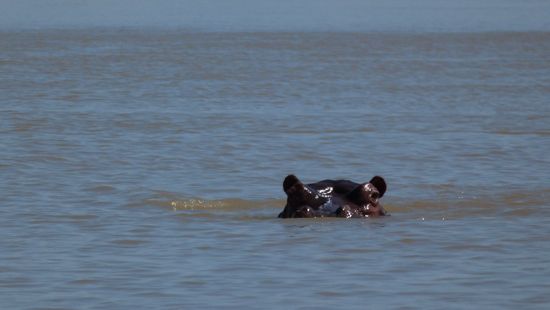
We drove up to the river cross barge, a private barge funded by the local camps to help get their guests across to the national park on the other side. The barge trip is an event in itself, hand pulled across the wide, but shallow Luangwa river. Shallow, but full of hippo, and full of crocodiles, too.

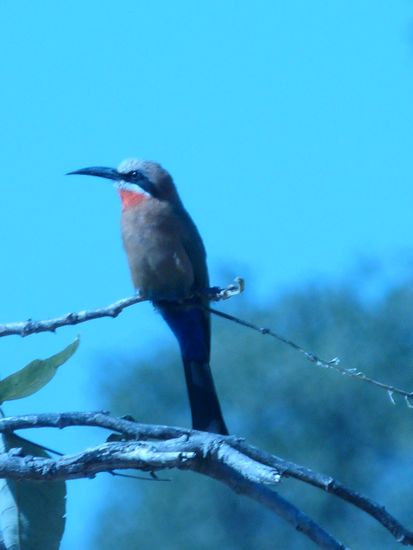
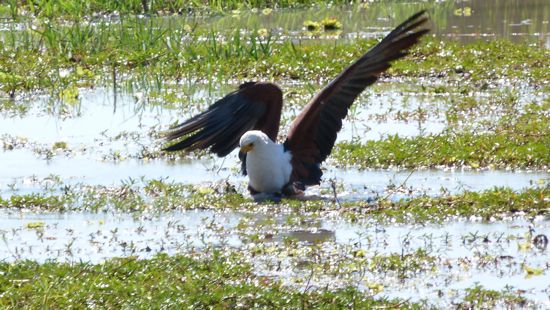
The best part of the morning was reaching a huge lagoon, full of exotic birds, and with a constant stream of animals coming to drink, parades of zebra, elephant, a fishing eagle, ibis, Egyptian duck and many others. We are a patient bunch, and we loved just finding a good position and watching the game pass through, getting a good shot when we could. By the time we headed back to the lodge for lunch, we were exhausted.

This isn’t the most crisp photo, but I love the length of that loooonnng trunk reaching out into the lagoon for water. Sometimes you only get one shot:


This is a fish eagle. The next shot, he has a fish in his claws, but it isn’t a very clear shot:

Nkwali Cape Buffalo

Then, just for our companion, we came across giraffe – lots of giraffe, but it’s not easy to get a good clear shot, because you are mostly shooting them against trees, head in the leaves, and you have to shoot fast or all you get are giraffe butts, walking away:

We leave the Land Cruiser on the National Park side of the river, and men from the camp poll us back. The river is so shallow that we almost get stuck on the sand bar.

You’d think we could just walk across, but there are territorial hippo and hungry crocodile, and we don’t want to tangle with either of them.
One of the funniest continuing jokes on the trip are the questions from people who have never traveled in Africa who with great concern ask “But what will you eat?” We took photos often, because we ate often, and well. This is our lunch the first day when we got back:

I always have a list of things I need to do. Like at these camps, women need to wash out their own underwear, it’s a cultural thing, men are doing the laundry but they won’t touch womens underclothes, so I always have some clothespins to hang things to dry. I also wanted to wash my hair, which gets dusty quickly out driving on the game drives. I have to do it in the afternoon, so it will dry (no hair dryers in the bush), and then I need to lay down, because I’m really sleepy, still jet lagging. When I wake up to the “tea-time” drums two hours later. I felt so good! I felt like it was the best sleep I had gotten since leaving Pensacola, and it made me feel good, and full of energy once again.
Here is what our cabin, and Nkwali Camp, look like:

This is our writing desk; there is one in each cabin:
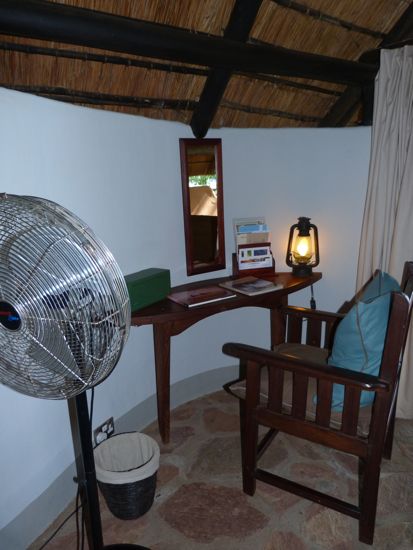
This is where you can unpack while you stay here, and where I lay out my clothes the night before so I don’t have to think when we get up early the next morning. When you are getting up really early, and only have about 15 minutes to get ready, you need to be able to get dressed without thinking too much about it. (It’s kind of like going to kid’s camp, only this is grown-up camp, LOL)

I almost hate to show you too much, it’s all such a wonderful surprise, finding these lovely cabins in the wild, but some people are so afraid to give it a try, I wanted to reassure you that it is quite civilized:
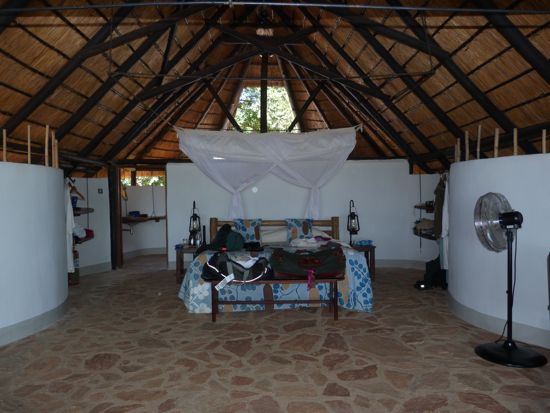
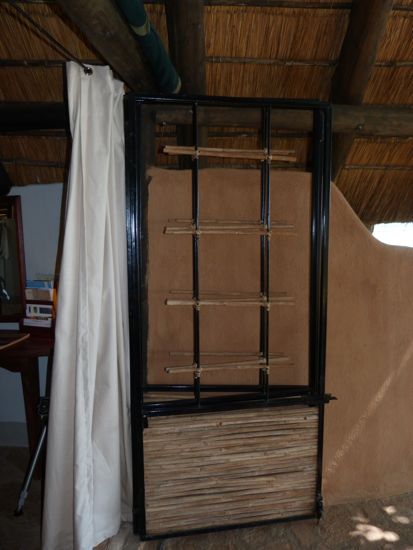
This doesn’t look like a lot, but the screen is enough to keep the wild animals out of your room when the sun goes down:
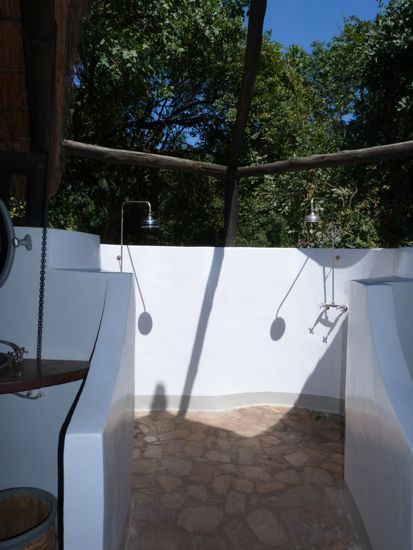
We love this bathroom:
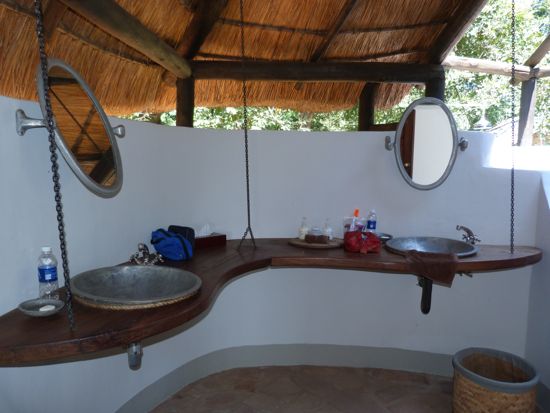

We really really love this, this huge shower, with dual heads, big enough for both of us to shower at the same time, in the hot afternoon.
This is the Nkwali dining area:

This is the pool area and lagoon adjoining the dining area:
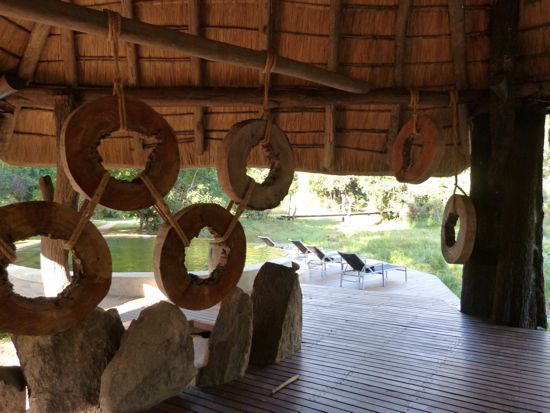
This is the gathering area/bar, and also where the campfire is, and where we eat breakfast around the campfire:
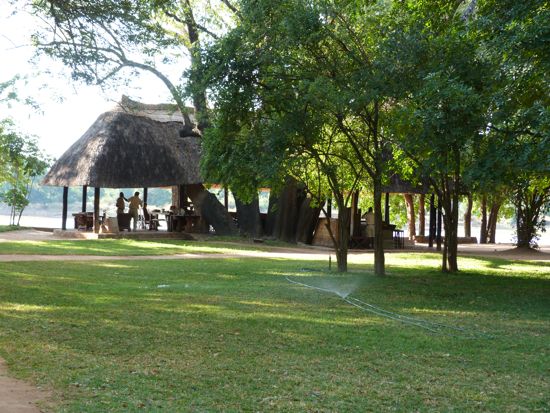
It seems to me that Nkwali is pretty much the intake area, where they help us all understand how things work, then they send us off to the other camps, Nsefu and Tena Tena, or to the fly camps (outdoor camping), or the mobile tented safaris. Before you go, you have to know the protocols, so Nkwali sort of educates you.
Your day goes like this – drums, get up, get dressed, go eat, load up into the car, go look for game. Back to camp for lunch, take care of washing underwear or hair, take a nap, drums, wake up, drink tea and eat cake, go for a game drive, stop for sun-downers, see lions (if you are lucky), back to camp, meet up in the gathering area/bar for drinks, drums for dinner, eat dinner, lay out your clothes, fall into bed (repeat)
After tea, we took a boat, polling back across to the national park, where we left the car. We drive, admiring giraffe (many!) and elephant and hippo. We run into one elephant who seriously, seriously does not like us. He does several mock charges, but he doesn’t walk away, he keeps charging.

We had a beautiful sunset on the river, and then went seriously looking for lion.


At the same time the sun is setting in the west, the full moon is rising in the east, fabulous:

The most exciting part was coming across a group of three young lions, one with a battered and bleeding ear, who tolerated our photo-taking until they didn’t. Then, one got up with a roar, and started walking and roaring.


Have you ever heard a lion roar? It is very very impressive; very loud, very resonant, it shakes your bones with its power. Shortly, one of his brothers joined him. They walked away down the wadi (what we call dry river beds when we live in the Middle East) and we thought we had a great night. Little did we know we were also going to have a leopard walk right next to our vehicle, and each of us was working frantically to figure out night time settings, so totally unexpected that not one of us got a photo. It didn’t matter. The very closeness of the passage and his utter disregard for our presence, his focus, was amazing and memorable.
All this fresh air and fabulous meals – Now I am back on schedule and sleeping through the night. I can hear the hippo outside munching as I am drifting off – but I just smile to myself and go happily straight to sleep.
BERNARD MIZEKI
Not bad, slept the night until 0530, and then found this in The Lectionary readings for today. To think I was so near, so close to the anniversary of his disappearance. . .
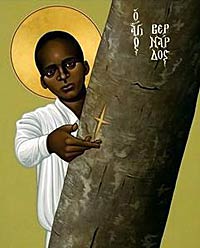
CATECHIST AND MARTYR IN AFRICA (18 JUNE 1896)
Bernard Mizeki was born in Portuguese East Africa (Mozambique) in about 1861. When he was twelve or a little older, he left his home and went to Capetown, South Africa, where for the next ten years he worked as a laborer, living in the slums of Capetown, but (perceiving the disastrous effects of drunkenness on many workers in the slums) firmly refusing to drink alcohol, and remaining largely uncorrupted by his surroundings. After his day’s work, he attended night classes at an Anglican school.
Under the influence of his teachers, from the Society of Saint John the Evangelist (SSJE, an Anglican religious order for men, popularly called the Cowley Fathers), he became a Christian and was baptized on 9 March 1886. Besides the fundamentals of European schooling, he mastered English, French, high Dutch, and at least eight local African languages. In time he would be an invaluable assistant when the Anglican church began translating its sacred texts into African languages.
After graduating from the school, he accompanied Bishop Knight-Bruce to Mashonaland, a tribal area in Southern Rhodesia (now Zimbabwe), to work there as a lay catechist. In 1891 the bishop assigned him to Nhowe, the village of paramount-chief Mangwende, and there he built a mission-complex. He prayed the Anglican hours each day, tended his subsistence garden, studied the local language (which he mastered better than any other foreigner in his day), and cultivated friendships with the villagers. He eventually opened a school, and won the hearts of many of the Mashona through his love for their children.
He moved his mission complex up onto a nearby plateau, next to a grove of trees sacred to the ancestral spirits of the Mashona. Although he had the chief’s permission, he angered the local religious leaders when he cut some of the trees down and carved crosses into others. Although he opposed some local traditional religious customs, Bernard was very attentive to the nuances of the Shona Spirit religion. He developed an approach that built on people’s already monotheistic faith in one God, Mwari, and on their sensitivity to spirit life, while at the same time he forthrightly proclaimed the Christ. Over the next five years (1891-1896), the mission at Nhowe produced an abundance of converts.
Many black African nationalists regarded all missionaries as working for the European colonial governments. During an uprising in 1896, Bernard was warned to flee. He refused, since he did not regard himself as working for anyone but Christ, and he would not desert his converts or his post. On 18 June 1896, he was fatally speared outside his hut. His wife and a helper went to get food and blankets for him. They later reported that, from a distance, they saw a blinding light on the hillside where he had been lying, and heard a rushing sound, as though of many wings. When they returned to the spot his body had disappeared. The place of his death has become a focus of great devotion for Anglicans and other Christians, and one of the greatest of all Christian festivals in Africa takes place there every year around the feast day that marks the anniversary of his martyrdom, June 18.
by James Kiefer
Sorry, China!
Found this on AOL News, reported by the Huffington Post
“Stop! Stop!” says China. “It is illegal to publish air pollution readings!”
LLLLLOOOOLLLLLLLL! Sorry, China, those days are past. Too many ways the information can get out and verified.
(Clarifies translated comment from ministry spokesman)
By Ben Blanchard
BEIJING, June 5 (Reuters) – A senior Chinese official demanded on Tuesday that foreign embassies stop issuing air pollution readings, saying it was against the law and diplomatic conventions, in pointed criticism of a closely watched U.S. embassy index.
The level of air pollution in China’s heaving capital varies, depending on the wind, but a cocktail of smokestack emissions, vehicle exhaust, dust and aerosols often blankets the city in a pungent, beige shroud for days on end.
Many residents dismiss the common official readings of “slight” pollution in Beijing as grossly under-stated.
The U.S. embassy has installed a monitoring point on its roof which releases hourly air-quality data via a widely followed Twitter feed. The U.S. consulates in Shanghai and the southern city of Guangzhou provide a similar service.
While China tightened air pollution monitoring standards in January, the official reading and the U.S. embassy reading can often be far apart.
Chinese experts have criticised the single U.S. embassy monitoring point as “unscientific”.
Deputy Environment Minister Wu Xiaoqing went a step further, saying such readings were illegal and should stop, though he did not directly name the United States.
“According to the Vienna Convention on Diplomatic Relations … foreign diplomats are required to respect and follow local laws and cannot interfere in internal affairs,” Wu told a news conference.
“China’s air quality monitoring and information release involve the public interest and are up to the government. Foreign consulates in China taking it on themselves to monitor air quality and release the information online not only goes against the spirit of the Vienna Convention … it also contravenes relevant environmental protection rules.”
Chinese Foreign Ministry spokesman Liu Weimin called on foreign diplomatic missions to respect China’s laws and regulations and to stop issuing the readings, “especially over the Internet”.
“If the foreign embassies want to collect this kind of information for their own staff and diplomats, I think it’s up to them,” Liu told reporters. “They can’t release this information to the outside world.”
The U.S. embassy acknowledges on its website (http://beijing.usembassy-china.org.cn) that its equipment cannot be relied upon for general monitoring, saying “citywide analysis cannot be done … on data from a lone machine”.
Despite his criticism, Wu acknowledged that China’s air quality and overall environmental situation remained precarious, with more than one tenth of monitored rivers rated severely polluted, for example.
“What needs saving is the country’s air quality, not the government’s face,” Zhou Rong, an energy campaigner for Greenpeace, said in emailed comments. “The environmental authorities must stop finger pointing and start taking actions that really address the issue.” (Additional reporting by Sui-Lee Wee; Editing by Nick Macfie)
And this also from the Huffington Post:
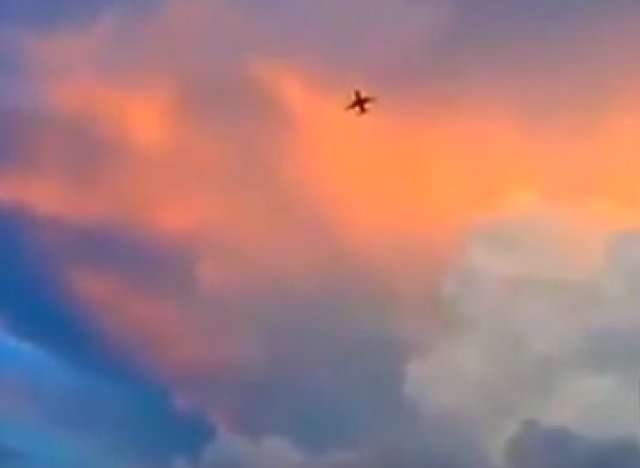
A mushroom-like cloud was spotted over Beijing earlier this week, closely resembling the explosion of an atomic bomb, reports China Daily.
Now, footage of the mysterious cloud has been released on YouTube. One shows raw video of the haze taken from what appears to be a high-rise building, while another video is an edited version documenting the haze on June 14.
The yellow and green haze led Chinese authorities to advise residents to stay inside Monday, according to Agence France-Presse.
While rumors swarmed online about the cause of the unusual cloud, Chinese police arrested two internet users who said the pollution had been triggered by a chlorine leak at a chemical plant or an explosion at a steel refinery, notes The Economic Observer.
Meanwhile, government authorities told the Xinhua news agency straw burning was the cause and denied there had been any industrial accidents.
Air pollution is increasingly becoming a major problem in China, and the government is often accused of downplaying the severity of the problem in metropolitan areas.
Earlier this month, China demanded the U.S. Embassy in Beijing to stop publishing air pollution readings, saying it was against diplomatic conventions and the law.
Packing For a Purpose
Part of what we love about the Robin Pope Safari Camps is that we also get to go into the village and see how the schools are doing. There is a consortium of safari camp service providers who donate a portion of their profits every year to providing for and maintaining schools, finding sponsors for children who have no parents, finding help for teachers in obtaining much needed supplies.
Many of the children of the village are truly being raised by the village, as fathers and mothers succumb to the dreaded wasting disease, to malaria, to yellow fever and to problems attending poor nutrition and inadequate access to health care. The camps bring in a volunteer doctor, when they can, who works with the villages six months to a year or so. Children are looked after by aunts and uncles, or grandparents, or a neighbor – who may not have much to spare, with her own children to look after.
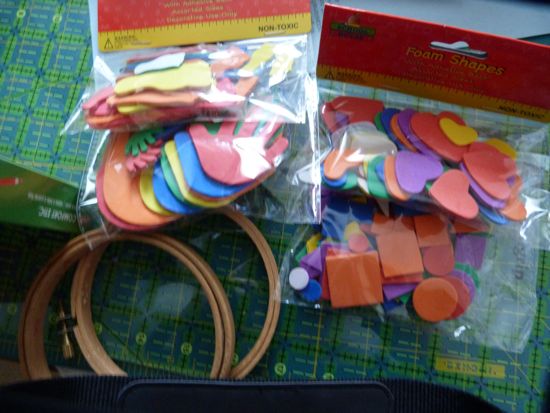
So, with a prayer, we headed for Staples to pick up school supplies. What a deal! Pocket dictionaries! Boxes of 60 pens! It is so exciting, I bought too much, and now we are hoping they won’t weigh our suitcases too accurately. We’ve jammed a lot in . . .

I should have checked the website again before I shopped, or I wouldn’t have bought so many pencils, but they DO still need erasers, and I bought a lot of those. And I try to stick in something they might have some fun with – sticky notes. foam shapes. glue sticks. This year I am including some threads and counted cross stitch fabrics, hoping maybe someone will develop an interest in needlework 🙂
We are getting so excited we can hardly stand it. AdventureMan is trying lots of new techniques and camera equipment, hoping to get some stellar shots. I am taking my new Lumix, the FZ40/45, a lightweight camera with a 24X optical zoom. He gets great artistic shots (water drops dripping off a wide-open hippo mouth as he opens his jaw unbelievably wide) and I get great documentary shots – the rooms, the bathroom fixtures (LOLL, yes, I can’t help it, I love creative design!) and textiles, as well as the wildlife and the environment.
We had just enough room in our suitcases for all the school supplies. Now we will have room for that last stop at Tribal Textiles . . . 🙂
Prescribed or Proscribed?
We will be taking a trip soon, and, thanks be to God, our travel companions alerted us in time that there is a new requirement for Yellow Fever Shots, malarial precautions are now strongly recommended, AND medications we buy over the counter are prescription medications in Zambia, and you can be arrested for carrying them into country; they would be contraband.

Horrors! I’ve always taken Benedryl for my allergies, and because I am also a mosquito magnet, I use Benedryl gel to survive the mosquitos, and the tse-tse flies. Our doctor is a gem; he wrote prescriptions and today we got them filled so we can take our OTC medications into Zambia with us. The pharmacists didn’t bat an eye. They see it all the time.

“You heading out on a mission?” another customer asked.
“Not a religious mission,” I laughed. AdventureMan has a mission to get some spectacular photographs. Pensacola has several churches that sponsor major missions throughout the world, and missionaries are found in Pensacola pharmacies stocking up on a couple years worth of prescription medications – as well as the medications proscribed by host countries. I also suspect that having all these people that travel and live throughout the world contributes to the variety of cuisines available and sought after in Pensacola restaurants. I just wish we’d get some Ethiopians!
Alaskan Heritage Celebration
I’m researching the Inuit / Eskimo / Yup’ik mask my Mother bought lo, these many many moons ago, and like anyone born to research, I am hopelessly lost, and enjoying every minute of the journey.
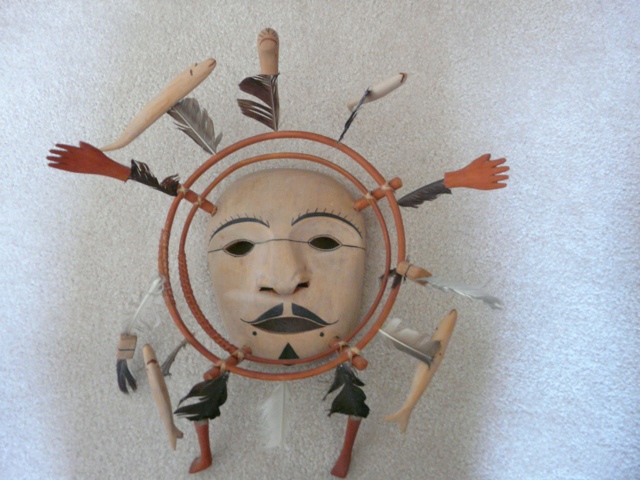
I’m not Alaskan. I was born in Alaska, and so many times through the years when I see blocks that need ticking, I have been tempted to tick “native Alaskan” but I know that they don’t mean me, and that there are people who really deserve those preferences. I FEEL Alaskan, even though I’ve been gone a long time.
(My Mother used to tell us not to play with the “natives” because “they had knives!” (Big scary eyes). LLLOOOLLLL! Can you think of any quicker way to get your kids to play with the forbidden group? They had knives! Plus, they were our neighbors, and our classmates, and we all played together. Skied together. Played Cowboys and . . . Indians. Yes! We did! LLOOOLLL!)
I found this fabulous video of segments from the “Celebration 2010” There is a reason I am sharing this – first, for all my friends of all nations who love textiles and handwork as I do – and our name is legion – I want you to see this video and to see the magnificant ceremonial robes they are wearing. They have to be hand made; they are each so individual, even among people of the same clan, the bear is different, one from the other, the fish – different, the raven – fabulously different, I even saw a sun! I hope your heart goes pitter patter, just as mine is going.
I wish I could bring this entire celebration to Kuwait and do a presentation with the KTAA (Kuwait Textile Arts Association.) They would LOVE these crafts, and the dancing. Look at the wonderful drums!
Second – did you hear them ululate? This is what I love about my travels; no matter what our differences, we have some amazing similarities.
Celebration, a First Nation heritage event taking place in Juneau, Alaska, originated and was sponsored in 1982 by Sealaska. The gathering takes place every other year and is the biggest event for Native Americans in Alaska for Tlingit, Haida and Tsimshian peoples.
To me, the coolest thing of all is that this is not done for tourists, but for the First Nation peoples, to transmit their culture to their children, and to celebrate themselves. This second video focuses on the clans and their special dances:
Now here is the exciting thing. It only happens every two years. This year it will take place June 6 – June 9. Here’s the information:
Celebration Native Cultural Conference
June 06, 2012 to June 09, 2012
A biennial Native cultural celebration featuring colorful costumed processions, dance performances, authentic arts and crafts and gatherings. Held in various venues including Centennial Hall Convention Center.
907-463-4844
http://www.sealaskaheritage.org
We already have plans for this June (I’ll share more about that later) but I talked to AdventureMan and said I really, really want to go in 2014. He said (are you sitting down?) “That’s just the kind of thing I LOVE! We’ve been planning to go to Alaska anyway, let’s go for that celebration!”
And that is why, after all these years of being married, I still adore my husband. He is a man with a heart for Adventure, and he gets all excited about the same things I do, well, some of the time. There was a falcon fest once in Tunisia that he dragged his feet on because he had just gotten in from a long trip, but once we got there, we all agreed it was one of those things that we would have regretted forever if we missed it. He is always up for a new adventure!
Wooooo HOOOOOOOOO!
See you there?
May In Seattle
From the bone chilliing 47 degrees mid-day on my arrival, the temperatures in Seattle flew up up and up. By Sunday, the American Mother’s Day, the temperatures were up 30 something degrees, in the mid to high 70’s, and Monday and Tuesday were the same. Good thing we got most of the heavy sorting and tossing andhauling done during the beautiful, but cooler weather before the weekend.
We had a lovely Mother’s Day, Mom got to sit out in the sun, under a huge umbrella, got to play with her great grandchildren, had all her children surrounding her. It was a gorgeous sunny day in a beautiful setting. We all had a lot of fun.
To add icing to the cake, I had the great luxury of time with my best friend from college, time to sit around and catch up, philosophize, all the things we did before husbands and children came along. Now we have as much to talk about as ever, and the great luxury of time in this trip to get to know all the little things, too. What a great blessing. Back to Pensacola, and gearing up for the next big trip!
Jesmyn Ward and Salvage the Bones

You are fifteen, poor, black, and motherless as this book opens. Dad drinks, and isn’t around much. You are the only girl in a family of brothers. Having sex is no big deal, and there is one guy you really like, Manny.
Your oldest brother’s pit bull is having puppies, and you are having trouble with throwing up most of what you eat, especially every morning. Dad says a hurricane is coming, but he’s said that before, no big deal.
As this book opens, it has the feel of a myth of the nightmare kind. We know, because we have the benefit of hindsight, that the impending storm, Katrina, will be catastrophic. The Batiste family has already suffered a catastrophic storm with the death of their Mama, just after the birth of her last child. Throughout the book, we watch these children suffer the daily absence of their mother, raising one another, squabbling, but tenderly looking after one another.
If someone had told me about this book, I don’t think I would have wanted to read it. Amazon.com kept telling me I needed to read it, so finally, I did. From the opening page, I was in a world utterly alien from my own, and yet a world I could understand and inhabit. There are worse things than being poor, and one of them is heartless. This family has heart; they are loyal to one another, they look after one another and they sacrifice for one another. For all the violence – and there is a lot of violence – there is also beauty.
There is the familial love, and there is the love between Skeet, the oldest brother, and his dog, China. There is friendship, and good people who give you refuge in the aftermath of the storm. There is the stunning numbness of surviving the worst hurricane ever.
Jesmyn West has a deft touch, with the language, with the interweaving of the Medea myth, with non-verbal communication, with the complexities of families and love. This is a book worth reading.
Recent Comments
ExpatAlien on What Country am I Living … intlxpatr on Yellowstone: Old Faithful to C… Michelle on Yellowstone: Old Faithful to C… Cathy on No Grown-Ups in Charge intlxpatr on Waiting for Snow Wikipedia Donate Button

Amazina


Early Voting in Florida


 Here There and Everywhere