Donna Leon and Beastly Things Made Me Cry

I can always count on Donna Leon. She gives me a good read, a solid mystery, a social issue, the louche damp atmosphere of Venice and the Venetian aristocracy, and my good friend Guido Brunetti, police commissario, with his lovely wife and dear children and great Italian meals.
This time, she fooled me.
A barrel chested man is found floating in the canals with no identification. When identified, he is found to be a veterinarian, separated from his angry and hostile and broken-hearted wife.
Then Donna Leon pulls me way out of my comfort zone – TWICE. First, there are parts of the book I can scarcely read, as she talks about the meat industry. I’m reading this book, dealing with the meat industry, and I’ve just watched the movie GreY posted on the devastation meat eating causes in your metabolism and blood; the passages in Beastly Things sealed the deal – I don’t think I can eat red meat again. I’m not sure I can even be around red meat. Leon is fearless; she spotlights issues few dare to tackle. There are issues here that are not for the faint-hearted. Read at your own risk.
It’s a tricky mystery, and at the end, Leon catches me by surprise again, as she describes the funeral of the veterinarian, a very unusual funeral, where his patients are also in attendance. It was hard to read. My eyes were blurring. If you like mysteries, if you have pets you adore, this is the sweetest literary funeral you will ever attend.
“I Want to See How they Handle the Israel Problem.”
AdventureMan zipped left across three lanes of traffic and into a parking lot.
“What are you doing?” I hollered, hanging on for dear life.
“Jordan Valley restaurant has a new sign up, a big map of the Middle East, and I want to see how they handle the Israel problem,” he answered.
That explains everything. No, really, it does. We’ve been married for a long time, I know what he means.
“Very clever,” we both agreed.

Teachers’ Expectations Evoke Life-Changing Achievement
Yes, this is a long article from National Public Radio, but it’s important. I want you to read it, and if you have the time, go to the website – you can click on the blue type above – and listen to it yourself, because it is life changing for us, and for how we treat our children, too.
Do it at a time when you have time to listen. It caught me by surprise, but I was so enthralled, I stayed for the entire segment. Children with the greatest challenges can succeed, if they are nurtured and mentored. Any child can be a success; there are no losers. This is powerful stuff. 🙂
by ALIX SPIEGEL
In my Morning Edition story today, I look at expectations — specifically, how teacher expectations can affect the performance of the children they teach.
The first psychologist to systematically study this was a Harvard professor named Robert Rosenthal, who in 1964 did a wonderful experiment at an elementary school south of San Francisco.
The idea was to figure out what would happen if teachers were told that certain kids in their class were destined to succeed, so Rosenthal took a normal IQ test and dressed it up as a different test.
“It was a standardized IQ test, Flanagan’s Test of General Ability,” he says. “But the cover we put on it, we had printed on every test booklet, said ‘Harvard Test of Inflected Acquisition.’ ”
Rosenthal told the teachers that this very special test from Harvard had the very special ability to predict which kids were about to be very special — that is, which kids were about to experience a dramatic growth in their IQ.
After the kids took the test, he then chose from every class several children totally at random. There was nothing at all to distinguish these kids from the other kids, but he told their teachers that the test predicted the kids were on the verge of an intense intellectual bloom.
As he followed the children over the next two years, Rosenthal discovered that the teachers’ expectations of these kids really did affect the students. “If teachers had been led to expect greater gains in IQ, then increasingly, those kids gained more IQ,” he says.
But just how do expectations influence IQ?
As Rosenthal did more research, he found that expectations affect teachers’ moment-to-moment interactions with the children they teach in a thousand almost invisible ways. Teachers give the students that they expect to succeed more time to answer questions, more specific feedback, and more approval: They consistently touch, nod and smile at those kids more.
“It’s not magic, it’s not mental telepathy,” Rosenthal says. “It’s very likely these thousands of different ways of treating people in small ways every day.”
So since expectations can change the performance of kids, how do we get teachers to have the right expectations? Is it possible to change bad expectations? That was the question that brought me to the Curry School of Education at the University of Virginia, where I met Robert Pianta.
Pianta, dean of the Curry School, has studied teachers for years, and one of the first things he told me when we sat down together was that it is truly hard for teachers to control their expectations.
“It’s really tough for anybody to police their own beliefs,” he said. “But think about being in a classroom with 25 kids. The demands on their thinking are so great.”
Still, people have tried. The traditional way, Pianta says, has been to sit teachers down and try to change their expectations through talking to them.
“For the most part, we’ve tried to convince them that the beliefs they have are wrong,” he says. “And we’ve done most of that convincing using information.”
But Pianta has a different idea of how to go about changing teachers’ expectations. He says it’s not effective to try to change their thoughts; the key is to train teachers in an entirely new set of behaviors.
For years, Pianta and his colleagues at the Curry School have been collecting videotapes of teachers teaching. By analyzing these videos in minute ways, they’ve developed a good idea of which teaching behaviors are most effective. They can also see, Pianta tells me, how teacher expectations affect both their behaviors and classroom dynamics.
Pianta gives one very specific example: the belief that boys are disruptive and need to be managed.
“Say I’m a teacher and I ask a question in class, and a boy jumps up, sort of vociferously … ‘I know the answer! I know the answer! I know the answer!’ ” Pianta says.
“If I believe boys are disruptive and my job is control the classroom, then I’m going to respond with, ‘Johnny! You’re out of line here! We need you to sit down right now.’ ”
This, Pianta says, will likely make the boy frustrated and emotionally disengaged. He will then be likely to escalate his behavior, which will simply confirm the teacher’s beliefs about him, and the teacher and kid are stuck in an unproductive loop.
But if the teacher doesn’t carry those beliefs into the classroom, then the teacher is unlikely to see that behavior as threatening.
Instead it’s: ” ‘Johnny, tell me more about what you think is going on … But also, I want you to sit down quietly now as you tell that to me,’ ” Pianta says.
“Those two responses,” he says, “are dictated almost entirely by two different interpretations of the same behavior that are driven by two different sets of beliefs.”
To see if teachers’ beliefs would be changed by giving them a new set of teaching behaviors, Pianta and his colleagues recently did a study.
They took a group of teachers, assessed their beliefs about children, then gave a portion of them a standard pedagogy course, which included information about appropriate beliefs and expectations. Another portion got intense behavioral training, which taught them a whole new set of skills based on those appropriate beliefs and expectations.
For this training, the teachers videotaped their classes over a period of months and worked with personal coaches who watched those videos, then gave them recommendations about different behaviors to try.
After that intensive training, Pianta and his colleagues analyzed the beliefs of the teachers again. What he found was that the beliefs of the trained teachers had shifted way more than the beliefs of teachers given a standard informational course.
This is why Pianta thinks that to change beliefs, the best thing to do is change behaviors.
“It’s far more powerful to work from the outside in than the inside out if you want to change expectations,” he says.
In other words, if you want to change a mind, simply talking to it might not be enough.
7 Ways Teachers Can Change Their Expectations
Researcher Robert Pianta offered these suggestions for teachers who want to change their behavior toward problem students:
Watch how each student interacts. How do they prefer to engage? What do they seem to like to do? Observe so you can understand all they are capable of.
Listen. Try to understand what motivates them, what their goals are and how they view you, their classmates and the activities you assign them.
Engage. Talk with students about their individual interests. Don’t offer advice or opinions – just listen.
Experiment: Change how you react to challenging behaviors. Rather than responding quickly in the moment, take a breath. Realize that their behavior might just be a way of reaching out to you.
Meet: Each week, spend time with students outside of your role as “teacher.” Let the students choose a game or other nonacademic activity they’d like to do with you. Your job is to NOT teach but watch, listen and narrate what you see, focusing on students’ interests and what they do well. This type of activity is really important for students with whom you often feel in conflict or who you avoid.
Reach out: Know what your students like to do outside of school. Make it a project for them to tell you about it using some medium in which they feel comfortable: music, video, writing, etc. Find both individual and group time for them to share this with you. Watch and listen to how skilled, motivated and interested they can be. Now think about school through their eyes.
Reflect: Think back on your own best and worst teachers, bosses or supervisors. List five words for each that describe how you felt in your interactions with them. How did the best and the worst make you feel? What specifically did they do or say that made you feel that way? Now think about how your students would describe you. Jot down how they might describe you and why. How do your expectations or beliefs shape how they look at you? Are there parallels in your beliefs and their responses to you?
Libyans Say “Sorry” In Counter-Protests
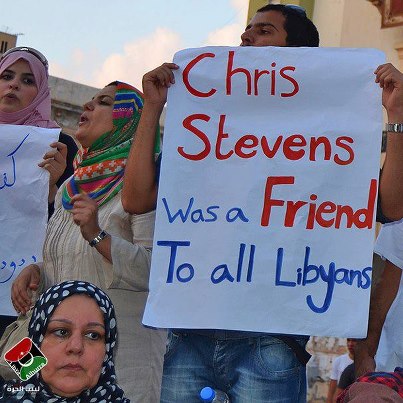
I was living in Qatar, and the Libyan ambassador’s wife had invited me, along with several other women, to morning coffee. It’s what people did. I was sitting between one of my Libyan friends and my good Iranian friend, and I started laughing. I said “Oh, what is this good little American girl doing sitting between a Libyan and an Iranian?” and then we all laughed. We weren’t Libyan, or American, or Iranian, we were just women who liked each other; we got along.
We were all religious women. Not the same religion, but all believers in the Abrahamic tradition. I felt more comfortable with them than I felt around non-religious women. We had a lot of fun together, and we liked each other.

It breaks my heart when bad things happen, and I know how good these people are, and that the people on the attack have their own agenda which has nothing to do with Islam, or Christianity, and everything to do with power. If they prevail, I fear for my good friends.

This article from USA Today made me cry this morning. Ambassador Stevens was loved, and these brave people are risking their futures to tell us so.

Libyans express sorrow over killing of Americans
by Donna Leinwand Leger, USA TODAY
Hours after learning of Ambassador Chris Stevens’ death, the Libyan Youth Movement transformed its Facebook page into a tribute to the slain diplomat. It changed its cover photo from “Free Libya” graffiti sprayed on a Tripoli wall to a somber photo of Stevens with the tag “RIP Christopher Stevens1960-2012.”
“As North America wakes up, dread washes over me. What a rough night. I’m sorry for the horrible day the world is about to face,” the administrator of the Shabab Libya page wrote. “We are sorry.”
As anti-American protests swept across North Africa and the Persian Gulf, a counter-protest of apology emerged. Photos of Libyans carrying hand-lettered signs condemning the violence and expressing contrition for their countrymen appeared on Facebook. “Sorry” became the trending mantra of Libyans on Twitter.
At one counter-protest, an unidentified man carried a crude sign phonetically written in English with blue marker on lined notebook paper, “Sorry People of America this not the Pehavior of our ISLAM and Profit.”
Another sign in red, white and blue read: “Chris Stevens wasa friend to all Libyans.”
On Facebook, one group formed The Sorry Project, designed to collect thousands of personal, written apologies from Libyans. Its profile photo is a man holding a sign, “USA. We are sorry. We are sad.”
“We Are Sorry,” the group wrote on the page created Sept.11. “We would like show that as Libyans we do not support on the actions committed by these criminals. USA, we are sorry and we will say it one thousand times over. Our apologies will never be enough, but the Libyan people will always be grateful for you since you were the first to stand by us in our fight for freedom and hopefully you will continue supporting us.”
One commenter, Hajer Sharief, vowed to avenge Stevens’ death by rebuilding a “new civilized democratic Libya.”
“We promise, we will not tire, we will not falter, and we will not fail,” Sharief wrote. “This is the way real Libyans will pay you back Mr. Ambassador Chris Stevens.”
At the ceremony Friday outside Washington to repatriate the remains of the four American victims, President Obama acknowledged Libya’s internal conflict.
“I know that this awful loss, the terrible images of recent days, the pictures we’re seeing again today, have caused some to question this work. And there is no doubt these are difficult days. In moments such as this — so much anger and violence — even the most hopeful among us must wonder,” Obama said. “But amid all of the images of this week, I also think of the Libyans who took to the streets with homemade signs expressing their gratitude to an American who believed in what we could achieve together. I think of the man in Benghazi with his sign in English, a message he wanted all of us to hear that said, ‘Chris Stevens was a friend to all Libyans.’ “
AdventureMan’s Garden
It’s all about rebirth, transformation, and new life. Gardening is a discipline, and a spiritual endeavor. You can plant the seeds, you can tend the process, but only God can make those seeds grow and flourish.
AdventureMan is so happy. He loves his garden. No, he doesn’t love weeding (does anyone?) but he loves the feeling of satisfaction when he looks at a formerly weedy bed and sees that it looks great now. His moonflowers are starting to bloom, his tomatoes are starting to ripen, we are using 8 different kinds of fresh basil, he has bounteous peppers, enough to share generously – life is good.

Tomatoes and more tomatoes!


An abundance of jalepenos!

Pear tomatoes coming along:


This is one of his butterfly gardens. We have all kinds of butterflies coming through, laying eggs, and hatching into butterflies – Monarchs, Gulf Fritillaries, Sulpher, Brown Beauties, many that he can name that I can’t!

He has been accepted into the Master Gardener’s program and is about to dazzle me with all his gardening expertize! 🙂
How One Church Handles Cell Phone Interruptions
LLLOOOOOLLLLLLL! A church with a sense of humor! Thank you, Kit Kat!
US Ambassador Killed by Angry Mob in Libya
Most people who die heroic deaths don’t wake up in the morning thinking “today I will do something heroic.” Most people who die heroic deaths end up dead because they make a choice to do the right thing.
Some minor film maker made a film mocking the prophet Mohammed. Under our system, it was his right; a man (or woman) can say what they think, even if another disagrees with it. It doesn’t mean the film is accurate, it doesn’t make it a good film; he had an idea and he made a film. The film – or even the idea of the film – is causing outrage, and attacks on US Embassies in Islamic countries. Ambassador Chris Stevens personally went to the consulate site to make sure his people got out safely while the consulate was under attack by an angry mob. He lost his life in the effort. May he rest in peace.
I’ve never liked crowds, and even less when a crowd is excited, or angry, and becomes a mob. There is something about doing things as a large group that anesthetizes thinking; mobs do horrendous things that any one individual acting within the mob would never do. Group-think is dangerous thinking; you need disagreement and dissent to rein in rash actions.
From today’s Huffpost:
TRIPOLI, Libya — The U.S. ambassador to Libya and three American members of his staff were killed in the attack on the U.S. consulate in the eastern city of Benghazi by protesters angry over a film that ridiculed Islam’s Prophet Muhammad, Libyan officials said Wednesday.
They said Ambassador Chris Stevens was killed Tuesday night when he and a group of embassy employees went to the consulate to try to evacuate staff as the building came under attack by a mob guns and rocket propelled grenades.
The three Libyan officials who confirmed the deaths were deputy interior minister for eastern Libya Wanis al-Sharaf; Benghazi security chief Abdel-Basit Haroun; and Benghazi city council and security official Ahmed Bousinia.
The State Department said Tuesday that one American was killed in the attack. It has not confirmed the other deaths.
The attack on the Benghazi consulate took place as hundreds of protesters in neighboring Egypt scaled the walls of the U.S. Embassy in Cairo and tore down and replaced the American flag with a black Islamic banner.
The attacks in Benghazi and Cairo were the first such assaults on U.S. diplomatic facilities in either country, at a time when both Libya and Egypt are struggling to overcome the turmoil following the ouster of their longtime authoritarian leaders, Moammar Gadhafi and Hosni Mubarak, in uprisings last year.
The protests in both countries were sparked by outrage over a film ridiculing Muhammad produced by an Israeli filmmaker living in California and being promoted by an extreme anti-Muslim Egyptian Christian campaigner in the United States. Excerpts from the film dubbed into Arabic were posted on YouTube.
Stevens, 52, was a career diplomat who spoke Arabic and French and had already served two tours in Libya, including running the office in Benghazi during the revolt against Gadhafi. He was confirmed as ambassador to Libya by the Senate earlier this year.
Before Tuesday, five U.S. ambassadors had been killed in the line of duty, the last being Adolph Dubs in Afghanistan in 1979, according to the State Department historian’s office.
___
Michael reported from Cairo. Associated Press writer Matthew Lee in Washington contributed to this report.
“I Am The Good Shepherd”

Every time I read those words from the Gospel of John, I am transported back to our first tour in Jordan, sitting outside our little villa near fourth circle, watching the shepherd and the sheep go by. Dusk is falling, you can hear multiple calls to prayer issuing from nearby mosques, and the shepherd is crossing back to their night time pastures.
But there is a ditch, a deep ditch, for new sewer and water lines, and there is only a thin board by which to cross.
One by one, he carries the sheep across. It takes a long time. The sheep are restless, but with a few words, he calms them. They don’t stray, they wait for him to lift and carry them across. Once across, they wait for the rest to follow before they all head on their way. The shepherd is grimy and dusty, covered with mud from ferrying the sheep across the ditch.
The sheep know the shepherd’s voice, and when faced with a new threat, they trust that he will deliver them safely. Sheep are pretty stupid. On their own, they can get into all kinds of trouble. If they have a good shepherd, they are safe.
This is today’s Gospel reading from John:
John 10:1-18
10‘Very truly, I tell you, anyone who does not enter the sheepfold by the gate but climbs in by another way is a thief and a bandit. 2The one who enters by the gate is the shepherd of the sheep. 3The gatekeeper opens the gate for him, and the sheep hear his voice. He calls his own sheep by name and leads them out. 4When he has brought out all his own, he goes ahead of them, and the sheep follow him because they know his voice. 5They will not follow a stranger, but they will run from him because they do not know the voice of strangers.’ 6Jesus used this figure of speech with them, but they did not understand what he was saying to them.
7 So again Jesus said to them, ‘Very truly, I tell you, I am the gate for the sheep. 8All who came before me are thieves and bandits; but the sheep did not listen to them. 9I am the gate. Whoever enters by me will be saved, and will come in and go out and find pasture. 10The thief comes only to steal and kill and destroy. I came that they may have life, and have it abundantly.
11 ‘I am the good shepherd. The good shepherd lays down his life for the sheep. 12The hired hand, who is not the shepherd and does not own the sheep, sees the wolf coming and leaves the sheep and runs away—and the wolf snatches them and scatters them. 13The hired hand runs away because a hired hand does not care for the sheep. 14I am the good shepherd. I know my own and my own know me, 15just as the Father knows me and I know the Father. And I lay down my life for the sheep. 16I have other sheep that do not belong to this fold. I must bring them also, and they will listen to my voice. So there will be one flock, one shepherd. 17For this reason the Father loves me, because I lay down my life in order to take it up again. 18No one takes* it from me, but I lay it down of my own accord. I have power to lay it down, and I have power to take it up again. I have received this command from my Father.’
Ten Shot While Kuwaiti Youngsters Are ‘Just Having Fun’
As AdventureMan and I read the Pensacola News Journal, we often wonder if we knew what we were getting into. Shootings in Pensacola are frequent. Killings, by gun, by beating, by knife – are equally frequent. Pensacola has one of the highest violent death rates per capita in the nation. Just this week a 72 year old man shot a preacher at his church because he thought the preacher was having an affair with his 69 year old wife. He then tried to enter the child care center where she was caring for small children, still with his loaded weapon. The paper quotes his wife as saying he has mental health issues.
What are people with mental health issues doing with loaded guns???
My Southern friends ask me if we more strictly regulate guns, how will they protect themselves, that the ‘bad guys’ will still have guns. Right now, they can protect themselves, they also have the right to shoot to defend their property? I can’t answer. All I know for sure is that the more people who carry guns, the more likely guns are to be used when the instinct strikes, whether it is a real threat or a perceived threat.
And then – there are these Kuwaiti teens, shooting passers-by, and when arrested, still carrying the shotgun used, say that they were ‘just having fun.’
KUWAIT: Jahra detectives, in cooperation with criminal investigation detectives, have arrested two Kuwaiti 17-year-old juveniles on charges of misuse of a hunting gun, which resulted in the shooting and wounding of 10 people in Jahra area. Police received several reports of pedestrians being wounded after they were shot by unknown assailants. Following an investigation, the juveniles were arrested with the gun still in their possession. They confessed to the shootings, claiming they were only having a good time. The teens were sent to concerned authorities. Later, Ministry of Interior officials called upon citizens and expatriates to watch their children and prevent them from behaving in ways that might cause harm to others, as the parents could be held liable for their children’s acts.
By Hanan Al-Saadoun, Staff Writer
Kuwait Times
The link refers to ‘hunting gun misuse.’ Because they are Kuwaiti, and because they are young, they are unlikely to have any severe punishment. They are likely to be released into the custody of their parents. Where were these parents when their children wounded ten innocent people? What lesson do these young men, 17 years old, learn if they can shoot ten people and be charged with ‘misuse’ of a weapon?
The only good thing I can think of in this case is that these youngsters had so little self-discipline that they never learned to shoot straight, thus no one was killed. They weren’t just lacking in any compassion for their fellow human beings, they were also bad shots. (I’m from a hunting culture. That’s an insult.)
Happy Birthday Cakes
Today I have been blogging for six years.

This gorgeous cake is from cakeguru.com
So much has changed. Six years ago, I was newly arrived in Kuwait. Kuwait had a vibrant and quickly changing blogging scene; even before we moved to Kuwait I had followed the blogs. Some came and went quickly, and a few very good ones are still in existence. Some other very good bloggers have also dropped off the scene.
Blogging is different now. Time is scarce, topics in Pensacola are far less exotic that sights and sounds and smells and celebrations in the Gulf.
I keep blogging because of my friends. I sent off a quilt to one of my first blogging friends the other day, to welcome her first little baby boy. Another friend wrote “I keep up with you through your blog, but that’s not really fair to you if I don’t comment.” I have a friend in Syria whose safety I am praying for. I think of all my friends in Kuwait who appreciated my daily sunrise photo, and what fun it was for me to look at StatCounter and see all the Kuwaiti students at university who would look to see what Kuwait looks like “this” morning. It’s fun for me. One of the reasons I started blogging still holds true – there is so much every day stuff I forget if I don’t write it down. This is my record.
The other part of what keeps me blogging is what I learn from you. This world is full of wonderful and amazing things, and so many things I didn’t even know I didn’t know, I have learned from you, my readers.
Here’s something that hasn’t changed: I still love over-the-top cakes. No, not eating them, just admiring them. So in honor of six years of blogging, I have selected cakes to please every taste. Enjoy!






And especially for AdventureMan, another cake from cakeguru.com :

Recent Comments
Kitchen on Isiais: Winding Down intlxpatr on Shampoo Ginger tigerbutterya0c5ff1d… on Shampoo Ginger intlxpatr on British Soldier Kidnapped, Esc… John on British Soldier Kidnapped, Esc… Wikipedia Donate Button

Amazina


Early Voting in Florida


