Views from Pensacola Beach
We have the Happy Toddler at the beach this week, and we are having so much fun. The weather is changeable – we have sunshine every day, but most days we might also have a couple minutes to a half hour of pouring rain.
Yesterday, AdventureMan grumbled “There is nothing I love more than being all wet and needing to run the car air conditioning because it is also hot and sticky!” Being damp and cold is miserable, only slightly less miserable than being damp and hot and sticky . . .
Most of the time, the sun is shining. Yesterday, the surf was up, bringing a treasure of seashells and depositing them on the beach and giving us some scary waves to jump – scary if you are a two and a half year old; those waves look BIG, scary if you are a grandmother and don’t want to watch your daring little grandson be washed away!


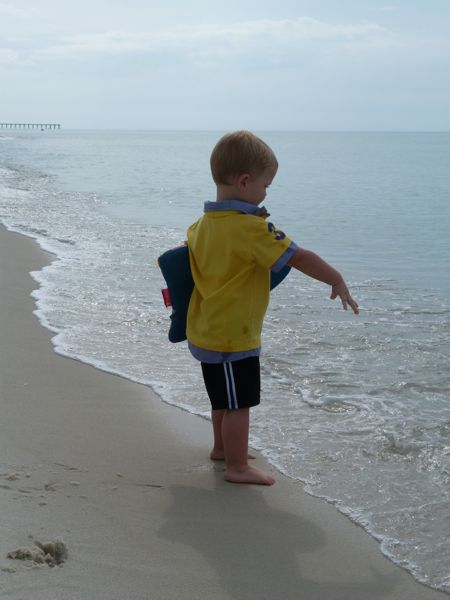

Some of the wonderful nearing-sunset blues I love so much:


And a picture of the little boy we love so much:

Beach Weather and Crabs: We Got ‘Em on Pensacola Beach
No, it’s not really my kind of beach weather. I’m an Alaska girl, a Pacific Northwest girl, I like a colder breeze, with hot days and cool nights. But Alaska and the Pacific Northwest don’t have Pensacola beaches, with the sugar white sand and the Italian greens drifting into indigo blues, and the shift of sun on the sand and waters making the colors glow.
We are out on the beach for a week, making daily treks the 20 minutes back into town to take care of the Qatari Cat, pick up mail, etc, but we are loving the beach nights.
First night sunset:
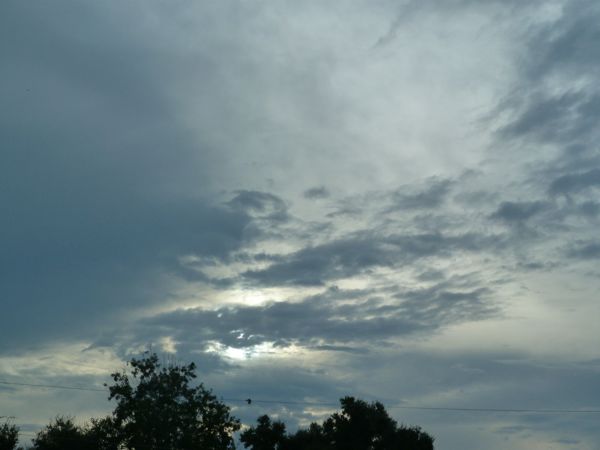
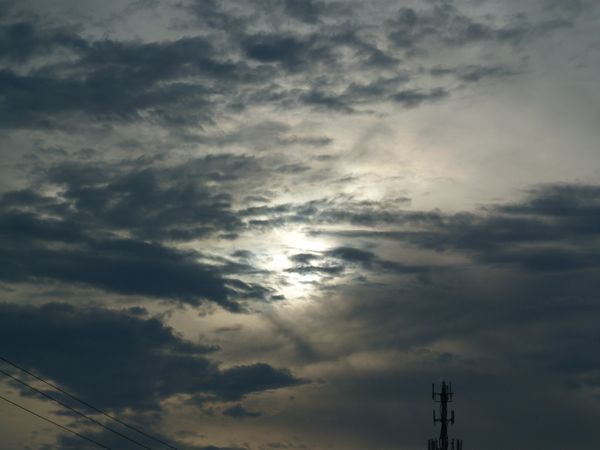
A very cloudy sunset:

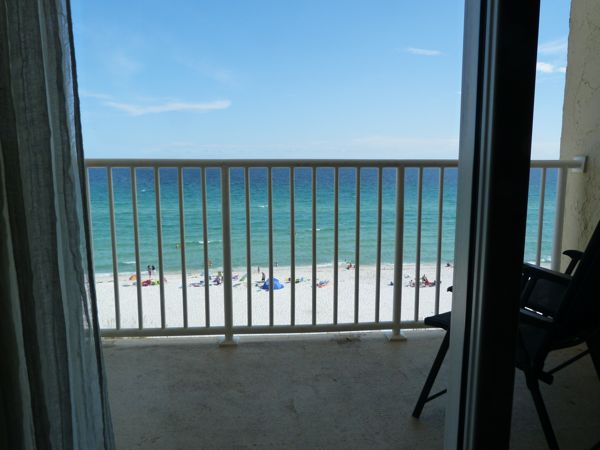
View of beach from condo:
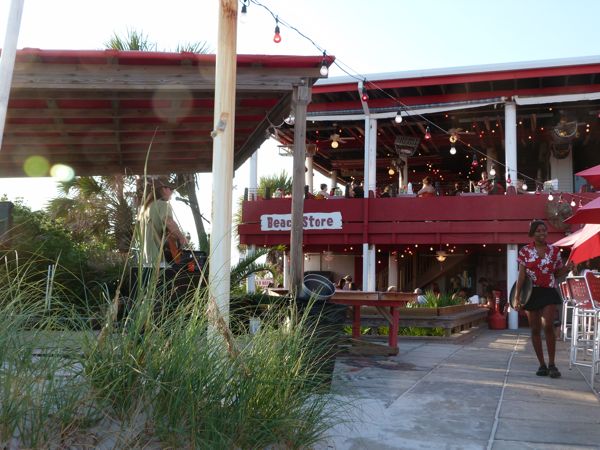
It’s dinner time, and we get a table next to the beach at Crabs: We Got ‘Em. It is a hot and humid evening, but there is a nice breeze, great beach music, a huge mellow crowd, and all is well:


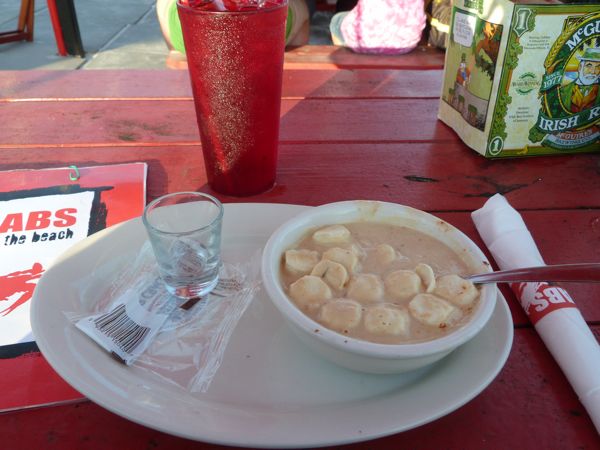
Our waitress is Chloe, and she is friendly, knowledgeable, nice and also fast 🙂 She brings our she-crab soup almost as soon as we order it.
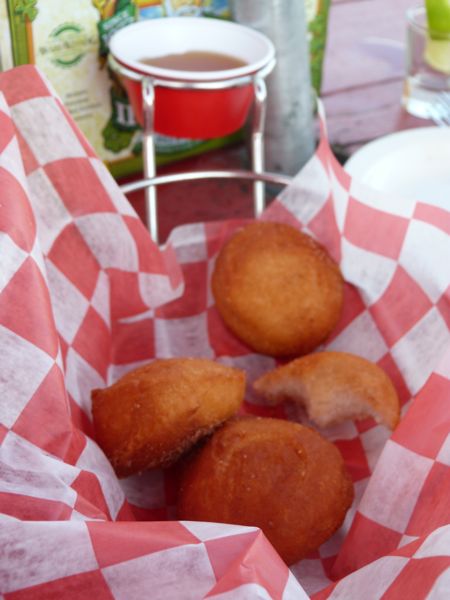
She also brought fresh hot “honey rolls” which are really sugar beignets and a little pot of honey to dip them in. Yes, I allowed myself one because I NEVER eat beignets and I totally love them.
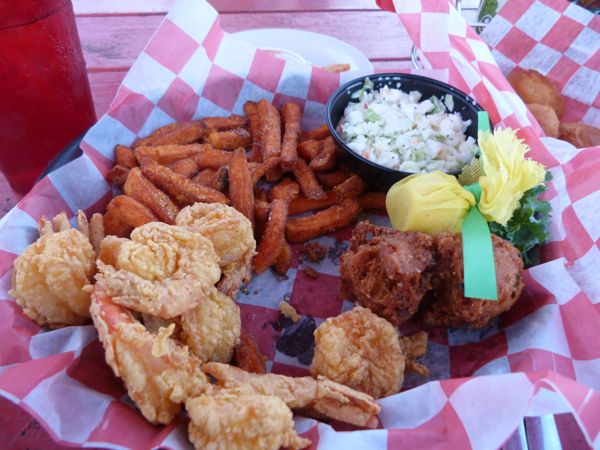
Both AdventureMan and I had the exact same dinner, the she-crab soup and Beer Batter Gulf Shrimp. There were SO many shrimp we couldn’t eat them all, and SO good. No, I didn’t eat my fries. Well, maybe just one or two, but not more. 🙂
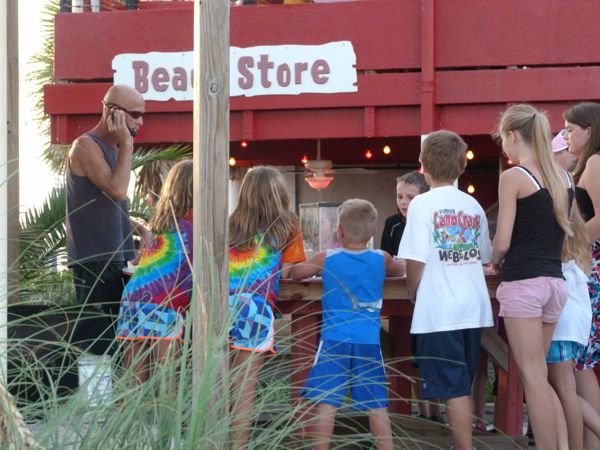
As we were eating, they announced their hermit crab race. This is hilarious, and very cleverly done, and the kids love it. The one who chooses the winning hermit crab wins a Crabs T-shirt:
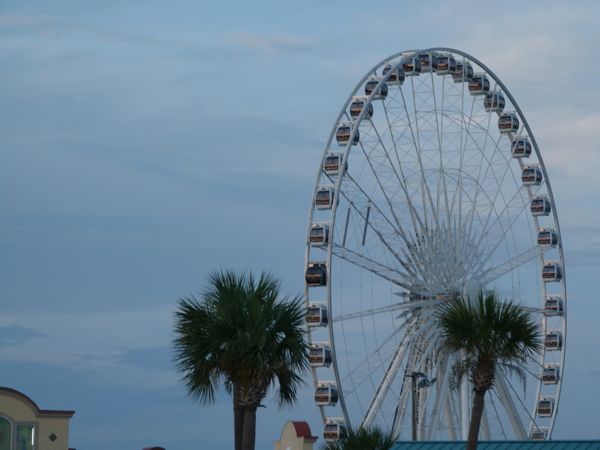
People were lining up to ride the new Pensacola Beach attraction, which is not called a ferris wheel, but I don’t remember what it is called. You ride in those little pods.
Hopjack’s Filling Station, Pensacola
This is all about the power of the press. This morning, as I checked my news online, I saw an article about a restaurant area in East Pensacola Heights, and it mentioned several restaurants, including Hopjack’s Filling Station, which our son had told us about.


“Today, I want to go to Hopjack’s!” AdventureMan announced after having read the Pensacola News Journal, and off we went.
Hopjack’s Filling Station is all about beer. I wish I had gotten a photo of the 33 taps for their beers on tap. Next to the 33 beers on tap, there is a huge refrigerator case, an entire wall of cold beers in bottles, so many I have no idea how many there are. And across from that wall, on the opposite wall, is another wall of beer.


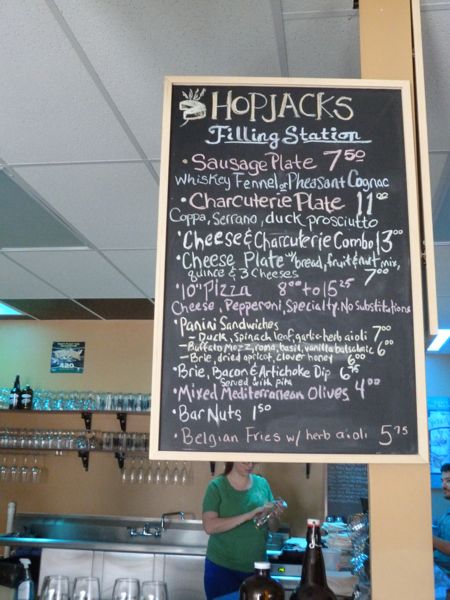
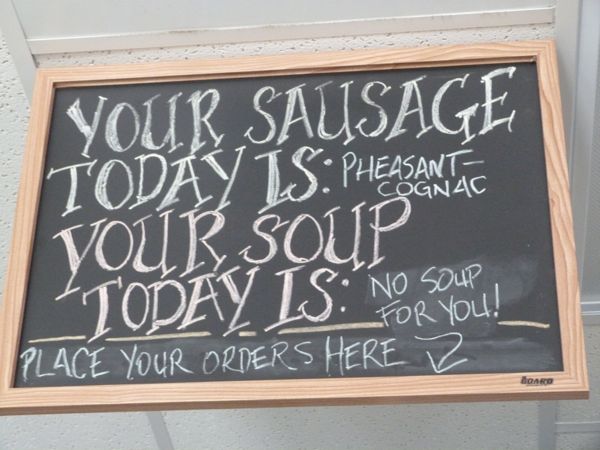
They also have food. 🙂 There is a cold chest full of hard-to-find cheeses, and not a huge menu, but a very very cool menu, a big city kind of brew-pub menu, with international offerings at reasonable prices:
I ordered the Duck Panini with the garlic aioli (really, a garlic mayonnaise) (“garlic aioli” is like saying “shrimp scampi” or “Vista View” LOL)

And AdventureMan ordered the Caprese Panini, which had a balsamic vinegar reduction that was divine:

And, of course, we both had beer :-). If you don’t know what you like, they have little tasting cups. I had a dark beer, just a tiny bit sweet, called Rogue, and AdventureMan had something he hoped would approximate a good German Pils, but he says we are going to have to go back and keep trying until he finds it. 🙂
Hopjack’s Filling Station will have a grand opening Friday, August 10, with wine tasting as well as beer sampling. Go welcome them to the neighborhood.
(I really want to go back and try their Belgian frites with aioli!)
McGuire’s For Lunch
“I just have a yen for a steak,” I said to AdventureMan, and since it is my turn to choose, he grins and says “I could use a steak, too.” We don’t even feel guilty. The last steak we had was New Year’s Day this year, also at McGruires. Two steaks a year, not so bad.
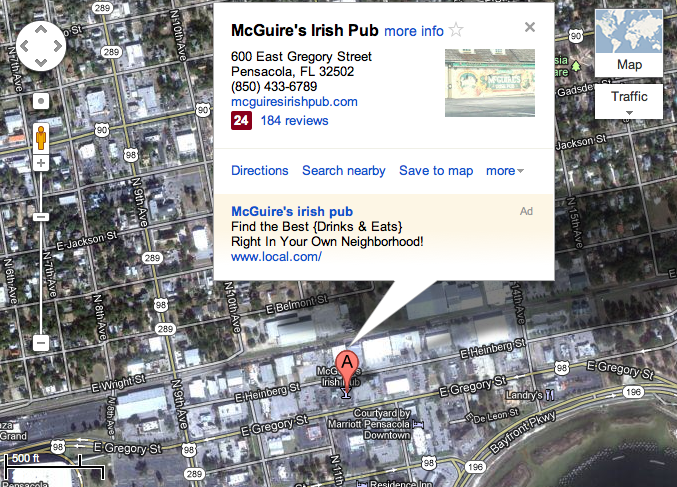
It’s a gloomy day, and we are hoping it’s not so crowded we have to wait. We are seated immediately, but upon looking around, AdventureMan said “Does anyone in here know that the economy is suffering? Do they know we are in a downturn?”
McGuires is PACKED. It’s not just old retired folk and tourists, either, it’s young Pensacola families and their children, generations meeting up for a Saturday lunch. The bar is packed, the tables are full throughout and as we leave, there is a line waiting.
The steaks – we like the Molly filet – were fabulous. Erin A, our excellent waitress, warned us that some people find the pepper coating too peppery, and we assured her we like a pepper coating to be very peppery; when our steaks came, they were VERY peppery, and we were very happy. They also had fresh asparagus, perfectly cooked, still just a little crisp. We were really bad, we also had the bleu cheese dressing on our salads. It was a wonderful meal, altogether, and Erin A was attentive without being intrusive. Erin kept our glasses full, swept used dishes away as soon as they were finished, and kept her eye on our table in case we had any needs. Her service added to our enjoyment of the meal. Isn’t that the best?
There are other steak houses in town, where you can get a steak almost as good for a lot less. You can’t beat McGuires for the overall experience, though, and when you only have steak every few months, why not have the best?
We also love it that our out-of-town guests LOVE McGuires, for the overall experience as well as for the food. Live entertainment at night, lots of old Irish ballads. 🙂
As we left, we had to run between the raindrops to get to our car. Big heavy voluminous clouds over Pensacola, and a daily humidity factor of around 100%.
Deepwater Horizon Spill and Hazards
On the front page of today’s Pensacola News Journal is a report by the Associated Press saying:
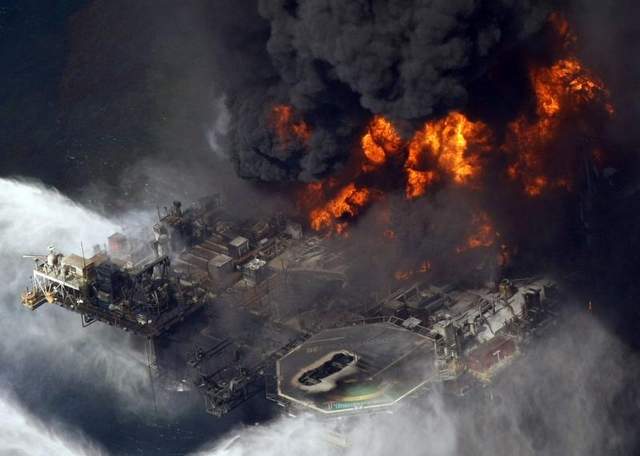
BP Missed Big Hazards, report says: Focus on worker safety obscured other problems.
HOUSTON – BP and the drilling contractor that operated the ill-fated Deepwater Horizon were so focused on worker safety they didn’t do enough to prevent major hazards, such as the 2010 rig explosion in the Gulf of Mexico that killed 11 people, federal investigators said yesterday.
Excuse me? Does that make sense to anyone?? So concerned with safety that 11 people got killed because they overlooked SAFETY problems?? I thought I must be crazy, but the report goes on to say the following:
The panel listed a litany of problems large and small they had already uncovered even though it has not received all of the records from Transocean, the drilling contractor that has challenged the board’s right to investigate the offshore incident.
Among the panel’s findings:
• BP and Transocean’s “bridging document,” designed to align safety procedures between the companies, was generic and addressed only six safety issues, but none of them dealt with major issues.
• The companies didn’t have key process limits or controls for safe drilling.
• There were no written instructions for how to conduct a crucial test at the end of the cementing process, one that ultimately was misinterpreted by the crew after it was conducted several times, each time differently.
• Similar concerns about too narrow a focus on personal safety were raised after an explosion in 2005 at BP’s Texas City refinery that killed 15 people, but few of the panel’s recommendations were implemented on the offshore rig.
“It’s always puzzled me why a company like BP … that has major resources available … is involved with two of the biggest accidents,” said John Bresland, a member of the board who is wrapping up his second five-year term and was involved in both investigations.
The drilling company doesn’t want to cooperate, and doesn’t think the federal government has the right to investigate? The company so focused on worker safety had an agreement with the drilling company that only focused on minor issues? NO key processes or controls?
What is wrong with this story? From this story, it is clear that worker safety was never a focus of BP. BP had another blowup with 15 deaths at a Texas refinery resulting from safety processes that were too narrowly focused, and now they are saying they are too focused on worker safety, and that is why they have so many worker deaths?
I guess, following the same reasoning, that the Deepwater Horizon blowup, which killed sealife, is still blackening beaches, which has created a tar carpet along the ocean floor, created birth defects among birds and mammals, and will create havok for a lifetime to come, all that resulted from BP’s excessive concern for the Environment?
Is this craziness? That kind of communication just makes me crazy.
I don’t care how much they end up paying to universities, groups promoting tourism, people who lost work, wildlife organizations, etc. as a result of the Deepwater Horizon explosion. You have to see that whatever they are paying is to buy silence, to buy complicity, to keep us from complaining too much when problems associated with the explosion continue to – literally – surface. Their money is to co-opt us. No matter what they are paying, it is too little.
James Lee Burke and the Creole Belle
James Lee Burke is number one on my guilty-pleasures list.

I first met his main character Dave Robicheaux in A Morning For Flamingos, a book I picked up in a military library at Lindsay Air Station, a post that doesn’t even exist any more. In the cold dark endless winter in Wiesbaden, Germany, James Lee Burke lit up my life. I had thought I was picking up just another escapist mystery novel, but when James Lee Burke puts words together to describe the way a storm moves in over the bayou, prose becomes poetry.
There is a downside. Whether it is his character Dave Robicheaux, the former New Orleans cop, now head homicide investigator in New Iberia, Louisiana, or his Hackberry Holland series set in West Texas, James Lee Burke’s books are filled with extreme violence and disturbing images that live in your head for a long time.
I’ve recommended James Lee Burke to friends, some of whom have said “Why do you read this trash??? It is HORRIBLE! It is full of over-the-top violence!”
And then again . . . he is writing about some really really bad people. They are out there. There are people who exist who inflict cruelty. I don’t understand it, I can’t begin to fathom where the urge would come from, but I’ve seen it. It’s out there. James Lee Burke pulls up that rock and exposes the dark happenings underneath.
On one level, as I started reading Creole Belle, I thought “Oh James Lee Burke, stop! Stop! It’s the same old formula! A downtrodden victim (often a beautiful woman) cries for help. You and Clete start looking for information and end up beating people up and then they retaliate by threatening your family! There is a rich, beautiful woman who seems vulnerable and who you kind of like, but she is complicated. There are rich amoral people who keep their hands clean, but who are calling the shots and never go to jail! Stop! Stop!”
Well, I should say that, and maybe I should stop. Then he starts talking about the smoke from the sugar cane fields and the bridge over the Bayou Teche, and the big Evangeline oak in St. Martinsville, and I am a goner. I’m sucked in, I’m hooked.
I detest the violence and the images. I keep coming back because James Lee Burke has some important things to say.
I’d love to have him to dinner. I’d love for him and our son to have a chance to talk about Law Enforcement. Here is what James Lee Burke has to say in Creole Bell:
There are three essential truths about law enforcement: Most crimes are not punished; most crimes are not solved through the use of forensic evidence; and informants product the lion’s share of information that puts the bad guys in a cage.
My son hates shows like CSI, and Law and Order, where the evidence convicts the criminals. He says it raises unreal expectations in juries, and makes it harder to get a conviction.
We watched a Violation of Parole hearing, or actually a series of hearings, where the judge asked each individual whose parole was about to be revoked what had happened when he or she was re-arrested. In each case, the parolee had done something stupid; drove a car with an expired license, drove to another state, was arrested driving drunk, etc. EVERY time. The judge made his point, I believe.
From Creole Belle:
But if Caruso was the pro Clete thought she was, she would avoid the mistakes and geographical settings common to the army of miscreants and dysfunctional individuals who constitute the criminal subculture of the United States. Few perpetrators are arrested during the commission of their crimes. They get pulled over for DWI, an expired license tag, or throwing litter on the street. They get busted in barroom beefs, prostitution stings, or fighting with a minimum-wage employee at a roach motel. Their addictions and compulsions govern their lives and place them in predictable circumstances and situations over and over, because they are incapable of changing who and what they are. Their level of stupidity is a source of humor at every stationhouse in the country. Unfortunately, the pros – high end safecrackers and jewel thieves and mobbed-up button men and second story creeps – are usually intelligent, pathological, skilled in what they do, middle class in their tastes and little different in dress and speech and behavior from the rest of us.
And then there are paragraphs like this that discuss the human experience, and have a far wider application than the book:
No one likes to be afraid. Fear is the enemy of love and faith and robs us of all serenity. It steals both our sleep and our sunrise and makes us treacherous and venal and dishonorble. It fills our glands with toxins and effaces our identity and gives flight to any vestige of self-respect. If you have ever been afraid, truly afraid, in a way that makes your hair soggy with sweat and turns your skin gray and fouls your blood and spiritually eviscerates you to the point where you cannot pray lest your prayers be a concesion to your conviction that you’re about to die, you know what I am talking about. This kind of fear has no remedy except motion, no matter what kind. Every person who has experienced war or natural ctastrophe or man-made calamity knows this. The adrenaline surge is so great that you can pick up an automobile with your bare hands, plunge through glass windows in flaming buildings, or attack an enemy whose numbers and weaponry are far superior to yours. No fear of self-injury is as great as the fear that turns your insides to gelatin and shrivels your soul to the size of an amoeba.
Last, but not least, this is what keeps me coming back to James Lee Burke, so much so that I buy the book almost as soon as it is released. James Lee Burke isn’t afraid to take on the big guys. He “gives voice to those who have no voices.” (Proverbs 31:8) His focus is always on the dignity of the common man, the dignity of hard work, done well, and on the dignity of doing unexpected kindnesses to those who have no expectation of kindness.
. . . All was not right with the world. Giant tentacles of oil that had the color and sheen of feces had spread all the way to Florida, and the argument that biodegradation would take care of the problem would be a hard sell with the locals. The photographs of pelicans and egrets and seagulls encased in sludge, their eyes barely visible, wounded the heart and caused parents to shield their children’s eyes. The testimony before congressional committees by Louisiana fisher-people whose way of life was being destroyed did not help matters, either. The oil company responsible for the blowout had spent an estimated $50 million trying to wipe their fingerprints off Louisiana’s wetlands. They hired black people and whites with hush-puppy accents to be their spokesmen on television. The company’s CEO’s tried their best to look ernest and humanitarian, even though the company’s safety record was the worst of any extractive industry doing business in the United States. They also had a way of chartering their offshore enterprises under the flag of countries like Panama. Their record of geopolitical intrigue went all the way back to the installation of the shah of Iran in the 1950’s. Their even bigger problem was an inability to shut their mouths.
They gave misleading information to the media and the government about the volume of oil escaping from the blown well, and made statements on worldwide television about wanting their lives back and the modest impact that millions of gallons of crude would have on the Gulf Coast. For the media, their tone-deafnessness was a gift from a divine hand. Central casting couild not have provided a more inept bunch of villains.
James Lee Burke has a voice, and he uses it. He could just cash in on his reputation as an Edgar Award winning author, but he uses his voice to speak out against injustice and corruption. He is a champion of the people. I’ve written several book reviews, and taken some trips just because I wanted to see James Lee Burke country; if you are interested in those, you can read them here.
I have a concern about this series, in that this book ended differently than all the others. So differently it made me seriously question whether Burke intends to continue writing about Dave Robicheaux or if Dave is about to hang up his shield and call it a day. He’s a guilty pleasure I am not yet ready to give up.
Ramadan for Non Muslims; An Annual Tradition
I wrote this post when I was living in Kuwait, for my readers in the US in particular, who knew little about Ramadan. I wrote it because I had discovered that much of what I knew about Ramadan was wrong. Living in lands where Ramadan was celebrated helped me see the month – and many of our own traditions – in a new light.
It has become a tradition to post it – or a similar post – annually for those who are interested in what Ramadan is all about.

I am repeating this post from September 13, 2007 because it found so much interest among my non-Muslim friends. We are all so ignorant of one another’s customs, why we do what we do and why we believe what we believe. There is a blessing that comes with learning more about one another – that blessing, for me, is that when I learn about other, my own life is illuminated.

(I didn’t take this photo; it is from TourEgypt.net. If you want to see an astonishing variety of Ramadan lanterns/ fanous, Google “Image Ramadan lanterns” and you will find pages of them! I didn’t want to lift someone else’s photo from Flicker or Picasa (although people do that to me all the time!) but the variety is amazing.)
Ramadan will start soon; it means that the very thinnest of crescent moons was sighted by official astronomers, and the lunar month of Ramadan might begin. You might think it odd that people wait, with eager anticipation, for a month of daytime fasting, but the Muslims do – they wait for it eagerly.
A friend explained to me that it is a time of purification, when your prayers and supplications are doubly powerful, and when God takes extra consideration of the good that you do and the intentions of your heart. It is also a time when the devil cannot be present, so if you are tempted, it is coming from your own heart, and you battle against the temptations of your own heart. Forgiveness flows in this month, and blessings, too.
We have similar beliefs – think about it. Our holy people fast when asking a particular boon of God. We try to keep ourselves particularly holy at certain times of the year.
In Muslim countries, the state supports Ramadan, so things are a little different. Schools start later. Offices are open fewer hours. The two most dangerous times of the day are the times when schools dismiss and parents are picking up kids, and just before sunset, as everyone rushes to be home for the breaking of the fast, which occurs as the sun goes down. In olden days, there was a cannon that everyone in the town could hear, that signalled the end of the fast. There may still be a cannon today – in Doha there was, and we could hear it, but if there is a cannon in Kuwait, we are too far away, and can’t hear it.
When the fast is broken, traditionally after the evening prayer, you take two or three dates, and water or special milk drink, a meal which helps restore normal blood sugar levels and takes the edge off the fast. Shortly, you will eat a larger meal, full of special dishes eaten only during Ramadan. Families visit one another, and you will see maids carrying covered dishes to sisters houses and friends houses – everyone makes a lot of food, and shares it with one another. When we lived in Tunisia, we would get a food delivery maybe once a week – it is a holy thing to share, especially with the poor and we always wondered if we were being shared with as neighbors, or shared with as poor people! I always tried to watch what they particularly liked when they would visit me, so I could sent plates to their houses during Ramadan.
Just before the sun comes up, there is another meal, Suhoor, and for that meal, people usually eat something that will stick to your ribs, and drink extra water, because you will not eat again until the sun goes down. People who can, usually go back to bed after the Suhoor meal and morning prayers. People who can, sleep a lot during the day, during Ramadan. Especially as Ramadan moves into the hotter months, the fasting, especially from water, becomes a heavier responsibility.
And because it is a Muslim state, and to avoid burdening our brothers and sisters who are fasting, even non-Muslims refrain from eating, drinking, touching someone of the opposite sex in public, even your own husband (not having sex in the daytime is also a part of fasting), smoking is forbidden, and if you are in a car accident and you might be at fault, the person might say “I am fasting, I am fasting” which means they cannot argue with you because they are trying to maintain a purity of soul. Even chewing gum is an offense. And these offenses are punishable by a heavy fine – nearly $400 – or a stay in the local jail.
Because I am not Muslim, there may be other things of which I am not aware, and my local readers are welcome to help fill in here. As for me, I find it not such a burden; I like that there is a whole month with a focus on God. You get used to NOT drinking or eating in public during the day, it’s not that difficult. The traffic just before (sunset) Ftoor can be deadly, but during Ftoor, traffic lightens dramatically (as all the Muslims are breaking their fast) and you can get places very quickly! Stores have special foods, restaurants have special offerings, and the feeling in the air is a lot like Christmas. People are joyful!
There were many comments on the original post, and, as usual in the history of Here There and Everywhere, the commenters taught us all more about Ramadan than the original post. If you want to read the original post and comments, you can click HERE.
Iran Raids Coffee Shops as Un-Islamic

(Starbucks in Dubai Mail)
I always thought coffee shops started in that part of the world – oh wait, right, those were just for men.
LOL, found this on AOL, from Huffpost, from a Reuters report:
DUBAI, July 15 (Reuters) – Iranian police shut down dozens of restaurants and coffee shops over the weekend, Iranian media reported, in a renewed crackdown on what the state sees as immoral and un-Islamic behaviour.
Regular officers and members of the “morality police” raided 87 cafes and restaurants in a single district of the capital Tehran on Saturday and arrested women for flouting the Islamic dress code, according to the Iranian Students’ News Agency (ISNA).
“These places were shut for not following Islamic values, providing hookah to women, and lacking proper licenses,” said Tehran police official Alireza Mehrabi, according to ISNA. Women are not allowed to smoke hookah, water pipes, in public.
Mehrabi said the raid came as part of a plan to provide “neighbourhood-oriented” security, and would continue in other parts of Tehran.
Coffee shop culture has flourished in Iran in recent years, offering wireless Internet, snacks, hot drinks, and a place to hang out for Iranian youth in a country where there are no bars or Western chain restaurants or cafes.
But that trend has been criticised by conservative Iranians who consider it a cultural imposition from the West and incompatible with Islamic values. The government periodically cracks down on behaviour it considers un-Islamic, including mingling between the sexes outside of marriage.
In 2007, Tehran police closed down 24 Internet cafes and other coffee shops in as many hours, detaining 23 people. (Reporting By Yeganeh Torbati; Editing by Robin Pomeroy)
Does the Surf Burger on Pensacola Beach Rock?
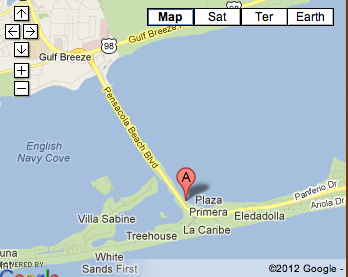
AdventureMan and I disagree about the Surf Burger on Pensacola Beach.
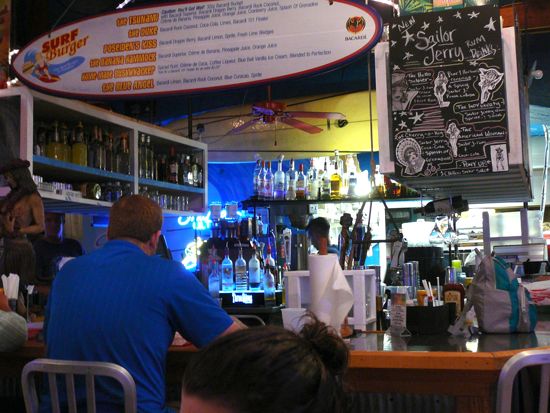
I don’t eat a lot of hamburgers. In fact, I eat about one a year, and it has become a sort of tradition that I go to the Red Robin around the Fourth of July for my annual hamburger quota. Like, if you’re going to do it, do it right. (“YUMMMMMMMMMMMMMMM.”) 🙂
But it was close to the 4th of July when our son called and said they were headed to the beach and did we want to meet them at the Surf Burger for dinner. We said sure, there is always something on the menu we can eat at most places, and we’ve never been to the Surf Burger. How can you live in Pensacola and never eat at the Surf Burger?
We got there first. There’s a part of me that felt comfortable there right away. It’s a lot like the old Red Robin used to be, the one we used to go to when I was in university, kind of a dive. There is a bar, and semi-sloshed looking people dressed in not-very-much trying to pick each other up, and a very basic menu, mostly hamburgers. And beer. And those mixed drinks with cute names you find at most beaches with 7 or more potentially lethal kinds of alcohol – in each drink.
It is both family friendly and pet friendly. If you are not wearing beach gear, you are overdressed. Service can be slow when they have a lot of customers, and often, they have a lot of customers. It’s very very hard on a Sunday night to find a parking place.
I knew just what I wanted – a Firecracker Burger. When it came, on two slices of toasted bread, I was disappointed, until I bit in. Once I tried it, I was happy. The burger tasted like 100% real meat, none of these chain burgers that you’re not sure how much is meat and how much is ‘special ingredients’ you really don’t want to know. It was SPICY; it was a Firecracker. I enjoyed every bite, and that is a good thing when you only eat one burger a year.

AdventureMan was not so happy. He ordered a SurfBurger. He hated the French Fries. He found his burger not that great. He thought it was greasy.
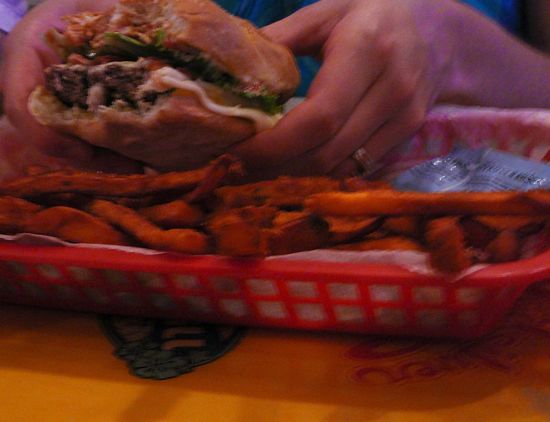
Our Vegan ordered a VeggieBurger, and she was happy, too. She said it tasted like meat, and had a great texture, but it wasn’t meat.

Surf Burger is probably not your destination kind of restaurant. It’s a burger joint. You go there for a hamburger because you are at the beach and you are hungry. You go there maybe to drink and hook up with a new friend. You go there because it is easy and comfortable and you don’t want to get cleaned up or dressed up. All those are good reasons to go to the Surf Burger.
Surf Burger
500 Quietwater Beach Blvd
Pensacola Beach, FL
850-932-1417
TO GO ORDERS WELCOMED
Mon – Thur: 11am – 10pm
Fri: 11am – 11pm
Sat: 8am – 11pm
Sun: 8am – 10pm
Hot Rain For Pensacola Blue Angels

It’s the biggest week for Pensacola and Pensacola Beach, it’s Blue Angels week, and people come from all over the USA to watch our home team do arial acrobatics. It’s always a thrill, driving to an appointment, when suddenly the Blue Angels appear in the sky, flying in close formation. Their practices are a weekly delight to Pensacolians.
It’s a funny week, though, a week when we have had rain almost every day. It makes summer in Pensacola different from summer in Kuwait and Qatar. In Pensacola, rain is a good thing, sometimes we don’t get enough. This year, we have been deluged; one area of our city flooded while we were in Zambia, and even our house suffered from the hurricane-force wind-driven rain.
It’s not a cold rain, it’s a hot rain, the rain falls and the temperatures are in the 90’s, falling to the high 80’s. We are planning to go out to the beach to watch the big practice on Friday (we do not plan to go for the full show on Saturday! Maybe someday when we can book a hotel room for that time) hoping the beach breezes keep the mosquitos at bay. Thundershowers are forecast for the entire week, through Saturday, but, when they come, they don’t last too long, an hour at most, and then the air is clear and clean. Not crisp, but clear and clean and HUMID!

The mosquitos are thriving. It was forecasted when we had such a mild winter that the insect population would rocket, and already, barely midsummer, or at least mid-heat of summer, and dengue fever has hit in New York, Miami, and other mosquito-borne illnesses are showing up throughout Florida. Dengue fever, the article referenced above states, used to be seen only in people returning from overseas country where it was present, but now, mosquitos in the USA are carrying it. Good time to wear repellant. 🙂
Recent Comments
Kitchen on Isiais: Winding Down intlxpatr on Shampoo Ginger tigerbutterya0c5ff1d… on Shampoo Ginger intlxpatr on British Soldier Kidnapped, Esc… John on British Soldier Kidnapped, Esc… Wikipedia Donate Button

Amazina


Early Voting in Florida


