Getting it Wrong
With all my years of living abroad, with all the experience I’ve had keeping my head down, observing, and trying to look and act like the locals, you’d think I’d get it right in my own country, right?
Wrong.
Well, most of the time I get it close enough. Sometimes I am overdressed at the Target or Home Depot. Rarely am I underdressed, but today I was. I looked around the church and I was one of very very few women in short sleeves. Almost every woman was wearing a jacket with either full length sleeves or 3/4 sleeves. Oops, I thought. When you are new, you especially need to try to look like those around you. It must be a calendar thing, not a temperature thing, because the temperatures today are back up in the 80’s; that is not long sleeve weather in my book, but it is in the Southern Lady Book.
One week I wore purple shoes – I love my purple shoes. I realized, too late, that they might go a lot of places, but probably not to our church. Oops.
Florida is particularly hard because there are the long-time Floridians and then those who are more newly arrived. I learned this the last time I lived in Florida, when, thanks be to God, I had an old Florida friend who told me all the inside scoop to help me pass. That was about 20 years ago, though, and some of the information has gotten a little outdated. The first rule, though, is not to look like a tourist. No little sundresses – and if you get a sunburn, you should have T-shirt marks on your arms so people will know you’ve been out fishing or working in the garden. No T-shirts with beachy sayings; T-shirts from the Breast Cancer Run or the Junior League Marketplace are OK.
My big dilemma right now has to do with legwear. I overheard some of the younger women in the locker room at aqua aerobics laughing about ‘old lady’ stockings, and I realized they meant nylon stockings. I haven’t worn them for a long time, except for once or twice in Seattle when I was back in the winter and had to go to funerals, but I don’t know what ladies are wearing in the place of nylon stockings. Nylon stockings in Qatar and Kuwait were pretty much irrelevant; when the temperatures are in the 120’s F, you simply don’t bother, wearing nylons is unthinkable.
You almost can’t even find nylon stockings in Florida, and a lot of the women seem to finesse the matter entirely by wearing pants, or not wearing stockings at all, which you can do in the summer, and of course you can wear pants in the winter, but what do you wear in the winter if you want to wear a skirt? It does get cold in Pensacola, and my legs are going to need some protection. I have a good supply of colored tights, which I have seen some younger women wearing, but this is one of those times when I feel like I have been gone from my own culture for too long and I am out of touch.
As I looked around the women at church today, I also had the funny idea that almost every woman in that church would do just fine in Qatar or Kuwait, they are covered to the elbow – and beyond – and they are covered to the knee, at the very least, with clothing that is mostly not too tight. Just as wearing long sleeves seems to be more cultural than weather-driven, covering your hair in the Islamic countries is more cultural than religious. Mohammed, the Prophet, told the women to ‘cover their adornments;’ it was the men who decided that hair is an adornment. My Saudi women friends told me that it originally meant ‘cover your breasts’. It’s cultural, not religious.
Still working out what works – and what doesn’t – in Pensacola. Praying that all my ‘oops’ are little ones.
A Day in Flomaton, Alabama
All we knew when we started the day was that we wanted to explore a little bit north of Pensacola, maybe even up into the part of Alabama that is across the state line to the north (as opposed to the part of Alabama that is across the state border to the west). We thought we were having a very boring day until we wandered into Flomaton, and AdventureMan discovered a railroad museum.
Flomaton is at the very top of the map:

The railroad museum was also an older house, now the museum, and an older 2 room cabin out back, moved from its original location. Here is a recreation of the old front parlor:


The Railroad Collection room:

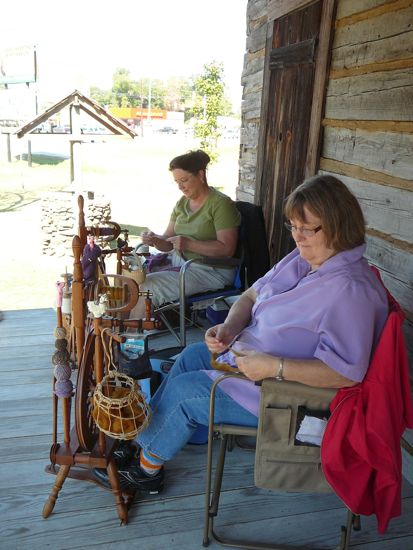
The log cabin was out back of the house, and had two women spinning wool into yarn on the porch, who very graciously allowed me to take their photo:
Inside the log cabin – we were told the couple who lived in this cabin had 12 children; they slept on the floor on pallets at night:


At the museum, there was a flyer about “Back to your hometown weekend” in Alabama, which just happened to be that very weekend. The town was full of returning people, there had been a parade and fireworks the night before (three former homecoming queens told me about this) and there was a street fair to celebrate Home Town Flomaton. 🙂
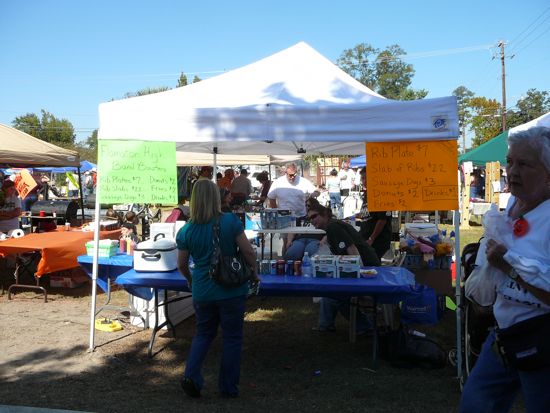
It was nearly lunchtime. We could smell Barbecue. The street fair was just a block away and there was parking right there, right by the fair. It was so much fun:

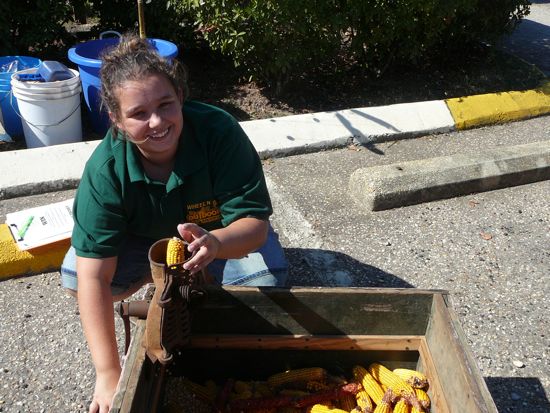
People were so kind and so helpful. This young woman was grinding corn, and we speculated that it must have been a great modern invention, and a real time saver, when it was invented. A woman passing by said she remembers her own mother using the same machine; all the corn was then taken to be ground, and stored in large airtight bottles in a dark ‘keeping room’ with preserves and food to get them through the winter.

This band was playing blues, gospel and country music, and they were pretty good!



As we stood and watched the choir, another woman welcomed us, and told us we really needed to see the new library (it was gorgeous!) and if we hurried, we could catch the Raptor Show at Otter Point. A Raptor Show!


Inside, there was a butterfly house, and several displays of local natural life:

There was also a wonderful hiking trail out over the wetlands, well maintained and beautiful:

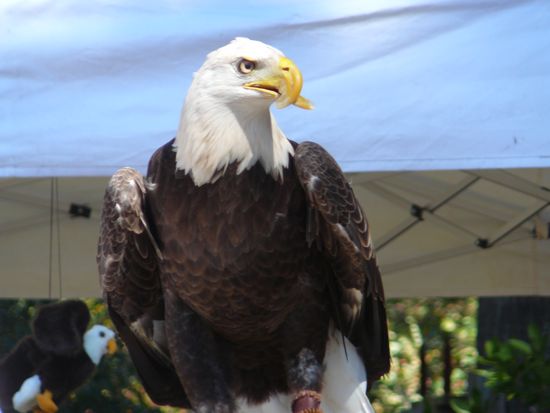
The Raptor presentation was very well done, informative and funny, on many levels. They had a large audience of children, who learned a lot, and also adults like us, who also learned a lot. The bald eagle’s beak is deformed by PCB’s, which, although banned back in the 1970’s, are still present in the environment in quantities high enough to cause birth deformities. The only reason they were able to adopt the bald eagle, a protected species, was that while he can hunt, he cannot tear his food apart with his malformed beak.
It was a day full of gracious hospitality. People were so kind to us, and went out of their way to make us feel welcome and to explain what we were looking at. For a day that started with no clear goal, we felt like we had been abundantly blessed by happening across this beautiful October day in Flomaton, Alabama.
When Bureaucracies Function Well
This week AdventureMan and I explored something new in our lives – Early Voting. We had heard about it from our friends. It’s not like absentee voting, where you are mailed a ballot and you mail it back in after you have filled in your votes. With early voting, you can actually go to a voting place and vote.

We went after lunch, and we didn’t know where it was, but once we got near, we started seeing signs. Great signage.
When we entered the door, there was a lady there to tell us where to go – and more signs, too.
When we got to the right floor, there were signs with arrows and “Vote Here” on them.
When we got to the voting office, there were lots of people to help us get our ballot. When I messed up my first ballot (I hadn’t read an amendment carefully), they quickly did all the necessary paperwork and got me voting again. The second time, the machine accepted my ballot. 🙂
All in all, a fabulous experience. And – they gave me a sticker! We were so impressed with the careful attention to detail that had gone into getting us to the right place and getting our vote accomplished.
Later in the week, I had a mammogram. Being new, I am not in the system, so I have to go through admitting procedures every time I go to a new doctor or a new institution. At the West Florida Hospital, as soon as I got to the right room, I could see a sign telling me where to wait my turn. The receptionist was welcoming AND efficient. There were a lot of people waiting, and one by one we were taken in to have our paperwork done. No need for a pen; you sign on a machine, like you do for credit card purchases in many stores. Then you sit in a small hallway until someone calls your name and you become a human train as a guide leads you to your stop. That part was half hilarious and half annoying. If I knew where it was, I might have gotten there faster on my own, but . . . I didn’t know where it was. As far as systems go – it worked. It kept people orderly. It got a lot of people in and out efficiently, and fairly. No one can break into the lines, claiming to be more important. I am guessing if there is a patient whose malady is serious enough to take precedence, they have procedures they can follow separate from the normal intake procedures.
I have to stop and admire when bureaucracies function as intended, to help us more efficiently accomplish our business. It is when they become a stomping ground for nepotism and inefficiency that they earn my ire.
When I arrived in Qatar, my bank had a Women’s branch which was convenient for me and I loved going there. I was often the only customer, and the women taking care of me were always charming, helpful and friendly. When the same bank broke into another section and became an Islamic bank, instead of a normal bank working with Islamic customs, I was no longer able to use the women’s bank, but I’ve always remembered their personal customer service.
On the other hand, banking in Qatar could be totally tortuous, if you had to use the normal bank where Mr. Important would walk right in front of you as if you didn’t exist, or certainly, as if you were far less important than he was. In Kuwait, at my bank branch, you took a number, and it appeared to me that most of the time the number system was honored, unless it was a personal friend, LOL. Personal friends, or friends of the family, or a friend of a friend of the family always get to go first.
I suspect there are similar exceptions in Pensacola, but less transparent. Mr. Important has his own banker he can go to without waiting, probably in a private office, and it is invisible to the rest of us. Ms. Important, on the other hand, probably has to wait in the waiting room with the rest of us for her mammogram.
“I’m The Present!”
As we were puffing away in one of the partners-exercises in Water Aerobics, my friend mentioned he would be heading up to Atlanta for the next couple weeks to visit children and grandchildren.
“Are you driving?” I asked between huffing and puffing.
“Nope, flying.” His answers were a lot shorter.
“You taking presents?” I asked, trying to keep my mind off my aching limbs.
“I AM the present!” he responded, and we both laughed.
When I was a kid, my favorite present was getting the small wrapped hotel soaps my Dad would bring back from his trips. To this day, I still like soaps!
What Mormons Do Right
Today, after church, AdventureMan took me to my very favorite place in Pensacola, Tudo’s (Vietnamese) and as we were waiting for our food, and our take out order (the Happy Baby has a bad cold so we are also taking lunch to his Mom and Dad) I notice the guys in the next booth are speaking in a foreign language, and because I don’t speak it, I can only guess, it was perhaps Maylay.
I think they had to be Mormons. They were in their twenties, and very clean cut. Two were probably foreign students, and two were in white shirts with ties, and dark pants, what I think of as Mormon-boys-on-their-mission dress, and it carries over into post-mission life. We saw them often, two by two, in Germany and in France, sometimes singing, sometimes going door to door, sometimes passing out pamphlets. They always spoke the language of the country they were in, maybe not so well at the beginning, but at the end of their two year mission, they spoke it pretty well.

From time to time, at the next table, they were all four speaking the same language, and it was not English.
So lets say, from a strategic point of view, that our goal is to spread the ‘good news’ (which, oh by the way, it is.) Doesn’t it just make sense that you make an effort to speak the language of your target nationality?
You would be amazed at how few of the other denominations who send ministers and evangelists overseas, how very few of them have much training in the language of the people they will be serving, or ministering to, or trying to share the good news with. You would not be amazed that when you are trying to communicate, especially big ideas, it really helps to be able to communicate. It also shows respect for another country and another culture, and humility to learn other languages and other ways. I can imagine that much of their success comes from an ability to build a personal relationship, and that is more likely to happen if you speak their language.
I am not Mormon, as you know, and I admire much of what they do right – I admire their neighborliness, their obligation to reach out and help where help is needed, and their stewardship of resources, built right into practicing the religion. I especially admire their ability to teach languages to the young missionaries they send out, and their vast library of genealogical resources.
Pensacola Symphony a WOW!
When I was just out of university, and not making much money, my one big splurge was season tickets to the Seattle Symphony with my best friend, and oh, what joy we had with those tickets. We were there for the first ever performance of Hovaness’ And God Created Great Whales among other thrills.
AdventureMan and I love music. We have tried season tickets over the years, but at the end of a long work day, we found ourselves dragging, and when you are dragging, you can’t enjoy the performances so much. Many an opera we departed at the intermission, delighted to have seen the sets, but needing our sleep. Now, as ‘retired’ people (there are reasons for those quote marks), we can attend a symphony, stay awake, and have the great luxury of time.
Father Harry Hill at Christs Church told us about the Pensacola Symphony Orchestra at our first meeting, and just in time to call and order season tickets. We’ve been waiting months for our first concert, and what a thrill it was.
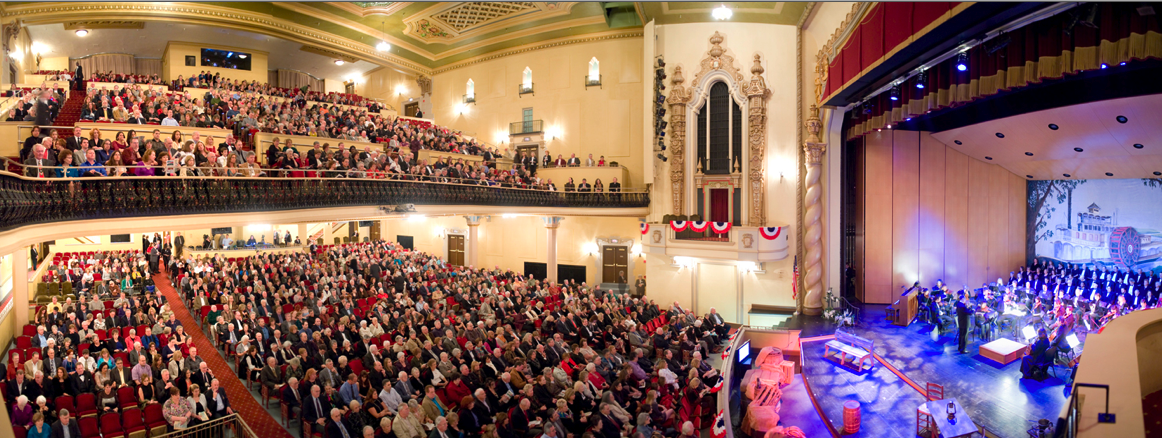
The theatre was packed. As a huge surprise to us, once the conductor, Peter Rubardt, entered, the orchestra went directly into a rousing rendition of ‘The Star Spangled Banner’ and all the audience sang lustily along! I’ve never seen this happen at a symphony before, but it was great fun, and gave us a chance to re-arrange our clothes. (The one downside is that the seats at the Saenger theatre are narrow, and I was sitting between two broad-shouldered men, it’s kind of like being in the middle seat in economy class for a three hour flight).
Rubart engages the audience right up front, explaining the context of the music (I was not familiar with any of the three pieces last night), foreshadowing curious elements in the pieces, spots to listen for – his explanations greatly increased my appreciation of the concert. These were the pieces:
Dvořák – Carnival Overture
BRAHMS – Double Concerto
SIBELIUS – Symphony No. 1
We discovered people we are sitting next to go to our church, and even though we are still new in Pensacola, we knew several people attending. That makes it more fun, too.
The orchestra is fine, amazing for a smaller town like Pensacola. Their timing and execution of the pieces seemed spot-on (I say that it ‘seemed’ because I am not an expert, but there were not obvious missed notes or timings, and some of the timings were deliberately not what I would expect). The audience is warm and enthusiastic.
There is plenty of parking. I know that doesn’t sound relevant, but in Seattle, parking could sometimes be a problem, especially when there is another event at the Seattle Center on the same evening. Finding a place to park and then walking to the theatre is easy and relaxing and you don’t have to do a big transition to enjoy the music.
The orchestra has a busy season coming up. You can learn more by visiting The Pensacola Symphony online. We can hardly wait for the next concert. 🙂
Anti Poverty Team Needs You in Escambia County
Volunteers Needed for Bridges to Circles poverty initiative!
If you are committed to making our community better by countering poverty or its impact on people and businesses in our community, come explore the innovative concepts from the trainers of Bridges to Circles. We believe this training will have a significant impact on how individuals relate to one another and to those living in poverty.
The Bridges to Circles poverty initiative, in collaboration with Unite Escambia’s Poverty Solutions Team, is actively working with families who desire to move from living below the poverty line to self-sufficiency. We are in need of community volunteers who are willing to serve as allies for these families.
If you are interested in volunteering please attend the Bridges Out of Poverty workshop on Thursday, October 14, 2010 and Hands-On ally training, Thursday, October 28, 2010. All training is conducted from 6-8 pm at the Catholic Charities Outreach Center, 1815 N. Sixth Avenue. For more information, contact Haley Richards, Bridges to Circles community organizer, at 429-7296, ext. 17 or email richardsh@cc.ptdiocese.org.
Thank you for supporting our efforts to reduce poverty in Escambia County!
Haley Richards
Bridges to Circles Community Organizer
Catholic Charities of NWFL
Office: (850)429-7296, ext 17 or (850)293-9565
Join us on Facebook!
Learn more at http://www.uniteescambia.com/
What Women Did For Fun
Several weeks ago, AdventureMan presented me with two (large) piles of files, saying that they were mine and needed to be gone through. I spent the day today tossing out old term papers, old manuscripts, old resumes – lots and lots of things that were worth saving, and now, not so much.
One thing I came across was a file with copies of work my departed aunt Helen had done to gain entrance into the DAR, Daughters of the American Revolution (Revolutionary War for America’s Independence). It was like a game, only when she started playing, there was no e-mail, only snail mail. Long distance telephone calls were expensive, and she was a Navy wife, so it was all done by hand.
Genealogy work, too, was painstakingly done, and family histories, cemetery records, lists of people arriving and departing on ships and who married who – all lovingly compiled and typed on manual typewriters by people with a passion for making connections, solving the mysteries of who married whom and for how long:
(“no need to mention the divorce” one correspondent wrote, “it happened in my family, too, and it isn’t relevant so we just won’t mention it” she wrote about a marriage that ceased to exist over a hundred years before)
My aunt had a sure thing, and she had a unique entry, so she was tracking three entries at the same time, trying to prove a new connection, while knowing she had in her pocket an already proven entry.
I lost a couple hours of my life, reading through all the correspondence, trying to decipher her notes and the arcane charts of relationships stretching back to 1690, when one line of the family arrived on these shores. I grinned, thinking how we document our bloodlines, leaving out the pirates and the horse thieves, and (legend has it) the French aristocrat who left his first family in France and started our branch here, without having divorced his first family, LOL.
My aunt must have been a little younger than I am when she started on this search, and I know that she served proudly in the DAR for many years, along with several civic committees, library committees and planning commissions in Santa Barbara, California. I still miss her.
Chase Ends with Suspect Trying to Drown Police and Police Dog
I loved reading the papers in Kuwait. What criminals could be so incredibly STUPID, I would wonder. (Here is my all time favorite Kuwait story.)
This morning, AdventureMan asked “Have you read the paper? Some guy had a high speed chase, then he tried to drown the policeman AND the policeman’s dog!”
No, I hadn’t read it. It is almost to stupid to be believed. What I do love is that the idiot is named in the Pensacola News Journal story and, of course, that his mother says he couldn’t have done it, LOL.
Chase Ends With Officer Fighting To Save His Life
Gulf Breeze Police Department Sgt. Stef Neff knows things can go bad in just a few seconds in his line of work.
That’s what happened in Gulf Breeze early Saturday morning when a traffic stop ended with Neff fighting for his life with a suspect in Hoffman Bayou.
“There is no lonelier feeling than that,” said Neff, a 15-year veteran who survived the fight without serious injuries. “I didn’t have any way to call anybody else. It was me and him.”
The suspect — Kyle Estes, 21, of Navarre — was eventually captured but it took more than an hour as he struggled in the water with two other officers and a police dog.

Estes remains in Santa Rosa County Jail today under $111,000 bond. He is facing a long list of charges related to Saturday’s fracas:
• Fleeing and eluding law enforcement officers.
• Obstruction of police.
• Aggravated battery.
• Resisting an officer.
• Driving while license is suspended or revoked.
• Hit and run.
• DUI with property damage.
The suspect’s mother hasn’t talked to him since the early morning battle, but she insists he is not violent by nature.
“It was totally out of character for Kyle to get violent like that,” Michelle Estes said today. “It was a very desperate and extreme attempt to get away from the police. I just think he didn’t want to get in trouble.”
The incident began when Gulf Breeze Police Officer Greg Baker tried to stop Estes at about 2 a.m. after seeing him speeding south on the Pensacola Bay bridge at about 95 mph, Neff said.
Baker followed Estes to Chanteclaire Circle, where Estes lost control of his vehicle and hit a cement wall, a mailbox and a tree, Neff said.
Estes jumped out the vehicle and ran. Neff and Gulf Breeze police officer Daylyn Wilson went to help Baker.
As Neff drove on Chanteclaire Circle, Estes ran by. Neff said he jumped out his vehicle, ran between some houses and pursued Estes to Hoffman Bayou.
Estes fell into the bayou from a rock embankment. Neff said Estes pulled him into the water.
“He tried to push me under the water,” Neff said. “He tried to drown me.”
Neff had no way to tell anyone where he was because his radio was disabled after being dunked in the water.
The Pensacola Police Department and Santa Rosa County Sheriff’s Office dispatched officers to help look for Neff.
Neff said he hit Estes in the head a few times with his flashlight as the two struggled in the water. He said Estes let him go after he hit him and started to swim across the bayou toward Laura Lane.
As Neff was coming out of the water, Wilson arrived. Neff told Wilson to head toward Laura Lane.
At first, Estes couldn’t be found after he swam away.
“He kind of hunkered down in some saw grass,” Neff said. “He just tried to wait us out.”
When Pensacola Police Officer Shawn Thompson made it to the area, he let his dog, Bandit, off his leash to search for Estes.
The dog found Estes hiding in the saw grass. Estes grabbed Bandit.
“Then he tried to drown the dog,” Neff said. “He was pulling the dog out into the bayou, holding him under the water.”
Thompson and Wilson jumped in to save Bandit. Estes started to swim away after taking some hits to the head with a flashlight, Neff said.
It wasn’t long before Estes was spotted under a pier. Neff and Santa Rosa County Sheriff’s Office Sgt. Judd White went into water and pulled Estes onto the pier.
None of the officers involved in the incident suffered serious injuries.
Estes was taken to Gulf Breeze Hospital, where he was treated for his injuries, and transported to jail.
Bandit was taken to a veterinarian.
“I think he’s doing fine now,” Pensacola Police Chief Chip Simmons said.
This story illustrates why police and fire crews and teachers and emergency room personnel are, to me, everyday heroes. Every day, they never know what might be out there to bite them.
Show Me the Money
Two themes came together, early this Sunday morning in Pensacola, first, as Father Harry spoke to us at Christ Church this morning on stewardship, and giving generously, and then later, as I was reading my Sunday Pensacola News Journal, an article on our elected officials, and their finances, their net worth and where their money is coming from.
Father Harry spoke about the rich man, at whose gate Lazarus begs, covered with sores, and then, at death, how the rich man asks God to send Lazarus to wet his lips, as he burns in the eternal hellfires, and Lazarus sits with God. He also asks God to send Lazarus to warn his rich family members that their choices, their lack of generosity, will have consequences, but God says (I paraphrase here) that Moses already told them, and earlier prophets, and that if the rich didn’t listen to them, they are not going to listen to Lazarus.
To me, it seems a given, that if you are blessed with plenty, then you have an obligation to help those who struggle. It isn’t necessarily money, it can be food, it can be time, it can be expertise, or – in my case – it can even be fabric. 🙂 We learn it in pre-school and kindergarten, don’t we? Share what you have, and everyone gets along.
It totally boggles my mind that many of our good friends, government and military people, have excellent health care under a highly socialized system – that’s what the military health care system is all about, we all have access to the same treatment. Many of the people who have access to medical treatment become rabid about supporting health care for those who don’t. Part of it seems to be “I earned it, and those lazy bums expect it for nothing.”
Most of my life, I’ve worked with ‘those lazy bums’ and have grown to have a lot of understanding and compassion for the circumstances that can make an entire family bone poor. Sometimes, it is poor choices – but how do people learn to make better choices without help? How do people aspire to more when they think that the ‘more’ is inaccessible to them?
The face of our nation changed after World War II when many more Americans gained access to higher education as a veteran’s benefit; prior to the GI Bill, higher education was only available to those comfortable people who could afford it.
Also in today’s Pensacola News Journal is an article about Study: Educating Women Saves Millions of Children which is an Associated Press Story about a study published this month in Lancet. “Educated women tend to use health services more and often make better choices on hygiene, nutrition and parenting,” the study (funded by the Bill and Melinda Gates Foundation) concludes.
And last, in the Pensacola News Journal, is an article that makes my heart sing, that makes me proud to live in a democracy, the article about how much our elected officials are worth, and where there money is coming from. I love it that we hold our leaders accountable, and that their wealth is (theoretically) transparent to us.
I’m a great advocate of wealth. I admire people who create wealth, who invest, who work hard for their money. The best of these people, and I mentioned Bill and Melinda Gates (above) for a reason, give back generously. Many people don’t start out rich, they start from little or nothing and build slowly slowly until they have reached a comfortable level. Sometimes, even in hard times, if you have built a strong foundation, that money just keeps multiplying, especially if it is invested with some diversity.
“It’s called the law of the harvest,” my Mormon friends told me when we were discussing how what you give comes back to you multiplied. It was so graphic, I’ve never forgotten it. There is nothing wrong with money. Money is just another tool, like a computer, or a hammer. It’s what you do with your money (tool) that makes the difference. Money is kind of like a seed, you plant and you harvest, but it is also like fertilizer – you spread it around, and amazing things happen.
Having money is a blessing, and giving it away is even more of a blessing. When you give, good things come back to you, multiplied. It’s the Law of the Harvest.
Recent Comments
ExpatAlien on What Country am I Living … intlxpatr on Yellowstone: Old Faithful to C… Michelle on Yellowstone: Old Faithful to C… Cathy on No Grown-Ups in Charge intlxpatr on Waiting for Snow Wikipedia Donate Button

Amazina


Early Voting in Florida


 Here There and Everywhere