The Christmas Lights of Pensacola
Last night, after our son and his family left after dinner, AdventureMan had a gleam in his eye. (No! not that gleam!)
“Want to go out and look at the Christmas lights?” he asked.
“Oh! Yes! Yes!” He knows I love the lights.
Pensacola isn’t so over-the-top as the Tampa Bay area used to be. Pensacola uses a lot more white, a lot less music and moving displays. Pensacola is more restrained, and more traditional.
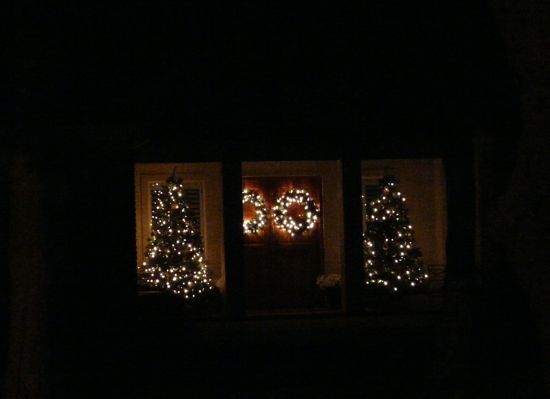
Just so you will know where I am coming from, here is my favorite:

Thoughtful, restrained, elegant. There are a lot of this kind of display, and I love them. I also love the others, although many are more exuberant. There seem to be a lot of white deer, and . . . some of them move their heads. Yes! I am telling the truth!
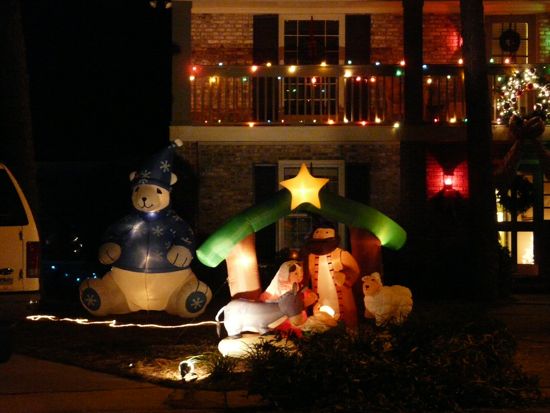
Some people just get totally into the spirit of the season, and go all out. Here is a sampling of what we saw:


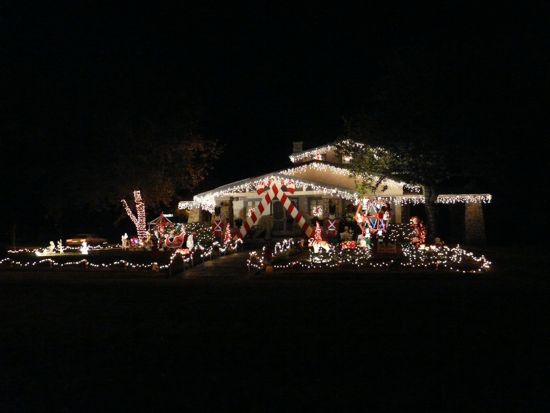



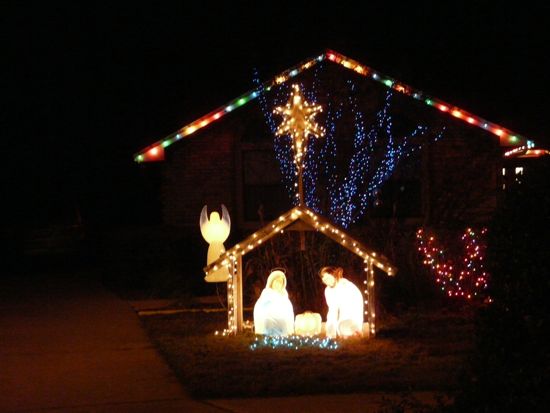
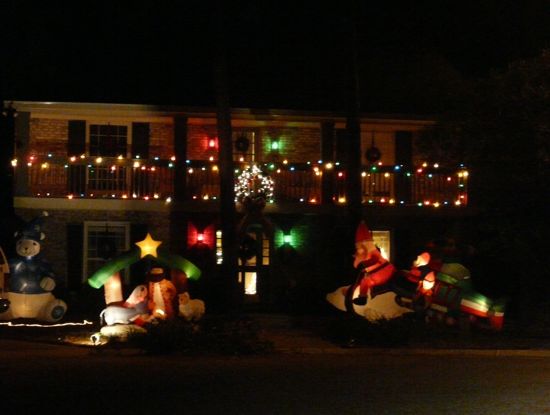
I can’t help but find this funny; Frosty the snowman and the Creche juxtaposed:
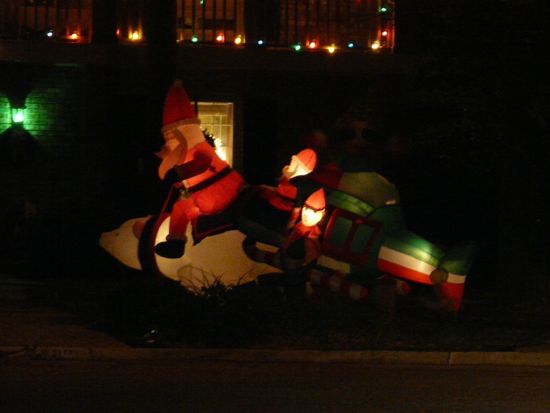
Along with Santas on rockets, LOL!
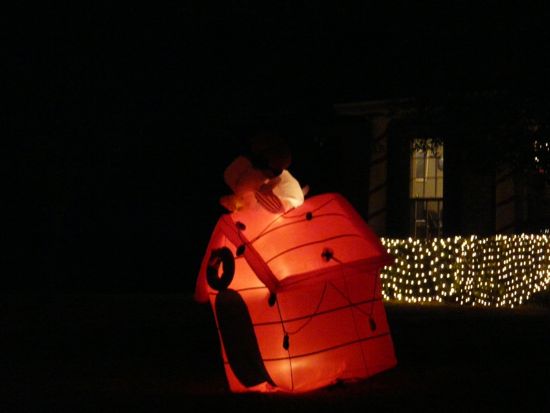
This is a Christmas Snoopy as an aviator on top of his doghouse. What does it have to do with Christmas? LLOOLL!

A lot of people are using balloons, with varying results. Santa on a motorcycle, Santa on rockets, all kinds of balloons, problematic because sometimes balloons loose air.
Here are Santas, and then a Santa loosing air, LOL


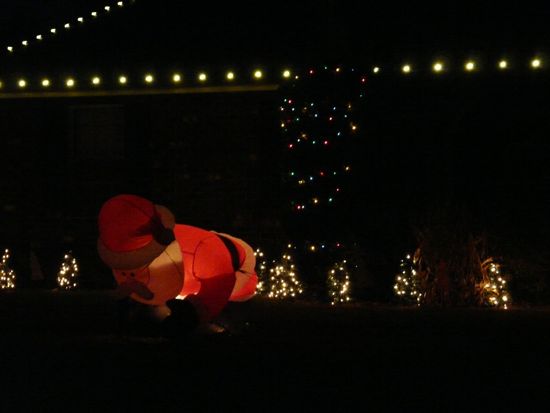
I love the way WordPress has put snow on all the blogs for December (you can turn it off if you don’t like it) but with these photos, snow falling is perfect. 🙂
Game Day
Today, more than any other Saturday, I saw Game Day T-shirts, not just on men and women, but on entire families. Flying from Pensacola to Atlanta and back, the flights were full of mostly FSU and Auburn. Sitting behind us at lunch today was a family of five, mom, dad, two sons and a baby, all dressed in Auburn colors (Pensacola is in the part of Florida sometimes called FloriBama because it is boarded on two sides by Alabama, and the lines are very fine.
Yes, I was wearing garnet and gold, but it was subtle. 🙂
Gulf Coast Citizen Diplomacy Council
I have a friend from church; she is a woman I admire greatly. Older than I am, though not much, she participates in the Spartacus Program at the “Y”, she is good at running things, she is good at making phone calls and even sounds like she enjoys them, she enjoys social life and she sparkles.
She is always thinking.
“I think I know just the group for you!” she exclaimed as we were working on a project. “Have you heard about the Gulf Coast Citizen Diplomacy Council?”
No, no, I hadn’t heard about that. Having lived here six months now, there is a lot I don’t know.
She told me all about it and she was right. It is right up my alley. The Gulf Coast Citizen Diplomacy Council greets foreign visitors and performs a variety of services, escorting them to appointments, showing them the area, even taking them shopping or inviting them for a dinner in your private home, all in the name of hospitality and showing the best side of this beautiful part of the United States.
The Gulf Coast Citizen Diplomacy Council is a non-partisan, non-profit organization whose mission is to create and encourage collaboration between like-minded community stakeholders who value sharing the Central Gulf Coast with the rest of the world by:
° Facilitating professional and personal interaction for international leaders during official visits to the Central Gulf Coast
° Enhancing respect and communication through international exchanges and alliances
Forging cultural, educational, and business relationships with the global community through citizen diplomacy
° Promoting greater understanding of global affairs in our community through a balance of public events, educational activities, and the International Visitor Leadership Program
° Promoting the Central Gulf Coast as an important center of commerce, culture, and tourism
How cool is that? Even AdventureMan is excited about joining this club; we are so grateful for all the wonderful hospitality shown us through many years of adventures abroad. We feel grateful for an opportunity to be hosts in turn.
In this club I am not so alien. The club members are people who have a broad world view. I met other people who have lived or visited in Qatar or Kuwait, and other parts of the world where I have never been. Oh, what fun.
Many of the members are former military, and I found myself listening to a discussion of an upcoming meeting. As this is a community that parties hearty during Mardi Gras, I assumed it must be the name of a Krewe, a Mardi Gras social club, all these high-testosterone men were discussing camellias, must be a code word for some secret society, right?
Wrong. As it turns out, many people here, men and women, are passionate about gardening, and there is a club devoted to turning out perfect camellias, and they are having a show coming up in December. I learn new things ever day. 🙂
The Gulf Coast Citizen Diplomacy Council was only founded a short couple years ago, and has already won awards for its programs and hospitality. A truly impressive group. 🙂
Insh’allah
When a western-world thinker first goes to live in an Islamic country, the words we love to hate are “bukra” (tomorrow) “badeen” (later) and “insh’allah (God willing), because in the world we are coming from, when you say “tomorrow,” it means that the plumber will be coming tomorrow. In Islamic countries, “tomorrow” or “later” might mean that they don’t want to upset you by telling you that it is unlikely that the plumber will be able to come within the next two weeks.
“Will you have this dress back to me by November 10th?” you ask, because you intend to wear it to the Marine Ball.
“Insh’allah,” they might answer, God willing. They have never seen a dress come back that fast, but God is mighty, and in his power anything is possible.
In today’s Lectionary, James reminds us that “insh’allah” should be our own response to every commitment, and I always find it humbling. We in the West are always so sure, so confident, and as we plan, God just laughs. Or weeps.
James 4:13-5:6
13 Come now, you who say, ‘Today or tomorrow we will go to such and such a town and spend a year there, doing business and making money.’ 14 Yet you do not even know what tomorrow will bring. What is your life? For you are a mist that appears for a little while and then vanishes. 15 Instead you ought to say, ‘If the Lord wishes, we will live and do this or that.’ 16 As it is, you boast in your arrogance; all such boasting is evil. 17 Anyone, then, who knows the right thing to do and fails to do it, commits sin.
5 Come now, you rich people, weep and wail for the miseries that are coming to you. 2 Your riches have rotted, and your clothes are moth-eaten. 3 Your gold and silver have rusted, and their rust will be evidence against you, and it will eat your flesh like fire. You have laid up treasure* for the last days. 4 Listen! The wages of the labourers who mowed your fields, which you kept back by fraud, cry out, and the cries of the harvesters have reached the ears of the Lord of hosts. 5 You have lived on the earth in luxury and in pleasure; you have fattened your hearts on a day of slaughter. 6 You have condemned and murdered the righteous one, who does not resist you.
Demon Cat From Hell at the East Hill Animal Hospital
The Qatari Cat occasionally has a little problem with cleanliness and hygiene, and since we don’t know if it might be a sign of something serious, we booked an appointment with a vet, the vet everyone talks about as being the best vet in town, so caring. We’ve visited her operation on open house day and we were impressed with her professionalism and knowledge, so we called her.
It was a really really good thing we did. When it came time to take him to the vet, I just plonked the cat cage down next to him, picked him up and put him inside, before he even really knew what was happening. He complained all the way to the vet, but nothing serious, like our diabetic cat who hated car motion and always threw up and defecated when we would take her places. 😦
We signed in, visited with the three little kittens seeking adoption, and then, our name was called. We took QC into an examination room where the assistant weighed him and stroked him and told him how sweet he was. He ate it up. He was as good as gold.
The vet came in, and took a look, said it didn’t look serious but that sometimes you see this problem in big cats and long haired cats, so they would just clean him up a little and shave his bottom.
“Hold him down like this,” she showed her assistant, and the Qatari cat cooperated. Er, well, he cooperated until the first vibration of the razor hit his hind-end hairs, at which time he did an instantaneous transformation into The Demon Cat From Hell, twisting, howling, hissing, trying to bite or scratch, little legs going in reverse, back writhing . . .
“I can’t hold him!” the assistant cried, and she hid her terror, but her voice trembled.
“Get the towel,” the vet said calmly, as she held him down with her two strong hands while the demon-cat-from-hell told her he intended great harm to her as soon as he could get free. She threw the towel over his head, which only made him madder and squirmier, but as the vet tech struggled and held the Qatari Cat down, the vet calmly continued with the “grooming.”
“We use these to clean the bottoms,” she said, pulling out those antiseptic wet-wipes we all carry around to wash our hands when there is no water around.
I just laughed. I have chased the Qatari cat around with warm wet cloths, with wet wipes, with towels . . . he does not like anyone messing with his bottom.
“Now that you’ve shaved him, I think he’ll be OK until the next time,” I said.
Trust me, Qatari Cat, when he is rational, knows I am the alpha. He obeys me. I can tell him to come in out of the garage and he will come; I can pat the bed and he will come lie down next to me. He knows my signals and he acknowledges my Queen-of-the-food-supply-and-warm-body status. Mess with his bottom, however, and all rational thought (in cat terms, rational thought, not our terms) flies out the window as the basest of instincts takes over.
Here is the sweet part. The clinic wrote us a thank you note for our visit. When it came in the mail, I was almost afraid to open it, afraid they would tell us that unfortunately, their practice is full right how and that they would like for us to find another vet for the Qatari Cat. Not so. It was a genuine thank you note, thanking us for our visit. They are totally a class act.
Sweet Prospect: Music At Christ Church
I remember when I lived in Qatar, and Kuwait, and then Qatar again, how I would read about something in the paper – the day after it happened. The things I did go to – and there were some spectacular events in Qatar – were mostly word of mouth, a personal invitation, very few cultural events were well advertised.
Not so in Pensacola. There is a wonderful Symphony, truly wonderful. There is an Opera, and several theatres, and even a Pensacola Ballet. And there is Music at Christ Church.

Yes, I am partial. We attend Christ Church, and I always love a concert where the surrounding is so beautiful. Tonight’s concert was irresistible – hammered dulcimers. Hammered dulcimers! Some of the earliest music in our country was hammered dulcimer. Lucky for me, AdventureMan loves music, and was as eager as I was to go to this concert.
So off to church in the morning, then meet up with our son and his wife – who ran the half marathon today, HOOOO-AHH! And of course, our darling little grandson, who wants nothing to do with me these days, not when there is AdventureMan, the original fun-guy. Famous Dave’s Barbeque, a wonderful meal with a truly great waiter, patient, kind, didn’t mind a baby and four dawdling adults – good fun, good conversation, good food, and then off to the concert.
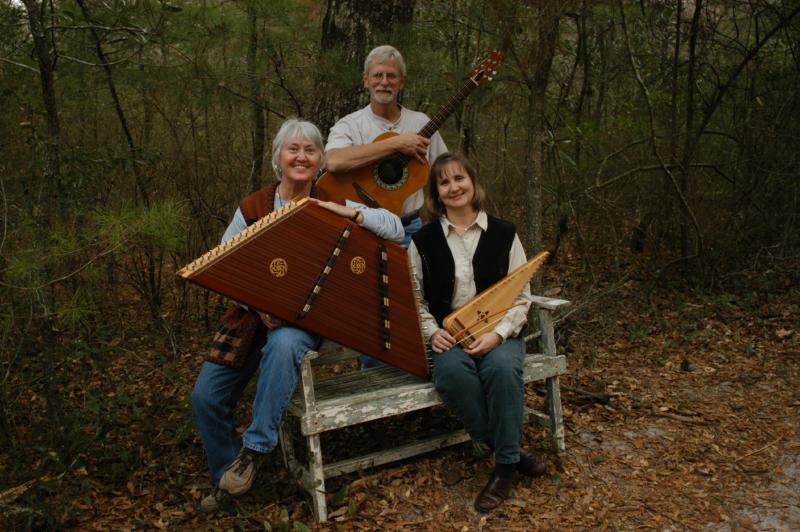
The sun started setting around 3:30, and the concert began in the dimmed church around 4. It was sheer magic. The group, Sweet Prospect, is so talented, and their music is so lovingly performed. Melissa Allured plays the recorder as well as most of the melodies in the selections they played today, Sheryl Bragwell plays the hammered dulcimer and a bowed psaltery, and Gary Diamond backs them up with guitar. They played a wide variety of tunes; Scottish, Irish, early American, even a very Wyndham Hill sounding piece from a Lopez Island (Washington State) artist Gary Haggerty, called Coffee American, which was lively and quick.

(angel playing Psaltery)
I have a complaint. The concert was only an hour long. I could have listened longer. But oh, what a wonderful hour it was! I love the Music at Christ Church program. There is a suggested donation for the concert, but if you can’t afford the $10 donation, no one is standing there scowling if you want to come into the church and hear some great music. There is a bowl out for collecting the donation, people toss their donation in and sit down. The concerts are also sponsored by several levels of music lovers at Christ Church who are patrons of the arts, and contribute generously so that these opportunities are available to the Pensacola community. How cool is that?
The good news is that on the Sweet Prospects website you can also listen to some of their recordings, and you can buy their CD’s. THIS IS IMPORTANT, ADVENTUREMAN! The one I really really want is called Cold Frosty Morn. If you go to their website, it tells you how to order it, or you can find one of the bookstores in Pensacola that sells it. (hint hint) It is Christmas music. If you want to go listen to a tune or two by Sweet Prospects, click on the blue type above, and listen away. 🙂 If you live in Pensacola, and you want to learn to play the dulcimer – or several other early musical instruments – there is a group that welcomes you and will teach you how. Learn to play hammered dulcimer – in Pensacola. I am blown away.
It’s just been such a great day, full of church, family and culture. We are so glad to be in Pensacola.
I just wish Sweet Prospects would be picked up to be sent on a cultural tour to our embassies in the Middle East. I wish our friends there, who love music, and who know the early musical instruments of the Middle East, could hear this music, and see these instruments, which are so similar. As I enjoyed every minute of this concert, I was wishing my Arab Gulf friends could be hearing it, too. This music is so American, and yet, you can hear the early strains of the Irish, the Scottish, and yes, even the sounds of the Holy Lands, brought back to Europe by the early crusaders.
Handel’s Hallelujah Chorus at Macys in Philadelphia
What a great way to start my day! Thank you, Momcat, for this wonderful new cultural random happening, this time at a large Macy’s in Philadelphia. Of course, this music is one I put on if I am feeling down; it lifts me right back up. 🙂
Blue Angels Coming Home to Pensacola

The Blue Angels have had a busy year, and coming up, Pensacola gets a chance to welcome them back home. The Blue Angels Homecoming will be November 11 – 13. You can always learn more at their official website: Blue Angels
Getting it Wrong
With all my years of living abroad, with all the experience I’ve had keeping my head down, observing, and trying to look and act like the locals, you’d think I’d get it right in my own country, right?
Wrong.
Well, most of the time I get it close enough. Sometimes I am overdressed at the Target or Home Depot. Rarely am I underdressed, but today I was. I looked around the church and I was one of very very few women in short sleeves. Almost every woman was wearing a jacket with either full length sleeves or 3/4 sleeves. Oops, I thought. When you are new, you especially need to try to look like those around you. It must be a calendar thing, not a temperature thing, because the temperatures today are back up in the 80’s; that is not long sleeve weather in my book, but it is in the Southern Lady Book.
One week I wore purple shoes – I love my purple shoes. I realized, too late, that they might go a lot of places, but probably not to our church. Oops.
Florida is particularly hard because there are the long-time Floridians and then those who are more newly arrived. I learned this the last time I lived in Florida, when, thanks be to God, I had an old Florida friend who told me all the inside scoop to help me pass. That was about 20 years ago, though, and some of the information has gotten a little outdated. The first rule, though, is not to look like a tourist. No little sundresses – and if you get a sunburn, you should have T-shirt marks on your arms so people will know you’ve been out fishing or working in the garden. No T-shirts with beachy sayings; T-shirts from the Breast Cancer Run or the Junior League Marketplace are OK.
My big dilemma right now has to do with legwear. I overheard some of the younger women in the locker room at aqua aerobics laughing about ‘old lady’ stockings, and I realized they meant nylon stockings. I haven’t worn them for a long time, except for once or twice in Seattle when I was back in the winter and had to go to funerals, but I don’t know what ladies are wearing in the place of nylon stockings. Nylon stockings in Qatar and Kuwait were pretty much irrelevant; when the temperatures are in the 120’s F, you simply don’t bother, wearing nylons is unthinkable.
You almost can’t even find nylon stockings in Florida, and a lot of the women seem to finesse the matter entirely by wearing pants, or not wearing stockings at all, which you can do in the summer, and of course you can wear pants in the winter, but what do you wear in the winter if you want to wear a skirt? It does get cold in Pensacola, and my legs are going to need some protection. I have a good supply of colored tights, which I have seen some younger women wearing, but this is one of those times when I feel like I have been gone from my own culture for too long and I am out of touch.
As I looked around the women at church today, I also had the funny idea that almost every woman in that church would do just fine in Qatar or Kuwait, they are covered to the elbow – and beyond – and they are covered to the knee, at the very least, with clothing that is mostly not too tight. Just as wearing long sleeves seems to be more cultural than weather-driven, covering your hair in the Islamic countries is more cultural than religious. Mohammed, the Prophet, told the women to ‘cover their adornments;’ it was the men who decided that hair is an adornment. My Saudi women friends told me that it originally meant ‘cover your breasts’. It’s cultural, not religious.
Still working out what works – and what doesn’t – in Pensacola. Praying that all my ‘oops’ are little ones.
A Day in Flomaton, Alabama
All we knew when we started the day was that we wanted to explore a little bit north of Pensacola, maybe even up into the part of Alabama that is across the state line to the north (as opposed to the part of Alabama that is across the state border to the west). We thought we were having a very boring day until we wandered into Flomaton, and AdventureMan discovered a railroad museum.
Flomaton is at the very top of the map:

The railroad museum was also an older house, now the museum, and an older 2 room cabin out back, moved from its original location. Here is a recreation of the old front parlor:


The Railroad Collection room:

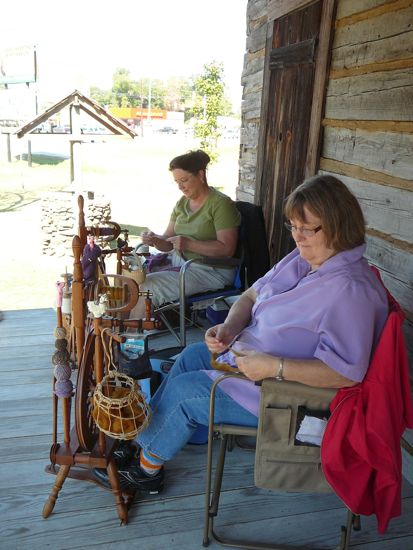
The log cabin was out back of the house, and had two women spinning wool into yarn on the porch, who very graciously allowed me to take their photo:
Inside the log cabin – we were told the couple who lived in this cabin had 12 children; they slept on the floor on pallets at night:


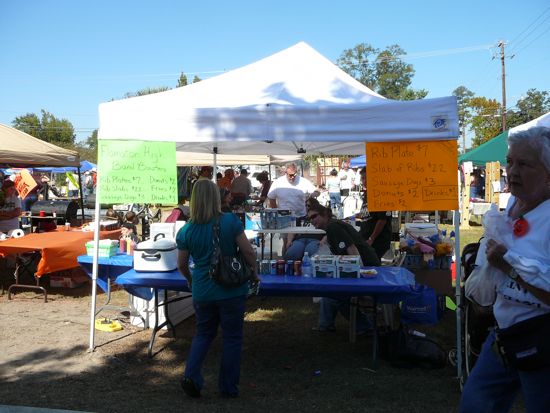
At the museum, there was a flyer about “Back to your hometown weekend” in Alabama, which just happened to be that very weekend. The town was full of returning people, there had been a parade and fireworks the night before (three former homecoming queens told me about this) and there was a street fair to celebrate Home Town Flomaton. 🙂
It was nearly lunchtime. We could smell Barbecue. The street fair was just a block away and there was parking right there, right by the fair. It was so much fun:

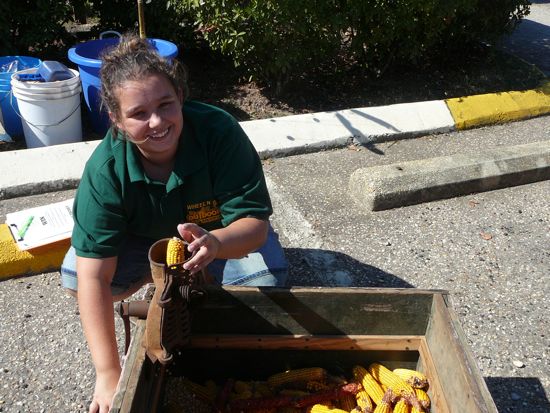
People were so kind and so helpful. This young woman was grinding corn, and we speculated that it must have been a great modern invention, and a real time saver, when it was invented. A woman passing by said she remembers her own mother using the same machine; all the corn was then taken to be ground, and stored in large airtight bottles in a dark ‘keeping room’ with preserves and food to get them through the winter.

This band was playing blues, gospel and country music, and they were pretty good!



As we stood and watched the choir, another woman welcomed us, and told us we really needed to see the new library (it was gorgeous!) and if we hurried, we could catch the Raptor Show at Otter Point. A Raptor Show!


Inside, there was a butterfly house, and several displays of local natural life:

There was also a wonderful hiking trail out over the wetlands, well maintained and beautiful:

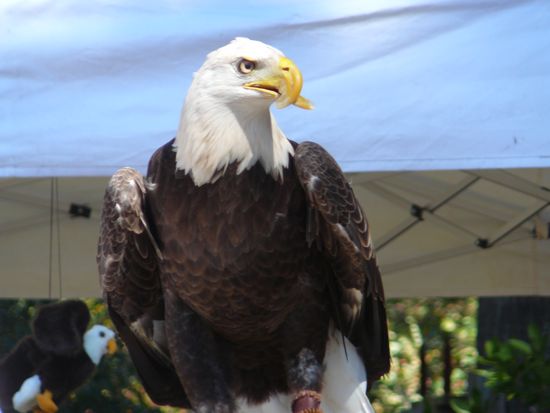
The Raptor presentation was very well done, informative and funny, on many levels. They had a large audience of children, who learned a lot, and also adults like us, who also learned a lot. The bald eagle’s beak is deformed by PCB’s, which, although banned back in the 1970’s, are still present in the environment in quantities high enough to cause birth deformities. The only reason they were able to adopt the bald eagle, a protected species, was that while he can hunt, he cannot tear his food apart with his malformed beak.
It was a day full of gracious hospitality. People were so kind to us, and went out of their way to make us feel welcome and to explain what we were looking at. For a day that started with no clear goal, we felt like we had been abundantly blessed by happening across this beautiful October day in Flomaton, Alabama.
Recent Comments
intlxpatr on Shampoo Ginger tigerbutterya0c5ff1d… on Shampoo Ginger intlxpatr on British Soldier Kidnapped, Esc… John on British Soldier Kidnapped, Esc… intlxpatr on British Soldier Kidnapped, Esc… Wikipedia Donate Button

Amazina


Early Voting in Florida


 Here There and Everywhere