Enmegahbowh
Yesterday, one of the songs we sang was an oldie but goodie, To Be a Pilgrim, written by John Bunyan, who wrote Pilgrim’s Progress while serving a jail term for preaching without a license. We sang the old fashioned version:
Who would true valour see,
Let him come hither;
One here will constant be,
Come wind, come weather
There’s no discouragement
Shall make him once relent
His first avowed intent
To be a pilgrim.
Whoso beset him round
With dismal stories
Do but themselves confound;
His strength the more is.
No lion can him fright,
He’ll with a giant fight,
He will have a right
To be a pilgrim.
Hobgoblin nor foul fiend
Can daunt his spirit,
He knows he at the end
Shall life inherit.
Then fancies fly away,
He’ll fear not what men say,
He’ll labor night and day
To be a pilgrim.
(Actually, I may have drifted off because I don’t remember singing the part about the hobgoblins or foul fiends . . . or maybe we sang a slightly more updated version . . .)
Yesterday’s reading in The Lectionary had a great prayer, which also included the word “pilgrim:
Almighty God, thou didst lead thy pilgrim people of old with fire and cloud; grant that the ministers of thy church, following the example of blessed Enmegahbowh, may stand before thy holy people, leading them with fiery zeal and gentle humility. This we ask through Jesus, the Christ, who liveth and reigneth with thee in the unity of the Holy Spirit, one God now and forever. Amen.
And it had this wonderful story of an American Saint, Enmegahbowh – A saint from the original inhabitants of our country:
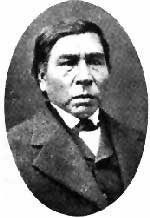
ENMEGAHBOWH
PRIEST AND MISSIONARY (12 JUNE 1902)
[James Kiefer has no bio for Enmegahbowh. Below is a biography from A Pioneer History of Becker County Minnesota by Alvin H. Wilcox (1907). Enmegabowh was the first Indian ordained in the Episcopal Church.]
In 1851, the Rev. Dr. Breck, a great missionary, whose name must be known to every reader of the “Soldier,” [“Christian Soldier”] began a mission at Leech Lake, among the Ojibwa Indians of Minnesota. This mission, from various circumstances, had only a partial success, and in the winter of 1855-56 troubles with the government agents roused the Indians to such madness that Dr. Breck was forced to leave, and the mission buildings were burned.
Two years later the Rev. Mr. Peake went to Crow Wing to establish another mission, and young Indian deacon, John Johnson, his Indian name Enmegahbowh, came to assist him. This man had beeen a catechumen under Dr. Breck, and had been baptized by him. He must have been born to some position in his tribe, as he had been set apart for a “Medicine Man” in youth, and his Indian name, Enmegahbowh, meant “The man who stands by his people,” a significant name, which in time proved to be a true one.
In 1861 Mr. Peake resigned the mission into the hands of Enmegahbowh. Crow Wing was then a settlement of very bad repute on the frontier. In 1862, the year of the Sioux outbreak, Hole-in-the-day, a leading Ojibwa chief, a bad man, full of craft and cunning, collected five hundred warriors, and prepared for a general massacre of the white people. Enmegahbowh, having prevented, by his influence, some other bands from joining these, was made a prisoner, but succeeded in escaping, and, through the midst of great perils, made his way to Fort Ripley, and by his timely information, such measures were taken that bloodshed and a more fearful massacre than that of the Sioux were prevented.
For a few years the mission work seemed at a stand still. From Canada Enmegahbowh received earnest invitations to go where comfort and hopeful work awaited him, but Bishop Whipple encouraged him, standing in the forefront for an unpopular cause and a hated people, and Enmegahbowh would prove the fitness of his name — he would not desert his people.
At last the government made new arrangements, and seven hundred Ojibwa were moved to what is called the White Earth Reservation, a tract thirty-six miles square in northern Minnesota. Of these seven hundred about one hundred and fifty were French half-breeds, or Roman Catholics. Amongst the remainder Enmegahbowh labored earnestly, the government now aiding in the work by encouraging the Indians in civilized ways. A steam sawmill was built at White Earth Lake, where Indians were taught to run the machinery, and from which lumber was furnished for building purposes. Eastern churchmen assisted the mission, and a church and parsonage were built.
At the time of the consecration of the church in August, 1872, quite a party of the clergy and laity, through the kindness of Bishop Whipple, were enabled to visit White Earth.
The consecration was on Thursday. Friday morning, the chiefs signified to the bishop their wish to meet with him in a council, which was therefore held, that afternoon, on the hillside in front of the church. It was a picturesque scene — the lovely landscape, the sunlight glancing through the tall oak trees on the bishop and Enmegahbowh, who sat in the centre, the chiefs and five or six clergymen grouped around. Behind the bishop three chairs were placed for the ladies of the party — the first time, I think, that ladies were ever admitted to an Indian council.
The chiefs spoke in turn, as they had themselves arranged, and were interpreted by Enmegahbowh. — Christian Soldier.
The Rev. John Johnson was born in Canada and died at White Earth on the 12th of June, 1902, at the age of 95 years.
God had someone in mind who was already set aside by his people to serve him, and he had the most wonderful name for a priest – The one who stands by his people. How cool is that? His heart was ready, when he heard the words, and he served mightily.
Baking Cookies for Palestine
When I was just starting out my own life, I had an idea what kind of life I wanted, but I had no clue how to get it. When AdventureMan and I met, we had the same vision, it was so cool, so unbelievable. We married, and this amazing life has unfolded.
Not everyone is born to move. You have to be good at change. Change can be daunting. Some people are better at staying in one place, sinking deep roots, developing lifetime relationships. Some people – like AdventureMan and me – have a need for stimulation, and we get it by changing locations. We feel so blessed.
It is always painful leaving the place we have been living, pulling up roots is just plain painful. The transplantation process takes time for the organism to adjust, for new roots to develop and take hold. Sometimes, the plant fails. In our case, we have had our failures to thrive, but for the most part, every move has helped us to learn and grow in new ways. We feel truly blessed; we have the lives we were born to lead.
Arriving back in Doha, I called my good friend. We have never lost touch, with e-mail and visits we have stayed in contact, and now I am calling her so she has my new number in Doha.
“You must come Tuesday morning!” she enthused, “We are baking cookies for Palestine!”
This wonderful woman was my teacher for reading and writing Arabic, and she did a great job. I read and write about as well as a five-year-old, but I can sound out words, and can write my name. Best of all, I adored this teacher, and when she called and asked me if there was something I could teach her daughters during the long hot Doha summer, I said “yes” and a new adventure began.
One of the things that happened is that I learned I never really knew what the day might bring. Getting to know her, her daughters, and her family better, I learned now ignorant I am of how totally differently others live their lives and see the world. I was learning all the time, and most of it was from the daughters. On one occasion, the daughters called me at 6 in the morning – they are never up at six! They asked if I would take them to the hospital to see their mother, and I sleepily said “Yes, of course,” and asked what time they wanted to go.
“Now!” they replied, joyfully, for this was a birth.
My sweet daughter-in-law was visiting, with our son, and so the two of us rushed over to pick up the girls, who came loaded with carafes loaded with coffee, boxes of finjan (tiny Arabic coffee cups) and sweets, loading up the car with goods and joyful laughter. When we got to the hospital, we had a quick visit with the Mom and then – the guests started arriving.
First – the room. Our friend was in a king sized bed, surrounded by lush curtains which could be pulled. She had a marble floor and a marble private bathroom with private shower, and a small dressing room. There was a visiting area with velvet covered seating for around 16 people, and mahogany paneling everywhere. This is the poshest maternity ward I have ever seen.
Many of the guests were stopping on their way to work. “When you visit someone in the hospital,” the girls informed me, “a thousand angels pray for you, for having made this visit.” These visits are de rigueur, an absolute must. We were there an hour, a constant stream of women came and went, staying around ten minutes, each receiving a small coffee. Then, the girls told us we could go, that they would stay to take care of serving the coffee and sweets.
The entire episode, we never had one clue as to what we were doing, or what was going to happen next. I learned just to go with whatever was happening, stay quiet, watch and learn. Sometimes, I ask questions, if there is a quiet moment.
So when my friend says come bake cookies, I go. I remember when she first baked her first cookie; she called me to come. She didn’t have a mother, growing up, and there were gaps – like how to bake cookies. We spent a morning learning how to make mamool, and it took me three days to get the smell of butter out of my hands. It was so much fun.
As I entered the workroom twenty pair of eyes looked up at me. Everyone was neatly dressed in aprons and headscarves, but my friend wasn’t there! I found my friend, we exchanged greetings, and she came to workroom to get me started. I had my own apron with me, and they provided me with a headscarf; we all looked a lot alike, little baker women. As a beginner, I got to put out the dough, later put the date paste on each piece of dough, later roll the dough around the date paste and put a hole in the top.
Most of the women, vastly more experienced than I, were using little tweezer tools to crimp the dough into the fabulous tiny ridges you can see in the photo. My friend explained that one of the women’s husbands had made the special tools for making the holes in the dough, and the table for them to use packing up the cookies and wrapping them, another had provided a portable oven for baking the cookies, another donated semolina (the flour) and another the dates.
Working once a week, making these beautiful cookies, (biscuits, if you are British trained) the women have built two wells in Palestine, and are currently building a bakery. They took their grief and outrage over Al Raza and turned it into the most amazing effort for good. They feed the hungry, give water to the thirsty, they clothe the poor, they take care of families whose men are imprisoned.

“You must come back!” one woman says as I am heading out the door. “You are a good worker!”
I wouldn’t miss it for the world. 🙂
Serious About Traffic Regulation in Doha, Qatar
We were all at dinner, having a wonderful time when the traffic issue came up.
“There’s so much traffic now!” they were all saying.
To me, traffic in Doha is pretty tame. It’s been six years since we were here for the first time, and Doha was still “sleepy little Doha.” We took photos of the changing skyline almost monthly from the spit where the Bandar restaurants used to be (one day they just disappeared!) and gasped at how fast Doha was changing.
There are a lot of changes. Traffic on the ring roads has been greatly streamlined, although it seems they continue to engineer D ring, over and over again. I just hope one day they will get it right and it will be open, all the way from the road to the north to the airport.
There are traffic lights at the roundabouts, and the traffic flows so smoothly I am astounded. There is still a lot of traffic around the seven to nine at night shopping/dining/visiting time, but the traffic lights have regulated the formerly death-defying roundabouts.
“Go! Go!” I told AdventureMan as the light started flashing green, and he just looked at me as if I had grown a second head.
“Flashing green means STOP!” he informed me.
“Flashing YELLOW means stop,” I informed him right back.
“Not in Qatar,” he said with the tone of voice that says ‘don’t argue this point with me.’
At dinner I learned he was absolutely right. If you enter a traffic circle on a flashing green and the light changes, the cameras – they are everywhere – will take your photo. They will take your photo and you will have a fine, a whopper of a fine, QR6,0000. That translates to around $1,700 in US Dollars. Gasp. And – here’s the cruncher – it is ENFORCED.
There was a time when I lived in Qatar before when the huge SUV behind me pushed me into the roundabout when I wasn’t moving fast enough for him. You still see the cowboys drive up on the sidewalks to cut across an empty field, but there are fewer and fewer of those empty fields left in Qatar. There is none of the speeding and weaving along the ring roads we used to see – there are cameras EVERYWHERE. People get fines for waiting at the airport doors, instead of parking. People get significant fines for going even 10 km over the speed limit. Points are assessed for moving violations, and they add up fast.
I’m going to have to improve my driving skills. I developed some aggressive habits, driving in Kuwait, and I am going to have to tone it down to survive the cameras in Qatar.
I am very interested to see how rapidly behavior can change when penalties are enforced. I am truly (and happily) shocked an how effective it can be. I await with great interest the year-end statistics, to see how the accident rate has been brought down – I bet we all get a very good surprise.
John the Baptist / Yahya ibn Zakariyya
Most westerners don’t have a clue that John the Baptist, as well as Jesus, are featured prominently in the Qur’an.
Today’s reading in The Lectionary starts of the magically lyrical Book of John, and, if you read between the lines, you get a clue to the mystery of the holy trinity – not three Gods, not at all, but three facets of the one God we people of the book believe in:
John 1:1-18
1In the beginning was the Word, and the Word was with God, and the Word was God. 2He was in the beginning with God. 3All things came into being through him, and without him not one thing came into being. What has come into being 4in him was life,* and the life was the light of all people. 5The light shines in the darkness, and the darkness did not overcome it.
6 There was a man sent from God, whose name was John. 7He came as a witness to testify to the light, so that all might believe through him. 8He himself was not the light, but he came to testify to the light. 9The true light, which enlightens everyone, was coming into the world.*
10 He was in the world, and the world came into being through him; yet the world did not know him. 11He came to what was his own,* and his own people did not accept him. 12But to all who received him, who believed in his name, he gave power to become children of God, 13who were born, not of blood or of the will of the flesh or of the will of man, but of God.
14 And the Word became flesh and lived among us, and we have seen his glory, the glory as of a father’s only son,* full of grace and truth. 15(John testified to him and cried out, ‘This was he of whom I said, “He who comes after me ranks ahead of me because he was before me.” ’) 16From his fullness we have all received, grace upon grace. 17The law indeed was given through Moses; grace and truth came through Jesus Christ. 18No one has ever seen God. It is God the only Son,* who is close to the Father’s heart,* who has made him known.
(This is the tomb of John the Baptist / Yahya in the Ummayad Mosque in Damascus, Syria)

So we ask ourselves, what exactly does the Qur’an have to say about John, and going to Wikipedia, I found the following (I have added paragraph separations to make it more readable):
According to the Qur’an
According to the Quran, Yahya was the son of Zakariya, and was foretold to his father by the angel Gabriel. Yahya is called a righteous, honorable and chaste person, as well as a Prophet of the Righteous ([Qur’an 6:85], [Qur’an 3:39]). He came to confirm the Word of God ([Qur’an 3:39]). His story was retold by Jafar to the Abyssinian King during the Migration to Abyssinia [2].
In his recent article, Agron Belica say’s the following: this prophet has been overlooked and misrepresented. One reason he has been overlooked is because there are five words used in the Quran to describe Prophet Yahya that have been misinterpreted in translations of the Quran. The first is the word hasur which is usually translated “chaste.” My research shows that the Arabic word hasur does not mean “chaste” with regard to Yahya; rather , it means “a concealer of secrets.”
Why the mistake in translation and commentary? As there was no extensive information given in the Quran about the life of Prophet Yahya nor in the hadith, the commentators then turned to Christian tradition and simply repeated what they found there. Nonetheless, the commentators of the Quran have placed considerable emphasis on this word.
Al-Tabari interprets the word hasur to mean one who abstains from sexual intercourse with women. He then reports a hadith on the authority of Said ibn al-Musayyab which has Prophet Muhammad saying the following: “Everyone of the sons of Adam shall come on the Day of Resurrection with a sin (of sexual impropriety) except Yahya bin Zechariah.’ Then, picking up a tiny straw, he continued, ‘this is because his generative organ was no bigger then this straw (implying that he was impotent).’” Does this mean that even the prophets outside of Yahya will be raised up with this sin of sexual impropriety? How can we accept that this was said by such a modest human being, comparing a straw to another prophet’s generative organ? Was Yahya impotent?
One commentator, Ibn Kathir, a renowned Islamic scholar , rejects this view and adds, “This would be a defect and a blemish unworthy of prophets.” He then mentions that it was not that he had no sexual relations with women, but that he had no illegal sexual relations with them. Indeed, the whole discussion is unseemly. It is known that prophets of God are immune from major sins, so this statement makes no sense at all when interpreting the word, hasur. In addition, I would like to mention the fact that in his commentary, ibn Kathir says he (Yahya) probably married and had children. He said this on the basis of what was related in the Quran of the prayer of Zachariah. There are at least three reasons why interpreting hasur in this context as “chaste” is a misinterpretation: First of all, there is another word in the Quran for “chaste” and that is muhasanah. As God used a different word with hasur, it must mean something different. Secondly, God says in the Quran that Islam did not bring monasticism but that it was something that they (the Christians) invented. Therefore, God would not have sent a Prophet who was celibate. In addition, it is contrary the exhortation in the Torah to “go forth and multiply.” Thirdly, Yahya’s father, Zechariah prayed for a protector who would provide descendants (dhuriyyat) for his family. “There Zachariah called to his Lord; he said: My Lord! Bestow on me good offspring from Thy presence; truly Thou art hearing supplication.” (3:38) God gave him Yahya.
God would not have sent a son to Zechariah who would not carry on the line of Jacob’s descendants because then God would not have answered the prayer of Zechariah. The word hasur is used only one time in the Quran and that is in regard to the Prophet Yahya.
A major Arabic-English lexicon, that of Edward William Lane (Taj al-Arus) states that when hasur is used alone, it means “concealer of secrets.” In his translation, of Ibn al- Arabi’s Book of the Fabulous Gryphon, Elmore also translates the Arabic hasur “as consealer of secrets.” In the referenced passage, “chaste” would not have been appropriate. (Gerald T. Elmore, Islamic Sainthood in the Fullness of Time, Brill 1999, P. 482)
The second word that has been misinterpreted is waliy (19:5) which in this verse and many others in the Quran means “protector” not “heir or successor.” In this specific case, Zechariah prays to his Lord: “And truly I have feared my defenders after me and my wife has been a barren woman. So bestow on me from that which proceeds from Thy Presence a protector (waliy).”
The third word that is misinterpreted is that of fard in (21:89): “And mention Zechariah when he cried out to his Lord: My Lord! Forsake me not unassisted (fard) and Thou art the Best of the ones who inherit.” It is usually translated as “heir,” but the same reasoning applies as above. The word “unassisted” refers to the fact that Zechariah did not want to be left alone without any protector. He feared for those who would defend him and his honor after he died, that they would be left without a protector and thereby could not defend his honor.
The fourth misinterpreted word in relation to Prophet Yahya is sayyid. Prophet Yahya is referred to as a sayyid, chief in the Quran. The commentators have interpreted this to mean that he was a scholar of religious law, a wise man, a noble wise and pious man, and so forth. This was a prophet of God. Knowledge and wisdom were given to him by his Lord. The title given to Yahya by his Lord shows that Prophet Yahya is one who has authority over his people and not “noble” or “honorable” as this word is usually translated. Honor and nobility are good qualities but they fail to indicate that Prophet Yahya is given a role of leadership by his Lord.
The fifth word is hanan which means “mercy,” which is part of the compound name Yu’hanan (in English “John”), meaning “God is Merciful.” The word hanan is used once in the Quran and that is in reference to Prophet Yahya: “And continuous mercy from Us and purity . . . .” This is singularly appropriate to the circumstances of the Prophet Yahya. The names Yahya and Yuhanan are not the same as many assume. They have two entirely different roots. Hanan and hanna both derive from the Semitic root h n n. While the word hanna means “mercy or tenderness,” the root word for Yahya is h y y. It means “life” or “he lives.” One does not need to be a linguist to see the obvious. In addition, I would like also to mention that this name and attribute given to Prophet Yahya can also be found in Sabean literature. The Sabians are mentioned in the Quran in verses (2:62), (5:69) and (22:17).
In their canonical prayer book we find Yahya Yuhanna. It has been known that it is the practice of the Sabians to have two names, a real name and a special name. According to the Sabians, this prophet’s real name was Yahya (he lives) and his lay name was Yuhanna (John). Prophet Yahya is the only one given this name as the Quran clearly states: “O Zechariah! Truly We give thee the good tidings of a boy; his name will be Yahya (he who lives) and We assign it not as a namesake (samiyya) for anyone before.” Again, another word that we need to pay attention to is samiya. It is used twice in the Quran, once in reference to Yahya (19:7) “O Zechariah! Truly We give thee the good tidings of a boy; his name will be Yahya and We assign it not as a namesake (samiya) for anyone before.” The other time it is used is in reference to God. “. . . Knowest thou any namesake (samiya) for Him [God]?” (19:65)
In the famous Arabic lexicon Lisan al-arab the root word s m w means elevation or highness. “Then the angels proclaimed to him while he was in the sanctuary that God gives you good tidings of Yahya-one who establishes the word of God as true- a chief and a concealer of secrets and a prophet, among the ones who are in accord with morality.”(3:39) See The Sublime Quran Pocket Size translated by Laleh Bakhtiar (2009)
So here is what I am thinking this morning . . . We have so much to offer one another. We use each other’s books – Jewish, Christian, Moslem – and studies to illuminate our beliefs. Why are we niggling over trivialities? If we were to clasp hands and fight together against the forces of darkness, what a mighty force for good we would be!
Some Are Silver and the Others Are Gold
Life gets funny when you move. Like 5 minutes after I landed, my Kuwait phone stopped working except for advertisements. The company provided me with a loaner, just so AdventureMan could keep in contact with me, and then like a light bulb going on in my head, I checked to see if the problem was lack of money – yep.
I used to have a phone plan. I am not a big phone user. I discovered those wonderful Hala cards, and at the very max might use 10KD per month – I really am a light user.
When I arrived, my good friend two villas down had her movers – she is leaving. We had like six days of overlap. Three of those days, she had her movers there and I had people here helping me get the new villa set up. We would grab a few minutes when we could – not even enough time for a cup of coffee, but as I left, I thought “this is just like old times.” We’ve both always had busy lives, and we would grab time together when we could.
In the USA, when kids go to camp, we learn songs. It occurs to me that many cultures transmit cultural values in songs – I know I can still remember French and Spanish songs I learned in language classes . . . there must be something about singing that imprints things in your memory. One of the songs is:
Make new friends – but keep the old,
One is silver and the other is gold.
You sing it once, all together, and then you divide into four groups and sing it as a round until it is all finished. You sing it when you are leaving camp, and you cry.
Of course, we are all grown up now. We don’t cry when friends leave. (Liar! Liar!)
The movers are gone, my friend SMS’d me “how about a swim tomorrow?” and I SMS’d back “Sure!”
We lolled around in the pool, sort of theoretically exercising, but her equipment is en route back to the USA and mine is en route from Kuwait, so we were pretty lax, sort of bobbing around and laughing and catching up. She is trying to bring me up to speed on what is going on in Qatar, and I am trying to remember everything she is telling me. We walk home, head in our separate directions again. I have a loaner car, and I get to go grocery shopping ALL BY MYSELF!
I am down to putting away my last two bags of groceries when my loaner phone rings and it is my good friend saying “I have to drop my son at school, have you eaten, want to have a late lunch?” and I laugh and say “sure” and we plan to meet at 1:30, but the QTEL (Telephone) man comes (the company sent him so I wasn’t expecting him) and the problem is too complicated, so he will come back and I just barely have enough time to get to the meeting-up restaurant.
Ooops – no, forget that, I am going to be late, I had forgotten about the traffic, so I break the law and call my friend on my mobile and say “I’m going to be another five minutes at least, I am so sorry, go ahead and order for me” and she just laughs.
We have a great lunch together, still catching up on all I need to know, and I ask if they have plans for dinner tonight and she says “no” and I say we would love to have them come to our house for something simple. Like I have napkins; the ones she gave me because they were leaving, but I don’t even have a tablecloth with me, it will be something casual like spaghetti and salad and garlic bread and she says she thinks they would just love that kind of evening but she has to check with her hubby.
We talk talk talk and then her hubby calls and she forgets to ask if he can do dinner with us, but then my hubby calls and says we need to do blood work for our residency and can we do dinner another night (we already have another date set up with them) and so I get off and have to say “uh, I am sorry, but I have to take back that dinner invitation.”
This all seems convoluted and round about, but this is where those GOLD friends come in. She just starts laughing (I love it when she cracks up) and says “OK! But I’m NEVER going to let you forget this! You WITHDREW an invitation!” and then we are both laughing and oh, Lord have mercy, I am so thankful just to have a little overlap with this crazy friend, and oh, how I am going to miss her.
Some friends are just THERE, they know what the important things are. This friend has me all set up with a really good cleaning lady who will start on Saturday, she told me the really good tailor she has found, the best car rental place, and which car wash guy to keep far away from. She borrowed a cup of laundry soap. Tomorrow, she needs to come here and iron her son’s shirt for graduation, and she and her husband are bequeathing to us their leftover (legal! legal!) booze. Here is what takes it beyond gold – our husbands like each other, too. Our cats . . . not so much. Her cat wants to make nice, my cat gets all hissy.
Inside this grown up expat body is still the little Girl Scout from camp, making new friends, and treasuring the old . . .
Kuwait Paper Dump Badge
I admit it. When I saw Ansam on her new blog had a Kuwait Paper Dump certificate, I was green with envy! I knew I didn’t deserve one – I have only contributed once, and even my contribution wasn’t truly acceptable because I don’t have a fax, so I took photos and sent them to Abaid.
Yesterday, when I opened my e-mail, I almost cried. He sent me a badge for my support and positive mentions. Honestly, it is the best badge I have ever sported on Here, There and Everywhere.
I’m from Seattle, remember, where recycle cans are issued, and sorting and recycling is mandatory. I’m also from the hippie generation, the back-to-the-earth movement that springs up every now and then, you know, make your own paper, make your own soap, grow your own tomatoes and basil. That my son, his wife, my sisters and my nieces and nephews and this new generation of Kuwaitis are all into saving the environment – it is just icing on my cake. And the candle on my cake is the new badge. You can see it here, and you can see it for the rest of the life of the blog under Kuwait Paper Dump in the Blogroll.

For those of you not familiar with the website, 3baid gathers up paper from around Kuwait from restaurants, service providers, Kuwait resources, events, etc. and publishes them all in one place, eliminating our need to keep track of all those papers. When you want to know what the possibilities are from a particular restaurant, you will find the menu there. When you want to know who has mushroom pizzas, you can click on “mushroom pizzas” and find out which places have them. It is an amazing public service they provide at Paper Dump, and they do it entirely as volunteers, serving the community.
I am so totally honored. Thank you for the badge. Thank you, too, for your quiet, persistent leadership in the Kuwait environmental/Green movement.
Down to the Sea in Ships
Even though I grew up in the capitol city, Juneau was a very small town, really a village, and fishing played a major role in people’s lives. Everyone had a locker, where fish caught during the summer and meat from hunting season was frozen and stored for the long Alaska winter. It’s probably one reason why I have loved both Kuwait and Qatar so much – while few – if any – Kuwaitis or Qatteris – need to fish for a living, there is still a love and respect for fishing and water sports that is probably hard wired into their souls.
Being in a boat on a sea makes believers of us all. The sea and the desert have this in common – when you go out beyond the sight of civilization, you realize, no matter how big your boat / ship is – you are very very small. You realize how powerless you are. One rogue wave, one unexpected sand storm can do you in.
These are verses taken from Psalm 107, part of today’s reading in the Lectionary that make me think of Kuwait.
23 Some went down to the sea in ships,
doing business on the mighty waters;
24 they saw the deeds of the Lord,
his wondrous works in the deep.
25 For he commanded and raised the stormy wind,
which lifted up the waves of the sea.
26 They mounted up to heaven, they went down to the depths;
their courage melted away in their calamity;
27 they reeled and staggered like drunkards,
and were at their wits’ end.
28 Then they cried to the Lord in their trouble,
and he brought them out from their distress;
29 he made the storm be still,
and the waves of the sea were hushed.
30 Then they were glad because they had quiet,
and he brought them to their desired haven.
31 Let them thank the Lord for his steadfast love,
for his wonderful works to humankind.
32 Let them extol him in the congregation of the people,
and praise him in the assembly of the elders.
Busted
Today, as I was getting ready to leave the church services, one of my very special friends hugged me and said farewell, and then said “But of course, I can keep up with you on your blog.”
It was as if time stopped for a second, then started up again.
“My blog? You read my blog? You know?” I stammered, not loudly because there were other people around.
She laughed.
“I figured it out when you described this guy,” she said, punching AdventureMan lightly on the shoulder. “I KNEW it was you.”
When we got into the car, AdventureMan had a big smug grin on his face.
“I almost told her I read your blog quickly first, to see if I’m in it,” he said, “but then I was embarrassed that I am so vain.”
LLLOOOLLLL!
I’ve gotten less careful. It’s becoming less and less relevant as I get closer to leaving.
Who Is My Neighbor?
You would think when someone so special is talking, people would listen. You would think that when he is trying to tell us what God expects from us to enter into his kingdom in the after life, people would be listening, and indeed, they listened, many listened. There were others who did not. There were also those closest to him who misunderstood! That always baffles me, that those closest could misunderstand.
Today’s lesson is one of my very favorites in the world. You can substitute any two races who hate one another and the story is equally clear. The man who was asking the question was setting Jesus up, or trying to, and Jesus used the occasion to teach a stunning truth – that love is stronger than hate.
Luke 10:25-37
25 Just then a lawyer stood up to test Jesus.* ‘Teacher,’ he said, ‘what must I do to inherit eternal life?’
26He said to him, ‘What is written in the law? What do you read there?’
27He answered, ‘You shall love the Lord your God with all your heart, and with all your soul, and with all your strength, and with all your mind; and your neighbour as yourself.’
28And he said to him, ‘You have given the right answer; do this, and you will live.’
29 But wanting to justify himself, he asked Jesus, ‘And who is my neighbour?’
30Jesus replied, ‘A man was going down from Jerusalem to Jericho, and fell into the hands of robbers, who stripped him, beat him, and went away, leaving him half dead. 31 Now by chance a priest was going down that road; and when he saw him, he passed by on the other side. 32 So likewise a Levite, when he came to the place and saw him, passed by on the other side. 33 But a Samaritan while travelling came near him; and when he saw him, he was moved with pity. 34 He went to him and bandaged his wounds, having poured oil and wine on them. Then he put him on his own animal, brought him to an inn, and took care of him. 35 The next day he took out two denarii,* gave them to the innkeeper, and said, “Take care of him; and when I come back, I will repay you whatever more you spend.” 36 Which of these three, do you think, was a neighbour to the man who fell into the hands of the robbers?’
37He said, ‘The one who showed him mercy.’ Jesus said to him, ‘Go and do likewise.’
I have seen this in my own life. I have seen hopeless situations, with no solution in sight, totally change because one person chooses to love, instead of to hate. Choosing to love, in the face of hatred, takes a lot more character, a lot more strength. It has the potential for changing everything.
Breathless Day
The air is still, and there isn’t a single wave on the vast, flat glassy Gulf. At eight in the morning, it is already breathlessly hot:

It’s not getting any better. Maybe by the beginning of next week, as you can see, a little “cold” weather will be moving in 😉

The only way you can determine the difference between water and air is the layer of yellow tinged haze on the far horizon:

Here is what my life looks like right now:

Yesterday, a sweet friend dragged me away from all the packing and focus on moving and treated me to a day at the Aquatonic Spa. I admit it, she had to drag me – I can get so immersed in my misery that I don’t even want to do something fun.
In spite of my churlishness, we had a great time. Playing around in that fabulous pool, and then having beauty treatments afterwards – it just took all the misery out of me. I felt great for the first time in weeks. I slept last night without waking, and awoke refreshed, thanks be to God, and thanks to my friend who knew what I needed better than I did.
Recent Comments
intlxpatr on Shampoo Ginger tigerbutterya0c5ff1d… on Shampoo Ginger intlxpatr on British Soldier Kidnapped, Esc… John on British Soldier Kidnapped, Esc… intlxpatr on British Soldier Kidnapped, Esc… Wikipedia Donate Button

Amazina


Early Voting in Florida


