The Upside Down Day
Yesterday was a totally upside down day, where I never really knew what to expect. First, my husband was already up when I woke up, and when he heard me stirring, came into the bedroom with his great big smile and shining eyes and said “Let’s go to the Early Bird for breakfast!”
I laughed, and dropped my morning routine and plans to enjoy this delightful surprise. Quickly dressed, we were out the door well before seven, even well before sunrise. As we drove into Fehaheel, I managed to catch the sunrise, although I didn’t see it until this morning when I finally had time to sit down and organize myself. This is for you, Daggero, yesterday’s icy morning sunrise!

Believe me, that shot is a surprise – we were at a stoplight, briefly, and I shot it through the window, not the ideal way to shoot a sunrise. Lucky shot, beautiful day.
The Early Bird was closed! Closed through today! What to do!? AdventureMan remembered seeing a small place deep in the heart of Fehaheel, and we’re in Fehaheel, it is not yet seven ayem and the streets are empty. We drove to the “Arabic Early Bird” and miracle of miracle, on a street that teems with traffic day and night, at 0h-dark-thirty in the morning, it is open and there is a beautiful parking spot, a LEGAL spot, available. We take this as a sign that we are meant to have breakfast there.

Indeed, the cook is ready, and already has betinjan (eggplant) and felafel all fried up for us – YUM!

The waiter brings us all kinds of goodies, most of which are totally delicious. This is my first time eating tomato scrambled eggs, which Mishary wrote about in Some Contrast sorry I can’t find the original article, but he shows you how to cook them. I think he used 12 eggs! Some of the pickles are strange to our taste, but the food is hot and fresh and delicious, and washed down with hot tea.

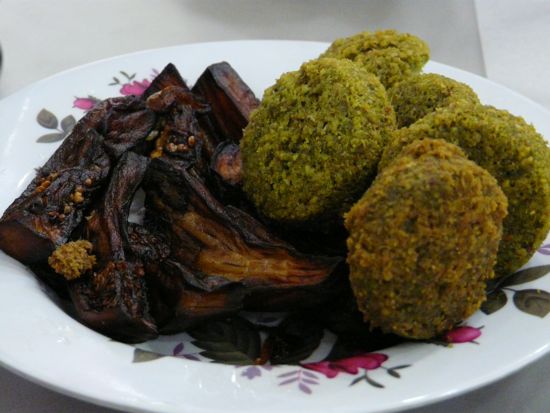


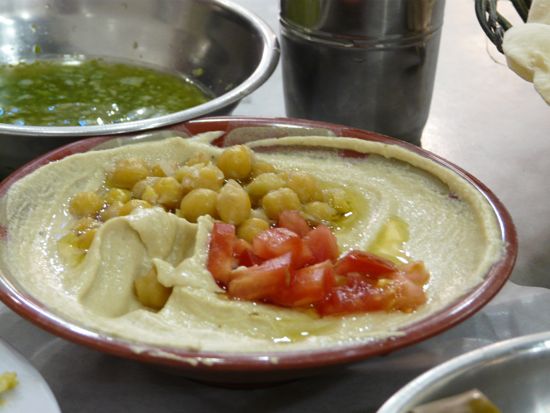
More food that we could eat! When we got the bill, it was KD 1.750. What luxury! 🙂 What a great way to start the day, in every way not what we expected.
What is it called in Kuwait? Can you do it?
In the comments of a recent post, blogger Moodi asked if I liked Qatayif. I checked the Wikipedia page, and it reminded me of something else.
In Qatar, when I lived there, our teachers at The Qatar Center for the Presentation of Islam demonstrated making a large, thin dough that was used in many ways, folded and used in casseroles, used as a foundation in serving dishes, crumbled up when dry and used in breakfast making . . .
It was made by hand, using a dough that you held in your hand, and tossed and brought back to your hand after leaving a dot on a hot griddle. I think the hot griddle might have been flat some times, and like an upside-down wok other times. The pancake would turn out large and round, but only a few atoms thick, they were very very thin and delicate.
I never have seen this in Kuwait, but that doesn’t mean it doesn’t exist.
Do any of your grandmothers or mothers make thin pancakes for special holidays in this manner? Can you tell me what it is called?
In Tunisia, women used to make Malsouqa, the thin thin dough used to make brik and sell it in stacks in the marketplace. You could wait, and buy it fresh off the stove, they would toss and grab, toss and grab, and then peel the very thin, fragile skin of dough off the burner. Pop in a little tuna, chopped parsley. salt, pepper and egg, fry lightly in a little olive oil in a frying pan – heaven in a wrapper.
I was obsessed. It took me an hour – but I found a wonderful blog, Chef Zadi with these fabulous photos of how malsouka are made. His blog is all about healthy North African cuisine
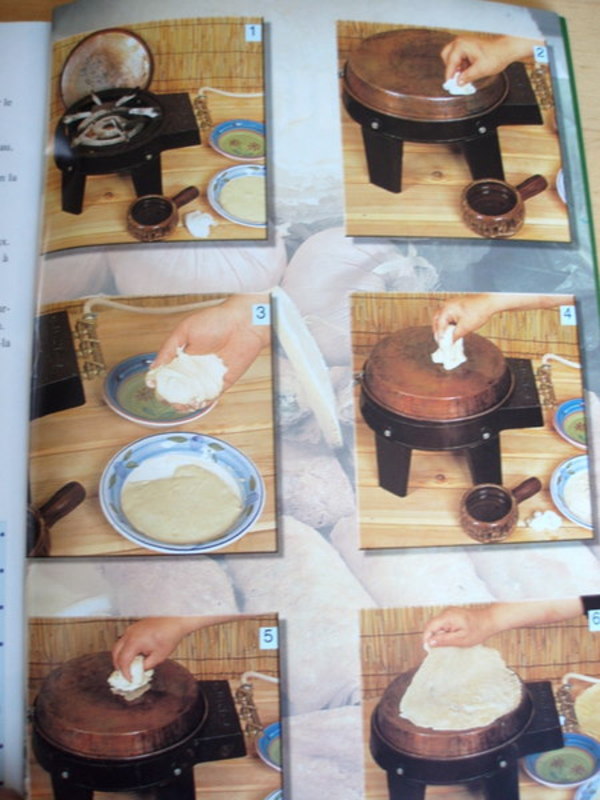
So – have you seen anything similar, something done on a hot iron with a dough held in the hand and tossed at the got grill over and over, leaving small spots of dough that gather into a large flaky thin pastry?
Sunrise 27 December 2008

It’s another beautiful winter’s day in Kuwait. The bone-chilling cold has gone – for the moment, anyway – and the days are balmy high sixty’s (Fahrenheit) – low seventies. At night, you get to wear a light sweater. It is heaven.
The market is still full of Kuwaiti shrimp, which disappear around the 15th of January, when the season finishes. Meanwhile – a feast!
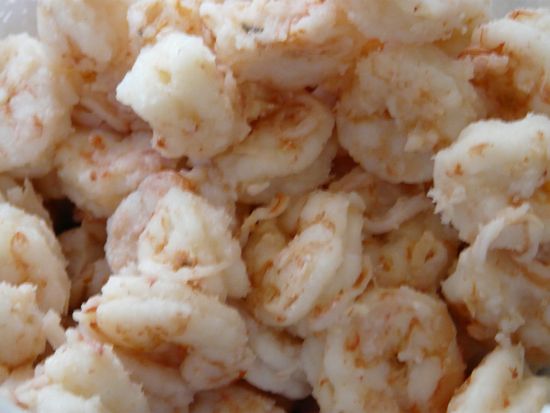
AdventureMan and I are dining on leftovers these days, sounds bad, but Christmas leftovers are the best. Flavors have time to mellow and marry, and we’d rather eat these leftovers than go out to eat!
Smoked Salmon Spread:

Rouladen:

Cranberry Salad:

The faucet in my kitchen is fixed, thanks be to God!
Have a great day, Kuwait.
Merry Christmas, Kuwait!
It is seven in the morning, and AdventureMan is sleeping in a little, giving me a chance to catch up with YOU.

We have always waited until morning to open our gifts. Last night, after our guests left, we said “No children! We could open our presents tonight!” and then . . . we laughed. It was late and we were tired and we needed our sleep. (I never thought I would see the day, so old that I would want to go to bed more than to open presents.)
Christmas Eve was so special, spent with dear friends, reminiscing over times together, past Christmases. There is one great thing about being an older adult, and that is you are no longer involved in the frenzy of school and church and after-school youth activities. At nine at night, I am not busy trying to get my son’s acolyte robe ironed, ready for the midnight service, I am not frantically putting together the last few plates of cookies that I am required to provide for a million events I don’t really even want to attend. Christmas is much more peaceful, more measured, less frantic now, and I love being able to enjoy the holiday at a more measured pace. Isn’t life full of delicious ironies, that I can enjoy Christmas more in a Moslem country?
One Christian friend told me years ago that Satan tries to distract us during the holiest days. (I would have imagined that to be true for my Moslem friends, too, but I think I remember that Satan is jailed during the month of Ramadan, and cannot tempt you; that if temptation comes, it is coming from your own heart and shows you where you need to work on your character.) Yesterday, as I was working on the Christmas Eve dinner, my kitchen faucet broke – simply would not shut off. Anytime I wanted to use water, I had to go under the sink and turn two knobs, or water would just continue to run.
My friend called and asked if she could use my oven, which, fortunately, I had just turned on, but wasn’t planning to use immediately, so she came for about half an hour and we had an unexpected and delightful visit while I worked on vegetables and she baked her Christmas cake.
If that was Satan, well, he inconvenienced us, but he certainly didn’t get in the way of our enjoying Christmas. Ha Ha on you, Satan!
I intended to take a bunch of photos showing you our Christmas Eve dinner, but it’s like you get on this track, and then the track takes over, and I only have a few images to show you, and nothing really from the meal.
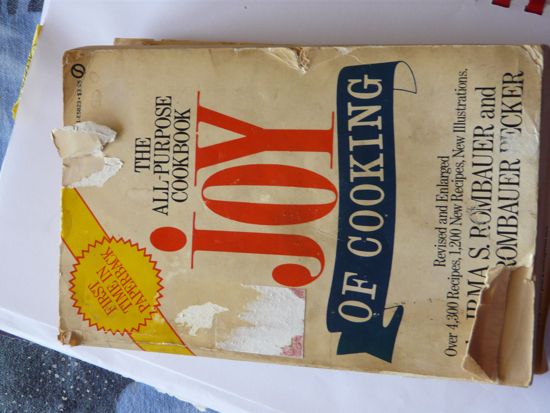
This is my oldest cookbook, I think I even had it before I was married. The glue has started to fail, pages are falling out, there are drops and stains throughout the book, but I don’t want to replace it because it has so many memories. This is my go-to book when I need an overview on how things work, and a basic, tried and true recipe.
Yesterday was a relatively easy day, pulling things out and putting them together. The harder days were before – creating the menu, figuring out what I needed from the store and getting it (AdventureMan helped) and “prepping”, i.e. getting all the walnuts chopped, the onions, the parsley, the cheese grated, etc. That’s the really hard work, I think.

One thing required a little extra preparation – I wanted to make peppermint candy ice cream, something I have made before. but a long time ago. It requires peppermint candy. Once I saw peppermint candy here, but it was a long time ago, in like February – I guess it hadn’t gotten here in time for Christmas. I brought back some from my recent trip to the US.
The ingredients for peppermint candy ice cream are wonderfully easy:
3 cups cream
2 cups crushed peppermint candy
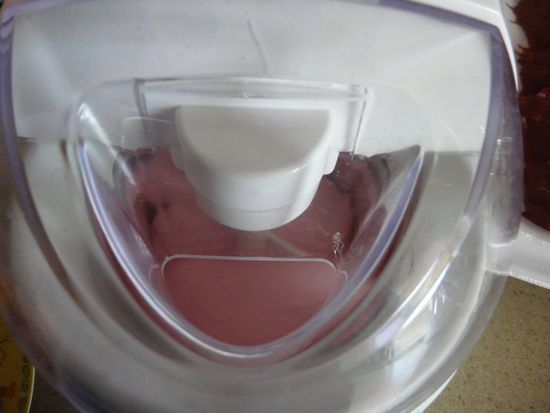
You add one cup to the cream, put it in the refrigerator overnight. The next day, you stir it, and put it in the ice cream making machine to process. When it is nearly finished (it is thickened and the machine starts to labor) you put the remaining one cup of crushed peppermint candy in through the tube where you can make additions, allow it to process maybe 30 seconds, then – it is finished.
No, there was no added sugar, there is enough in the candy to make it sweet enough. Because it is pure cream and no additives, it is very very fattening and very very delicious.
How will we spend Christmas Day? When AdventureMan gets up, I will heat him up a cup of Christmas punch and we will open the presents in our stockings:


Here is what the rule is – laid down in my family many many uncountable years ago – as long as you believe in Santa Claus, Santa Claus will come. To this day, we believe in Santa Claus, so when we wake up on Christmas morning, we have stockings with little gifts. (I think maybe one of mine sparkles 😉 )
We also open gifts from family – and the gifts from our son and his wife arrived just in time, yesterday, and are under the tree!

Then, we will get ready for church, and go and greet all our church friends – Merry Christmas! Merry Christmas!
That is . . . unless the plumber comes to fix the faucet. Yes, for my friends who do not live in Kuwait, for the rest of the world, this is just any old day, and plumbers come on Christmas day. They do NOT come on Fridays, the Moslem world Sunday, so if the plumber comes – and we just never know when that might be – I would have to miss church.
We will gather again tonight with friends for Christmas dinner. Unless the plumber comes.
(No, Satan, I can roll with this. You are NOT going to ruin my Christmas!)
I wish you all a great day, a wonderful, sweet day.
PS. The Qatteri Cat celebrated by eating three Kuwaiti shrimp. For some reason, they are not so good for him, so he only gets them on special occasions. He would live on only shrimp if he had his way.
Good Morning, Kuwait
Another gorgeous winter day dawning in Kuwait, with a high expected around 77°R/25°C today, while my poor family in the US is shivering with cold. I have a good friend who had three different family members stranded in three different airports, trying to get home for Christmas, and snow accumulating up to 18 inches while she prays for their safe arrivals.

Have a sweet day, Kuwait. 🙂
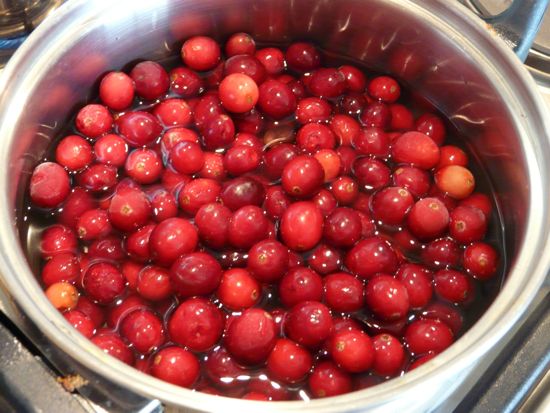
I will spend the day preparing for major meals on Christmas Eve and Christmas Day. Mom, I am making your Cranberry Salad. 🙂
Rosette Update
I’ve been making rosettes for over 30 years now; I can’t remember a Christmas I haven’t made them. I’ve gotten pretty good, but yesterday, when I couldn’t find my traditional recipe from my Mother, and I didn’t want to take the time to boot up my laptop to retrieve it, I used one from the very traditional old Joy of Cooking and it totally threw me off.
My FryBaby doesn’t work here; I don’t have a transformer big enough and I don’t want to buy a 220 appliance I only use once a year – for rosettes – so I use a thermometer. Normally, you aim for a temperature around 370° F, but yesterday, maybe the batter was a little thinner, but the normal temperature was too high, and I found the best temperature was around 350 – 360°. All these years, and I’m still learning new tricks. 🙂
Black Friday
Black Friday – the Friday after Thanksgiving – bargain hunters in the USA head to the stores. Some stores opened as early as midnight to attract bargain hunters. Many more open around 5 or 6 in the morning. Most have loss leaders – i.e. specially priced items, maybe even below cost – hoping people will come in looking for the bargains and buy something else.
Not me.
Not in a million years.
I did it one year; we had just come back to the US after living for years on Germany. I needed 110v Christmas lights, so I went to a store at 0530 and stood in line until it opened at 6 and got many packages . . . but not enough. Later in the day I went back to see if there were any of the bargain priced lights left, and there were stacks and stacks of them. I learned my lesson.
We also learned that many things go on sale a couple days before in some stores, or are still on sale and in good supply the following Monday.
I hate lines. I hate competitive shopping. I have seen women grab things out of one another’s hands, I have seen them race down the aisles . . . and I just ask myself “What is this all about?” I have that primitive instinct too, hunting down that elusive bargain, bagging it and getting it home – but at what cost?
Anomaly – while gas prices have dropped back to reasonable rates here, fewer Americans are traveling this year. Normally, Thanksgiving is the holiday with the highest accident rate of all the holidays because of the road traffic, but because Americans are holding tight to their purses this year, fewer are on the road or in the air.
We are packing up today and moving on to the next stop. We will stop and see good friends en route to our destination, have a meal and a good visit with them . . .
yes, yes, thank you, we had a truly wonderful and memorable Thanksgiving, a truly Southern Thanksgiving, with family, with friends, and I will share it with you as soon as I get a card-reader so I can upload to the computer. 🙂 There were three kinds of turkey – a deep fried turkey, a smoked turkey, and turkey breast pieces pan-fried in batter, like chicken nuggets only fresher, and tasty. My favorite was a big bucket of venison stew, one of the hunters had bagged a big buck up in Kentucky.
I don’t believe there was a steamed vegetable or un-sauced vegetable in sight! Lots of gelatins made with sour cream or cream cheese, macaroni and cheese, three or four different kinds of stuffings and sweet on sweet sweet potatoes . . . and then came dessert, oh my. The tables – separate stations for meats, stuffings, vegetables and salads – were groaning, but then again, there were many many people to feed. My Southern husband was in heaven, eating all the foods I don’t know how to make and never dreamed of making.
The very best part of Thankgiving was the visiting. It was like one great big diwaniyya, with people in the kitchen and living room, people way out back shucking oysters and peeling shrimp, loads of ice tea all made up, sweet, unsweet, Splenda, lemondade . . . young people playing football or running around. . . it was a very sweet family day, beautiful weather, you couldn’t order a nicer Thanksgiving, and we were so delighted to be included.
Pomegranate in Quinoa Pilaf
Hot off the press, from the New York Times:
Quinoa Pilaf With Chick Peas, Pomegranate and Spices
By MARTHA ROSE SHULMAN
Published: November 7, 2008
Considered by many nutritionists to be a superfood, pomegranate juice is loaded with antioxidants and appears to lower blood pressure. This quinoa pilaf is based on a Turkish pilaf that is traditionally made with rice or bulgur.
1 teaspoon cumin seeds
3/4 teaspoon coriander seeds
2 tablespoons extra virgin olive oil
1/2 medium onion, chopped
1/2 teaspoon salt
2 garlic cloves, minced
1 cup quinoa, cooked (4 cups cooked quinoa)
1 cup cooked chick peas (canned are fine), rinsed
1/4 cup pomegranate seeds
For garnish (optional):
1 cup thickened yogurt
1 small garlic clove, pureed (optional)
1. Heat a large, heavy frying pan over medium-high heat and add the cumin seeds and coriander seeds. Toast in the pan, stirring or shaking the pan, until they begin to smell fragrant, and transfer to a spice mill. Allow to cool for a few minutes, then pulse to crush or coarsely grind. Set aside.
2. Return the frying pan to medium heat and add 1 tablespoon of the olive oil. Add the onion and cook, stirring often, until tender, about 5 minutes. Add the garlic and salt, stir together for about half a minute, and stir in the cumin seeds, and coriander seeds. Add the remaining olive oil and stir in the quinoa, chick peas, and 3 tablespoons of the pomegranate seeds. Stir over medium heat to heat through, several minutes. Taste and adjust salt. Transfer to a platter or wide bowl and decorate with the remaining pomegranate seeds. You can also mold the pilaf into 1/2-cup ramekins or timbales and unmold onto the plate, then decorate with pomegranate seeds.
3. Stir the garlic into the thickened yogurt. Serve the pilaf topped with the yogurt.
Yield: Serves 6
Variation: Some people like to drizzle a few drops of lemon juice over the top of this pilaf.
Advance preparation: This can be made a day ahead and reheated.
Blood Spatter and Persephone’s Pomegranates
This morning I was hulling pomegranates. I’m not very good at it, and I was imagining the cooks at someplace like Shebastan could make quick work of what took me quite a while. My hands were thoroughly stitcky, but I had a nice healthy bowl of seeds, which I now know are called Aril, that I will eat like candy, and pop into my morning oatmeal – makes it edible and it tastes like health in a bowl.
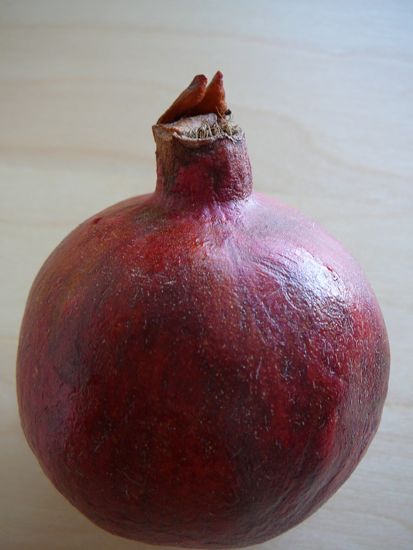
Pomegranate - Just look at that beautiful color!
My very cool Mom bought me my first pomegranate – here in Kuwait, they are called Roman’, which my husband said is because they came in with the Romans, but that seems very strange to me because clearly they are Iranian in origin. It took me forever to dig the seeds out. Now I know to just lightly cut the skin in a few places, tear off a hunk and start separating. I read on Wikipedia that it goes faster in water, the seeds sink and the pulp floats. I’ll have to try that next time.

Pomegranate seeds - again - look at those colors!
Mom bought me the pomegranate because I was crazy about Greek mythology, and Persephone had to spend six months in hell every year because (it’s a long story, this is just the short version) she had been tempted to eat and she ate just six pomegranate seeds, and so when she was freed from hell she still has to go back for six months and that’s why we have winter (well, I was just a kid and it made sense to me) but I always wondered what a pomegranate would be like.
I’ve loved them ever since. But when I was done, I noticed I had spots and streaks like something out of Dexter all over the walls. I think I have it all cleaned up, but I keep finding places I missed!
But you know how one thing leads to another, and then leads to Wikipedia. I wanted to make sure I got the legend of Persephone right, but instead, I learned that pomegranates have symbolism in all three religions of the book – Judaism, Christianity and Islam. Click on the blue type above and you can learn more about Pomegranates. Read below for what Wikipedia tells us about the pomegranate’s symbolism in different religions:
Pomegranates and symbolism
[edit]Judaism
Exodus 28:33–34 directed that images of pomegranates be woven onto the hem of the me’il (“robe of the ephod”), a robe worn by the Hebrew High Priest. 1 Kings 7:13–22 describes pomegranates depicted on the capitals of the two pilars (Jachin and Boaz) which stood in front of the temple King Solomon built in Jerusalem. It is said that Solomon designed his coronet based on the pomegranate’s “crown” (calyx).[31]
Jewish tradition teaches that the pomegranate is a symbol for righteousness, because it is said to have 613 seeds which corresponds with the 613 mitzvot or commandments of the Torah. For this reason and others, many Jews eat pomegranates on Rosh Hashanah. However, the actual number of seeds varies with individual fruits.[32] It is also a symbol of fruitfulness.[33] The pomegranate is one of the few images which appear on ancient coins of Judea as a holy symbol, and today many Torah scrolls are stored while not in use with a pair of decorative hollow silver “pomegranates” (rimmonim) placed over the two upper scroll handles. Some Jewish scholars believe that it was the pomegranate that was the forbidden fruit of the Garden of Eden.[33] Pomegranate is one of the Seven Species (Hebrew: שבעת המינים, Shiv’at Ha-Minim), the types of fruits and grains enumerated in the Hebrew Bible (Deuteronomy 8:8) as being special products of the Land of Israel.
[edit]Christianity
For the same reasons, pomegranates are a motif found in Christian religious decoration. They are often woven into the fabric of vestments and liturgical hangings or wrought in metalwork. Pomegranates figure in many religious paintings by the likes of Sandro Botticelli and Leonardo da Vinci, often in the hands of the Virgin Mary or the infant Jesus. The fruit, broken or bursting open, is a symbol of the fullness of his suffering and resurrection.[33] In the Eastern Orthodox Church, pomegranate seeds may be used in kolyva, a dish prepared for memorial services, as a symbol of the sweetness of the heavenly kingdom.
[edit]Islam
According to the Qur’an, pomegranates grow in the gardens of paradise (55:068). According to Islamic tradition, every seed of a pomegranate must be eaten, because one can’t be sure which aril came from paradise. The Prophet Mohammed is said to have encouraged his followers to eat pomegranates to ward off envy and hatred.[33] The Qur’an also mentions (6:99, 6:141) pomegranates twice as examples of good things God creates.
[edit]Greece and Greek mythology
The wild pomegranate did not grow natively in the Aegean area in Neolithic times. It originated in eastern Iran and came to the Aegean world along the same cultural pathways that brought the goddess whom the Anatolians worshipped as Cybele and the Mesopotamians as Ishtar.
The myth of Persephone, the chthonic goddess of the Underworld, also prominently features the pomegranate. In one version of Greek mythology, Persephone was kidnapped by Hades and taken off to live in the underworld as his wife. Her mother, Demeter (goddess of the Harvest), went into mourning for her lost daughter and thus all green things ceased to grow. Zeus, the highest ranking of the Greek gods, could not leave the Earth to die, so he commanded Hades to return Persephone. It was the rule of the Fates that anyone who consumed food or drink in the Underworld was doomed to spend eternity there. Persephone had no food, but Hades tricked her into eating four pomegranate seeds while she was still his prisoner and so, because of this, she was condemned to spend four months in the Underworld every year. During these four months, when Persephone is sitting on the throne of the Underworld next to her husband Hades, her mother Demeter mourns and no longer gives fertility to the earth. This became an ancient Greek explanation for the seasons.
Dante Gabriel Rossetti’s painting Persephona depicts Persephone holding the fatal fruit. It should be noted that the number of seeds that Persephone ate varies, depending on which version of the story is told. The number of seeds she is said to have eaten ranges from three to seven, which accounts for just one barren season if it is just three or four seeds, or two barren seasons (half the year) if she ate six or seven seeds. There is no set number.
The pomegranate also evoked the presence of the Aegean Triple Goddess who evolved into the Olympian Hera, who is sometimes represented offering the pomegranate, as in the Polykleitos’ cult image of the Argive Heraion (see below). According to Carl A. P. Ruck and Danny Staples, the chambered pomegranate is also a surrogate for the poppy’s narcotic capsule, with its comparable shape and chambered interior.[34] On a Mycenaean seal illustrated in Joseph Campbell’s Occidental Mythology 1964, figure 19, the seated Goddess of the double-headed axe (the labrys) offers three poppy pods in her right hand and supports her breast with her left. She embodies both aspects of the dual goddess, life-giving and death-dealing at once. The Titan Orion was represented as “marrying” Side, a name that in Boeotia means “pomegranate”, thus consecrating the primal hunter to the Goddess. Other Greek dialects call the pomegranate rhoa; its possible connection with the name of the earth goddess Rhea, inexplicable in Greek, proved suggestive for the mythographer Karl Kerenyi, who suggested that the consonance might ultimately derive from a deeper, pre-Indo-European language layer.
Pomegranate — opened up
In the 6th century BC, Polykleitos took ivory and gold to sculpt the seated Argive Hera in her temple. She held a scepter in one hand and offered a pomegranate, like a ‘royal orb’, in the other. “About the pomegranate I must say nothing,” whispered the traveller Pausanias in the 2nd century, “for its story is something of a mystery.” Indeed, in the Orion story we hear that Hera cast pomegranate-Side (an ancient city in Antalya) into dim Erebus — “for daring to rival Hera’s beauty”, which forms the probable point of connection with the older Osiris/Isis story. Since the ancient Egyptians identified the Orion constellation in the sky as Sah the “soul of Osiris”, the identification of this section of the myth seems relatively complete. Hera wears, not a wreath nor a tiara nor a diadem, but clearly the calyx of the pomegranate that has become her serrated crown.
The pomegranate has a calyx shaped like a crown. In Jewish tradition it has been seen as the original “design” for the proper crown.[31] In some artistic depictions, the pomegranate is found in the hand of Mary, mother of Jesus.
In modern times the pomegranate still holds strong symbolic meanings for the Greeks. On important days in the Greek Orthodox calendar, such as the Presentation of the Virgin Mary and on Christmas Day, it is traditional to have at the dinner table “polysporia”, also known by their ancient name “panspermia,” in some regions of Greece. In ancient times they were offered to Demeter[citation needed] and to the other gods for fertile land, for the spirits of the dead and in honor of compassionate Dionysus.
When one buys a new home, it is conventional for a house guest to bring as a first gift a pomegranate, which is placed under/near the ikonostasi (home altar) of the house, as a symbol of abundance, fertility and good luck. Pomegranates are also prominent at Greek weddings and funerals. When Greeks commemorate their dead, they make kollyva as offerings, which consist of boiled wheat, mixed with sugar and decorated with pomegranate. It is also traditional in Greece to break a pomegranate on the ground at weddings and on New Years. Pomegranate decorations for the home are very common in Greece and sold in most homegoods stores.[35]
The photos, by the way, are of Indian pomegranates, but I bought Indian ones, Iranian ones and Egyptian ones; some are great big and very red, some are more orangey-red. These Indian ones are delightfully sweet!
Google can help you find all kinds of pomegranate recipes, but there is actually an organization called Pomegranates.org that lists lots of recipes in one easy location. 🙂 This must be pomegranate season, because they are plentiful, and reasonably priced, and oh, what luxury!
Here is one of their recipes:
Chicken with Pomegranate and Walnuts
2-3/4 pound fryer chicken
2 cups walnuts, finely chopped
3 tablespoons shortening
3-1/2 cups water
1/2 teaspoon poultry seasoning
1 teaspoon salt
1/2 teaspoon cinnamon
1/2 teaspoon pepper
2 teaspoons lemon juice
1 large onion, finely chopped
1 cup fresh pomegranate juice
3 teaspoons butter
2 teaspoons tomato sauce
1 teaspoon sugar
Prepare chicken for frying. Saute chicken with poultry seasoning in shortening until light brown, set aside. In a large pot saute the onion in 3 teaspoon butter until golden brown. Add tomato sauce and saute for a few minutes. Add walnuts to the onions and saute over meduim heat about 5 minutes, stirring constantly. Add water, remaining seasonings, lemon juice, and pomegranate syrup. Cover and let cook on low about 35 minutes. Taste the sauce and add sugar if needed. Arrange browned chicken pieces in the sauce, cover and let simmer 20-25 minutes. Serve over white rice.
Serves 6.
Sweet October Morning
Goooooood Morning, Kuwait!
It is a sweet morning, a beautiful morning. You can see almost all the way to the horizon, and the lethal layer that hangs over it is somehow thinner this morning:

One of my favorite places, Weather Underground: Kuwait tells us we have five more days below 100°F coming up and here is what it looks like this morning:

The house still smells of cinnamon and clove and Mom’s Fruit Cakes which I spent all day yesterday chopping, pitting, baking, and wrapping in the crisp Kuwait Autumn weather. 😉 I fell into bed last night around eight, and slept almost straight through until 0600 this morning, an exhausted Qatteri Cat snuggled up between AdventureMan and me. No, no, we don’t eat the fruitcakes yet. You make them around the end of October and you store them, heavily wrapped, in the refrigerator until Thanksgiving (4th Thursday in November) when you are allowed to taste the first one. They mellow as they age in the refrigerator.
In other countries, not Kuwait, you wrap them in cheesecloth soaked in brandy, and you can open them now and then and brush on a little more brandy with a pastry brush. Sigh. I am not much for drinking, but I miss the smell of the brandy soaking into the fruitcakes.
Recent Comments
ExpatAlien on What Country am I Living … intlxpatr on Yellowstone: Old Faithful to C… Michelle on Yellowstone: Old Faithful to C… Cathy on No Grown-Ups in Charge intlxpatr on Waiting for Snow Wikipedia Donate Button

Amazina


Early Voting in Florida


 Here There and Everywhere