Down the Drain
As I was wandering through the Co-op (Jamiya) the other day, picking up a few basics, I came across something not-so-basic – a bottle of alcohol-free Merlot.
I was making spaghetti sauce – and here is the truth as I see it – almost any sauce is improved by the addition of a little wine. And this is alcohol-free! I can serve it to my Islamic dinner guests.
The sauce was superb, even if it is me saying it about myself. Just a basic meat sauce, but with the fresh basil from our friend’s prolific garden, and the cup of Merlot – sublime.
That was a week ago. Today, I went to use the Merlot in another sauce and HORRORS! Look at that!

Can you see that? That great big spot of MOLD growing on the Merlot-drink-that-does-not-contain-alcohol???
I had to throw it all out. I don’t take chances on making people sick from food bourn illnesses, not even myself. And while AdventureMan and I are generous in our nature, we are frugal in our private lives, and throwing nearly $16 literally down the drain horrifies me! Maybe it was the humidity – my bread also went green very quickly – or maybe it is the non-alcohol that allowed it to mold so quickly. I don’t know. I don’t think I will be buying another bottle of Merlot here in Kuwait any time soon.
One Step Beyond: Baan Sabaidee
We all have our limits. When it comes to food, my limits are farther out there than most – I like taste. I like most cuisines, or at least most of most cuisines. I do have my limits.
One limit is okra / ladyfingers/ bamyi:
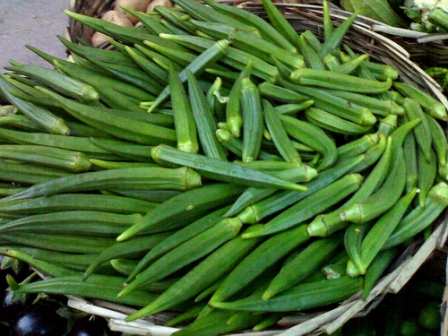
One time, at a buffet in Jordan, I told my husband I was going back for something I found totally delicious, and he laughed and said “You know it is okra?” No, I didn’t know. I did go back and get a little more anyway, but it no longer tasted the same – I knew it was okra. It’s the texture; okra is, to me, slimy, gooey, in my mouth it gives me shudders. It’s like raw oysters. Shudder.
Deep fried okra in a spicy tomato sauce was OK – until I knew it was okra.
I was visiting with a friend, working on some projects and we decided to order out from a nearby newly opened Thai restaurant for lunch. She’s a crazy woman, like me. We are not alike – she says “tomahto” and I say “tomato” and somehow we get along just fine. We decided to order things we have never ordered before.
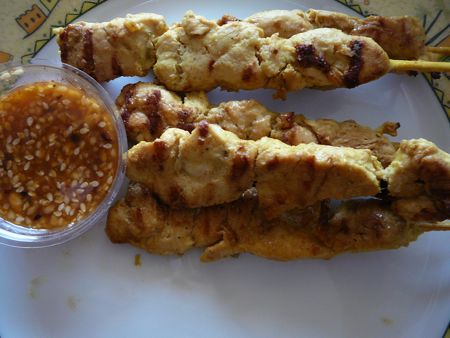
We ordered two safe things – the first was Gai Sate (chicken sate). It was gorgeous and delicious. The sauce is one of the best sauces I have had with Thai food, hot, sweet, and sesame. Delightful.
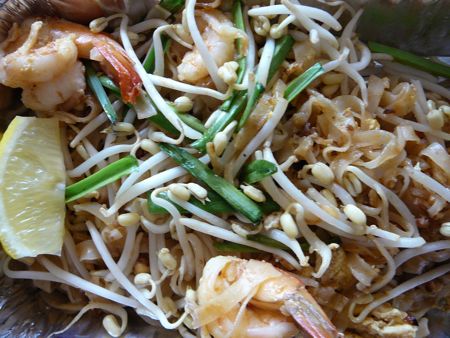
The second safe thing was Pad Thai, which was also beautiful and tasty:
We ordered Pad Ka Phrao, because we had never heard of it, and because it has basil leaves in it:
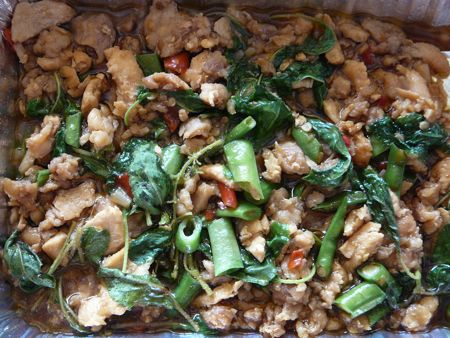
It was delicious.
We loved the way the food was packaged. The green curry and the soup was packed in sealed plastic sacks, inside the normal plastic containers. Not a single drop was spilled in the bag. I’m impressed. I love soups, and I hate the mess when soups spill in the bags:

This is the green curry (Gaeng Khew Wan). It is totally delicious.
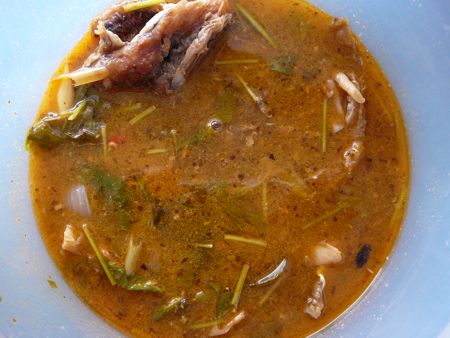
You know me. I love fish. We had never tried the Tom Kling (smoked herb soup) so we ordered that, with grilled smoked fish. It came beautifully packaged, like the above curry. When we went to eat the soup, however, although it was delicious, I had to fish out the fish. I am not normally squeamish, but their little fishy eyes were too much for me:

AdventureMan and I later made a trip to find the restaurant. It wasn’t easy, but it was worth the trouble. Tucked back behind some of the behomoth apartments on the Southern Gulf Road, it only has maybe six tables, but it is tiny and exquisite. Someone went to a lot of trouble to make this little place beautiful and serene. Although it is a new restaurant, it was already packed when we got there, but a table opened up just as we arrived.
We asked for recommendations, and tried the Tod Mun (shrimp cakes) and a dish I loved. Pad See Ew, which was vermicelli noodles stir fried in soy sauce with shrimp. We also had the chicken sate again – delicious. We were busy watching other people with big pots of something in front of them, shared by groups. We have to go back and try that, whatever it was.
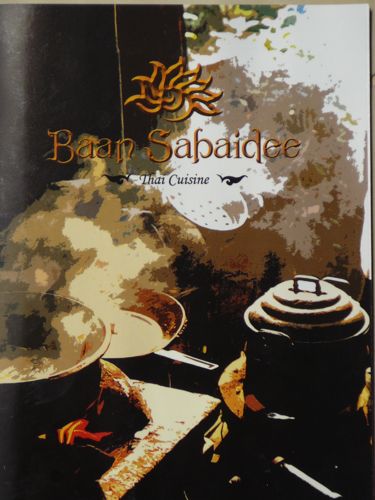
Their take out menu has a nice feel to it – heavy paper with good photos so you can guess what you are ordering:
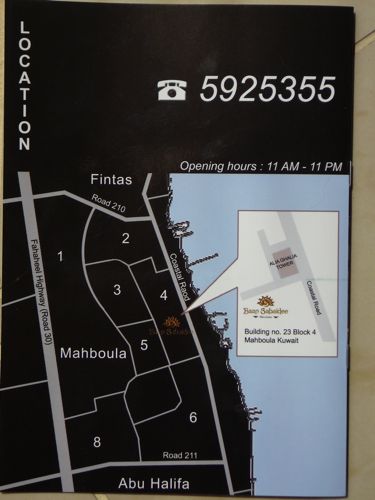
And- the bonus – it has a map of how to get there on the back, so I don’t have to confuse you trying to figure out the directions:
If they are full, I noticed across the street is another branch of China Queen, one of the best kept secrets in Kuwait for Chinese food with authenticity.
Pasta Melanzane
I first had Pasta Melanzane at a wonderful restaurant near my home in Wiesbaden, Germany. We were always looking for the best Italian restaurant we could find, and when we found Marcello’s, we stopped looking. No matter what we ate there, the food was delicious. Melanzane, by the way, means eggplant, or aubergine. I always use that word because a lot of people think they don’t like eggplant.
I tried hard to duplicate Marcello’s Pasta Melanzane, but the more I added, the weirder it would get. In the end, my very best results came from keeping things simple and fresh:

Pasta Melanzane
1 fairly large eggplant, cut into fingers about 1/2 inch, like french fries
6 – 10 cloves of garlic, peeled, chopped
olive oil
2 packets / small cans tomato paste
1 Tablespoon (1 large glop) finely chopped sun dried tomatoes
(red pepper flakes – optional)
water to thin
Put the eggplant fingers in a colander (bowl shaped strainer) and sprinkle with salt. Leave half an hour, rinse with water and dry with paper towels. You do this because sometimes eggplant can be bitter, and this takes away the bitterness.
Put some olive oil – maybe 2 Tablespoons – in a deep frying pan and heat, add chopped garlic and heat until garlic is softened. If you are using red pepper flakes, add those in now, too, and let them soften with the garlic.
Add the eggplant fingers, turn the heat way down, add a little more olive oil and cook slowly until the eggplant is also softened all the way through.
Meanwhile, mix the tomato paste, chopped sun dried tomato pieces, and some water into sauce.
(If you are in a place where you can legally use red wine, you can use a cup or so in place of some of the water. I have also used pomegranate juice, but it is not quite the same.)
Add the sauce to the eggplant, put on a spatter guard (You can find them at the Sultan Center and sometimes in the souks – they are a round screen with a handle that keeps sauce from splashing all over your stove) and turn the gas down to the very lowest it will go.
Set the timer for 30 minutes, and go about your business. Keep checking every 30 minutes, give it a stir, add a little more liquid if it needs it, give it a taste.
When it is ready, turn the burner off. This sauce just gets better and better as it mellows.
When it is time to serve dinner, boil a pot of pasta and re-heat the melanzane sauce at the same time. Because it is a strong sauce, you can use strong pastas, like penne, to serve it over.
Grilled Portobellos
My friends, this is not my recipe. This is what happens when you are up at 4 a.m. and there is no one around to play with. I have never checked my Amazon blog before, I’ve never even noticed it at the top of my page, but I saw I had two new entries, and I clicked.
OMG.
Another book I never knew I needed. This recipe sounds to-die-for. Every single ingredient is available in Kuwait, and lucky lucky you if you are growing your own basil!

It’s easy to expand your barbecue menu with these mouth-watering mushrooms from the BBQ Queens (the recipe’s from their book The Big Book of Barbecue, which is available from Harvard Common in both paperback and hardback, depending on how you like your books served). The hard part is deciding which cooking method to use, as the Queens disagree in this instance–barbecue style can be a bit divisive even within the tightest cooking teams. You can check out Judith’s way and Karen’s way in the directions below, and then choose your mushrooming option.
Serves 4
Ingredients:
4 large Portobello mushrooms
1/4-cup extra virgin olive oil
4 cloves garlic, minced
8 ounces goat cheese, crumbled or cubed (can also substitute feta cheese, Boursin, Gorgonzola, or Brie)
2 tablespoons toasted pine nuts
8-10 fresh basil leaves, chopped
Kosher or sea salt for seasoning
Directions:
1. Remove the stems from the Portobello mushrooms, then brush both sides of each mushroom with extra virgin olive oil.
2. In a small bowl, combine the minced garlic cloves; the goat cheese (or feta cheese, Boursin, Gorgonzola, or Brie); the toasted pine nuts; and the chopped fresh basil leaves.
3.:
Karen’s version: Place one-fourth of the mixture inside each mushroom cap. Season with kosher or sea salt to taste. Place the mushroom caps directly over the hot fire and grill with the lid down until the mushrooms are soft, 8 to 10 minutes.
Judith’s version: Grill the mushrooms gill side down for about 4 minutes with the grill lid open. Turn the mushrooms, fill them with the goodies, and season with salt. Close the lid and grill for another 4 minutes. Serve hot.
–A.J. Rathbun
Eat Your Tomatoes!
I have a Kuwaiti friend who grows tomatoes, and was grousing because this year’s crop wasn’t as abundant as last year’s. Two short weeks later, he changed his tune.
“Come get tomatoes! We have all the tomatoes in the world!”
He had planted a large variety this year, partly because I wanted to see how some American “heirloom” seeds would do here. Either the climate is a little funny this year, or the heirloom seeds just take a little longer, but oh, what a crop there is! One of my friends said “it is like eating tomato candy!” Some of them are that sweet!
Just a little balsamic vinegar and a little of the best olive oil, a little fresh ground pepper and a little salt – oh, what heaven.
But there were so many, we cooked up a tomato sauce, just tomatoes, not even any onions. It was magnificent.
And then in today’s Health News, we learn that in addition to helping us have a healthy heart, eating tomatoes can also help protect our skin against the sun:

(photo courtesy BBC News)
From yesterday’s BBC Health News. (You can read the entire article by clicking on the blue type.)
Tomato dishes ‘may protect skin’
Pizza and spaghetti bolognese could become new tools in the fight against sunburn and wrinkles, a study suggests.
A team found adding five tablespoons of tomato paste to the daily diet of 10 volunteers improved the skin’s ability to protect against harmful UV rays.
Damage from these rays can lead to premature ageing and even skin cancer.
The study, presented at the British Society for Investigative Dermatology, suggested the antioxidant lycopene was behind the apparent benefit.
This component of tomatoes – found at its highest concentration when the fruit has been cooked – has already been linked to a reduction in the risk of prostate cancer.
Now researchers at the universities of Manchester and Newcastle have suggested it may also help ward off skin damage by providing some protection against the effects of UV rays.
Anti-ageing paste?
They gave 10 volunteers around 55g of standard tomato paste – which contains high levels of cooked tomatoes – and 10g of olive oil daily. A further 10 participants received just the olive oil.
After three months, skin samples from the tomato group showed they had 33% more protection against sunburn – the equivalent of a very low factor sun cream – and much higher levels of procollagen, a molecule which gives the skin its structure and keeps its firm.
Penny Carrot Salad
So easy and so good, this salad is also very sweet, so I am sharing it with my Kuwaiti friends. (Is it possible to be Kuwaiti and not have a sweet tooth?)
It is called Penny Carrot Salad because you cut the carrots into round pieces about 1/4 inch thick, so that they look like coins. Do not over cook, or you will have carrot mush! Especially good on hot summer nights.
2 lbs (4 cups) sliced, cooked carrots
1 large onion
1 large green pepper
1 can tomato soup
1/2 cup olive oil
1 cup sugar
1/4 cup vinegar
1 teaspoon worcestershire sauce
1 teaspoon mustard
Mix liquid and seasonings together and pour over drained carrots as soon as they are finished cooking. Refrigerate overnight. Keeps well.
Cynthia’s Praline Cake
My friend Cynthia, who knows I love mysteries, confessed to me that it was HER praline cake featured in JA Jance’s Joanna Brady series, and that she was the Cynthia who, in the book, brings it to the community potluck supper. And . . . she shared the recipe with me!
My friends, it is an easy recipe if you have the ingredients on hand (oats, brown sugar, butter) but I warn you – no substitutions! Yes, it is full of sugars and fats – why do you think it tastes so good??
Cynthia’s Praline Cake
(This is another one you can make in two 8″ round pans, and freeze one for later.)
1 cup quick-cooking oats
1 cup cold water
1 cup white sugar
1 1/4 cups brown sugar
1 cup oil
2 eggs
1 1/2 cups flour
1 teaspoon baking soda
1 teaspoon cinnamon
1/4 teaspoon salt
Icing
1 stick butter (1/2 cup)
2 Tablespoons milk
1 cup packed light brown sugar
1 1/4 cut chopped pecans
In a small bowl combine the oats and water, set aside. In another small bowl, combine and mix the dry ingredients – the flour, soda, cinnamon and salt.
In a larger mixing bowl, cream together the sugars, oil and eggs. Beat, add the oat mixture alternately with the mixed dry ingredients. Mix well.
Pour into greased and floured 9 x 13 inch baking pan. Bake at 350 degrees for 35 – 40 minutes.
For the icing: Just before the cake is done, combine butter, milk, and brown sugar in a saucepan, bring it to a boil and boil for one minute. Add the pecans and mix. Spread over cake.
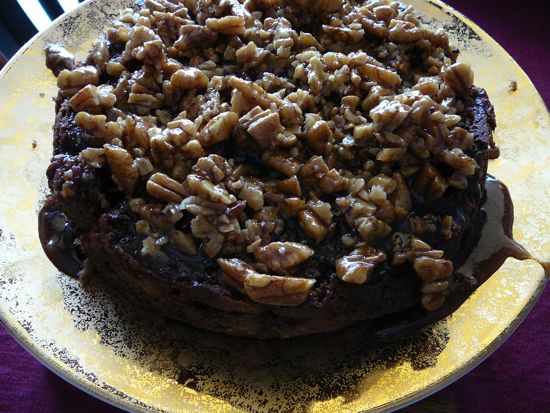
For Jewaira, who always asks for pictures, this is what the finished cake looks like:
Shop and Eat Locally
I’m fascinated with the concept of trying to eat “local” and there is an article in Wired: How to Shop and Eat Locally that tells us more about it. Below is an excerpt:
Innumerable books and other media extol the virtues of eating food that’s grown and processed near you: it benefits the planet, it benefits the farmers, it tastes better, it’s better for you. ReadMichael Pollan or Barbara Kingsolver for examples.
But piecing together a local menu isn’t as easy as going to the Local aisle of your supermarket. Here are some tips for bringing your meals closer to home.
Start small. Shopping locally goes against the grain (pun intended) of our globalized economy, so it’s not the easiest thing to do. Even if you live in a region that’s rich in vegetables and meats, chances are you won’t have easy access to staples like sugar, salt, oil, and flour. Just focus on what you can get, and keep an eye out for sources and/or substitutes for what you can’t.
Personalize. If you want to try the classic 100-mile diet, you can find your personal 100-mile radius at 100milediet.org.
Get a supplier. You can find farms, greenmarkets, and locally oriented stores in your area using web tools offered atEatwellguide.org and Localharvest.org. If you live in a city, investigate CSA — Community-Supported Agriculture. Citydwellers pay a fee to subscribe to a farm, and get a share of its output delivered in weekly boxes of joy. Just Food offers a listing for New Yorkers.
Pecan – Date Pie (for Mrm)
This is for Mrm, who requested EASY recipes. My friends, good cooking CAN be easy, and with rare exception, all my recipes are EASY. The treasures are the recipes which are EASY and yummy, too. This one is so rich and so sweet that people can’t resist it – they go back for more, and they want the recipe. It was sent to me by one of my Southern friends – they always have the best recipes!
The hardest part of this recipe is getting the seeds out of the dates – but it only takes a half cup full of dates, and that isn’t much.
Pecan – Date Pie
1/2 cup whole pitted dates, chopped
1/2 cup chopped pecans
1 cup dark corn syrup
1/2 cup packed brown sugar
3 T. all purpose flour
1 teaspoon vanilla
4 large eggs
Sprinkle dates and pecans over crust. Combine corn syrup and next 5
ingredients in a bowl, beat with a mixer at medium speed until well
blended. Pour into prepared crust. Bake at 325 degrees F. (180 degrees C.)
for 55 minutes or until knife inserted comes out clean. Cool on a wire rack. Serve
with whipped cream.
“Pour into prepared crust” – Hohohohohoho – if you can find a prepared crust in Kuwait!
But you can find digestive biscuits/ graham crackers, so make this easy easy crust – crush about 1 cup of the crackers/biscuits, add 1/4 cup medium chopped walnuts or pecans, and 1/4 cup melted butter. Press into the bottom and a little up the sides of a BUTTER greased pie tin.
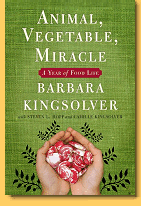
Animal, Vegetable, Miracle: Kingsolver
A friend passed along a fascinating book by one of my favorite fiction authors, Barbara Kingsolver, who wrote the cross-culturally unforgetable Poisonwood Bible, and many other very readable books. This book is about how her family vowed to eat locally for one year. I haven’t finished it yet, this is not a book review, but I am trying to think how eating locally would apply in Kuwait.
We would have a year-round supply of fish, which I love. We would have spinach in December and January, and those wonderful Kuwaiti tomatoes in the Spring. Cilantro, green onions and mint are grown year round, too, I think, and we would have chickens and eggs and maybe some sheep – or does most of the sheep in Kuwait come from elsewhere? Pomgranates? Pistacios?
I need YOUR help. What would our diet look like in Kuwait if everything we ate were local? Which month would we be able to eat what? What could we preserve in some way – drying, canning, freezing – for future months?
What grain would we have? Let’s say keep the food “local” and give ourselves a 100 mile radius. What would we eat?
Recent Comments
intlxpatr on Shampoo Ginger tigerbutterya0c5ff1d… on Shampoo Ginger intlxpatr on British Soldier Kidnapped, Esc… John on British Soldier Kidnapped, Esc… intlxpatr on British Soldier Kidnapped, Esc… Wikipedia Donate Button

Amazina


Early Voting in Florida


