The Olive Oil Scandal

A good friend gave me a subscription several years ago to The New Yorker, and at the time I didn’t know how lucky I was. First, I loved the cartoons. A couple magazines later, I got pulled in by some of their excellent travel and political writing. Later, the fiction issues pulled me in and introduced me to authors I had never read before. In no time at all, I was totally addicted.
Now, when The New Yorker arrives, Adventure Man and I fight to see who gets to read it first! Often he wins; he skims it. He knows I will take too long getting through it.
It was the New Yorker magazine who informed me about the great olive oil scandal.
I love olive oil. I only use other oils in baked goods, where the olive oil might give an odd taste, we use olive oil almost exclusively. Or so I thought.
In the August 13 Issue of the New Yorker, Tom Meuller starts like this:
On August 10, 1991, a rusty tanker called the Mazal I docked at the industrial port of Ordu, in Turkey, and pumped twenty-two hundred tons of hazelnut oil into its hold. The ship then embarked on a meandering voyage through the Mediterranean and the North Sea. By September 21st, when the Mazal II reached Barletta, a port in Puglia, in southern Italy, its cargo had become, on the ship’s official documents, Greek olive oil. It slipped through customs, possibly with the connivance of an official, was piped into tanker trucks, and was delivered to the refinery of Riolio, an Italian olive-oil produce based in Barletta. There it was sold—in some instances blended with real olive oil—to Riolio customers
Between August and November of 1991, the Mazal II and another tanker, the Katerina T., delivered nearly ten thousand tons of Turkish hazelnut oil and Argentinean sunflower-seed oil to Riolio, all identified as Greek olive oil.
Riolio’s owner, Domenico Ribatti, grew rich from the bogus oil, assembling substantial real-estate holdings, including a former department store in Bari. He bribed two officials, one with cash, the other with cartons of olive oil, and made trips to Rome, where he stayed at the Grand Hotel, and met with other unscrupulous olive-oil producers from Italy and abroad. As one of Italy’s leading importers of olive oil, Ribatti’s company was a member of ASSITOL, the country’s powerful olive-oil trade association, and Ribatti had enough clout in Rome to ask a favor—preferential treatment of an associate’s nephew, who was seeking admission to a military officers’ school—of a high-ranking official at the Finance Ministry, a fellow-pugliese.
However, by early 1992 Ribatti and his associates were under investigation by the Guardia di Finanza, the Finance Ministry’s military-police force. One officer, wearing a miniature video camera on his tie, posed as a waiter at a lunch hosted by Ribatti at the Grand Hotel. Others, eavesdropping on telephone calls among Riolio executives, heard the rustle of bribe money being counted out. During the next two years, the Guardia di Finanza team, working closely with agents of the European Union’s anti-fraud office, pieced together the details of Ribatti’s crime, identifying Swiss bank accounts and Caribbean shell companies that Ribatti had used to buy the ersatz olive oil.
The investigators discovered that seed and hazelnut oil had reached Riolio’s refinery by tanker truck and by train, as well as by ship, and they found stocks of hazelnut oil waiting in Rotterdam for delivery to Riolio and other olive-oil companies.
The investigators also discovered where Ribatti’s adulterated oil had gone: to some of the largest producers of Italian olive oil, among them Nestlé, Unilever, Bertolli, and Oleifici Fasanesi, who sold it to consumers as olive oil, and collected about twelve million dollars in E.U. subsidies intended to support the olive-oil industry. (These companies claimed that they had been swindled by Ribatti, and prosecutors were unable to prove complicity on their part.)
You can read this entire fascinating article here: Tom Meuller: Slippery BusinessGive yourself plenty of time. It is an article well worth reading.
There is another good reference here: The Great Olive Oil Scandal from PalestinianOliveOil.org
Investigators have gathered evidence indicating that the biggest olive oil brands in Italy — Bertolli, Sasso, and Cirio — have for years been systematically diluting their extra-virgin olive oil with cheap, highly-refined hazelnut oil imported from Turkey. [1]
A 1996 study by the FDA found that 96 percent of the olive oils they tested, while being labeled 100 percent olive oil, had been diluted with other oils. A study in Italy found that only 40 percent of the olive oil brands labeled “extra-virgin” actually met those standards. Italy produces 400,000 tons of olive oil for domestic consumption, but 750,000 tons are sold. The difference is made up with highly refined nut and seed oils. [2]
EVEN THE BIGGEST OF THEM WILL MISLEAD THE PUBLIC…
“In 1998, the New York law firm Rabin and Peckel, LLP, took on the olive oil labeling misnomer and filed a class action suit in the New York Supreme Court against Unilever, the English-Dutch manufacturer of Bertolli olive oil. The firm argued that Bertolli’s labels, which read “Imported from Italy,” did not meet full disclosure laws because, even though the oil had passed through Italian ports, most of it had originated in Tunisia, Turkey, Spain or Greece. “Bertolli olive oil is imported from Italy, but contains no measurable quantity of Italian oil,” according to court documents.”
Curezone lists manufacturers of adulterated olive oil and marketers of the same oil. It is disgusting. We pay high prices for junk-olive oil. From Curezone.com/forums
The Guilty
Below is a list of known adulterated brands and dishonest distributors with links to information about their cases.
Adulterated brands of extra virgin olive oil
with country of origin
Andy’s Pure Olive Oil (Italy)
Bertolli (Italy)
Castel Tiziano (Italy)
Cirio (Italy)
Cornelia (Italy)
Italico (Italy)
Ligaro (Italy)
Olivio (Greece)
Petrou Bros. Olive Oil (California)
Primi (Italy)
Regale (Italy)
Ricetta Antica (Italy)
Rubino (Italy)
San Paolo (Italy)
Sasso (Italy)
Terra Mia (Italy)
Distributors caught selling adulterated olive oil
Altapac Trading
AMT Fine Foods
Bella International Food Brokers
Cher-Mor Foods International
D&G Foods
Deluca Brothers International
Gestion Trorico Inc.
Itaical Trading
Kalamata Foods
Les Ailments MIA Food Distributing
Lonath International
Mario Sardo Sales, Inc.
Petrou Foods, Inc.
Rubino USA Inc.
Siena Foods Ltd.
Vernon Foods
So who do we trust? How do we know that we are getting a quality, unadulterated product? This is fraud in an international scale!
Nanaimo Bars – A Cool Weather Treat
Nanaimo Bars – a Pacific Northwest Speciality
Makes about 25 small squares

Mom sent me several recipes for these, but this is the one that works – except In Florida, Doha, Kuwait, etc where the climate is hot.These are truly a Pacific Northwest specialty; they melt too easily in heat and humidity! On a cool day – or in a seriously air conditioned house – you can make these incredibly delicious treats.
Bottom Layer:

1/2 cup unsalted butter
1/4 cup granulated sugar
5 Tablespoons cocoa powder
1 egg, beaten
1 3/4 cup graham cracker crumbs
1 cup coconut flakes
1/2 cup finely chopped almonds
Middle Layer:
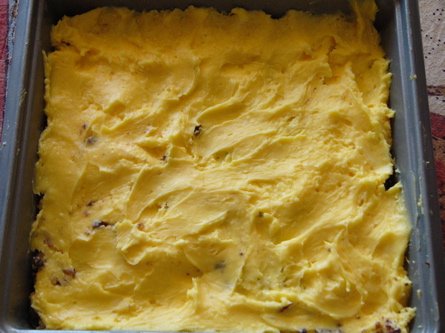
1/2 cup unsalted butter, room temperature
3 Tablespoons whipping cream
2 Tablespoons vanilla-custard powder (pudding)
2 cups powdered sugar
Top Layer:

4 squares (1 oz. each) semisweet chocolate
2 Tablespoons unsalted butter
1. For bottom layer, melt butter, granulated sugar and cocoa powder together in the top of a double boiler over simmering water. Add the egg and stir constantly until thickened, about 2 – 3 minutes. Remove from heat. Stir into graham cracker crumbs, coconut and almonds. Press firmly into an ungreased 8 x 8 inch pan.
2. For middle layer, cream butter, whipping cream, vanilla custard powder and powdered sugar together. Beat until light. Spread over bottom layer.
3. For top layer, melt chocolate and butter over low heat. Cool. When cool, but still liquid, pour over second layer and chill in refrigerator about 15 minutes, then cut into bars. (These bars can be made 3 – 4 days in advance and kept covered and refrigerated.)
Special Occasions: Cream Puffs and Profiteroles
Cream Puffs
Cream Puffs got me through a lot of guest dinners. They look so amazing, they taste so good, and they are really easy to make. So give it a try, and have fun.
The secret is taking the top off while they are still hot, and pulling out the filiments of excess dough so it doesn’t steam the puff from within and wilt it. They are so easy, we even taught them to kids in a summer fun program when we lived in Tunisia. They loved putting the whipped cream in (I think more got in the kids than in the creme puffs)
1 cup water
1/2 cup butter
1 cup flour
4 eggs
Heat oven to 400°F/ 200°C. Heat water and butter to strong rolling boil. Stir in flour, stir vigorously over low heat about one minute or until mixture forms a ball. (You’ll know it when you see it.)
Remove from heat, beat in eggs, all at one time, continue beating and beating until smooth. Drop dough by Tablespoons 3” apart onto UNGREASED baking sheet. Bake 35 – 40 minutes or until puffed and golden. Cool away from drafts. Cut off tops, pull out filaments of dough inside.

When ready to serve, fill with Creme Chantilly, put the top on, and drizzle chocolate syrup over top and down the sides. Gorgeous!
Creme Chantilly
1 cup heavy whipping cream
1/2 cup sifted powdered (sometimes called confectioners) sugar
2 teaspoons vanilla extract
Whip the whipping cream until just stiff, quickly fold in the powdered sugar and vanilla extract.
Chocolate Syrup
3 Tablespoons Hershey’s cocoa powder
1 Tablespoon butter
1 cup powdered sugar
1-2 Tablespoon(s) HOT water
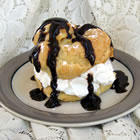
Mix together cocoa powder and butter, and melt over low heat. Remove from heat and stir in 1 cup powdered sugar and 1 Tablespoon hot water. Beat until smooth. Only add more hot water if it is too thick; needs to be “drizzle-able”.
Profiteroles
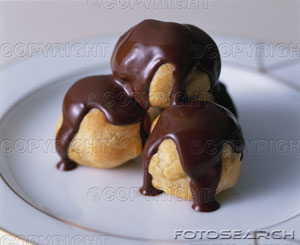
Profiteroles are very small cream puffs, just smaller balls, same dough, cooked, covered with the same chocolate syrup. Instead of serving one cream puff, you serve maybe six small profiteroles.
Spaghetti Sauce
In our family, one of the first things you learn to make when you start cooking is spaghetti sauce. It couldn’t be easier, and you can make a double batch and freeze half and have it again in a couple weeks (thawed, of course.)
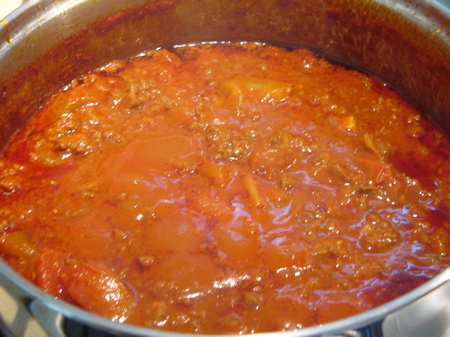
Chop one large onion, saute over low heat in olive oil. While the onion is sauteeing, peel and chop four or five cloves of garlic. Toss them is just before the onion is all soft and glistening. (Garlic needs less cooking than onion.)
Empty the saute pan into a bowl, and brown about 1 lb (1/2 kilo) of ground beef. If you want to take an extra step, also add in some ground Italian sausage (you can find it at the Sultan Center.) Brown it until there is no pink left, but the meat is still soft.
Pour the hot browned meat into a large pot. Add the sauteed onions. Chop up some tomatoes, real tomatoes that don’t look good enough for the salad. Having some real tomato in the sauce makes all the difference.
Add three or more small packets of tomato paste (small cans in the US) and four cups of water. It will look kind of soupy. Don’t worry! (In the US or countries where you can drink alcohol, use some red wine in place of some of the water, maybe a cup, for taste.)
Over low heat, cook the spaghetti meat sauce for hours – maybe three – until it has become less soupy and more sauc-y.
Fifteen minutes before serving, add 1 Tablespoon sugar.
The above is a very plain, very basic, but delicious spaghetti sauce. If you like flavors a little more complex, you can add in fifteen fresh chopped basil leaves when you add the sugar and stir them in well.
You can add a chopped green pepper to the onion when sauteeing.
You can add other meats, chopped finely.
Once you have mastered the basic sauce, you can customize it to your own tastes.
How easy is that?
Blog Header
My friend and frequent commenter, Abdulaziz, created a new blog header for me. I don’t have a customizable header with this format, and while I have looked at the customizable ones, I don’t understand enough to make the leap. But I want to share with you what he created, using the photo Adventure Man and I took last week.
Isn’t it beautiful?

Kuwaiti Shrimp Spaghetti
This looks so plain, and it tastes so good. It’s especially good with Kuwaiti shrimp in season – I’ve never seen such big shrimp, and Adventure Man says he thinks they are the best tasting shrimp in the world.
You need really good olive oil. You need as much garlic as you can handle (think building up your immunities for the cold season to come) and fresh washed cilantro. You need some fresh walnuts or pine nuts. If you are using walnuts, break them with your fingers, you don’t want them too small. Saute:

Clean the shrimp. (Or pay a little extra and have them cleaned at the fish market or Sultan Center) Make a thin slice down the back and pull out that unsightly intestine. (They say it causes no harm, but . . .better safe, and it looks a whole lot nicer) Check the pan, is everything lightly sizzling? Add the shrimp!

Saute that shrimp until just pink, just cooked through, but still soft and juicy.
Drain your cooked spaghetti (hint: break the spaghetti strands into halfs or even thirds for easier eating if you are eating with others) and quickly put it back in the cooking pot. Put it back on the burner, turned off but still warm, and add the olive oil, shrimp, etc. Use a wooden spoon and get at all out of the frying pan, and stir it well into the pasta.
Spoon into bowls. Most people don’t put cheese on a seafood pasta, but if you have a really good parmesan, freshly grated . . . we won’t tell! 😉 Salt to taste.
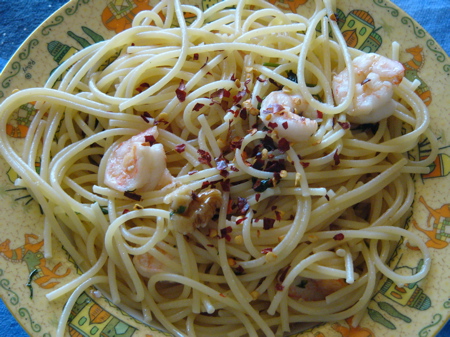
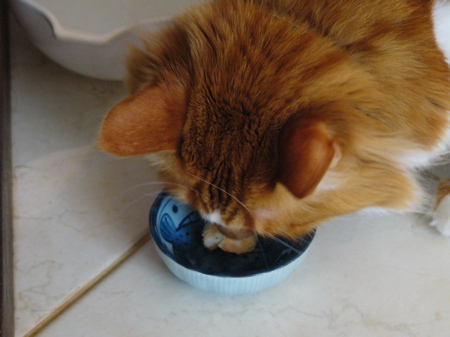
Did I tell you the Qatteri Cat won’t eat meat? He makes an exception for sardines, tuna water, and SHRIMP. As none of these seem to be very good for him, he only gets a little, now and then, as a special treat:
Bon appetite!
“Red” Vinegar
There is a vinegar used often for salad dressings, for marinades, for braising, called wine vinegar. It doesn’t have any alcohol in it, it is just vinegar, but usually in the Middle East you will find it called red vinegar.
So when I found it at the co-op, I grabbed it. It was dimly lit in there, but I could see that it was indeed red.
Can you see how red it is? Hmmmmm. . . . it’s sort of an odd color of red for wine vinegar . . .
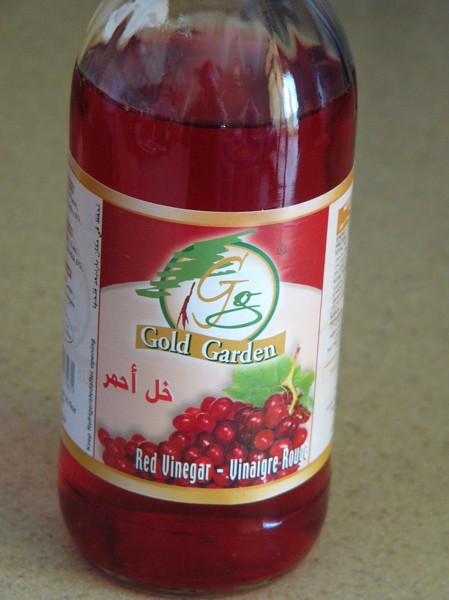
In fact, the color is so wrong that I check the labels – and it is indeed, just “red” vinegar:

I’m not even going to use it. It’s not the same. It’s not the real thing. I don’t need red food coloring.
Ramadan Futoor
I was invited to a friend’s for Iftar the other day. We played, and as the day lengthened, she napped while I read. Her husband came down yelling “get up! get up! It’s almost time!” and had the radio on so we could hear the sound of the cannon, announcing the end of the day’s fasting.
We had water and dates, and then soup. Because these are dear friends, and because they love me, we also had Kuwaiti fish!
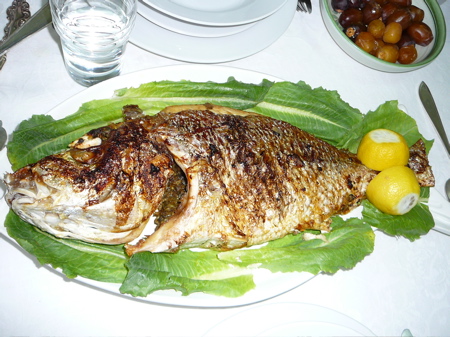
It was stuffed with parsley, onions and garlic, oh WOW. It was delicious.
As we ate, they were telling me about the thin thin pancakes you can buy at this time of the year to make a special stew. They are made on a dome shaped pan, with a very liquid dough, and evidently you can buy them at the co-op or along the side of the road (I have got to find one of these women!) because the thin pancake you can get during Ramadan is very close, I think, to the brik skin that you use for the Tuna Tunisienne which, hmmmmmm, could also be made with just about any leftover fish.
You have to be quick, because the dough is so fragile. While the photo shows all the ends tucked in, I was never that good, and neither are most Tunisiens – most of the brik I ate in Tunisia were all just folded over and fried in olive oil. So you have to have the oil hot before you put the brik in, and it sizzles, but it can’t be too hot because it has to cook long enough to cook the egg (if you add egg) or to heat the tuna through. Ohhhh, yummmm!
I was also asking about Swair’s Ramadan Soft Dumplings / Lgaimat and they were laughing and telling me how hard they are to make well, and that you have to eat them all the same day they are made, they are so fragile.
Later in the meal, as they were showing me low to roll the rice and fish into a ball together and pop it into your mouth in the old gulf way, my host mentioned the act of making that ball is called “ligma” and – – – ta da! it is the same root as Swair’s lgaimat!
I don’t know about you, but making a connection like that is like having a big light go on in my head. I love it. I can’t always remember words correctly unless I write them down, but this one – making balls to pop in your mouth/ making sweet dumplings balls – don’tcha just love it when things come together like that?
(I am posting this early in the day because you won’t feel hungry for fish this early if you are fasting – I hope – and it might give you a good idea for tonight’s Futoor!) Ramadan kareem!
Friday Surf Fishing
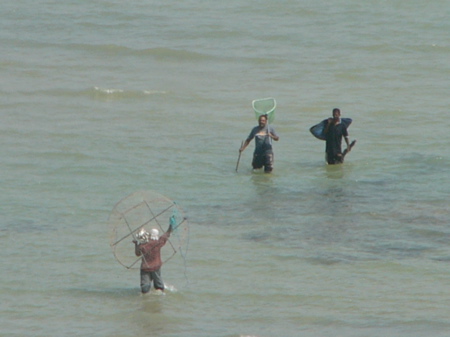
The fishermen brought in a lot of fish, just fishing near the shore. Later, at low tide, they also gathered shell fish. I would love to smell and taste the feast they had after sundown!
Tuna Tunisienne
I didn’t dare publish this photo before the day’s fast had ended. Doesn’t it look just yummy?

We all know what tuna salad is all about, right? A can of tuna, maybe some pickle, and some mayo, slosh it on the bread and you’re done? If you’re getting fancy, you can grill it?
When I moved to Tunisia, I learned a whole new way to eat tuna – I still add the sweet pickle, but now, I also add a LOT of parsley, a little lemon juice, some finely chopped onion, coarse pepper and salt, and then, just a little mayo.
It has a fresh flavor. You can taste all the individual tastes, but together they are magnificent. If you have any capers, you can throw them in, too. C’est magnifique!
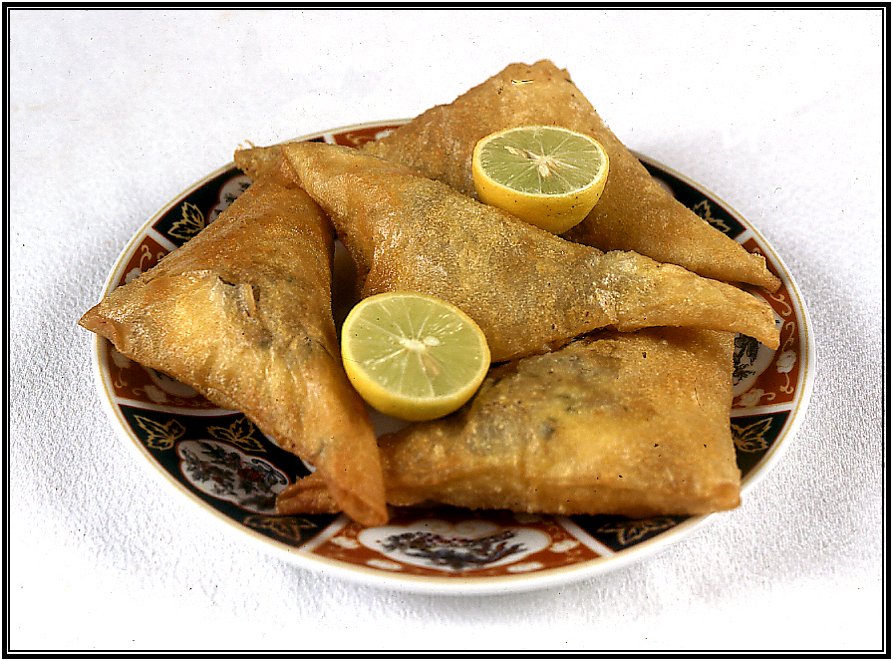
This is how the Tunisians fix their tunafish, in a very common appetizer dish called brik (breek), probably distantly related to the Turkish borek. Sometimes made with just egg, sometimes with tuna and egg, it was the inspiration for my own tuna salad sandwich.
I can actually make brik, but there is no substitute for fresh Tunisian brik, made in Tunisia, with the special very thin brik skins that fry up thin and crisp in the best Tunisian olive oil. The photo is from PromoTunisia.
Recent Comments
ExpatAlien on What Country am I Living … intlxpatr on Yellowstone: Old Faithful to C… Michelle on Yellowstone: Old Faithful to C… Cathy on No Grown-Ups in Charge intlxpatr on Waiting for Snow Wikipedia Donate Button

Amazina


Early Voting in Florida


 Here There and Everywhere