Moorish Americans Claim Abandoned Properties
Fascinating situation. How do these nut cases convince one another that what they dream up is true??? Parents in nearby Navarre had a son killed, regretfully, by police because he claimed Sovereign Citizenship, and printed his own money. It would be funny, if the consequences were not so tragic. He’s dead and his parents are grieving. It’s not like the police LIKE shooting people; they have to live with the consequences, too. There are no winners when people try to claim these non-legal rights.
This is an AOL Original article by Graham Wood
Squatter Lamont Butler Puts Faith-Based Claim on Lavish Mansion
An interesting phenomenon has been popping up around the country: Squatters attempting to claim ownership of vacant or foreclosed homes because, they say, their religion gives them the right. That’s what 28-year-old Lamont Butler argued as he attempted to take over a gaudy $6 million home (pictured above and in the photo gallery at bottom) that, The Washington Post reported, was vacant and up for sale in Bethesda, Md. Butler (pictured below) said that he claimed the home as a Moorish American national and member of the Moorish Science Temple of America, a religious group founded in the early 20th century.
Some who say they follow its precepts preach that African-Americans lived in America before European settlement and so don’t need to abide by U.S. laws, such as those pertaining to property ownership. By this rationale, Butler claimed ownership of the Bethesda mansion.
“If only a palace will do,” the home’s listing says, “this is your home.” It’s a 35,000-square-foot juggernaut of a house with 12 bedrooms and 17 bathrooms, imported marble floors and limestone terraces. The home that once played host to political bigwigs such as Bill and Hillary Clinton, now was rightfully his, Butler said. According to the Post, Butler went to Maryland’s Department of Assessments and Taxation with a historic map and documents referencing peace treaties, then asked that tax records on the home be updated to reflect his ownership. The department refused to do so without a deed showing a transfer of ownership.
After that, Butler allegedly entered the empty home on two occasions. Neighbors alerted the home’s owner when they saw cars parked out front. When police arrived at the house after complaints, they found “No Trespassing” signs hanging in the windows, a stereo on full blast and food in the refrigerator. Butler sent emails to real estate agent Jordan Fainberg, who represents the home’s listing, stating: “Even though there was no false arrest made … by the Public Servant Trustee Police Enforcers for the private foreign corporate-for-profit entity styled as Montgomery County Police Department, and conversations ended on peaceable terms, I, as well as others, will be coming to the land property estate this week.”
Butler was eventually arrested, the Post said, and along with the case of breaking-and-entering against him in Bethesda, he’d already been charged elsewhere with identity theft and concealing a dangerous weapon. Authorities say that his claim on the Bethesda mansion holds no weight. But this very odd case is no isolated incident. People calling themselves Moorish Americans have been attempting to take over properties all over the country. “I can promise you that every state has had their challenges with these guys,” Carol Foglesong, a land records official in Orange County, Fla., told the Post. States including Virginia and Maryland are even passing laws to impose stricter penalties against those who attempt such property takeovers.
Earlier this month in Memphis, Tenn., a woman claiming to be a Moorish American was arrested after allegedly breaking into and squatting in a $3.1 million mansion, Memphis TV station WHBQ reported. In that incident, a SWAT team stormed the home to remove Tabitha Gentry and her teenage daughter. Gentry claimed that her status as a Moorish American national meant that the government could not control her.
Reports of Sexual Assault Increasing in India: Warning Issued
Another Woman Who Should Have Known She Was in the Wrong Place? She’s in her hotel room – near the Taj Mahal . . . is this another case of being in the wrong place in India? You’re not safe in your own hotel room? The manager of the hotel comes to your room to wake you for a wake-up call???
20 March 2013
Tourist balcony jump: Hotel manager and guard in court
A hotel manager and guard accused of sexually harassing a British tourist who jumped from a hotel balcony to escape have appeared in court in Agra.
A lawyer acting for hotel manager Sachin Chauhan said his client denied the charge and he had been trying to wake the woman up because she had asked for an early morning call.
The 31-year-old British woman was injured after jumping on Tuesday.
The Briton has been giving her statement at the court.
Initial reports suggested the woman told police she asked for a wake-up call at 04:00 local time and was offered a massage by the hotel owner when he knocked on her door.
She said the man would not leave so she locked the door and jumped from her balcony to the level below, injuring her leg, before fleeing the hotel.
On Tuesday, a spokesman for the British High Commission in India said UK consular officials in Delhi had spoken to the woman and local police.
The Foreign Office recently updated its advice for women visiting India, saying they should use caution and avoid travelling alone on public transport, or in taxis or auto-rickshaws, especially at night.
It added that reported cases of sexual assault against women and young girls were increasing and recent sexual attacks against female visitors in tourist areas and cities showed that foreign women were also at risk.
Police arrested six people following an alleged gang rape of a Swiss tourist in Madhya Pradesh state last week.
The woman was attacked with her husband as they camped in woodland near a village in Datia district.
The arrests came as India’s politicians prepared to debate a new law against rape, following the outcry over the fatal assault on a female Delhi student last year.
It’s Your Fault if You Assume You Are Safe: Indian Officials
Horrifying. Disgusting. At the very least, if you are an official and tourists are gang raped in your area, keep your mouth shut. If you must say something, tell the visitors how sorry you are this happened to them. Never, never, never suggest that they should have ASKED if they were safe, NEVER blame the victim for being in the wrong place at the wrong time. You just look really, really ignorant.
These crimes will keep happening as long as there is such a preference for male children that there are not enough mates for the males once they mature. They will keep happening as long as men are not taught, as children, that women are to be equally respected.
Swiss Gang Rape Victim, Husband Partially To Blame For Attack, Indian Officials Suggest
The Huffington Post | By Cavan Sieczkowski
Posted: 03/18/2013 12:13 pm EDT
Officials in India suggested that a Swiss tourist and her husband are partially to blame for an alleged attack and gang rape in a remote wooded area in Madhya Pradesh last week. They said the couple did not inquire about the safety of the region.
On Friday, a Swiss woman and her husband pitched a tent in a forest in Madhya Pradesh while on a three-month cycling excursion, according to the Associated Press. Around 9:30 p.m. a group of men attacked the couple, beat up the husband, tied him to a tree, gang raped the wife and robbed the pair, police said.
During a press conference on Sunday, police spokesperson Avnesh Kumar Budholiya suggested the tourists are partially to blame for the assault because they chose to travel that area without speaking to local police, the Independent reports.
“No one stops there,” Budholiya said. “Why did they choose that place? They were in the wrong place at the wrong time. They would have passed a police station on the way to the area they camped. They should have stopped and asked about places to sleep.”
Another official also appeared to place blame on the victim and her husband.
“The rape of the Swiss national is unfortunate but foreign travelers should inform the police about their movement so they can be provided with adequate protection,” said Umashankar Gupta, the Home Minister of Madhya Pradesh, according to The Times. “They often don’t follow the state’s rules.”
Madhya Pradesh reportedly has one of the highest rates of crimes against women in the country, a fact the Swiss tourists were unaware of, according to the Times of India.
“They apparently lost track and took a wrong turn and decided to halt for the night by the side of a village brook little realizing that the district with 85:100 men to women ratio is not the safest place for women,” a senior official from the region told the newspaper.
Six men have been arrested in connection with the most recent reported gang rape, CNN reports. The victim, who was hospitalized after the attack, claims four of the men raped her. The other two reportedly robbed her and her husband. All six appeared in court Monday.
The most recent attack comes just three months after a 23-year-old woman was gang raped and beaten on a public bus by five men in New Delhi. The defense lawyer for three of the accused placed some of the blame on the now-deceased victim, saying a “respected lady” does not get raped.
Blaming a female victim of a sex crime is common in India because of a woman’s role in society, according to the Sydney Morning Herald.
“This is the mentality which most Indian men are suffering from unfortunately,” Ranjana Kumari, director for the New Delhi-based Centre for Social Research, told the newspaper. “That is the mindset that has been perpetrating this crime because they justify it indirectly, you asked for it so it is your responsibility.”
Scam from Marina Parma
Urgent Reply.
Greetings to you and your family, I am the manager of bill and exchange in THE
BANK, I have a business of 5.5 Million
United State Dollars to be transfer to your account for investment in your
country, if you are ready to assist me get
back to me, I will give you full details on how the fund will be transfer to
you.
Be rest assured that everything will be handled confidentially because, this is
a great opportunity we cannot afford to
miss, as it will make our family profit a lot.
It has been 6 years go, that most of the greedy African Politicians used our
bank to launder money overseas through the
help of their Political advisers.
Most of the funds which they transferred out of the shores of Africa were gold
and oil money that was supposed to have
been used to develop the continent.
The Political advisers always inflated the amounts before transfer to foreign
accounts so I also used the opportunity to
divert part of the fund worth five million five hundred united state dollars I
told you about and I am aware that there
is no official trace of how much was transferred as all the accounts used for
such transfers of fund at that particle
time were closed after transfer.
I am the account officer to most of the politicians and when I discovered that
they were using me to succeed in their
greedy act, I also cleaned some of their banking records from the Bank files and
no one cared to ask me for the money
was too much for them to control, as I am sending this message to you, I was
able to divert five point five Millions
Dollars ($5.5M) which is in an escrow transit account belonging to no one in the
bank, and now my bank is very anxious
to know the real beneficiary of the funds is for they have made a lot of profits
with the fund.
It has been more than five years ago and most of the politicians are no longer
in power again and they don’t use our
bank to transfer funds overseas anymore since their tenure had expired.
The $5.5 Million United State Dollars has been lying in the bank as unclaimed
fund and i will soon retire from the bank
immediately the fund is transfer into your account over there.
Immediately the fund has been successfully transfer into your account i will
come to your country for the sharing of the
fund, the fund will be shared 50% for me and 40% for you, and the other 10% for
the orphanages home and poor with
less-privilege people.
Please know that there is no one that is going to question you about the fund if
you will comply with me and follow my
instruction which will help us a lot to achieve this goal for everything is well
secured.
Please indicate your interest in this transaction my replying back and if you
are not interested do not waste your time
to reply kindly delete my message from your box ok.
Waiting to hear from you soon.
Yours Faithfully,
Mrs Marina Parma
parmamarina@voila.fr
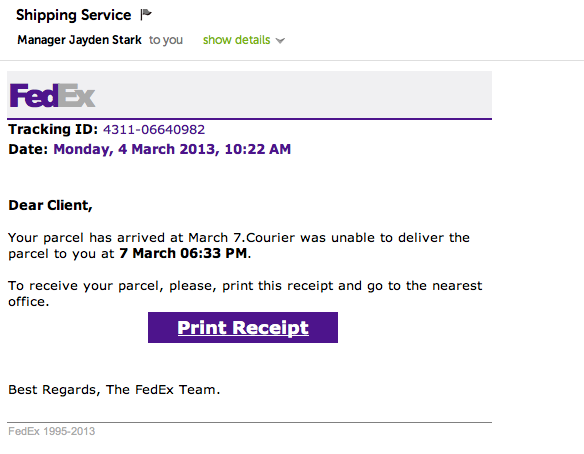
FedEx Scam
I am not expecting any delivery – especially as Intlxpatr, LOL. Warning, when you receive notices like these, do not click anything, except the SPAM button!
Mayhem on SVU
One of the funniest things that happened on the opening show of Law and Order SVU, season 14 was that there was an undercover detective screwing up the works, but what made it funny was that he also appears on Allstate insurance commercials as “Mayhem”. I don’t think I can ever see him in an acting role that I won’t think of his as Mayhem, LOL.
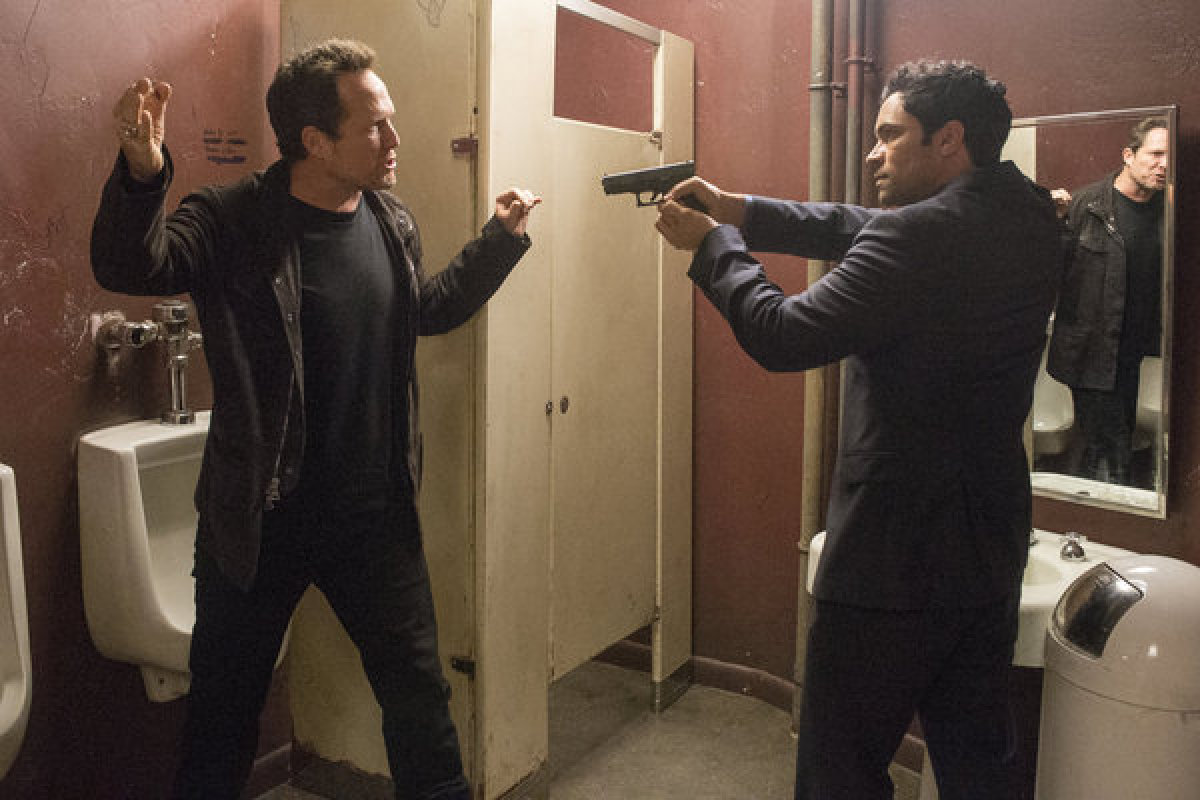 (If you don’t know L&O SVU; Mayhem is on the left.)
UPDATE: Watching an early L&O:SVU episode about a serial killer, there he was – MAYHEM – performing as Detective Cassidy. I said to AdventureMan “That’s Mayhem!” and he checked it on IMDb, and indeed, it was. So Mayhem has a long history with S&O, SVU.
Stay With A Violent Man, You End up Dead
No, no, this was not Rihanna and Chris Brown, it just sort of SEEMED familiar, like their story. Bottom line, Law and Order SVU is saying, if a guy hits you, abuses you, it is not likely to get better. You stay, you risk, at the very least, continued and increasing damage at best, increasing violence toward those you hold dear, even brothers, sisters, mothers, fathers and CHILDREN to the self-centeredness of the violent abuser, and ultimately, many abuse victims end up dead. It’s not a story about Rihanna and Chris; it’s a story about every woman who stacks up economic realities against a violent outcome and chooses to stay.
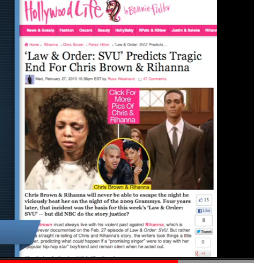
‘Law & Order: SVU’ Tackles The Chris Brown-Rihanna Story Of Abuse, Reconciliation
It’s a staple of the “Law & Order” franchise to rip stories straight from the headlines. For the latest episode of “Law & Order: Special Victims Unit,” the case was one that is very familiar to music fans, and remains as controversial today as it was when the story first broke in 2009. Using obvious counterparts, “SVU” tackled the Chris Brown and Rihanna story.
Brown assaulted Rihanna in 2009 before the Grammy Awards. The two have since reconciled and have remained linked romantically off and on since then. In the “SVU” episode they were Micha and Caleb. Just like Rihanna, Micha was assaulted by Caleb. The case went to trial, but the two reconciled. But “SVU” took their story further down a dark path.
In this fiction, Caleb finally went too far and killed Micha. “Shocked fans gathered in Manhattan tonight to mourn the death of rising talent, Micha Green, whose body was discovered a few hours ago in Bermuda,” a reporter said in the aftermath of hear death.
Did they take it too far? E! wondered that very thing, while Hollywood Life worried that the ending could hit too close to home for the real couple, writing, “Overall, the show took some liberties … but pretty much wrapped things up exactly as they are: Chris is a violent man and Rihanna accepts a bad man in her life. How sad!”
Maldives Rape Victim Sentenced to 100 Lashes for PreMarital Sex
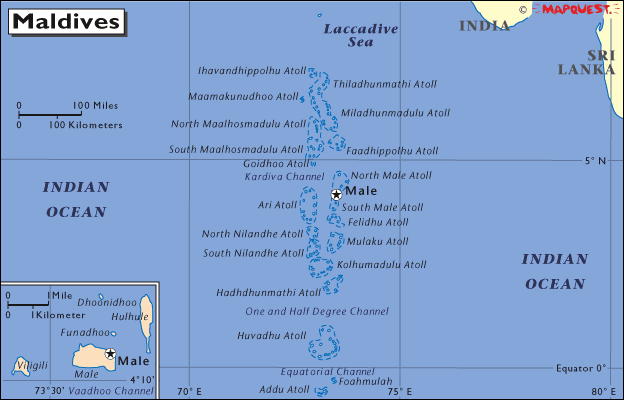
Where are the Maldives Islands?
Raped by her stepfather, impregnated against her will, her stepfather killed the baby, and now, sentenced by Sharia law to 100 lashes for pre-marital sex. How can this be justice? (This is from BBC News)
Maldives girl to get 100 lashes for pre-marital sex
By Olivia Lang
BBC News
A 15-year-old rape victim has been sentenced to 100 lashes for engaging in premarital sex, court officials said.
The charges against the girl were brought against her last year after police investigated accusations that her stepfather had raped her and killed their baby. He is still to face trial.
Prosecutors said her conviction did not relate to the rape case.
Amnesty International condemned the punishment as “cruel, degrading and inhumane”.
The government said it did not agree with the punishment and that it would look into changing the law.
Baby death
Zaima Nasheed, a spokesperson for the juvenile court, said the girl was also ordered to remain under house arrest at a children’s home for eight months.
She defended the punishment, saying the girl had willingly committed an act outside of the law.
Officials said she would receive the punishment when she turns 18, unless she requested it earlier.
The case was sent for prosecution after police were called to investigate a dead baby buried on the island of Feydhoo in Shaviyani Atoll, in the north of the country.
Her stepfather was accused of raping her and impregnating her before killing the baby. The girl’s mother also faces charges for failing to report the abuse to the authorities.
The legal system of the Maldives, an Islamic archipelago with a population of some 400,000, has elements of Islamic law (Sharia) as well as English common law.
Ahmed Faiz, a researcher with Amnesty International, said flogging was “cruel, degrading and inhumane” and urged the authorities to abolish it.
“We are very surprised that the government is not doing anything to stop this punishment – to remove it altogether from the statute books.”
“This is not the only case. It is happening frequently – only last month there was another girl who was sexually abused and sentenced to lashes.”
He said he did not know when the punishment was last carried out as people were not willing to discuss it openly.
Putting TEETH into Anti-Rape Solutions :-)
Thank you, Hayfa, you always find the most amazing articles. What I love about this one is that if everything is where it is supposed to be, nobody gets hurt. Only invasive behavior results in . . . .lets hope excruciating pain 🙂 It also gives an attacker something else to focus on. This invention is a public service.
Rape-aXe: The Anti-Rape Condom
This is so brilliant! An anti-rape female condom invented by Sonette Ehlers.… A South African woman working as a blood technician with the South African Blood Transfusion Service, during which time she met and treated many rape victims. The device, known as The Rape-aXe, is a latex sheath embedded with shafts of sharp, inward-facing microscopic barbs that would be worn by a woman in her vagina like a tampon. If an attacker were to attempt vaginal rape, their penis would enter the latex sheath and be snagged by the barbs, causing the attacker pain during withdrawal and (ideally) giving the victim time to escape. The condom would remain attached to the attacker’s body when he withdrew and could only be removed surgically, which would alert hospital staff and police. This device could assist in the identification and prosecution of rapists.

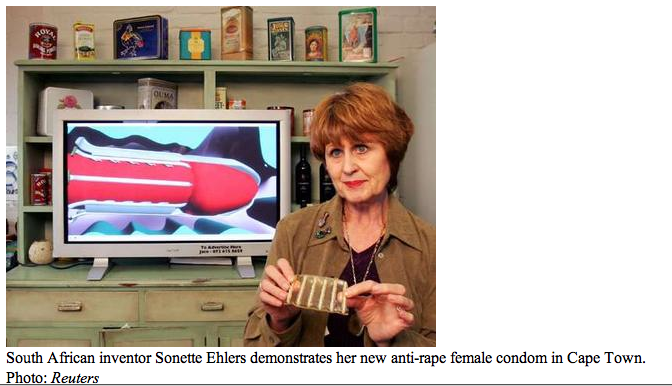
A medieval device built on hatred of men? Or a cheap, easy-to-use invention that could free millions of South African women from fear of rape, in a country with the world’s worst sexual assault record?
Dubbed the “rape trap”, trademarked “Rapex”, the condom-like device bristling with internal hooks designed to snare rapists has re-ignited controversy over South Africa’s alarming rape rate, even before plans for its production were announced in Western Capethis week.
Some say the inventor, Sonette Ehlers, a former medical technician, deserves a medal, others that she needs help.
The device, concealed inside a woman’s body, hooks onto a rapist during penetration and must be surgically removed.
Ms Ehlers said the rape trap would be so painful for a rapist that it would disable him immediately, enabling his victim to escape; but would cause no long-term physical damage and could not injure the woman.
Some women’s activists call the device regressive, putting the onus on women to address a male problem.
Charlene Smith, an anti-rape campaigner, said it “goes back to the concept of chastity belts” and would incite injured rapists to kill their victims.
“We don’t need these nut-case devices by people hoping to make a lot of money out of other women’s fear,” Ms Smith said.
But Ms Ehlers contends that South Africa’s rape problem is so severe women cannot wait for male attitudes to improve.
“I don’t hate men. I love men. I have not got revenge in mind. All I am doing is giving women their power back,” Ms Ehlers said. “I don’t even hate rapists. But I hate the deed with a passion.”
The United Nations says South Africahas the world’s highest per capita rate of reported rapes – 119 per 100,000 people. Analysts say the total, including unreported rapes, could be nine times higher.
Ms Ehlers sees her invention as particularly attractive to poorer black women, because they often walk long distances through unsafe areas to and from work. She foresees women inserting the device as part of a daily security routine.
She said a majority of women surveyed said they were willing to use the device, which will go into production next year and sell for one rand (20 cents).
Ms Ehlers said she was inspired after meeting a traumatised rape victim who told her, “If only I had teeth down there.”
Recent Comments
intlxpatr on Shampoo Ginger tigerbutterya0c5ff1d… on Shampoo Ginger intlxpatr on British Soldier Kidnapped, Esc… John on British Soldier Kidnapped, Esc… intlxpatr on British Soldier Kidnapped, Esc… Wikipedia Donate Button

Amazina


Early Voting in Florida


 Here There and Everywhere