Coen and No Country for Old Men
AdventureMan and I watched No Country for Old Men last night, and oh! it held us on the edge of our chairs. At the end, we ran for the phone to call our son and ask “Whoa! What happened??”

In short, we loved the movie (and I can hardly wait to read the book, although Cormac McCarthy goes a lot darker than I care to go). The Coen brothers also go darker than I care to go, but we find ourselves drawn to their movies because there is so much thought put into them, so many references to other genres, other films, and because the characters are so true to life. We first met them in Fargo, a movie we pull out and watch again from year to year – that’s a rare movie. We love the characters, even the bad guys are so human.
It’s the same in No Country for Old Men. Set in the desolation of West Texas, there are whole minutes when you listen to the wind whistling in the desert as the hero hikes down to a drug-exchange-gone-bad.
There is a good guy, a sherif played by craggy-faced Tommy Lee Jones, and an ordinary guy who finds a whole lot of money, and we really want him to get away with it, and then there is a really really bad guy, who is also smart, and . . . well, something inside of him is just bent. He’s not right. The Coen’s have a way of making him both appalling and just a guy doing his job very well. It’s not personal, but we wish he wouldn’t enjoy inflicting harm so much.
What I love about the Coen films is that they can capture the essence of a character so sparely, with just a few words, a few lines. There is a trailer park manager who refuses to give the very very bad guy an address. You hold your breath; she could get blown away, she doesn’t know it. She holds firm. In another scene, an older woman tells a Mexican man who has just helped her “You don’t see too many Mexicans in suits.” So so so politically incorrect, and so ordinarily normal, the plain-spokeness of the elderly. The Coen’s capture the West Texas-ness which permeates the film.
This movie is worth watching again.
Warden Message and More
Fresh in the mailbox from the Embassy comes this warning:
Embassy of the United States of America
Kuwait City, Kuwait
May 4, 2008
MEMORANDUM
To: All American Wardens
From: Consular Section
Subject: Warden Notice 2008 – 9
Please circulate the following message without additions or omissions
immediately to all American citizens within your area of responsibility.
Begin text.
The Minister of Interior, Sheikh Jaber Khaled Al-Sabah, has issued a Ministerial
decree that prohibits drivers in Kuwait from using a cellular phone while
driving a vehicle. This decree (number 76/81) is intended to keep drivers in
Kuwait focused on driving and not talking on a cellular phone. This decree is
consistent with what is going on in our own country in many states that are
enacting laws prohibiting cellular phone use while driving.
This decree goes into effect on May 1, 2008. As a practical matter, drivers
should not be talking on cellular phones while driving at any time. They should
find a safe place to pull over and stop their vehicles before talking on the
cellular phone. Keep in mind this new decree is an amendment to a previous law
already in effect that includes eating or drinking while driving a vehicle an
offense in Kuwait.
You should expect some increased vigilance on the roads by police in the coming
weeks to enforce this decree. Our information from MOI is the fine for use of a
cellular phone while driving will be 15KD.
Comments: There is already a law in effect that bans eating and drinking while driving??? Who knew?
Waaaaaayyyyy back in February, a chart started circulating, said to be a fraud, that pretty accurately defined the new laws in effect 1 May. Looking at it now, I am betting it is a list of new laws that went into effect in JORDAN, and Kuwait used it as a template for changes in Kuwait. I know new traffic laws – very similar – went into effect in Syria on May 1st.
I can’t help wondering how all this came about, but most of all, for your protection and mine, I am thankful for these new laws and the commitment on the part of the government to enforce these laws equally, across the board. The statement we keep hearing is “no one is above the law.” Wooo Hooo, Kuwait!
The only funny thing is – the chart I have seen most often in Kuwait says the fine is KD 50 for driving while on a cell phone. This message says KD 15. The announcement in the paper said KD 5. If anyone out there has been charged for taking on a cell phone while driving, will you let us know what the real fine is?
Is the ban being enforced equally against all drivers? The Kuwait Times says 200 people were charged on the first day of enforcement.
Army Audits: Official Sites, Not Blogs, Breach Security
This report came out in August of 2007, on WIRED so it is not new news.
What it IS, is something for those who are considering monitoring blogs in Kuwait, to think about.
It isn’t bloggers complaining about roads, or complaining about a do-nothing-but-hold-a-grill-party Parliament, or about laws not being enforced. If bloggers are blogging and comlaining, people are grumbling. Bloggers might be considered a weather-vane, but bloggers are not creating the weather, if you catch my drift.
The US Army was blaming bloggers – until a study showed that it was their own OFFICIAL websites that gave away important information.
I used to ask AdventureMan about things and he would snap “Where did you hear that? It’s classified!” and I would tell him I read it in the New York Times – or in the Stars and Stripes.
We bloggers aren’t your problem. We bloggers are mostly geeks and nerds who love our computers, love thinking about things, and we are not out there rabble raising . . . we are sharing ideas. We don’t all agree. We are not your problem.
For years, members of the military brass have been warning that soldiers’ blogs could pose a security threat by leaking sensitive wartime information. But a series of online audits, conducted by the Army, suggests that official Defense Department websites post far more potentially-harmful than blogs do.
The audits, performed by the Army Web Risk Assessment Cell between January 2006 and January 2007, found at least 1,813 violations of operational security policy on 878 official military websites. In contrast, the 10-man, Manassas, Virginia, unit discovered 28 breaches, at most, on 594 individual blogs during the same period.
The results were obtained by the Electronic Frontier Foundation, after the digital rights group filed a lawsuit under the Freedom of Information Act.
“It’s clear that official Army websites are the real security problem, not blogs,” said EFF staff attorney Marcia Hofmann. “Bloggers, on the whole, have been very careful and conscientious. It’s a pretty major disparity.” The findings stand in stark contrast to Army statements about the risks that blogs pose.
Rolls Royce and Lamborghini Dumped
From today’s Arab Times:
Rolls Royce and a Lamborghini dumped in a desert
Kuwait : Police found two luxurious cars — a Rolls Royce and a Lamborghini — worth KD 200,000 dumped in a desert area, reports Al-Anba daily. Reportedly, the cars were stolen from a rental office about 20 days ago. Personnel from the Criminal Evidences Department lifted fingerprints to identify the culprits.
Does anyone else find this funny? I mean funny, hahahaha, not funny strange, or weird. I mean it IS weird, it is so weird, but it makes me laugh.
In a little village in Washington State, there was a huge snowstorm a few years ago, and the roofs in the yacht club collapsed from the weight of the snow, collapsed on all those big fine yachts, and the citizens of the little village gathered and laughed. Boat moorage in their own little village had gotten so expensive, they couldn’t afford it, so these were all other people’s boats. And they just laughed.
200,000 KD worth of car in two cars. Just dumped in the desert. Seems kinda wasteful, doesn’t it?
Kuwait Elections: Vote Buying
Front page of the online Arab Times:
They’re buying votes … Do something
KUWAIT CITY : The Ministry of Interior should immediately take the necessary action to curb the widespread vote-buying in some constituencies and prevent incompetent candidates from entering the Parliament, former MPs and 2008 parliamentary election candidates told the Arab Times.
One of the smartest bloggers out there, Touche´, wrote a comment on an earlier election blog entry, and it was SO good, so memorable (this man should be writing and editing for one of the daily English papers and teaching Political Science) on vote buying and how it is implemented that I am going to reprint his comments here to illustrate how the vote buying in Kuwait is accomplished.
Let me indulge you with our rotten political trends.
This is a funny ironic melancholic TRUE story, I have a colleague at work who is “Mutawa” (fresh your old post) who belongs to “Salaf a.k.a. The Islamic Heritage Rejuvenating Society (this is my best translation) and who is has the last name of one of the tribes. Now on the last elections back on 2006 I asked him to whom did you vote, thinking that he must have voted for that group’s candidates, and the shocking news is that he said the week before elections I swore an oath with all the area followers to vote for the Islamic candidates and I quote him “When I went there to vote and tried to vote for the sworn names, the pen would go directly to those candidates who belong to my tribe, I couldn’t do it, so I voted for one of the Islamic candidates and the other vote went to our tribe’s guy”. Now I told him that you’ve sworn on the Quran!! How cold you do that? The answer was simple, “I just couldn’t, it’s in my blood, it’s something beyond your comprehension”
As for your question about votes purchasing, it starts as follows (sorry but I had to put them into steps for clarity purposes:
1. The buyer’s representative (BR) scouts the area for the right voters who are willing to sell their votes for money.
2. BR approaches the voter and persuade him/her and both agree on the price of each vote (female votes are being negotiated with the woman’s brother, father or husband)
3. Once the deal is closed, the voter has to submit his/her national ID to the BR to insure that voter hasn’t closed another deal with another candidate and the documents are held with the BR until elections day (on extreme cases, a trust worthy voter won’t submit the documents and his word is taken as it is considered stronger than oak)
4. All BRs know each other as they are basically residents of the same area and they exchange a list of those voters who sold their votes an cross examine them for duplications to prevent any frauds.
5. Now the interesting tactics, on election day, a candidate may choose not to give the national ID to the voter if the he feels that he has secured his win and thus eliminating any chances of any frauds by voter to shift his votes to opponents.
6. If the candidate needs the vote, the corresponding BR calls up the voter and walks him to the election classroom signaling another same candidate’s BR who sits in that classroom to observe the integrity of the processes, now that guy knows that the voter isn’t a supporter and has been paid based on the signal thus he keeps a hawk eye on him trying to see how many ticks were placed on the voting form and does the tick fits the area on the form where candidate’s name is printed (it’s merely an approximate observation).
P.S.
a. The timing of the purchased votes isn’t random and are chosen specifically by the candidate’s campaign and usually the purchased voted are being herded as sheep in groups either at the early morning or an hour before the closing time.
b. The paid amount is %50 before voting and the remaining %50 when the inside BR sms the voter’s delivery BR that the vote has been verified based on his observation and thus the full payment is due.
c. The vote’s price depends on the nature of the vote itself (solo/dual for the old election ways). Solos are the highest paid and the ones which BRs aim for.
d. Buying votes isn’t to insure number of votes, the key element of the whole process is to target those votes which are considered as opponents insured votes, by keeping those national ID (voting ID for this election) the candidate uses a term called “Votes Burning” where he holds back those IDs and never giving them to voters until election boxes are sealed to eliminate opponents’ insured votes.

Blogger Chirp reports being offered KD 4000 (that’s about $16,000) for her vote. Imagine the temptation! Chirp has character and integrity, and turned it down, but imagine how tempting that might be to a young person who wants education, or a new car, or to pay off debts, or who has a wedding coming up. That’s a LOT of money for just one vote; imagine the deep pockets who can afford to buy that many votes?
Parking Problem
From the Arab Times:
Kuwaiti brothers critically hurt in gang attack over parking row
KUWAIT CITY : Eight persons broke into a Kuwaiti family’s house in Salmiya and attacked three brothers with knives, machetes, sticks and similar weapons just because the brothers did not allow a female student of a nearby institute to park her car opposite their house.
The brothers were critically wounded and had to be admitted to the Intensive Care Unit of Mubarak Al-Kabeer Hospital.
Securitymen, who rushed to the scene after receiving a call from their mother, managed to arrest one of the attackers but the rest of them bolted from the scene.
A case was registered.
By Mizyed Al-Saeedi
Special to the Arab Times
People here can get pretty riled up over parking. One time, my husband and I were attending a social event, and we parked on – well, it looked like a public street to us, and public streets, unless they have numbered, private parking, you are allowed to park on public streets because you are the public. That’s what we thought anyway.
When we came out, we had cars literally blocking us, forward and rear, from getting out. My husband approached the owner of the house in front of whom we were parked, who was around the corner in his diwaniyya (on the public sidewalk) and when my husband said he was sorry, the man said he could put his “assif” (sorry) in his pocket!
Not one to give up easily, AdventureMan schmoozed for a while. The man said he would have his driver take me home, and AM asked him if he would put HIS wife in a car with a strange driver. That got an appreciative grin. Long story short, finally he allowed us to leave. He had some legitimate gripes – the facility where we had attended the performance has people who block his parking access to his house all the time.
My husband visited him again the next day with a parcel of dates to express his appreciation for the guy having let us go, and visited the facility and helped arrange to insure that people would not park in front of this guy’s house again. He and the man became – well, not friends, but cordial acquaintances.
I’ve always been glad AM handled it in a gentlemanly fashion. Imagine, breaking in and stabbing people over a parking spot!
Traffic ENFORCEMENT
Whoda thunk?
I am (almost) speechless!
Can this be a turning point in Kuwait? Are we going to have laws that might actually be meant to be followed? Wooo Hoooo, traffic police, Woooo Hoooooo, court of law!
From The Arab Times: Kuwait Crime:
‘Deport motorist’ – Driving on E-lane
KUWAIT CITY : Assistant Undersecretary for Traffic Affairs, Major-General Thabet Al-Muhanna has ordered the deportation of an Arab man who was caught driving at 140 km/h along the Fifth Ring Motorway, reports Al-Seyassah daily.
According to a security source Al-Muhanna saw the motorist driving along the emergency lane and ordered his immediate arrest.
After his arrest the man admitted to committing the offence. He apologized and said he was in a hurry. However, the man will be administratively deported, say sources.
Questions and Comments: Woo Hooo, al-Muhanna!
Suggestion: With the great advent of tiny, easily carried cameras and cell phone cameras, photographic evidence is easy to provide. How about the Ministry of Interior setting up a website where we can send them photos of people WE see in flagrant violation of the laws?
Three Years to Defeat Al Qaeda
I wish he wouldn’t say things like that. Robert Mueller told BBC News that he thinks we will see the end of Al Qaeda in three years.
To me, that is like waving a red flag in front of a bull. It’s a dare. I wish he would just go about defeating Al Qaeda in three years, and not talk about it until it’s done. Maybe it is superstitious; I prefer action to talk. When you talk about defeating someone, you might just be setting yourself up to eat humble pie.
The head of the FBI has said he believes the West can achieve victory over al-Qaeda within three-and-a-half years.
Robert Mueller described how his organisation is working closely with British intelligence to confront ever-more-complex plots.
Flanked by broad-shouldered security men with tell-tale bulges beneath their suits, the director of the FBI gave a rare public address in London.
As head of one of 16 US intelligence agencies, Mr Mueller is at the forefront of preventing a repeat of the September 11 attacks.
It was a task, he said, which could not be done without strategic partnerships with allies like Britain.
You can read the entire article HERE.
Warden Message
If this was a warden message, I didn’t get it. I get most of them. I found this in today’s Arab Times:
Terrorists may target Americans
Following is the full text of the Kuwait 2008 Crime & Safety Report released by the US State Department in March, 2008
Overall Crime and Safety Situation
The Department of State rates Kuwait as low threat for crime. The incidence of crime in Kuwait City remains low. The Government of Kuwait (GOK) maintains a high police profile, with large numbers of uniformed and plainclothes officers on the streets. Each district and governate has police stations operating under the direction of the Ministry of Interior (MOI) Directorate of Public Safety. Street crime does occur and incidents have been reported to the embassy’s Regional Security Office (RSO) recently that required monitoring and security notice dissemination.
Of particular concern are an alarming number of crimes involving individuals impersonating police officers and then assaulting victims, who are primarily third-country nationals (TCNs) and more susceptible to intimidation. The evolving modus operandi (MO) involves a male in plain clothes and an unmarked vehicle stopping a TCN, whether on foot or in a vehicle, asking for his ID, then demanding the person get into the impostor’s vehicle without any explanation of his offense or their destination. The TCN is then driven to a deserted area and assaulted.
The British Embassy released a Warden Notice about an assault that took place in February 2007 that did not involve a British national, but occurred in the Manghaf neighborhood where a large number of British citizens reside. In this case, a TCN was taken in broad daylight from a public area by a police impostor and assaulted, employing the aforementioned MO. A second Warden Notice from the British Embassy in March detailed an incident occurring behind the US Embassy Kuwait, at a shopping center in Mishref, where two young men believed to be local nationals forced a British male teenager into their vehicle late one evening and made sexual advances toward him. The victim escaped by throwing himself from the moving vehicle, where a passing Kuwaiti military vehicle offered assistance and returned him home safely. Based on a long-standing relationship of mutual cooperation and information-sharing, the Regional Security Office (RSO) at US Embassy Kuwait distributed security notices based on the British reports advising staff of these specific instances and included personal security guidance for all employees and their family members.
Violent crime is primarily confined within the TCN community, which comprises the majority of the manual labor force in Kuwait – approximately two-thirds of Kuwait’s residents. It is probable that a high percentage of crimes in the TCN community go unreported. The threat of immediate deportation looms large for many of these guest workers who generally prefer maintaining a low profile so as to avoid unwanted attention from the GOK.
Although several districts within Kuwait City are known to have higher incidences of crime, only one area (Jahra) remains generally off-limits to official embassy personnel. One factor contributing to the high rate of crime in Jahra is the inability of the police to enforce laws in areas where tribal customs take precedence. Known offenders regularly intimidate foreign guest workers, including workers employed by US companies and US military bases, by damaging vehicles, starting fires in trash cans and harassing them while they enter and exit their residences.
Harassment is not due to any affiliation to the United States or US military efforts; instead, it is generally due to criminalsbelieving they can act with impunity. Young Bedouin men who comprise the majority of these gangs are subject to their tribal mores first, but the tribal structure has proven ineffective in controlling these individuals which hinders the efforts of police to crack down on their illicit activities.
Residential crime remains low. There have been no reported break-ins at any official embassy residences within the past year, nor have any vehicles been stolen. A domestic employee of an embassy officer had her purse stolen from an individual on a motorbike outside of the officer’s residence. The perpetrator was later captured by police in the same neighborhood days after the attack. It is not uncommon for embassy staff and dependents to report suspicious persons in their neighborhoods to the RSO, but the majority of these instances have been resolved without any criminal or other hostile intent discovered.
There are no reports of petty thefts against the official American community in any of the popular outdoor markets or shopping malls frequented by tourists and Westerners living in Kuwait. However, the potential for such crime does exist. Individuals should remain aware of their surroundings at all time and assume that no venue is safe from crime. Additionally, vehicle break-ins, although rare, do occur if valuables are left in plain view. Visiting Americans are urged to take the same security precautions in Kuwait that they would practice in the United States. Hotel room doors should be locked and valuables should be stored in hotel safes when available. Visitors should instruct the hotel management not to divulge their room numbers over the telephone to any callers, but only to connect them to their room or to take a message.
Incidents of harassment and road rage, although infrequent, do occur and appear to be on the rise. Females have reported being occasionally accosted or harassed by Arab or South Asian males, particularly while driving alone in the morning or nighttime hours. In an incident involving an Embassy spouse in the fall of 2007, a local male harassed the spouse in a local shopping center, which prompted a security notice by the RSO and a Warden message by the Consular Affairs Section. Women who are the victim of harassment should immediately seek a public area and notify either store management or security personnel. Women should not travel home alone.
Male drivers using their personal vehicles forcefully to stop a female driver or attempting to gain the female’s attention for socializing purposes have been reported. Often this action is meant only to acquire a telephone number or arrange a date. However, reports of males impersonating police or military officers and utilizing his authority to command compliance from unsuspecting females have been increasing. Determining who is a legitimate police officer and who is an impostor is troublesome. In the reports received by the RSO, the individual initiating the contact was not wearing a uniform and was not driving in a clearly marked official GOK police or military vehicle.
Kuwaiti police have the authority to make traffic stops while in civilian clothes and driving in their personal vehicles but must identify themselves with their police ID, which has both Arabic and English writing on it. To ensure that the stopping officer is a legitimate police officer, individuals should remain in their own vehicles with the doors locked, lowering the window only enough to receive the person’s police identification. While checking the bona fides as best as possible, we advise staff to use their mobile phone to alert someone of their situation and if at all possible travel to their location. Tell the person you will agree only to follow him to a police station, and specify which one, keeping your mobile phone open so the person you called can hear the destination.
Lastly, relay the license plate number for the person’s vehicle to your colleague on the phone if at all possible. While Kuwait is in many ways a tolerant country, allowing women to drive, vote, and run for public office, Kuwait is still an Islamic country where conservative customs and dress are the norm. Potential harassment can be reduced if visitors dress conservatively and maintain a respectful demeanor and a low profile. Visitors should avoid confrontational situations, and move away from angry, threatening or aggressive persons, either on foot or in vehicles.
Incidents of vehicle pursuit, extremely aggressive and reckless driving, and vehicle gamesmanship, in which vehicles play a form of high-speed cat and mouse on the freeways, may force vehicles off the road or result in a collision with other vehicles. Speed is the most common cause of vehicle accidents in Kuwait. Apart from periodic storms, road conditions and weather are favorable in Kuwait. Drivers must remain defensive and alert to the hazards posed by others who neglect to yield in merges, cut across lanes to exit, drive aggressively and at excessive rates of speed, pass on shoulders and often operate without headlights at night.
Unexploded bombs, mines, and other ordnance from the 1991 Gulf War remain present in some desert areas in Kuwait. US Embassy Kuwait urges caution if traveling off paved surfaces outside of Kuwait City. A TCN worker was recently killed by unexploded ordinance located near a border checkpoint with Iraq. The unexploded ordinance exploded while the TCN was attempting to remove wiring from the device. Unexploded ordnance has also been discovered in piles of sand used at construction sites, including at Camp Arifjan, the largest US military base in the country.
During the cooler months in Kuwait (October-March) Kuwaitis often travel to the desert to camp. Many of these campgrounds are located very close to the major roadways, but some Kuwaitis travel long distances to camp in isolated areas. Camping in established camp areas decreases the potential for coming into contact with unexploded ordnance. Visitors should avoid camping away from population centers. The US Embassy and the GOK have received threat information indicating official and private Americans may be targeted for terrorist attacks. Soft targets such as western hotels and restaurants can be considered vulnerable to terrorist attack, although many are making improvements to their perimeter and internal security. American citizens are advised to avoid apartment complexes where Americans or other Westerners are generally known to congregate in large numbers. We recommend that Americans maintain a low profile and vary routes and times for required travel to avoid predictable schedules.
Political Violence
For several years after the September 2001 on the US, Kuwait City experienced no major demonstrations or other related violence. During this time, Kuwait has remained a strong ally of the United States, even after the US military invasion into Iraq and the subsequent onset of insurgent violence began to reverberate throughout the region. In early 2006, the controversy over Danish cartoons of the Prophet Mohammed provoked several demonstrations in the country, but these remained peaceful and uneventful. However, when Israel attacked Lebanon in the summer of 2006, several large protests occurred, including two at the US Embassy. Demonstrators expressed an unprecedented amount of anti-US hostility during these protests. While there were no injuries or damage during the protests, the police were not prepaired for how quickly the second demonstration materialized and grew in number. Demonstrators numbering in the hundreds burned American and Israeli flags, while waving the yellow flag of Hezbollah and chanting “Death to Israel and Death to America.” Since the end of the summer 2006 war, there have been no major demonstrations in Kuwait City. While these events were isolated, they clearly illustrate how quickly certain events can evoke an emotional response even in a country not known for political demonstrations or violence.
The primary terrorist threat to US personnel in Kuwait comes from individuals with links to al-Qaeda and regional jihadist networks. In January 2005, Kuwaiti police and Special Forces attempted to arrest members of an indigenous terrorist organization known as the Peninsula Lions. In July 2004, Kuwaiti security forces arrested up to 20 individuals who were engaged in recruitment, training and financing of local youth or terrorist operations in Iraq and Kuwait. These arrests demonstrate the development of extremist elements in Kuwait. In 2002 and 2003, individuals were able to conduct lethal attacks against US military and civilian contractors in Kuwait. While there have been no lethal attacks in the last 12 months, the presence in Kuwait of a growing number of US military and contractor personnel in support of Operation Iraqi Freedom continues to make Kuwait a potential target.
Post-specific Concerns
American citizens traveling to Kuwait should be aware that possession of drugs and alcohol is illegal. Additionally, pornographic materials, weapons, and pork products are confiscated if discovered during customs checks at the airport. Customs authorities will x-ray and search luggage upon entry into the country. While in Kuwait, both women and men should dress conservatively at all times. Shorts and sleeveless shirts are discouraged from being worn in public.
Throughout Kuwait the chances of being involved in a motor vehicle accident are far greater than being a victim of criminal or terrorist act. Driving in Kuwait is hazardous. Embassy employees are briefed upon their arrival in Kuwait that driving is very dangerous in Kuwait. Night driving is particularly dangerous because many drivers do not turn on their headlights. A good general rule to follow while driving in Kuwait is to avoid driving in the number one (far left) lane on Kuwaiti highways, as this lane normally has the drivers traveling at the highest rate of speed. Number one-lane drivers are extremely aggressive and will flash heir headlights rapidly in order to encourage slower-moving drivers to change lanes. Drivers should so be prepared to see camels or other livestock near the side of major highways.
Tips on How to Avoid Becoming a Victim
Americans should maintain a low profile, vary routes and times for all travel to the extent possible, and treat mail and packages from unfamiliar sources with suspicion. All Americans are urged to be suspicious of unexpected visitors and to pay particular attention to suspicious vehicles. Any suspicious activities or vehicles should be reported to the local police as soon as possible. The neighborhoods of Khaitan and Farwaniya, located on the outskirts of Kuwait City International Airport, are recognized and identified as high-crime areas due to criminal elements operating drug, prostitution, gambling, and black market enterprises. These areas are largely populated by TCNs who are poorly paid and may turn to crime for financial gain. Incidences of rape, theft and murder are usually not directed at Americans and Western personnel but largely involves TCNs. Americans are urged to avoid this area altogether, especially at night.
For further information
The main Embassy phone number is +965 259-1001. The Regional Security Officer can be reached by calling +965 259-1001 ext 1704. To contact Consular/American citizen services please call +965 259-1001 ext 1581. The Consular Section Chief can be reached by calling +965 259-1001 ext 1278. The Foreign Commercial Office can be reached by calling +965 259-1001 ext 1392.
The embassy’s working hours are Sunday – Thursday 8:00 am-4:30 pm. During this time, visa applications for travel to the Untied States are accepted. Personal interviews are required and appointment times are requested online. Interviews are conducted at the embassy Monday-Thursday from 8:00 am-12:00 pm. American Citizen Services operates Sunday-Thursday from 9:00 am-11:00 am and 1:00 pm-3:00 pm for routine services, and will generally see any American citizen for emergency services anytime during the workday. The section is closed Monday mornings.
Hold Your Calls, Save Your Life
Actually – not a bad slogan. Pithy, personal, memorable.
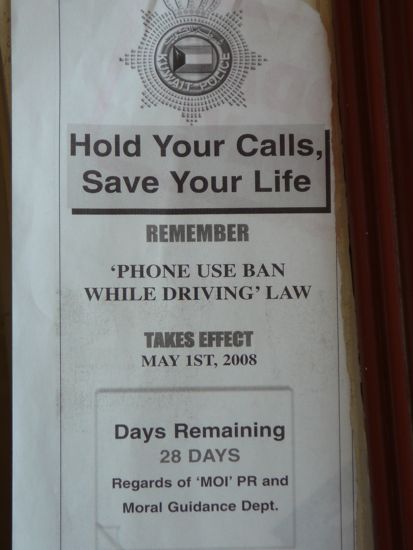
Found this in yesterday’s Kuwait Times. Was it also in the Arabic language newspapers? Doesn’t say anything about the fine . . . . the newspaper announcement leads us to believe they are serious. The fine of 5KD (about $20) remains laughable. Nonetheless – if you use a mobile phone while driving, you will become a CRIMINAL after May 1! 😉
No one is going to hate this law more than AdventureMan. Sometimes he calls me when he is driving just to see if I will hang up on him. He tries to talk me into talking with him. I have always said I don’t want to hear his last words being “Oh ____!”
Recent Comments
intlxpatr on Shampoo Ginger tigerbutterya0c5ff1d… on Shampoo Ginger intlxpatr on British Soldier Kidnapped, Esc… John on British Soldier Kidnapped, Esc… intlxpatr on British Soldier Kidnapped, Esc… Wikipedia Donate Button

Amazina


Early Voting in Florida


