Here There and Everywhere

Expat wanderer

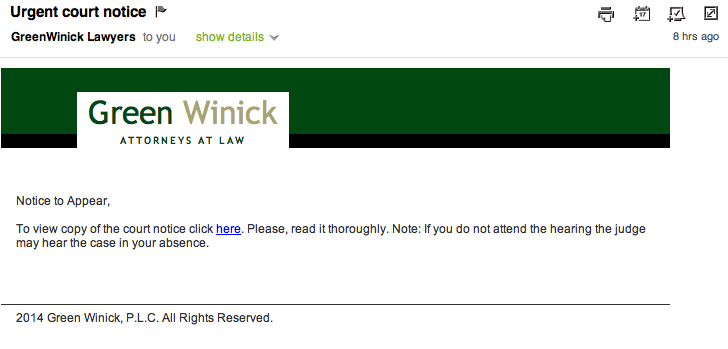
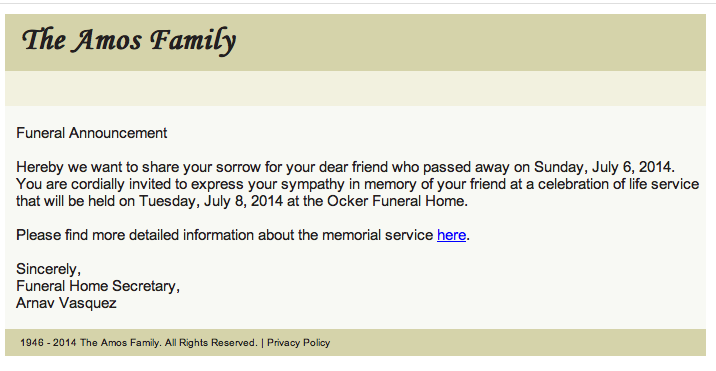
AOL Mailbox Scam


This one almost gets me every time. I always check the details – that does not look like an authentic AOL Team e-mail address. These scammers are sometimes better than other times.


Screen shot 2014-05-27 at 11.18.23 AM

May 27, 2014 Posted by | Crime, Lies, Scams | | Leave a comment

Crime to be “Happy” in Teheran?

From today’s Kuwait Times:


TEHRAN: The arrest of six Iranian youths for dancing to US singer Pharrell Williams’ hit “Happy” in a video that went viral highlights the rift between conservatives and youths fascinated by the West. Recorded on a smartphone and uploaded multiple times on YouTube, the clip shows three girls dancing and singing along to the song in a room, on rooftops and in secluded alleys with three young men. For the youths, the homemade video now watched one million times was merely an “excuse to be happy”, but for the Iranian authorities it was “vulgar” breach of the Islamic republic’s values. Originally posted online in April, the clip gradually spread online before it led to the arrest of the dancers and their director on Tuesday for having “hurt” the country’s strict moral codes, according to Tehran police chief Hossein Sajedinia.

The youths appeared on state television repenting for appearing in the clip, after the girls failed to properly observe hijab, a series of rules that oblige women in Iran to cover their hair and much of their body when outside.

Their arrest sparked international fury and criticism in the media and online, with many Iranians expressing shock and some observers questioning whether it was a “crime to be happy in Iran”. Supporting the young Iranians, Williams himself chimed in and hit out at their treatment, saying on Twitter and Facebook: “It’s beyond sad these kids were arrested for trying to spread happiness.” Reports emerged Wednesday night that the dancers were released on bail, with one of the arrested girls, Tehranbased fashion photographer Reihane Taravati, saying on Instagram: “Hi I’m back.” The arrests came after President Hassan Rouhani-a selfdeclared moderate who claims to be for more social freedomsreiterated in a weekend speech his calls for a relaxation of Internet censorship. Rouhani’s statements have irked the conservatives, who have long imposed limitations on the Internet, blocking millions of websites particularly social media platforms, including Facebook and Twitter, as well as YouTube. — AFP


May 23, 2014 Posted by | Adventure, Arts & Handicrafts, Civility, Community, Crime, Cross Cultural, Cultural, ExPat Life, Experiment, Faith, Family Issues, Humor, Iran, Living Conditions, Movie, Music, Women's Issues | Leave a comment

UN Will Help With Transfers?

This has to be the real thing, right? It says United Nations – that has to be the real deal. . . right?  But I didn’t deposit any funds or invest in Nigeria . . .
From: Ms. Carman L. Lapointe.
UNITED NATIONS OFFICE OF INTERNATIONAL OVERSIGHT SERVICES
Internal Audit,Monitoring,Consulting And Investigations Division.


My name is Ms. Carman L. Lapointe, from the United Nations. It is a distinct pleasure to write you again and as you are well aware many foreigners have invested thousands of United States Dollars into Nigeria transactions in Hopeless Dreams to have none of them become a reality.
 
 
Right now, as directed by our secretary general Mr.Ban Ki-Moon, We have agreed with the Nigeria Government that US$100,000.00 (One Hundred Thousand United States Dollars Only) would be paid to you through the Western Union Money Transfer Via special arrangement as first installment.
 
 
This is to enable you have enough funds to pay for the Tax Clearance and bank charges before you will receive the balance of US$4.1M (Four Million One Hundred Thousand United States Dollars Only). Please take note that you will pay US$185 only, being Notarization fee and this is the only financial obligation that you will undertake to receive the US$100,000.00 (One Hundred Thousand United States Dollars Only) through the Western Union Money Transfer.
 
 
Lastly,i will like you to reconfirm your information to me such as your full name, address and telephone number so that I will proceed with your Western Union Money Transfer within the next 24 hrs and the transaction information will be released to you.
 
 
I await your response for further proceedings.
 
 
Sincerely yours,
 
 
Ms. Carman L. Lapointe
{Under-Secretary-General}
United Nations

May 20, 2014 Posted by | Crime, Financial Issues, Nigeria, Scams | Leave a comment

“Private and Discreet”

I heard a program on NPR this weekend telling that the Nigerian scams are based on these letters appealing to the most gullible, and eliminating the skeptics. Evidently, it is a very effective technique.

Dear friend,

Your immediate reply needed please.

My name is dr.ousman diallo from the Republic of guinea conakry.

I am presently in morocco, I have a confidential transaction worth of 25 Million U.S Dollars to discuss with you. Kindly let me know if you are interested so that i can email you some more details about what i really need you to do for me and for us to organise, how and where to meet for a better discussion.

We would need to adopt one attitude “discreet” for something that is of a private and secret life.
Please send your reply only through my private email address at:

( drdiallousman@yahoo.com )

Thanks.
I await your prompt response please.

Regards,
dr.ousman diallo.
E-mail,(drdillousman@yahoo.com)
Tel: +212629618977.

May 19, 2014 Posted by | Crime, Financial Issues, Nigeria, Scams | Leave a comment

Pregnant Sudanese Woman Sentenced to Death for ‘Apostasy’

She is also charged with adultery, for marrying a Christian man and (gasp) having sex with him. Now pregnant with her second child, Mariam claims she has never been a Muslim, was raised Christian, but the judge is applying new and strict Sharia laws.

Screen shot 2014-05-16 at 5.08.34 PM

As you might guess, I do not usually use Fox News as a news source, but this is an update on a story I am following:

International outrage grows for Sudanese woman sentenced to death for apostasy

Published May 16, 2014FoxNews.com

Meriam Ibrahim and Daniel Wani married in a formal church ceremony in 2011. The couple has an 18-month-old son, Martin, who is with Meriam in jail.
International outrage is mounting over the death sentence a Sudanese judge ordered for the pregnant wife of an American citizen — all because she refuses to renounce her Christian faith.

Meriam Ibrahim, 26, was sentenced Thursday after being convicted of apostasy. The court in Khartoum ruled that Ibrahim must give birth and nurse her baby before being executed, but must receive 100 lashes immediately after having her baby for adultery — for having relations with her Christian husband. Ibrahim, a physician and the daughter of a Christian mother and a Muslim father who abandoned the family as a child, could have spared herself death by hanging simply by renouncing her faith.

“We gave you three days to recant but you insist on not returning to Islam,” Judge Abbas Khalifa told Ibrahim, according to AFP. “I sentence you to be hanged to death.”

But Ibrahim held firm to her beliefs.

“I was never a Muslim,” she answered. “I was raised a Christian from the start.”

Ibrahim was raised in the Christian faith by her mother, an Orthodox Christian from Ethiopia. She is married to Daniel Wani, a Christian from southern Sudan who has U.S. citizenship, according to sources who spoke on condition of anonymity.

“I was never a Muslim. I was raised a Christian from the start.”
– Meriam Ibrahim
The cruel sentence drew condemnation from Amnesty International, the U.S. State Department and U.S. lawmakers.

“The refusal of the government of Sudan to allow religious freedom was one of the reasons for Sudan’s long civil war,” Rep. Chris Smith, R-N.J., chairman of the House congressional panel that oversees U.S. policy in Africa, said in a statement. “The U.S. and the rest of the international community must demand Sudan reverse this sentence immediately.”

Amnesty International called the sentence a “flagrant breach” of international human rights law and the U.S. State Department said it was “deeply disturbed” by the ruling, which will be appealed.

Khalifa refused to hear key testimony and ignored Sudan’s constitutional provisions on freedom of worship and equality among citizens, according to Ibrahim’s attorney Al-Shareef Ali al-Shareef Mohammed.

“The judge has exceeded his mandate when he ruled that Meriam’s marriage was void because her husband was out of her faith,” Mohammed told The Associated Press. “He was thinking more of Islamic Shariah laws than of the country’s laws and its constitution.”

Ibrahim and Wani married in a formal ceremony in 2011 and have an 18-month-old son, Martin, who is with her in jail. The couple operate several businesses, including a farm, south of Khartoum, the country’s capital. Wani fled to the United States as a child to escape the civil war in southern Sudan, but later returned. He is not permitted to have custody of the little boy, because the boy is considered Muslim and cannot be raised by a Christian man.

Sudan’s penal code criminalizes the conversion of Muslims into other religions, which is punishable by death. Muslim women in Sudan are further prohibited from marrying non-Muslims, although Muslim men are permitted to marry outside their faith. Children, by law, must follow their father’s religion.

Islamic Shariah laws were introduced in Sudan in the early 1980s under the rule of autocrat Jaafar Nimeiri, whose decision led to the resumption of an insurgency in the mostly animist and Christian south of Sudan. An earlier round of civil war lasted 17 years, ending in 1972. In 2011, the south seceded to become the world’s newest nation, South Sudan.

Sudanese President Omar Bashir, an Islamist who seized power during a 1989 military coup, said his county will implement Islam more strictly now that the non-Muslim south is gone. A number of Sudanese have been convicted of apostasy in recent years, but they have all escaped execution by recanting their faith. Religious thinker and politican Mahmoud Mohammed Taha — a vocal critic of Nimeiri — was sentenced to death after his conviction of apostasy and was executed at the age of 76 in 1985.

Ibrahim’s case first came to the attention of authorities in August, when members of her father’s family complained that she was born a Muslim but married a Christian man. They claimed her birth name was “Afdal” before she changed it to Meriam. The document produced by relatives to indicate she was given a Muslim name at birth was a fake, Mohammed said.

Ibrahim refused to answer the judge when he referred to her as “Afdal” during Thursday’s hearing.

Ibrahim was initially charged with having illegitimate sex last year, but she remained free pending trial. She was later charged with apostasy and jailed in February after she declared in court that Christianity was the only religion she knew.

The US-based Center for Inquiry is demanding that all charges against Ibrahim be dropped, saying the death sentence is a clear violation of the International Covenant on Civil and Political Rights, which forbids persecution or coercion of religious beliefs and the right to marry.

“Religious belief must never be coerced and free expression must never be punished, through threat of imprisonment, violence, or any other means,” the group wrote in a letter to Sudan’s UN ambassador, H.E. Hassan Hamid Hassan. “This cannot go unanswered, and the world will not stand for it.”

Fox News’ Joshua Rhett Miller and The Associated Press contributed to this report.

May 16, 2014 Posted by | Character, Circle of Life and Death, Community, Crime, Cultural, ExPat Life, Faith, Family Issues, Health Issues, Law and Order, Living Conditions, Political Issues, Relationships, Social Issues, South Sudan, Sudan, Values, Women's Issues | | 4 Comments

Nigeria’s Stolen Girls

This is what I love about New Yorker magazine: they print stories no one prints, they follow stories that need following. They lead, and they do their job, alerting us to issues that matter. My heart goes out to the families, Christian and Muslim, of these girls who were abducted because they were being educated. Boko Haram believes educating women goes against Islam. Someone should read them a Quran.


APRIL 30, 2014

NIGERIA’S STOLEN GIRLS

AP218361876356-580.jpg“I thought it was the end of my life,” Deborah Sanya told me by phone on Monday from Chibok, a tiny town of farmers in northeastern Nigeria. “There were many, many of them.” Boko Haram, an Islamist terrorist group, kidnapped Sanya and at least two hundred of her classmates from a girls’ secondary school in Chibok more than two weeks ago. Sanya, along with two friends, escaped. So did forty others. The rest have vanished, and their families have not heard any word of them since.

Sanya is eighteen years old and was taking her final exams before graduation. Many of the schools in towns around Chibok, in the state of Borno, had been shuttered. Boko Haram attacks at other schools—like a recent massacre of fifty-nine schoolboys in neighboring Yobe state—had prompted the mass closure. But local education officials decided to briefly reopen the Chibok school for exams. On the night of the abduction, militants showed up at the boarding school dressed in Nigerian military uniforms. They told the girls that they were there to take them to safety. “They said, ‘Don’t worry. Nothing will happen to you,’ ” Sanya told me. The men took food and other supplies from the school and then set the building on fire. They herded the girls into trucks and onto motorcycles. At first, the girls, while alarmed and nervous, believed that they were in safe hands. When the men started shooting their guns into the air and shouting “Allahu Akbar,” Sanya told me, she realized that the men were not who they said they were. She started begging God for help; she watched several girls jump out of the truck that they were in.

It was noon when her group reached the terrorists’ camp. She had been taken not far from Chibok, a couple of remote villages away in the bush. The militants forced her classmates to cook; Sanya couldn’t eat. Two hours later, she pulled two friends close and told them that they should run. One of them hesitated, and said that they should wait to escape at night. Sanya insisted, and they fled behind some trees. The guards spotted them and called out for them to return, but the girls kept running. They reached a village late at night, slept at a friendly stranger’s home, and, the next day, called their families.

Sanya could not tell me more after that. She is not well. Her cousins and her close friends are still missing, and she is trying to understand how she is alive and back home. All she can do now, she said, is pray and fast, then pray and fast again.

The day after the abduction, the Nigerian military claimed that it had rescued nearly all of the girls. A day later, the military retracted its claim; it had not actually rescued any of the girls. And the number that the government said was missing, just over a hundred, was less than half the number that parents and school officials counted: according to their tally, two hundred and thirty-four girls were taken.

In the wake of the military’s failure, parents banded together and raised money to send several of their number into the forest to search for the girls. The group came across villagers who persuaded the parents to turn back. They told the parents that they had seen the girls nearby, but the insurgents were too well armed. Many of the parents had just bows and arrows.


***

The circumstances of the kidnapping, and the military’s deception, especially, have exposed a deeply troubling aspect of Nigeria’s leadership: when it comes to Boko Haram, the government cannot be trusted. Children have been killed, along with their families, in numerous Boko Haram bombings and massacres over the past five years. (More than fifteen hundred people have been killed so far this year.) State schools and remote villages in the north have borne the brunt of Boko Haram’s violence this year. The group is believed to be at least partly waging a campaign against secular values. The kidnapped girls were both Christian and Muslim; their only offense, it seems, was attending school.

Last June, I visited Maiduguri, the capital of Borno state and the birthplace of Boko Haram, to report on the insurgency and the Nigerian government’s counteroffensive, a security operation that placed three northeastern states, including Borno and Yobe, under a state of emergency as troops launched attacks on terrorist hideouts and camps. The military cut phone lines and Internet access, and, while residents were glad for the intervention, there was a sense of living in the dark. Gunshots, a bomb blast: was it Boko Haram or a military attack? Were the hundreds of men disappeared by the military actually terrorists—even the young boys? And was the government, as it claimed, really winning the war?

The military has restored phone lines in Borno. But the sole airline that flew to Maiduguri cancelled the route at the end of last year. The road to Chibok is so hazardous that Borno’s governor visited the town with a heavy military escort. Much of the northeast is now physically isolated. What is happening there that we cannot see?

Nigerians in the rest of the country had, until recently, been able to ignore the deaths. The general mood has been one of weary apathy—from a government waging a heavy-handed crackdown on northerners to civilians far removed from the chaos. That mood may finally change.


***

Sanya’s father, a primary-school teacher named Ishaya Sanya, is struggling with conflicting emotions: gratitude that his daughter has returned to him; guilt that the daughters of his siblings, friends, and neighbors are still somewhere in the bush; and an angry frustration that there seemed to be no effort to rescue the girls.

“We don’t know where they are up until now, and we have not heard anything from the government,” he told me. “Every house in Chibok has been affected by the kidnapping.” The only information that the families had been able to gather about the kidnapped girls, he went on, was from the girls who had escaped.

He remembers the exact time that Deborah appeared in front of him after her escape—4:30P.M.—and how he felt: “very happy.” But his despair soon returned. “Our area has been affected very seriously,” he told me. Parents had fallen physically ill, and some were “going mad.”

The military’s current plans are unclear; the Chibok parents hope that it is acting swiftly and cautiously. There is worry, too, that a rescue operation could result in the deaths of many of the girls; this happened during a previous attempted rescue, of two Western engineers kidnapped by Boko Haram. Last week, a military spokesman, Brigadier-General Chris Olukolade, said only that the search for the girls had “intensified.”

In the meantime, as in so many other ways in Nigeria, each community has to fend for itself. For a while after the abduction, girls trickled back into town—some rolled off trucks, some snuck away while fetching water. That trickle has stopped. “Nobody rescued them,” a government official in Chibok said of the girls who made it back. “I want you to stress this point. Nobody rescued them. They escaped on their accord. This is painful.”

A pastor in Chibok whose daughter is missing told me that he set out with friends on the morning after the abduction to find the girls. “I was forced to come home empty-handed,” he told me by phone. “I just don’t know what the federal government is doing about it. And there is no security here that will defend us. You have to do what you can do to escape for your life.”

I asked the pastor about rumors that Boko Haram has taken the girls outside of Nigeria’s borders, into Cameroon and Chad, and forcibly married them. He paused, and then said, “How will I be happy? How will I be happy?”

Four students walk in Chibok following their escape from Boko Haram. Photograph by Haruna Umar/AP.


May 1, 2014 Posted by | Community, Crime, Cross Cultural, Cultural, Faith, Interconnected, Law and Order, Leadership, Living Conditions, Marriage, Mating Behavior, Nigeria, Values, Women's Issues | , , , | Leave a comment

Third Notice?

This one looks pretty real. Only the return e-mail address looks fishy:


Screen shot 2014-04-21 at 8.09.53 AM

April 21, 2014 Posted by | Crime, Lies, Scams | 2 Comments

Kuwait Citizens Cite ‘Wasta’ (Undue Influence) as Problem for Crime Prevention

From todays Arab Times Kuwait:


‘Wasta’ Major Setback In Battle Against Crime; Some Police Not Keen To Tackle Issues

In this week’s online poll, the Arab Times probed the factors that are blunting the efforts to fight crime in Kuwait. A majority of the voters felt that Wasta is a major setback to the fight against crime. About 56% of the voters felt this way.

Speaking to the Arab Times, respondents said criminals use Wasta to escape the long arm of the law. “I know a citizen who routinely cuts red lights. He pats his back and says that he has Wasta to dodge penalties. This is a traffic offence, and may not be considered a crime. However, if this is possible in the case of traffic offences, it should be possible in major crimes too.” Another respondent shared a personal experience when one of his neighbors had a conflict with the landlord.

The neighbor decided to go to the court, and he was asked to pay the rent there. However, the person in charge of collecting the rent in the court gave lame excuses and avoiding collecting the amount in time. The landlord used this as a pretext to procure an ejection notice from the court. “It looks like some authorities in the court were in cahoots with the landlord to deny justice to my neighbor.”

About 13% of the voters felt that law keepers themselves become law breakers, and that’s why it becomes hard to fight crimes. Respondents cited the example of the recent case that made headlines when cops raped a woman in her flat, entering her flat under the pretext of looking for residence violators. “This is an example of policemen stooping to the lowest level, becoming worse than criminals.” Others brought up a report that Arab Times had published some time back about the ‘Trolley Mafia” in the airport. “The workers in the airport literally extort money from the passengers forcing the trolley service on them for a charge of 500 fils.

They do not let us take the trolley.” Respondents said it’s highly improbable for this mafia to work in this fashion without the knowledge and blessings of the concerned authorities in the airport, especially after the report coming in the newspapers several times. One of the respondents said that he had an altercation with one of the workers in the airport over the trolley. “I used an expletive in the course of the heated exchange, and the worker complained to a policeman in duty.

The cop came over to me to inquire if I had used the bad word, but as he didn’t speak our language I told him that it was only an impolite word, and not a bad word. The officer went to the extent of calling another passenger, who spoke our language, to verify if what I was saying was true. To my good luck, the passenger concurred with me.

The officer let me go, but then I complained to him about the worker who was trying to extort money from me. The officer walked away as if he couldn’t care less.” The trolley mafia is continuing to operate without any hassles, and people suspect the tacit support of the authorities.

About 16% of the voters said that the police are not very keen on solving crimes, and that is encouraging criminals. Other reasons for the increase in crime in the society, according to the poll, included unemployed youth wanting to make quick money, corrupt politicians and crime getting accepted as a part of life. However, these only won very small percentage of votes. A very tiny fraction of voters felt that criminals are getting smarter.


By: Valiya S Sajjad Arab Times Staff

April 11, 2014 Posted by | Community, Crime, Cultural, ExPat Life, Kuwait, Law and Order, Living Conditions, Local Lore | 8 Comments

Qatar Teacher’s Murderer Sentenced to Death

From Doha News:


After verdict, Patterson family worries justice won’t be served

583

SHARES
 
 Print

Alison Patterson, mother of Lauren Patterson.

At this time last year, Alison Patterson was celebrating Mother’s Day in the UK with two of her three children. Her eldest daughter Lauren was working in Qatar, and sent a gift and a card home, as she always did when she was away.

Today, things are very different for the Patterson family. Daughter Lauren was killed in October by acquaintances in Doha, and on Thursday, a criminal court here found two Qatari men responsible for the 24-year-old teacher’s murder.

One of the defendants, 22-year-old Badr Hashim Khamis Abdullah Al-Jabar, was given a death sentence.

Badr Hashim Khamis Abdullah Al-Jabar

The other, 24-year-old Muhammad Abdullah Hassan Abdul Aziz, was handed a three-year jail term for helping Al-Jabar burn Patterson’s body, which was considered damaging and erasing evidence.

At the time of the sentencing, Alison Patterson told media that “justice was served” in the case of Al-Jabar, but that she was deeply upset with Abdul Aziz’s lighter sentence.

In an interview with Doha Newstoday, Patterson said she is worried that neither of the convicted men will pay for what they did to her daughter.

“Is it something that’s just been said – and that’s never going to happen?” she asked.

At the root of her doubts is a scene she witnessed after Thursday’s verdict inside the courthouse. Patterson had gone in search of her two younger children, and ended up passing a sitting area where the defendants were being held.

“They were just laughing and joking with each other,” she said. “It just almost makes me feels that they were laughing at what happened. They have no respect for the sentence they’ve been given.”

Another issue that troubles her is that Qatar has not executed any prisoners in more than a decade, according to Amnesty International.

Prior to her daughter’s death, Patterson said she never gave the death penalty much thought. But after being told that Al-Jabar sexually assaulted her daughter, stabbed her to death and then attempted to burn her remains at a farm outside of Doha, she said she supported the punishment.

“Lauren came home in a box the weighed 7 kilos,” Patterson said with regards to her daughter’s remains. “She weighed 50 kilos when she died.”

Other questions

Patterson has also been unable to shake an argument she read on a recent blog post about her daughter’s case on “Muslims Worldwide,” which she found while googling Lauren’s name.

The site appears to be full of hate speech about Islam and its adherents, but the post on Patterson struck a chord with Lauren’s mother because it questioned whether the quick sentencing of Al-Jabar was done so that officials could close the book on this crime, which the prosecutor called “heinous, foreign and shocking to a society as conservative as Qatar’s.”

The blog post reads:

“Sharia gives no justice to a kafir (non-Muslim/non-believer). And it never gives a death sentence to a Muslim over a crime committed against a non-Muslim…

So why would they announce the ‘death penalty’ if it is not given out? To appease the media. This case has been circulating all over the world. Arabs can’t stand negative media attention…These Arab countries make bogus claims of justice only to get the media off their back. In reality they keep them in prison and release them after 1-2 years.”

The last sticking point is that the verdicts must pass through two appellate courts here before they’re officially final, meaning closure could be some ways off for Patterson and her family.

Waiting

Speaking to Doha News, Patterson’s partner Kevin Crotty said they were grateful for all the Qatari government has done to ensure a speedy trial.

“They’ve been more than generous and more than reasonable,” he said. “Everything’s been done that should have been done. But them (the defendants) smiling – and the lighter sentence for the second one… Ultimately, we’ve always felt the political angle was there. Is there something that we should worry about?”

The Pattersons’ lawyer, Sami Abu Shaikha, has said he plans to appeal Abdul Aziz’s three-year sentence, asking for a more severe penalty.

Meanwhile, Alison Patterson, who has started smoking again after 15 years due to the stress of all that’s happened, said she knows that whatever the outcome, the pain will likely never go away.

“There will never be peace. (But) I just really don’t want to be let down,” she said.


April 6, 2014 Posted by | Crime, Cultural, Doha, ExPat Life, Law and Order, Living Conditions, Safety | 12 Comments

‘Cambodian’ Scam Letter

Have not seen one featuring a Cambodian bank before . . .

Screen shot 2014-03-18 at 8.10.01 AM

March 18, 2014 Posted by | Crime, Financial Issues, Scams | Leave a comment