Side Dishes – More to Give Thanks For!
Take another deep breath. These are not mandatory, these are just options!
Shrimp Cocktail
Buy BIG shrimp. Take the shells off, and with a tiny paring knife, make a tiny line down the back of the shrimp where you see that black stuff, and take the black stuff out. (Don’t think about this, just do it.) Bring water to simmer, put shrimp in and TAKE OFF heat. Let them turn pink – about one minute – and pour water out immediately.
Williamsburg Peanut Soup
(If you have help and want to serve in courses)
Fresh tomatoes, canned tomatoes or stewed tomatoes, chopped and heat in pot.
Chicken broth – together with the tomatoes, about enough for all who are coming.
Sauteed onions if you like them can go in, too.
Add glops of CHUNKY peanut butter into the hot liquid and stir until you like the consistency. Salt if you think it needs it. Ladle into bowls and then sprinkle a few chopped peanuts over each dish. People will think you labored for hours on this soup, and it is SO delicious. Big bang for the buck on this one!
Shrimp Cocktail Sauce: Take about a cup of Heinz Ketchup, add 1 Tablespoon Horseradish and 1 Tablespoon very fine SWEET, finely chopped pickle or pickle relish. Mix together. Some people add a little chili powder, but you know your own family.
Use bowls or champagne glasses. Put a little salad greens in the bottom, and place shrimp over the rim around the glass or bowl. Put cocktail sauce in the well formed in the center, right on the greens (Hardly anybody ever eats the greens, they are just there to be pretty.)

Cornbread Stuffing
(Mandatory if you are married to a Southerner)
You can find cornmeal in any grocery store, but we like the coarser grind found in the health foods section.
Make a batch of cornbread according to the instructions on the corn meal you have bought. Cool it slightly.
While the cornbread is baking, sautee:
1 large onion, chopped
1 cup celery, chopped
1/4 cup chopped parsley
in 1/2 cup butter.
(You can use corn oil, but it won’t have the same flavor.)
Sautee 1/2 lb Jimmy Dean sausage, mild (here, in Islamic Kuwait, I am using smoked turkey sausage)
When cornbread is slightly cool, crumble it into a large bowl, add the sauteed onion, celery, parsley, butter and sausage, and stir together. Add 1/2 cup chopped walnuts or pecans. At this point, you can store in the refrigerator until the turkey is baked.
Gather one – two cups turkey broth, mix into cornbread mix with one egg, salt, pepper, a little sage and thyme to taste. Pour into baking dish and bake 30 minutes at 300°. Serve with turkey as side dish.
The Turkey: Centerpiece of the Meal
I imagine it is possible to have Thanksgiving without a turkey, but I have never, never in my life seen one. Wherever we are, by hook or by crook, we find a turkey.
The irony is that it doesn’t even matter if you like turkey that much – and turkey can be tough and dry if overcooked – it is tradition. You can skip other things, but if you don’t have a turkey, you probably should at least have a paper turkey in the center of your table, something, anything, that will satisfy the need for “rightness” as in “this isn’t right!” if there is no turkey.
The good news is that left over turkey makes great sandwiches, filling for burritos, makes great sweet n’ sour, makes great turkey-noodle soup, cassarols – there are a lot of uses for cooked, left over turkey. If that doesn’t appeal to you, buy a bunch of those wonderful tin trays with lids at the supermarkets and send all your guests home with leftovers!
Your turkey will come with instructions. I usually thaw mine in the refrigerator – it takes up space that on Thanksgiving Day, when take the turkey out to cook, there is space for things I need to store for dinner. Space in the refrigerator will be a very good thing (says Martha).
Be sure to take out the innards. If you are going to make gravy, this is what most people use. You slow simmer the neck and gizzards in about a litre of water. You can pull meat off, and be sure to get all the bones out. That stock will be part of the gravy later on.
Your turkey roasting pan should have sides at least 10 cm (4 inches) high, because of all the turkey juice that leaks out. HINT: Spray that pan liberally with oil – it will be easier to clean down the road, trust me on this. I have a wonderful kitchen gadget that you put olive oil in and pump, and it sprays pure olive oil just like one of those store-bought sprays full of chemicals.
Spray the pan. Spray the turkey. Place the turkey in the pan, breast side up. (I have cooked them upside down and they were OK, too.) Put strips of fatty bacon over the top of the turkey.
Now here is the great secret: Put your turkey in a paper bag, tray and all, and staple shut. If you are using a meat thermometer, put it in the turkey right through the paper bag, it’s OK. Put the turkey in the oven at the temperature it says in your instructions that came with the turkey. (Usually around 180 C.) Every 30 minutes or so, spray that bag with water, like with the sprayer you use to spray clothes that need ironing.
When the turkey has an hour of cooking left, tear off that paper bag and begin basting, which is dripping the turkey juices back over the turkey. Baste every 15 minutes or so.
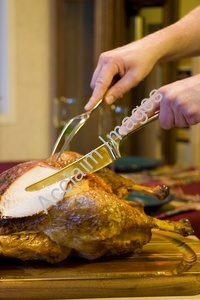
The house should smell wonderful by now. The turkey needs to come out of the oven about half an hour before serving. It needs to sit for 10 minutes and then someone needs to carve it, i.e. cut slices of it for serving. Often the big turkey wings are put on the plate of sliced turkey and some young man will eat the turkey right off the bone.
Second – Get Organized
Here’s what you need for this step – paper, pen, phone, e-mail, WOM (word of mouth). Figure out who you want to spend Thanksgiving with. Give them a call. If they sound genuinely disappointed because they have visitors from out-of-town, tell them to bring their visitors – Thanksgiving is a great holiday for flexibility. (We usually have more than one table going, one for the kids, too, or several mixed up)
Our book says that we are to entertain strangers, that sometimes when we welcome strangers, we welcome angels without knowing it. Sometimes a stranger adds the most amazing memory.Our first married Thankgiving, we had a soldier join us who would soon be leaving the military. We still remember his delight and amazement at being included. We’ve never fogotten him – he added so much to that day.
When someone asks what they can bring – have some ideas ready! It’s usually safe to ask someone to bring a dessert – or drinks – or dinner rolls. If they have something else in mind, unless it is totally outlandish, say “yes” and just roll with it. It’s part of the fun.
Outline what you want to serve – finger foods before dinner, dinner – courses if you are including soup, dessert and coffee (in the same room? move to another room?)
Make a grocery list. Do the major shopping now, so you have everything you need. Go with what is available – for example, last night in the fish market, I saw the most amazing, huge shrimp, and the man told me they are from Kuwait. Believe me, we will have shrimp cocktail on our menu this year!
Figure out how you want the table(s) and check your linens to be sure what you need is clean and ironed. Make sure the silver is polished, the crystal washed and sparkling. Do this now! You don’t want to have to worry about this close to Thanksgiving. Give yourself the gift of time, by doing the little things in advance that can throw you off course if you let it go to the last minute. We want you to be thankful on Thanksgiving, happy and relaxed and delighted to see your friends – and that takes some preparation and work ahead of time.
(My preference is to set up a buffet table – that way people can eat what they want and pass on what they don’t want, without being conspicuous. You know, like you may adore creamed onions, and the kids will hate them! It’s OK. They’re kids. It’s Thanksgiving.)
Take another deep breath – honestly, this is going to be fun.
First – Take a Deep Breath (Thanksgiving 2)
You inspired me! I didn’t expect such a response to the post on Thanksgiving. Once again, I am baffled, and delighted, at what strikes your fancy.
So – how to do Thanksgiving. To do it properly, you have to focus on the right things. So first, take a deep breath, close your eyes, and allow yourself to feel thankful. Even in the worst of years, there are blessings. Bring them to mind. Feel them. Rejoice! Now you are prepared.
It’s all about the gathering. Yes, we have traditional foods, but in different parts of the country, traditions vary. Turkey is traditional, for example, but it can get so boring. In the South, you can buy a turkey that has been smoked (lovely!) or a turkey that has been stuffed with a duck that has been stuffed with a chicken. When we lived in Germany, I inserted tiny slivers of garlic under the skin – like hundreds of slivers – and served the slices with a variety of French mustards (WOW!). We’ll talk turkey in the next post.
Some Thanksgiving favorites:
Turkey
Stuffing (also called Dressing)
Cranberry sauce
Mashed Potatoes + Gravy
Sweet Potatoes (usually served “candied” i.e. with a sweet sauce, covered with tiny marshmallows)
Green Salad + dressing
black pitted olives (kids put them on their fingers)
green beans
(South: creamed onions, cornbread stuffing, macaroni and cheese, jambalaya, peanut soup)
(Pacific Northwest: shrimp cocktail, smoked salmon, smoked oysters)
Desserts: Pumpkin Pie, Mincemeat Pie, Fruitcake, etc. etc . . . )
The Thanksgiving Table is an excuse to get out all the good stuff you don’t use every day – beautiful white linens for the cloth and napkins, your silver, your crystal, the best china . . . polish up the silver candlesticks, put fresh candles in the crystal ones . . . but this is not the HEART of Thanksgiving, only the icing. We have had fabulous Thanksgivings with plates on our laps, as we gathered together with friends in countries where Thanksgiving is totally unknown. It’s the gathering that is important, not the food, not the table.
The Feast of Thanksgiving
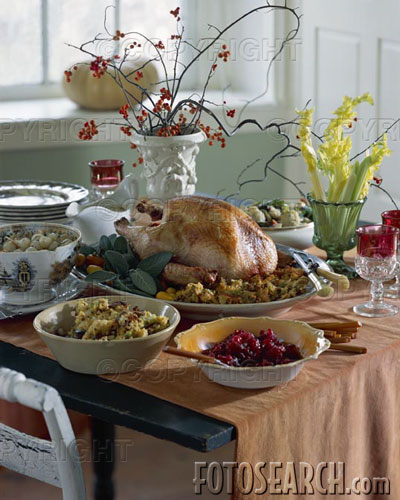
This coming Thursday, the fourth Thursday in November, is the American Thanksgiving. Although it has a religious context – giving thanks for all we have been given – it is not a church holiday, but a secular one.
A group of people fled England (we call them the Pilgrims) seeking a place where they could practice their particular and very fundamental religion without persecution. They landed in a new country and established a colony. A good many of them died in the first year – from starvation, from minor ailments like ear infections that went untreated and became more serious illnesses. At the end of the harvest, the following year, they gave a great feast to celebrate those who had survived.
Honored guests were the Native Americans, who had welcomed the newcomers, showed them berries and forms of wildlife good for gathering and hunting, and without whom the Pilgrims could not have survived. At the table were foods never seen in the old world – turkey, corn, cranberries, possibly potatoes. . .
Wherever we are in the world, we take this 4th Thursday in November to give thanks, and to feast, preferably with family and friends.
My nieces, Little Diamond and Sparkling Diamond grew up going to the local soup kitchen on Thanksgiving with their parents to serve the poor and homeless their Thanksgiving meal. Many of us have special church services that day. Most of us spend a good part of the day in the kitchen!
We have so much to be thankful for this year. Although my parents are old, I have been able to go back and help them several times this year. The next generation of our family has (mostly) finished school and all have jobs they love doing. We shifted our tent successfully to another country this year, and are having a great time getting to know Kuwait. We have found a church here and are thankful to be able to worship freely. Through another friend, we met a family here we dearly love, and we will spend Thanksgiving with them. I am sure it will be a mountain of food.
I will be fixing my Mom’s cranberry salad, cornbread stuffing for my husband-of-Souther-origins, a pumpkin pie, and some balsamic roasted sweet-potatoes (the potatoes are tradition, the balsamic is not) and a few other dishes. We try to balance the traditional with something new from time to time. We will break open one of the fruitcakes to serve with the other desserts. Mom’s Fruitcake Recipe
You will know where people will be gathering and feasting by the delicious aroma of roasting turkey as you take advantage of this gorgeous weather to go out walking . . . We give thanks for the beautiful weather, too.
Mom’s Fruit Cake Recipe
Wooo Hooooooo! The fruitcakes are in the oven, and already the house smells wonderful. I’ve been making these cakes since I got married. I don’t think I have missed a year, but I may have. I grew up smelling these delicious cakes every winter. I don’t think my Mom makes them every year any more. I wish I were close enough to pop one into her refrigerator for their holidays.
Mom’s Fruit Cake
Even people who think they HATE fruit cake like this fruit cake. It has a secret ingredient – chocolate!
This is the original recipe. I remember cutting the dates and prunes with scissors when I was little; now you can buy dates and prunes without pits and chop them in the food processor – a piece of cake!
1 cup boiling water
1 cup sugar
1/2 cup lard or butter
1 T. cinnamon
1 t. cloves
3 Tablespoons chocolate powder
1/4 cup jelly
1 cup seeded raisins
1 cup chopped walnuts
1/2 cup candied citron
1/2 cup cut prunes
1/2 cup cut dates
Put all in a pan on stove and bring to a boil. Boil for three minutes. Let cool. Add:
2 cups flour
1 teaspoon baking soda
Flavor with lemon
Bake at 350° in loaf pans for one hour. Makes 2 normal bread loaf sized cakes.
My variations: I put in about three times the fruit, the difference primarily in the candied citron – I prefer using whole candied cherries, because they are so pretty when the loafs are cut. This recipe doubles, or quadruples with no problems.
Pans: Mom used to line all the pans with brown paper and grease the paper. I grease the pans, then dust with more of the chocolate powder. Use a good quality chocolate, not cocoa. When the cakes come out of the oven, let them cool for ten minutes, loosen them with a knife, then they will shake out easily. Let continue to cool until they are totally cool, then wrap in plastic wrap, with several layers, then foil, then seal in a sealable plastic bag. Let them age a couple months in a corner of your refrigerator. I make mine around Halloween, and serve the first one at Thanksgiving.
I never make these the same any two years in a row. This is the first year, ever, that I won’t be using any brandy – alcohol in Kuwait being against the law. Yeh, I have some friends who laugh and say “you can get it anywhere!” but we made a decision to obey the law. Only rarely do I regret it . . . sigh . . .fruitcakes really need brandy.
Update: If you are in a country where brandy is available, and if you want to use brandy, here is how to use it in this recipe. You know how raisins get all dried out and taste yucky in fruitcakes? The night before you intend to make the fruitcakes, take all the raisins you intend to use (depending on how many fruitcakes you intend to make) and put them in a glass container. Pour brandy over them, to cover. Microwave just to the boiling point. Let stand in the microwave overnight.
The next day, you can drain that brandy and use it in a stew or something, and in the meanwhile, you now have plump, juicy raisins to use in your fruitcake, and just a hint of brandy flavor. Yummmm!
You Can’t Make This Stuff Up
Today’s Grin for today, from, no kidding, The Kuwait Times, page 6:
Brothels’ raids continue
Raids launched against brothels and suspected love dens continued unabated all over Kuwait. A security force yesterday raided two apartments in Jleeb Al-Shuyoukh where 34 Asians were caught red-handed in the most uncompromising positions . . . .
Philippa Gregory and Catherine of Aragon
Being sick has one advantage. . . you can catch up on some of your reading. Philippa Gregory is one of my favorite writers of historical fiction.
To my great shame, I have a very difficult time reading history. Unless it is vigorously written, it puts me to sleep. It is particularly embarassing when my husband has a degree in History, and his eyes light up discussing battles and strategems and who said what to whom and why it matters. It has to do with my hard-wiring, it’s not even a gender thing.
So I gravitate toward historical fiction; give me people and motivations and interactions any day, and I can remember it. Sometimes, I even learn something. Philippa Gregory never lets me down. She researches, she documents, and she might speculate, but you always have a clear idea what is real (historically documented) and what is a good story, putting meat on the bones of the history.
Out of sequence, I read The Queen’s Fool and The Other Boleyn Girl. Each of these books is peripheral to the story of Catherine of Aragon. The first features a woman chosen to be a Fool at the court of Queen Mary, Catherine’s daughter. She is of Jewish descent, hiding as a Christian, escaped from the fires of the Spanish Inquisition. She lives in fear of being caught out in her deception. With her father, a printer, she tries to secrete and maintain many of the books of Moorish Spain, the knowledge of the ancients, which the church begins to declare heretical in England. The second book, The Other Boleyn Girl, is about Anne Boleyn, but told from the perspective of her sister, Lady Mary, who was also mistress to Henry, King of England, while he was married to Catherine of Aragon. The Boleyn girls are portrayed as mere pawns in the great game of power in the English court.
So this newest book, The Constant Princess, opens in Spain, as Queen Isabella of Castile, Catherine’s mother, and King Ferdinand of Aragon fight to eliminate the Moors and to unite their lands into one Kingdom. The little girl, whose mother is the chief strategist and who fights in armor alongside her husband, learns battlefield tactics at her parent’s feet and in their camps and learns diplomatic skills in their throne rooms.
We follow Catherine to England, married first to Arthur, then after Arthur’s death, to Henry. She assures them her marriage to Arthur was never consummated, that Arthur was too young, and impotent. Gregory assumes this was a lie. We don’t know. I would guess that it was one of those lies that nobody believes but was convenient to all to pretend to believe, for money, for power, for alliances.
We stand with Catherine as she sends Henry off to fight the French, then leads her own troops up to vanquish the Scots. We agonize with her as she strives to become pregnant, to carry an heir to the throne full term to birth, and as she loses a seemingly perfect baby boy to infant death. We sit with her in stragegic councils, watch her balance the budgets for court and state, and scheme to protect the English borders against all threats. Whew! Being a Queen of England is hard work!
The book ends with Catherine facing the eccliastical trial as her own husband disputes the validity of her marriage to him and seeks to set her aside for his freedom to marry Anne Boleyn.
I don’t review every book I read, but I was captivated by the cross cultural threads in this book, and by the fact that while we all know the basic facts of the story – Henry divorces Catherine of Aragon to marry Anne Boeyn – Catherine’s history, her talents, her strengths and victories were news to me. The influence of her upbringing in Moorish Spain and the influence it played on her growing understanding of the world is a golden thread woven throughout the story.
Early in her first marriage, the young princess tells her beloved husband of her childhood in Grenada:
” . . . We walk in their gardens, we bathe in their hammams, we step into their scented leather slippers and we live a life that is more refined and more luxurious than they could dream of in Paris or London or Rome. We live graciously. We live, as we have always aspired to do, like Moors. Our fellow Christians herd goats in the mountains, pray at roadside cairns to the Madonna, are terrified by superstition and lousy with disease, live dirty and die young. We learn from Moslem scholars, we are attended by their doctors, study the stars in the sky which they have named, count with their numbers which start at the magical zero, eat of their sweetest fruits and delight in the waters which run through their aquaeducts. Their architecture pleases us: at every turn of every corner we know that we are living inside beauty. . . . We learn their poetry, we laugh at their games, we delight in their gardens in their fruits, we bathe in the waters that have made flow. We are the victors, but they have taught us how to rule. . . .”
I can hardly wait for a trip to Spain!
Men on Choosing a Wife: Pure Fluff
My husband hates what he calls “male bashing jokes.” I read this one to him this morning, and he snickered, so I guess it is safe to share with you. If you are very sensitive, however, skip to the next blog – I don’t want to hurt your feelings.
A man wanted to get married. He was having trouble choosing among three likely candidates. He gives each woman a present of $5,000 and watches to see what they do with the money.
The first does a total make over. She goes to a fancy beauty salon gets her hair done, new make up and buys several new outfits and dresses up very nicely for the man. She tells him that she has done this to be m ore attractive for him because she loves him so much.
The man was impressed.
The second goes shopping to buy the man gifts. She gets him a new set of golf clubs, some new gizmos for his computer, and some expensive clothes. As she presents these gifts, she tells him that she has spent all the money on him because she loves him so much
Again, the man is impressed.
The third woman invests the money in the stock market. She earns several times the $5,000. She gives him back his $5,000 and reinvests the remainder in a joint account. She tells him that she wants to save for their future because she loves him so much.
Obviously, the man was impressed.
The man thought for a long time about what each woman had done with the money he’d given her.
Then, he married the one with the biggest boobs.
(There is more money being spent on breast implants and Viagra today than on Alzheimer’s research. This means that by 2040, there should be a large elderly population with perky boobs and huge erections and absolutely no recollection of what to do with them.)
What is YOUR Comfort Food?
You know how it is. You’re not yourself. Your throat hurts or your tummy hurts and Mom fixes something something you love, and it happens so often throughout your childhood that when you get to be an adult, and you find yourself sick, it’s the food you think of.
And, of course, it depends on the illness. For tummy things, I remember chicken broth and jello. But for colds and flu, it was always tomato soup and grilled cheese sandwiches. Now, even if I just had a bad day, grilled cheese sandwich and tomato soup can still cheer me up.
For my husband, raised in another part of the country, it is vegetable soup and cornbread. After we married, I learned to make cornbread in an iron skillet, and it is pretty good. He breaks it up and puts it in a glass of milk, though, and I can’t even watch him eat it.
Our son grew up in Tunis – when he has a sore throat, nothing will do but mint tea.

So what is YOUR comfort food? What did your Mamma (or Papa) make you when you were sick as a child? What do you dream of even now, all grown up, but sick and miserable?
Recent Comments
ExpatAlien on What Country am I Living … intlxpatr on Yellowstone: Old Faithful to C… Michelle on Yellowstone: Old Faithful to C… Cathy on No Grown-Ups in Charge intlxpatr on Waiting for Snow Wikipedia Donate Button

Amazina


Early Voting in Florida


 Here There and Everywhere