Best Group Ever!
Sometimes, out of nowhere, comes a wallop, even a good wallop. Yesterday came such a startling change. The itinerary looked ordinary, do-able, nothing inspirational, but all get-the-job-done.
My group had a great weekend. They got to sleep, they got to walk on the beach, they got to eat a great meal or two. They had fabulous weather, a chance to chill and to integrate all the information we are piling on them, and a chance to walk away for a little while. They love Pensacola. Who wouldn’t, when the weather hits around 70° and the beach is white and the sky is blue?
First, we hit our volunteer experience, working at Manna to sort donations, making sure all the items were within acceptable expiration dates. At first, I wasn’t sure this group was going to “get” volunteering, but in a very short time, they were all focused and working hard, and working efficiently. As they sorted, other volunteers drove up in SUV’s, in big cars, in vans and we all helped unload. By the end of their experience, the warehouse manager said “You have processed enough food for over 1,000 people!” and complimented them. They glowed. None of them are from countries with a tradition of volunteerism, and this was a new – and thrilling – experience for them. It always gives me a thrill to see that light go on, to see oneself as part of something larger, organic, to see how connected we all are and to love being a part of something good, sharing. It thrilled my heart.
We ate lunch together downtown, and talked about events going on in each country, about the weekend, about their experiences. We bought coffee – oh! the universal need for caffein! – and headed on to our next appointment, which featured environmental issues and complex ways governments interact to combat the problems and enforce the regulations. It was a tough slog. These relationships are so complex that most of us don’t even think about it. These delegates have work to do; they are here to solve problems in their own countries, and they are persistent and dogged about getting solutions that they can apply in their own bureaucracies. It is a delight to see people so committed to solving problems that seem . . . almost unsolvable.
It is also inspiring, to me, to learn so much about Pensacola, in this job. When I was working on my Masters, I studied heroism, among other things. What I am loving about these office and field visits is that my education continues, and I see heroes at every level of bureaucracy, holding back the evil forces of laziness, corruption, and cronyism. And, sustaining my initial findings about heroes, heroines and heroism, they don’t even see themselves as heroes. They say, as all heroes do, “I am/was just doing my job.” They think anybody would do it. (They are wrong.)
At our very last appointment, I was thinking I would probably cut the day short. The speaker had given out information, the delegates had bags to pack, and all of a sudden, a spark, and an explosion! The good kind!
One delegate could not believe the head of this agency could maintain an important list with integrity. He kept drilling down on the structure, the details of how things worked (all the delegates were keen on the details of how the structures of organizations and bureaucracies worked to accomplish their missions) and where there were openings for corruption.
She was explaining how her employees were constantly trained, and how the agency was monitored to ensure fairness and an adherence to procedure. The delegates, all from countries where bureaucracies function differently, kept pressing her. Is there never anyone taken out of turn? Never?
“If I did that, I would lose my job,” she replied.
What followed was one of the most exciting hours of discussion I have ever experienced, as delegates from five different countries frankly compared their own challenges and experiences, and with great intensity tried to figure out how bureaucracies could function without corruption.
We tried to explain that we, also, are not immune from corruption, and cronyism, but that the combination of training and monitoring helps keep agencies within the boundaries, as best it can. Transparency doesn’t come overnight; we are still trying to achieve it.
As I listened, I could not stop grinning. These are young leaders, and the leaders of tomorrow. They admire what they see in our country. They want to bring trust into their own governments, but how do you create trust? How do you build trust? How do you maintain trust?
I don’t know those answers. And yet the process is working; the discussion was so inspiring, so heartfelt, and they had built enough trust in one another to share their challenges, without having to maintain that artificial facade that lack-of-trust builds.
Their liaison said “You will each have to find your own path; it won’t look exactly like the US path because it has to be a fit with your own culture.”
When I left the group, I told them “You are the best group I have worked with, ever.” There is a part of me that wanted to be a part of that discussion, because they were still deep in that discussion as we parted. My role had ended; I had done what I do.
And today, I am still grinning. I love this job, I love the people it brings me into contact with, international and local. I feel so blessed.
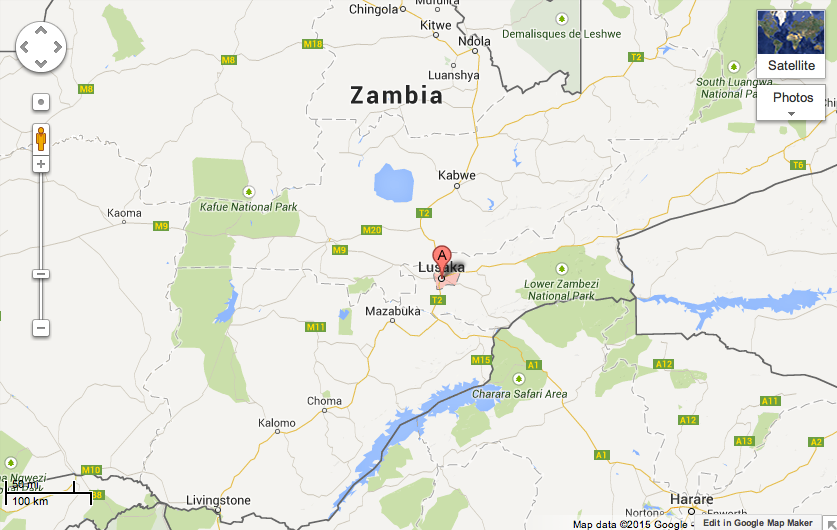
Zambia: “What is it like where you live?”
Today the church prays for the diocese of Lusaka, and I smile as I pray for my Zambian friends. We have stayed in Lusaka several times, and visited schools and clinics in remote parts of Zambia. Zambia is an amazing country – something like 70 different peoples and languages, and training in all the schools to help them learn how to live together.
One young Zambian told us that when they come into contact, it is normal to feel strange; the “other” doesn’t speak the same dialect, may be a traditional enemy, is just different, uncomfortable. They are trained to ask “What is it like where you live?” and to listen to the response.
I have used that phrase so many times; it is so useful. When you listen to an “other” talk about his or her life, you connect. You find similarities, and differences, and you learn the joys and challenges of this different life. It is a wonderful question. I used it the first time in Zambia, at a dinner with a lot of people we didn’t know. The woman next to me seemed stuffy, but sometimes that can be shy, so I asked “What is it like where you are from?” and she looked at me with concern and said, very sharply, “What do you mean?” I said “what is your life like, tell me about what you do in a day?” and she said “That is a very odd question!” but she went on to tell me about her life, her country house and her passion for riding. By the end, we were having a great conversation.
May God bless you richly, Zambia. May your peoples live together in God’s peace!
From Whom Every Tribe in Heaven and On Earth Takes Its Name
I’ve been looking for this line forever, but it is no wonder that I couldn’t find it, I remembered it wrong, or I was using a different translation. When Father Ian at Church of the Epiphany in Doha would begin the prayers, he began with that invocation, reminding us that we, too, are tribal in our passions and affiliations. He used that word, tribal, instead of family. It is probably more true to the original intent.
Once people start drawing and adhering to lines between them and us, things get ugly in a hurry. I liked what Pope Francis said about Freedom of Speech being fine but it had to include respect for the religions of others, and self restraint. We all need to remember that it is the one true God who is the father of us all, and he will be the only one to judge us in the end.
We all get a lot of things wrong. Let’s hope He is truly the all-merciful and all-compassionate.
Ephesians 3:14-21
14 For this reason I bow my knees before the Father,* 15 from whom every family* in heaven and on earth takes its name. 16 I pray that, according to the riches of his glory, he may grant that you may be strengthened in your inner being with power through his Spirit, 17 and that Christ may dwell in your hearts through faith, as you are being rooted and grounded in love. 18 I pray that you may have the power to comprehend, with all the saints, what is the breadth and length and height and depth, 19 and to know the love of Christ that surpasses knowledge, so that you may be filled with all the fullness of God.
20 Now to him who by the power at work within us is able to accomplish abundantly far more than all we can ask or imagine, 21 to him be glory in the church and in Christ Jesus to all generations, for ever and ever. Amen.
Freedom of Speech: Je Suis Charlie
In our country, in the West, open discussion is a part of life. Your point of view may be ignorant, or repugnant to me, but I will defend to the death your right to express your opinion. One of the great weapons of freedom of speech is humor. It’s hard to maintain a dignified moral high-ground when one of the cartoonists piques with a cartoon showing the emperor has no clothes. Or at least the emperor has flaws, as do we all.
Pensacola is blessed with such an editorial cartoonist, Andy Marlette. Andy Marlette is controversial, and in a state with lax gun laws and pistol-packin-mamas, he risks his life daily, skewering the pomposity of us all. Occasionally, he is outrageous. Occasionally, he is offensive. That’s OK. If an editorial cartoonist isn’t skewering someone, or all of us at once, he isn’t doing his job. His job is to elicit discussion.

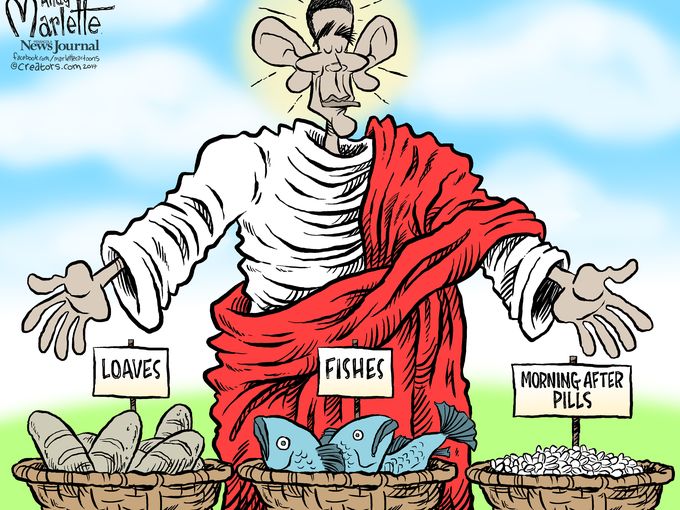



I have lived for so long in Moslem world that I take a risk now, offending my Moslem friends, by printing the cartoon of Mohammed weeping. It’s the cartoon that touched me to the bone. I have listened and learned in the Moslem world, and I have never met with hatred. The Mohammed I have read about in the Qu’ran and in hadith, and heard about in legend and stories from my Moslem friends portrayed a prophet who, like Jesus, was all about loving and serving the one true God. He would weep at what has been done in his name, as Jesus weeps for us, when we kill others in his service.

Where is Lafia, Nigeria?
Today the church prays for Lafia, Nigeria, which is near Abuja, in the part of Nigeria where Boko Haram runs rampant, and where over 250 girls were kidnapped from their school in 2014. Some few escaped, most were married off to poor young Boko Haram soldiers into hardship and near-slavery. Boko Haram does not believe in educating women. The Nigerian government at one point announced that Boko Haram had agreed to return the girls, but nothing happened. The Nigerian military and police do nothing to get them back.

John the Baptist and Brood of Vipers
It is a rainy, chilly morning in Pensacola.
Even as I write those words, I smile. Our grandson inherited my cold genes through his father. By cold genes, I mean we are more comfortable being cool than hot. We sleep cool. We need less clothing to stay warm. He told his Baba, AdventureMan, that “chilly is not cold” because he didn’t want to wear long pants, he prefers shorts.

(There are a lot of images of John the Baptist, but this one made me grin; he looks a little Rastafarian, and I hadn’t thought of him as so long haired and skinny, but he was living in the wilderness and eating locusts and honey . . . )
I can still feel the air grow still as the British Ambassador to Kuwait read a very odd scripture about John the Baptist. It was odd because while it talked about John, it was unfamiliar to me. At the end, he said “A reading from the holy Qu’ran” and I was astonished for two reasons. First, I didn’t know that the Muslims recognized John the Baptist (they do, he is called Yahya Yahanna, and they have a beautiful tomb to him in the Ummayad Mosque in Damascus, Syria, where many visit and pray) and second, I didn’t know I belonged to a church that would allow the Qu’ran to be read as Holy Scripture.

Life is long, and full of surprises. I love it. I think the ability to be surprised, and to ponder those quick flickers of perspective keeps us young in heart, and young in spirit.
Today, John speaks to us, each and every one. The true path is coming, the word of God embodied in a human being, born a tiny baby, a human baby, God come down into flesh. (My Muslim friends are quivering with fear at this point, waiting for me to be struck down for such blasphemy. They don’t believe Jesus was the son of God, but that he was a messenger, like Mohammed. They also believe Jesus will be the judge at the end of times.)
Life among the Moslems. Bible study with the Baptist. My very Mormon friends. My own very Episcopalian faith. All these influences – and my Alaskan heritage – mashed together with smatterings of others, have gone into making me a very odd sort of Christian.
I’m OK with that.
Luke 3:1-9
3 In the fifteenth year of the reign of Emperor Tiberius, when Pontius Pilate was governor of Judea, and Herod was ruler* of Galilee, and his brother Philip ruler* of the region of Ituraea and Trachonitis, and Lysanias ruler* of Abilene, 2during the high-priesthood of Annas and Caiaphas, the word of God came to John son of Zechariah in the wilderness. 3He went into all the region around the Jordan, proclaiming a baptism of repentance for the forgiveness of sins, 4 as it is written in the book of the words of the prophet Isaiah,
‘The voice of one crying out in the wilderness:
“Prepare the way of the Lord,
make his paths straight.
5 Every valley shall be filled,
and every mountain and hill shall be made low,
and the crooked shall be made straight,
and the rough ways made smooth;
6 and all flesh shall see the salvation of God.” ’
7 John said to the crowds that came out to be baptized by him, ‘You brood of vipers! Who warned you to flee from the wrath to come? 8 Bear fruits worthy of repentance. Do not begin to say to yourselves, “We have Abraham as our ancestor”; for I tell you, God is able from these stones to raise up children to Abraham. 9 Even now the axe is lying at the root of the trees; every tree therefore that does not bear good fruit is cut down and thrown into the fire.’
Beginning to Look a Lot Like Christmas . . .
I’m not a person who likes to be rushed, and I am a person who front-loads, who gets things done early, so as not to have to make decisions or preparations in a rush. If I can plan, and execute early, it all falls into place.
So when we had another early cold spell this week, our second ‘unseasonal’ cold spell, so cold we had to cover our more sensitive plants and bring others into protected areas, and with Thanksgiving coming so late this year, I decided I could let myself do a little early Christmas prep.

No, no tree, not yet, and no lights outside. Time enough for all that, just a little sparkle to get us started. As much as I love real greenery, real garlands, the temperatures here are too high for it it stay green longer than a week, so I use the artificial kind. You’d think the benefit would be no dropping needles, but this stuff also drops ‘needles’, and we laugh at where we find them hiding in August.

We bought our crêche many years ago in Germany, and it has gone with us everywhere we lived. It has lost a lot of its Germanic moss through the years, but I wouldn’t dream of replacing it:

The normal crêche occupants through the years have been supplemented by extra sheep and camels, and actually, by French santons, extra wise men, an angel ornament . . . hmmm, maybe it’s getting a little kitchy, but we wouldn’t sacrifice a single thing. One of our Saudi friends contributed a line of camels 🙂

In France and in Germany, crafters make the cutest sheep, and we found ourselves buying them at Christmas or crafts markets.

And, from Doha, The Church of the Epiphany, our “Aboona” or Our Father, the Lords Prayer written in Arabic calligraphy, one of our treasures.

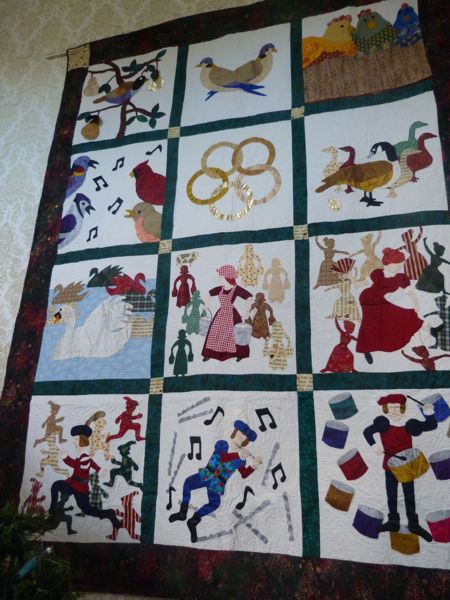
Last, but not least, time to change the hallway quilt, and The 12 Days of Christmas will reign for more like 40 days 🙂
Faithful Friends
Today’s reading in the Lectionary is from Sirach, one of the books of the Apocrypha, and features wisdom on faithful friends. I especially love “let your advisors be one in a thousand.” I have been greatly blessed to have found a few of those, and they stick with you for a lifetime.
Bless you, bless you, faithful friends!
Sirach 6:5-17
5 Pleasant speech multiplies friends,
and a gracious tongue multiplies courtesies.
6 Let those who are friendly with you be many,
but let your advisers be one in a thousand.
7 When you gain friends, gain them through testing,
and do not trust them hastily.
8 For there are friends who are such when it suits them,
but they will not stand by you in time of trouble.
9 And there are friends who change into enemies,
and tell of the quarrel to your disgrace.
10 And there are friends who sit at your table,
but they will not stand by you in time of trouble.
11 When you are prosperous, they become your second self,
and lord it over your servants;
12 but if you are brought low, they turn against you,
and hide themselves from you.
13 Keep away from your enemies,
and be on guard with your friends.
14 Faithful friends are a sturdy shelter:
whoever finds one has found a treasure.
15 Faithful friends are beyond price;
no amount can balance their worth.
16 Faithful friends are life-saving medicine;
and those who fear the Lord will find them.
17 Those who fear the Lord direct their friendship aright,
for as they are, so are their neighbours also.
Inequality: No Respect For Our First Nation Citizens (Blog Action Day)
I grew up in a small town, Juneau, Alaska, and not even in the main town, but on Douglas Island, across the Gastineau Channel from Juneau. My neighbors were fishermen, hunters, pilots, entrepreneurs and hard-working people struggling to make a living.
It was an upside down world. In most places, those who live there the longest are the leaders of society. In Southeast Alaska, those who lived there the longest were at the bottom of the heap, the Native Americans, the Tlingit, Haida and Tsimshian. I went to school with them. Yes, the boys carried knives. No, they were not dirty, and none of my little friends in elementary school were drunks. We were kids, we played together, we were all in the same classes all through elementary school – it was a small school.
Many of them did have family problems. There were problems of alcoholism, unemployment, domestic violence and hunger. They weren’t the only ones. The big problem was no respect. Although there were a few pieces of Native Art in the city museum, Native culture and Native craft were given little value. The Native way of life, living off the land, hunting and fishing, had greatly diminished as lands were apportioned off and hunting and fishing activities regulated.
In 1971 a huge lawsuit was settled and the Alaska Native Claims Settlement Act provided some restoration for the damaged peoples. Alaska Natives now have regional corporations to administer and grow funds to support the culture, to provide education for the children, to provide health clinics and hospitals. SEALASKA began to organize a biennial Celebration, a gathering of all the Alaska natives to share their stories, to celebrate their culture, to dance and to transmit culture to their children. It’s a great opportunity for people you might see every day in their western life to remember where they come from and to be proud of who they are. This Celebration is held every two years and includes Alaska Natives from all over Alaska who want to participate. It is a very inclusive Celebration. The next Celebration will be June 8 – 11, in 2016. You can read a little more about Celebration 2014 here.
They learn the legends of their clans – the Eagles, The Ravens, the Beavers, the Bears and a number of other clans. They spend the time between celebrations stitching together elaborate costumes for their parade and dance exhibitions, hollowing out canoes from trees, making elaborate hats and masks.
We first learned of the Celebration gathering in 2012, when we already had tickets to go back to Zambia at the exact time the Celebration was taking place, but my sweet husband promised we could go back for the 2014 Celebration. As we researched, we discovered just how much of Alaska we wanted to see, and did a reconnaissance trip in 2013. We loved our time there, and we were delighted to be able to return this last year for Celebration 2014.
It was one of the most thrilling moments of my life, to see the gathering, to see the old women cry as canoes came into sight full of young Alaskan natives, and say “I never thought I would see this again in my life”, to watch the exhilaration of the dancers, to feel the energy of the parade and especially – to see the children. To see the pride in marching, in dancing, to see the joy in being able to express who they are and to share that with others. I was moved beyond my ability to express in words; it was a feeling that in one small way, a train of events that had gone very off track had moved incrementally back in the right direction.
Here are some photos from the joyous Celebration of 2014:



Where is Susa?
We have had a choice of Old Testament readings this week in the Lectionary readings, either Esther or Judith, (Judith is in the Apocrypha). I like both stories 🙂 Judith is a tale to curl your hair, a tale not for children, but an amazing story within that culture, and telling. Meanwhile, I wondered, where is Susa?
As it turned out, I lived almost next door to Susa. So close I could spit across the Gulf. I wonder if I will ever have a chance to visit Iran? As hopeless as the current situation(s) in the Middle East look, I have seen amazing and wondrous things in my life – the fall of the Berlin Wall and the unification of South Africa sans apartheid – and I believe, by God’s grace, anything is possible.
Here is Susa:

Recent Comments
intlxpatr on Shampoo Ginger tigerbutterya0c5ff1d… on Shampoo Ginger intlxpatr on British Soldier Kidnapped, Esc… John on British Soldier Kidnapped, Esc… intlxpatr on British Soldier Kidnapped, Esc… Wikipedia Donate Button

Amazina


Early Voting in Florida


