“Why Do Americans Do This?”
AdventureMan and I were with a group of delegates from Iraq yesterday, taking them on a visit to a variety of Pensacola sites. They are here visiting through the GCCDC, on the IVLP program, studying elections and campaign strategies in the USA.
One stop we make with many delegates is the First Methodist program Serving the Hungry. Two days a week, led by Jerry Vititow and supported by many happy, willing volunteers, they serve a hot lunch to the hungry, varying in numbers but never less than fifty or so.
The delegates learn about the program, then don aprons and serve up the trays. It is often one of the highlights of the trip.
One delegate raises his hand to ask a question.
“We see this everywhere,” he starts, “Americans who are working for nothing and smiling. Why do they do this?” He was genuinely perplexed.
Jerry explained that it wells up from many sources, a yearning to give back some of the blessings we have received, an eagerness to serve those who have less, maybe just an eagerness to serve. “It’s part of what we believe in,” he sums it up.
The delegates had a wonderful time.
Jesus Heals Lepers
My friend Renee sent this one, along with several Christian cartoons, but this one really made me laugh. Yes, as Christians, it is OK to show the image of Jesus.
In our book, the Bible, there are even small jokes. In one verse, a man is told that Jesus, the Messiah, had come from Nazareth, and the man says “can anything good come out of Nazareth?” People are people, yes, it was meant to be humorous.

Happy National Day Kuwait
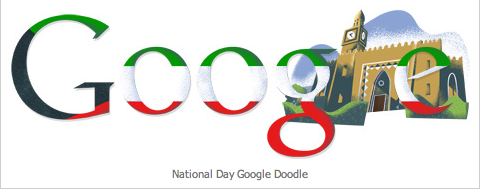
Happy Liberation Day and Happy National Day to all my friends in Kuwait. Party hearty 🙂
Almost twenty-five years since the Invasion of Kuwait. Imagine. There are young Kuwaitis graduating from college who weren’t even alive when Iraq invaded.
Stellenbosch on A-Word-A-Day
A-Word-A-Day was the very first website I ever bookmarked. I was getting my certification to teach English as a Foreign Language and my students loved words. I’m pretty good with words, even so A-Word-a-Day teaches me a new one, or a new meaning for an old one, more often than not. You can subscribe and receive a new word five days a week and a discussion at the end of the week.
This is a great word, and one I had never heard used before:
stellenbosch
PRONUNCIATION:
(STE-len-bosh)
MEANING:
verb tr.: To relegate someone incompetent to a position of minimal responsibility.
ETYMOLOGY:
After Stellenbosch, a town in South Africa. Earliest documented use: 1900.
NOTES:
Stellenbosch, near Cape Town, was a British military base during the Second Boer War. Officers who had not proven themselves were sent to Stellenbosch, to take care of something relatively insignificant, such as to look after horses. Even if they kept their rank, this assignment was considered a demotion. Eventually the term came to be applied when someone was reassigned to a position where he could do little harm.
A similar term is coventry.
Babayaga by Toby Barlow

You know how books come your way in coincidental ways? Amazon.com had told me I needed to read Babayaga, so I ordered it. I’ve always loved mythologies, I devoured them like candy when I was young, always looking for more. Babayagas are very old, and exist under many names in most cultures – elderly women who usually deal with concoctions, often medicinal, who live alone. In the west, they were often called witches, in the Slavic countries, babayaga, and it seems to me there is an old woman used to scare children in the Gulf, too. It seems to be a cross-cultural phenomenon.
Here is what Wikipedia has to say about Babayaga:
Baba Yaga is a witch (or one of a trio of sisters of the same name) in Slavic folklore, who appears as a deformed and/or ferocious-looking elderly woman. She flies around in a mortar and wields a pestle. She dwells deep in the forest, in a hut usually described as standing on chicken legs, with a fence decorated with human skulls. Baba Yaga may help or hinder those that encounter or seek her out, and may play a maternal role. She has associations with forest wildlife. Sometimes she frightens a hero (e.g. by promising to eat him), but helps him if he is courageous. According to Vladimir Propp’s folktale morphology, Baba Yaga commonly appears as a donor, a villain, or something altogether ambiguous. In many fairy tales she kidnaps and eats children, usually after roasting them in her oven).
Andreas Johns identifies Baba Yaga as “one of the most memorable and distinctive figures in eastern European folklore,” and observes that she is “enigmatic” and often exhibits “striking ambiguity.”[1] Johns summarizes her as “a many-faceted figure, capable of inspiring researchers to see her as a cloud, moon, Death, Winter, snake, bird, pelican or earth goddess, totemic matriarchal ancestress, female initiator, phallic mother, or archetypal image”.[2]

Barlow’s BabaYaga includes all the backstory, inserted here and there, the Russian purges, revolts, revolutions, the wars, the mud, the snows, following the troops, and several different Babayaga, while focusing one one, the beautiful and mesmerizing Zoya, who lives in a magical post World War II Paris. She in unforgettable – unless, of course, she has woven a spell to muddy your mind and make you forget.
What I love about this book is that if it were true, you would still think it is fiction. If every single thing happened just as Barlow wrote it, you would never believe it. LOL! A wicked sour old babayaga turns a police detective investigating a murder into a flea; he finds it a novel experience and manages to make things come right even as a flea.
A young American man, Will, loving living in Paris, works for an ad agency and also for THE Agency in the heady days of post war Paris, where the rules are not yet in place and lines are fuzzy. Falls for a witch with a long history of loving and killing men, but that’s life. Is it better to love and lose than never to have loved? What if your love is a gorgeous babayaga who helps you live life with a vibrance and intensity you have never experienced?
There is a long, intricate, time-appropriate adventure/spy/industrial-scientific plot which I am not sure I entirely followed, with murders and shootouts and the Paris jazz and club scene, and it didn’t matter one whit whether I could follow the plot line or not, it was a wild ride of a novel and a lot of fun. 🙂
Study Shows Muslim Nations Differ on How Women Should Dress
Digg started sending me articles, I don’t know why, but every now and then something turns up truly interesting. This is a Pew Research Center Study found in Slate Online Magazine:

Charted: How People in Seven Muslim Countries Believe Women Should Dress
By Joshua Keating
As the chart above, created by the Pew Research Center, goes, there’s quite a bit of variation over what constitutes proper dress for women in the Islamic world. The data for the chart come from the Middle Eastern Values Survey conducted by the University of Michigan’s Institute for Social Research. (Several hundred people comprising what the researchers describe as a nationally representative sample in terms of education, religion, and social class were polled in each country. The gender breakdown was close to 50–50 in each of them.)
As you’ll see, the majority overall said that a woman should completely cover her hair but not her face. The majority in conservative Saudi Arabia favored the face-covering niqab, while relatively liberal Lebanon and Turkey had the highest support for no covering at all. (Hijabs are still prohibited for women in a number of jobs in Turkey.)
Overall, Tunisia had the highest number of respondents (56 percent) saying it is “up to a woman to dress whichever way she wants.” Only 14 percent of Egyptians agreed. Interestingly, given that it has the most stringent legal dress codes of any country sampled, 47 percent of Saudis said women should be able to dress how they wish.
A TCK Wedding (Third Culture Kids)
Several years ago, back in my earlier blogging years, a Kuwaiti friend, Amer al Hilaliya wrote a wonderful post: I Am a Third Culture Kid, Are You? He never anticipated the result – comment after comment, some short, some a little bitter, some longer and insightful. The Third Culture Kids know who they are, and are eager to share their insights and experiences – but mostly with other Third Culture Kids, who understand.
Others . . . don’t get it.
This weekend, we went to a wonderful Third Culture Kids wedding. It wasn’t billed that way, but it was so thoroughly that way that I couldn’t stop seeing it. It doesn’t hurt that we are reading the seminal work on Third Culture Kids by David C. Pollock and Ruth E Van Renken called, yep, you guessed it, Third Culture Kids.

It’s almost like reading a whole new book. It has all the Third Culture Kids stories, but has expanded to include third culture kids cousins, like the adult third culture kids, ATCKs (those who have lived a goodly share of their lives in a non-native culture), cross culture adoptees, cross cultural marriages, etc. One of the points they make is that being third culture kids cuts across a lot of boundaries and makes for odd – odd by normal standards – friendships. Once again, across the boundaries – countries, old, young – friendships are determined by a commonality in experiences outside the native culture. It is a fascinating read.
People don’t think of how LONG Florida is, tip to tip, but from Pensacola to Fort Myers is a fuuur piece, as they say, even if it is on an inside curve. Thank God it wasn’t Key West! We thought it would be an eight hour drive, and it turned into thirteen, with heavy traffic from Lake City to Ft Myer.
The wedding was sweet, simple and heart felt. Both sets of parents had done significant missionary work in foreign countries, and the kids were definitely third culture kids. The groom would speak Turkish in his sotto voce asides to his best man, who grew up with him on the streets of Ankara. The bride’s brother read all the greetings and best wishes to the bride from her friends in Hungary – and he read them all in Hungarian.


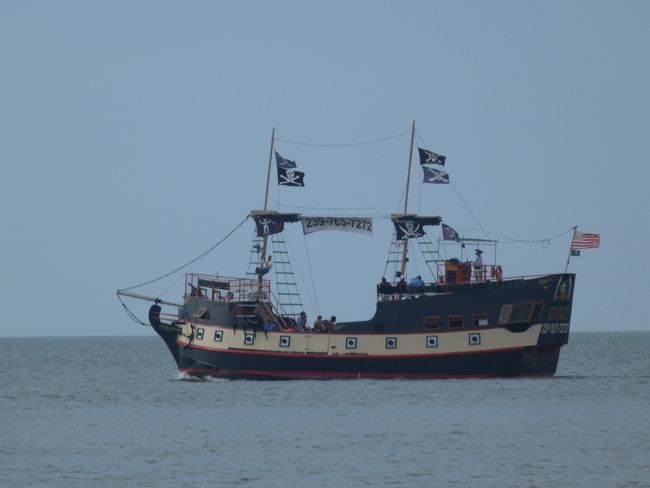
Just as the ceremony started, along came a pirate ship! Some things, you just can’t plan, they just happen.
They all told family stories, and one of them stuck in our hearts because it reflects our own experiences growing up in the Moslem world. The groom, as a young man, came home flustered because a woman on the metro, as he was coming home, noticed he was not wearing an undershirt under his T-shirt, and assumed he was a homeless child. She started talking with all the other passengers, and they marched him off the train to the souks, where they insisted on buying him an undershirt (who knew that you were not properly dressed in Turkey unless you were wearing a sleeveless undershirt?) and also a sweater, to keep him warm on the streets. All this, in spite of the fact that this homeless boy spoke excellent Turkish and kept telling them he had a home! No! No undershirt, he has to be homeless.
Few people in America know the kindnesses we experience living in the Moslem world. It may not always make sense to us – in Tunis, we always wondered if we were getting the annual Eid platter of lamb and couscous showed up because we were thought to be poor or because we were strangers? There has always been a sweetness and generosity to our Moslem neighbors that humbled us. Because of the layering upon layering of these kindnesses, we see Islam, and the Middle East, differently from most of our American friends who have never lived among Moslems. Maybe if we all knew one another a little better, we would have less cause to fear one another, and maybe without all that fear, we could manage a little less hatred.
What is a wedding without babies and children to remind us of the Circle of Life (which AdventureMan calls The Circle of Death). This little one speaks English and Turkish already, and loved the sugar white sands of Ft. Myers Beach and the little seashells, just her size.

As more and more people cross borders, for work, for play, for marriage, for education, as we live in ‘alien’ cultures and learn other ways of thinking, maybe we are growing into an entire world with a larger viewpoint?
Kuwait: Operation Hope Keeps on Giving
Brava, Sheryl Mairza, brava for the good work you are doing that makes so much difference in so many lives. May God bless the work of your hands! From the Kuwait Times:
Spreading cheer in the land
Sheryll Mairza
Operation Hope, an NGO established by Sheryll Mairza, is touching people’s lives throughout the world. A grassroots humanitarian outreach that is motivated by compassion to alleviate suffering in Kuwait, Operation Hope serves those in the greatest of need through the support of the local and international community. Since 2005, more than 50,000 bags of winter clothing have been distributed to impoverished workers in Kuwait.
Operation Hope is now slowly reaching out to people around the world through organizations and individuals. After the recent typhoon in the Philippines, Operation Hope contributed relief goods for the affected areas.
“For the Philippines, we contributed some of our collected goods when we were approached by organizations and individuals to help them in their relief efforts. We have a lot of gently used clothes ready to be sold, but we gave it to third party organizations that shipped it to typhoon victims in Philippines,” Mairza said.
Another instance where Operation Hope reached out to people of other countries was through a proxy. Mairza said a Gambian woman who wanted to stock her library with books had her wish fulfilled. “We were approached by a woman from Gambia who had started a drive to fill her local library with books so she could help boost the literacy rate of adults there. We have an abundance of books here, so we helped her and shipped the books to Gambia,” she said.
According to Mairza, Operation Hope has a very limited budget and people to do international relief efforts, but through third party organizations, they can reach people on the other sides of the world. “We cooperate with people in areas where need arises. If people there want to start volunteering work similar to Operation Hope, they can do so. I allow the use of Operation Hope’s plans,” she mentioned. “I don’t personally want to go to different places to set up Operation Hope. If volunteers like to spread it in other countries and set up their own NGOs, they can take my blueprint and apply it there. They can be founders of Operation Hope for example in Malaysia, Indonesia or Philippines. I will be happy to share the formula I used to set up this NGO,” she said.
Creative Ways
Mairza admitted Operation Hope was affected by the global financial crisis of 2008, which saw a great decline of support from donors. “When it became evident that support was dwindling, we came up with more creative ways to keep the funds flowing. We started Christmas bazaars and sold used clothes and kitchenware to raised funds. With the support of locals and expats, we opened a boutique inside a compound of my in-laws’ house to sell gently used household items.
The need is great and extended beyond winter, so we organized more frequent bazaars. A vast place in my in-laws’ property in Rumaithiya was utilized to display the products. We received so many donations – from toys to clothes to household things – that we didn’t know where to put them; even the embassy shelters had no place to store all of it, so I thought of selling these items,” Mairza said. “With the help of the British Society of Kuwait, we renovated the facility and opened it on January 12, 2012. We are generating income from it and we distribute it in the form of tickets for the repatriation of runaway maids. We also regularly send toiletries and sanitary products for women in the shelters of the Ethiopia, Nepal, Philippines and Sri Lanka embassies,” she explained.
A few months ago, according to Mairza, an Ethiopian woman fell from the third floor of her employer’s house, and her leg was amputated. “Operation Hope provided her with a prosthetic leg, and we helped her rehabilitation,” she noted.
Asked on how he she was able to monitor and control the flow of donations to Operation Hope, she said, “We don’t keep a substantial amount of money in the bank. Whatever we get we give it right away to the needy. We need donations to flow regularly to carry out the work at Operation Hope. We are also lucky to have the support of a woman from the Behbehani family, who has a heart of gold. She is always ready to contribute; always ready to support us financially and emotionally and with words of encouragement. She is a shining star, and one of the Kuwaitis who have been contributing to our cause. This woman calls us and asks what else she can contribute. She is very passionate about helping and serving others
Charity Work
The need for a charity work is great according to Mairza. Apart from individuals and organizations, she is also thankful for the support given to her by educational institutions in Kuwait. “I get phenomenal support from schools. They are very helpful and volunteer time and effort to collect things,” she added.
Mairza dreams a time will come when Operation Hope is no longer needed. “I know this dream is very idealistic, that the gap between the haves and have-nots will narrow,” she said. Realistically, her vision is to continue moving forward to raise the younger generation to be aware of realities and look beyond their personal goals and ambitions.
“I want them to see the persons to their left and right, because at the end of the day, we are brothers and sisters. We come from different places, but we are all brothers and sisters. We need to continue to strive to support and help one another,” she mentioned.
In May 2013, she was presented with $10,000, an award she received for inspiring women of the GCC, sponsored by Philadelphia cheese. “It was a very amazing award which I used to add to our winter program. It was a huge blessing for us,” she concluded.
By Ben Garcia
Recent Comments
ExpatAlien on What Country am I Living … intlxpatr on Yellowstone: Old Faithful to C… Michelle on Yellowstone: Old Faithful to C… Cathy on No Grown-Ups in Charge intlxpatr on Waiting for Snow Wikipedia Donate Button

Amazina


Early Voting in Florida


 Here There and Everywhere