Happy Islamic New Year
My good friend and commenter, Daggero, left this comment for us yesterday announcing the new Islamic year:
For your information yesterday we entered the Islamic year 1435 Hijri ( hijri = immigration ) which marks the year the prophet Muhammad peace be upon him, emigrated after 13 years of calling people to Islam from Mecca to Medina, ( where he is burried in his Mosque , Masjid an Nabawi, the second holliest mosque in Islam after the Mecca )
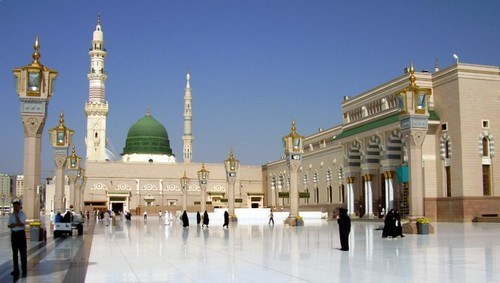
So total Islam time from begining to now is 1448 years, and on this auspicious occasion i wish you , AdventureMan and your family and the little ones a happy and a blessed New Islamic year.
We wish you the same, Daggero, and I smiled as I read that you discussed the topic we were discussing with your daughter on the drive to school in the morning. I remember those days so well, as young people begin to draw off into their own lives and the time we spend with them in cars can be so precious. Happy New Year to you and your family.
We had a friend from Libya whose family name meant “from Madina;” before we had ever lived in any Middle East country, he had told us a little about Madina, and what a beautiful city it is. The mosque is very beautiful. I think the tradition is that green was the prophet Mohammed’s favorite color?
Happy New Year, too, to all our Moslem friends.
Saudi Women Drive, No Problem
For your delight of the day, please go to YouTube and watch this hilarious Saudi video, No Woman, No Drive! Click on the blue type above 🙂

From The Guardian:
Dozens of Saudi Arabian women drive cars on day
of protest against ban
-
Staff and agencies
- theguardian.com, Saturday 26 October 2013 12.03 EDT
Activists say at least 60 joined call to allow female drivers – making it country’s biggest ever demonstration against the ban
More than 60 Saudi women got behind the wheels of their cars as part of a protest against a ban on women driving in the kingdom, activists have claimed.
A Saudi professor and campaigner, Aziza Youssef, said the activists have received 13 videos and another 50 phone messages from women showing or claiming they had driven, the Associated Press reported.
She said it had not been not possible to verify all of the messages. But, if the numbers are accurate, they would make Saturday’s demonstration the biggest the country has ever seen against the ban.
Despite warnings by police and ultraconservatives in Saudi Arabia, there have been no reports from those who claimed to have driven of being arrested or ticketed by police.
A video clip of a protest by May al-Sawyan, a 32-year-old economics researcher and mother of two, was uploaded on the YouTube channel of the October 26 driving for women group, along with several other videos of women purportedly driving in defiance of the ban in Riyadh, al-Ahsa and Jeddah. It was not possible to verify when they were filmed. Another video to feature on YouTube was the spoof No Woman, No Drive.
“I am very happy and proud that there was no reaction against me,” she told AP. “There were some cars that drove by. They were surprised, but it was just a glance. It is fine. They are not used to seeing women driving here.”
Sawyan said she had obtained a driver’s licence from abroad. She said she was prepared for the risk of detention if caught but added that she was far enough from a police car that she was not spotted.
“I just took a small loop. I didn’t drive for a long way, but it was fine. I went to the grocery store,” she said.
Her husband and family waited at home and called her when she arrived at the shop to check on her, she said. She drove with a local female television reporter in the car. They were both without male relatives in the vehicle.
“I know of several women who drove earlier today. We will post videos later,” one of the campaign organisers told Reuters.
The Associated Press reported that a security official said authorities did not arrest or fine any female drivers on Saturday.
Youssef said she and four other prominent women activists received phone calls this week from a top official with close links to Interior Minister Prince Mohammed bin Nayef, warning them not to drive on Saturday, the day the campaign set for women’s driving.
She also said that “two suspicious cars” have been following her everywhere all day. “I don’t know from which party they are from. They are not in a government car,” she said.
Activists said they have 16,600 signatures on an online petition calling for change. Efforts to publicise the issue have been described as the best-organised social campaign ever seen in Saudi Arabia, where Twitter has millions of users and is used to circulate information about the monarchy and official corruption.
Previous attempts to promote change fizzled out in arrests for public order offences and demoralisation. In 2011, the activist Manal al-Sharif made a YouTube video urging women to drive their own cars, and was imprisoned for more than a week. But the signs are far more positive now.
Three female members of the shura (advisory) council – among 30 appointed by the 90-year-old King Abdullah – recommended this month that the ban be rescinded, though no debate has yet taken place.
Latifa al-Shaalan, Haya al-Mani and Muna al-Mashit urged the council to “recognise the rights of women to drive a car in accordance with the principles of sharia and traffic laws”.
The three – praised by supporters for “stirring the stagnant water” – framed their argument with careful references to religious edicts banning women from being in the company of an unrelated male driver. Other ideas designed to reassure critics are appointing female traffic police and driving instructors. Cost is another big factor, with families having to employ chauffeurs, as is convenience.
Though no specific Saudi law bans women from driving, women are not issued licenses. They mostly rely on drivers or male relatives to move around.
Powerful clerics who hold far-reaching influence over the monarchy enforce the driving ban, warning that breaking it will spread “licentiousness.” A prominent cleric caused a stir when he said last month that medical studies show that driving a car harms a woman’s ovaries.
God-With-A-Sense-of-Humor at King O Felafel in Orlando
After driving seven and a half hours to get to the convention hotel, AdventureMan and I needed dinner! We settled in to our hotel and took a quick look at the menu – nope. We needed something comforting, something familiar. And there it was, just one minute, I am not kidding, from our hotel, the King O Felafel.
God-with-a-sense-of-humor had plopped us splat down in a hotel in the middle of Middle-Eastern-Land. Minutes from Disney, minutes from all the shoddy tackiness of Orlando, we find ourselves “home.”
The King O Felafel’s shop was full of regulars, including one very large family taking up about five tables all put together, and having a wonderful time. The King himself makes his own felafels, using that little felafel making tool, he was so quick. The was clean clean clean, and service was quick.
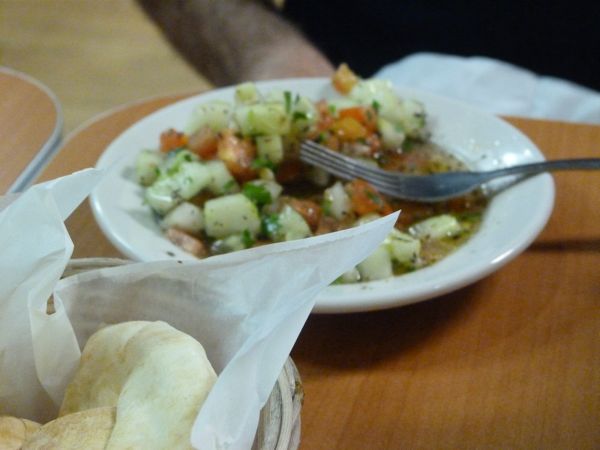
We started with lentil soup, and I ordered the Vegetarian Platter (which was like a mezze) and AdventureMan ordered a Felafel Sandwich.
Oh, how we have been yearning for the simple joy of a felafel sandwich done right. The King O Felafel was heaven for us.

Thank goodness I remembered to take a picture before we demolished the entire platter!

So simple, so good. A homemade felafel. Perfection.

This shop is not undiscovered. He has a large clientele of all kinds of people who appreciate superb food, beautifully and tastily prepared.
Across the street from the King O Felafel is a mosque which also has a gym and a meeting hall. There are several other ‘Mediterranean’ restaurants nearby, and several hookah lounges. There are so many shops in this little area of Kissimmee with ‘halal’ foods and even groceries selling halal meats. Wow.
Mosque – my photo was blurry, so I grabbed this from Google Maps. I guess it used to be a computer shop; now it has arabic writing on it and a sign that says it is the AMYL Center (Masjid Shadi)


Where is Terekeka, South Sudan?

Today the church prays for the diocese of Terekeka, in the South Sudan. I have never heard of Terekeka – have you?
When I looked for it on Google Maps, it didn’t have any information. When I went to The South Sudan and then googled Terekeka, it came up with a reference, and I had to go to this website to find it – they had a map.
The organization who put up the map, Harvesters Reaching Nations, has two locations in the southernmost part of South Sudan, the newest nation on earth. They are building hospitals, and taking in orphans. If I hadn’t gone looking, I would never have heard of the good works they are doing, saving lives, changing lives.
This is what they say:
We currently serve more than 190 orphans in two locations in South Sudan – Yei and Terekeka. Our school in Yei provides a Christian education to more than 500 students. In addition to our school-age orphans, more than 400 children from surrounding villages attend our school.
The Harvesters campus in Yei consists of 90 acres of land donated by the South Sudan government. Since our beginning in 2001, we have built homes, dorms, classrooms and other facilities within a fenced-in campus. We use the land we own beyond the fencing for planting and growing corn, tomatoes and other vegetables for use in the orphanage.
Harvesters’ campus in Terekeka, South Sudan opened in 2010. At this campus, we currently provide care for 44 orphans, but will grow to 80 in the near future. We have built homes, dorms and a clinic within a five acre, fenced-in campus. Additional facilities, including a church and school classrooms, will be built in the near future as the needs and resources dictate.
To do this, they sold everything they owned, and moved to the South Sudan, and used the proceeds from selling everything to build the hospitals and schools. I bet they are the happiest they have ever been, and the most thoroughly engaged in life they have ever been.
Saudi Arabia Inching Toward Allowing Women to Drive
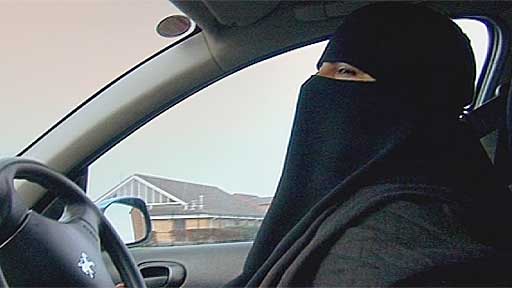
Saudi Arabia is the only country in the world where women are not allowed to drive. There is an irony – there is no law banning women from driving. They do not issue driver’s licenses to women, they arrest women seen driving, and they do not – officially – teach women to drive. Thank God for good fathers and brothers and husbands, who take their daughters, sisters and wives to isolated places and teach them, often for the good of the family in case of an emergency.
Saudi women drive in Europe, in the USA – they drive everywhere except in their own country. The government shows signs of wanting to allow women to drive (officially) but they seem hesitate to stir the wrath of the religious police who believe – based on nothing – that God forbids women to drive. Recently, the head of the Saudi religious police said there is nothing in Islam that forbids a woman to drive. What’s the hold-up guys?
This article is from AOL Auto News, where you can also see a video of a woman driving in Saudi Arabia with cars passing her and waving encouragement:
Saudi Arabian Women To Protest Driving Ban On Oct. 26
Saudi society is slowly inching toward more equality, but driving is still disallowed for women

When Farha was a young girl, about seven years old, her mother told her something that rocked her world: She said women could drive.
For Farha, a 24-year-old writer who has spent her entire life in Saudi Arabia, this was akin to a Western child learning the truth about Santa Claus. She’d only ever seen men behind the wheel in her country, where women are not permitted to drive. The revelation was slightly scandalous, a little bit funny, and totally paradigm-shifting.
It took another two years for Farha (who didn’t want to be identified with her last name due to the sensitivity of the issue in her home country) to decide she would, one day, learn how to drive a car. And, for good measure, she’d learn how to ride a bike. Two modes of transportation that have been banned to women and girls for most of Farha’s lifetime.
On Oct. 26, women in Saudi Arabia will engage in the third protest against the female driving ban by getting behind the wheel anyway. The protest won’t be widely attended, because the vast majority of women in Saudi Arabia don’t know how to drive. There are no driving schools in the Kingdom that cater to females, and state agencies will not issue a driver’s license to a woman.
“Since there is no justification for the Saudi government to prohibit adult women citizens who are capable of driving cars from doing so, we urge the state to provide appropriate means for women seeking insurance of permits and licenses to apply and obtain them,” a petition at the protestor’s web site reads. The web site has been blocked within Saudi Arabia, yet there are still a thousand or so names on the petition. The few women who are adept behind the wheel learned while living overseas, often in the U.S., Canada, or nearby Bahrain or Dubai.
In urban areas, women are chauffeured around by male relatives or paid drivers, or they pay for taxis. In rural areas, the driving ban generally isn’t enforced, and more women drive out of necessity. One woman who was recently videotaped disobeying the ban got support from her fellow (male) drivers, who passed by and gave her the thumbs up, a sign that society may be more willing to accept an eventual change.
Learning to drive
Farha tackled the task of learning to drive first by reading about the process. She edited a story on how to drive for her high school newspaper, and from that she felt she learned quite a bit. Then her father spent some time talking to her about how cars work, and the theoretical aspects of driving. He took her out for a few hours over the course of a few days, letting her drive around their neighborhood in the coastal city of Jeddah. But she never ventured onto the main roads.
She also learned the basics of riding a bicycle, but doesn’t consider herself adept at either skill. When the ban is lifted, she said she’ll sign up for classes at a real driving school.
“I always thought this ban would go away when I was 18,” she told AOL Autos. We connected with her through a publication where Farha wrote, under a pseudonym, about the driving ban. “And I’m still hoping it will be lifted when I am 26.”
“I always thought this ban would go away when I was 18,” Farha said. “And I’m still hoping it will be lifted when I am 26.”
Not driving makes life’s everyday movements difficult. Sidewalks aren’t available, so walking isn’t realistic. Farha’s father has mostly been responsible for driving her and her mother around, but five months ago he got into a car accident and broke his leg. He is currently unable to drive. Farha feels the burden of her father’s injury. If she could drive, she said, she could bring him to doctor’s appointments and help him get out of the house. Instead, the family is home-bound unless they pay someone to bring them places.
Farha has hired a part-time driver to take her to and from work. It costs about 2,000 to 3,000 Saudi riyals (or around $530 to $800) a month for a driver. That’s about the same amount that women make earning minimum wage in Saudi Arabia, prompting many women to just stay home.
“A lot of women don’t feel the incentive to work and hire a driver,” she said. “It doesn’t make any economic sense.”
Some women opt for the public bus system, but that makes women from conservative families feel nervous because it exposes them to strange men – the exact problem the country is trying to avoid by banning women drivers. Taxis run the same problem, putting females into cars with strange men. “It doesn’t make sense,” Farha said.
Farha is considering signing up for a karate class, but she’ll have to pay her driver for more hours or take a taxi to the classes. On top of the class fees, the price of getting to and from karate starts to seem like a silly amount of money, she said.
And she worries she’s spending too much money on herself. She could spend 30 riyals on a taxi each way, or she could donate that money to a family in need. Or spend that money sending school supplies to girls in other countries.
“It’s a difficult decision to make every time,” she said.
One unintended consequence of the rule strikes Farha as incredibly unsafe: Women often let their 13-year-old sons drive them around when they are out of other options. Farha’s observation was backed up by a U.S. intelligence research note made public by Wikileaks, which noted that these young drivers sometimes get into very serious accidents.
Weird, long history
Oddly enough, there isn’t any actual law in Saudi Arabia banning women from driving. In 1991, the late Grand Mufti of Saudi Arabia, Sheik Abdulaziz bin Baz issued a fatwa prohibiting women from driving. A fatwa is different from a government law, in that only followers of the religious leader who issues the fatwa are obliged to follow that law. But given the intertwined nature of Saudi Arabia’s government and its religious leaders, the fatwa took hold. The government agency in charge of issuing driver’s licenses will not issue one to a woman. Saudi Arabia’s court system relies heavily on fatwas from the Grand Mufti.
So, in essence, the religious order became a rule that everyone follows, even though it’s not enforced by the Saudi government. The government just makes it impossible for women to get drivers licenses, and if they catch women driving, they make them sign a pledge promising they won’t do it again.
Abdulaziz bin Baz said at the time that the ban would protect women, because allowing women to drive would put them out in society alone, leaving them to mix with men. If women were stranded by the side of the road due to a flat tire or car problem, they could end up being assaulted or raped by a man who came to help them, argue critics who still uphold the ban.
A reporter for the Christian Science Monitor recalled a 2012 conversation with a man in Saudi Arabia about what would happen if the ban was lifted. “What would happen if a woman got in a car accident, he asked? Then she would be forced to deal with the male driver of the other car, a stranger, with no oversight – a problematic situation in a country where male guardianship of women is deeply entrenched.”
Just last week, a Saudi cleric came under fire for claiming women were damaging their pelvises and causing birth defects by driving. Sheikh Saleh bin Saad al-Lohaidan argued women should put reason ahead of their hearts, because it “could have negative physiological impacts as functional and physiological medical studies show that it automatically affects the ovaries and pushes the pelvis upward.”
Saudi society is slowly inching toward more equality for women. Just this week, four women became attorneys. Earlier this year, women were allowed to work in retail establishments that sell underwear and bras, taking away the embarrassment for women who’d previously had to purchase these items from male salespeople.
Since around 2006, the Saudi government has been indicating it would consider lifting the driving ban if society deems it acceptable for women to drive. Diplomatic cables released by Wikileaks showed the U.S. government has been paying attention to this issue, and putting some pressure on the Saudis to change their ways.
Will of the people?
But it’s clear the Saudi government won’t make any controversial moves: “This has to do with the will of Saudi society,” said Saudi Justice Minister Muhammad Al-Issa in a TV interview in April, according to a translation by the non-profit group MEMRI. “If Saudi society, given its culture, wants women to drive, it’s fine. But if society has any reservation for whatever reason, that’s fine too.”
Farha said she’s holding out hope that the rules will change, as soon as possible. But the change will depend greatly on men’s attitudes.
“More men certainly support it now, but … they have their concerns,” she said. And “some are outright hostile to the idea.”
When she does get her license, Farha said she’d like to try driving a sports car. It doesn’t matter what kind, she just would like to try driving something fun. But she’d rather be able to walk or bike to work, even if she could drive.
“Cars feel suffocating inside,” she said. “But the whole idea is to lift this difficulty for women. I hope it happens soon.”
In sharing this story, and others, with our readers we hope you are inspired to Raise Your Hand for girls’ education, helping us spread the word on this crucial effort.
Gospel for 9/11

Are we who we say we are?
Do we follow the spirit of The Word? Do we as believers pick and choose from our holy book(s) or do we humble ourselves, as Christ did, and do as he commands?
The Lord Jesus Christ commanded a very difficult life style. I have met holy people among all religions; I am forced to believe that “the way and the truth and the light” are behavioral, and that there will be many surprises when we get to the last days.
September 11th is a difficult day. This is a difficult Gospel reading for a difficult day:
Matthew 5: 38 – 47
Eye for Eye
38 “You have heard that it was said, ‘Eye for eye, and tooth for tooth.’h 39 But I tell you, do not resist an evil person. If anyone slaps you on the right cheek, turn to them the other cheek also. 40 And if anyone wants to sue you and take your shirt, hand over your coat as well. 41 If anyone forces you to go one mile, go with them two miles. 42 Give to the one who asks you, and do not turn away from the one who wants to borrow from you.
Love for Enemies
43 “You have heard that it was said, ‘Love your neighbori and hate your enemy.’ 44 But I tell you, love your enemies and pray for those who persecute you, 45 that you may be children of your Father in heaven. He causes his sun to rise on the evil and the good, and sends rain on the righteous and the unrighteous. 46 If you love those who love you, what reward will you get? Are not even the tax collectors doing that? 47 And if you greet only your own people, what are you doing more than others? Do not even pagans do that? 48 Be perfect, therefore, as your heavenly Father is perfect.
Happy 7th Blog-iversary to Me!
Once a year I get to troll the internet looking for cakes. It is so much fun. I had no idea there is so much creativity out there, so much daring. I found a wedding cake that is tilted! Something in me loved it, loved the spirit of a woman who would marry knowing life is often off-kilter and messy.
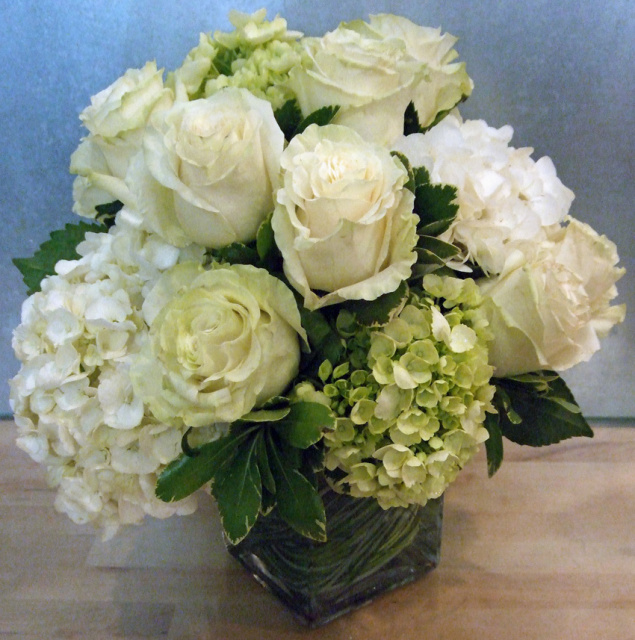
I love white roses, so this year I have sent some to myself:
Come on by, have some virtual cake with me to celebrate seven years of blogging:
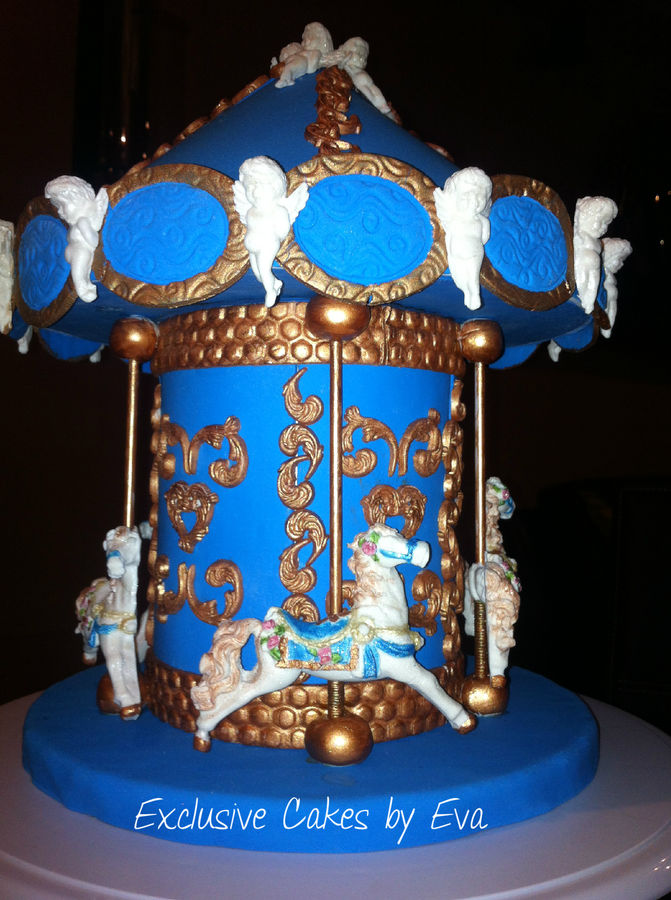

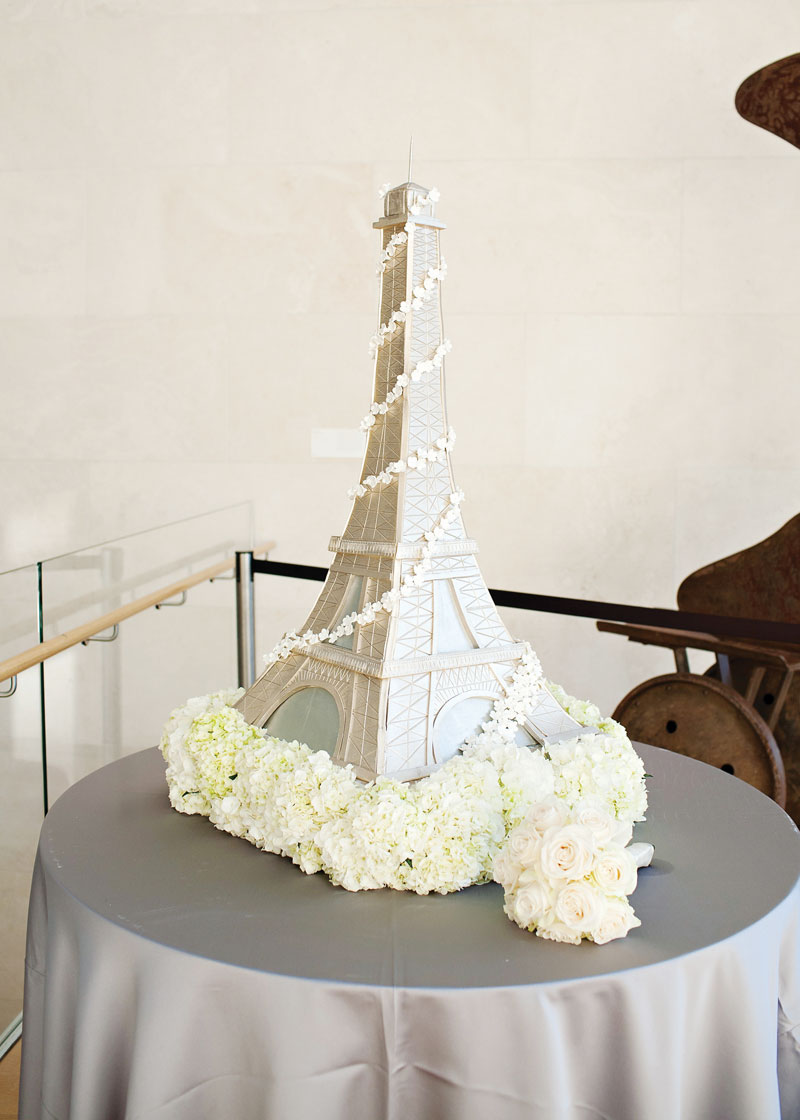
And here, an elegant combination of cake and white roses:

Seven years ago in Kuwait, I started blogging. There was a wild blogging scene in Kuwait, a lively community. Blogs were candid, and many were substantial, dealing (carefully) with political and economic issues in Kuwait. I remember reading and learning, and finally gathering up my courage to write my very first entry, and it has been a recurring theme, cross-cultural communication. I learned so much from my life in the Middle East, Tunisia, Jordan, Saudi Arabia, Qatar and Kuwait. I made the most amazing friends. It changed my life and my perceptions utterly.
Of the three Kuwait female bloggers who inspired me to start blogging, Jewaira has gone private, 1001 Nights is a good friend, a mother, and an author 🙂 and Desert Girl is still going strong. Mark, at 2:48 a.m. is also still going strong, so strong that he has been able to leave his full time employment and operate on a consultant basis.
Of course, as any blogger will, I sometimes think of quitting. There are days I find myself with nothing to say, nothing in my life so interesting that I think it is worth sharing, not even a news story worth noting. So I’ve had to ask myself why I continue.
I do it for myself. When I started, I had a reason and that reason still stands. I forget things. This isn’t age-related, it’s busy-life busy-world related; we forget the details.
My Mother saved all my letters from Tunisia. I remember reading them and laughing because at three, my son’s best friend in his day school was a boy he called Cutlet. I know his real name is Khalid, but Cutlet was as close as this little American boy in a French-Tunisian school could get. I had totally forgotten, until I read the letter. So my primary reason for continuing to blog is documentary – just plain record keeping, like an old fashioned diary. Noting things in my daily life or the life around me.
Even now, sometimes I see a post written long ago, usually one of our Africa trips, Botswana, Namibia, Tanzania, Zanzibar, Zambia – will start getting a rush of stats. It thrills my heart. It makes it all worthwhile, knowing something I have put out there is helping others, even years later. Perhaps one day, I will quit blogging, but leave the blog up, with these informational articles.
My stats make no sense at all, one of my biggest stat gainers this year was a news article I tossed off about the prank on the South Korean pilot names after the plane crash landed in San Francisco. It just made me giggle, and I couldn’t resist printing it. It ended up with a life of its own, as many entries do – and you just never know. Someone pins an image and you get a million (ok hyperbole here) hits you never expected.
In the end, I believe that those who keep blogging do it because as Martin Luther once said, “I cannot other.” We do it because something within needs to be expressed, even if it is just some kind of daily record. I know it’s why I blog.
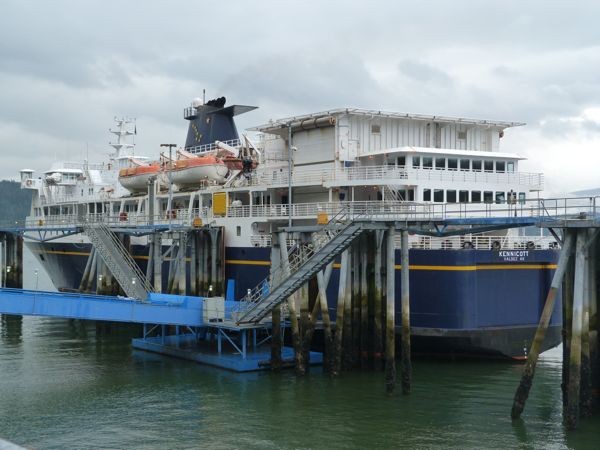
Welcome Aboard the M/V Kennicott
When most people think of an Alaskan cruise, they think of the ships the size of small cities. We saw many of them in Juneau, docked, three, four, five at a time, inundating the town. In a town of around 30,000 the population can nearly double when five cruise ships are in port at the same time.
Juneau has a lot of services in place to handle the tourist demands. You can sign up for glacier tours, or whale watching tours, or both right at the landing dock. You can have a fine meal, you can buy tanzanite or brown diamonds, or fine sporting gear just across the street, or you can take a cable car up to the top of Mt. Roberts – right from the dock where you landed.
No. We didn’t do that.
We boarded the M/V Kennicott out in Auke Bay, where the Alaska Marine Highway Ferries come in and out shuttling the locals from town to town. There are ferry routes that are regional, like you can take a ferry to Haines, or Skagway, or Ketchikan, or Petersburg, places on the SE panhandle of Alaska, or you can, like us, take a ferry that goes all the way around the Gulf of Alaska from Juneau via Yakutat, Whittier, Chenega Bay, Kodiak Island to Homer. You can even continue on to Seldovia before you head back. Some years, when the ferry hasn’t broken down, you can take a ferry all the way down to Unalaska/Dutch Harbor, all the way down on the very tip of the Aleutian Islands. Wouldn’t that be a grand adventure!?
It’s all part of the Alaska Marine Highway System, a very practical part of the entire Alaska transportation system which is a lot like Africa. You take a big plane or a big ship to get there, then you take a smaller ferry or a small – even tiny – airplane to get to the more remote places. Juneau is not connected to anywhere. All the highways end. Kodiak Island is . . . well, an island. There are many remote places that there is no way to reach without ferry or tiny aircraft service.
We picked up our tickets at the Ferry Terminal a couple days in advance, and were surprised to see that while the ferry was scheduled to leave at 12:00 noon, boarding said 0900 in the morning.
No problem. We were packed and ready to go, grabbed a little breakfast and coffee, and the shuttle took us out to the ferry terminal, about 15 minutes away. The Best Western Country Lane shuttle makes everything so easy; they take you to the airport, they take you to the terminal, they take people to the restaurants they want to go to, they run you downtown – a trip that costs about $35 if you come in to the Ferry Terminal and want to go into downtown Juneau. The shuttle is one reason why we chose this hotel, and we were so glad we did.
So we arrived, on time, at 0900 to board the ferry and the guy at the counter looked surprised and said “You want to board now?” and I said “It says we are supposed to board at 0900. It doesn’t make sense to me, either, but here we are.” He said “OK, you can board if you want.”
It’s not like an airplane. It’s not like you see “Boarding at 0900” and it means you MUST be there at 0900, in this case, it means “you can board if you want to.” LOL, this is my culture, and it’s confusing to me!
Laurie, the boarding purser, checks our I.D. and checks our tickets and waves us to the vehicle entrance with our rolley-bags, saying “just go in here and take the elevator.”
It wasn’t until after the trip that I learned the M/V part of M/V Kennicott means Motor Vessel, i.e. this is a ship that transports motor vehicles. We love learning new ways how things are done, and the boarding and unloading of the vessel was endlessly fascinating to us. Great technology, and it also requires great planning and execution.
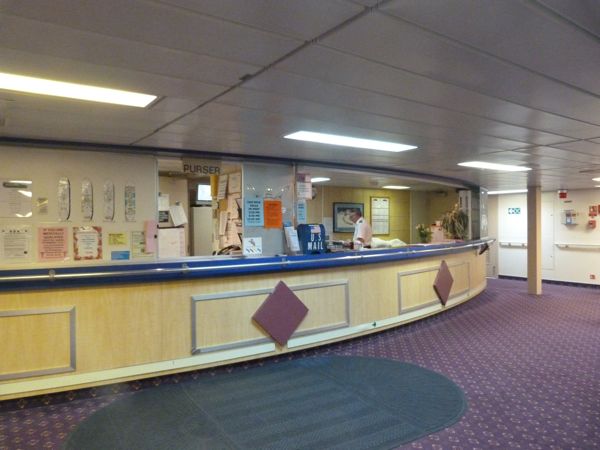
We went to the purser’s office to get our cabin, but the cabins weren’t clean yet. He suggested we go up to the forward lounge, have a cup of coffee, he would call us when the rooms were ready.
The forward lounge was full of Alaskan art objects. This is a shaman’s mask:

This is a Haida clam basket (basket weaving is so fascinating to me, all those patterns. How did people figure out, oh so long ago, how to gather living plant material and weave it in these ways? On our trip, we saw baskets woven so finely that you could boil water in them. Imagine!)

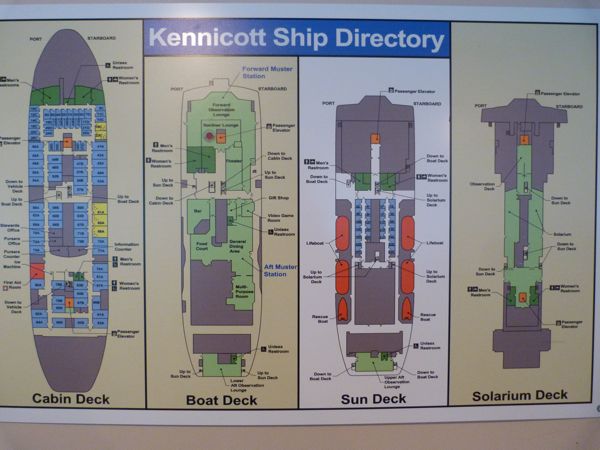
I explored around a little, well, I snooped. While the cabins were being cleaned, I looked in to see the various kinds of cabins. It was so interesting. The majority of the cabins did not have bathrooms.
There were one person little cabins, like a booth, with two seats that would slide down and together, and a table that could be clipped up when a person didn’t want to sit at the table and wanted to sleep on a flat surface. It was a pretty narrow surface, and a room like a coffin, but it locked, and it would be a safe place for one person to sleep and keep their bags safe, too.
There were two person roomettes, they also had a little table and two bunks that attached to the wall unless you wanted to sleep, in which case they came down.
There were four person cabins without baths and four person cabins with baths. If only two people were in the cabin, the unused bunks were attached up to the walls, and you had a couch to sit on during the day. The outside cabins had nice large windows, big square ones.
There was a solarium up on top designated for campers. There are a LOT of campers in Alaskan, not just Alaskans, but also visiting campers from all over the world. The solarium gives them a safe dry place to pitch their tents. There are also big lockers where they can stow their gear.
People are also allowed to camp in the aft lounges, upper and lower, but the signs ask that you only roll out your sleeping gear between 8 at night and 8 in the morning, so that all the passengers can use the lounges during daylight hours.
This isn’t a cruise ship. This is transportation. This is how people get from one place to another, how they take their kids to boarding school when their village is too small to support a school. This is how high school teams might travel to their away games. These are working ships.
When the purser announced that people could come check in to their cabins, I went, but I ended up at the end of a long line. I saw people get assigned and then the purser would hand them a set: one pillow, two sheets, one pillowcase and one blanket. (@) (@) ! No! No! I did not sign up to be making up bunk beds! Enough democracy!
Lucky me, those sets were for the roomettes, and you don’t even have to rent them, you can do without them if you prefer. I think the rental per night for the set is $3.00, but they also have it broken down, so if you just want to rent a pillow and pillow case it might be $1.00 per night, or just a blanket. Our cabin is beautiful and spacious. We have a big window, and dolphins romp by, and beautiful mysteriously foggy islands. We have our own toilet and shower, thanks be to God, and a washstand with plenty of clean towels. This is heaven. 🙂
The food is not elegant, but neither is it institutional. It is a giant step above McDonalds, or any of the fast food outlets. These are the menus posted in the hallway leading to the galley (kitchen):
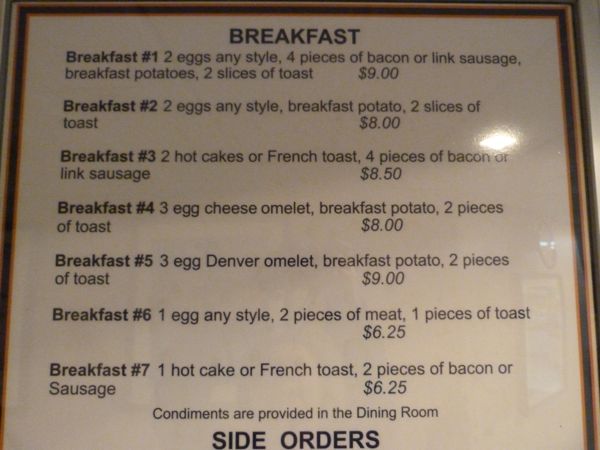
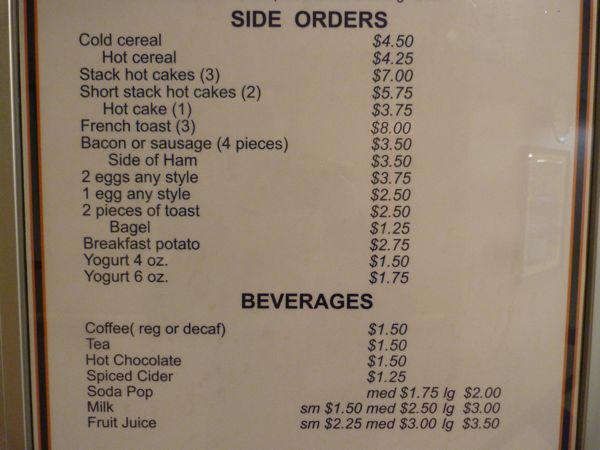


There are a variety of food stations – drinks of all kinds on the left, a salad and soup station on your right. Every day there were three soup choices, a soup like chicken noodle or French onion, a smoked salmon or clam chowder, and a chili. There were four prepared salads, and a big bar with greens and accoutrements; carrots, tiny tomatoes, peas, etc.

There was also a deli sandwich and pizza station, where the lady would make you what you want.
There was another station, the hot station, where you could order several different hot things. There would be three main meal choices at every meal, like beef stew, salmon steak or pork fried rice, for example, and a veg and a starch. They even had brown rice.

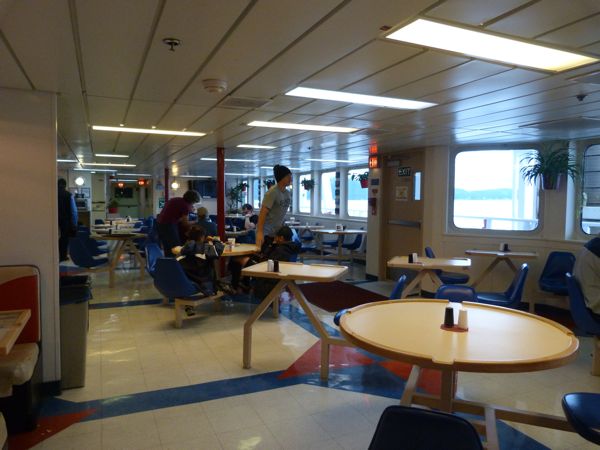
After you paid, cafeteria style, you enter the dining hall. It’s a working ship, remember, so it’s not just paid eaters who eat there, but also there is a microwave available for people who bring their own food. I saw one young man who had the BEST food, the first day he had a cucumber with salt and pepper, and bread. At breakfast, he had brought his own granola kind of mix. (Then he was gone, it’s a ferry, and people come and go.)
There are families with children warming up spaghettio’s, and single women with bowls of Ramen. It’s all very democratic, everyone sitting in the same dining hall.
There is always a large display full of desserts; they must have specialized in desserts, very tempting desserts. AdventureMan succumbed one meal to a piece of Coconut Cream Pie, and I yielded to a Blueberry Pie at another meal.
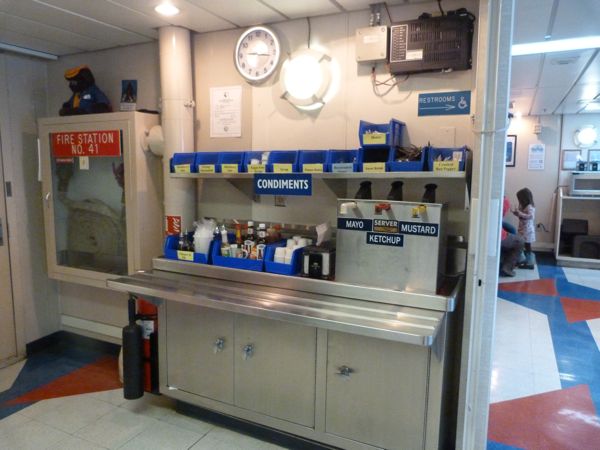
They also had all kinds of condiments, in case you like a little kick with your foods, the more common ones, ketchup, mustard and mayonnaise you pumped into small containers, but there were also things like Thai chili sauce, Tiger Sauce, Tabasco sauce, soy sauce – things different people like.
There were several booths with Alaskan wildlife and bird life on them:

Near the dining hall, across from the gift shop was a small room for small children with a rubber floor 🙂

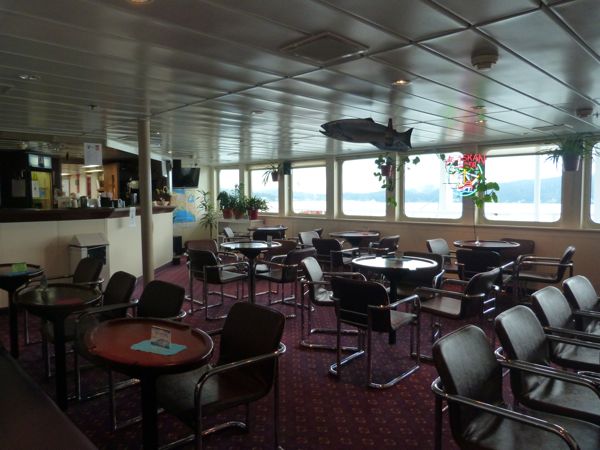
This is the bar, which was closed every day until around 5:00 and it was the only place on board that sold alcohol. You weren’t supposed to take it out of the bar. They had Alaskan beer, which is very tasty.
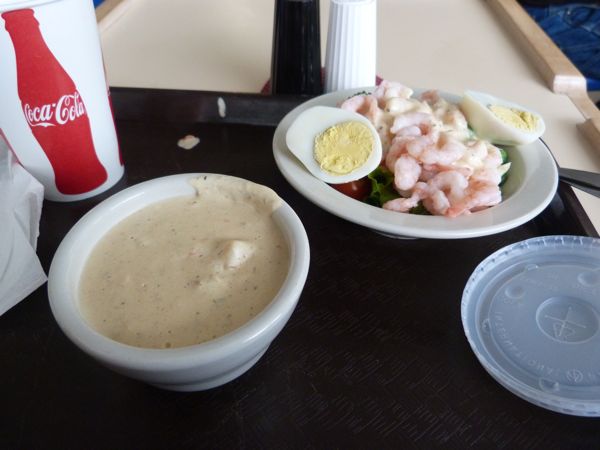
This was lunch our first day on board, Smoked Salmon Chowder and a shrimp salad:
After every meal, we walk the decks, and, in fact, other than climbing in and out of my bunk, most of our exercise was walking, walking, walking, and climbing stair up and down. It didn’t do us any harm 🙂 The scenery is ever changing. Our first day out, we pass the same humpbacks we had seen on the whale watch the day before, spouting, someone always can be counted on to shout “Thar she blows!” The Alaskan waters team with wildlife; sparkling fish jumping, dolphins, seals, sea lions, otter – we saw them all. I would be typing up notes in our cabin, facing out the window, and I would see a couple dolphins just zipping along, so graceful, just doing their dolphin thing.
No Internet??? No Wi-Fi??? No Phone Service???
No, I have not abandoned you.
When my son asked about communicating with us from Alaska, I confidently assured him “oh, Alaska will be like Africa! Land lines are so expensive to install, there will be cell towers everywhere, and besides, my iPhone is covered everywhere! I can use the internet.”
Oh Pride, Intlxpatr, Pride. You speak whereof you do not know!
Our time in Juneau was a lot of fun. From the moment we arrived, it was just so smooth. The airport is small, like Africa. You can be in and out of the airport in minutes. We picked up our car; it was so easy, the reservation was waiting, and the car is out in the small lot. It is a car a lot like our own and we really like it. Not five minutes later, we are in our room at a nearby hotel, and it is a nice room, and of course it has Wi-Fi, that’s how I sent the earlier entries.
I called an old friend of my Mother’s, a friend I remember well from my childhood, she and my mother would laugh a lot together, and our families travelled together, out on a big old Coast Guard cutter fishing in Alaska, or out to islands where we would pick berries, or out, just out, because it was a beautiful weekend and when the weather is good, Alaskans go outside.
We planned to meet up for coffee, and when we did, she was just like the old days, only older. I laughed and told her I am now older than when I knew her before. She laughed at AdventureMan’s jokes, and she had a beautiful living place near where my family used to live, with a view to die for. It reminded me of Kuwait. I could lose hours looking out her window, if I lived there. Eagles flying by, cruise ships coming in and out, the weather changing on the mountain across the way – it was a magnificent location, and it was all made even better by good coffee, good conversation and a great deal of love based on old relationships.
But we needed to go! We had things we needed to see!
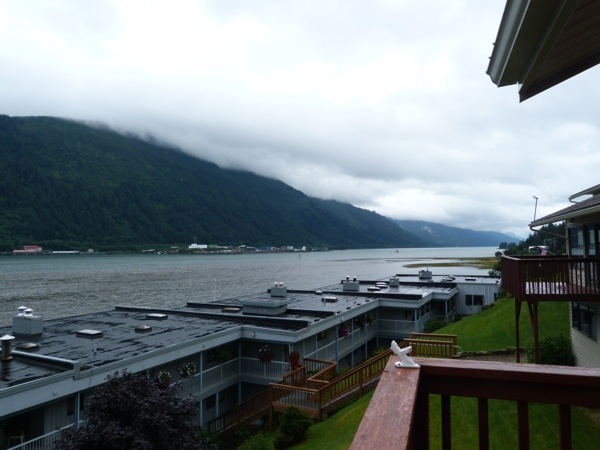
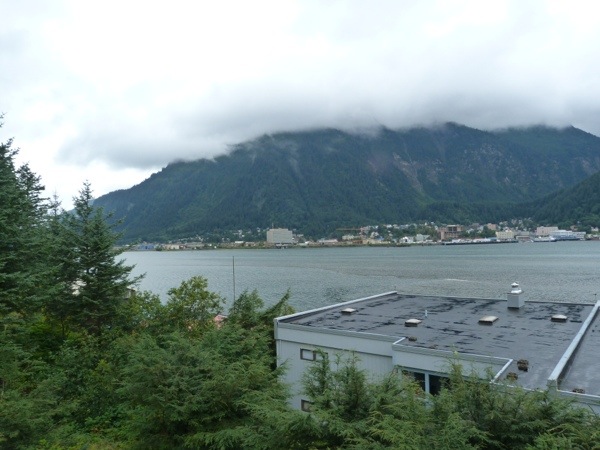
This is the view from our friend’s house in West Juneau:

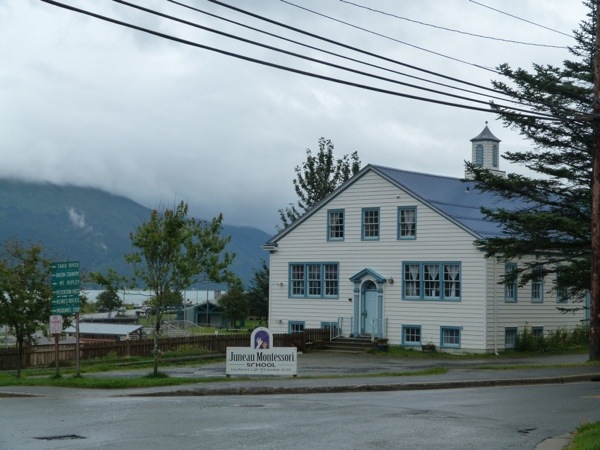
My old school:
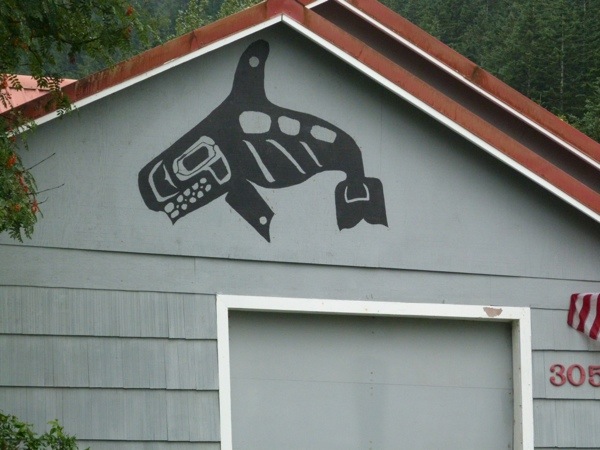
Alaskan Indian art, painted over a garage door:
The beach we used to go to, called Sandy Beach. Occasionally a dead walrus would wash up there, causing no end of excitement to us young people.

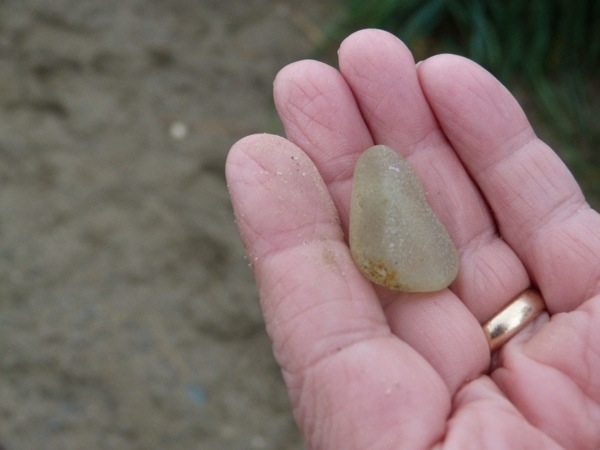
AdventureMan found a piece of the sea glass I love:
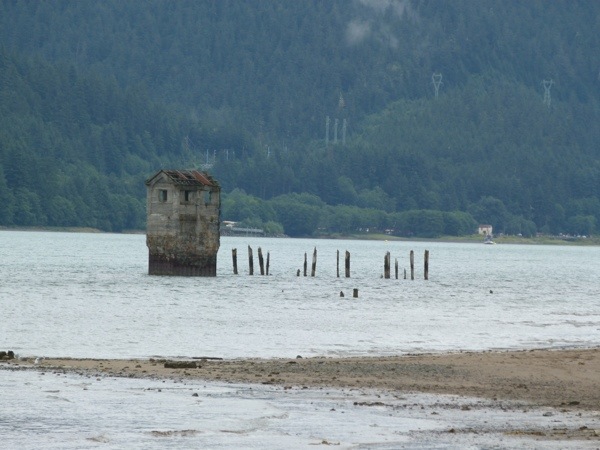

I thought this school above was a lot bigger than this . . . . I remember it being a lot bigger . . . LOL!
This is our old house, many many years ago. It used to have a much bigger front yard, before they widened the road. It also seemed farther from the little grocery store near the bridge that my Mom would send me to, but it’s gotten shorter!

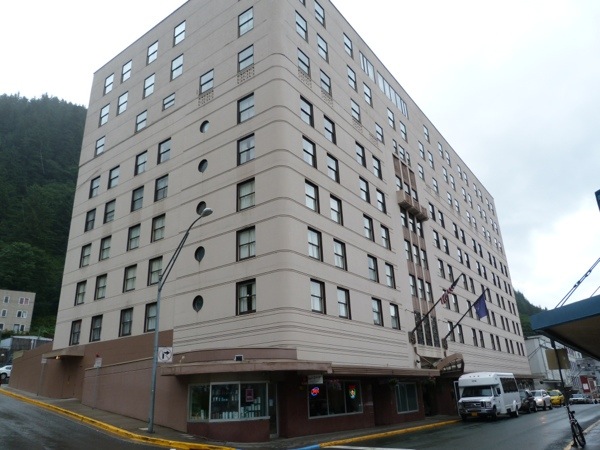
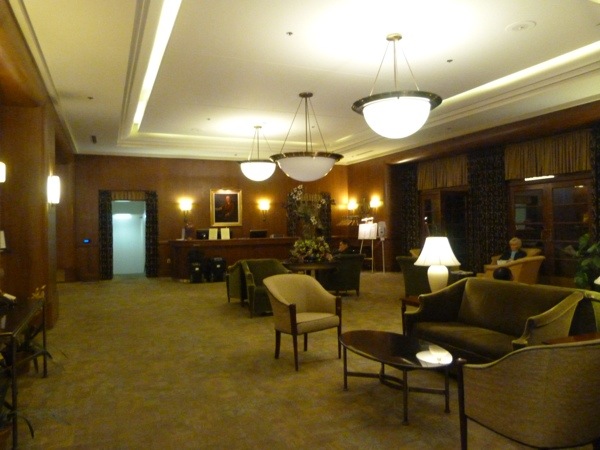
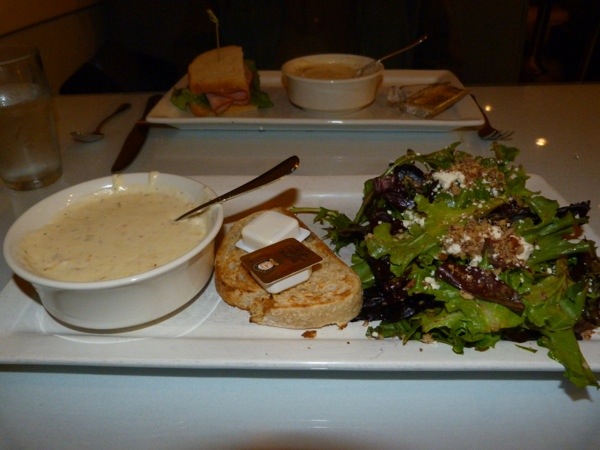
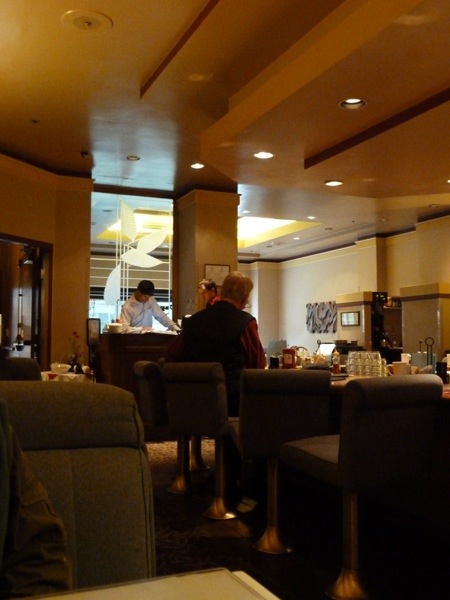
This is the Baranof Hotel, where my parents met. It used to be a very grand hotel, but it is now a Westmark hotel, and while it pretends to still be grand, it is shopworn and tired, and needs a major overhaul to be back in the game. We ate lunch there – to honor my parents meeting – and it was also a very mediocre meal. The very chipper waitress, Holly, tried to make it nice, but the Capitol restaurant needs better lighting and brighter colors. It was very, very dark.
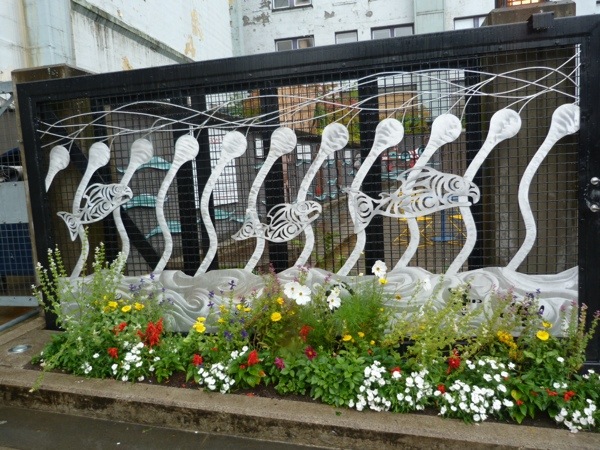
Some public art. Later as we passed the same location we heard guys call out “The police are coming!” and saw them approach three men who looked like maybe they were drinking or drugging.
AdventureMan is so patient with me. When I spotted a quilt shop, he said he was going down the street and to call him when I was finished. 🙂

The best part of the day was picking up our friend for dinner, and hearing her stories. We loved hearing about Juneau in the old days, and hearing her laugh.
Recent Comments
intlxpatr on Shampoo Ginger tigerbutterya0c5ff1d… on Shampoo Ginger intlxpatr on British Soldier Kidnapped, Esc… John on British Soldier Kidnapped, Esc… intlxpatr on British Soldier Kidnapped, Esc… Wikipedia Donate Button

Amazina


Early Voting in Florida


