Here There and Everywhere

Expat wanderer

Pope Francis Defines Slave Labor

I have had wonderful women who have worked for me; they were from the Philippines, from Sri Lanka, from India. They worked hard and they didn’t spend their money. They sent their money home to help support mothers, fathers, siblings, children. They had some real horror stories to tell about how they had been treated in prior employment – employers with jealous wives, touchy-feelie employers and their sons, people who seemed to assume that because they were working under their sponsorship, they owned their lives. In Qatar and in Kuwait, Labor law provides for a mandatory day off – except for house-workers. Some work from crack of dawn getting the children ready for school until the last thobe is ironed, late late in the night.


ITUC Rally Doha

I did a little research. Here is what 38 Euros per month – slave wages – is worth:

$50.13 US Dollars  (Minimum wage $7.25/hour + social security)

Qatari Rial 182.52  (Qatar has not set a minimum wage)

Kuwaiti Dinar 14.24  (Minimum wage = 60 KD per month)


From Agence France Presse  via AOL News:


Pope Francis on Wednesday condemned as “slave labour” the work conditions of victims of a factory collapse in Bangladesh in which more than 400 people have been found dead, Vatican radio reported.

“A headline that really struck me on the day of the tragedy in Bangladesh was ‘Living on 38 euros a month’. That is what the people who died were being paid. This is called slave labour,” the pope was quoted as saying at a private mass.

“Today in the world this slavery is being committed against something beautiful that God has given us — the capacity to create, to work, to have dignity. How many brothers and sisters find themselves in this situation!” he said.

“Not paying fairly, not giving a job because you are only looking at balance sheets, only looking at how to make a profit. That goes against God!” he was quoted as saying.

“There are many people who want to work but cannot. When a society is organised in a way that not everyone is given the chance to work, that society is not just,” he said.

Copyright (2013) AFP. All rights reserved.


If you have the time for some fascinating reading, it’s all available on the internet at the US State Departments Human Rights website; you can access by clicking here. Read – or skip – the overview, then go to the second column where you can see what is happening in every individual country. I’ve printed out labor excerpts below, but there are also fascinating observations on leadership, government, human rights and human trafficking.


QATAR: Labor Conditions according to

Country Reports on Human Rights Practices for 2012

a. Freedom of Association and the Right to Collective Bargaining

The law does not adequately protect the right of workers to form and join independent unions, conduct legal strikes, and bargain collectively, a situation that made the exercise of these rights difficult. The law provides workers in private sector enterprises that have 100 citizen workers who are18 and older a limited right to organize, strike, and bargain collectively. For those few workers covered by the law protecting the right to collective bargaining, the government circumscribed the right to bargain collectively through its control over the rules and procedures of the bargaining and agreement processes. The labor code allows for only one trade union, the General Union of Workers of Qatar (General Union), which was composed of general committees for workers in various trades or industries. Trade or industry committees were composed of worker committees at the individual firm level.

Noncitizens are not eligible to join worker committees or the national union, effectively banning foreign workers from organizing, striking, or bargaining collectively. The law explicitly prohibits public sector workers or the military from organizing.

Civil servants and domestic workers do not have the right to strike; the law also prohibits strikes at public utilities and health or security service facilities, which include the gas, petroleum, and transportation sectors. Although the law recognizes the right to strike for some workers, restrictive conditions made the likelihood of a legal strike extremely remote. The law requires approval for a strike by three-fourths of a company’s workers committee. The Complaint Department of the Ministry of Labor in coordination with the Ministry of Interior must rule on all industrial disputes before workers can call a strike.

In organizations with more than 30 workers, the law permits the establishment of “joint committees” with an equal number of worker and management representatives to deal with a limited number of workplace issues. Foreign workers may be members of joint labor-management committees. The law offers a means to file collective disputes. If not settled internally between the employees and employer, the Ministry of Labor can be brought in to mediate a solution to such disputes.

The law requires Ministry of Labor approval for worker organizations to affiliate with groups outside the country. The law does not prohibit antiunion discrimination or provide for reinstatement of workers fired for union activity.

Freedom of association and the right to collective bargaining were not respected in practice. The General Union was not a functioning entity. Employees could not freely practice collective bargaining, and there were no workers under collective bargaining contracts. While rare, when labor unrest occurred, mostly involving the country’s overwhelmingly foreign workforce, the government responded by dispatching large numbers of police to the work sites or labor camps involved; the strikes generally ended peacefully after these shows of force. In most cases the government summarily deported the workers’ leaders and organizers. For example, on January 24, 127 Nepali workers were detained after they went on strike to protest low pay; some were later deported.

b. Prohibition of Forced or Compulsory Labor

The law prohibits all forms of forced or compulsory labor, and the government generally enforced the law.

The government made efforts to prevent and eliminate forced labor during the year. The government arrested and prosecuted individuals for labor law violations; two cases each of forced labor and bonded labor were before courts at year’s end. In addition the government closed 15 recruitment firms during the year. The QFCHT and the NHRC conducted several training sessions during the year for migrant laborers to educate them on their rights in the country. The NHRC printed and distributed pamphlets that included pertinent articles of the labor and sponsorship laws in multiple languages to better educate migrant workers on their rights. In addition the Ministry of Labor opened a free legal clinic for low-income migrant workers in March.

There were continuing indications of forced labor, especially in the construction and domestic labor sectors, which disproportionately affected migrant workers. Exorbitant recruitment fees incurred abroad entrapped many workers in long-term debt, making them more vulnerable to being exploited for forced labor. Some foreign workers who voluntarily entered the country to work had their passports and pay withheld, were refused exit permits, and worked under conditions to which they had not agreed. In a critical June report, Human Rights Watch highlighted a number of these problems, including poor living conditions, employers who routinely confiscated worker passports, and a sponsorship system that gave employers inordinate control of workers.

Also see the Department of State’s Trafficking in Persons Report at www.state.gov/j/tip.

c. Prohibition of Child Labor and Minimum Age for Employment

The law sets the minimum age for employment at 16 and stipulates that minors between the ages of 16 and 18 can work with parental or guardian permission. Minors may not work more than six hours a day or more than 36 hours a week. Employers must provide the Labor Department with the names and occupations of their minor employees and obtain permission from the Ministry of Education to hire a minor. The Labor Department may prohibit the employment of minors in jobs judged dangerous to their health, safety, or morals. The government generally enforced relevant laws effectively, and child labor rarely occurred in practice.

d. Acceptable Conditions of Work

There is no minimum wage. The law requires equal pay for equal work in the private sector. The labor law prescribes a 48-hour workweek with a 24-hour rest period and paid annual leave days. Employees who work more than 48 hours per week or 36 hours per week during the holy month of Ramadan are entitled to an overtime pay supplement of at least a 25 percent. The law requires premium pay for overtime and prohibits excessive compulsory overtime. The government set occupational health and safety standards. The labor law and provisions for acceptable conditions of work do not apply to workers in the public sector, agriculture, or to domestic servants.

Responsibility for laws related to acceptable conditions of work fell primarily to the Ministry of Labor as well as the Ministry of Energy and Industry and the Ministry of Health. The government did not effectively enforce standards in all sectors; working conditions for citizens were generally adequate, as government agencies and the major private sector companies employing them generally followed relevant laws. Enforcement problems were in part due to insufficient training and lack of personnel. There were approximately 150 inspectors in the Ministry of Labor. Fear of penalties such as blacklisting, which allows the Ministry of Labor to suspend specific operations, appeared to have had some effect as a deterrent to some labor law violations.

The government took action to prevent violations and improve working conditions during the year. According to foreign diplomats and some individual migrant workers, the Ministry of Labor’s Department of Labor Affairs was perceived to be objective within its mandate when dealing with the nonpayment of wages, health and safety violations, and other labor law violations. The department claimed it resolved 80 percent of the 6,000 complaints filed by workers during the year. The ministry referred 292 cases to the labor courts for judgment. During the first half of the year, the labor courts heard 8,101 cases, of which 813 received final verdicts, 920 received preliminary verdicts, 5,236 were still under review, 1,111 were cancelled, and 21 were linked to existing cases. The courts ordered that companies provide both financial compensation and airline tickets to their country of origin for plaintiffs in 49 cases, financial compensation only in six cases, and airline tickets only in five cases. A limited number of labor complaints were referred to the criminal courts, but statistics were not publicly available.

The Labor Inspection Department conducted monthly and random inspections of labor camps; when it found them below minimum standards, the operators received a warning, and authorities ordered them to remedy the violations within one month. If they did not remedy the violations, the Ministry of Labor blacklisted the company and on occasion referred the matter to the public prosecutor for action. Some cases went to trial. During the year inspectors conducted 46,624 observations of work and labor housing sites. Inspectors found 90 percent of companies were compliant with the administrative aspects of the law, such as timely payment of salaries and work regulations, while 70 percent were found to be compliant with safety standards. The Ministry of Labor issued 7,337 warning notices, 5,245 for health and safety reasons and 2,092 for administrative reasons. There were 377 companies that were issued reports of violations, 231for health and safety reasons and 146 for administrative reasons. Violators faced penalties of up to 6,000 riyal ($1,648) and 30 days’ imprisonment in the most serious cases, but labor observers reported that most safety and health violations were handled through administrative fines or blacklisting. The Ministry of Labor maintained an office in Doha’s industrial area, where most unskilled laborers resided, to receive complaints about worker safety or nonpayment of wages.

Violations of wage, overtime, and safety and health standards were relatively common, especially in sectors employing foreign workers, in which working conditions were often poor. Employers often ignored working hour restrictions and other laws with respect to domestic workers and unskilled laborers, the majority of whom were foreigners. A November survey by Qatar University’s Social and Economic Survey Research Institute found that 90 percent of unskilled laborers worked on average six days per week and 9.3 hours per day. Many unskilled foreign laborers were housed in cramped, dirty, and hazardous conditions, often without running water, electricity, or adequate food. The International Trade Union Confederation (ITUC) has repeatedly reported abusive conditions, including unexplained and work-related deaths, for migrant workers, especially in the construction sector. After an ITUC investigation of working conditions for Nepali workers, the organization alleged that work-related deaths due to problems such as heat exhaustion were wrongly attributed to heart attacks or natural causes.

Domestic workers, who are not protected by the labor law, often faced unacceptable working conditions. Many such workers frequently worked seven days a week and more than 12 hours a day with few or no holidays, no overtime pay, and no effective means to redress grievances.

According to the ITUC and other organizations, foreign workers faced legal obstacles and lengthy legal processes that prevented them from seeking redress for violations and exploitative conditions. The sponsorship law was widely considered the root of these violations. Under the country’s sponsorship system, most employees cannot leave the country without permission and are prevented from switching jobs without a “no objection letter” from their employer. Employees leaving the country without a no objection letter are barred from reemployment in the country for two years.


Kuwait Labor Practices According to

Country Reports on Human Rights Practices for 2012

a. Freedom of Association and the Right to Collective Bargaining

The law protects the right of workers to form and join trade unions, conduct legal strikes, and bargain collectively, with significant restrictions. The law does not apply to public-sector employees, domestic workers, or maritime employees. Discrete labor laws set work conditions in the public and private sectors, with the oil industry treated separately. The law permits limited trade union pluralism at the local level, but there was only one government-authorized federation, the Kuwait Trade Union Federation (KTUF). The law also stipulates any new union must include at least 100 workers, and that at least 15 of the total must be Kuwaiti citizens.

The law provides workers a limited right to collective bargaining, excepting domestic servants, maritime workers, and civil servants. There is no minimum number of workers needed to conclude such agreements.

Public-sector workers do not have the right to strike. Private-sector workers have the right to strike, although cumbersome provisions calling for compulsory negotiation and arbitration in the case of disputes limit that right. Legal strikes require permission from the Ministry of Interior, which was rarely granted. The law does not prohibit retaliation against striking workers or prevent the government from interfering in union activities, including the right to strike.

The law prohibits antiunion discrimination and employer interference with union functions, and provides for reinstatement of workers fired for union activity.

However, the law empowers the courts to dissolve any union for violating labor laws or for threatening “public order and morals,” although a union can appeal such a court decision. The Ministry of Social Affairs and Labor can request the Court of First Instance to dissolve a union. Additionally, the emir may dissolve a union by decree.

Foreign workers, who constitute approximately 85 percent of the workforce, may join unions only as nonvoting members after five years of work in the particular sector the union represents, provided they obtain a certificate of good conduct and moral standing from the government. They cannot run for seats or vote in board elections. Both the International Labor Organization and the International Trade Union Confederation criticized the citizenship requirement for discouraging unions in sectors that employ few citizens, including much of private-sector employment, such as construction.

The government enforced applicable laws, and procedures were generally not subject to lengthy delay or appeals.

Although the law restricts freedom of association and collective bargaining rights, the government did not always enforce these limits. For example, according to KTUF, the government did not consistently enforce the requirement that foreign workers have at least five years working in Kuwait in a specific sector prior to joining a union.

The government also treated worker actions by citizens and noncitizens differently. While citizens and public-sector union leaders and workers faced no government repercussions for their roles in union or strike activities, companies directly threatened noncitizen workers calling for strikes with termination and deportation.

The government did not respect freedom of association and the right to collective bargaining. Worker organizations were generally not independent of the government, and the government interfered in union activities. The government essentially treated licensed unions as parastatal organizations, providing as much as 90 percent of their budgets and inspecting financial records; if a union ceases to exist, the government confiscates its assets.

While the National Trade Union Federation petitioned the government for official recognition during the year, it did not receive a license by year’s end.

b. Prohibition of Forced or Compulsory Labor

The law prohibits forced or compulsory labor “except in cases specified by law for national emergency and with just remuneration,” but the government did not effectively enforce the law.

Forced labor and conditions indicative of forced labor occurred in practice, especially among migrant workers. Such practices were usually a result of employer abuse of the sponsorship system for noncitizen workers. Employers frequently and illegally withheld salaries from domestic workers and minimum-wage laborers.

Domestic servitude was the most common type of forced labor, principally involving foreign domestic workers employed under the sponsorship system, but forced labor in the construction and sanitation sectors also existed. Forced labor conditions for migrant workers included nonpayment of wages, long working hours, deprivation of food, threats, physical and sexual abuse, and restrictions on movement, such as withholding passports or confinement to the workplace. There were numerous media reports throughout the year of domestic workers being abused by their sponsors or sustaining significant injuries while trying to escape from their sponsors; some reports alleged abuse resulted in workers’ deaths. Female domestic workers were particularly vulnerable to sexual abuse. Police and courts were reluctant to prosecute citizens for abuse in private residences.

See also the Department of State’s Trafficking in Persons Report at www.state.gov/j/tip.

c. Prohibition of Child Labor and Minimum Age for Employment

The law prohibits child labor. The legal minimum age for employment is 18 years; however, employers may obtain permits from the Ministry of Social Affairs and Labor to employ juveniles between 15 and 18 years old in some nonhazardous trades. Juveniles may work a maximum of six hours a day with no more than four consecutive hours followed by a one-hour rest period. Juveniles cannot work overtime nor between 7:00 p.m. and 6:00 a.m.

Although it was not extensive, there were credible reports of child labor by domestic servants of South Asian origin and Bidoon children. Some underage workers entered the country on travel documents with falsified birth dates.

Bidoon children as young as seven worked long hours as street vendors, sometimes under dangerous conditions, according to reports by human rights NGOs. Their need to provide for their families often led to poor educational performance or abandoning school.

The government made efforts to enforce the law effectively. Approximately 300 Ministry of Social Affairs and Labor inspectors routinely monitored private firms for labor law compliance, including laws against child labor. Noncompliant employers faced fines or a forced suspension of their company operations. However, the government did not enforce child labor laws in informal sector occupations, such as street vending.

d. Acceptable Conditions of Work

The law sets the national minimum private-sector wage at 60 dinars ($216) per month.

The law limits the standard workweek to 48 hours (40 hours for the petroleum industry), and gives private-sector workers 30 days of annual leave. The law also forbids requiring employees to work more than 60 hours per week or 10 hours per day. The law provides for 13 designated national holidays annually. Workers are entitled to 125 percent of base pay for working overtime and 150 percent of base pay for working on their designated weekly day off.

The government issued occupational health and safety standards. For example, the law provides that all outdoor work stop between 11 a.m. and 4 p.m. during June, July, and August or times when the temperature rises to more than 120 degrees Fahrenheit in the shade.

The law and regulations governing acceptable conditions of work do not apply to domestic workers. The Ministry of Interior has jurisdiction over domestic worker matters.

The Ministry of Social Affairs and Labor was responsible for enforcement of wage and hour, overtime, and occupational safety and health regulations. However, enforcement by the ministry was poor, especially with respect to unskilled foreign laborers.

Approximately 500 labor inspectors monitored private firms. The government periodically inspected enterprises to raise awareness among workers and employers and to ensure they abided by existing safety rules, controlled pollution in certain industries, trained workers to use machines, and reported violations.

The Ministry of Social Affairs and Labor monitored work sites to ensure compliance with rules banning summer work and recorded hundreds of violations during the year. Workers could also report these violations to their embassies, the KTUF, or the Labor Disputes Department. Noncompliant employers faced warnings, fines, or forced suspensions of company operations, but these were often not substantial enough to deter violators.

Workers submitted complaints to the Ministry of Social Affairs and Labor’s Labor Disputes Department; however, the government did not enforce the standards uniformly.

At times the Ministry of Social Affairs and Labor intervened to resolve labor disputes between foreign workers and their employers. The Ministry of Social Affairs and Labor’s labor arbitration panel sometimes ruled in favor of foreign laborers who claimed violations of work contracts by their employers. The government was more effective in resolving unpaid salary disputes involving private-sector laborers than those involving domestic workers. However, during the year the Ministry of Interior’s Department of Domestic Labor Office collected 8,340 dinars ($30,000) owed to 71 domestic workers by their employers.

Foreign workers were vulnerable to unacceptable conditions of work. Domestic servants and other unskilled foreign workers in the private sector frequently worked substantially in excess of 48 hours a week, often with no day of rest.

Since labor standards did not apply to domestic workers, such workers had little recourse when employers violated their rights. There were no inspections of private residences, the workplace of the majority of the country’s domestic workers, nor did the government make significant efforts to address working conditions for these workers. Reports commonly indicated employers forced domestic workers to work overtime without additional compensation. There were frequent reports of domestic workers committing or attempting suicide due to desperation over abuse or poor working conditions.


May 1, 2013 Posted by | Civility, Community, Cross Cultural, Doha, ExPat Life, Family Issues, Health Issues, Kuwait, Living Conditions, Middle East, Qatar, Social Issues, Statistics, Transparency, Work Related Issues | , , , , | Leave a comment

Qatar returns statues to Greece amid nudity dispute

Hilarious! Thank you, John Mueller and the Guardian for this giggle.

Qatar returns statues to Greece amid nudity dispute

Culture clash erupts after Greek minister visits Doha show and spots ancient treasures covered in strategically placed cloth.

Qatar and Greece row – Kouros sanctuary of Ptoan Apollo Archaic 520 BC Greek Greece Museum

Naked ambition: cash-strapped Greece has long been wooing Qatar. The display was meant to ‘open a bridge of friendship’ between the countries. Photograph: Alamy


It was a spat that nobody wanted – neither the Greeks, the Qataris nor, say officials, the two nude statues that sparked the furore.

But in a classic clash of cultures, Greece has found itself at odds with the oil-rich state – a nation it is keen to woo financially – over the presentation of masterworks depicting athletes in an exhibition dedicated to the Olympic games.

“The statues are now back at the National Archaeological Museum in Athens,” said a culture ministry official.

The dispute, though authorities are not calling it that, broke when Greece’s culture minister, Costas Tzavaras, arrived in Doha last month to discover the “anatomically challenging” treasures cloaked in cloth for fear of offending female spectators.

“In a society where there are certain laws and traditions authorities felt women would be scandalised by seeing such things, even on statues,” added the official who was present at the time.

“The minister, of course, said while he totally respected local customs he couldn’t accept the antiquities not being exhibited in their natural state,” she told the Guardian. “They were great works of art and aesthetically it was wrong.”

The statues, an archaic-era Greek youth and a Roman-era copy of a classical athlete, were to be the centrepiece of an exhibition entitled Olympic Games: Past and Present. Bankrupt Greece was delighted to facilitate when organisers in Doha got in touch. Mired in its worst economic crisis in modern times, the debt-stricken country is eager for investment from the Gulf state, which this year promised to pour €1bn into a joint investment fund.

In another hopeful sign, the emir of Qatar, Sheik Hamad bin Khalifa Al Thani, recently bought six isles in the Ionian sea with a view to building palaces on them for his three wives and 24 children.

Visiting the Qatari capital for the opening of the show, Tzavaras seized the opportunity to describe the exhibition as “opening a bridge of friendship” between the countries. The discovery of the covered-up antiquities was a setback few had envisaged.

“We don’t want to portray it as a row, and we certainly didn’t want it to overshadow the exhibition,” explained the official. “It was all very friendly. When they turned down our request (to remove the cloth) the statues were boxed up again and sent back to Athens.”

Mystery, nonetheless, shrouds the affair. The show, which had previously been hosted in Berlin, features more than 700 artworks from around Greece, including numerous nude statues. It remains unclear why Qatari authorities had taken such umbrage over the antiquities in question, although officials in Athens described the young athletes – both from Eleusis – as being especially beautiful.

April 29, 2013 Posted by | Arts & Handicrafts, Beauty, Bureaucracy, Community, Cross Cultural, Doha, ExPat Life, Humor, Living Conditions, Public Art, Qatar, Values | | Leave a comment

Luke 6 – The Hard Teachings

It just doesn’t make sense. It goes against everything we think we know. If someone hits you on the cheek, turn the other one to be hit, too? If someone robs you, don’t go looking for your stolen goods? If someone asks you for something, give it to them, and more?

And, for me, the one that convicts me –

30Give to everyone who begs from you;

We have always worked hard and saved hard for what we want. How to know who is conning when he begs, and who is genuinely in need? Jesus says it doesn’t matter – give.

Luke 6:27-38


27 ‘But I say to you that listen, Love your enemies, do good to those who hate you, 28bless those who curse you, pray for those who abuse you. 29If anyone strikes you on the cheek, offer the other also; and from anyone who takes away your coat do not withhold even your shirt. 30Give to everyone who begs from you; and if anyone takes away your goods, do not ask for them again. 31Do to others as you would have them do to you.

32 ‘If you love those who love you, what credit is that to you? For even sinners love those who love them. 33If you do good to those who do good to you, what credit is that to you? For even sinners do the same.34If you lend to those from whom you hope to receive, what credit is that to you? Even sinners lend to sinners, to receive as much again.35But love your enemies, do good, and lend, expecting nothing in return.* Your reward will be great, and you will be children of the Most High; for he is kind to the ungrateful and the wicked. 36Be merciful, just as your Father is merciful.

37 ‘Do not judge, and you will not be judged; do not condemn, and you will not be condemned. Forgive, and you will be forgiven; 38give, and it will be given to you. A good measure, pressed down, shaken together, running over, will be put into your lap; for the measure you give will be the measure you get back.’


The above is from the Lectionary readings for today.

April 24, 2013 Posted by | Character, Charity, Cross Cultural, Cultural, ExPat Life, Faith, Financial Issues, Lectionary Readings | Leave a comment

Doha, Qatar on House Hunters International

Oh what fun – last night on House Hunters International, I got to search for an apartment in Doha. Well, not really, but virtually. Here is what the episode description says on HGTV:


Just after getting married to Meena, architect Ken jumped at the chance to help design Doha’s new international airport. So, they’re trading in the golden state of California for the golden lands of Qatar. But as these newlyweds discover each other, the new city of Doha is also discovering its own identity as it moves towards the future. From sleek new development to traditional neighborhoods, real estate agent Ana Figueiredo will help them navigate Doha’s changing landscape. Watch as House Hunters International uncovers all that glitters in Doha, Qatar.


I checked YouTube; the episode is not yet up. It was so much fun, seeing this young couple in the Souks, down near Al Saad in Mirqab, and out at the Pearl. The apartment they settled on was in Al Ashmak, near the Corniche; I think it was one of the Bilal apartment buildings.

April 19, 2013 Posted by | Adventure, Cross Cultural, Doha, ExPat Life, Living Conditions, Local Lore, Moving, Qatar | , , , , | 4 Comments

A Woman Scorned

I subscribe to a website called GoodReads.com, where I keep track of the books I read and get great recommendations from seeing what my GoodReads friends are reading. They also send me a newsletter a couple times a month, one a general newsletter, and one customized based on authors it sees me reading regularly. This morning, I got the general newsletter (which I actually do skim) and when I reached the end, I read this chilling poem.

Chilling?

When we lived in Kuwait, the first two lines of the poem were a reality. A first wife whose husband was taking a second wife set fire to the celebration tent where the women were celebrating. While the bride escaped, several lives were lost in a horrifying fire, fed by an accelerant.

Joan Colby captures the power and rage of the woman, scorned, in every culture.

A Woman Scorned

by Joan Colby (Goodreads Author)

A woman scorned sets fire to the tent
Where the new wife is celebrating.
Carves her name and yours into a tree
Then chops that tree down with her nail file.
Cages a bird and teaches it to speak
In a language where every verb is an obscenity.
Combs her hair with broken glass until
It glitters like a million diamonds
That you stroke until your hands bleed rubies.
Watches how you sit quietly near the water
While she poisons the tea she is about to serve.
Drives a team of black horses down the avenue
Of your lovers whipping them white as judges.
Climbs through the window that you forgot to secure
Wearing a burglar suit sewn of her eyelashes.
Picks a bouquet of jimson weed, hydrangea,
Lily of the valley, poison ivy, rhododendron
To prove the base and beautiful can both be lethal.
Paints graffiti on the wall of your Facebook
And for good measure stamps a letter with your heartsblood.
Enters your dream unbidden
Wearing the scarlet dress you once admired.
Paces up and down, up and down
Before your place of business.
Removes all the signposts pointing to
The street you used to live on when you were happy.

April 4, 2013 Posted by | Character, Crime, Cross Cultural, Cultural, ExPat Life, Family Issues, Kuwait, Language, Marriage, Mating Behavior, Relationships, Women's Issues | Leave a comment

“In the beginning was the Word . . .”

He is risen!

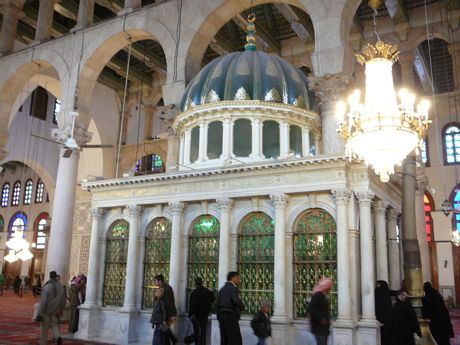
In today’s Lectionary readings, Saint John explains the coming of the light (Jesus Christ) into the world. On this day, when we celebrate that he is risen from the dead, it is a most fitting and wonderful verse to read. Below is the tomb of John-the-Baptist (Yahyah,) in the Umayyad Mosque in Damascus, one of my favorite cities on earth. On this wonderful day of new beginnings, I pray for the peace and prosperity of Syria and all mankind, that we might set aside all the pettiness and grubbing for small things, and look to the larger and harder issues of how to love one another.

00umyahyahstomb

John 1:1-18

1In the beginning was the Word, and the Word was with God, and the Word was God. 2He was in the beginning with God. 3All things came into being through him, and without him not one thing came into being. What has come into being 4in him was life,* and the life was the light of all people. 5The light shines in the darkness, and the darkness did not overcome it.

6 There was a man sent from God, whose name was John. 7He came as a witness to testify to the light, so that all might believe through him. 8He himself was not the light, but he came to testify to the light. 9The true light, which enlightens everyone, was coming into the world.*

10 He was in the world, and the world came into being through him; yet the world did not know him. 11He came to what was his own,* and his own people did not accept him. 12But to all who received him, who believed in his name, he gave power to become children of God, 13who were born, not of blood or of the will of the flesh or of the will of man, but of God.

14 And the Word became flesh and lived among us, and we have seen his glory, the glory as of a father’s only son,* full of grace and truth. 15(John testified to him and cried out, ‘This was he of whom I said, “He who comes after me ranks ahead of me because he was before me.” ’) 16From his fullness we have all received, grace upon grace. 17The law indeed was given through Moses; grace and truth came through Jesus Christ. 18No one has ever seen God. It is God the only Son,* who is close to the Father’s heart,* who has made him known.

March 31, 2013 Posted by | Beauty, Cross Cultural, Easter, ExPat Life, Lectionary Readings, Spiritual, Travel, Values | , , , | Leave a comment

“You’re Not Southern – You’re Arab!”

My mind works in quirky ways, and yesterday as I was setting up for the hands-on Heirloom Feathers workshop with Cindy Needham, one of the good local Pensacola quilters was telling her how you can tell a Southerner from a Northerner.

“If you go to a Southerner’s house, they’ll ask you first thing if you’d like a drink of water, or iced tea or something, but if you go into a Northerner’s house, you can sit there for five hours and they won’t offer you ANYTHING!”

I grinned to myself, no, I have learned to censor these thoughts. But I couldn’t help it.

“You’re not a Southerner,” I am thinking, “You’re ARAB!”

I thought about a long ago trip through Morocco, we have a rental car and on our way from Ouazazarte to Marrakesh, on an isolated stretch of the road, we see a car in trouble. We stop and ask if we can help, if the man would like a lift to the next town. He tells us no, he wants to stay with the car, but asks if we would go to such and such service station and tell his uncle he needs help, and where he is.

Of course.

Screen shot 2013-03-30 at 4.47.18 PM

We drive into town, find the service station, and find the young man’s uncle, who is the owner. He sends help.

Did I mention it was Ramadan? No eating or drinking in public from dawn to dusk?

The owner insisted we come into his house, and seated us in his diwaniyya, and sent in mint tea and luscious almond-filled dates to refresh us. We said “No! No! It’s Ramadan!” but he told us it was his honor. He sat while we drank and ate.

Such enormous hospitality. Such grace. We only stayed a very short time; we still had a long drive, but I’ve never forgotten his hospitality.

Then again, it was Southern Morocco. 🙂 Maybe he was Southern.

March 30, 2013 Posted by | Adventure, Africa, Character, Cold Drinks, Cross Cultural, ExPat Life, Food, Hot drinks, Morocco, Pensacola, Road Trips, Travel | Leave a comment

Reports of Sexual Assault Increasing in India: Warning Issued

Another Woman Who Should Have Known She Was in the Wrong Place? She’s in her hotel room – near the Taj Mahal . . . is this another case of being in the wrong place in India? You’re not safe in your own hotel room? The manager of the hotel comes to your room to wake you for a wake-up call???

20 March 2013

Tourist balcony jump: Hotel manager and guard in court

A hotel manager and guard accused of sexually harassing a British tourist who jumped from a hotel balcony to escape have appeared in court in Agra.

A lawyer acting for hotel manager Sachin Chauhan said his client denied the charge and he had been trying to wake the woman up because she had asked for an early morning call.

The 31-year-old British woman was injured after jumping on Tuesday.

The Briton has been giving her statement at the court.

Initial reports suggested the woman told police she asked for a wake-up call at 04:00 local time and was offered a massage by the hotel owner when he knocked on her door.

She said the man would not leave so she locked the door and jumped from her balcony to the level below, injuring her leg, before fleeing the hotel.

On Tuesday, a spokesman for the British High Commission in India said UK consular officials in Delhi had spoken to the woman and local police.

The Foreign Office recently updated its advice for women visiting India, saying they should use caution and avoid travelling alone on public transport, or in taxis or auto-rickshaws, especially at night.

It added that reported cases of sexual assault against women and young girls were increasing and recent sexual attacks against female visitors in tourist areas and cities showed that foreign women were also at risk.

Police arrested six people following an alleged gang rape of a Swiss tourist in Madhya Pradesh state last week.

The woman was attacked with her husband as they camped in woodland near a village in Datia district.

The arrests came as India’s politicians prepared to debate a new law against rape, following the outcry over the fatal assault on a female Delhi student last year.

March 20, 2013 Posted by | Crime, Cross Cultural, Cultural, ExPat Life, India, Living Conditions, Travel | Leave a comment

It’s Your Fault if You Assume You Are Safe: Indian Officials

Horrifying. Disgusting. At the very least, if you are an official and tourists are gang raped in your area, keep your mouth shut. If you must say something, tell the visitors how sorry you are this happened to them. Never, never, never suggest that they should have ASKED if they were safe, NEVER blame the victim for being in the wrong place at the wrong time. You just look really, really ignorant.

These crimes will keep happening as long as there is such a preference for male children that there are not enough mates for the males once they mature. They will keep happening as long as men are not taught, as children, that women are to be equally respected.

Swiss Gang Rape Victim, Husband Partially To Blame For Attack, Indian Officials Suggest
The Huffington Post | By Cavan Sieczkowski

Posted: 03/18/2013 12:13 pm EDT

Officials in India suggested that a Swiss tourist and her husband are partially to blame for an alleged attack and gang rape in a remote wooded area in Madhya Pradesh last week. They said the couple did not inquire about the safety of the region.

On Friday, a Swiss woman and her husband pitched a tent in a forest in Madhya Pradesh while on a three-month cycling excursion, according to the Associated Press. Around 9:30 p.m. a group of men attacked the couple, beat up the husband, tied him to a tree, gang raped the wife and robbed the pair, police said.

During a press conference on Sunday, police spokesperson Avnesh Kumar Budholiya suggested the tourists are partially to blame for the assault because they chose to travel that area without speaking to local police, the Independent reports.

“No one stops there,” Budholiya said. “Why did they choose that place? They were in the wrong place at the wrong time. They would have passed a police station on the way to the area they camped. They should have stopped and asked about places to sleep.”

Another official also appeared to place blame on the victim and her husband.

“The rape of the Swiss national is unfortunate but foreign travelers should inform the police about their movement so they can be provided with adequate protection,” said Umashankar Gupta, the Home Minister of Madhya Pradesh, according to The Times. “They often don’t follow the state’s rules.”

Madhya Pradesh reportedly has one of the highest rates of crimes against women in the country, a fact the Swiss tourists were unaware of, according to the Times of India.

“They apparently lost track and took a wrong turn and decided to halt for the night by the side of a village brook little realizing that the district with 85:100 men to women ratio is not the safest place for women,” a senior official from the region told the newspaper.

Six men have been arrested in connection with the most recent reported gang rape, CNN reports. The victim, who was hospitalized after the attack, claims four of the men raped her. The other two reportedly robbed her and her husband. All six appeared in court Monday.

The most recent attack comes just three months after a 23-year-old woman was gang raped and beaten on a public bus by five men in New Delhi. The defense lawyer for three of the accused placed some of the blame on the now-deceased victim, saying a “respected lady” does not get raped.

Blaming a female victim of a sex crime is common in India because of a woman’s role in society, according to the Sydney Morning Herald.

“This is the mentality which most Indian men are suffering from unfortunately,” Ranjana Kumari, director for the New Delhi-based Centre for Social Research, told the newspaper. “That is the mindset that has been perpetrating this crime because they justify it indirectly, you asked for it so it is your responsibility.”

March 18, 2013 Posted by | Bureaucracy, Community, Crime, Cross Cultural, Cultural, ExPat Life, India, Law and Order, Leadership, Living Conditions, Mating Behavior, Women's Issues | 1 Comment

Scam from Marina Parma

Urgent Reply.

Greetings to you and your family, I am the manager of bill and exchange in THE
BANK, I have a business of 5.5 Million
United State Dollars to be transfer to your account for investment in your
country, if you are ready to assist me get
back to me, I will give you full details on how the fund will be transfer to
you.

Be rest assured that everything will be handled confidentially because, this is
a great opportunity we cannot afford to
miss, as it will make our family profit a lot.

It has been 6 years go, that most of the greedy African Politicians used our
bank to launder money overseas through the
help of their Political advisers.
Most of the funds which they transferred out of the shores of Africa were gold
and oil money that was supposed to have
been used to develop the continent.

The Political advisers always inflated the amounts before transfer to foreign
accounts so I also used the opportunity to
divert part of the fund worth five million five hundred united state dollars I
told you about and I am aware that there
is no official trace of how much was transferred as all the accounts used for
such transfers of fund at that particle
time were closed after transfer.

I am the account officer to most of the politicians and when I discovered that
they were using me to succeed in their
greedy act, I also cleaned some of their banking records from the Bank files and
no one cared to ask me for the money
was too much for them to control, as I am sending this message to you, I was
able to divert five point five Millions
Dollars ($5.5M) which is in an escrow transit account belonging to no one in the
bank, and now my bank is very anxious
to know the real beneficiary of the funds is for they have made a lot of profits
with the fund.

It has been more than five years ago and most of the politicians are no longer
in power again and they don’t use our
bank to transfer funds overseas anymore since their tenure had expired.

The $5.5 Million United State Dollars has been lying in the bank as unclaimed
fund and i will soon retire from the bank
immediately the fund is transfer into your account over there.

Immediately the fund has been successfully transfer into your account i will
come to your country for the sharing of the
fund, the fund will be shared 50% for me and 40% for you, and the other 10% for
the orphanages home and poor with
less-privilege people.
Please know that there is no one that is going to question you about the fund if
you will comply with me and follow my
instruction which will help us a lot to achieve this goal for everything is well
secured.

Please indicate your interest in this transaction my replying back and if you
are not interested do not waste your time
to reply kindly delete my message from your box ok.

Waiting to hear from you soon.

Yours Faithfully,
Mrs Marina Parma
parmamarina@voila.fr

March 16, 2013 Posted by | Crime, Cross Cultural, Cultural, ExPat Life, Financial Issues, Scams | Leave a comment