Doha, Qatar on House Hunters International
Oh what fun – last night on House Hunters International, I got to search for an apartment in Doha. Well, not really, but virtually. Here is what the episode description says on HGTV:
Just after getting married to Meena, architect Ken jumped at the chance to help design Doha’s new international airport. So, they’re trading in the golden state of California for the golden lands of Qatar. But as these newlyweds discover each other, the new city of Doha is also discovering its own identity as it moves towards the future. From sleek new development to traditional neighborhoods, real estate agent Ana Figueiredo will help them navigate Doha’s changing landscape. Watch as House Hunters International uncovers all that glitters in Doha, Qatar.
I checked YouTube; the episode is not yet up. It was so much fun, seeing this young couple in the Souks, down near Al Saad in Mirqab, and out at the Pearl. The apartment they settled on was in Al Ashmak, near the Corniche; I think it was one of the Bilal apartment buildings.
A Woman Scorned
I subscribe to a website called GoodReads.com, where I keep track of the books I read and get great recommendations from seeing what my GoodReads friends are reading. They also send me a newsletter a couple times a month, one a general newsletter, and one customized based on authors it sees me reading regularly. This morning, I got the general newsletter (which I actually do skim) and when I reached the end, I read this chilling poem.
Chilling?
When we lived in Kuwait, the first two lines of the poem were a reality. A first wife whose husband was taking a second wife set fire to the celebration tent where the women were celebrating. While the bride escaped, several lives were lost in a horrifying fire, fed by an accelerant.
Joan Colby captures the power and rage of the woman, scorned, in every culture.
A Woman Scorned
by Joan Colby (Goodreads Author)
A woman scorned sets fire to the tent
Where the new wife is celebrating.
Carves her name and yours into a tree
Then chops that tree down with her nail file.
Cages a bird and teaches it to speak
In a language where every verb is an obscenity.
Combs her hair with broken glass until
It glitters like a million diamonds
That you stroke until your hands bleed rubies.
Watches how you sit quietly near the water
While she poisons the tea she is about to serve.
Drives a team of black horses down the avenue
Of your lovers whipping them white as judges.
Climbs through the window that you forgot to secure
Wearing a burglar suit sewn of her eyelashes.
Picks a bouquet of jimson weed, hydrangea,
Lily of the valley, poison ivy, rhododendron
To prove the base and beautiful can both be lethal.
Paints graffiti on the wall of your Facebook
And for good measure stamps a letter with your heartsblood.
Enters your dream unbidden
Wearing the scarlet dress you once admired.
Paces up and down, up and down
Before your place of business.
Removes all the signposts pointing to
The street you used to live on when you were happy.
“In the beginning was the Word . . .”
He is risen!
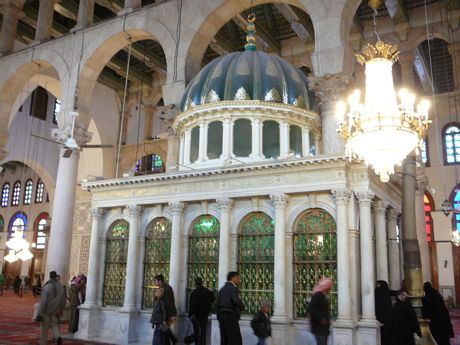
In today’s Lectionary readings, Saint John explains the coming of the light (Jesus Christ) into the world. On this day, when we celebrate that he is risen from the dead, it is a most fitting and wonderful verse to read. Below is the tomb of John-the-Baptist (Yahyah,) in the Umayyad Mosque in Damascus, one of my favorite cities on earth. On this wonderful day of new beginnings, I pray for the peace and prosperity of Syria and all mankind, that we might set aside all the pettiness and grubbing for small things, and look to the larger and harder issues of how to love one another.
John 1:1-18
1In the beginning was the Word, and the Word was with God, and the Word was God. 2He was in the beginning with God. 3All things came into being through him, and without him not one thing came into being. What has come into being 4in him was life,* and the life was the light of all people. 5The light shines in the darkness, and the darkness did not overcome it.
6 There was a man sent from God, whose name was John. 7He came as a witness to testify to the light, so that all might believe through him. 8He himself was not the light, but he came to testify to the light. 9The true light, which enlightens everyone, was coming into the world.*
10 He was in the world, and the world came into being through him; yet the world did not know him. 11He came to what was his own,* and his own people did not accept him. 12But to all who received him, who believed in his name, he gave power to become children of God, 13who were born, not of blood or of the will of the flesh or of the will of man, but of God.
14 And the Word became flesh and lived among us, and we have seen his glory, the glory as of a father’s only son,* full of grace and truth. 15(John testified to him and cried out, ‘This was he of whom I said, “He who comes after me ranks ahead of me because he was before me.” ’) 16From his fullness we have all received, grace upon grace. 17The law indeed was given through Moses; grace and truth came through Jesus Christ. 18No one has ever seen God. It is God the only Son,* who is close to the Father’s heart,* who has made him known.
“You’re Not Southern – You’re Arab!”
My mind works in quirky ways, and yesterday as I was setting up for the hands-on Heirloom Feathers workshop with Cindy Needham, one of the good local Pensacola quilters was telling her how you can tell a Southerner from a Northerner.
“If you go to a Southerner’s house, they’ll ask you first thing if you’d like a drink of water, or iced tea or something, but if you go into a Northerner’s house, you can sit there for five hours and they won’t offer you ANYTHING!”
I grinned to myself, no, I have learned to censor these thoughts. But I couldn’t help it.
“You’re not a Southerner,” I am thinking, “You’re ARAB!”
I thought about a long ago trip through Morocco, we have a rental car and on our way from Ouazazarte to Marrakesh, on an isolated stretch of the road, we see a car in trouble. We stop and ask if we can help, if the man would like a lift to the next town. He tells us no, he wants to stay with the car, but asks if we would go to such and such service station and tell his uncle he needs help, and where he is.
Of course.

We drive into town, find the service station, and find the young man’s uncle, who is the owner. He sends help.
Did I mention it was Ramadan? No eating or drinking in public from dawn to dusk?
The owner insisted we come into his house, and seated us in his diwaniyya, and sent in mint tea and luscious almond-filled dates to refresh us. We said “No! No! It’s Ramadan!” but he told us it was his honor. He sat while we drank and ate.
Such enormous hospitality. Such grace. We only stayed a very short time; we still had a long drive, but I’ve never forgotten his hospitality.
Then again, it was Southern Morocco. 🙂 Maybe he was Southern.
Reports of Sexual Assault Increasing in India: Warning Issued
Another Woman Who Should Have Known She Was in the Wrong Place? She’s in her hotel room – near the Taj Mahal . . . is this another case of being in the wrong place in India? You’re not safe in your own hotel room? The manager of the hotel comes to your room to wake you for a wake-up call???
20 March 2013
Tourist balcony jump: Hotel manager and guard in court
A hotel manager and guard accused of sexually harassing a British tourist who jumped from a hotel balcony to escape have appeared in court in Agra.
A lawyer acting for hotel manager Sachin Chauhan said his client denied the charge and he had been trying to wake the woman up because she had asked for an early morning call.
The 31-year-old British woman was injured after jumping on Tuesday.
The Briton has been giving her statement at the court.
Initial reports suggested the woman told police she asked for a wake-up call at 04:00 local time and was offered a massage by the hotel owner when he knocked on her door.
She said the man would not leave so she locked the door and jumped from her balcony to the level below, injuring her leg, before fleeing the hotel.
On Tuesday, a spokesman for the British High Commission in India said UK consular officials in Delhi had spoken to the woman and local police.
The Foreign Office recently updated its advice for women visiting India, saying they should use caution and avoid travelling alone on public transport, or in taxis or auto-rickshaws, especially at night.
It added that reported cases of sexual assault against women and young girls were increasing and recent sexual attacks against female visitors in tourist areas and cities showed that foreign women were also at risk.
Police arrested six people following an alleged gang rape of a Swiss tourist in Madhya Pradesh state last week.
The woman was attacked with her husband as they camped in woodland near a village in Datia district.
The arrests came as India’s politicians prepared to debate a new law against rape, following the outcry over the fatal assault on a female Delhi student last year.
It’s Your Fault if You Assume You Are Safe: Indian Officials
Horrifying. Disgusting. At the very least, if you are an official and tourists are gang raped in your area, keep your mouth shut. If you must say something, tell the visitors how sorry you are this happened to them. Never, never, never suggest that they should have ASKED if they were safe, NEVER blame the victim for being in the wrong place at the wrong time. You just look really, really ignorant.
These crimes will keep happening as long as there is such a preference for male children that there are not enough mates for the males once they mature. They will keep happening as long as men are not taught, as children, that women are to be equally respected.
Swiss Gang Rape Victim, Husband Partially To Blame For Attack, Indian Officials Suggest
The Huffington Post | By Cavan Sieczkowski
Posted: 03/18/2013 12:13 pm EDT
Officials in India suggested that a Swiss tourist and her husband are partially to blame for an alleged attack and gang rape in a remote wooded area in Madhya Pradesh last week. They said the couple did not inquire about the safety of the region.
On Friday, a Swiss woman and her husband pitched a tent in a forest in Madhya Pradesh while on a three-month cycling excursion, according to the Associated Press. Around 9:30 p.m. a group of men attacked the couple, beat up the husband, tied him to a tree, gang raped the wife and robbed the pair, police said.
During a press conference on Sunday, police spokesperson Avnesh Kumar Budholiya suggested the tourists are partially to blame for the assault because they chose to travel that area without speaking to local police, the Independent reports.
“No one stops there,” Budholiya said. “Why did they choose that place? They were in the wrong place at the wrong time. They would have passed a police station on the way to the area they camped. They should have stopped and asked about places to sleep.”
Another official also appeared to place blame on the victim and her husband.
“The rape of the Swiss national is unfortunate but foreign travelers should inform the police about their movement so they can be provided with adequate protection,” said Umashankar Gupta, the Home Minister of Madhya Pradesh, according to The Times. “They often don’t follow the state’s rules.”
Madhya Pradesh reportedly has one of the highest rates of crimes against women in the country, a fact the Swiss tourists were unaware of, according to the Times of India.
“They apparently lost track and took a wrong turn and decided to halt for the night by the side of a village brook little realizing that the district with 85:100 men to women ratio is not the safest place for women,” a senior official from the region told the newspaper.
Six men have been arrested in connection with the most recent reported gang rape, CNN reports. The victim, who was hospitalized after the attack, claims four of the men raped her. The other two reportedly robbed her and her husband. All six appeared in court Monday.
The most recent attack comes just three months after a 23-year-old woman was gang raped and beaten on a public bus by five men in New Delhi. The defense lawyer for three of the accused placed some of the blame on the now-deceased victim, saying a “respected lady” does not get raped.
Blaming a female victim of a sex crime is common in India because of a woman’s role in society, according to the Sydney Morning Herald.
“This is the mentality which most Indian men are suffering from unfortunately,” Ranjana Kumari, director for the New Delhi-based Centre for Social Research, told the newspaper. “That is the mindset that has been perpetrating this crime because they justify it indirectly, you asked for it so it is your responsibility.”
Scam from Marina Parma
Urgent Reply.
Greetings to you and your family, I am the manager of bill and exchange in THE
BANK, I have a business of 5.5 Million
United State Dollars to be transfer to your account for investment in your
country, if you are ready to assist me get
back to me, I will give you full details on how the fund will be transfer to
you.
Be rest assured that everything will be handled confidentially because, this is
a great opportunity we cannot afford to
miss, as it will make our family profit a lot.
It has been 6 years go, that most of the greedy African Politicians used our
bank to launder money overseas through the
help of their Political advisers.
Most of the funds which they transferred out of the shores of Africa were gold
and oil money that was supposed to have
been used to develop the continent.
The Political advisers always inflated the amounts before transfer to foreign
accounts so I also used the opportunity to
divert part of the fund worth five million five hundred united state dollars I
told you about and I am aware that there
is no official trace of how much was transferred as all the accounts used for
such transfers of fund at that particle
time were closed after transfer.
I am the account officer to most of the politicians and when I discovered that
they were using me to succeed in their
greedy act, I also cleaned some of their banking records from the Bank files and
no one cared to ask me for the money
was too much for them to control, as I am sending this message to you, I was
able to divert five point five Millions
Dollars ($5.5M) which is in an escrow transit account belonging to no one in the
bank, and now my bank is very anxious
to know the real beneficiary of the funds is for they have made a lot of profits
with the fund.
It has been more than five years ago and most of the politicians are no longer
in power again and they don’t use our
bank to transfer funds overseas anymore since their tenure had expired.
The $5.5 Million United State Dollars has been lying in the bank as unclaimed
fund and i will soon retire from the bank
immediately the fund is transfer into your account over there.
Immediately the fund has been successfully transfer into your account i will
come to your country for the sharing of the
fund, the fund will be shared 50% for me and 40% for you, and the other 10% for
the orphanages home and poor with
less-privilege people.
Please know that there is no one that is going to question you about the fund if
you will comply with me and follow my
instruction which will help us a lot to achieve this goal for everything is well
secured.
Please indicate your interest in this transaction my replying back and if you
are not interested do not waste your time
to reply kindly delete my message from your box ok.
Waiting to hear from you soon.
Yours Faithfully,
Mrs Marina Parma
parmamarina@voila.fr
Strangers in America; No American Friends
This article is so sad, and I have also seen it the other way around, hoardes of American students abroad, hanging out with other Americans, then other ex-pats, and lastly, the local inhabitants. It IS hard. The differences can seem overwhelming. (That is my very first blog entry, and it had to do with the risks you expose yourself to when you open yourself to a cross cultural relationship 🙂 ) Overcoming those differences makes life so much richer.
Thank you, Professor John Mueller, for forwarding this fascinating article:
Strangers in a Strange Land
March 4, 2013 – 3:00am
By
Elizabeth Redden
In interviews with 40 international students at four research universities, Chris R. Glass was struck by the relative absence of Americans from his subjects’ stories. The interviewees, half undergraduate and half graduate students, described close relationships with their international peers, including those coming from countries other than their own. But while they frequently characterized their American classmates as friendly or helpful, only rarely did they seem to play a significant role in their lives.
“Only one student has described a significant relationship with a U.S. peer and that student was from Western Europe and that peer was her boyfriend,” said Glass, an assistant professor of educational foundations and leadership at Old Dominion University. “That to me is a striking omission from the stories that they’re telling.”
As the number of international students at U.S. colleges continues to rise — and as the mix of international students has shifted in favor of undergraduates — there are increasing concerns as to how well they’re being integrated into campus life. There have been periodic reports of racist incidents and – overt discrimination aside – there is the question of disconnection raised by Glass’s research. Another study authored by Elisabeth Gareis, a communication studies scholar at Baruch College, found that nearly 40 percent of international students reported having no close American friends. In explanation, many of the students cited “internal factors” such as limited language proficiency or shyness, but they also described a perceived lack of interest on the part of American students.
At the recent Association of International Education Administrators annual conference, a roundtable session on the integration of international students (co-moderated by this Inside Higher Edreporter) drew a standing-room only crowd, as attendees discussed the difficulties they’ve encountered in encouraging and equipping American and international students to (productively) interact. Domestic students are not necessarily cross-culturally competent – a point made lucidly when one audience member described the tendency of American study abroad students to request compatriots as roommates. At the same time, international students may not always be interested in initiating contact. An audience member from a Midwestern institution shared his observation that a fair number of students from China – a rapidly growing and by far the biggest group of international undergraduates on U.S. campuses – seem to be more interested in interacting with one another than with their American classmates.
Yet, even those students who are interested may find social structures on campus to be exclusionary or mystifying or both. On American campuses dominated by fraternity and sorority life, or obsession over intercollegiate athletics, or where everyone seems to have gone to the same high school, international students may feel foreign in ways that go beyond their nationality. “The lack of interaction is as much due to individual attributes as it is to social context,” said Glass, who is conducting his qualitative research in collaboration with Rachawan Wongtrirat, the assistant director of Old Dominion’s international initiatives office. Given the natural tendency of people to gravitate toward others who are like them (what social psychologists call the “similarity-attraction effect”), “are universities creating contexts where these interactions can happen?” he asked.
In interviews with Inside Higher Ed, researchers and professionals in international education spoke about the challenges in this regard and their efforts to create opportunities for meaningful interactions between domestic and international students through programming. It seems that many universities have a long way to go in living up to the promise presented by increasing numbers of international undergraduates – the promise being increased opportunities for sustained and meaningful cross-cultural interactions in classrooms, dorm rooms, and so forth.
‘Encounters With Difference That Make a Difference’
“It’s a combination of factors that have made this issue so salient,” said Larry A. Braskamp, the president of the Global Perspective Institute and a professor emeritus at Loyola University Chicago. “One is there are just a lot more international students on campus now, particularly at institutions that have not historically had a lot. The second is that everybody is interested in global learning: we know we need to prepare students to be more globally competent. And the third is that these students represent on some campuses a fairly significant contribution to the bottom line. Most of these students pay full tuition and as a result a lot of institutions see them as one way to balance the budget. So they have to make sure that the retention rate is high; they have to develop a good reputation so that other students will come.”
In Braskamp’s research, he’s found that entering American freshmen do not tend to think complexly, are not comfortable amidst difference and do not typically have friends who are unlike them. “We’ve said, O.K., the implication of all this is we need to create ‘encounters with difference that make a difference,’ ” he said. “I’ve thought of it as students being on a journey: they start with rather simplistic views of themselves, of their social interactions and the ways in which they understand the world around them. So in some ways what we need to do in college is increasingly provide them opportunities for encounters to get them to rethink who they are, how they think, and how they relate to others. In many ways, international students coming on campus is an opportunity for students, faculty members, and international administrators to take advantage of that difference and that diversity. But it’s really hard work.”
Such encounters can be curricular, co-curricular or informal: in fact, Braskamp’s research suggests that informal encounters such as discussion of current events with other students may be the most impactful. Still, he emphasized that there’s much more that can be done in the classroom to facilitate such encounters. In a sample of about 48,000 undergraduates at more than 140 four-year colleges, he found that about one-third report never having taken a course that “focuses on significant global/international issues or problems” or that “included opportunities for intensive dialogue among students with different backgrounds and beliefs.”
As one audience member at the AIEA conference said, unless faculty members are on board, all the student services programs in the world won’t be enough: “Students really look to their professors to give them direction and advice and deepen their conversations, so if faculty were taught to embrace these conversations about ‘difference’ and ‘other’ and ‘cross-cultural competencies’ and international challenges in engineering, then those conversations would take on meaning for the students,” she said. Participants in the session described the value of professional development programs such as Duke University’s Intercultural Skills Development Program for faculty and staff.
Case Western Reserve University is another institution that has begun to offer training designed to help professors better serve international students and integrate them into the classroom: according to Molly Watkins, the university’s director of international affairs, the first two trainings focused on Chinese students and attracted 60 to 70 faculty members each. “There’s obviously a need,” Watkins said.
Opportunities for Meaningful Interaction
At the AIEA session, audience members discussed co-curricular strategies such as peer mentoring or “buddy” programs, living-learning communities and other residence life initiatives, and more robust orientations for international students. Many universities have some iteration of one or all of the above: Mount Holyoke College, for example, has a new “Global Partners” program that pairs returning study abroad students with new international students and holds “re-orientation” events for international students during the academic year. The University of Iowa is launching a new required online orientation program that will begin in the summer before the students arrive and continue with five to eight small-group sessions throughout the fall semester.
The University of Arkansas at Fayetteville, which had 611 international undergraduates last fall, has a host of programs with alliterative names like Campus Cousins, Friendship Families and Global Greeks, which pair international students with American students, local families and fraternity or sorority members, respectively. Wesleyan University is “trying to capitalize on the idea of roommates,” hosting a dinner for first-year international students and their roommates at the beginning of the fall semester, according to Alice Hadler, the associate dean for international student affairs and an instructor of English. St. Norbert College, a Roman Catholic institution in Wisconsin, has a living-learning community with 25 international and domestic students (international students are the resident advisers) and a 10-member interfaith group consisting of Muslim students from Saudi Arabia and domestic Christian students. Initiatives such as these reach only a small number of students, concedes Marcy O’Malley, St. Norbert’s director of international programming, but, she said, “What I’ve seen work is one-on-one.”
“Instead of superficial contact with a lot of people, do more meaningful contact with a smaller number, and let them be your ambassadors to the larger student body,” she said.
Christopher J. Viers, the associate vice president for international services at Indiana University at Bloomington, has used theInternational Student Barometer to survey students about their experiences, and cited the surprising finding that international students rate their relationships with American students as those that are most important to them (as compared to relationships with other students from their home country or international students in general). “In looking at the feedback that came in we thought very critically about what we could do to help facilitate opportunities for international and domestic students to interact in meaningful ways to hopefully have conversations and potentially build relationships,” Viers said.
In talking with colleagues across the country, Viers said he’s come to the conclusion that “too often our programming is limited to the one-time, big, annual event.” This event, which often takes the form of an international student fair or show, can be good in celebrating international students’ contributions to campus and perhaps can help a domestic student learn a bit about another culture or cultures, but, he said, “opportunities for meaningful transformative learning are pretty limited.” As such, he continued, “We work hard to provide the big annual event that helps to showcase the contributions of our students and the diversity of the population with the excitement and food and entertainment, but not a week goes by when we’re not putting together, hand-in-hand with students, small, highly interactive opportunities for domestic and international students to get together. We run a weekly noon concert series, for example, where students from our Jacobs School of Music perform classical music or folk music from their home country and then there’s a free lunch that’s provided. That regularly gets people who have an interest in music together.”
“It’s absolutely essential as colleges are putting in place plans to actively grow international enrollment that appropriate levels of service and support are put in place, and then the students have responsibilities as well,” Viers said. “So much of just about anything in life in terms of what you gain from an experience has much to do with what you put into it yourself. This is where at times perhaps those of us in the field of international education are not vocal about some of the very real, very significant additional hurdles and challenges that students from other countries face while they’re here: the enormous pressures that they’re under to succeed academically and to move as quickly as possible though a program. It’s very expensive to come to the U.S. to pursue an undergraduate degree. There are often major expectations from family members and others; there’s a lot of pressure to succeed and do well.” And then there are the extra academic challenges inherent in pursuing a degree in a non-native language. Is it any wonder that not every student will want to come out for mixers and “cultural coffee hours”?
“I think that sometimes we underestimate that pressure, and apply a different kind of meaning to the experience that we perceive a student is having,” Viers said.
Seafood Platter Deli AKA Gulf Coast Seafood Deli on 9 Mile Road
“We’re going to drive ‘all the way’ out there,” AdventureMan tells me and we laugh, because ‘all the way’ is such a relative term. When we lived in Kuwait and in Qatar, we would drive a minimum 30 minutes to get to a restaurant, any restaurant, not only because of distances but also because of traffic, horrendous traffic, in the evenings. While the Seafood Platter Deli is 13 miles away, it takes us less than 20 minutes to get there. Welcome to Pensacola 🙂


This is a very unusual restaurant. It is so old-timey Gulf Seacoast, and at the same time, I thought as we entered “My Moslem friends would love this!”
Many of my Moslem friends think Americans are unbelievers. They think we don’t talk about God. They don’t know we pray – sometimes without ceasing. Just as I was astounded as I learned things about Islam and Moslem culture living in the Middle East, they were also astounded learning things about us, like that we take care of our families. Think about it – most of what many people in the world know about Americans comes from the impact of cable TV. They watch American TV and they think they understand American culture. Horrifying thought, isn’t it?
So how amazing is it to walk into a restaurant where, as you stand at the counter to order, and you look at the big menu on the wall, there is a stand, with a bible on it. And there is paper, and a pencil, and a sign saying “Prayer requests.” I don’t know about your restaurant experiences, but this is unique in my experience – in America. In the Middle East, there are all kinds of restaurants with Qu’ranic verses on the walls, and the sounds of religious services piped into the restaurant. People talk about God all the time. It’s a whole different world; and my Moslem friends would feel right at home in the Seafood Platter Deli.

Of course, in Saudi Arabia, we would rush to buy our pre-sunset felafels, and then sit and munch, listening to all the souk grates coming down as shops closed for the Mahgrib prayer. Everything closed, five times a day, in Saudi Arabia, for prayer.
At the Gulf Coast Seafood Deli / Seafood Platter Deli (I don’t know what the real name is, and both names appear when you Google it) there are scriptures on the wall. When you sit down, the little basket holding condiments tells you to “count your blessings.”

The interior dining room (as opposed to the deli section, and the counter where you order food when you come in) is wall-to-wall sea mural, family friendly, Fish and sea life everywhere. There are also families who pray when their meal is delivered to the table, before they eat. The wait-staff is patient, and personal. You get the impression they truly want you to have a good experience at this restaurant.
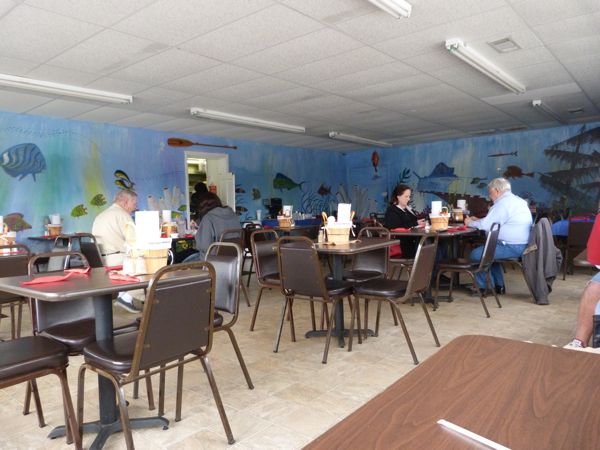
We were hungry. We are mildly disgruntled to see piping hot food delivered to tables around us who arrived after we did, but not very. Even though we are hungry, we know that our ordering our food grilled or blackened slows things up in the kitchen, where the majority of the meals are fried. It is really really hard for people like us to watch other customers thoroughly enjoying their fried shrimp, fried catfish, fried grouper, fried scallops, etc. They look SO delicious. Every now and then, maybe once every couple months, we slip up and eat something deep fried, just because yes, yes, it tastes so good, and we know it is like the WORST thing for us. What a pity that deliciousness can be so lethal.
Ah! There it is! Our meals! We tuck right in and then I remember “Oh no! I haven’t taken any pictures!” AdventureMan is used to this, and bless his heart, he stops eating so I can shoot what is left of his grilled scallops, so tasty and delicious, so fresh!
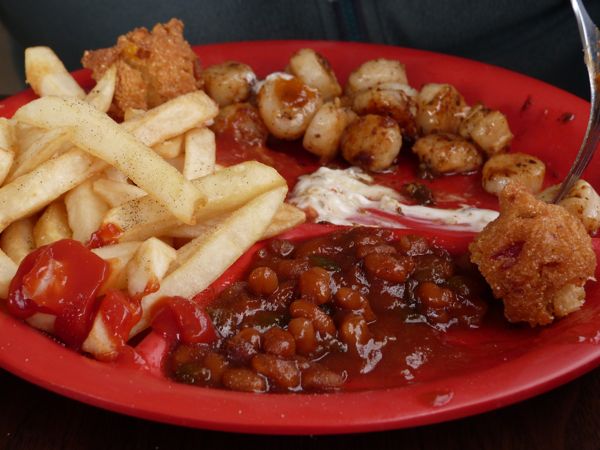
I had so much salmon on my platter that I had salmon and steamed vegetables for dinner, too! The salmon was copious, lightly blackened, seared on the outside, moist on the inside, just the way I love it. It was some of the best salmon I have had in Pensacola (not exactly salmon country, but that little Alaska girl still lives in my heart and I can’t resist salmon when I see it on the menu.)

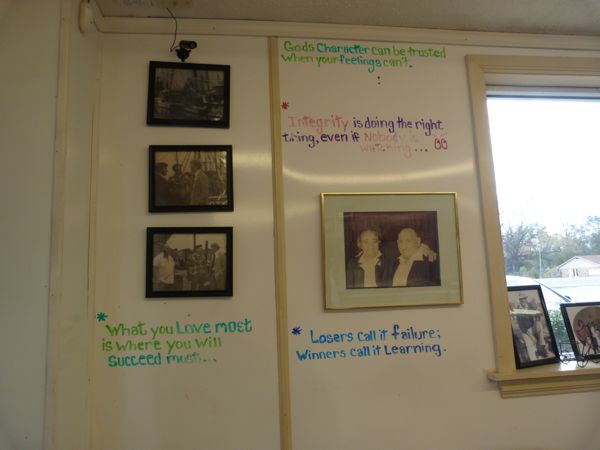
There’s another thing we loved about the Seafood Platter Deli – remember Dembo’s Smokehouse? We love restaurants that honor their heritage, and the Seafood Platter Deli has this wonderful wall:
Last, but not least, the food was so good, and so plentiful, that we couldn’t eat it all and ended up taking some home. We also took home some dessert, one dessert, $1.99 for a goodly portion of Vanilla Wafer pudding, that old-fashioned kind, maybe Banana pudding. It was so GOOD, we wish we’d gotten two. 🙂
Gulf Coast Seafood Deli / Seafood Platter Deli
Address: 2250 W Nine Mile Rd, Pensacola, FL 32534
Phone:(850) 969-3299
We love this place, and look forward to driving ‘all the way out there’ for more fabulous Gulf seafood.
START with Sea of Poppies, by Amitav Ghosh

I recently wrote a book review on River of Smoke, by Amitav Ghosh, which held me spellbound, so riveting that I had to order Sea of Poppies, which is actually the first volume of the trilogy. I had heard a review of River of Smoke on NPR and although it was written as the second volume in a trilogy, it can be read as a stand-alond.
Yes. Yes, it can be read as a stand-alone, but it is so much easier, I can state with authority, if you read them in order. Once I started Sea of Poppies, I also discovered an extensive glossary in the back, several pages, a list of the words, annotated with suggested origins, and it adds so much color to an already brilliantly colored novel. Much of both novels uses words from many cultures, and words that have been formed by another culture’s understanding of the words (some hilarious). If you like Captain Jack Sparrow, you’re going to love the polyglot language spoken by ship’s crews from many nations trying to communicate with one another. It can be intimidating, but if you sort of say the words out loud the way they are written at the beginning, you begin to find the rhythm and the gist of the communication, just as if you were a new recruit to the sea-going vessels of the early 1800’s. I loved it because it captured the difficulties encountered trying to say the simplest things, and the clever ways people in all cultures manage to get around it, and make themselves understood.
Sea of Poppies starts in a small Indian village, with one of the very small poppy gardens, planted on an advance from an opium factory representative, thrust upon the small farmer, with the result that most small Indian farmers converted their entire allotment from subsistence foods to poppies. Ghosh walks us through an opium processing factory, which is a little like walking through the circles of hell. We meet many of the characters we will follow in River of Smoke, and learn how this diverse group bonded into one sort of super-family through their adventures – and misadventures – together.
It is an entirely engrossing work. Sea of Poppies was short listed for the Man Booker award, and was listed as a “Best Book of the Year” by the San Francisco Chronicle, Chicago Tribune, Washington Post and The Economist. The theme is the opium trade, leading to the Opium Wars, with China, and is a chilling indictment of how business interests manipulate a population’s perceptions of national interests to justify . . . well, just about anything, in the name of profit.
The theme is woven through human stories so interesting, so textured, so compelling, that you hardly realize you are reading history and learning about the trade, cultures, travel, clothing, traditions, religions, food, and motivations as you avidly turn the pages.
I can hardly wait for the third volume. Get started now, so you’ll be ready for it when it comes out!
Recent Comments
intlxpatr on Shampoo Ginger tigerbutterya0c5ff1d… on Shampoo Ginger intlxpatr on British Soldier Kidnapped, Esc… John on British Soldier Kidnapped, Esc… intlxpatr on British Soldier Kidnapped, Esc… Wikipedia Donate Button

Amazina


Early Voting in Florida


