Libyans Say “Sorry” In Counter-Protests
I was living in Qatar, and the Libyan ambassador’s wife had invited me, along with several other women, to morning coffee. It’s what people did. I was sitting between one of my Libyan friends and my good Iranian friend, and I started laughing. I said “Oh, what is this good little American girl doing sitting between a Libyan and an Iranian?” and then we all laughed. We weren’t Libyan, or American, or Iranian, we were just women who liked each other; we got along.
We were all religious women. Not the same religion, but all believers in the Abrahamic tradition. I felt more comfortable with them than I felt around non-religious women. We had a lot of fun together, and we liked each other.

It breaks my heart when bad things happen, and I know how good these people are, and that the people on the attack have their own agenda which has nothing to do with Islam, or Christianity, and everything to do with power. If they prevail, I fear for my good friends.
This article from USA Today made me cry this morning. Ambassador Stevens was loved, and these brave people are risking their futures to tell us so.
Libyans express sorrow over killing of Americans
by Donna Leinwand Leger, USA TODAY
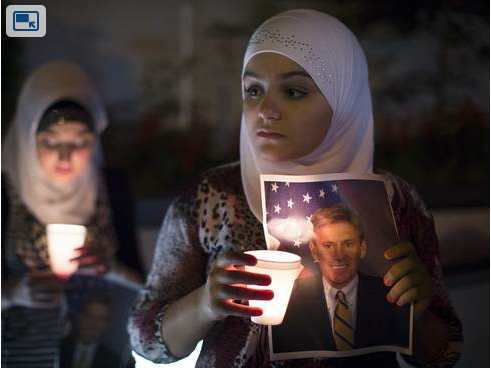
Hours after learning of Ambassador Chris Stevens’ death, the Libyan Youth Movement transformed its Facebook page into a tribute to the slain diplomat. It changed its cover photo from “Free Libya” graffiti sprayed on a Tripoli wall to a somber photo of Stevens with the tag “RIP Christopher Stevens1960-2012.”
“As North America wakes up, dread washes over me. What a rough night. I’m sorry for the horrible day the world is about to face,” the administrator of the Shabab Libya page wrote. “We are sorry.”
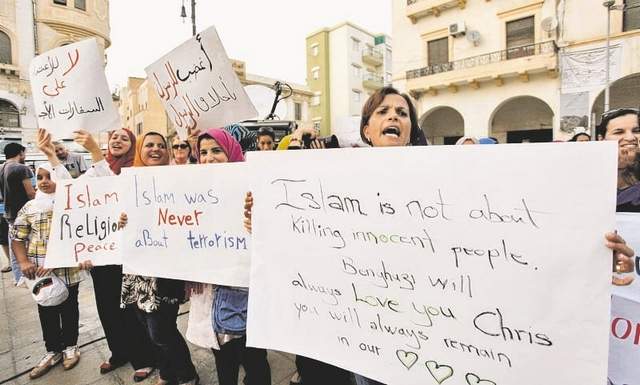
As anti-American protests swept across North Africa and the Persian Gulf, a counter-protest of apology emerged. Photos of Libyans carrying hand-lettered signs condemning the violence and expressing contrition for their countrymen appeared on Facebook. “Sorry” became the trending mantra of Libyans on Twitter.
At one counter-protest, an unidentified man carried a crude sign phonetically written in English with blue marker on lined notebook paper, “Sorry People of America this not the Pehavior of our ISLAM and Profit.”
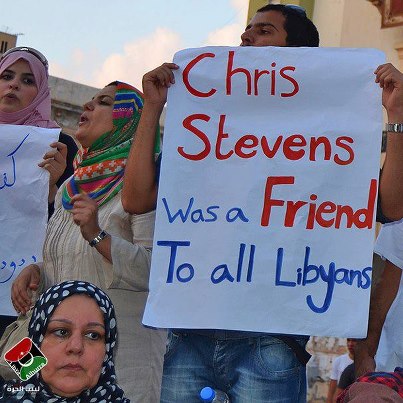
Another sign in red, white and blue read: “Chris Stevens wasa friend to all Libyans.”
On Facebook, one group formed The Sorry Project, designed to collect thousands of personal, written apologies from Libyans. Its profile photo is a man holding a sign, “USA. We are sorry. We are sad.”
“We Are Sorry,” the group wrote on the page created Sept.11. “We would like show that as Libyans we do not support on the actions committed by these criminals. USA, we are sorry and we will say it one thousand times over. Our apologies will never be enough, but the Libyan people will always be grateful for you since you were the first to stand by us in our fight for freedom and hopefully you will continue supporting us.”
One commenter, Hajer Sharief, vowed to avenge Stevens’ death by rebuilding a “new civilized democratic Libya.”
“We promise, we will not tire, we will not falter, and we will not fail,” Sharief wrote. “This is the way real Libyans will pay you back Mr. Ambassador Chris Stevens.”
At the ceremony Friday outside Washington to repatriate the remains of the four American victims, President Obama acknowledged Libya’s internal conflict.
“I know that this awful loss, the terrible images of recent days, the pictures we’re seeing again today, have caused some to question this work. And there is no doubt these are difficult days. In moments such as this — so much anger and violence — even the most hopeful among us must wonder,” Obama said. “But amid all of the images of this week, I also think of the Libyans who took to the streets with homemade signs expressing their gratitude to an American who believed in what we could achieve together. I think of the man in Benghazi with his sign in English, a message he wanted all of us to hear that said, ‘Chris Stevens was a friend to all Libyans.’ “
US Ambassador Killed by Angry Mob in Libya
Most people who die heroic deaths don’t wake up in the morning thinking “today I will do something heroic.” Most people who die heroic deaths end up dead because they make a choice to do the right thing.
Some minor film maker made a film mocking the prophet Mohammed. Under our system, it was his right; a man (or woman) can say what they think, even if another disagrees with it. It doesn’t mean the film is accurate, it doesn’t make it a good film; he had an idea and he made a film. The film – or even the idea of the film – is causing outrage, and attacks on US Embassies in Islamic countries. Ambassador Chris Stevens personally went to the consulate site to make sure his people got out safely while the consulate was under attack by an angry mob. He lost his life in the effort. May he rest in peace.
I’ve never liked crowds, and even less when a crowd is excited, or angry, and becomes a mob. There is something about doing things as a large group that anesthetizes thinking; mobs do horrendous things that any one individual acting within the mob would never do. Group-think is dangerous thinking; you need disagreement and dissent to rein in rash actions.
From today’s Huffpost:
TRIPOLI, Libya — The U.S. ambassador to Libya and three American members of his staff were killed in the attack on the U.S. consulate in the eastern city of Benghazi by protesters angry over a film that ridiculed Islam’s Prophet Muhammad, Libyan officials said Wednesday.
They said Ambassador Chris Stevens was killed Tuesday night when he and a group of embassy employees went to the consulate to try to evacuate staff as the building came under attack by a mob guns and rocket propelled grenades.
The three Libyan officials who confirmed the deaths were deputy interior minister for eastern Libya Wanis al-Sharaf; Benghazi security chief Abdel-Basit Haroun; and Benghazi city council and security official Ahmed Bousinia.
The State Department said Tuesday that one American was killed in the attack. It has not confirmed the other deaths.
The attack on the Benghazi consulate took place as hundreds of protesters in neighboring Egypt scaled the walls of the U.S. Embassy in Cairo and tore down and replaced the American flag with a black Islamic banner.
The attacks in Benghazi and Cairo were the first such assaults on U.S. diplomatic facilities in either country, at a time when both Libya and Egypt are struggling to overcome the turmoil following the ouster of their longtime authoritarian leaders, Moammar Gadhafi and Hosni Mubarak, in uprisings last year.
The protests in both countries were sparked by outrage over a film ridiculing Muhammad produced by an Israeli filmmaker living in California and being promoted by an extreme anti-Muslim Egyptian Christian campaigner in the United States. Excerpts from the film dubbed into Arabic were posted on YouTube.
Stevens, 52, was a career diplomat who spoke Arabic and French and had already served two tours in Libya, including running the office in Benghazi during the revolt against Gadhafi. He was confirmed as ambassador to Libya by the Senate earlier this year.
Before Tuesday, five U.S. ambassadors had been killed in the line of duty, the last being Adolph Dubs in Afghanistan in 1979, according to the State Department historian’s office.
___
Michael reported from Cairo. Associated Press writer Matthew Lee in Washington contributed to this report.
Ten Shot While Kuwaiti Youngsters Are ‘Just Having Fun’
As AdventureMan and I read the Pensacola News Journal, we often wonder if we knew what we were getting into. Shootings in Pensacola are frequent. Killings, by gun, by beating, by knife – are equally frequent. Pensacola has one of the highest violent death rates per capita in the nation. Just this week a 72 year old man shot a preacher at his church because he thought the preacher was having an affair with his 69 year old wife. He then tried to enter the child care center where she was caring for small children, still with his loaded weapon. The paper quotes his wife as saying he has mental health issues.
What are people with mental health issues doing with loaded guns???
My Southern friends ask me if we more strictly regulate guns, how will they protect themselves, that the ‘bad guys’ will still have guns. Right now, they can protect themselves, they also have the right to shoot to defend their property? I can’t answer. All I know for sure is that the more people who carry guns, the more likely guns are to be used when the instinct strikes, whether it is a real threat or a perceived threat.
And then – there are these Kuwaiti teens, shooting passers-by, and when arrested, still carrying the shotgun used, say that they were ‘just having fun.’
KUWAIT: Jahra detectives, in cooperation with criminal investigation detectives, have arrested two Kuwaiti 17-year-old juveniles on charges of misuse of a hunting gun, which resulted in the shooting and wounding of 10 people in Jahra area. Police received several reports of pedestrians being wounded after they were shot by unknown assailants. Following an investigation, the juveniles were arrested with the gun still in their possession. They confessed to the shootings, claiming they were only having a good time. The teens were sent to concerned authorities. Later, Ministry of Interior officials called upon citizens and expatriates to watch their children and prevent them from behaving in ways that might cause harm to others, as the parents could be held liable for their children’s acts.
By Hanan Al-Saadoun, Staff Writer
Kuwait Times
The link refers to ‘hunting gun misuse.’ Because they are Kuwaiti, and because they are young, they are unlikely to have any severe punishment. They are likely to be released into the custody of their parents. Where were these parents when their children wounded ten innocent people? What lesson do these young men, 17 years old, learn if they can shoot ten people and be charged with ‘misuse’ of a weapon?
The only good thing I can think of in this case is that these youngsters had so little self-discipline that they never learned to shoot straight, thus no one was killed. They weren’t just lacking in any compassion for their fellow human beings, they were also bad shots. (I’m from a hunting culture. That’s an insult.)
Turkish Rape Victim Kills and Beheads Her Rapist to Protect Her Honor
Not all women will show this kind of courage and determination when bullied and intimidated by a powerful rapist. Now, she faces the penalty, but her actions have ignited a debate in Turkey. I found this on Huffpost, a re-publication of a CNN story:
A 26-year-old Turkish woman, who was impregnated by her rapist, reportedly shot and beheaded her alleged attacker to protect her honor. The case has forced the country into a new round in the intensifying debate over abortion.
Nevin Yildirim, a mother of two from Turkey’s Yalvac district, faces charges of murder for the August killing of 35-year-old Nurettin Gider. Yildirim, according to CNN, is at least five months pregnant and claims she was rape-impregnated by Gider.
Yildirim told police that Gider, a father of two who was married to her husband’s aunt, first raped her in January, when her husband left town to work a seasonal job.
Yildirim said Gider threatened to kill her children if she alerted anyone to the crime. The rapes allegedly continued over the course of the next several months and Gider reportedly threatened to publish photos he took of Yildirim’s pregnant body if she did not do as he said, Turkish broadcaster DHA reported.
On Aug. 28, Yildirim claims spotted Gider climbing up a wall behind her house and grabbed a rifle that was hanging on the wall.
“I knew he was going to rape me again,” Yildirim said at an Aug. 30 preliminary hearing.
Yildirim allegedly shot Gider twice and chased him from her property. She claimed in court he was armed at the time.
“He fell on the ground. He started cussing,” she said. “I shot his sexual organ this time. He became quiet. I knew he was dead. I then cut his head off.”
Witnesses told police they saw Yildirim walk into the village square, carrying Gider’s bloody head by his hair.
“Don’t talk behind my back, don’t play with my honor,” Yildirim allegedly told witnesses in the square as she threw Gider’s head to the ground. “Here is the head of the man who played with my honor.”
Authorities arrived on the scene shortly thereafter and Yildirim was taken into custody without incident.
“He kept saying that he would tell everyone [about the rape],” Yildirim told authorities, according to Doğan News Agency. “My daughter will start school this year. Everyone would have insulted my children. Now no one can.”
“I saved my honor,” she added. “They will now call [her children] ‘the kids of the women who saved her honor.'”
According to CNN, Yildirim went to a health clinic for an abortion prior to the murder but was turned away because she was 14 weeks pregnant at the time. In Turkey, abortion is only permitted during the first 10 weeks of pregnancy. Anything beyond that requires a special circumstance.
Turkey’s abortion debate has now been re-kindled as the public prosecutor’s office considers Yildirim’s request. Authorities are waiting for experts to weigh in on her mental stability.
“The extremity of Nevin’s actions show the extent of the trauma the rape has caused,” Dr. Gürsel Öztunalı Kayır, Foundation for Women’s Solidarity, told International Business Times. “We shouldn’t be distracted by the murder; if she wants to have an abortion following months of abuse, she should have the right.”
Prime Minister Recep Tayyip Erdogan, however, considers abortion “murder” and wants the practice outlawed. Melih Gökçek, mayor of the capital, Ankara, supports the proposed ban, saying a mother who considers abortion should “kill herself instead and not let the child bear the brunt of her mistake,” IBT reported.
Women’s groups in Turkey consider Yildirim a heroine. The case also resonates in the United States, where abortion remains a topic of heated debate.
African Sweet Potato Peanut Soup
This is another wonderful recipe I found on allrecipes.com. My sweet daughter-in-law told me about allrecipes.com, and once I signed up, they started sending me recipes every day. Not all of them are of interest to me, but most of those I have tried have been really good.
We LOVE this soup. It is delicious, and easy to fix. While it is an African recipe, we find that many of the most delicious Southern dishes are similar to African dishes, probably because there were so many African ex-pats brought to the USA and settled in the South a few hundred years ago. Their legacy lives on in Southern cookbooks.
African Sweet Potato and Peanut Soup
Ingredients
• 1 tablespoon good olive oil
• 1 large onion, chopped
• 6 cloves garlic, minced
• 2 teaspoons minced fresh ginger root
• 2 teaspoons ground cumin
• 2 teaspoons ground coriander
• 1 teaspoon ground cinnamon
• 1 pinch ground cloves
• 3 medium tomatoes, chopped
• 1 1/2 pounds sweet potatoes, peeled and chopped
• 1 carrot, peeled and chopped
• 4 1/2 cups chicken broth
• 1 teaspoon salt
• 1/4 cup chopped unsalted dry-roasted peanuts
• 1 pinch cayenne pepper
• 2 tablespoons crunchy peanut butter
• 1 bunch fresh chopped cilantro
1. Heat the oil in a large saucepan over medium-high heat. Saute the onion 10 minutes, until lightly browned. Mix in the garlic, ginger, cumin, coriander, cinnamon, cayenne and cloves. Stir in the tomatoes, sweet potatoes, and carrot, and continue to cook and stir about 5 minutes.
2. Pour chicken broth into the saucepan, and season the mixture with salt. Bring to a boil, reduce heat, and simmer 30 minutes. Add peanut butter.
3. Remove the soup mixture from heat. With a blender wand, blend the soup and peanuts until almost smooth. Stir in fresh cilantro. Serve hot.
FBI Sending Me a LOT of Money! Or Arresting Me?
Would the real FBI blind-copy me on something of this nature? Would they have sent it from an e-mail address that looks like this:
Fb.Info FbteamC@carrot.ocn.ne.jp
LLLLOOOOLLLLLLLLL! I needed a good laugh for today.
Special Agent in Charge
Federal Bureau of Investigation
Intelligence Field Unit
El Paso Federal Justice Center
660 South Mesa Hills Drive
El Paso, TX 79912 USA
URGENT ATTENTION
I am special agent Mark A. Morgan, from the Intelligence Unit of the Federal Bureau of Investigation (FBI). We just intercepted/confiscated one (1) Trunk Box at the Dallas/Fort Worth International Airport Texas. We are on the verge of moving this consignment to the bureau headquarters. However, we scanned the said box and found out that it contained a total of USD$10.5M. Investigation carried out on the Diplomat who accompanied this box into the United States, revealed that he was to make the delivery of the fund to your residence, as these fund are entitled to you, been Contract/Inheritance over due payments. The funds were from the office of the Dr. (Mrs.) Ngozi Okonjo-Iweala Minister of Finance, Federal Republic of Nigeria.
Furthermore, after cross checking all the information we found in the box backing you up as the beneficiary of the funds, it became known to us that one of the documents is missing. This document is very important and until we get the document, the box will be temporarily confiscated pending when you will provide it. The much needed document is the Diplomatic Immunity Seal of Delivery Certificate (DISDC). This document will protect you from going against the US Patriot Act Section 314a and Section 314b. This delivery will be tagged A Diplomatic Transit Payment (D.T.P) once you get the document.
You are therefore required to get back to me on this email (officefdagnt@gmail.com) within 72 hours so that I will guide you on how to get the much needed document. Failure to comply with this directive may lead to the permanent confiscation of the funds and possible arrest. We may also get the Financial Action Task Force on Money Laundering (FATF) involved if do not follow our instructions. You are also advised not to get in contact with any Bank in Africa, Europe or any other institution, as your fund are here now in the United States of America.
Agent Mark A. Morgan
Special Agent in Charge
Federal Bureau of Investigation
Intelligence Field Unit
El Paso Federal Justice Center
660 South Mesa Hills Drive
El Paso, TX 79912 USA
Email:officefdagnt@gmail.com
Confidentiality Notice: This communication and its attachments may contain non-public, confidential or legally privileged information. The unlawful interception, use or disclosure of such information is prohibited. If you are not the intended recipient, or have received this communication in error, please notify the sender immediately by reply email and delete all copies of this communication and attachments without reading or saving them.
That Cheeky Woman At The Well
Today’s Gospel reading from the Lectionary is one of my favorites, and every time I read it, I am amazed. Amazed that this good Jewish boy would speak to a woman who cavorted with men, having five husbands, and being with a man now who was not her husband. It’s the middle of the day, and he is sitting by a well having a conversation with a woman most good Jewish boys would run from, a woman of ill-repute!

She must have had a rough life, five husbands, etc. but it hasn’t broken her spirit, and she is joking around with Jesus. She knows something about Jewish traditions, but has no idea who Jesus might be. Then, oddity of oddity, he reveals himself to her as the Messiah – to this woman. He reveals himself to a woman at the very lowest end of the social scale, a woman barely tolerated in her own society. This woman believes him; for all her sins, she ‘hears’ the truth of what he is saying in her heart.
John 4:1-26
4Now when Jesus* learned that the Pharisees had heard, ‘Jesus is making and baptizing more disciples than John’— 2 although it was not Jesus himself but his disciples who baptized— 3he left Judea and started back to Galilee. 4But he had to go through Samaria. 5So he came to a Samaritan city called Sychar, near the plot of ground that Jacob had given to his son Joseph. 6Jacob’s well was there, and Jesus, tired out by his journey, was sitting by the well. It was about noon.
7 A Samaritan woman came to draw water, and Jesus said to her, ‘Give me a drink’. 8(His disciples had gone to the city to buy food.) 9The Samaritan woman said to him, ‘How is it that you, a Jew, ask a drink of me, a woman of Samaria?’ (Jews do not share things in common with Samaritans.)* 10Jesus answered her, ‘If you knew the gift of God, and who it is that is saying to you, “Give me a drink”, you would have asked him, and he would have given you living water.’ 11The woman said to him, ‘Sir, you have no bucket, and the well is deep. Where do you get that living water? 12Are you greater than our ancestor Jacob, who gave us the well, and with his sons and his flocks drank from it?’
13Jesus said to her, ‘Everyone who drinks of this water will be thirsty again, 14but those who drink of the water that I will give them will never be thirsty. The water that I will give will become in them a spring of water gushing up to eternal life.’ 15 The woman said to him, ‘Sir, give me this water, so that I may never be thirsty or have to keep coming here to draw water.’
16 Jesus said to her, ‘Go, call your husband, and come back.’ 17The woman answered him, ‘I have no husband.’ Jesus said to her, ‘You are right in saying, “I have no husband”; 18for you have had five husbands, and the one you have now is not your husband. What you have said is true!’ 19The woman said to him, ‘Sir, I see that you are a prophet. 20Our ancestors worshipped on this mountain, but you* say that the place where people must worship is in Jerusalem.’
21 Jesus said to her, ‘Woman, believe me, the hour is coming when you will worship the Father neither on this mountain nor in Jerusalem. 22You worship what you do not know; we worship what we know, for salvation is from the Jews. 23But the hour is coming, and is now here, when the true worshippers will worship the Father in spirit and truth, for the Father seeks such as these to worship him. 24God is spirit, and those who worship him must worship in spirit and truth.’ 25The woman said to him, ‘I know that Messiah is coming’ (who is called Christ). ‘When he comes, he will proclaim all things to us.’ 26Jesus said to her, ‘I am he,* the one who is speaking to you.’

Olympic Committee OK’s Hijab for Saudi Judo Contestant
From AOL/Huffpost
LONDON — A female judo fighter from Saudi Arabia will be allowed to compete in the Olympics wearing a form of headscarf after a compromise was reached that respects the “cultural sensitivity” of the Muslim kingdom.
Judo officials had previously said they would not let Wojdan Ali Seraj Abdulrahim Shahrkhani compete in a headscarf because it was against the principles of the sport and raised safety concerns.
But an agreement was reached after several days of IOC-brokered talks between the International Judo Federation and the Saudi Olympic Committee that clears the way for her to compete Friday in the heavyweight division.
“They have a solution that works for both parties, all parties involved,'” International Olympic Committee spokesman Mark Adams said. “The athlete will compete.”
The agreement was later formally announced in a joint statement by the judo federation and the Saudi committee.
“Working with the IOC, a proposal was approved by all parties,” the statement said. “The solution agreed guarantees a good balance between safety and cultural considerations.”
Ali Seraj Abdulrahim Shahrkhani, the judoka’s father, declined to describe what changes – if any – will be made to his daughter’s head cover for the competition.
He told The Associated Press his daughter has been training with women at a special facility in London for an hour and a half every day since she arrived with her parents and her brother. Shahrkhani said his daughter, who has a blue belt in judo, is preparing for Friday’s fight in seclusion.
“It’s her first time in competition and it’s the Olympic Games, so she is focused on that,” Shahrkhani said.
Saudi Arabia, which had never sent female athletes to the Olympics before, brought its two first female Olympians to London on condition they adhere to the kingdom’s Islamic traditions, including wearing a headscarf.
Shahrkhani’s participation was thrown into doubt last week when judo officials said a headscarf could be dangerous because of chokeholds and aggressive grabbing techniques.
Without giving precise details, Adams said the headscarf agreement is in line with Asian judo rules and is “safety compliant but allows for cultural sensitivity.'”
“In Asia, judo is a common practice so they asked for something that would be compliant with that, and the judo federations have reached a compromise that both are happy with,” he said.
Asian judo federations have previously allowed Muslim women to wear the headscarf, known as a hijab, during major competitions. Headscarves are allowed in taekwondo, but taekwondo fighters also wear a headguard, which covers the headscarf.
Shahrkhani may be the first judoka to fight at the Olympics who does not hold a black belt in judo, a Japanese martial art. She did not qualify for her Olympic spot like most of the other judo fighters. The IOC extended a special invitation for her to compete as part of negotiations to bring Saudi women to the Olympics for the first time. The other Saudi female athlete to compete in London is 19-year-old Sarah Attar, a California-based 800-meter runner.
Saudi Arabia, Qatar and Brunei had been the only three countries that had never fielded female Olympians in their teams. With all three now including women, these are the first Olympics in which every competing nation – 205 – is represented by female competitors.
“Our aim is that we want to have women from all national Olympic committees competing in the games,” Adams said. “Clearly one of those that is new is Saudi. We want to make sure we give a maximum chance for women from every NOC to take part in the games.”
Taco Rock in Pensacola
AdventureMan has been talking about the Taco Rock for months, and for some reason, we just haven’t made it there until today. I laughed when I first saw it, bright yellow, clearly a family-owned place, the kind of place we love.

“Hey! It’s Taco Buffet Day!” AdventureMan said gleefully. There wasn’t a self-serve buffet set up, that’s not how it works, you tell them what you want, like I said chicken and beef. AdventureMan wanted Al Pastor.
No one hurried us to make our choices. They have a hand printed menu above where you order, and some photos over to the right. The two gals at the order counter were pouring over a couple catalogs. When we were ready to order, they were ready to take our order, but they didn’t hurry us.

Then the cooks went into business; we could see them. They have some of the foods prepped, and then they heat the tortillas, crisp the tostada shells, everything comes hot and fresh to the table.


We saw a lot of customers taking out, there are about 20 seats at small tables inside, and room for maybe 20 more outside. The food is individually prepared. This is not your chain kind of place; it’s a real people kind of place, just where Palafox forks away from Pensacola Highway. Not fancy. No tablecloths. Great authentic tacos, burritos, tamales made and served by people who take pride in their work. 🙂


I could hear AdventureMan laughing when we got home.
“What’s so funny?” I called from my office to his.
“I’m reading the reviews for Taco Rock,” he laughed, “and they are all positive except for one, and it says ‘Horrible atmosphere. Felt like I was in Mexico.'”
We were dying, we were laughing so hard.
Ramadan for Non Muslims; An Annual Tradition
I wrote this post when I was living in Kuwait, for my readers in the US in particular, who knew little about Ramadan. I wrote it because I had discovered that much of what I knew about Ramadan was wrong. Living in lands where Ramadan was celebrated helped me see the month – and many of our own traditions – in a new light.
It has become a tradition to post it – or a similar post – annually for those who are interested in what Ramadan is all about.

I am repeating this post from September 13, 2007 because it found so much interest among my non-Muslim friends. We are all so ignorant of one another’s customs, why we do what we do and why we believe what we believe. There is a blessing that comes with learning more about one another – that blessing, for me, is that when I learn about other, my own life is illuminated.

(I didn’t take this photo; it is from TourEgypt.net. If you want to see an astonishing variety of Ramadan lanterns/ fanous, Google “Image Ramadan lanterns” and you will find pages of them! I didn’t want to lift someone else’s photo from Flicker or Picasa (although people do that to me all the time!) but the variety is amazing.)
Ramadan will start soon; it means that the very thinnest of crescent moons was sighted by official astronomers, and the lunar month of Ramadan might begin. You might think it odd that people wait, with eager anticipation, for a month of daytime fasting, but the Muslims do – they wait for it eagerly.
A friend explained to me that it is a time of purification, when your prayers and supplications are doubly powerful, and when God takes extra consideration of the good that you do and the intentions of your heart. It is also a time when the devil cannot be present, so if you are tempted, it is coming from your own heart, and you battle against the temptations of your own heart. Forgiveness flows in this month, and blessings, too.
We have similar beliefs – think about it. Our holy people fast when asking a particular boon of God. We try to keep ourselves particularly holy at certain times of the year.
In Muslim countries, the state supports Ramadan, so things are a little different. Schools start later. Offices are open fewer hours. The two most dangerous times of the day are the times when schools dismiss and parents are picking up kids, and just before sunset, as everyone rushes to be home for the breaking of the fast, which occurs as the sun goes down. In olden days, there was a cannon that everyone in the town could hear, that signalled the end of the fast. There may still be a cannon today – in Doha there was, and we could hear it, but if there is a cannon in Kuwait, we are too far away, and can’t hear it.
When the fast is broken, traditionally after the evening prayer, you take two or three dates, and water or special milk drink, a meal which helps restore normal blood sugar levels and takes the edge off the fast. Shortly, you will eat a larger meal, full of special dishes eaten only during Ramadan. Families visit one another, and you will see maids carrying covered dishes to sisters houses and friends houses – everyone makes a lot of food, and shares it with one another. When we lived in Tunisia, we would get a food delivery maybe once a week – it is a holy thing to share, especially with the poor and we always wondered if we were being shared with as neighbors, or shared with as poor people! I always tried to watch what they particularly liked when they would visit me, so I could sent plates to their houses during Ramadan.
Just before the sun comes up, there is another meal, Suhoor, and for that meal, people usually eat something that will stick to your ribs, and drink extra water, because you will not eat again until the sun goes down. People who can, usually go back to bed after the Suhoor meal and morning prayers. People who can, sleep a lot during the day, during Ramadan. Especially as Ramadan moves into the hotter months, the fasting, especially from water, becomes a heavier responsibility.
And because it is a Muslim state, and to avoid burdening our brothers and sisters who are fasting, even non-Muslims refrain from eating, drinking, touching someone of the opposite sex in public, even your own husband (not having sex in the daytime is also a part of fasting), smoking is forbidden, and if you are in a car accident and you might be at fault, the person might say “I am fasting, I am fasting” which means they cannot argue with you because they are trying to maintain a purity of soul. Even chewing gum is an offense. And these offenses are punishable by a heavy fine – nearly $400 – or a stay in the local jail.
Because I am not Muslim, there may be other things of which I am not aware, and my local readers are welcome to help fill in here. As for me, I find it not such a burden; I like that there is a whole month with a focus on God. You get used to NOT drinking or eating in public during the day, it’s not that difficult. The traffic just before (sunset) Ftoor can be deadly, but during Ftoor, traffic lightens dramatically (as all the Muslims are breaking their fast) and you can get places very quickly! Stores have special foods, restaurants have special offerings, and the feeling in the air is a lot like Christmas. People are joyful!
There were many comments on the original post, and, as usual in the history of Here There and Everywhere, the commenters taught us all more about Ramadan than the original post. If you want to read the original post and comments, you can click HERE.
Recent Comments
ExpatAlien on What Country am I Living … intlxpatr on Yellowstone: Old Faithful to C… Michelle on Yellowstone: Old Faithful to C… Cathy on No Grown-Ups in Charge intlxpatr on Waiting for Snow Wikipedia Donate Button

Amazina


Early Voting in Florida


 Here There and Everywhere