Reading Eight Months on Ghazzah Street by Hilary Mantel
When I told my niece I had become thoroughly engrossed in Hilary Mantel’s Wolf Hall and Bring Up The Bodies, she asked me if I had read her book Eight Months on Ghazzah Street. I hadn’t.

Meanwhile, I had started re-reading George R.R. Martin’s A Storm of Swords, so I’ll be ready when HBO does Season Three, and while there is no redeeming value, I sure enjoy the escape, and like my sister Sparkle, sometimes I forget it isn’t the real world, it’s not history, it’s FICTION. I enjoy every minute.
But now I am reading Eight Months on Ghazzah Street, and from the opening pages – where the main character is living in Zambia – I have been totally engrossed.
Frances and her husband Andy move to Saudi Arabia. It’s 1985, Andy is going to build a Saudi ministry headquarters, but it might well been the late nineties, when we lived there. Her flight into Saudi Arabia whipped me back to those days, and to all the loud-mouthed drinkers who kept the rest of us awake.
Frances goes in with preconceptions, but also with a spirit of adventure, and is quickly stifled by the claustrophobic apartment, the limited social opportunities and the lack of free movement as a woman. The heat is oppressive, the clothing rules arbitrary and annoying, and Frances finds all the cockroaches good company during her long lonely days while her husband works.
Her situation was not mine. I lived on a compound, with bus routes that took women shopping every day, twice many days. We had a pool, and a small store, and a video rental kiosk. I had more options, and I probably had more fun. AdventureMan was good about taking me down to the souks at night; it was exotic and interesting. It was also, as Frances describes it, stultifying. It was oppressive. Sometimes the phone worked just fine. Sometimes your dial-up access to the internet functioned. Even on a compound, where some women did drive, walking on your own invited ogling and comments from non-Western men. Living in a country where your sponsor holds on to your passport, and where you need to ask permission to leave the country, and where laws are enforced sometimes, and sometimes not, and where women cannot drive but 12 year old boys have their own cars – it’s La La Land, it’s crazy-making.
Even though I had options and friends, Hilary Mantel captures the time alone. You spend a lot of time alone. In my case, I got used to it . . . we also had a lot of time on our own in Qatar and in Kuwait, where you are more free, where women can drive, but where you can only go to the malls and souks so many times; even when the heat isn’t enough to knock you over, there really just isn’t that much to do. You learn to amuse yourself, you develop a talent for creating, you learn to like your own company.
Then you get back to the USA and the availability of so many options makes you feel semi-autistic, bombarded by so much stimulation you quail and retreat.
I haven’t even gotten to the meat of the plot; I’m about a third of the way in, and I’m feeling hot and sticky and restless and she has totally taken me back to expat life in Saudi Arabia.
Barnes and Nobles: Paradise
We’d had guests, people we really like and admire, and now I was about to take them shopping. This kind of shopping is special. It is people-on-limited-budget shopping by people-who-may-never-visit-the-United-States-again and who have a lot of people hoping they will bring something back for them. We know this feeling – we’ve been those people on a limited budget who want to delight our family and friends with some exotic treasure.
I had a plan. Truthfully, I should know by now how it is going to work out, but I always plan bigger, just in case. This time, we started at TJ Maxx and The Dollar Store.
We park in a highly visible place. I know it sounds rude, but I escort them in, explain a few little things, then I go back to the car. I have a book with me, and Sudoku; they get to shop at their own pace without feeling like they are inconveniencing me. They have my phone number, and they know where the car is parked. Some groups come back and forth, many times, they bring packages, drop them, and head back again. This time, I didn’t see them, so after two hours, I went in and found them and told them this was their “one hour warning.” I had promised to have them back at their hotel by seven.
Almost on the minute one hour later, they came out, entered the car, and were so excited. One said she had finished all her shopping; she had something just right for everyone. The other said “Look! My friend wanted Bicycle cards! They had Bicycle cards!” They had found special gifts for all their friends and family, but the price was high. They had wanted to go to the Barnes and Noble store, but we had run out of time.
Deep sighs.
“It’s totally worth it,” the older one said, “I really really needed to have the peace of knowing my shopping was done. But . . . I’ve never seen the Barnes and Noble, only heard about it. Maybe I’ll have another chance at our next city . . . ”

I couldn’t bear it.
“The Barnes and Noble is only a short distance away,” I gave in, “I will take responsibility for getting you back late IF you promise me to only go in and look, just take a quick look, and come back out to the car.”
“Yes! Yes!” they both promised enthusiastically.
They were gone for twenty minutes. When they came back out, their faces were stunned. They got in the car, so silent I was afraid there was a problem.
The youngest leaned over, buried her head in her hands. She looked like she was going to be sick.
“What’s the matter?” I asked, alarmed.
“I almost feel sick,” she said. “So many books! We walked everywhere, but I stayed most of the time in the Business Management section; they had EVERYTHING. They had Who Moved My Cheese. Oh! They had so many good books, not the blah-blah-blah you get in textbooks, but the way they teach in parables, it’s so easy to understand their point. I can’t carry all the books I wanted to buy. I’m feeling shocked. All those books, right there where anyone can buy them! I want them all and I can’t have them.”
“You could order them, have them sent,” the older girl offered, and then remembered that no, she couldn’t have things sent in her country. She would never get them.
All the way to the hotel we had a great conversation about the flow of ideas, about censorship and the internet and cable television and Twitter, and how ideas flow more freely everywhere in the world, in spite of those who would try to restrict what their citizens might access. We also talked about freedom to travel – or the lack of freedom. We talked about families, caring for the elderly, and family responsibilities. We talked about what we’ve learned from one another, the truths travel teaches you about your prejudices and opinions, about others, and about yourself.
As I dropped them off, we all hugged, sadly realizing that we may never see one another again. Nonetheless, no regrets. Just the time I had with these two impressive young women was a great gift, and seeing the Barnes and Noble through their eyes – I will never again take a book shop for granted.
Emirates Women Seek Law Forcing Tourists to Dress Modestly
Qatari women have the same concerns in Qatar; this article from http://www.huffingtonpost.com/2012/07/06/emiratis-dress-code_n_1653446.html?utm_hp_ref=world:

ABU DHABI, United Arab Emirates — With the number of foreigners dwarfing that of locals in her hometown of Abu Dhabi, Asma al-Muhairi has become increasingly anxious at the prospect of her younger nieces abandoning their full-length black robes in favor of Western attire that seems to be everywhere she goes.
But it wasn’t until the 23-year-old marketing worker came face to face with two scantily-clad female foreigners at one of the many luxury shopping malls in the United Arab Emirates that she decided to take action.
“While going to a mall, I saw two ladies wearing … I can’t say even shorts. It was underwear,” said al-Muhairi, whose black abaya – a long garment worn by conservative Gulf women – is offset by a gold Versace watch and egg-shell blue handbag.
“Really, they were not shorts,” she said. “I was standing and thinking: `Why is this continuing? Why is it in the mall? I see families. I see kids around.'”
Failing to persuade the mall to intervene, al-Muhairi and another Emirati woman, Hanan al-Rayes, took to Twitter to air their concerns in May.
They were inundated with responses that prompted them to launch a Twitter campaign dubbed (at)UAEDressCode that aims to explore ways to combat the growing number of shoppers in low-cut dresses and hot pants.
As the campaign picked up steam, it also has served to symbolize the growing concerns among Emiratis, a tiny minority in their own country.
Emirati citizens account for a little more than 10 percent of the 8 million people living in the Gulf nation. Most of the population is made up of Asian, African and Middle Eastern guest workers, as well as Western expatriates living here temporarily.
The overall population more than doubled over the past decade as the country embarked on a building boom that transformed Dubai, up the coast from Abu Dhabi, into the Arabian Gulf’s financial hub and a popular tourist draw.
“I think in an increasingly tumultuous region and in an era of powerful and often intrusive globalizing forces, citizens of the UAE are increasingly concerned that their traditions and core values are being eroded,” said Christopher Davidson, an expert on Gulf affairs at Britain’s Durham University.
“In some senses, it is a grassroots reaction to authorities and leaders that have for many years done little to check this erosion,” he added. “We’ve seen reactions to alcohol, so now we are seeing a reaction to immodest dress.”
Jalal Bin Thaneya, an Emirati activist who has embraced the dress code campaign, said it is a way for Emiratis to show they are concerned about the loss of traditions.
“If we were the majority and had the same make up, things would be different,” Bin Thaneya said. “You wouldn’t need anything. You would see Emiratis everywhere and you would be afraid of offending them … Now, we’re a minority so you feel the need to reach out to an authority.”
As the number of foreigners has increased, so have the stories of them violating the UAE’s strict indecency code, which limits drinking to bars and nightclubs and bans public displays of affection. A drunken couple was caught having sex on the beach and another allegedly having sex in a taxi. A Pakistani was deported for flipping the middle finger at a motorist, and the courts are filled with cases of foreigners having sex out of wedlock.
Most Emiratis rarely come face-to-face with misbehaving foreigners.
The malls, however, are a different story.
They are one of the few places where everyone comes together to escape the brutal summer heat. The cultural clash is hard to ignore, as families of traditionally dressed Emiratis shop and relax in cafes alongside foreign women wearing tank tops, shorts and even transparent gowns over bikinis.
Most malls have policies in place that require “conservative” dress and encourage shoppers to avoid showing shoulders and knees, but few publicize them or enforce them. Police in Dubai, where the mall that al-Muhairi visited was located, didn’t respond to a request for comment. They told the Gulf News newspaper there is nothing they can do since there are no specific laws against immodest dress.
“People were seeing it for a long time but they didn’t say anything,” Bin Thaneya said. “You can’t go to the police for such stuff. There is no one to go to. You can’t go to the mall management. The mall security guard gets paid less than someone at McDonald’s. He isn’t going to do anything.”
Al-Muhairi’s campaign is just one of several over the years led by Emirati women who have tried in vain to enforce the dress code – handing out brochures, confronting foreigners. But hers has benefited from the growing popularity of social media as well as the Arab Spring popular uprisings, which has given Emiratis a sense they can speak out on some social issues.
The UAEDressCode feed has more than 3,300 followers with a lively discussion that includes plenty of support for a code but also concerns that it would unfairly target foreigners or create divisions between locals and foreigners. Unlike similar campaigns in Kuwait or Saudi Arabia, the impetus for a code has not come from Islamic hard-liners, but from moderate locals like al-Muhairi who love their Starbucks and Western movies but just want foreigners to respect local customs.
“We are not asking others to cover up like us. We are giving them freedom based on their beliefs and religion,” al-Muhairi said. “We are not judging and saying this shows she has other interests. We never want to judge. Do whatever you want and wear what you want but with limits. Just respect the public here.”
The campaign has caught the attention of the Federal National Council, which pledged last month to push for stronger measures to enforce the dress codes. That came after the country’s culture minister, Abdulrahman al-Owais, supported efforts to emphasize the conservative traditions of the UAE.
Members of a half-elected, half-appointed council have suggested a law could include warnings and fines but not jail time for offenders. But the FNC has no law-making powers, so any decision now rests with the UAE government.
“If there is a law, the behavior will be different,” said Hamad al-Rahoomi, an FNC member who compared a UAE dress code to laws in France that bans the niqab, in which a veil has only a slit exposing a woman’s eyes, or the new dress code at Royal Ascot in Britain that aims to limit provocative outfits.
“We don’t want to catch people. We just want people to think of the other parties,” al-Rahoomi said. “What I want is to go with my family in my country and not see something that is harming me.”
The Abu Dhabi police issued this week a booklet on dos and don’ts for tourists that will be available at the Abu Dhabi International Airport and hotels, according to The National newspaper. It advises tourists that public displays of affection including kissing are considered indecent and that they should wear “modest” clothing.
Tourists – some in skimpy summer dresses, others in shorts and T-shirts – defended their right to wear what they want, either because it is fashionable or keeps them cool in the summer heat. None of the 10 people interviewed in Dubai and Abu Dhabi knew about a mall dress code, nor were they advised their outfits violated it. Several said a dress code law would go too far.
“I think it’s ridiculous because most of the people in Dubai are tourists,” said Sarah, a 21-year-old tourist from Kenya wearing a short dress exposing her shoulders and legs. “I want to go somewhere where I would be comfortable in my own skin as a travel destination. I feel comfortable like this and this is how I will dress.”
Not the Day We Expected – Even Better
LOL, as our Friday dawned with thunder and lightning, our day totally changed. We had thought we would rush to our water aerobics class, rush home, hand up our clothes, head out to meet friends for Italian food near Destin, and then come home.
With the thunder and lightning, however, we knew there couldn’t be a class, and so we had an unexpected holiday from exercise, sort of puttered around the house taking care of things that needed taking care of, and headed off to meet up with our friends. We had a great time, great conversations, and they mentioned – as have other friends – how much they enjoyed The Best Exotic Marigold Hotel, and that we really needed to see it. After long, fond farewells, we headed home, via the beach, which we always love. So far, it was a much cooler day, only reaching the 80’s as we drove along, due to the cloud cover.
AdventureMan suggested we look at the GulfBreeze4, a really fun little theatre we love to go to where they show a lot of foreign movies or quirky movies that didn’t make it to the big screen, and there it was, the Best Exotic Marigold Hotel, and we were just in time for the afternoon showing.

It is a delightful movie. It has a lot of fun moments, some sad moments, many very human moments. You know me, I especially love the cross-cultural moments, and the thought that people can grow and adapt – no matter what age. We really enjoyed the movie.
And, when we left, we just had to have Indian food. We stopped at Taste of India on the way home and had Talli. It was one of those nights when almost every table was taken, but they had room for us.
“How spicy?” our favorite waitress asked.
“Spicy,” we stated emphatically.
“Oh!” she exclaimed, “Indian spicy!” and we said “Yes!”
When it came, it tasted like being back in Kuwait, eating food my friends had prepared. Not dumbed down food. Good, strong spicy food. We couldn’t even eat it all; but we know how good it will taste tomorrow. We brought a lot of it home 🙂
So it wasn’t the day we expected, but we feel blessed by the day we had. Good friends, good conversation, lots of laughing, good movie and a good time at Taste of India. A great day altogether.
Syria’s Stonehenge
Older than the pyramids . . . desert find in Syria
A mystery city lies in Syria’s deserts, one older than the pyramids — but the war-torn area is preventing archaeologists from decoding its riddles.
Fragments of stone tools, stone circles and lines on the ground, and even evidence of tombs appear to lie in the desert near the ancient monastery of Deir Mar Musa, 50 miles north of Damascus, archaeologist Robert Mason of the Royal Ontario Museum said. He likened the formations to “Syria’s Stonehenge.”
“What it looked like was a landscape for the dead and not for the living,” Mason said Wednesday during a presentation at Harvard University’s Semitic Museum, according to the University publication the Harvard Gazette.
He made the find during a 2009 trip and is eager to return and further explore the site. But he says regional conflicts make such a return trip nearly impossible.
“It’s something that needs more work and I don’t know if that’s ever going to happen.”
‘What it looked like was a landscape for the dead and not for the living.’
– Archaeologist Robert Mason
The monastery itself, also called the Monastery of Saint Moses the Abyssinian, was built in the late 4th or early 5th century, he said, and contains several frescoes from the 11th and 12th century depicting Christian saints and Judgment Day. He told the audience at Harvard that he believes it was originally a Roman watchtower, partially destroyed by an earthquake and rebuilt.
But the desert puzzle is much older.
Bits of tools Mason found nearby suggest the mystery he discovered in the desert is much older than the monastery. It may date to the Neolithic Period or early Bronze Age, 6,000 to 10,000 years ago, the Gazette said.
Egypt’s oldest pyramid, the Great Pyramid of Giza, was built about 4,500 years ago.
Mason also saw corral-like stone formations called “desert kites,” which would have been used to trap gazelles and other animals. The desert around the monastery is hardly a verdant pasture — “very scenic, if you like rocks,” Mason reportedly said — but was probably greener a few millennia ago, the archaeologist explained.
Like Indiana Jones exploring Italy’s museums in “The Last Crusade,” Mason hopes to return to the monastery to excavate under the church’s main altar — he believes he’ll find an entrance to underground tombs there.
He also hopes to return to strange stone formations he found in the desert, which he dubbed “Syria’s Stonehenge.”
Nsefu, Day One, Parting Ways
Friday, June 8
The sun rises on our first morning in Nsefu, we eat our porridge, and we head off on a game drive with our old friend Daudi.


Our friends are off to visit Kawazaa village, warning us NOT to find lion without them, and we take off – of course, we are looking for lion! We are always looking for lion! We don’t find lion, but we find lots of raptors, the biggest eagle, cranes and herons, we watch hippos, and once back in camp, we spend hours watching the elephant families crossing the Luangwa.


As you might guess, it feels like we are eating all the time, but when we get back, we haven’t gained an ounce. I think it is because we are doing a lot of active riding; the roads are bumpy and you have to steady yourself, you are climbing in and out of the game vehicles, and there are a lot of crossings where the guide says “Hold on!” Here is Daudi, taking us across one of those river crossings:


As you can see, not every game drive stars lion, or leopard, but there are thrilling moments with birds, elephant, hippo – or crossing the river.
This is a Lillian’s Lovebird, one of my favorite birds in the world. The camps are full of them, but they are fleeting and flitting, and very difficult to capture in photos.

Morning tea at a hippo pond – you know how I love hippo:
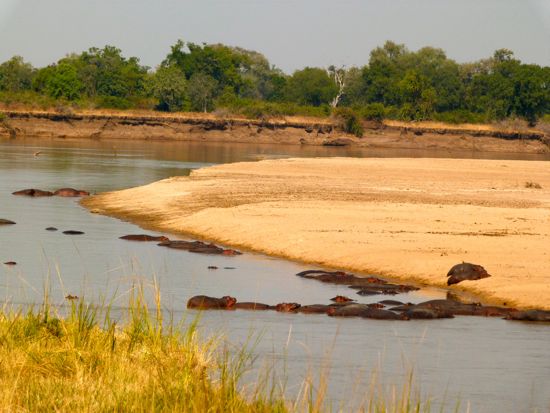


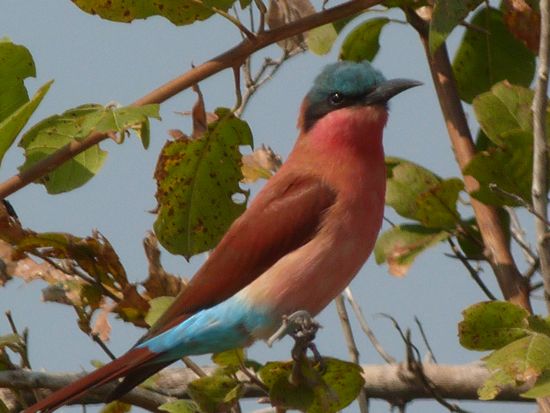
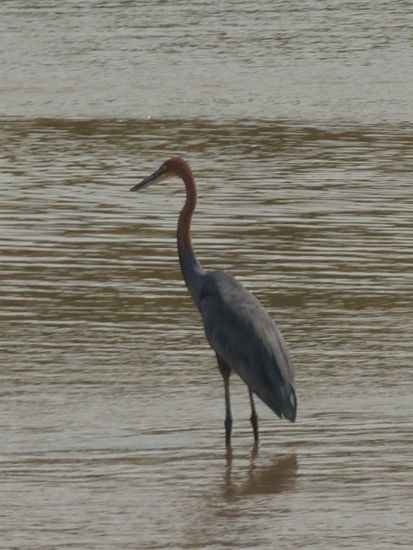
Back at camp, it seems to be elephant river crossing day. One group will gather, and cross, while another group waits across the river. They meet and greet, and then head on their way, while another group crosses.


This group has a baby. The baby can actually walk most of the way, but when it is too deep, there is always a barrier of larger elephants on the downstream side of the baby elephant, who is holding on to Mama’s tail, and is supported from behind by another elephant.


At one point, something spooks the elephants crossing close to the dozing hippo, they start running and splashing, maybe an elephant accidentally steps on a hippo, and a loud ruckus breaks out. Elephants trumpet, hippos scold loudly. Fortunately, it is all show and no go, no real fight and no bloodshed, the elephants continue on and the hippos go back to slumber.


Our friends came back just in time for tea, and begged off the afternoon drive, saying the mating lions they had seen on the way to the village would have to be enough. They’ve been to the Kawazaa school, and to the village for lunch, visiting the clinic and even helping kill the chicken for lunch. It’s been so much fun, but also very stimulating, and they want to take a break.
Mating lions?! You saw mating lions? Let’s go see the mating lions!
Jonah found the mating lions in no time, which was a thrill, except that they had mated with such great vigor that now they were lying in sated stupor. We took some photos, but how many photos can you take of exhausted sleeping lions?



Nsefu Sunset:

We started back, but on the river road, saw an unusual sight – lions on the river banks across the river, and a lion climbing up the bank we were on.

He wasn’t wet, but he was calling to the lion damsels across the river, and had clearly made them some promises he intended to keep.
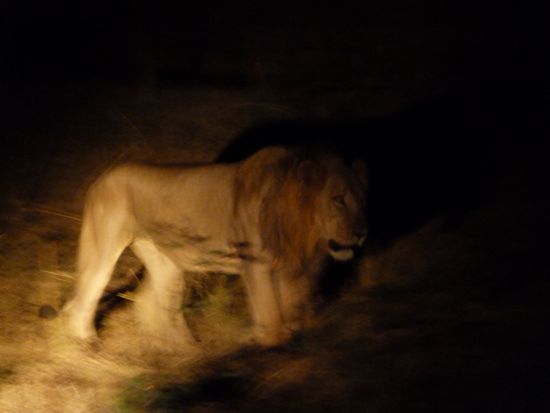
We tracked him for a while at a distance as he gauged his chances for a safe crossing here and there, and finally, we left him with our best wishes for a safe passage to lion nirvana.

At dinner we finalized plans with Jonah for an early departure for another trip to the Chichele hot springs with hopes of finding that dark maned (older) lion Madolyn was able to photograph with her iPhone, with breakfast at the hot springs and back at Nsefu Camp noonish.
A Chat With Daudi En Route to Nsefu
“Happy Anniversary to You! Happy Anniversary to You! I Love You! I love you! Happy Anniversary to you! Happy Anniversary to you!” AdventureMan sings me awake to the tune of the Superman theme. He always knows how to make me laugh, and after 39 years, he can still surprise me. We are so delighted to wake up here, in Tena Tena, on our anniversary. Life is sweet.
Morning at TenaTena Camp:

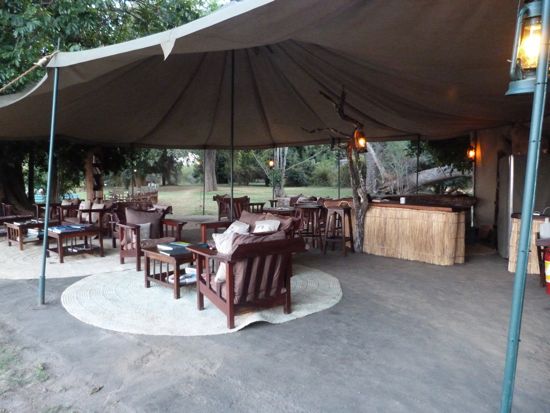

AdventureMan is walking to the next camp, and I am spending the morning catching up on notes, organization, small things, charging up my iPad, etc.
As I was saying earlier, you’d think this would all be very restful, and everything is done for us, but it all revolves around our game drive schedule, and any necessary re-charging depends on the generator schedule (unless you are in Nkwali, where you can re-charge everything in your own rooms; there are lots of electrical outlets) and at the same time, why on earth are we bringing all these electronic devices to the bush???
I’ve discovered a program on the iPad called Notes, and it allows me to write so much more than I would if I were writing by hand. I forget a lot of the smaller details and some of those small details are what makes camping life here so much fun.
The Robin Pope camps pay a lot of attention to detail. One of the things they provide is an insect repellant that is also lotion; it goes on easily, it smells good, and it really seems to keep the insects away, so I gladly use it instead of the Deet we brought with us which melts plastic if it leaks. How can that be good for our cameras?? How can that be good for us? And it is oily, and it smells so bad, and the tsetse flies just ignore it altogether. The insect repellant lotion, on the other hand, seems to work . . . and it smells like lemons.
We are all discovering new ways to use our cameras. I have discovered a program called Night Scenery, which allows me to take spectacular sunsets, and even photograph the essence of a night drive with some clarity – how cool is that? We are a good group in that we can sit patiently and shoot twenty or thirty shots of the lilac breasted roller, experimenting with various shutter speeds, aperatures, and compare them to the automatic function.

(I love my Lumix. I get great shots, and it takes me close to get the finest detail of a bird feather. It is lightweight, easy to handle, and doesn’t need as much light as many of the longer interchangable lenses on other cameras. I have two batteries, so I can be charging one and using another. I have another, smaller Lumix also with me as a back-up in case the unthinkable happens and something goes wrong with the bigger Lumix. My one gripe – the back-up battery is not a Panasonic battery; it works, but it doesn’t show how much battery is left, so just at the worst moment, my camera can just die if I don’t remember to change the battery out when I think it might be time.)
Our new Scottish friends, Mark and Madolyn, show us photos they took at the salt pan and they saw lion with a big huge bushy dark mane, and she took a photo – are you sitting down? – with her iPhone, that I would have killed to take. It is close, it is detailed, it is every bit as good as a photo taken with a camera. So much for all the control we are trying to develop.
They also ran a rescue mission for all the village men passing on bicycles, telling them of the lion ahead, loading bikes into the Land Cruiser, ferrying them past the lion and dropping them off past the danger zone. Some of the pride of lions have 10 – 20 members. Most avoid humans, but . . . would you want to bet on that, riding by a pride of lion, say . . . hungry lion . . .on a bicycle? (shiver) Not me!
It is approaching deep winter here, so it can be cold, not bitterly cold, but cold enough to make you stupid when you get up in the morning, cold enough that you want a fleece and a scarf for the first few hours of the morning drive. Around mid-morning you start stripping off layers, until around noon when it is very hot and you know the sunscreen won’t be enough; you have to put on some kind of cover against the strong African sun, even approaching mid-winter.
On my way to Nsefu, our last camp in the South Luangwa, I am with our old friend Daoudi, whom we first met twelve years ago, on our first trip to the South Luangwa. We talked of our families, and changes, and I thought to ask him about a conversation I had had the night before, with our Tena Tena guide, Julius. I had asked him how his wife coped with him gone guiding several weeks each month, and he began his response with “She is a well-mannered girl . . . ” going on to discuss how they problem-solve and work with the situation. It’s of interest to me, as a former military wife; military wives also spend time apart from their husbands.
So I pondered this, it was the first thing he said, “she is a well-mannered girl . . . ” and that tells me being well mannered is the most important thing, but well-mannered behavior differs, I have learned, sometimes painfully, from culture to culture.
“Daoudi, when a Zambian girl is said to be well-mannered, what does it mean?” and he explained it meant from her earliest days, her parents had instructed her on proper behavior.
“OK. I understand that. But I might not understand well-mannered the same way you do. Like when we lived in the Middle East, you know I learned to wear clothes that covered me to the elbow and to the knees, and did not have a low necklline . . . ”
“Yes, modest . . .” he said, thoughtfully.
“Yes, exactly,” I affirmed, “but also things very un-American . . . I learned to keep my eyes down, or at least not to look directly at a man and smile – that for us it might be friendly, but there it might seem forward. And I learned to use my quiet voice in public, and not to laugh out loud in the souks. Things like that, things I would not have even known if I had not been told.”
“Ah, yes!” he agreed, “these are also what it is to be a well-mannered Zambian woman. To speak softly with your husband, not to be shouting at him when you disagree, but to talk softly so you can come to agreement. Like that.”
We rode together in a comfortable silence, then I had another question.
“Would it be OK for a Zambian woman to be sitting here in the car with you when she is not your wife or your sister or a closely related woman?” and he laughed and said “Yes, it is helpful! Like you give someone a lift to help her get where she is going, there is nothing improper in that.”
So while some of the manners are like the manners of the Middle East, there are differences, too, and a person could spend a lifetime learning all these little distinctions and still not get it all right. Learning another culture is a never ending task, and it makes you envy those children who are born of two cultures (or more) and can pass fluently from one to another, knowing the subtleties of each.
We have American nieces and nephews who have lived most of their entire lives in a foreign country, and while they are not born of different cultures, they played on the streets, attended social functions, the local culture seeped into them by their daily lives. They are idiomatically fluent and inter-culturally fluent, but it takes a lifetime of bi-cultural living to attain their level without a dual-culture mother and father.
Nsefu Camp, the original Norm Carr camp, has little round plastered bandas set right on the river, where you can watch the elephant families cross the river, entirely lovely.
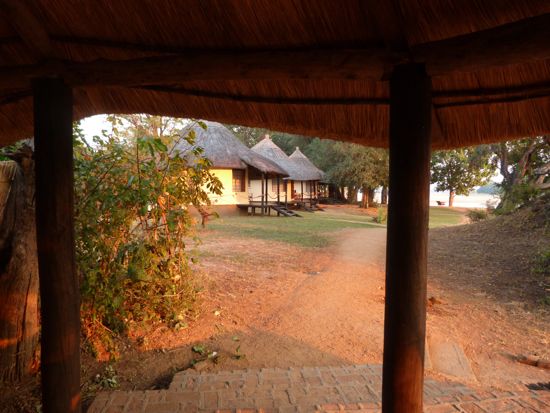




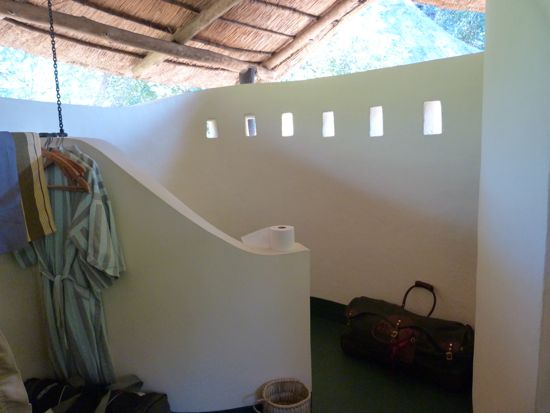
Everyone arrives hot and tired from the walk, and delighted with all they have learned. We have a lovely lunch, and AdventureMan sleeps soundly for an hour before afternoon tea.
Afternoon tea is a lot of fun; the chef has baked a beautiful chocolate cake for our birthday girl, and seven men enter singing “Happy Birthday” with the birthday cake for tea. 🙂



On the afternoon game drive we spot a civet cat, which we have never seen so clearly before,

and we see a porcupine family. When we first spotted them, it looked like the big porcupine was dragging something, but no, it was a little tiny baby porcupine sticking to Mom’s heelslike glue.
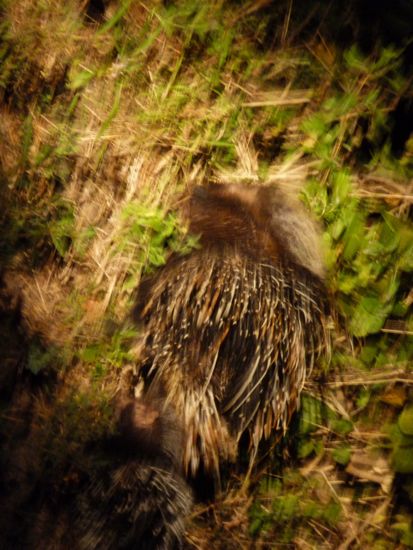
(Sorry, it’s just hard to get good clear sharp shots at night)
Again, a gorgeous night sky and a lot of fun trying to find constellations. Dinner was a Mongolian barbecue, with sparkling wine provided by the Australian honeymooners, who had a true honey moon – the moon rose huge and red in the sky as we were eating our dinner.
Seventy Times Seven
I come from a great mixture of nationalities, but two of them, the Irish and the German, specialize in carrying grudges for a long time. I once lived in a small German village, where a woman told me that her family did not speak to this other family, nor that family to them. Their grandmothers had some great falling out – nearly 100 years ago – and while no one can remember what it was about, the families still don’t speak.
Seventy times seven – it goes against the grain, doesn’t it? Jesus said so many earth-changing things, like “Love your neighbor as yourself” and to take care of the poor and the prisoners and the widows and children – people who are considered, even in today’s society, to have less value. To let go of your angry feelings, to forgive – that is hard work.
And yet, he spells out how very damaging our grudges are – to US! If we can get over our selves, and our own selfish instincts, our lives are so much happier and so much more productive . . .
Matthew 18:21-35
21 Then Peter came and said to him, ‘Lord, if another member of the church* sins against me, how often should I forgive? As many as seven times?’ 22Jesus said to him, ‘Not seven times, but, I tell you, seventy-seven* times.
23 ‘For this reason the kingdom of heaven may be compared to a king who wished to settle accounts with his slaves. 24When he began the reckoning, one who owed him ten thousand talents* was brought to him; 25and, as he could not pay, his lord ordered him to be sold, together with his wife and children and all his possessions, and payment to be made. 26So the slave fell on his knees before him, saying, “Have patience with me, and I will pay you everything.” 27And out of pity for him, the lord of that slave released him and forgave him the debt. 28But that same slave, as he went out, came upon one of his fellow-slaves who owed him a hundred denarii;* and seizing him by the throat, he said, “Pay what you owe.”
29Then his fellow-slave fell down and pleaded with him, “Have patience with me, and I will pay you.” 30But he refused; then he went and threw him into prison until he should pay the debt.
31When his fellow-slaves saw what had happened, they were greatly distressed, and they went and reported to their lord all that had taken place. 32Then his lord summoned him and said to him, “You wicked slave! I forgave you all that debt because you pleaded with me. 33Should you not have had mercy on your fellow-slave, as I had mercy on you?” 34And in anger his lord handed him over to be tortured until he should pay his entire debt. 35So my heavenly Father will also do to every one of you, if you do not forgive your brother or sister* from your heart.’
BERNARD MIZEKI
Not bad, slept the night until 0530, and then found this in The Lectionary readings for today. To think I was so near, so close to the anniversary of his disappearance. . .
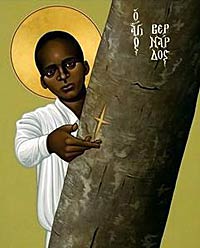
CATECHIST AND MARTYR IN AFRICA (18 JUNE 1896)
Bernard Mizeki was born in Portuguese East Africa (Mozambique) in about 1861. When he was twelve or a little older, he left his home and went to Capetown, South Africa, where for the next ten years he worked as a laborer, living in the slums of Capetown, but (perceiving the disastrous effects of drunkenness on many workers in the slums) firmly refusing to drink alcohol, and remaining largely uncorrupted by his surroundings. After his day’s work, he attended night classes at an Anglican school.
Under the influence of his teachers, from the Society of Saint John the Evangelist (SSJE, an Anglican religious order for men, popularly called the Cowley Fathers), he became a Christian and was baptized on 9 March 1886. Besides the fundamentals of European schooling, he mastered English, French, high Dutch, and at least eight local African languages. In time he would be an invaluable assistant when the Anglican church began translating its sacred texts into African languages.
After graduating from the school, he accompanied Bishop Knight-Bruce to Mashonaland, a tribal area in Southern Rhodesia (now Zimbabwe), to work there as a lay catechist. In 1891 the bishop assigned him to Nhowe, the village of paramount-chief Mangwende, and there he built a mission-complex. He prayed the Anglican hours each day, tended his subsistence garden, studied the local language (which he mastered better than any other foreigner in his day), and cultivated friendships with the villagers. He eventually opened a school, and won the hearts of many of the Mashona through his love for their children.
He moved his mission complex up onto a nearby plateau, next to a grove of trees sacred to the ancestral spirits of the Mashona. Although he had the chief’s permission, he angered the local religious leaders when he cut some of the trees down and carved crosses into others. Although he opposed some local traditional religious customs, Bernard was very attentive to the nuances of the Shona Spirit religion. He developed an approach that built on people’s already monotheistic faith in one God, Mwari, and on their sensitivity to spirit life, while at the same time he forthrightly proclaimed the Christ. Over the next five years (1891-1896), the mission at Nhowe produced an abundance of converts.
Many black African nationalists regarded all missionaries as working for the European colonial governments. During an uprising in 1896, Bernard was warned to flee. He refused, since he did not regard himself as working for anyone but Christ, and he would not desert his converts or his post. On 18 June 1896, he was fatally speared outside his hut. His wife and a helper went to get food and blankets for him. They later reported that, from a distance, they saw a blinding light on the hillside where he had been lying, and heard a rushing sound, as though of many wings. When they returned to the spot his body had disappeared. The place of his death has become a focus of great devotion for Anglicans and other Christians, and one of the greatest of all Christian festivals in Africa takes place there every year around the feast day that marks the anniversary of his martyrdom, June 18.
by James Kiefer
Jet Lag, iPads and Small Things
The first leg(s) of our travel are completed; today we head for our destination, the Robin Pope Camps in the upper Luangwa in the eastern part of Zambia. We took the relatively new Delta flight 200 from Atlanta to Johannesburg, leaving out of the new airport terminal in Atlanta for international flights. More on that later when I am back to my computer and can more easily insert photos the size I want them.
Fifteen hours is a long flight. There are a couple ways of doing long travel; one is to break up the journey, like go through Paris and spend a couple days, then fly on to your African destination. I say Paris, because it would be our destination of choice, but you can as easily connect through London or Frankfurt, and a few other places. Many people like doing that, and one of these days, we might, too.
During our years in the Gulf, we developed a pattern of just gutting it through, getting on a very long flight and just getting there, dealing with all the consequences once we reached our destination. For me, going west, it is a piece of cake. For some reason, when I fly east, my body rhythms are jangly for two or three weeks, my sleep patterns erratic, and all you can do is gut it through. We have learned that getting on schedule at your arrival destination helps, getting sunshine and exercise helps, but nothing keeps you from those long lonely hours awake in the middle of the night.
It has hit each one of us differently. I got almost no sleep for two nights, then got a good eight hours (broken) last night. AdventureMan is getting lots of sleep and having very little trouble adjusting.
I am getting used to using the iPad. Just before leaving, I discovered a Sudoko program, and very shortly learned a couple things – electronic Sudoku is just different from paper Sudoku, it is harder to quit. You also can find you’ve lost hours to playing and it gives you a splitting headache – unlike paper Sudoku. It also eats up your time, and although the battery is supposed to have ten hours, either it runs out faster when you are playing Sudoko, or it FEELS like it runs out faster because the time passes so quickly. All I know is that I suddenly became aware that ten hours is not all that much, and I am constantly looking for re-charging places; it has become a priority.
At the last minute, I also pitched my books, and downloaded books to the iPad. I find I am enjoying reading on the iPad (I never thought I would), but once again I am constantly concerned with how fast the time is going (it doesn’t seem to use as much battery time when I am reading) and when and where will I be able to recharge? I am wondering if the camps in the bush have made allowances for their customers increased reliance on electronics – iPads, cameras that have batteries that need recharging, etc.) and I am also wishing I had brought a book with me – it’s just easier.
On the other hand, I have also discovered that on the iPad I have a little program called “notes” where I can make . . . notes! I can do it on a daily basis and it keeps them separate, and it is much faster than writing notes in a little notebook.
The internet at the Taj Pamodzi in Lusaka is much more reliable and much faster than the last time I was here. I hope it is also more secure.
Small things. We are hearing a voice singing outside, we heard the call to prayer from the mosque this morning and felt oh, so nostalgic for our times living near the mosques of Qatar and Kuwait. The singing voices are coming from a nearby school; we can’t understand the words, but it sounds joyful. We have a newspaper, it is much wider and thicker than our Pensacola News Journal, and I think I remember our newspapers also were wider and thicker once. The first few pages were full of people being arrested for corruption, and it makes me happy for Zambia, not happy that they have corruption, but happy that their police are free to arrest highly placed corrupt officials who are stealing from the Zambian people and their heritage, and also that they are free to name the names.
I have lived in countries where offenders are not named, so as not to bring shame on the innocent families, but I believe that when the offender is named, it is a deterrent to corruption. And for what? Is a shiny Mercedes worth the shame, and the jail time? Even though corrupt people in high places steal on an unimaginable scale, the things they buy with them are . . . just things. When you place your value in things, you lead an unsatisfied life. No thing can fill the void that lack of integrity leaves.
Recent Comments
ExpatAlien on What Country am I Living … intlxpatr on Yellowstone: Old Faithful to C… Michelle on Yellowstone: Old Faithful to C… Cathy on No Grown-Ups in Charge intlxpatr on Waiting for Snow Wikipedia Donate Button

Amazina


Early Voting in Florida


 Here There and Everywhere