Prescribed or Proscribed?
We will be taking a trip soon, and, thanks be to God, our travel companions alerted us in time that there is a new requirement for Yellow Fever Shots, malarial precautions are now strongly recommended, AND medications we buy over the counter are prescription medications in Zambia, and you can be arrested for carrying them into country; they would be contraband.

Horrors! I’ve always taken Benedryl for my allergies, and because I am also a mosquito magnet, I use Benedryl gel to survive the mosquitos, and the tse-tse flies. Our doctor is a gem; he wrote prescriptions and today we got them filled so we can take our OTC medications into Zambia with us. The pharmacists didn’t bat an eye. They see it all the time.

“You heading out on a mission?” another customer asked.
“Not a religious mission,” I laughed. AdventureMan has a mission to get some spectacular photographs. Pensacola has several churches that sponsor major missions throughout the world, and missionaries are found in Pensacola pharmacies stocking up on a couple years worth of prescription medications – as well as the medications proscribed by host countries. I also suspect that having all these people that travel and live throughout the world contributes to the variety of cuisines available and sought after in Pensacola restaurants. I just wish we’d get some Ethiopians!
Alaskan Heritage Celebration
I’m researching the Inuit / Eskimo / Yup’ik mask my Mother bought lo, these many many moons ago, and like anyone born to research, I am hopelessly lost, and enjoying every minute of the journey.
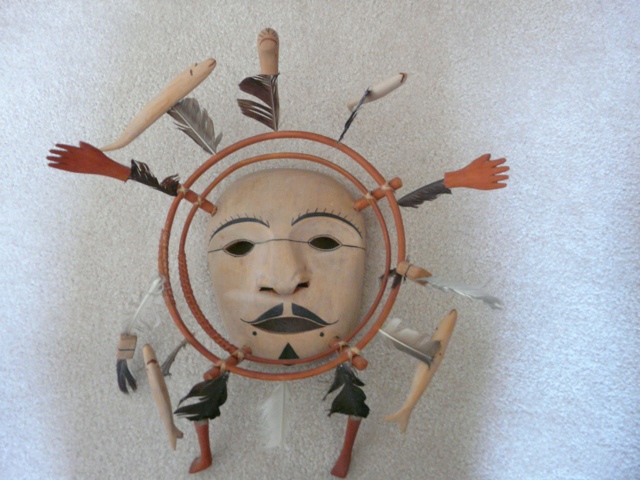
I’m not Alaskan. I was born in Alaska, and so many times through the years when I see blocks that need ticking, I have been tempted to tick “native Alaskan” but I know that they don’t mean me, and that there are people who really deserve those preferences. I FEEL Alaskan, even though I’ve been gone a long time.
(My Mother used to tell us not to play with the “natives” because “they had knives!” (Big scary eyes). LLLOOOLLLL! Can you think of any quicker way to get your kids to play with the forbidden group? They had knives! Plus, they were our neighbors, and our classmates, and we all played together. Skied together. Played Cowboys and . . . Indians. Yes! We did! LLOOOLLL!)
I found this fabulous video of segments from the “Celebration 2010” There is a reason I am sharing this – first, for all my friends of all nations who love textiles and handwork as I do – and our name is legion – I want you to see this video and to see the magnificant ceremonial robes they are wearing. They have to be hand made; they are each so individual, even among people of the same clan, the bear is different, one from the other, the fish – different, the raven – fabulously different, I even saw a sun! I hope your heart goes pitter patter, just as mine is going.
I wish I could bring this entire celebration to Kuwait and do a presentation with the KTAA (Kuwait Textile Arts Association.) They would LOVE these crafts, and the dancing. Look at the wonderful drums!
Second – did you hear them ululate? This is what I love about my travels; no matter what our differences, we have some amazing similarities.
Celebration, a First Nation heritage event taking place in Juneau, Alaska, originated and was sponsored in 1982 by Sealaska. The gathering takes place every other year and is the biggest event for Native Americans in Alaska for Tlingit, Haida and Tsimshian peoples.
To me, the coolest thing of all is that this is not done for tourists, but for the First Nation peoples, to transmit their culture to their children, and to celebrate themselves. This second video focuses on the clans and their special dances:
Now here is the exciting thing. It only happens every two years. This year it will take place June 6 – June 9. Here’s the information:
Celebration Native Cultural Conference
June 06, 2012 to June 09, 2012
A biennial Native cultural celebration featuring colorful costumed processions, dance performances, authentic arts and crafts and gatherings. Held in various venues including Centennial Hall Convention Center.
907-463-4844
http://www.sealaskaheritage.org
We already have plans for this June (I’ll share more about that later) but I talked to AdventureMan and said I really, really want to go in 2014. He said (are you sitting down?) “That’s just the kind of thing I LOVE! We’ve been planning to go to Alaska anyway, let’s go for that celebration!”
And that is why, after all these years of being married, I still adore my husband. He is a man with a heart for Adventure, and he gets all excited about the same things I do, well, some of the time. There was a falcon fest once in Tunisia that he dragged his feet on because he had just gotten in from a long trip, but once we got there, we all agreed it was one of those things that we would have regretted forever if we missed it. He is always up for a new adventure!
Wooooo HOOOOOOOOO!
See you there?
Diversity: No Holding Back the Tide
From today’s AOL News/ Huffpost:
So here’s the thing. In the USA, as in many countries, people study their ancestry, their bloodlines. Some people want those bloodlines to make them special, but anyone who has read history in any big-picture kind of way understands that most of history is people coming and going, waves of migration, immigration and emmigration, mostly depending on food supply, but often, too, depending on employment opportunities. Bottom line, most of it is about survival.
Now, blood. When we go to the hospital, or are taken there after an accident, do we ask whose blood it is that we receive when we need a transfusion? Blood is blood. The match to your antibodies and needs may be from another, despised race. Do we really know who our fathers are? Do women raped always admit to being raped? Do women admit to having a relationship outside of marriage? Many a child is born whose parenthood is not what it is claimed to be.
National DNA testing is controversial. Kuwait has been trying to do DNA testing to construct a profile for who is or is not Kuwaiti. 🙂 Do you really want to know?

Minority Birth Rate Now Surpasses Whites In US, Census Shows
By HOPE YEN 05/17/12 03:16 AM ET
WASHINGTON — For the first time, racial and ethnic minorities make up more than half the children born in the U.S., capping decades of heady immigration growth that is now slowing.
New 2011 census estimates highlight sweeping changes in the nation’s racial makeup and the prolonged impact of a weak economy, which is now resulting in fewer Hispanics entering the U.S.
“This is an important landmark,” said Roderick Harrison, a former chief of racial statistics at the Census Bureau who is now a sociologist at Howard University. “This generation is growing up much more accustomed to diversity than its elders.”
The report comes as the Supreme Court prepares to rule on the legality of Arizona’s strict immigration law, with many states weighing similar get-tough measures.
“We remain in a dangerous period where those appealing to anti-immigration elements are fueling a divisiveness and hostility that might take decades to overcome,” Harrison said.
As a whole, the nation’s minority population continues to rise, following a higher-than-expected Hispanic count in the 2010 census. Minorities increased 1.9 percent to 114.1 million, or 36.6 percent of the total U.S. population, lifted by prior waves of immigration that brought in young families and boosted the number of Hispanic women in their prime childbearing years.
But a recent slowdown in the growth of the Hispanic and Asian populations is shifting notions on when the tipping point in U.S. diversity will come – the time when non-Hispanic whites become a minority. After 2010 census results suggested a crossover as early as 2040, demographers now believe the pivotal moment may be pushed back several years when new projections are released in December.
The annual growth rates for Hispanics and Asians fell sharply last year to just over 2 percent, roughly half the rates in 2000 and the lowest in more than a decade. The black growth rate stayed flat at 1 percent.
The immigrants staying put in the U.S. for now include Narcisa Marcelino, 34, a single mother who lives with her two daughters, ages 10 and 5, in Martinsburg, W.Va. After crossing into the U.S. from Mexico in 2000, she followed her brother to the eastern part of the state just outside the Baltimore-Washington region. The Martinsburg area is known for hiring hundreds of migrants annually to work in fruit orchards. Its Hispanic growth climbed from 14 percent to 18 percent between 2000 and 2005 before shrinking last year to 3.3 percent, still above the national average.
Marcelino says she sells food from her home to make ends meet for her family and continues to hope that one day she will get a hearing with immigration officials to stay legally in the U.S. She aspires to open a restaurant and is learning English at a community college so she can help other Spanish-language speakers.
If she is eventually deported, “it wouldn’t be that tragic,” Marcelino said. “But because the children have been born here, this is their country. And there are more opportunities for them here.”
Of the 30 large metropolitan areas showing the fastest Hispanic growth in the previous decade, all showed slower growth in 2011 than in the peak Hispanic growth years of 2005-2006, when the construction boom attracted new migrants to low-wage work. They include Lakeland, Fla.; Charlotte, N.C.; Atlanta; Provo, Utah; Las Vegas; and Phoenix. All but two – Fort Myers, Fla., and Dallas-Fort Worth – also grew more slowly last year than in 2010, hurt by the jobs slump.
Pointing to a longer-term decline in immigration, demographers believe the Hispanic population boom may have peaked.
“The Latino population is very young, which means they will continue to have a lot of births relative to the general population,” said Mark Mather, associate vice president of the Population Reference Bureau. “But we’re seeing a slowdown that is likely the result of multiple factors: declining Latina birth rates combined with lower immigration levels. If both of these trends continue, they will lead to big changes down the road.”
William H. Frey, a demographer at the Brookings Institution who analyzed the census data, noted that government debates over immigration enforcement may now be less pressing, given slowing growth. “The current congressional and Supreme Court interest in reducing immigration – and the concerns especially about low-skilled and undocumented Hispanic immigration – represent issues that could well be behind us,” he said.
Minorities made up roughly 2.02 million, or 50.4 percent of U.S. births in the 12-month period ending July 2011. That compares with 37 percent in 1990.
In all, 348 of the nation’s 3,143 counties, or 1 in 9, have minority populations across all age groups that total more than 50 percent. In a sign of future U.S. race and ethnic change, the number of counties reaching the tipping point increases to more than 690, or nearly 1 in 4, when looking only at the under age 5 population.
The counties in transition include Maricopa (Phoenix), Ariz.; King (Seattle), Wash.; Travis (Austin), Texas; and Palm Beach, Fla., where recent Hispanic births are driving the increased diversity among children. Also high on the list are suburban counties such as Fairfax, Va., just outside the nation’s capital, and Westchester, N.Y., near New York City, where more open spaces are a draw for young families who are increasingly minority.
According to the latest data, the percentage growth of Hispanics slowed from 4.2 percent in 2001 to 2.5 percent last year. Their population growth would have been even lower if it weren’t for their relatively high fertility rates – seven births for every death. The median age of U.S. Hispanics is 27.6 years.
Births actually have been declining for both whites and minorities as many women postponed having children during the economic slump. But the drop since 2008 has been larger for whites, who have a median age of 42. The number of white births fell by 11.4 percent, compared with 3.2 percent for minorities, according to Kenneth Johnson, a sociologist at the University of New Hampshire.
Asian population increases also slowed, from 4.5 percent in 2001 to about 2.2 percent. Hispanics and Asians still are the two fastest-growing minority groups, making up about 16.7 percent and 4.8 percent of the U.S. population, respectively.
Blacks, who comprise about 12.3 percent of the population, have increased at a rate of about 1 percent each year. Whites have increased very little in recent years.
Other findings:
_The migration of black Americans back to the South is slowing. New destinations in the South, including Atlanta, Charlotte, N.C., Raleigh, N.C., and Orlando, Fla., saw sharp drop-offs in black population growth as the prolonged housing bust kept African-Americans locked in place in traditional big cities. Metro areas including New York, Chicago, Los Angeles and San Francisco had reduced declines or gains.
_Nine U.S. counties in five states saw their minority populations across all age groups surpass 50 percent last year. They were Sutter and Yolo in California; Quitman in Georgia; Cumberland in New Jersey; Colfax in New Mexico; and Lynn, Mitchell, Schleicher and Swisher in Texas.
_Maverick County, Texas, had the largest share of minorities at 96.8 percent, followed by Webb County, Texas, and Wade Hampton, Alaska, both at 96 percent.
_Four states – Hawaii, California, New Mexico and Texas – as well as the District of Columbia have minority populations that exceed 50 percent.
The census estimates used local records of births and deaths, tax records of people moving within the U.S., and census statistics on immigrants. The figures for “white” refer to those whites who are not of Hispanic ethnicity.
___
Associated Press writer John Raby in Charleston, W.Va., contributed to this report.
Petroglyphs in the Petrified Forest
So here we segue back to the Petrified Forest, and it may not seem logical in a linear, chronological sense, like time-as-pearls-strung-together-on-a-string sort of thing, but in terms of like things, the next chronological entry is going to be on 700 years of culture, the Ancestral Puebloans who used to be called the Anasazi, but before I go there, I want to show you some petroglyphs.
(I’m putting in a lot of links in case you are as big a petroglyph nerd as I am, and want to read more)
I always imagine the problems with being early man. Imagine they are smart, and spend a lot of their days figuring things out, most important being 1. What are we going to eat? 2. How are we going to keep dry/warm? 3. How do we protect ourselves from our enemies? They have the same problems we have, only on a much more basic level, and with fewer resources.
Have you ever thought about how easy it is to get information now? (The hard part being sifting through so you get the most reliable, most relevant information). Imagine a world where you have to figure it out for yourself, every day.
Early civilizations fascinate me. I am always interested in little tiny things that can be very important, like how did they fasten skins together to keep themselves warm? How do you poke a hole in a sharp bone so you can use it as a needle? How do you make a button, or make strips that can be used to tie clothing together?
How do you fasten a spear head onto a spear, or an arrowhead onto an arrow?
Early man was a problem solver, and I am fascinated by petroglyphs, which are either early attempts at documentation, or early attempts at communication, or maybe both? The first petroglyphs and cave paintings I ever visited were the Font de Gaume Caves near Les Eyzies-de-Tayac-Sireuil, and they took my breath away. I didn’t even hesitate because it was a cave, I wanted to see them so badly.
I want you to look at this photo of a fairly early dwelling in Les Eyzies de Tayac-Sireuil and hold it in your mind before we move on:

Later, living in Saudi Arabia, one of the most fun day trips ever was to a rock formation called Graffiti Rock, which had no protection, so very old petroglyphs mingled with modern carvings, but some of the older carvings were so interesting, so intriguing.
Coming across petroglyphs in the Petrified Forest was a delight.
Here is part of what the national parks website has to say about petroglyphs found in the Petrified Forest:
In 1977 a spiral petroglyph at Chaco Canyon National Monument was discovered which displayed a precise interaction with sunlight at the time of summer solstice by means of a narrow shaft of sunlight that moved down a shadowed rock face to bisect the center of a large spiral petroglyph. Subsequent observations found that on winter solstice and equinoxes there were intriguing interactions of sunlit shafts with the large spiral and a smaller spiral nearby. No other example of a sunlight interaction with prehistoric or historic petroglyphs was known at this time. However, there was a tradition of Pueblo sun watching in historic times, particularly of the varying sunrise and sunset positions throughout the year, to set the dates for ceremonies.
As a result of the Chaco Canyon find, Bob Preston initiated a research project to determine whether other petroglyph sites in the Southwest functioned as solar “observatories.” Over the last 16 years he has identified about 120 examples of similar solstice events at more than 50 petroglyph sites in Arizona, New Mexico and southern Utah. Evidence indicates that the phenomenon may have been spread over as much as a 1000-km region. These findings show clearly that certain petroglyphs were used by early pueblo cultures to function as calendrical markers for the winter and summer solstices. Petrified Forest National Park contains the greatest known concentration of solar calendars, with 16 of the sites being in or immediately adjacent to the park, and has been key to understanding their nature.
Shadows and sunlit images are found to move across petroglyphs due to other rocks being in the path of the sun’s rays. As the sun’s path across the sky changes throughout the year, the positions of the shadows and sunlit images change on the petroglyph panels. In many cases the petroglyphs have been placed on the rock faces in just the right position so that specific interactions occur on the solstices. The most common types of petroglyphs on which solsitial interactions have been identified are spirals and circles. The key to determining that these were intended and not by chance is that interactions are seen from site to site, and occur on the solstices more frequently than on other days of the year. These consistent interactions may involve a point of sunlight or shadow piercing the center or tracing the edge of a spiral or circular petroglyph; or shadow lines may suddenly appear or disappear at the center or edges of the petroglyph; or they may move up to the center or edge and then retreat. It is not uncommon for a single petroglyph to display multiple interactions of this type, either on the same solstice or on each of the solstices. In fact, at one site, there are five circular and spiral petroglyphs that show 15 interactions on the both solstices.
An intriguing question is whether types of petroglyph images were involved with specific dates. In several cases similar sunlight and shadow interactions occur on spiral and circular petroglyphs on the equinox, and distinctive interactions occur with other petroglyphs on the solstices and other dates. Clearly much of the puzzle remains to be unraveled.
There was a WEALTH of petroglyphs. I’m just going to show you a few of those we found:
This one makes me laugh; it looks so much like our modern day stork-who-brings-babies (LOL, where did that legend/story start anyway??)

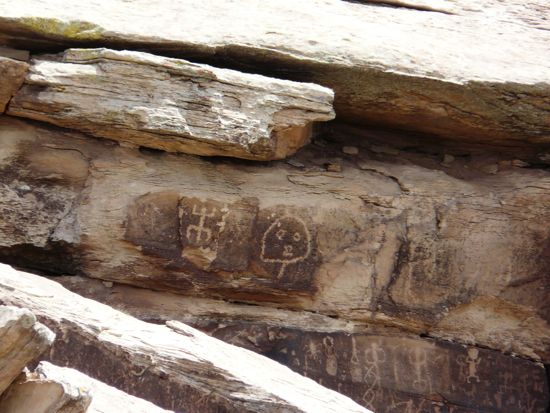
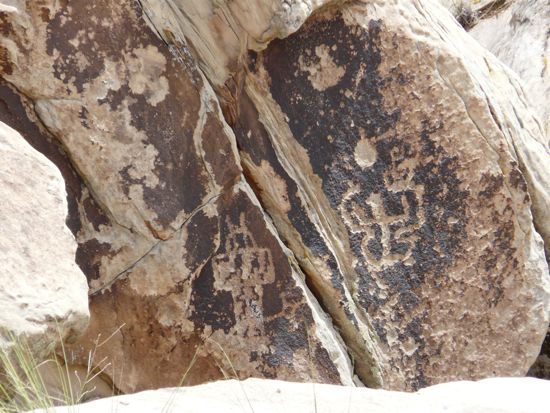

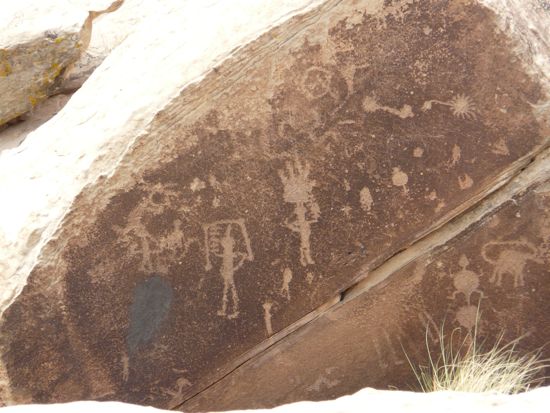
LOL, these feet are larger than life, or else they were made by giants!


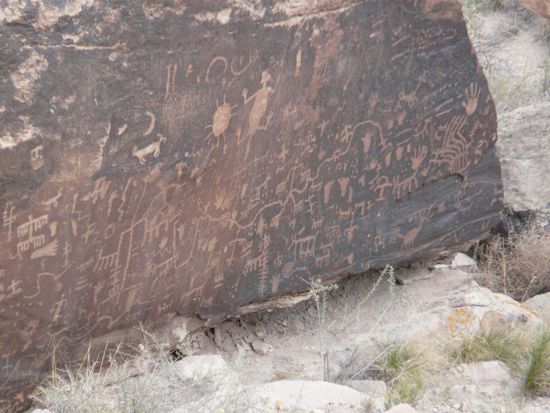
Early people in widely separated parts of the world carved and painted on rock, probably for a number of reasons, maybe keeping track of solar activity and seasons, maybe magical/religious thinking for a good hunt or nostalgia for a good hunt, maybe just someone who, like today’s blogger, just has to document in some way . . . 😉
Stop Kony 2012
I love this campaign. I love its focus and specificity. I love that it goes after a merciless bully who uses children as a weapon, and twists religion to serve the evil. I spit on you, Lords Resistance Army.
Please, take twenty-something minutes to watch this, what young people all around the world are doing to stop a hideous abuse of children in Uganda.
April 20. Wooo HOOOO!
Driving in Qatar
Almost every day, the two articles garnering the greatest number of hits have to do with new traffic rules in Kuwait and in Qatar. I think I wrote the posts in 2009. Here is what the US Department of State has to say to US Nationals about driving in Qatar:
TRAFFIC SAFETY AND ROAD CONDITIONS: While in Qatar, you may encounter road conditions that differ significantly from those in the United States. The information below concerning Qatar is provided for general reference only and is subject to change at any time. Current traffic regulations may be obtained through the Ministry of Interior’s Traffic Police.
Short-term visitors should obtain a valid International Driving Permit prior to arrival and should not drive in Qatar on a U.S. driver’s license. New and prospective residents should obtain a permanent Qatari Driving License immediately after arrival. To obtain a Qatari driver’s license, U.S. citizens need to pass a driving exam, including a road test. Short-term visitors and business travelers can also obtain a Temporary Qatari Driving License by presenting their U.S. driver’s license at any branch of Qatar’s Traffic Police.
Traffic accidents are among Qatar’s leading causes of death. Safety regulations in Qatar are improving, thanks to a more stringent traffic law adopted in October 2007 and a country-wide traffic safety campaign. However, informal rules of the road and the combination of local and third-country-national driving customs often prove frustrating for first-time drivers in Qatar. The combination of Qatar’s extensive use of roundabouts, many road construction projects and the high speeds at which drivers may travel can prove challenging. The rate of automobile accidents due to driver error and excessive speed is declining but remains higher than in the United States. In rural areas, poor lighting, wandering camels and un-shouldered roads present other hazards.
Despite the aggressive driving on Qatar’s roads, drivers should avoid altercations or arguments over traffic incidents, particularly with Qatari citizens who, if insulted, have filed complaints with local police that resulted in the arrest and overnight detention of U.S. citizens. Drivers can be held liable for injuries to other persons involved in a vehicular accident, and local police have detained U.S. citizens overnight until the extent of the person’s injuries were known. Due to its conservative Islamic norms, Qatar maintains a zero-tolerance policy against drinking and driving. Qatar’s Traffic Police have arrested Americans for driving after consuming amounts of alcohol at even smaller levels normally accepted in the U.S.
Any motor vehicle over five years old cannot be imported into the country. For specific information concerning Qatari driver’s permits, vehicle inspection, road tax and mandatory insurance, please contact either the Embassy of the State of Qatar in Washington, DC or the Consulate General of the State of Qatar in Houston, Texas.
There are things that the Department of State is too diplomatic to tell you, and that people living there will not write for fear of having a travel ban put against them, a case filed against them for ‘insulting’ a national or the government.
The beautiful roads in Qatar were wonderful when they had a tenth of the cars on the road they have now. There are two categories of “most dangerous.” One category is the expat $200 car held together with gum and rubber bands that breaks down in the worst possible place, or has a blow-out, or hits someone because the driver not only doesn’t have a license, he also doesn’t know how to drive.
Although there are rules about what trucks are allowed to haul and how it is to be tied down, the laws are ignored and unenforced. It is still important never to travel behind or beside a truck carrying cement blocks. They look like they are not secured. They are not secured. Watch out, too, for any truck delivering bottled water (that makes a huge mess all over the roundabout) or sheep or cows, which regularly overturn.
The worst hazard of all is Qatari male drivers between 11 and 35 years old. They own the roads. They will drive on the sidewalks, down the wrong way of a six lane highway to get to the roundabout, through red lights. They will push you into an unsafe roundabout with the Hummer daddy bought for their 12th birthday. If you insult a Qatari young male driver in any way, they may block you, stop you and threaten you, and no one, least of all the police, will come to your aid. They know no speed limits, blow through stop lights, harass female expat drivers, and they pay no fines for traffic violations. For a short time, the law was applied somewhat equally to all, but there were so many outraged Qataris paying the humungous fines that no one enforced the law against the Qataris anymore, and you rarely see the police stopping anyone except the poorest of the poor.
If you want to drive in Qatar, you will want a sturdy car to get over the unpaved areas and the roads torn up for infrastructure improvements, as well as for protection against the aggressive Qatari male drivers and the accidents that may not be your fault but cannot be avoided. You will want to drive only during the lowest traffic times of the day, if possible. Even during the summer, when much of the population goes elsewhere, anywhere, to avoid the heat, night traffic on the major ring roads, the major arterial roads and on the Corniche is gridlock.
The Department of State will also not tell you that if you are ever in trouble on the road, you are certain to have many kind older Qatari men stop and render assistance. They will insist on giving you water, and fixing whatever they can fix, or at the very least waiting with you until help comes. If they think you are lost as you journey around Qatar, they will make sure you get where you are going. There is a long tradition of taking good care of the guest, and of civility among the Qataris, but mostly it seems to kick in when they mature – like around 35 or so.
This may not be the truth for everyone; we all have our own stories, horror stories and stories of kindness. It’s a little bit of the wild west, driving in Qatar.
Just a Little Less Alien

It’s great having friends who all returned to the USA after our years of living in Qatar (and Kuwait) so we can share our experiences, our frustrations, our challenges. It’s been two years for me since AdventureMan and I made the big decision to retire, and in Pensacola, not Edmonds, WA.
Pensacola is a pretty cool place to be retired. One of the best things, after living in Kuwait especially, is the traffic. People might complain, but the traffic here is laughable. It’s very calm. Traffic might be waiting two lights at a stoplight, but hey – people wait, don’t just drive right through. No one has ever pushed me into a round about, or anywhere else, unlike Qatar, when I got in some young man’s way, and he pushed me out of his way (!)
When you go to the symphony, or to church, or to aqua aerobics, in the worst traffic it might take ten minutes. There are restaurants everywhere, many of them pretty good. The worst restaurants are usually better, cleaner, faster than most of the restaurants in Kuwait and Qatar. The only cuisine we have not been able to find here is Ethiopian, and we can drive to Atlanta or New Orleans and get that.
It’s been two years . . . there is something in me that starts getting a little restless, starts looking at my household goods with an eye to getting rid of, giving away, cutting down on weight. At the very least I might have to paint something, or change the furniture around . . .
My friends are suffering many of the same challenges, the challenge of being an expat back in the USA. What was formerly comfortable is not such a good fit anymore; we have changed, and we are trying to cobble together lives that can accomodate the changes.
I had a minor triumph; I realized that after two years, I am starting to have people I can go sit with when I walk into a crowded venue. It may sound like a small thing, but the fear of having to sit alone in a crowd where everyone is visiting and sharing is a little daunting. Who wants to look pathetic?
But my expat friends and I laugh; in expat world two years makes you an old-timer. When new people come in, you are expected to show them around, show them where (and how) to shop for things, where to get things fixed, altered, where to go to pay your bills and how to pay them. Two years makes you and old hand, often with one foot out the door, getting ready for the next posting or contract.
Three of my friends went back to their home locations, only AdventureMan and I settled in a new place. While I am making some progress, two years in, I still wonder who my friends will be? Will I ever feel at home in Pensacola?
Wooo HOOOOO! Official Zain Kuwait Flashmob – فلاش موب زين الكويت
I LOVE this! Thank you, Hayfa! I love it that it is real Kuwaiti’s; I can’t tell the song, but I think it is one of the National Day songs (National Day and Liberation Day are coming up, February 25 / 26) and oh, what a wonderful, fun way to celebrate.
I especially love the security guard 🙂
Everyone is having such a great time!
Recent Comments
ExpatAlien on What Country am I Living … intlxpatr on Yellowstone: Old Faithful to C… Michelle on Yellowstone: Old Faithful to C… Cathy on No Grown-Ups in Charge intlxpatr on Waiting for Snow Wikipedia Donate Button

Amazina


Early Voting in Florida


 Here There and Everywhere