Veteran’s Day Tribute
Thank you for your faithful service to your country, and to mankind.
“To Serve You More Efficiently”
This is a photo we saw yesterday in the drive-through window at McDonalds. I will add that AdventureMan hates any kind of drive-through because he thinks there is a greater chance of not really getting what you ordered, but I love the convenience, and I was only ordering one simple thing:
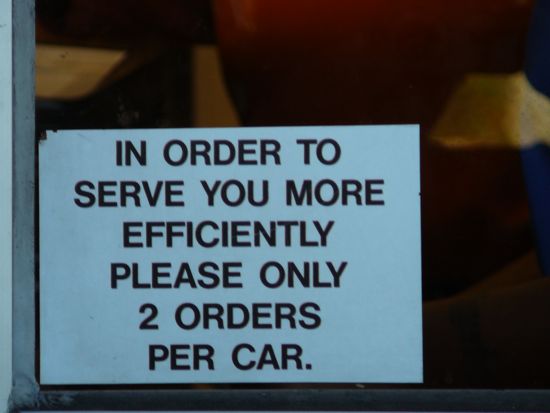
Excuse me? If you have four ladies coming back from a shopping trip (say like) and each wants to pay her own order, you can’t do that? To serve us more efficiently, we can only make two orders per car? If I were a fast-food chain which relied on my customer’s good will, I would serve them, period.
Whenever a bank or a store or a fast-food joint start a sentence with “to serve you more efficiently” start looking for CUTS in service – shorter hours, fewer free services, fewer employees, fewer amenities.
Getting it Wrong
With all my years of living abroad, with all the experience I’ve had keeping my head down, observing, and trying to look and act like the locals, you’d think I’d get it right in my own country, right?
Wrong.
Well, most of the time I get it close enough. Sometimes I am overdressed at the Target or Home Depot. Rarely am I underdressed, but today I was. I looked around the church and I was one of very very few women in short sleeves. Almost every woman was wearing a jacket with either full length sleeves or 3/4 sleeves. Oops, I thought. When you are new, you especially need to try to look like those around you. It must be a calendar thing, not a temperature thing, because the temperatures today are back up in the 80’s; that is not long sleeve weather in my book, but it is in the Southern Lady Book.
One week I wore purple shoes – I love my purple shoes. I realized, too late, that they might go a lot of places, but probably not to our church. Oops.
Florida is particularly hard because there are the long-time Floridians and then those who are more newly arrived. I learned this the last time I lived in Florida, when, thanks be to God, I had an old Florida friend who told me all the inside scoop to help me pass. That was about 20 years ago, though, and some of the information has gotten a little outdated. The first rule, though, is not to look like a tourist. No little sundresses – and if you get a sunburn, you should have T-shirt marks on your arms so people will know you’ve been out fishing or working in the garden. No T-shirts with beachy sayings; T-shirts from the Breast Cancer Run or the Junior League Marketplace are OK.
My big dilemma right now has to do with legwear. I overheard some of the younger women in the locker room at aqua aerobics laughing about ‘old lady’ stockings, and I realized they meant nylon stockings. I haven’t worn them for a long time, except for once or twice in Seattle when I was back in the winter and had to go to funerals, but I don’t know what ladies are wearing in the place of nylon stockings. Nylon stockings in Qatar and Kuwait were pretty much irrelevant; when the temperatures are in the 120’s F, you simply don’t bother, wearing nylons is unthinkable.
You almost can’t even find nylon stockings in Florida, and a lot of the women seem to finesse the matter entirely by wearing pants, or not wearing stockings at all, which you can do in the summer, and of course you can wear pants in the winter, but what do you wear in the winter if you want to wear a skirt? It does get cold in Pensacola, and my legs are going to need some protection. I have a good supply of colored tights, which I have seen some younger women wearing, but this is one of those times when I feel like I have been gone from my own culture for too long and I am out of touch.
As I looked around the women at church today, I also had the funny idea that almost every woman in that church would do just fine in Qatar or Kuwait, they are covered to the elbow – and beyond – and they are covered to the knee, at the very least, with clothing that is mostly not too tight. Just as wearing long sleeves seems to be more cultural than weather-driven, covering your hair in the Islamic countries is more cultural than religious. Mohammed, the Prophet, told the women to ‘cover their adornments;’ it was the men who decided that hair is an adornment. My Saudi women friends told me that it originally meant ‘cover your breasts’. It’s cultural, not religious.
Still working out what works – and what doesn’t – in Pensacola. Praying that all my ‘oops’ are little ones.
When Bureaucracies Function Well
This week AdventureMan and I explored something new in our lives – Early Voting. We had heard about it from our friends. It’s not like absentee voting, where you are mailed a ballot and you mail it back in after you have filled in your votes. With early voting, you can actually go to a voting place and vote.

We went after lunch, and we didn’t know where it was, but once we got near, we started seeing signs. Great signage.
When we entered the door, there was a lady there to tell us where to go – and more signs, too.
When we got to the right floor, there were signs with arrows and “Vote Here” on them.
When we got to the voting office, there were lots of people to help us get our ballot. When I messed up my first ballot (I hadn’t read an amendment carefully), they quickly did all the necessary paperwork and got me voting again. The second time, the machine accepted my ballot. 🙂
All in all, a fabulous experience. And – they gave me a sticker! We were so impressed with the careful attention to detail that had gone into getting us to the right place and getting our vote accomplished.
Later in the week, I had a mammogram. Being new, I am not in the system, so I have to go through admitting procedures every time I go to a new doctor or a new institution. At the West Florida Hospital, as soon as I got to the right room, I could see a sign telling me where to wait my turn. The receptionist was welcoming AND efficient. There were a lot of people waiting, and one by one we were taken in to have our paperwork done. No need for a pen; you sign on a machine, like you do for credit card purchases in many stores. Then you sit in a small hallway until someone calls your name and you become a human train as a guide leads you to your stop. That part was half hilarious and half annoying. If I knew where it was, I might have gotten there faster on my own, but . . . I didn’t know where it was. As far as systems go – it worked. It kept people orderly. It got a lot of people in and out efficiently, and fairly. No one can break into the lines, claiming to be more important. I am guessing if there is a patient whose malady is serious enough to take precedence, they have procedures they can follow separate from the normal intake procedures.
I have to stop and admire when bureaucracies function as intended, to help us more efficiently accomplish our business. It is when they become a stomping ground for nepotism and inefficiency that they earn my ire.
When I arrived in Qatar, my bank had a Women’s branch which was convenient for me and I loved going there. I was often the only customer, and the women taking care of me were always charming, helpful and friendly. When the same bank broke into another section and became an Islamic bank, instead of a normal bank working with Islamic customs, I was no longer able to use the women’s bank, but I’ve always remembered their personal customer service.
On the other hand, banking in Qatar could be totally tortuous, if you had to use the normal bank where Mr. Important would walk right in front of you as if you didn’t exist, or certainly, as if you were far less important than he was. In Kuwait, at my bank branch, you took a number, and it appeared to me that most of the time the number system was honored, unless it was a personal friend, LOL. Personal friends, or friends of the family, or a friend of a friend of the family always get to go first.
I suspect there are similar exceptions in Pensacola, but less transparent. Mr. Important has his own banker he can go to without waiting, probably in a private office, and it is invisible to the rest of us. Ms. Important, on the other hand, probably has to wait in the waiting room with the rest of us for her mammogram.
Killing Us Softly: Women in Advertising
Thanks once again to my vigilant Kuwait friend who sends me these wonderful references, this time some really good YouTube videos about how women are victimized by the images we are given of ourselves in advertising, and how impossible it is for us to live up to them.
1001 Inventions: Muslim Inventions That Changed the World
A fabulous new exhibition, 1001 Inventions has opened, and will be coming to this country in December of this year. The exhibit details our Muslim heritage in the arts and sciences.
1001 Inventions – Discover The Muslim Heritage In Our World
From coffee to cheques and the three-course meal, the Muslim world has given us many innovations that we take for granted in daily life. As a new exhibition opens, Paul Vallely nominates 20 of the most influential- and identifies the men of genius behind them
Saturday, 11 March 2006

1 The story goes that an Arab named Khalid was tending his goats in the Kaffa region of southern Ethiopia, when he noticed his animals became livelier after eating a certain berry. He boiled the berries to make the first coffee. Certainly the first record of the drink is of beans exported from Ethiopia to Yemen where Sufis drank it to stay awake all night to pray on special occasions. By the late 15th century it had arrived in Mecca and Turkey from where it made its way to Venice in 1645. It was brought to England in 1650 by a Turk named Pasqua Rosee who opened the first coffee house in Lombard Street in the City of London. The Arabic qahwa became the Turkish kahve then the Italian caffé and then English coffee.
2 The ancient Greeks thought our eyes emitted rays, like a laser, which enabled us to see. The first person to realise that light enters the eye, rather than leaving it, was the 10th-century Muslim mathematician, astronomer and physicist Ibn al-Haitham. He invented the first pin-hole camera after noticing the way light came through a hole in window shutters. The smaller the hole, the better the picture, he worked out, and set up the first Camera Obscura (from the Arab word qamara for a dark or private room). He is also credited with being the first man to shift physics from a philosophical activity to an experimental one.
3 A form of chess was played in ancient India but the game was developed into the form we know it today in Persia. From there it spread westward to Europe – where it was introduced by the Moors in Spain in the 10th century – and eastward as far as Japan. The word rook comes from the Persian rukh, which means chariot.
4 A thousand years before the Wright brothers a Muslim poet, astronomer, musician and engineer named Abbas ibn Firnas made several attempts to construct a flying machine. In 852 he jumped from the minaret of the Grand Mosque in Cordoba using a loose cloak stiffened with wooden struts. He hoped to glide like a bird. He didn’t. But the cloak slowed his fall, creating what is thought to be the first parachute, and leaving him with only minor injuries. In 875, aged 70, having perfected a machine of silk and eagles’ feathers he tried again, jumping from a mountain. He flew to a significant height and stayed aloft for ten minutes but crashed on landing – concluding, correctly, that it was because he had not given his device a tail so it would stall on landing. Baghdad international airport and a crater on the Moon are named after him.
5 Washing and bathing are religious requirements for Muslims, which is perhaps why they perfected the recipe for soap which we still use today. The ancient Egyptians had soap of a kind, as did the Romans who used it more as a pomade. But it was the Arabs who combined vegetable oils with sodium hydroxide and aromatics such as thyme oil. One of the Crusaders’ most striking characteristics, to Arab nostrils, was that they did not wash. Shampoo was introduced to England by a Muslim who opened Mahomed’s Indian Vapour Baths on Brighton seafront in 1759 and was appointed Shampooing Surgeon to Kings George IV and William IV.
6 Distillation, the means of separating liquids through differences in their boiling points, was invented around the year 800 by Islam’s foremost scientist, Jabir ibn Hayyan, who transformed alchemy into chemistry, inventing many of the basic processes and apparatus still in use today – liquefaction, crystallisation, distillation, purification, oxidisation, evaporation and filtration. As well as discovering sulphuric and nitric acid, he invented the alembic still, giving the world intense rosewater and other perfumes and alcoholic spirits (although drinking them is haram, or forbidden, in Islam). Ibn Hayyan emphasised systematic experimentation and was the founder of modern chemistry.
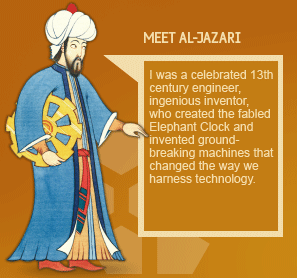
7 The crank-shaft is a device which translates rotary into linear motion and is central to much of the machinery in the modern world, not least the internal combustion engine. One of the most important mechanical inventions in the history of humankind, it was created by an ingenious Muslim engineer called al-Jazari to raise water for irrigation. His 1206 Book of Knowledge of Ingenious Mechanical Devices shows he also invented or refined the use of valves and pistons, devised some of the first mechanical clocks driven by water and weights, and was the father of robotics. Among his 50 other inventions was the combination lock.
8 Quilting is a method of sewing or tying two layers of cloth with a layer of insulating material in between. It is not clear whether it was invented in the Muslim world or whether it was imported there from India or China. But it certainly came to the West via the Crusaders. They saw it used by Saracen warriors, who wore straw-filled quilted canvas shirts instead of armour. As well as a form of protection, it proved an effective guard against the chafing of the Crusaders’ metal armour and was an effective form of insulation – so much so that it became a cottage industry back home in colder climates such as Britain and Holland.
9 The pointed arch so characteristic of Europe’s Gothic cathedrals was an invention borrowed from Islamic architecture. It was much stronger than the rounded arch used by the Romans and Normans, thus allowing the building of bigger, higher, more complex and grander buildings. Other borrowings from Muslim genius included ribbed vaulting, rose windows and dome-building techniques. Europe’s castles were also adapted to copy the Islamic world’s – with arrow slits, battlements, a barbican and parapets. Square towers and keeps gave way to more easily defended round ones. Henry V’s castle architect was a Muslim.
10 Many modern surgical instruments are of exactly the same design as those devised in the 10th century by a Muslim surgeon called al-Zahrawi. His scalpels, bone saws, forceps, fine scissors for eye surgery and many of the 200 instruments he devised are recognisable to a modern surgeon. It was he who discovered that catgut used for internal stitches dissolves away naturally (a discovery he made when his monkey ate his lute strings) and that it can be also used to make medicine capsules. In the 13th century, another Muslim medic named Ibn Nafis described the circulation of the blood, 300 years before William Harvey discovered it. Muslims doctors also invented anaesthetics of opium and alcohol mixes and developed hollow needles to suck cataracts from eyes in a technique still used today.
11 The windmill was invented in 634 for a Persian caliph and was used to grind corn and draw up water for irrigation. In the vast deserts of Arabia, when the seasonal streams ran dry, the only source of power was the wind which blew steadily from one direction for months. Mills had six or 12 sails covered in fabric or palm leaves. It was 500 years before the first windmill was seen in Europe.
12 The technique of inoculation was not invented by Jenner and Pasteur but was devised in the Muslim world and brought to Europe from Turkey by the wife of the English ambassador to Istanbul in 1724. Children in Turkey were vaccinated with cowpox to fight the deadly smallpox at least 50 years before the West discovered it.
13 The fountain pen was invented for the Sultan of Egypt in 953 after he demanded a pen which would not stain his hands or clothes. It held ink in a reservoir and, as with modern pens, fed ink to the nib by a combination of gravity and capillary action.
14 The system of numbering in use all round the world is probably Indian in origin but the style of the numerals is Arabic and first appears in print in the work of the Muslim mathematicians al-Khwarizmi and al-Kindi around 825. Algebra was named after al-Khwarizmi’s book, Al-Jabr wa-al-Muqabilah, much of whose contents are still in use. The work of Muslim maths scholars was imported into Europe 300 years later by the Italian mathematician Fibonacci. Algorithms and much of the theory of trigonometry came from the Muslim world. And Al-Kindi’s discovery of frequency analysis rendered all the codes of the ancient world soluble and created the basis of modern cryptology.
15 Ali ibn Nafi, known by his nickname of Ziryab (Blackbird) came from Iraq to Cordoba in the 9th century and brought with him the concept of the three-course meal – soup, followed by fish or meat, then fruit and nuts. He also introduced crystal glasses (which had been invented after experiments with rock crystal by Abbas ibn Firnas – see No 4).
16 Carpets were regarded as part of Paradise by medieval Muslims, thanks to their advanced weaving techniques, new tinctures from Islamic chemistry and highly developed sense of pattern and arabesque which were the basis of Islam’s non-representational art. In contrast, Europe’s floors were distinctly earthly, not to say earthy, until Arabian and Persian carpets were introduced. In England, as Erasmus recorded, floors were “covered in rushes, occasionally renewed, but so imperfectly that the bottom layer is left undisturbed, sometimes for 20 years, harbouring expectoration, vomiting, the leakage of dogs and men, ale droppings, scraps of fish, and other abominations not fit to be mentioned”. Carpets, unsurprisingly, caught on quickly.
17 The modern cheque comes from the Arabic saqq, a written vow to pay for goods when they were delivered, to avoid money having to be transported across dangerous terrain. In the 9th century, a Muslim businessman could cash a cheque in China drawn on his bank in Baghdad.
18 By the 9th century, many Muslim scholars took it for granted that the Earth was a sphere. The proof, said astronomer Ibn Hazm, “is that the Sun is always vertical to a particular spot on Earth”. It was 500 years before that realisation dawned on Galileo. The calculations of Muslim astronomers were so accurate that in the 9th century they reckoned the Earth’s circumference to be 40,253.4km – less than 200km out. The scholar al-Idrisi took a globe depicting the world to the court of King Roger of Sicily in 1139.
19 Though the Chinese invented saltpetre gunpowder, and used it in their fireworks, it was the Arabs who worked out that it could be purified using potassium nitrate for military use. Muslim incendiary devices terrified the Crusaders. By the 15th century they had invented both a rocket, which they called a “self-moving and combusting egg”, and a torpedo – a self-propelled pear-shaped bomb with a spear at the front which impaled itself in enemy ships and then blew up.
20 Medieval Europe had kitchen and herb gardens, but it was the Arabs who developed the idea of the garden as a place of beauty and meditation. The first royal pleasure gardens in Europe were opened in 11th-century Muslim Spain. Flowers which originated in Muslim gardens include the carnation and the tulip.
“1001 Inventions: Discover the Muslim Heritage in Our World” is a new exhibition which began a nationwide tour this week. It is currently at the Science Museum in Manchester. For more information, go to www.1001inventions.com.
Jonah and the Bush in the Quran
The readings in our Lectionary or daily readings, have been from Jonah. Johan has always been very real to me, growing up in Alaska, where great whales would swim in front of my house and occasionally a whale would beach, to the sorrow of all. Then one day, in far away Doha, a world away from Alaska, my Arabic instructor started telling us this story of Younis, and it sounded remarkably similar. I’d lived in the MIddle East for years, and I had no idea how many of our prophets also appear in the Quran.

So this morning, as the chapter of Jonas was finishing, I came to this one part, which has never made a lot of sense to me, Jonah mad at God because when Nineveh repents, God relents and does not destroy Nineveh (Jonah 3:10 – 4:11):
10 When God saw what they did, how they turned from their evil ways, God changed his mind about the calamity that he had said he would bring upon them; and he did not do it.
4 But this was very displeasing to Jonah, and he became angry. 2 He prayed to the Lord and said, ‘O Lord! Is not this what I said while I was still in my own country? That is why I fled to Tarshish at the beginning; for I knew that you are a gracious God and merciful, slow to anger, and abounding in steadfast love, and ready to relent from punishing. 3 And now, O Lord, please take my life from me, for it is better for me to die than to live.’ 4 And the Lord said, ‘Is it right for you to be angry?’ 5 Then Jonah went out of the city and sat down east of the city, and made a booth for himself there. He sat under it in the shade, waiting to see what would become of the city.
6 The Lord God appointed a bush,* and made it come up over Jonah, to give shade over his head, to save him from his discomfort; so Jonah was very happy about the bush. 7 But when dawn came up the next day, God appointed a worm that attacked the bush, so that it withered. 8 When the sun rose, God prepared a sultry east wind, and the sun beat down on the head of Jonah so that he was faint and asked that he might die. He said, ‘It is better for me to die than to live.’
9 But God said to Jonah, ‘Is it right for you to be angry about the bush?’ And he said, ‘Yes, angry enough to die.’ 10 Then the Lord said, ‘You are concerned about the bush, for which you did not labour and which you did not grow; it came into being in a night and perished in a night. 11 And should I not be concerned about Nineveh, that great city, in which there are more than a hundred and twenty thousand people who do not know their right hand from their left, and also many animals?’
Jonah is sulking? Jonah is angry that Nineveh listened, and turned from their evil ways?
(This time, too, as I read, I saw that last line where God is talking and he asks Jonah should he not be concerned about more than a hundred and twenty thousand people AND also many animals. 🙂 I love having a verse to quote from a book about a prophet common to both Christianity and Islam which clearly shows God has a concern for how animals are treated. )
So I Googled “Jonah in Quran” and found a Wikipedia article describing Jonah’s story from the Quran, which
Jonah’s Qur’anic narrative is extremely similar to the Hebrew Bible story. The Qur’an describes Jonah as a righteous preacher of the message of Islam but a messenger who, one day, fled from his mission because it’s overwhelming difficulty. The Qur’an says that Jonah made it onto a ship but, because of the powerfully stormy weather, the men aboard the ship suggested casting lots to throw off the individual responsible for this ‘bad luck’. When the lots were cast, Jonah’s name came out, and he was thrown into the open ocean that night. A gigantic fish came and swallowed him, and Jonah remained in the belly of the fish repenting and glorifying God to the maximum.
As God says: So also was Jonah among those sent (by Us). When he ran away (like a slave from captivity) to the ship (fully) laden, He (agreed to) cast lots, and he was condemned: Then the big Fish did swallow him, and he had done acts worthy of blame. Had it not been that he (repented and) glorified God, He would certainly have remained inside the Fish till the Day of Resurrection. (37:139-144).
God forgave Jonah out of His mercy and kindness for the man, and because he knew that Jonah was, at heart, one of the best of men. Therefore, the fish cast Jonah out onto dry land, with Jonah in a state of sickness. Thus, God caused a plant to grow where Jonah was lying to provide shade and comfort for the man. After Jonah got up, fresh and well, God told him to go back and preach at his land. As the Qur’an says:
But We cast him forth on the naked shore in a state of sickness, And We caused to grow, over him, a spreading plant of the gourd kind. And We sent him (on a mission) to a hundred thousand (men) or more. And they believed; so We permitted them to enjoy (their life) for a while. (37:145-148).
Aha! Jonah was sick. If I were in the belly of a fish for three days, I might be sick, too. And when I am sick, I can be irrational, and cranky, and like a sick cat I just want to crawl away and hide under a bush. In another commentary, the author suggests that as a Hebrew, Jonah might wish for the demolition of an Assyrian stronghold, which also makes sense.
Food Shortages?
My friends in Kuwait are complaining about the price of tomatoes. The price of tomatoes in Kuwait?? Can a Kuwaiti cook without tomatoes?? 😉
I remember when suddenly, rice, a reliable cheap staple, suddenly went through the roof, and then, disappeared from the shelves when India announced a shortage and refused to export Indian rice. Kuwait, and other Gulf countries, announced they were buying unused farmland in other countries to insure their food supplies. But tomatoes? I thought everyone in Kuwait grew tomatoes, at least in winter.
And then, today, I saw this article on creeping food shortages:
Another lackluster monthly jobs report took center stage Friday. Stocks rallied, and government bond yields remained at rock-bottom levels as investors anticipate more action soon by the Federal Reserve to drive down interest rates even further.
Reports about how much slack the U.S. economy still needs to work through — like unemployment — understandably get the spotlight. But investors may be overlooking an even bigger story as the developing world stages a sharp rebound: Shortages of items like food and commodities are once again becoming a major concern.
Prices for agricultural commodities spiked so much on Oct. 8 that they triggered daily movement limits on the Chicago exchange. Options markets saw prices for commodities like corn soar more than 13% during the day following reports of supply shortages around the world.
Commodity-oriented exchange-traded funds like the PowerShares DB Agriculture (DBA) leaped as well. The ETF surged almost 10% over the previous week, with more than 6% of the gains registered on Friday alone.
Supply and Demand Discrepancies
A sharp shortfall in the U.S. Department of Agriculture’s corn production forecast, due to poor weather patterns, also helped set prices soaring around the world. U.S. corn crop yields would come in 4% short of prior estimates and drop to their lowest levels in 14 years, the Agriculture Department said.
Fears of commodity shortages in the face of surging global demand are leading to export-slashing. Ukraine announced a sharp cutback in the amount of commodities like wheat and barley it would allow to be shipped out of the country. The likelihood of a major discrepancy between supply and demand have led to surging prices worldwide. European wheat prices rallied 10%, with other commodities, such as soybeans and cotton, climbing as well.
Still, investors should be cautious because commodity prices are known to be extremely volatile and difficult to put a price on.
Fundamental Forces
Nevertheless, rising prices are creating alarm about humanitarian concerns. Morgan Stanley (MS) and the U.N. have warned about the prospects of a rerun of the 2007 food crisis that slammed the developing world.
See full article from DailyFinance: http://www.dailyfinance.com/story/poor-crops-soaring-demand-currency-wars-a-recipe-for-food-sho/19667693/?icid=sphere_copyright
As we drove across the United States this summer, we saw acres and acres of US farmland, unworked, for sale. Farming is a tough life, and fewer and fewer families are still farming. It’s scary and sad.
What Mormons Do Right
Today, after church, AdventureMan took me to my very favorite place in Pensacola, Tudo’s (Vietnamese) and as we were waiting for our food, and our take out order (the Happy Baby has a bad cold so we are also taking lunch to his Mom and Dad) I notice the guys in the next booth are speaking in a foreign language, and because I don’t speak it, I can only guess, it was perhaps Maylay.
I think they had to be Mormons. They were in their twenties, and very clean cut. Two were probably foreign students, and two were in white shirts with ties, and dark pants, what I think of as Mormon-boys-on-their-mission dress, and it carries over into post-mission life. We saw them often, two by two, in Germany and in France, sometimes singing, sometimes going door to door, sometimes passing out pamphlets. They always spoke the language of the country they were in, maybe not so well at the beginning, but at the end of their two year mission, they spoke it pretty well.

From time to time, at the next table, they were all four speaking the same language, and it was not English.
So lets say, from a strategic point of view, that our goal is to spread the ‘good news’ (which, oh by the way, it is.) Doesn’t it just make sense that you make an effort to speak the language of your target nationality?
You would be amazed at how few of the other denominations who send ministers and evangelists overseas, how very few of them have much training in the language of the people they will be serving, or ministering to, or trying to share the good news with. You would not be amazed that when you are trying to communicate, especially big ideas, it really helps to be able to communicate. It also shows respect for another country and another culture, and humility to learn other languages and other ways. I can imagine that much of their success comes from an ability to build a personal relationship, and that is more likely to happen if you speak their language.
I am not Mormon, as you know, and I admire much of what they do right – I admire their neighborliness, their obligation to reach out and help where help is needed, and their stewardship of resources, built right into practicing the religion. I especially admire their ability to teach languages to the young missionaries they send out, and their vast library of genealogical resources.
Guide to Giving to Beggers
I don’t see so many beggers in Pensacola, but I do see a lot of men sleeping rough; the warm temperate climate here attracts a lot of homeless. The churches provide hot breakfasts, sometimes, and there is a homeless shelter and long term transition facility downtown. Giving to beggers was a much bigger issue in Qatar and Kuwait, where the begging woman with the baby in the souks or the guy with the plastic bag full of urine and blood would accost me, and I always had half a feeling I was being scammed.
Today’s reading in Forward Day by Day puts it all in perspective:
THURSDAY, September 23
Luke 4:14-30. The Spirit of the Lord is upon me, because he has anointed me to bring good news to the poor.
Snow fell on me as I waited for a cab. A rumpled homeless man in a stocking cap and fingerless gloves asked me for money.
I like to know that anyone I give money to is worthy (which usually means working or actively looking for work) and I don’t want him spending the money on alcohol or drugs. So I donate through a church or community organization. Pastors usually encourage that kind of giving.
I gave the man twenty dollars because I’d just been to the ATM and had nothing smaller. He stared at me for a moment and stammered, “Ma’am? You meant to give me a dollar, didn’t you?” When I said no, he put his head back and began to yell, “Thaaaank you, Jesus!” over and over. He went to a nearby coffee shop and came out with a huge cookie and a cup of coffee, still singing out, “Thaaaank you, Jesus!”
What if a beggar misuses my money? That isn’t my business. Giving to a beggar is between me and God; what he does with the money is between the beggar and God. (2004)
Thank you, Jesus. 🙂
Recent Comments
ExpatAlien on What Country am I Living … intlxpatr on Yellowstone: Old Faithful to C… Michelle on Yellowstone: Old Faithful to C… Cathy on No Grown-Ups in Charge intlxpatr on Waiting for Snow Wikipedia Donate Button

Amazina


Early Voting in Florida


 Here There and Everywhere