The Devil’s Queen by Jeanne Kalogridis
“I need an ESCAPE!” I shouted to AdventureMan, at the end of my rope. So many things going on in my life that are out of my control, I just don’t want to deal with it any more, and I just want to run away and hide. “I’m going out to buy a BOOK!”
I found just the book, The Devil’s Queen by Jeanne Kalogridis.
I don’t know much about the late 1500’s in Europe, do you? At first, reading about this rich, spoiled little girl growing up in Florence, I felt a little impatient with her. All around her people are starving, and she hasn’t a clue. The plague strikes, and people are dying, but she survives. She starves, she suffers cold and fleas and is tossed by fate like a little cork on the water – all before she is 12 years old. Catherine de Medici learns early in life that she has no control over the forces of history and society swirling around her, over who she will love and who she will marry, even over whether she lives or dies. Surviving an attack on her family compound, held prisoner – alone – in nunneries until she is 12 years old – this girl’s life makes mine look peaceable!

I’m feeling better already.
Kalogridis is no Phillipa Gregory, but she has done her research, and draws us in. By the time Pope Clement betrothes Catherine to Henri of France, we are totally hooked. Thirteen years old, and off to live in a strange country as the bride of a man she has never met. She studies French as quickly as possible, but then again – this is a very bright young woman, who has been trained – by life and by education – to survive.
One of the paragraphs made me laugh out loud – as Catherine enters France, she is aware that her very fashionable Italian clothing is very unfashionable in France. She also notes that all the French women are painfully thin, thin to the point of gauntness, and are whispering behind their hands at her more normal size.
Lack of thinness is the least of her problems. She marries Henri, who is also 14, scared, and not in love with her, and they are expected to consummate their marriage under the eye of the King. Oh aargh! Catherine is on a steep learning curve, mastering French culture, diplomacy, the art of war, court politics and fighting the threat of repudiation the only way she can – with utter humility.
What I like the most about this book is that I feel like I was there with her. She is very human, and also very royal. People who are royal have different ideas than the rest of us, and are entitled in ways we can never imagine. They have obligations we can’t imagine. She makes choices I would never make, and yet the author convinced me that given her circumstances, she does the best she can with the resources at hand.
I also like it that Catherine of Medici was a brilliant and educated woman who held her own in a world where the balance was definitely in favor of being a man, and women were greatly at a disadvantage. While she made some horrifying choices, she had her reasons. This is not a book for the faint hearted; it is very earthy and it feels like an accurate portrayal of the times.
As I read these books, I think, too, how little we appreciate how free women are these days, and how recent that freedom is. Being able to choose our own mates – this is very recent. Being able to inherit and to manage our own money – this is very recent. As I talk with my friends who live in the Arabian Gulf, where marriages can still be based on family alliances, maintaining wealth and power, and where divorce can still equal personal disaster, it no longer seems so alien to me – we have this in our own history. We used to marry by contract, and our husbands had full use of our wealth. We used to be judged by whether we could bear children, how many, how many were sons, and how well we managed our households. We used to die in childbirth, and many of our children didn’t survive their infancy.
If you are looking for a good escape, this is a book that will take you there. It will make your own troubles look small in comparison. This book will keep you engrossed, horrified, and entertained, and, in the end, you might learn something, as I did.
You can find The Devil’s Queen at Amazon.com for a mere $10.40 plus shipping, and yes, I own stock in Amazon.com. LOL, we invest in that which we believe to lasting and important, and books play a large role in our lives. 🙂
News and Roosters
“How’d you sleep?” I cheerily greeted my sister, Sparkle, newly arrived from Paris to our small farming village in Germany.
“That #*%@ing ROOSTER!” she exclaimed. “He started crowing around 3:00 a.m. and never stopped! You must have heard him! He was right under our window!”

No. No, there was no rooster under our windows. The nearest rooster was up in the next farm, maybe 100 yards away. But I kind of remembered when we first moved in, I think I remember we heard him. We no longer heard him. You just get used to it, I guess.
What brings this to mind is that KUOW in Seattle has a program today on the Seattle City Council vote – they are about to vote to increase the number of chickens allowed by ‘urban farmers’ but to prohibit the roosters.
You can hear the discussion for yourself by going to KUOW. There are some hilarious comments, one by a man who said “Sure, ban roosters, right after you ban boom boxes, and teenagers, and heavy trucks, and garbage pickups. There are a lot worse sounds in the city than roosters!” (I may have paraphrased that quote, I was laughing too hard to write it all down.)
AdventureMan and I love National Public Radio. We support our local NPR station, WUWF in Pensacola, which I listen to while I am driving, but when I am working on a project, I still stream KUOW, which I started doing while I was living in the Gulf. I love the huge variety of opinions and subjects, and I appreciate that there is more news in the world than what they show on TV, after all, on TV they can only show what they have film footage of. There are books to be discussed, and movies, and music, and social situations in Khandahar and Botswana and Sri Lanka and boy soldiers in Liberia . . . things I haven’t a clue about unless I listen to my national public radio station. I read the paper daily. I watch the news once a day – but it doesn’t meet the depth of coverage of NPR.
I think chickens are pretty cool. They are also pretty stupid, but I am all for a chicken or two, fresh eggs, etc. When I needed fresh eggs in Germany, I just walked up the hill and bought them from the chicken lady. When I asked my landlady about recycling, she just laughed, and we walked our food leftovers, peelings, coffee grounds, etc up the hill and threw them over the fence for the chickens. I don’t even mind roosters. Sorry, Sparkle!
Freedom Isn’t Free
Happy Birthday, United States of America! Happy Fourth of July, AdventureMan.
Opposite World
At one time I was doing a Christian weight-loss program (it really worked!) and on the tape I was listening to, the leader was talking about opposite world – how the world we live in operates by different rules than the ones we are supposed to be living by.
In many ways, I find myself in Opposite World now.
In the Gulf, the abaya isn’t something a woman is forced to wear, it is a cover, and a tradition. Women who wear the abaya have mostly chosen to wear it because that’s what is done. It has less to do with religion and more to do with customs.
So in Florida, I am having to rethink how I operate.
After my water aerobics class the other day, one woman was asking what the biggest changes are that I face being back here.
I laughed and told her that I was off to buy cat food, and that it made me laugh that I could go out with wet hair and shorts and a t-shirt, and because it’s Florida, that’s the way to avoid attention, to look like everyone else. If I am wearing a skirt and have my hair fixed, people notice me. The way to fly under the radar is to look like everyone else – I don’t even need to wear makeup. No one is going to notice, no one is going to care. It is very freeing, and at the same time. very weird for me.
When women wear abayas, it is like saying ‘look away’ or look somewhere else; I am modest. If I were to wear an abaya in Pensacola – and, LOL, sometimes I do, like to run out and get my morning paper or to run out and pull in the garbage can late at night – people would look, people would notice. Here, it doesn’t say ‘look away.’
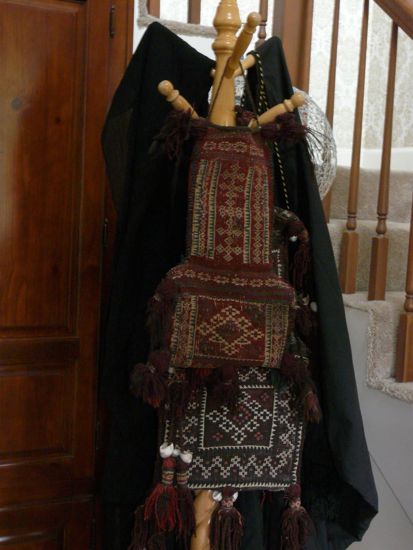
Good Enough
This is from Rick Warren’s Daily Hope send out for today, and for me, it really hits home. So many times I hesitate to step up to the plate, waiting until I am sure my skills are what is needed, when what is really needed is just for someone to have the courage to step up, to speak out.
The best ‘Christian’ person I know, who follows this Christian principle, was born Muslim. She is always the first to serve, and the last to take anything. She is the first to give and the first to start cleaning up after an event. She is never afraid to get her hands dirty, or to defend the dignity of ‘the least of these.’
Real servants do their best with what they have. Servants don’t make excuses, procrastinate, or wait for better circumstances. Servants never say, “One of these days” or “When the time is right.” They just do what needs to be done.
The Bible says, “If you wait for perfect conditions, you will never get anything done” (Ecclesiastes 11:4 NLT).
God expects you to do what you can, with what you have, wherever you are. Less-than-perfect service is always better than the best intention.
One reason many people never serve is that they fear they are not good enough to serve. They have believed the lie that serving God is only for superstars. Some churches have fostered this myth by making “excellence” an idol, which makes people of average talent hesitant to get involved.
You may have heard it said, “If it can’t be done with excellence, don’t do it.” Well, Jesus never said that! The truth is, almost everything we do is done poorly when we first start doing it — that’s how we learn.
At Saddleback Church, we practice the “good enough” principle: It doesn’t have to be perfect for God to use and bless it. We would rather involve thousands of regular folks in ministry than have a perfect church run by a few elites.
Before You Leave Doha – No Regrets
I was neither the first nor the last of my group to leave Doha. Well, yes, actually, I was the first, I left Doha for Kuwait, but it doesn’t count because I came back and then was no longer the first to leave. The next to leave are leaving soon, so I want to share something with you.
All my visitors from Kuwait bought these at the Museum of Islamic Art in Doha. I didn’t get it. It just doesn’t rain that much in Kuwait, but the umbrellas are only 100 QR, and that is a reasonable price for a big umbrella, well made.
My last visit to the Museum of Islamic Art, just before leaving, I broke down and bought one, too, and packed it immediately for moving to Pensacola. I was with a good friend, she bought one too. I kind of wondered if I would ever use it.
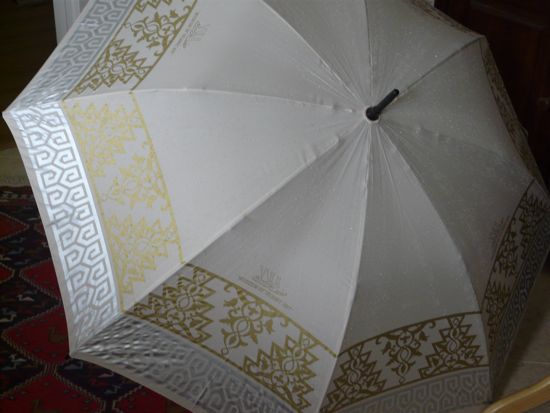
We are getting some serious rain in Pensacola, related to Hurricane Alex. Do you have any idea how BIG hurricanes are, even smaller ones? They whoosh around in a huge counter-clockwise circle, and if you look at a satellite photo, you will see that the circular whoosh can cover hundreds of miles – thus, pouring rain in Pensacola.
I had put my umbrella in the car, as a just in case. Yesterday, I had an opportunity to unfurl it for the first time.
It is gorgeous.
Some things don’t translate well. Some things you buy, you look at and wonder ‘Why did I buy this?” It looks so good in Doha, but you get it back to the USA and . . . sometimes, it doesn’t look so good.
This umbrella looks GREAT. It is so classic, in the ivory, and I love the silver and gold pattern; it is subtle and beautiful. It really covers well, too, and keeps the rain off you and one other. 🙂 This is a very good buy!
Truth in Packaging?
I am always skeptical of the products I call “hope in a bottle” (to my great amusement, there is actually a great product line which is now called Hope In A Bottle) but people will buy anything in hopes that it will keep their skin looking young and fresh.
When you live in heat, and when you do water aerobics, you need more. I was looking for something light I could put on often, something for day, and something for night. This is above and beyond the magic elixirs I put on my face that show “amazing, visible results in 7 Days!!!!” although seven days later I wonder what my face might have looked like if I hadn’t been using Product X . . .
So I bought some hope in a bottle to use days and nights, and yes, partly I will admit I bought the beautiful packaging. It is beautiful, isn’t it?
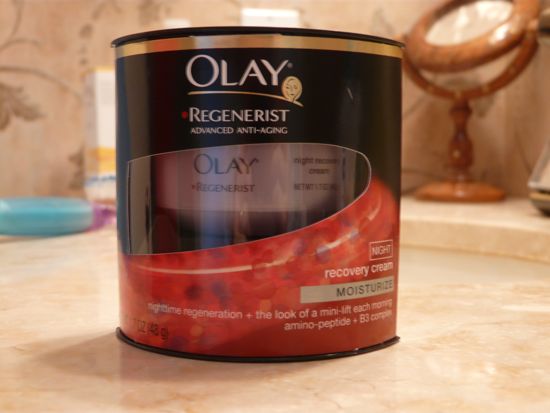
And it wasn’t that hard to open, which is a bonus. But wait! What is this inside? I paid for a lot of AIR!

The next package was the same – beautiful packaging; a lot of air . . .

Maybe, in its own way, it is more true than fiction. After all, when we are buying vanity, when we invest in the hope of beautiful skin, a lot of it is illusion and air, isn’t it?
Breath of Fresh Air at Christ’s Church, Pensacola
AdventureMan and I slid into our seats just as the bell started ringing, and looked at one another in concern – “Does it feel hot in here to you?” “Yep.”
It was only eight in the morning, but the church was breathless.
It made me smile, remembering our church in Tunisia, St. George’s, where there was no air conditioning, only fans – when the electricity was working. St. George’s is the oldest Anglican Church in Africa, and is located in the large Tunis souk. Summers were long and hot, and many a Sunday I had to gather my squirming two-year-old and take him out to the garden for a stern talking-to. It was a wonderful, diverse church, and we loved our time there – breathless or not.
And we got through the service, heat and all, it wasn’t that bad.
The sermon was really good. Father Neal was talking about Jesus, invited to a banquet, having his feet washed by the tears of Mary Magdelen, and dried with her hair.
As an aside, one of the things I love about Jesus was his kindness to women, including them when he talked, healing their hurts, defending them against stoning – in a culture not unlike that in which we have been living, where women are contracted into marriage, “protected” by laws which often deprive them of independence and choices, and living lives greatly separate from men. Jesus spoke to women, and he spoke to their hearts. He included them among his followers and supporters. In the context of his society, his behavior was radical and challenging to the status quo.
Father Neal totally got that. He talked about the scandalous sensuality of Mary’s act, washing Jesus feet and then drying them with her long hair. He talked about hair, traditionally covered in that part of the world, being a woman’s glory, and only privately displayed among family and to husband. He talked about her remorse, and her humility, and that through her loving act, her spirit was cleansed and her sins forgiven. And he talked about the customs and traditions of hospitality, and the shock of Jesus criticizing his host – who was criticizing him – for his lack of welcome, and signs of hospitality to an honored guest.
His sermon was a breath of fresh air in a very warm church. We held on to every word.
Later in the day, old friends came for dinner, and our son and his wife and our grandson. Cannot imagine a more wonderful day. 🙂
Shhhh! I’m Reading!
The doorbell rang, it was after dinner, and we figured it was our son coming by, so we ran to the door. No-one there, but we can see back of the UPS man trying to cross to his vehicle on the other side of the road, and there is a small package on our porch.
I was briefly disappointed, but not for long. The package was a book I had pre-ordered:
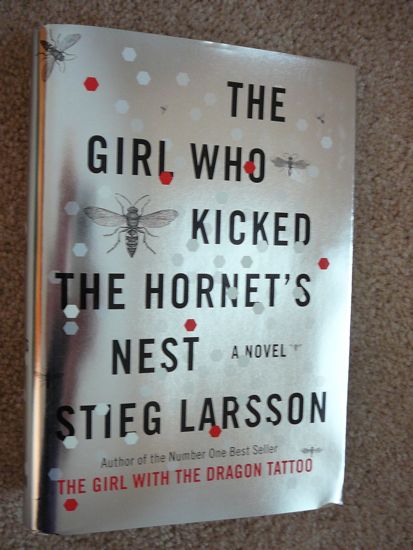
I don’t often order a hardcover book; I don’t care that much. Most of the time. Now Stieg Larsson is another story. His last book, The Girl Who Played With Fire, was a cliff-hanger, which I read while waiting to move in to our house, while it was being rewired. I could hardly wait to find out how everything resolves, so I pre-ordered from Amazon, and started reading as soon as I had opened the box. 🙂
While in Sam’s Club doing some shopping for Memorial Day, I noticed that on a very full book rack, the Stieg Larsson paperback books are flying off the shelf.
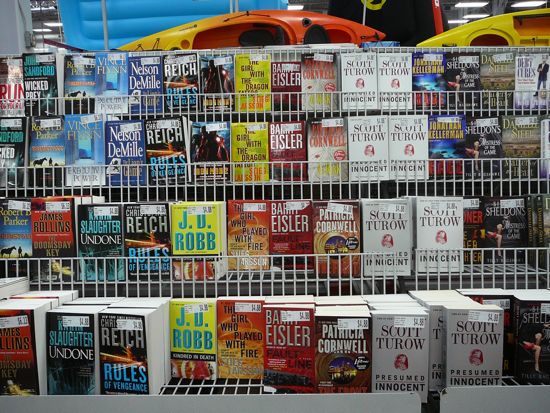
This time, I couldn’t wait for the paperback edition. 🙂
Kuwait or Qatar or Pensacola?
Showering after my water-aerobics class, I could hear voices discussing a local political-social situation. A benefits agency has groups of families working in it, and they know all the tricks. They know how to insure more of their own family members hired, and they know how to help all their family members (and friends) take advantage of all the entitlements.
Expats abroad call it nepotism, and scorn it as a third-world corruption. In truth, it happens everywhere.
There is an ongoing schism taking place in Qatar and Kuwait, countries that have been gracious and welcoming to me. The nationals of Kuwait and Qatar control citizenship carefully. The citizen base is about 20% of the population, on a good day. The rest of the population are people who are in Kuwait and Qatar to work. Most there to work can never hope for citizenship. For many, the poverty in their home country is so brutal that no matter how hard the working conditions, at least it is a salary, and they can send something home so that, literally, their families can eat. They dream – like we do – of educating their children so that they will have a better, more secure life.
Here is the problem. When 80% of the population is NON-Kuwaiti, or NON-Qatari, your country starts to change. One way in which things have changes is that in a very short time, the highways have gone from very quiet to gridlock, due to a dramatic increase in drivers and cars. In Qatar, the situation is made worse by nationalization of the taxi service, resulting in so few taxis that hotels now use private limo services, because finding a taxi at peak times is near to impossible.
That’s one issue. The second issue is language. Imagine your elderly parents going into shops to buy something – in their own country – and the clerks don’t speak their language. As they are stumbling and bewildered, some noisy “workers” walk in, state their needs, are understood, conduct their business and exit before you even get served. This is happening in Kuwait and in Qatar; everyone is speaking English. In a country where the workers are Indian, Nepalese, Philipino, Saudi, Yemani, Omani, Lebanese, Syrian, French, Dutch, English, Australian, South African, American (and about thirty or forty others) the common language has evolved to be English, not Arabic.
How do you think you would feel if it were happening here? If the great majority of cars on the road were not “us” but “guests” in our country? If the clerks in stores couldn’t understand what you want, because although they are in your country, they don’t speak your language?
Another problem is what to do with the huge, disproportionate number of geographically single males brought in to work as builders, cleaners, heavy equipment operators, dishwashers, drivers, security guards and other fairly low-paid positions? In Kuwait and in Qatar, non-married sex is strictly forbidden, even holding hands in public is considered an affront to morality. These men are banned from malls where families might gather, and from other public places. Their existence is grim, and they often find themselves unpaid, or paid far less than they were promised for their labor.
Last, but not least, this very modest Gulf culture has people – foreign guest workers – parading themselves on their streets in various states of undress. Think about it – that’s how we look to them. We have no shame. We bare our faces. We flaunt the glory of our uncovered hair. Sometimes a shawl might drop and a glimpse of bare arm or even a hint of cleavage might shock the modest eyes of a believer.
In Pensacola, there are also fundamentalists who wear long skirts, long sleeves, and determinedly modest clothing. I wonder what these believers think about the skimpy clothing on the beaches, or in the malls?
Coming home has been a real eye opener. It was easy for me to be critical of things I saw in Qatar and in Kuwait. Coming home, we joke all the time about “Kuwaiti drivers” here in the US, but the real joke is – they sure look a lot like us.
Last week, we saw a man here make a U-turn right in the middle of the road, and rock as he tried to regain control of his truck, and almost blast right through a red light he didn’t see. The back of his truck was down, and items loose in the truck bed were heading toward the highway – fortunately he figured that out, and last we saw, he had stopped to fix his rear door. Maybe he wasn’t sober. Maybe he had had an argument with his wife or boss or someone and was not paying close attention to his driving. All I know is that we have seen a goodly number of inattentive drivers here, too.
When a bureaucracy gets corrupted, when the rules are not applied equally to all, when select groups get favored treatment – here in Pensacola, at the immigration department in Kuwait or in the traffic department in Qatar – everyone suffers. It’s a political problem, a social problem, and a systemic problem. God willing, if we are truly evolving as a species, we will find a way to create truly fair and transparent systems which will work as they are ideally intended to work.
It’s on us. We have to make it happen. We have to want it badly enough to make it happen, even making sacrifices for the greater good.
I don’t have any answers. I don’t know how to make us better people that we are, how to make ourselves make the right choices. I do know this – whether it is a tiny village in Germany, or an eagle’s aerie in Kuwait, or the lush life of Doha – we are all more alike, and share more similarities and problems, than we are different. If we could only learn to see through one another’s eyes, maybe we could find ways to resolve our differences and learn to cooperate.
Recent Comments
Catherine on Donna Leon Crossing Cultu… intlxpatr on Ignoring the Law thani on Ignoring the Law Anon. on British Soldier Kidnapped, Esc… Reeva Mills on Cahors to Bordeaux, Preparing… Wikipedia Donate Button

Amazina


Early Voting in Florida


 Here There and Everywhere