Music Banned in Somalia
We are in our own world these days, boxes needing unpacking, deliveries interrupting tasks, and no connection – no TV, no internet, no land line phone. We do have a cell phone, and Friday night our son called to ask us if we have heard about the weather.
Nope.
Heavy rains, strong winds, possibility of tornados. It was lively!
I hadn’t heard about Somalia, either.
This is really scary to me. This is the kind of thing I worry about in my own country – who makes the rules? Who gets to say what music I listen to, what movies I watch? Who gets to restrict my access to information?
Who gets to tell me that as a woman, I can’t have a checking account in my name? Or that I have to wear a burqa? Or that I am not allowed to wear a niqab (if that’s what I want?)
Somalia Radicals Declare Music ‘Un-Islamic,’ and Radio Goes Tuneless
POSTED: 04/25/10
If, as my colleague Sarah Wildman reports, the Francophonic world is intent on curbing expressions of fundamentalist Islam belief, then the radical Muslim world is taking no prisoners with the West, either. Last week, the Somalian fundamentalist Islamic group Hizbul Islam announced that music of any kind is “un-Islamic,” warning of “serious consequences” for those who dare to violate their decree. In response, radio stations all over the country, including those run by the moderate Muslim transitional government, cut all music from their broadcasts. Even intro music for news reports was scrapped. In its place? “We are using sounds such as gunfire, the noise of vehicles and the sound of birds to link up our programmes and news,” said one Somalian head of radio programming.
Get the new
PD toolbar!
Somalia has been wracked with inter-tribal violence for nearly two decades. In the last few years, increasingly radical Muslim militants, including the dominant Shabab group, have taken over large parts of the country and become closely affiliated with al-Qaeda. A moderate Muslim transitional government, helmed by a former teacher named Sheik Sharif Sheik Ahmed, controls a small part of the country. His government is largely propped up by African Union peacekeepers, with United Nations’ and U.S. support.
In the meantime, Islamic radicals like Shabab have gone on a campaign the New York Times described as “a quest to turn Somalia into a seventh century style Islamic state.”
The music decree follows a string of fundamentalist decrees, including prohibitions on wearing bras (also “un-Islamic”), the banning of modern movies and news channels, including the BBC and Voice of America.
As evidence of a power struggle between the moderate Muslim government and the hard-line radicals who control many parts of the country, Sheik Ahmed’s government responded last Sunday by saying any radio stations that stopped playing music would face closure. In the government’s eyes, those radio stations that complied with the ban were colluding with the radicals.
In the meantime, the radio stations have been caught between a rock and a hard place. “The order and counter-order are very destructive,” radio director Abukar Hassan Kadaf said in the Times article. “Each group are issuing orders against us and we are the victims.”
In the escalating tug-of-war between Western and Islamic powers over freedom of expression, what remains to be seen is how much of a causal relationship exists between the two. Is a proposed burqa ban in Quebec a result of the shuttering of a radio station in Somalia? Does a call for prohibition of headscarves in Paris force a bra-burning in Mogadishu?
If Islamic decrees do, in fact, fuel the fire for legal actions in the West (and vice versa), then continued and increased prohibition seems inevitable. But if radical Islam and a skeptical West are destined to one-up each other in a battle of bans, the powers that be might remember the men and women caught in the crossfire. That is, the women in the West who wear niqabs by choice, or the men and women in Somalia who just want to listen to music. What is perhaps most strikingly absent in all the brouhaha surrounding sharia vs. Western law are the voices of the moderate Muslims themselves. In the end, perhaps the gulf between the two sides will prove too great to be bridged, but for the immediate future, we would do well to remember the ground we share in common. Before there’s nothing left to ban.
AdventureMan Finds the Sunset
It was getting close to five p.m. and AdventureMan had just awakened from a much shorter nap than usual. There is no pressure to adjust to the local time, so he is taking it slow. I love to watch him take a nap.
“So what do you want to do?” he asks me, and suppresses a groan when I remind him he said we would find some places where I can watch the sun set.
We decided to head over to Perdido Bay, me navigating, but sometimes I miss the right turn and we have an “adventure.” It’s all OK, it’s not like we have to be anywhere by any time, so there’s no such thing as a wrong turn, just another opportunity to make some additional connections in the brain cells as we try to figure out Pensacola. Or that’s the way I am telling it, and it is my blog. Anyone can make a mistake, right?
Pensacola has very funny roads. Almost all the roads curve. Like the road we live on is the same road my son lives on, but where he lives, the road is north south, but where we live, it is almost east-west. A road called 9th, you would think would be a straight road, but it is more like a parabola! Fairchild road will turn south and become Navy Boulevard, but the real Fairchild road actually continues, considerably diminished. You just have to get used to it; it doesn’t have to make sense.
And there are Kuwaiti drivers everywhere!
(So, OK, now it comes. I apologize for all the bad things I ever said about Kuwait drivers. American drivers are also going through the orangey-red lights, even going through the red lights, and American drivers are also making left turns from the far right turn lanes. Yep. I’ve seen it. Guess I’ve been gone a long time. I wonder if even Seattle has become the Wild West on the roads? The difference between the really bad American drivers and the Kuwait drivers is that the Americans are mostly driving a lot slower when they do these things. So Kuwait, I apologize.)
We discover there is no state park along the band of land from where we thought we were going to watch the sunset, and there sure are a lot of slabs where houses used to be – which usually means they were blown away or seriously destroyed in one hurricane or another.
AdventureMan found a fabulous place, though, Tarkiln Bayou Preserve State Park. They have two walking trails, and since it was getting close to sunset (and I have a thing about being in swampy areas after dark) we chose to do the short hike, like one mile, out to the Bayou, but next time we will do the 7.2 mile hike out to the Bay.

We didn’t know we were going to do the hike when we left the car, so I didn’t have my camera. At first, we were walking not too far from the busy highway and thought it wasn’t such a great hike, but then AdventureMan spied the endangered white pitcher plant, a carnivorous plant that traps insects. Pretty fantastic!
This was one fantastic adventure. I am going to show you some pictures I got from the Florida State Parks website, focusing on Tarkiln Bayou.

This is a view of where the trail ended – it was unbelievably beautiful. The sun was setting and we were on a bayou with not another human being in sight, not a house, not a trail – it was pure nature surrounding this gorgeous tiny little bayou. But . . . the sun was setting, and I don’t like to be out in a park after dark. No, I am not chicken, I am a realist, foolish people who are where they should not be can find themselves in big trouble when the sun goes down. Also, I hate mosquitos and mosquito bites, and they usually come out around sundown, so we did our return hike at a healthy pace.

As we headed home, AdventureMan said “I think I remember a good place where you can see the sunset.”
And within five minutes, we were there.
You know how I love those sunrises in Kuwait. Sunsets are what I love even more. Here are some photos of last night’s sunset, thanks to AdventureMan 🙂
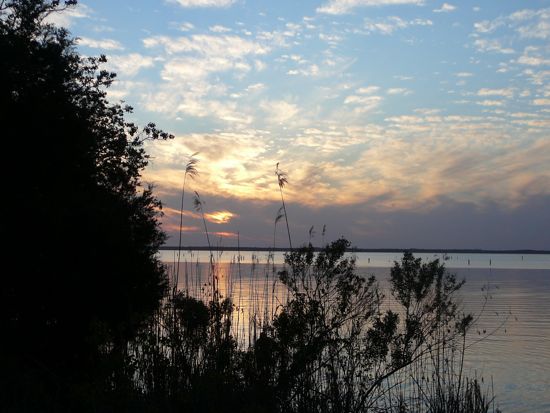


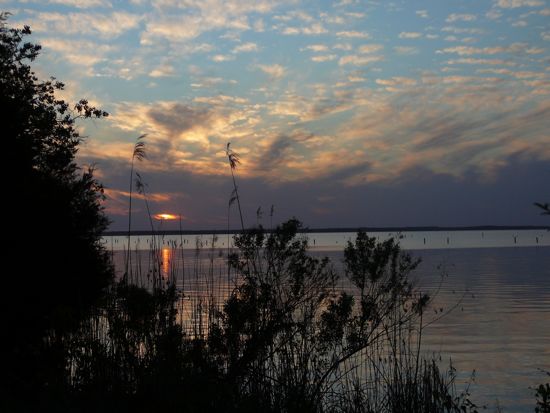
And so I ask you – is this not a magnificent way to end a day?
Pensacola Navy Exchange and Customer Service
One of the things that totally blows us away in the United States is customer service. Every now and then you run into bad customer service and it is so noticeable because most of the customer service is so GOOD. It is so good so often that you take it for granted, if you haven’t lived in countries where sometimes they treat you like you are lucky they notice your existence and maybe you aren’t good enough for their product, LOL!
I have a sweet, very elegant Indian friend in Kuwait. One time she told me she wanted to buy a beautiful pen for her husband, but when she went to the store, the man behind the counter didn’t want to show her the pen she wanted – because she is Indian. She said “here he is, working behind the counter, and he treats me like he doesn’t think I can afford to buy the pen I want to look at!” How insulting is that??
Oops. I digress. Sorry.
We decided to check out the Navy Exchange in Pensacola. Pensacola is a big military retirement area. It is a beautiful place, beautiful white powdery sands, green to turquoise to blue to purple waters, green palms and trees and right now azaleas blooming everywhere – many military people think it is heaven on earth, and come back to retire here. It’s a fun place, the Blue Angels practicing on Tuesday and Wednesday mornings; you can hear them thundering through the skies and over the Gulf, practicing their moves.
We get to the exchange (the souks, for my Gulf readers 😉 ) I am disappointed – it’s small. There is another building, but it is also small, and I am looking for big appliances, like a clothes washer and dryer. As we are leaving, a store guy asks us if we found everything OK, and we said ‘no, not really’ and he listened to us and then laughed and told us we were at the wrong place, and he took his time to tell us how to get to the right place, and to make sure we understood.
When we got to the right exchange (and it is HUGE!) there were lots of parking places – I love this place. We parked next to a reserved space. There are lots of reserved spaces – remember, this is a military base. The commander of this, the commander of that, a space for flag officers (generals) and then . . .this space. It gave me a big grin. And there are TWO of them, right in front of the Naval Exchange:

In my seven years in the Gulf, in Qatar and in Kuwait, I saw some amazing changes, including going from total disregard of handicapped spaces to increasing respect for the handicapped spaces. Wouldn’t it be cool to have a couple Expectant Mother spaces reserved in front of the Co-ops, and maybe in front of Toys R Us, and the hospitals?
Once inside, I was looking at washer and dryers, and a lady asked if she could help me. I said no, but then I couldn’t find the ones I was looking for, the ones recommended by Consumer Reports and I saw the lady behind a counter so I asked her. She said if we didn’t see them, we could order them, looked them up and told me the price, which was only minimally lower than I had seen them off base, except that on base we don’t have to pay the sales tax, which would make a difference.
But then, she started telling me more. Right now, we could take off 15% for this sale, and get a $50 mail-in rebate (better!) but if I could wait to order until April 12, the price would be 20% off for three days (woo hoo, even better!) AND if I used my Navy Star card for the first time, I could take an additional 10% off anything I purchased on the first day (WOOO HOOOOO, better and better!)
We are about to set up an entire household in a country where we haven’t lived for 12 years. We need EVERYTHING. We’ve been saving, so this isn’t going to put us in debt, but it’s like God just handed us this huge gift when he sent this woman our way to explain how it all works. So I applied for the credit card and was instantly approved, and I asked if I should put AdventureMan on the card and she laughed and said “no!” because what if we wanted something else BIG down the road, then he could apply for his own card and we would get the 10% all over again.
Now, my friends, THAT is customer service. What a woman!
Washer
Dryer
Vacuum Cleaner
2 Plasma TVs
wireless BlueRay/DVD player channels Netflix
All-in-one fax/scanner/printer
etc.
We are going to save a bundle.
First, AdventureMan is coming with me to our Water Aerobics class at the YMCA. He has toured the Y, met the instructor, and no longer thinks this is going to be ‘girly’. From there, we will head for the NEX (Naval Exchange) to make our purchases and place our orders.
Next week, the major start-up grocery shop. Imagine, starting your kitchen once again from scratch. No, I have pots and pans and tools, but the basics, from salt and pepper, through olive oil, flour, sugar, etc . . .everything. oh, AARRGH.
Pensacola Ramadan Lanterns
Have I mentioned how low my shopping resistence is? Oh? More than once? LLOOLLL . . . . it is a serious problem for expats coming back to settle. It is even a problem these days for expats coming back just for a few weeks! You see all the kinds of things available that you never see, or you see things you never buy at prices you cannot believe, and if you are returning, you return with a ton of chocolate chips (if you are me) and Hidden Valley Ranch Dressing Mix, Knox gelatine, colored sugar crystals, and . . . well, you get the idea.
At one time, we could take two big duffels, even in economy. At one time, when you checked in overweight bags, the people checking you in just looked the other way, most of the time. So we brought stuff back, books, computers, printers, whatever you could get in a duffel – and trust me, you can get a LOT in a duffel.
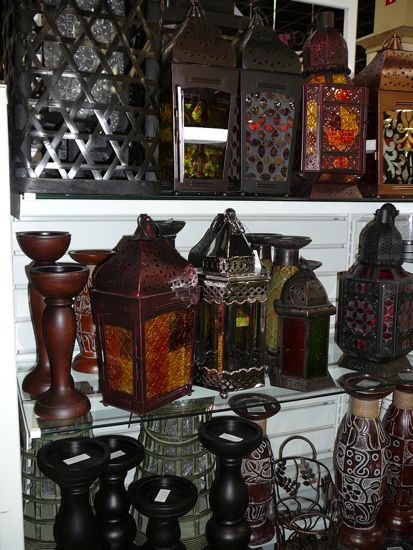
There was one thing, though, that I couldn’t resist in Doha, and in Kuwait, the Ramadan lanterns. I loved those lanterns, so beautiful, so exotic. I bought many, different styles, I loved them.
So imagine, I walk into the local Pensacola TJMaxx and what do I see? These are advertised as ‘garden’ lanterns, but many of them bear an amazing resemblance to ‘Ramadan’ lanterns:
Long Term Care for The Aged: Hidden In Plain Sight
One of the most amazing things that happened to me while I was living in Doha was a conversation I had with a group of Qatteri and Palestinian women. We were talking about our summer plans, and when it was my turn, I told them I was going back to the US to take care of my Dad while my Mom had a knee replacement. They all looked at me in stunned silence, and I wondered what I had said wrong.
“You do this?” one of them finally asked me, “You take care of your parents?”
“Yes, of course,” I replied, not understanding her puzzlement.
There was a burst of excited chatter I couldn’t follow, and then one of the younger women said to me “but we NEVER see this on TV.”
Things have probably changed by now, with all the cable stations available, with Lifetime and a broader spectrum, but what they think of as America is Dynasty and – well, think of what your favorite programs are, and then imagine an alien culture watching and trying to figure out your culture from what you watch. If you are living with the aliens, they way we portray our own culture on television and in movies is appalling!
Long story short, most adults want to stay independent as long as possible. They never want to be a burden on their sons and daughters and grandchildren. I am willing to bet that this is almost universal. For one thing, from the point of view of the aging, if you live with someone else, you know you will increase their work load, and if you go to a facility, you lose a lot of options to choose. Being able to have someone to come into your own house allows you to remain independent as long as possible. If you live with one of your children, you still get to have home-care, which relieves a lot of the burden on those with whom you are living.
Here is an AOL Health News article on a ‘hidden’ provision of the new health care act which will make it possible to keep our elders at home longer. Believe me, this is a very good thing, if you have ever dealt with a rehab facility, or a residence for the aged.
Health Care Reform Will Impact Long-Term Care
From AOL News: HealthCare
Robert W. Stock
Contributor
(March 26) — As health care reform became the law of the land this week, a huge bloc of Americans with a unique interest in the outcome sat watching on the sidelines.
The 49 million people who care for older family members were hidden in plain sight, as usual, quietly shouldering a burden that so often takes a heavy toll on their finances and their physical and emotional well-being. Many of them — I know a few — are opposed to the new health care law, even though it includes one of the most important steps ever taken to improve caregivers’ lot, especially those of the middle-class persuasion. Of course, hardly any of them are aware of that.
The Community Living Assistance Services and Supports Act, otherwise known as CLASS, provides for a national insurance program to help cover the cost of long-term care — something 70 percent of people over 65 will need at some point along the way. The premiums will be much lower than those for private plans, and you won’t get screened out because you’ve already had some health problems. Once vested after five years, enrollees unable to care for themselves will be able to claim cash benefits for as long as needed.
Joe Raedle, Getty Images
A health aide helps a patient at his home in Miami. The new health care reform law could “transform long-term care” and make it possible for more patients to stay at home, said the chief of the National Council on Aging.
If you’re rich, you don’t require much financial help with long-term care. If you’re poor and can no longer fend for yourself, Medicaid pays the bills, often at a nursing home. For the rest of us, long-term care — at home or in an institution — now requires that we, or our caregivers, choose from among some unpleasant options.
We can spend down our retirement savings until we’re eligible for Medicaid funds. We can protect our savings by taking out expensive long-term care insurance — it costs my wife and me more than $5,000 a year. Or, depending on how dependent we are, we can throw ourselves, or be thrown, on the mercy of our families.
My friend — I’ll call him Frank — was a retired lawyer and in great shape until four years ago. He had just turned 90 when emergency surgery laid him low for months on end. Then his sight and hearing began to go. “I’m one of the lucky ones,” his wife, Helen, told me. “His mind is fine. But he can’t get around on his own — he falls, even with a walker. He can’t make a cup of tea or shower by himself.”
For now, Helen can afford to hire an aide for a few hours a day to help with Frank and allow her to get out of the apartment. “James gives me a life,” she said. The future looks darker.
Surveys show that 90 percent of Americans want to age at home. Frank is no exception, but he never signed up for long-term care insurance. “If I couldn’t keep taking care of him, I don’t what I’d do,” Helen said. “If he went into assisted living, it would use up all our money. It’s very scary.”
CLASS, one of the legacies of the late Ted Kennedy, offers caregivers and care recipients another option. “If it’s successful, if a large enough number of people sign up, it will transform long-term care,” says James Firman, president and CEO of the National Council on Aging. “It will create a market-based economy for keeping aging people at home.”
That’s an important “if,” since the program, by law, must be self-sustaining. Premiums will generally be collected as part of workers’ payroll deductions unless they opt out. The younger the worker, the smaller the premium.
There is a vicious circle built into the current arrangements. Many caregivers must hold down a job and maintain their own separate family household while also watching over an aging parent. That kind of pressure can have consequences.
In recent studies, workers 18 to 39 years of age who were caring for an older relative had significantly higher rates of hypertension, depression and heart disease than non-caregivers of the same age. Overall, caregivers cost their companies an extra 8 percent a year in health care charges and many more unplanned days off.
In other words, the strains of family caregiving can hasten the caregiver’s need to be the recipient of care.
CLASS bids to crack if not break that vicious circle. Its benefits would make it much simpler and less expensive for families to make sure Mom gets the support she needs to be able to spend life’s endgame where she wants — in her own home. Good news for Mom, and good news for the future health of her caregivers.
In the last few days, I’ve conducted a poll of a dozen friends who have been closely following the health care reform debate. I wanted to find out how much they knew about CLASS.
Not one among them had even heard of it. It somehow seemed fitting that this major program, just like the caregivers themselves, was hidden in plain sight.
Dubai Easter Camel
LLOOLL, saw this in the Dubai Airport and could not resist taking a photo. I would have loved to bring some back for Easter basket surprises on Easter morning, but they are surprisingly bulky, as much fun as they are:

Who Is the Terrorist?
Sent by my Kuwaiti friend; I almost died laughing and I hope you will, too:
Places I’ll Remember . . .
I’m not very good at being sad. Today is one of the saddest days of my life. I’ve been weeping all day, and I’m not one of those women whom the camera loves when they weep. My throat gets thick, so clogged with emotion that I can’t talk clearly, and my eyes get all red and swollen. My cheeks get all blotchy. I hate it, my eyes are leaking, and my nose is running. I think I’ve got it all stopped, and it all starts up again.
Most of the house is packed, the kitchen cupboards cleared out and all the goods not going with us distributed. I weep as I pack my bags. I weep as I take out the garbage. I weep as I load one last load of wash into the washer.
“What is it in particular?” AdventureMan asks me, as I weep, yet again, as I start to write this entry.
“It’s the end of an era,” I choke out, and the tears start rolling once again in spite of all my efforts not to succumb.
“We’ve lived our lives as nomads ever since we met,” I continue.
“It isn’t like we want to live in Doha forever, Doha is changing, too, old friends are leaving.”
“It isn’t like I love packing up and starting over in a new place.”
“I shouldn’t have scheduled to leave on a Friday after church,” I philosophized, but it’s too late now. The waterworks started in church and have turned on and off with ever fresh goodbye.
I steeled myself to smile cheerily at my oldest friends, knowing we’ll meet up again – a wedding, a retirement, a gathering of old hands. But small things defeated me. The friends who switched their normal place in church and sat beside us. The communion hymn “Lord of the Dance” sung as a duet. One of our friends provided our very very favorite meal for lunch. The priest blessing my travels and sending me on with the prayers of the people. The difficult ceremony of saying goodbye to the people we love in a place which has nurtured us, spiritually and socially.
And one young woman painted a watercolor for us of our new grandson.
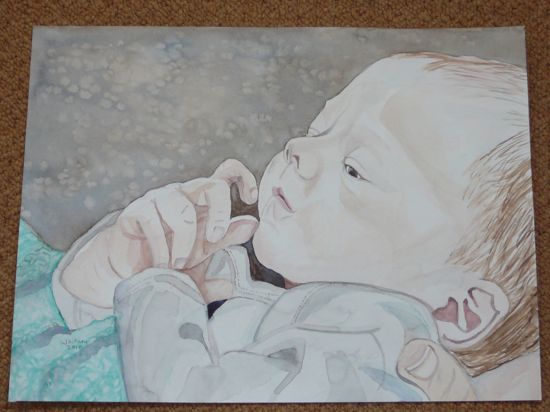
It is a stunning watercolor, I can hardly wait to have it framed. There is something very special in it – I have a friend who knits, but is constantly telling us how badly she knits. She knit a blanket for the grandson, and it was COLD in Pensacola, and that blanket was used over and over again. The blanket is in the lower left corner of the watercolor. 🙂
It’s going to be a long trip to our new life. We are going to a happy place – sunshine, but not so much heat. Humidity and lightning, but also four seasons and seafood. Our son, his wife, our grandson. All these are happy things. Our new house, a new life, closer to our families. All good things.
I couldn’t leave without saying goodbye to my Palestinian friend, like my sister, and she shared all her children with me through these years of friendship. Saying goodbye to her was horrible. We know we may never see one another again. Her daughters assure me they will help us correspond; they will help her use modern technology to stay in touch. 🙂 I don’t know when I will ever see her again . . . and it breaks my heart. I guess I kind of thought she would come visit me. “No,” she said sadly, “no, I will never have the right papers to visit you.” Until that moment, I hadn’t realized how devastating are the restrictions on her life. And I’m just a friend. She hasn’t seen her own father, in Palestine, for years. Sometimes they can meet up in Egypt. . .
I’m not the first expat to leave here. One good friend left Doha last summer, she led the way. We all know that leaving the nomadic life is charting new territory. We’ve had a lot of fun, we’ve loved (most of) the expat experience. We know it’s time. It’s just the inner twenty-five year old is not ready.
AdventureMan’s company keeps saying “when you’ve had a break . . . ” and AdventureMan laughs and says “I’m not taking a break, I am RETIRING!” His company is savvy; they know that three months down the road the domestic life may get a bit old for these high testosterone kind of guys and they will invite him back for a special project or two. He promises me, if it is Doha or Kuwait, I can come with him. Even just a week or two, to see old friends . . . I’ll take it!
Thanks be to God, for creating us, and for giving us this wonderful life we were created to live. Thanks be to God for all these great adventures, for the exotic, the sights and smells and sounds, and for the eyes to see and the ears to hear. Thanks be to God for the generous spirited friends called to his life, who have shared the path with us. And thanks be to God for this outlet, this blog, where I can share the good, the bad and the ugly with friends from all countries who have ever lived as strangers in a strange land (even when that ‘strange’ land is the USA, LOL!) Thank YOU, friends.
A Great Day in Doha
Yesterday, I had a great day.
Most of my boxes are packed. Many addresses are changed. I know what I will take in my suitcases. The Qatteri Cat has a reservation. All the little details, by the grace of God, are falling into place.
So I could relax for a day.
I hit the pool with my long-time (I did not say OLD!) exercise buddy, and oh, that felt good! We swam, we exercised, but mostly we talked and laughed.
Joined up with another friend for coffee. Took a few minutes to shower and fix up, then treated ourselves to a Doha delight, where photos are forbidden:

Normally, and astonishingly, in the Doha Museum of Islamic Art, photos are not only allowed, they are graciously encouraged, so I was surprised and embarrassed to be told I was not allowed to take photos in the magnificent Pearl exhibit. It truly is a fabulous display. My favorite part was not the pearls, but a very very beautiful old pearling box, complete with inlay, and compartments, and a set of pearl size sifters. I know, I am weird. I would rather have that than the pearl of great price. I would worry about the pearl being stolen. The box would give me pleasure every single day, for it’s beauty and its usefulness. I have one, a plain one, and I am delighted to have it, but seeing this glorious pearl box also gave me joy.
On Mondays the special exhibit is free, but we still had most of it to ourselves, and could peruse the treasures at a leisurely pace.
I really love this place; I love the building, the spaciousness, the graciousness and serenity of it. I love that it attracts people, and that huge numbers can be in the building and you never know it.
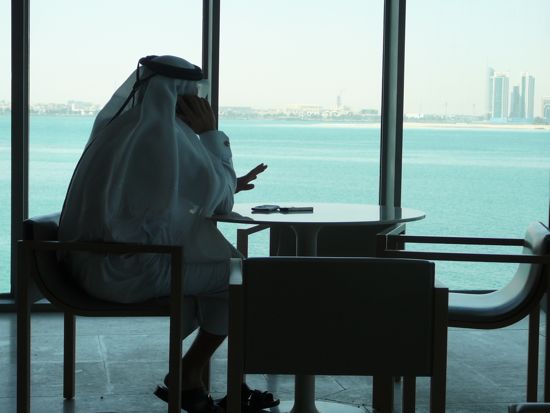
This is what I call a phone call with a view:
Tourists can’t resist snapping:
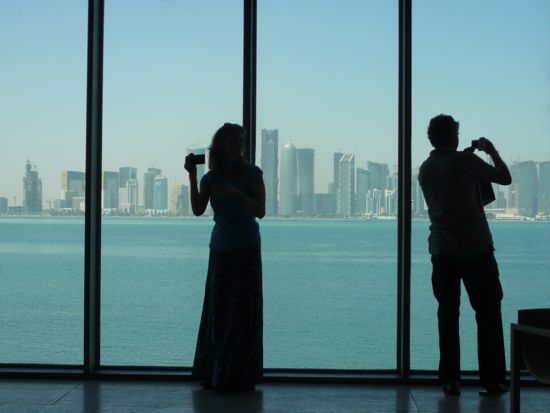
It’s a great place for photographs:

One of these guys told me that he could see when I was younger, I must have been very beautiful. I am guessing he thought I would take it as a compliment, LLLOOOLLLL.
Recent Comments
ExpatAlien on What Country am I Living … intlxpatr on Yellowstone: Old Faithful to C… Michelle on Yellowstone: Old Faithful to C… Cathy on No Grown-Ups in Charge intlxpatr on Waiting for Snow Wikipedia Donate Button

Amazina


Early Voting in Florida


 Here There and Everywhere