“You’re Such a Good Driver”
Twice in the last two weeks, friends riding with me have said “You’re such a good driver.” You’d think I would be flattered, but instead, it makes me aware of how much I have adapted to driving conditions in Doha. The truth is, I am pretty good. The truth is, that’s not a good thing.
Doha is smaller than Kuwait. The trick in Doha is to know which roads are closed, (that is usually in the newspaper,) and to have two or three routes to get to the same place. The trick is to know where the lanes are going to go wonky with all the people needing to make a left turn, and at the same time, how to avoid the mandatory left turn lane that can catch you by surprise.
The trick is to yield to the bigger vehicle, especially if he is a cement truck, crane, or similar very heavy vehicle, unless you think you can quickly get ahead of them so you won’t have to go 15 km/hr for the next thirty miles. The trick is to avoid being behind a truck loaded with not-secured concrete blocks. The trick is to know that new cameras are going up all the time – have you noticed? Even the locals are slowing down, so I am guessing that the fines here are being imposed across the board.
Last week, I even saw a policeman pull a truck over for an illegal left turn – he turned from the lane next to the legal turn lane – he got pulled over. I don’t know if he got a citation, but he got a talking to. He seemed to be listening respectfully. I was shocked. There are times you will see three lanes turn left, only one of which is the legal left turn lane. It’s so common, you take it for granted. But things seem to be changing.
I have also caught myself doing some things I would never ever think of doing in the US. I needed to use a cash machine, and all the parking spaces were filled. I gave it 5 seconds thought, parked my car behind two cars right by the cash machine, and prayed no one would need to move while I was getting my money. Unfortunately – no one did. My bad behavior was positively reinforced.
The other night, picking up food on the way home, I begged some workers to let me park in a marked “no parking” spot so I could pick up my food.
“Bas hamsa deqiqa” I smiled as I ran to pick up my food, which, fortunately was ready and I paid, ran back out, tipped a little for the spot and drove off.
These are things I would never never never do in the United States. I do it here because it makes my life easier and because . . . everybody else does it.
I can still hear my Mother’s voice saying “and if everyone were jumping off a bridge, would you do that?” That’s what mother’s say. I probably said it myself. And here I am, knowing I shouldn’t do it, and doing it.
When I first got here, a woman was taking me shopping and as we got to the roundabouts, she said “You’ve just got to commit!” and she would whirl through the roundabout with seconds to spare. An Iranian friend got us from the airport to the Diplomatic Club once in 17 minutes in peak night-time traffic. It was easier for me to watch the clock than to watch her drive; she didn’t even look left when she entered the roundabouts. And she got us across town in 17 minutes. I still wonder at that accomplishment, and feel myself, at the same time, quaking in my boots at her confidence.
So I wonder if my admiring friends feel the same way, if I have become so used to local driving that I am adapting dare-devil tactics in my driving as well as in my parking?
I shudder at the re-education I will have to undergo when I return to the US for good.
He turns a desert into pools of water
One of today’s readings in The Lectionary are these verses from a much longer reading, Psalm 107. When I read these lines, I can’t help thinking how this very dull and flat land, Qatar, this little thumb sticking up into the Gulf, has greened, how the oil and gas have served to green this land, to change its face, and how much money is flowing out from this country to many other countries of the world.
All those of us from far away countries who labor here are benefitting from these springs of wealth, sending money home.
33He turns rivers into a desert,
springs of water into thirsty ground,
34a fruitful land into a salty waste,
because of the wickedness of its inhabitants.
35He turns a desert into pools of water,
a parched land into springs of water.
36And there he lets the hungry live,
and they establish a town to live in;
37they sow fields, and plant vineyards,
and get a fruitful yield.
38By his blessing they multiply greatly,
and he does not let their cattle decrease.
39When they are diminished and brought low
through oppression, trouble, and sorrow,
40he pours contempt on princes
and makes them wander in trackless wastes;
41but he raises up the needy out of distress,
and makes their families like flocks.
42The upright see it and are glad;
and all wickedness stops its mouth.
43Let those who are wise give heed to these things,
and consider the steadfast love of the Lord.
For my Christian readers, Muslims also use the Psalms as holy readings –
“The Qur’an (Surah An-Nisa 4:163) states “and to David We gave the Psalms”. Therefore, Islam confirms the Psalms as being inspired of God.”
Did you know that?
FYI: How Long is a Generation?
So I get on a track and I can’t get off, like a little hamster running on the wheel. I got to thinking about generations, and how long ago is 10 generations and so I had to ask Google the question: How long is a generation? Don’t you love Google? They always have an answer.
Now I know something new. Now I will share it with you. This comes from Ancestry.com
Research Cornerstones: How Long Is a Generation? Science Provides an Answer
How Long Is a Generation?
By Donn Devine, CG, CGI
We often reckon the passage of time by generations, but just how long is a generation?
As a matter of common knowledge, we know that a generation averages about 25 years—from the birth of a parent to the birth of a child—although it varies case by case. We also generally accept that the length of a generation was closer to 20 years in earlier times when humans mated younger and life expectancies were shorter.
In genealogy, the length of a generation is used principally as a check on the credibility of evidence—too long a span between parent and child, especially in a maternal line, has been reason to go back and take a more careful look at whether the evidence found reflects reality or whether a generation has been omitted or data for two different individuals has been attributed to the same person. For that purpose, the 20- and 25-year averages have worked quite acceptably; birth dates too far out of line with the average are properly suspect.
But now, researchers are finding that facts differ from what we’ve always assumed—generations may actually be longer than estimates previously indicated.
Several recent studies show that male-line generations, from father to son, are longer on average than female-line generations, from mother to daughter. They show, too, that both are longer than the 25-year interval that conventional wisdom has assigned a generation. The male generation is at least a third longer; the female generation is about one-sixth longer.
As early as 1973, archaeologist Kenneth Weiss questioned the accepted 20- and 25-year generational intervals, finding from an analysis of prehistoric burial sites that 27 years was a more appropriate interval but recognizing that his conclusion could have been affected if community members who died away from the village were buried elsewhere.
Why Age Matters
In a more-recent study regarding generation length, sociologist Nancy Howell calculated average generational intervals among present-day members of the !Kung, contemporary hunter-gatherer people of Botswana and Namibia whose lifestyle is relatively similar to that of our pre-agricultural ancestors. The average age of mothers at the birth of their first child was 20 years and at the last birth 31, giving a mean of 25.5 years per female generation—considerably above the 20 years often attributed to primitive cultures. Fathers were six to 13 years older than mothers, giving a male generational interval of 31 to 38 years.
A separate study, conducted by population geneticists Marc Tremblay and Hélène Vézina, was based on 100 ascending Quebec genealogies. Researchers found a generational interval, based on the years between parents’ and children’s marriages, to average 31.7 years, and they determined that male generations averaged 35.0 years while female generations averaged 28.7 years.
Biological anthropologist Agnar Helgason and colleagues used the Icelandic deCODE genetics database to arrive at a female line interval of 28.12 years for the most recent generations and 28.72 years for the whole lineage length. Male line lineages showed a similar difference—31.13 years for the recent generations and 31.93 years overall. For a more mathematically appealing average, Helagason and fellow researchers recommended estimating female generational line intervals at 30 years and male generational intervals at 35 years, based on the Quebec and Iceland studies.
Calculating Ideas
What does this mean to the genealogist? When assigning dates to anthropologically common ancestors 50 or more generations in the past, using the “accepted” 20 or 25 years as a conversion factor can produce substantial underestimates of the time interval.
For my own purposes, however, given the imprecision of the various results and my own need for an estimate that lends itself to easy calculation, I decided that three generations per century (33 years each) for male lines and 3.5 generations per century (29 years each) for female lines, might work better when I needed to convert generations into years.
To check the accuracy of my values, I decided to compare the generational intervals from all-male or all-female ranges in my own family lines for the years 1700 to 2000. I was pleasantly surprised to see how closely the intervals agreed with the estimates I was using. For a total of 21 male-line generations among five lines, the average interval was close to 34 years per generation. For 19 female-line generations from four lines, the average was an exact 29 years per generation.
In genealogy, conclusions about relationships are subject to change whenever better evidence is discovered. Similarly, it’s the nature of the physical and biological sciences that current understandings are subject to change as more data becomes available and that data’s interpretation becomes more certain. So, for now, when genealogists want to convert generations to years and create probable date ranges, using an evidence-based generational interval—like Helagason’s 30 and 35 years or one that you’ve developed based on your own family history research—may be the best solution.
Donn Devine, CGSM, CGISM, a genealogical consultant from Wilmington, Delaware, is an attorney for the city and archivist of the Catholic Diocese of Wilmington. He is a former National Genealogical Society board member, currently chairs its Standards Committee, is a trustee of the Board for Certification of Genealogists, and is the administrator for Devine and Baldwin DNA surname projects.
Only Ten Generations
We were talking about marriage prospects, and I mentioned one young man.
She hesitated, then told me “we don’t marry with this family.”
“Why not?” I asked her. “He’s handsome, and kind, and I am told that they are the richest family in Qatar.”
“They are Iranian,” she said shortly.
“Iranian?” I asked. “They are Qatteri! They have been here more than ten generations!”
She grinned at me.
“It’s not enough,” she said. “They are still Iranian.”
Doha: Keep Your Camera Handy
Today I had one of those experiences I have so often in Doha, a “no-one-would-believe-me” moment, but I have learned to keep my camera handy, and fortunately we were stopped in traffic so I could snap this one without endangering any lives, especially my own.
Traffic is steady, busy, but pretty mellow. Yeh, there are the normal “I’m-going-to-make-a-left-turn-from-the-right-lane” guys; I’ve lived here for so long it doesn’t even rate a roll of the eyes. It’s part of the Doha / Kuwait driving culture.
This, however, I only see in Qatar. Mr. I’m-So-Important-I-Can’t-Wait is this guy in the white Land Cruiser.
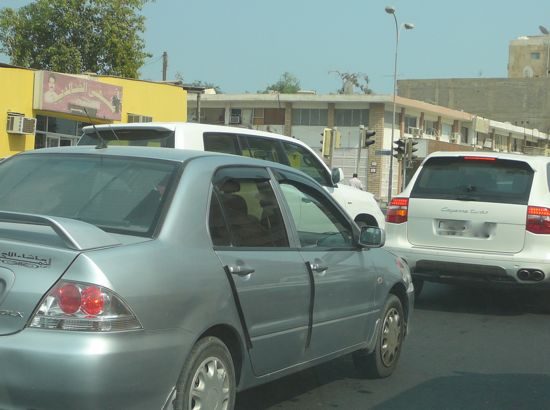
He is sitting half on top of the street median, trying to get back into traffic going in his direction. To get there, he drove down the wrong way down the street on the other side of the divider. At first, there was no traffic, but when traffic came, he got up on the divider so he was only HALF blocking traffic from the other direction, and he is bullying his way back into the line he was too important to wait in.
I carry my camera now, every day, in my purse, because I know if I just tell you about these things, you won’t believe them.
I have seen this also at major roundabouts. Some yahoo drives up the other side of the road to the roundabout to avoid waiting in the line. Up over the medians, facing oncoming traffic. I know, I know, what are they thinking?
In Kuwait, I was sickened by the number of young men killed on the roads every week, every month. If it were an epidemic killing young men, people would do something about it, but tell these guys to obey the law? Make them pay fines for reckless driving? Make them wear seat belts? Their behavior tells me that no one has ever held them accountable for their arrogant and dangerous driving habits.
While we are told that “no one is above the law” somehow the message hasn’t made it to these guys.
Halloween Post Mortem
Hallowe’en is really more a cultural tradition these days than a religious event. We no longer worry about spirits walking around on Hallowe’en, and wear costumes to try to scare them away from us. In fact, many of the trick-or-treaters who came by our house last night were pretty! There were fairies, and little mermaids, and some very alluring witches.
In fact, there were so many trick-or-treaters that we ran out! How embarrassing! I thought I had a LOT, but there were more trick-or-treaters than we had treats.
It was a great evening, altogether, and next year I will know better.
Here is our not-scary pumpkin. I wish you could see the ears – it is an orange cat pumpkin, in honor of the Qatteri Cat.

All the visitors made the Qatteri Cat jumpy. He was happy to stay inside and hide with all the action in the streets last night.
Back in Traffic; How Do You Alphabetize / File?
So today I became, once again, a legal driver in Qatar, five months to the day from my arrival. Yep, for those of you who never have the joy of trying to maneuver through the complexity of getting a license in a foreign country – you have NO idea. NO idea. There are people who try and try to get a license and never do.
We are really lucky. We have some very good people who help us get things done. Somehow, it’s my turn to be lucky today.
When I showed up at the office, however, one of the HR girls told me “Oh! Flana is not here today! You will have to come back.”
You all know how nice I am. I smiled at her and said “my husband told me to be here today to get my driver’s license. Someone is going to help me.” Smile again, big smile.
Sure enough, someone is going to help me, and it is someone who I like, someone who has helped me before and who is always calm and patient and knows how to persist pleasantly until he gets what he wants from the bureaucrats. In fact, I admire him, because people end up liking to help him. He is low key. He takes me to the driver’s station, where, because of my advanced age (DO NOT ASK) I have to have an eye test. This leads me to wonder. Doesn’t everyone have to have an eye test?
Then I wait, in the special ladies’ majlis:
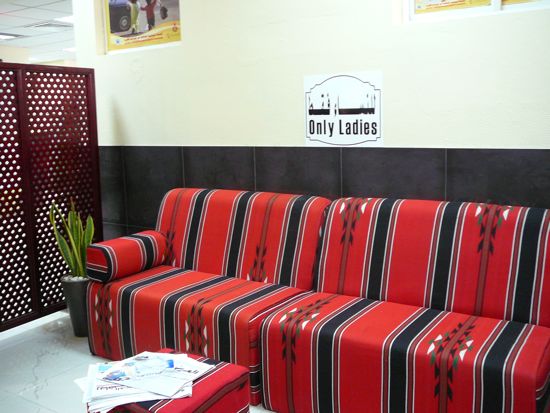
I had to wait quite a long time, but I was comfortable, and while I was waiting, I read all the driving safety signs they had up along the ceiling. They were all in English and Arabic, and they were great thoughts, but too many words. Like if you are reading that many words: If you are driving too fast you may not get home alive (that is not a real one, but that was the gist of most of them) so I was creating a new driving safety campaign called the equal campaign:
Speed + Texting = (shows a vehicle turned on its side and all smashed
Speed + Weaving = Two or three crunched vehicles
Texting + Driving = QR (enormous fine)
Something simple to read, graphically simple, something you can glance at and get the meaning.
When I got my driver’s license, I was really happy, except for one tiny little thing – it’s kind of my name but not exactly my name. It’s an easy mistake to make, names can be complicated, but . . . it isn’t my name on my license. It’s my face, it’s my information – it isn’t my name. For half a heartbeat, I consider saying something and then Wisdom kicks in and I zip my lip.
So then, driving home in traffic, I got to thinking about names and how we file things, alphabetically, and even Europeans sometimes file us wrong, which has led us to first class seats because airlines can’t find us, etc. It isn’t always such a bad thing.
Then I started wondering about how Arab speaking people file. Like do you have half the files in the “A” drawer, like Al So-and-So and Al Somebody Else, and how do the sun and moon words affect the filing, like Ar Rayyan, or Ath Thalaka, or As Shams, etc. Once you have filed someone, the goal is to be able to retrieve that information? How does alphabetization work in Arabic? How are things filed?
So being stuck in traffic might not be so bad if someone answers my question and I learn something. 🙂
Pomegranate Soup by Marsha Mehran
I saw a mention of this book in an Amazon.com referral as a book I might like, and was almost set to order it when something said “go check the stack of books Little Diamond left for you” and sure enough, I already had the book.

I use books as an incentive to get me through life’s inevitable tasks I don’t like – like “if I finish this project on time, I get to read this book as a reward.” It works for me.
When I first started reading Marsha Mehran’s book about three Persian sisters starting up a cafe in a small Irish town after fleeing Iran, I found it sour. The author has a critical point of view, and generally speaking, I don’t like hanging around with people who criticize others and judge them harshly. At the beginning of the book, Mehran introduces a lot of people, many of whom we are not meant to like.
Even the sisters are not all that sympathetic – at the beginning. But also, near the beginning, she discusses Persian cooking, the idea of balance in a meal, hot and cold, spicy and bland, so you kind of get the idea that if there is sour, then there will also be sweet. In addition, at the end of each chapter there is a wonderful recipe, a wonderful, fairly easy-to-follow recipe, and she included one, Fesanjan, that is my all-time favorite Iranian dish and now, I know how to make it, Wooo HOOOO!
Three sisters, orphaned by fate, held together by love and duty, start a cafe, which, against all odds, becomes a raging success. Raging success does not heal all the old wounds, however, nor the hearts that bear them, and we learn through the book what the sisters have borne and overcome.
It turns out to be a sweet book, one well worth reading. And oh! the recipes! In each chapter, there are also hints that make them even better, so you can’t just copy out the recipes and use them, you really have to read the book. 🙂
It’s a pity that two of the most wonderful countries in the world – Syria and Iran – are off limits. We’ve been back to Syria, and it was everything we remembered (see the Walking Old Damascus blog entries) but oh, how we would love to explore Iran. Sigh. The world turns, and we can only hope to be able to get there in our lifetime. Stranger things have happened.
NO PARKING!
On my way home, driving along the wall of our compound where they recently installed bright shiny new NO PARKING signs – not one or two, but like twenty; one every thirty feet – there are a whole brigade of big huge trucks, you know, the kind that accompany beginning construction? I am not even sure I can get through, there are so many, like six or seven or eight (it is a small street).
But one of the trucks is orange, and I am hoping hoping hoping, so I grab my camera out of my bag as I inch by, and yes! yes! he has parked right next to one of the signs. I take my shot and keep inching by, and just beyond the last truck on the left is a gaggle of truck drivers, I guess they are trying to figure out what to do about something.
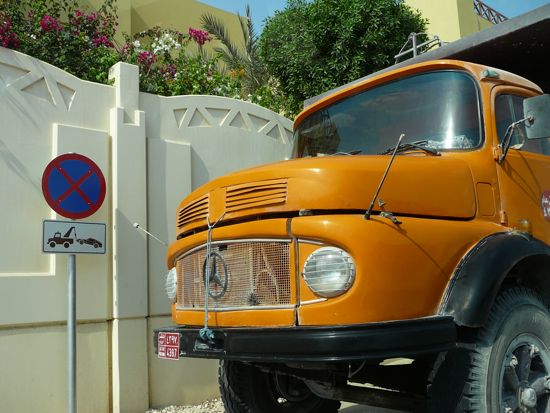
When I get to our gate, I tell them, “there are many trucks parked by the compound wall” (here I point in the direction) “can’t you see them on the security cameras??” and the gate guy says there is a man fixing the camera input right now, but did I get the truck number?
(Did I get the truck number I am thinking??? GO DO YOUR JOB! YOUR JOB IS SECURITY! GO TELL THEM NOT TO PARK THERE!)
I smiled and said “you need to tell them to move their trucks, and not to park right by the compound wall, it is a security risk.” I am a nice lady, yes I am, and so I say this nicely, with a smile, but there is a hint of steel in my voice.
He says “we have people working out there! They will tell them!”
The people out there working are the gardening crew.
I said “No. Your people are about 400 feet away from the trucks, and they are gardeners. They are not going to tell Pakistani truck drivers to move their big trucks.” (The smile is still there, but there is a hardness in my eyes.)
He doesn’t want to go. “Did you get his number?” he asks again. “I say no,” but then I pull out my camera and show him the photo. His eyes widen. The security man comes, and the gate guard shows him and his eyes widen. He assures me they will call the Bolice immediately.
Did they? I don’t know. Honestly, you do what you can. Sometimes it is like knocking your head against a wall, it just feels so good when you stop.
Too Much Food
AdventureMan and I have lived more years outside our own country than inside it. We have lived on-and-off in the Middle East for more than 30 years. You’d think we would know everything by now, but we are still delighted to discover new things and to learn from the culture in which we are living.
Our Kuwaiti friends were good about letting us peek inside the culture, telling us stories of family life “before oil” and Kuwait traditions. Like women aren’t supposed to eat too much when they to to someone’s house for dinner or the people will say “do you think she has never seen food before?”
On the other hand, it is shameful not to provide enough food, so you always prepare way more than the group invited can possibly eat, like in ten years.
Sometimes a lot of the food goes to waste, but I have also discovered these wonderful plastic bags and tin trays found in every supermarket in the Middle East. What doesn’t get eaten now – gets eaten. I admit it, I am a lazy wife. I don’t like cooking big meals when it is just the two of us, so I love being able to pull something out of the freezer and have it all heated up and fresh for dinner.


It also makes me feel very ecological to have food in the freezer, ready to fix, and to know that not a lot went to waste. We are learning from our son and his sweet wife, and all the young adults in our family, who are WAY more ecologically aware than we ever were, and we thought we were pretty good, the generation who invented recycling.
AdventureMan used to bring home people for dinner, mostly guys from out of town in town for a short time who needed a home-cooked meal. We always had food in the freezer, something I could pull out on short notice.
One time, I made beef burgundy. When I went to serve it, I looked for the cheesecloth bundle of spices and couldn’t find it. I looked and looked, and then I figured I must have taken it out earlier and forgot I’d done it. Then, during dinner, one of the men had a very puzzled look on his face – he was chewing on the spices ball! I was SO embarrassed, but they all just laughed, thank God.
Recent Comments
ExpatAlien on What Country am I Living … intlxpatr on Yellowstone: Old Faithful to C… Michelle on Yellowstone: Old Faithful to C… Cathy on No Grown-Ups in Charge intlxpatr on Waiting for Snow Wikipedia Donate Button

Amazina


Early Voting in Florida


 Here There and Everywhere